Hydroponic nutrient deficiencies can appear surprisingly quickly because plants depend entirely on the nutrient solution around their roots. Yellow leaves, brown spots, curling edges, pale new growth, weak stems, and slow development can all signal that something in the system is out of balance.
But a plant that looks deficient does not always need more fertilizer.
Sometimes the nutrients are already in the reservoir, but the plant cannot absorb them properly. Incorrect pH, excessive nutrient strength, unhealthy roots, or imbalances between minerals can all interfere with nutrient uptake. This is often referred to as nutrient lockout.
That is why identifying the cause before adding more nutrients is so important.
In this guide, you’ll learn how to recognize the most common hydroponic nutrient deficiencies, which leaves they usually affect first, what causes them, and how to correct the underlying problem. We’ll also cover pH, EC, nutrient lockout, root health, and other conditions that can mimic a true deficiency.
For crop-specific nutrient and pH ranges, use our Hydroponic Nutrient & pH Chart while troubleshooting your system.
What Are Hydroponic Nutrient Deficiencies?
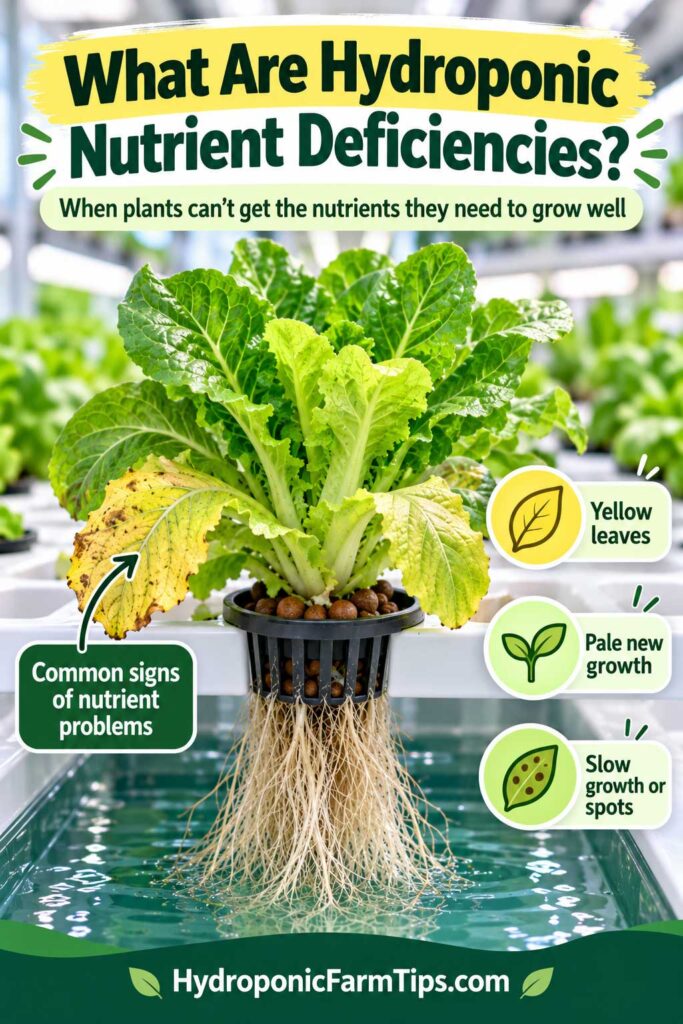
Hydroponic nutrient deficiencies occur when plants cannot access enough of one or more essential nutrients needed for healthy growth.
Unlike soil-grown plants, hydroponic plants rely almost entirely on the nutrient solution in the reservoir. That gives growers more control, but it also means problems can appear quickly when the solution becomes unbalanced.
Plants need a combination of macronutrients and micronutrients to grow properly.
The main macronutrients include:
- Nitrogen (N) – supports leafy growth and chlorophyll production
- Phosphorus (P) – helps with root development, flowering, and energy transfer
- Potassium (K) – supports water regulation, plant strength, and stress tolerance
- Calcium (Ca) – important for cell walls and healthy new growth
- Magnesium (Mg) – a key component of chlorophyll
- Sulfur (S) – supports protein and enzyme production
Plants also need smaller amounts of micronutrients such as iron, manganese, zinc, boron, copper, and molybdenum.
A deficiency can develop when a nutrient is genuinely too low in the solution, but that is only one possibility.
Hydroponic plants may also show deficiency symptoms when pH moves outside the useful range, EC becomes too high or too low, nutrient ratios become unbalanced, roots are damaged or oxygen-starved, reservoir temperatures become stressful, or salts accumulate around the root zone. Fast-growing plants can also use certain nutrients faster than they are being replaced.
This is why simply adding more fertilizer is not always the right solution.
A better first step is to look at which part of the plant is affected and how the symptoms are developing. Some deficiencies appear first on older leaves, while others show up mainly in new growth.
That pattern can provide an important clue about which nutrient—or which underlying system problem—may be responsible.
How to Tell a Nutrient Deficiency From Other Hydroponic Problems
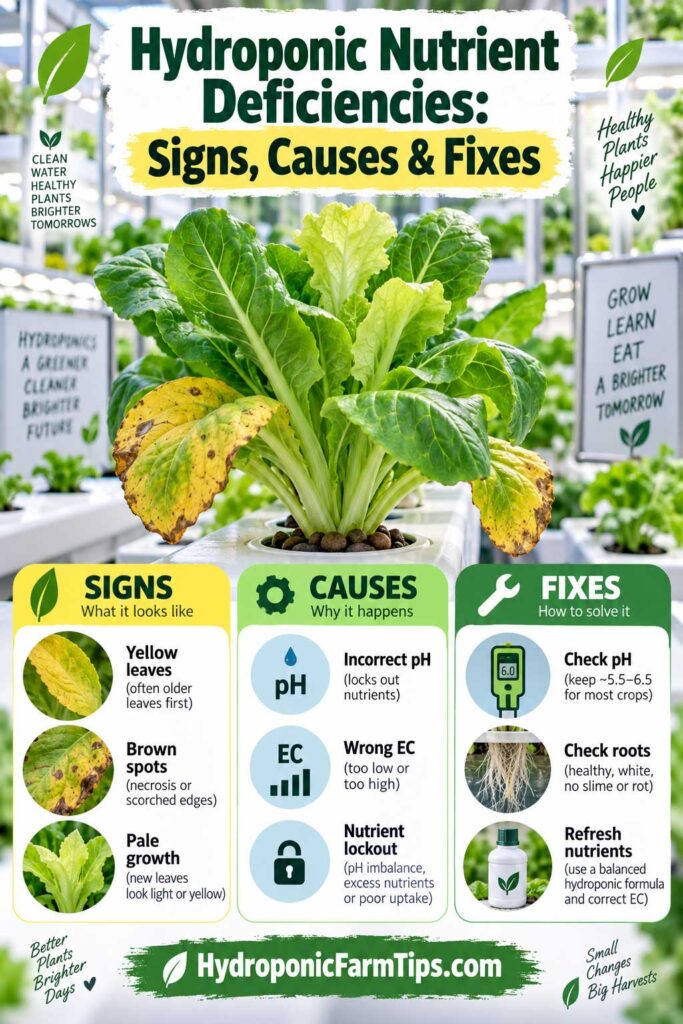
Not every yellow leaf or brown spot means your plants are missing nutrients. In hydroponics, several problems can create symptoms that look very similar to a true deficiency.
Before changing the nutrient solution, look at the plant and the system as a whole.
Hydroponic nutrient deficiencies are more likely when symptoms follow a recognizable pattern rather than appearing randomly on one damaged leaf. Some deficiencies begin on the oldest leaves, while others affect the newest growth first. You may also notice consistent yellowing, spotting, curling, or slowed growth across several leaves rather than damage limited to one area.
Two of the biggest lookalikes are pH problems and root stress.
If pH drifts outside the useful range, nutrients may be present in the reservoir but become harder for the plant to absorb. Likewise, damaged, oxygen-starved, or unhealthy roots may struggle to take up water and minerals even when the nutrient solution itself is correctly mixed.
Other problems that can mimic a deficiency include:
- Nutrient burn – often causes brown or crispy leaf tips and margins.
- Light stress – may cause bleaching, curling, or damage on leaves closest to the grow light.
- Heat stress – can lead to wilting, curling, and slower growth.
- Excessively strong nutrient solution – high EC can interfere with normal water and nutrient uptake.
- Low dissolved oxygen – stressed roots may develop deficiency-like symptoms.
- Pests or disease – spotting, discoloration, and distorted growth are not always nutritional.
A useful rule is to avoid diagnosing a deficiency from one damaged leaf alone.
Instead, look at where the symptoms started, whether they are spreading, the condition of the roots, your current pH and EC readings, and whether anything recently changed in the reservoir.
For example, if several older leaves gradually turn pale yellow while newer growth remains healthy, a mobile nutrient such as nitrogen may be involved. If the newest leaves become pale or distorted while older leaves remain relatively normal, the problem may involve nutrients such as iron or calcium.
Getting this distinction right can prevent one of the most common hydroponic mistakes: adding more nutrients when the plant cannot properly absorb what is already available.
Quick Hydroponic Nutrient Deficiency Chart
Use this chart as a starting point when identifying hydroponic nutrient deficiencies and comparing their most common symptoms. Symptoms can overlap, so always check pH, EC, root health, and reservoir conditions before making major nutrient adjustments.
For a detailed overview of essential plant nutrients and deficiency symptoms, Penn State Extension also provides a useful guide to plant nutrition in hydroponic systems.
| Nutrient | Common Signs | Usually Appears First | Common Causes | Typical Fix |
|---|---|---|---|---|
| Nitrogen | Overall yellowing, pale leaves, slow growth | Older leaves | Weak or depleted nutrient solution | Refresh nutrients and confirm EC |
| Phosphorus | Dark green or purplish leaves, slow growth | Older leaves | Cold roots, pH imbalance, low phosphorus | Check root temperature and pH |
| Potassium | Brown or scorched leaf edges, weak growth | Older leaves | Nutrient imbalance, high salt levels | Check EC and refresh solution if needed |
| Calcium | Distorted new leaves, brown spots, damaged growing tips | New growth | Poor uptake, high humidity, root stress | Correct pH and improve root conditions |
| Magnesium | Yellowing between green veins | Older leaves | Low magnesium, nutrient imbalance | Check pH and nutrient formulation |
| Iron | Pale or yellow new leaves with greener veins | New growth | High pH, iron lockout | Correct pH before adding more iron |
| Sulfur | Uniform yellowing and weak growth | Newer leaves | Incomplete or unbalanced nutrient solution | Use a complete nutrient formula |
| Zinc | Small leaves, short internodes, yellowing | New growth | High pH, excess phosphorus | Correct pH and nutrient balance |
| Manganese | Interveinal yellowing with small brown spots | New growth | High pH, nutrient lockout | Bring pH back into range |
| Boron | Brittle or distorted new growth | Growing tips | Low boron, pH or uptake problems | Use a complete micronutrient formula |
| Copper | Twisted young leaves, weak stems, poor growth | New growth | Low copper, high pH | Check pH and micronutrient supply |
Old Leaves vs. New Leaves: A Useful Clue
One of the easiest ways to narrow down a possible deficiency is to notice where symptoms appear first.
Some nutrients are mobile within the plant. When they become scarce, the plant can move them from older tissue into newer growth. As a result, deficiencies involving nitrogen, phosphorus, potassium, and magnesium often become visible on older leaves first.
Other nutrients are less mobile. Problems involving calcium, iron, boron, manganese, zinc, and copper are therefore more likely to appear in young leaves and growing tips.
This is not a perfect diagnostic method, but it is one of the most useful clues when combined with pH, EC, root condition, and the overall symptom pattern.
Next, we’ll look at each major nutrient deficiency individually, starting with one of the most common: nitrogen deficiency.
Nitrogen Deficiency in Hydroponics
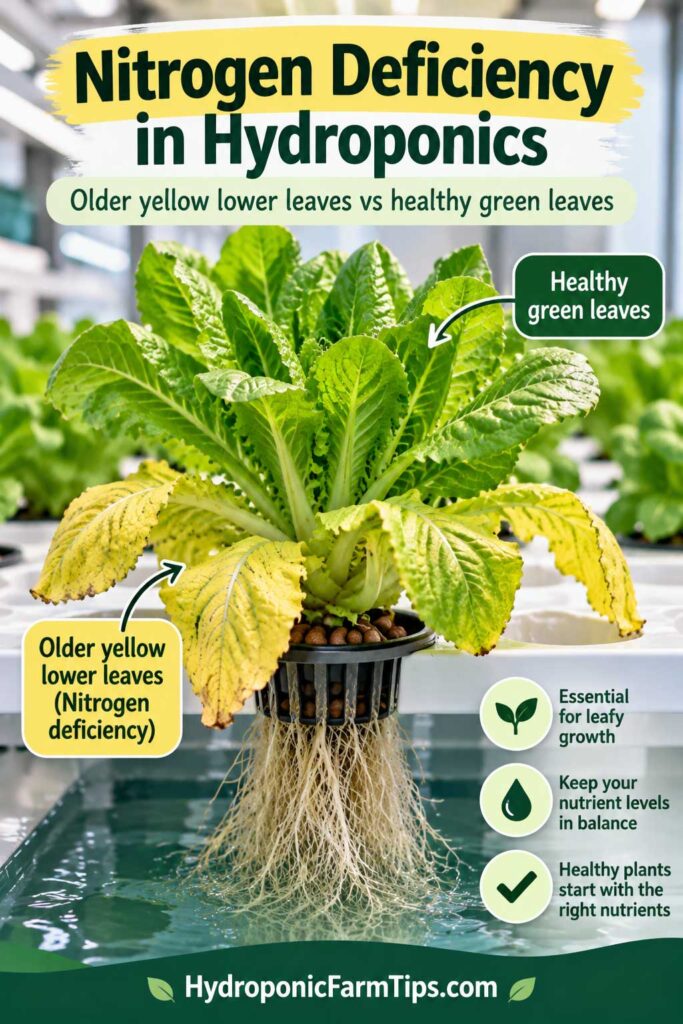
Nitrogen is one of the most important nutrients for leafy plant growth. Plants use it to produce chlorophyll, amino acids, proteins, and enzymes, so a shortage can quickly affect both color and overall development.
Signs of Nitrogen Deficiency
Nitrogen deficiency usually appears first on the older, lower leaves because nitrogen is mobile within the plant. When supplies are limited, the plant can move nitrogen from older tissue to support newer growth.
Common symptoms include:
- Older leaves turning pale green or yellow
- Yellowing that spreads fairly evenly across the leaf
- Slow or stunted growth
- Smaller-than-normal leaves
- Thin or weak stems
- Premature dropping of older leaves
- An overall pale appearance
Unlike iron or magnesium deficiencies, nitrogen deficiency usually causes more uniform yellowing rather than yellowing mainly between the veins.
What Causes Nitrogen Deficiency?
Nitrogen deficiency can develop when the nutrient solution is too weak, the reservoir has become depleted, nutrients were mixed incorrectly, or plants are growing quickly enough to use nitrogen faster than it is being replaced.
It can also appear when pH is outside the useful range, roots are damaged, or the reservoir has been repeatedly topped up with plain water until the nutrient concentration becomes too dilute.
Fast-growing leafy crops such as lettuce and basil may show symptoms relatively quickly when nitrogen availability drops.
If you are choosing crops for your system, our guide to the 10 Best Hydroponic Vegetables includes lettuce and other popular hydroponic crops.
How to Fix Nitrogen Deficiency
Start by checking your pH and EC rather than immediately adding extra nitrogen.
If pH is outside the recommended range for your crop, correct it gradually and allow the plant time to resume normal nutrient uptake.
Next, check EC. If the reading is lower than expected, the nutrient solution may simply be too dilute. Bring it back toward the recommended strength for the crop and growth stage using a complete hydroponic nutrient formula.
If the reservoir is old or you are unsure of its nutrient balance, it may be better to drain the old solution, clean the reservoir if needed, refill it with fresh water, mix a complete nutrient solution, then adjust pH and recheck EC.
Avoid pouring concentrated nitrogen fertilizer directly into the reservoir in an attempt to correct the problem quickly. Too much nitrogen can create a new imbalance and encourage excessive soft, leafy growth.
Will Yellow Leaves Turn Green Again?
Mildly affected leaves may improve, but heavily yellowed older leaves often do not return completely to their original color.
Instead of judging recovery by damaged leaves, watch the new growth.
If fresh leaves emerge healthy and green and the plant begins growing normally again, the correction is probably working.
Phosphorus Deficiency in Hydroponics
Phosphorus plays an important role in energy transfer, root development, flowering, and fruit production. Hydroponic plants do not need it in the same quantity as nitrogen or potassium, but a shortage can still noticeably slow growth.
Signs of Phosphorus Deficiency
Phosphorus deficiency often affects older leaves first because phosphorus is mobile within the plant.
Common symptoms include:
- Slow or stunted growth
- Dark green leaves
- Purplish or reddish coloration, especially on older leaves or stems
- Weak root development
- Smaller leaves
- Delayed flowering or fruiting
- Reduced overall vigor
Purple coloration can be a useful clue, but it is not definitive. Some plant varieties naturally develop purple stems or leaves because of genetics, strong light, or cool temperatures.
What Causes Phosphorus Deficiency?
Phosphorus deficiency can develop when the nutrient solution contains too little phosphorus, the pH moves outside a useful range, the reservoir becomes old or unbalanced, or roots are damaged and unable to absorb nutrients efficiently.
Cold root-zone conditions can also play a major role. When the nutrient solution becomes too cold, phosphorus uptake may slow even when enough phosphorus is present in the reservoir.
How to Fix Phosphorus Deficiency
Start by checking the reservoir rather than immediately adding a phosphorus supplement.
Review your pH, EC, reservoir temperature, and root health. If the nutrient solution is too cold, pH is outside the target range, or the roots appear stressed, correct those conditions first.
If the reservoir is old or you suspect its nutrient balance has drifted, replace it with a fresh, complete hydroponic nutrient mix.
Avoid adding large amounts of phosphorus on its own unless you have a clear reason to do so. Excess phosphorus can interfere with the availability of micronutrients such as iron and zinc, potentially creating additional deficiency symptoms.
What Recovery Looks Like
Existing purple or damaged leaves may not fully return to normal.
Instead, look for healthier new growth, stronger roots, and improved flowering or fruit development in mature plants.
If symptoms continue despite correct nutrient levels, look closely at pH, root temperature, and root health before increasing phosphorus further.
Potassium Deficiency in Hydroponics
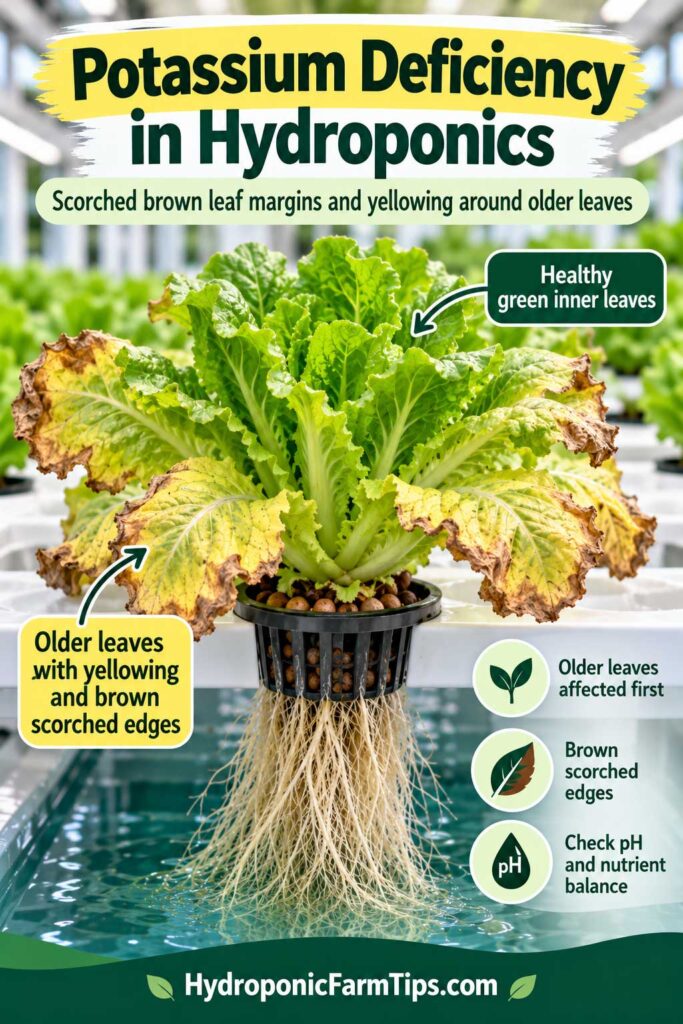
Potassium helps plants regulate water, move sugars, activate enzymes, strengthen tissues, and tolerate environmental stress. It becomes especially important as plants mature and begin producing flowers or fruit.
Because potassium is mobile within the plant, deficiency symptoms usually begin on the older leaves.
Signs of Potassium Deficiency
Common symptoms include:
- Yellowing along the edges of older leaves
- Brown, dry, or scorched-looking leaf margins
- Small brown spots that may spread
- Leaf edges curling upward or downward
- Weak stems
- Slower growth
- Poor flowering or fruit development
- Reduced tolerance to heat or other stress
As the deficiency progresses, the damaged margins may become increasingly dry and brittle while the center of the leaf remains greener.
What Causes Potassium Deficiency?
A true potassium shortage can occur, but hydroponic growers should also consider nutrient balance and root conditions.
Potassium problems may develop when the nutrient solution is too weak or depleted, fertilizer ratios are incorrect, salt levels become too high, pH moves outside the useful range, or the roots are damaged and unable to absorb nutrients efficiently.
Excessive levels of certain nutrients can also interfere with potassium uptake even when potassium itself is present in the reservoir.
How to Fix Potassium Deficiency
Start by measuring both pH and EC.
If EC is unusually high, adding more fertilizer could make the problem worse. Excess dissolved salts can interfere with normal water and nutrient uptake.
If EC is lower than expected and the reservoir has become diluted, bring the nutrient solution back toward the recommended strength for your crop using a complete hydroponic nutrient formula.
If readings are unstable or the reservoir has been in use for a long time, replacing the solution is often more reliable than trying to correct potassium by itself.
Also inspect the roots. Healthy hydroponic roots are generally firm and well developed, although nutrient staining can sometimes affect their color. Brown, slimy, or foul-smelling roots may indicate a separate root-zone problem that needs attention first.
Avoid Overcorrecting With Potassium
Adding a concentrated potassium supplement without confirming the cause can upset the nutrient balance.
Too much potassium may interfere with the uptake of calcium and magnesium, potentially creating a new set of deficiency symptoms.
After correcting the reservoir, monitor new growth rather than damaged leaf edges. Brown or scorched tissue will not heal, but healthy new leaves are a good sign that the plant is recovering.
Calcium Deficiency in Hydroponics
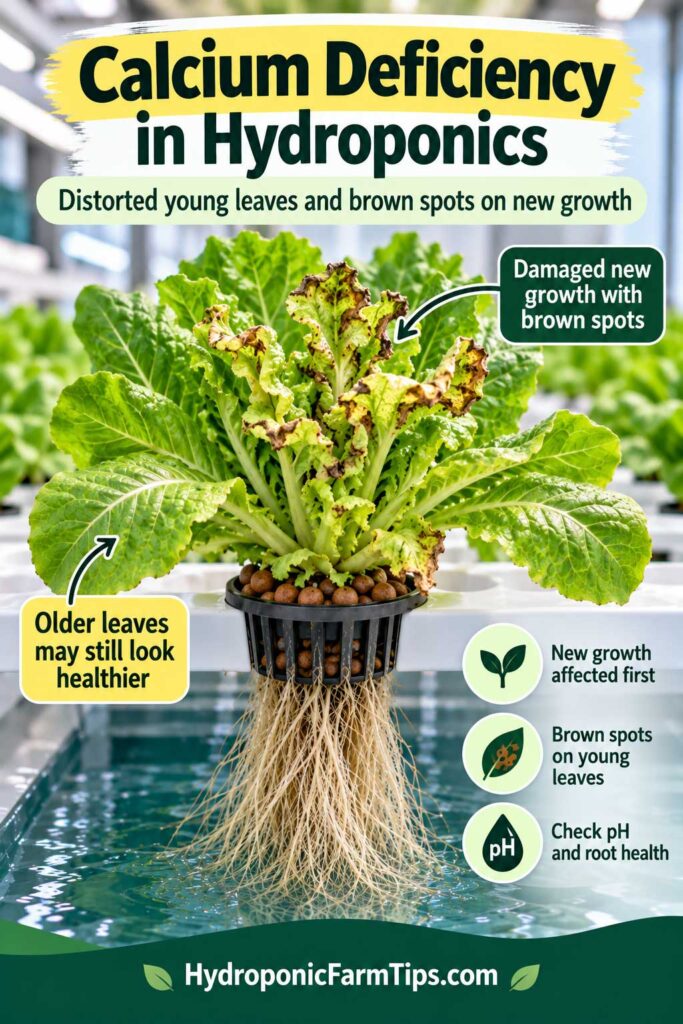
Calcium is essential for strong cell walls, healthy root tips, and the development of new leaves, shoots, flowers, and fruit. Unlike nitrogen or potassium, calcium does not move easily from older tissue into new growth.
That means calcium deficiency usually appears first in the newest leaves and growing tips.
Signs of Calcium Deficiency
Common symptoms include:
- Distorted or curled new leaves
- Brown or dead spots on young leaves
- Weak or damaged growing tips
- Stunted new growth
- Brittle leaves
- Poor root-tip development
- Blossom-end rot on tomatoes, peppers, and similar fruiting crops
One of the strongest clues is that the new growth looks damaged while older leaves may still appear relatively healthy.
What Causes Calcium Deficiency?
A calcium problem does not always mean there is too little calcium in the reservoir.
Poor uptake can develop when pH is outside the useful range, roots are damaged, EC is too high, or excessive potassium or magnesium interferes with calcium uptake. Very soft or reverse-osmosis water can also contribute when the nutrient formula does not supply enough calcium.
Environmental conditions matter too. Calcium moves through the plant largely with water flow, so high humidity, weak airflow, or very low transpiration can make it harder for calcium to reach rapidly growing leaves and fruit.
How to Fix Calcium Deficiency
Start by checking pH and EC, then inspect the roots for signs of stress or poor oxygenation.
Next, review your nutrient formula to make sure it supplies calcium in an appropriate amount for hydroponic growing. If you use reverse-osmosis or very soft water, pay closer attention to the calcium and magnesium provided by your nutrient program because the starting water contributes very little of either mineral.
If the reservoir is old or heavily supplemented, replacing it with a fresh, balanced nutrient solution may be more reliable than adding calcium by itself.
Should You Use Cal-Mag?
Calcium-magnesium supplements, commonly called Cal-Mag, can be useful in certain situations, but they should not automatically be added every time you see brown spots.
Cal-Mag may make sense when:
- You use reverse-osmosis or very soft water
- Your base nutrient provides relatively little calcium or magnesium
- Your measurements and symptom pattern point to a genuine shortage
Unnecessary Cal-Mag can raise EC and upset the balance between potassium, calcium, and magnesium, so check your base nutrient before adding another supplement.
What Recovery Looks Like
Damaged growing tips and brown spots will not repair themselves.
Instead, watch the next set of leaves. Healthy, normally shaped new growth is one of the best signs that calcium availability has improved.
For fruiting crops, newly developing tomatoes or peppers should also be less likely to develop the dark, sunken areas associated with blossom-end rot.
Magnesium Deficiency in Hydroponics
Magnesium is a key part of chlorophyll, the pigment plants use to capture light for photosynthesis. When magnesium becomes unavailable, leaves can lose their green color even while the veins remain relatively dark.
Because magnesium is mobile within the plant, symptoms usually appear first on the older, lower leaves.
Signs of Magnesium Deficiency
Common symptoms include:
- Yellowing between the leaf veins
- Veins remaining greener than the surrounding tissue
- Symptoms beginning on older leaves
- Rust-colored or brown spots as the problem progresses
- Leaf edges curling upward
- Premature leaf drop
- Slower growth in severe cases
The classic symptom is interveinal chlorosis, where the areas between the veins turn yellow while the veins themselves remain green.
What Causes Magnesium Deficiency?
Magnesium deficiency can develop when the nutrient solution contains too little magnesium, nutrients are mixed incorrectly, pH moves outside the useful range, or roots become stressed and unable to absorb minerals efficiently.
Excessive levels of potassium or calcium can also compete with magnesium uptake. Very soft or reverse-osmosis water may contribute when the nutrient program does not provide enough magnesium, while high EC or salt buildup can interfere with overall nutrient absorption.
This is why adding more fertilizer without checking the reservoir can make the problem worse.
How to Fix Magnesium Deficiency
Begin by checking pH and EC.
If pH is outside the suitable hydroponic range, correct that first. Magnesium may already be present in the reservoir but remain difficult for the plant to absorb when pH drifts too far.
Next, review your nutrient formula. A complete hydroponic fertilizer should provide magnesium in balance with calcium, potassium, and the other essential nutrients.
If you use reverse-osmosis water or a nutrient program that supplies relatively little calcium and magnesium, a Cal-Mag supplement may sometimes be appropriate. Follow the manufacturer’s recommended rate rather than adding large amounts.
If the reservoir is old or you suspect the nutrient balance has drifted, replacing it with a fresh solution is often safer than trying to correct magnesium alone.
Magnesium vs. Iron Deficiency
Magnesium and iron deficiencies can look surprisingly similar because both may cause yellowing between green veins.
The easiest clue is where the symptoms begin:
- Magnesium deficiency: usually starts on older leaves.
- Iron deficiency: usually starts on the newest leaves.
That distinction can help narrow down the problem before you make changes to the nutrient solution.
What Recovery Looks Like
Leaves with severe yellowing or brown damage may never look completely normal again.
Instead, watch for healthy new growth and no further spread of interveinal yellowing. If new leaves develop normally and the existing symptoms stop getting worse, the plant is likely recovering.
Iron Deficiency in Hydroponics
Iron is a micronutrient, which means plants need it in relatively small amounts, but it is still essential for chlorophyll formation and healthy new growth.
In hydroponics, iron deficiency is often associated with pH that has risen too high. In many cases, the reservoir contains enough iron, but the plant cannot absorb it efficiently.
Signs of Iron Deficiency
Iron deficiency usually appears first on the newest leaves.
Common symptoms include:
- Pale yellow or almost white new leaves
- Green veins remaining visible against yellow tissue
- Interveinal chlorosis on young leaves
- Slow or weak new growth
- Increasingly pale growing tips
- Severe bleaching in advanced cases
Older leaves may remain relatively green at first, which helps distinguish iron deficiency from magnesium deficiency.
What Causes Iron Deficiency?
Iron problems can develop when pH rises too high, the nutrient formula provides inadequate or poorly available iron, the reservoir becomes old or unbalanced, or roots are damaged and unable to absorb nutrients efficiently.
Excessive levels of certain nutrients may also interfere with micronutrient uptake.
High pH should be one of the first things you investigate. Pale new leaves do not automatically mean the reservoir needs more iron; correcting the pH may be enough to restore normal uptake.
How to Fix Iron Deficiency
Start by testing the reservoir pH.
For many hydroponic crops, nutrient availability is generally good around pH 5.5–6.5, although the best target depends on the crop and system.
If pH is too high, adjust it gradually rather than making a dramatic correction all at once.
Next, check EC, root health, the age of the nutrient solution, your mixing ratios, and whether your fertilizer contains a suitable form of iron.
Many hydroponic nutrient formulas use chelated iron, which helps keep iron available to plants across a useful pH range.
If the nutrient solution is old or you are unsure of its balance, replacing it with a fresh, complete hydroponic nutrient solution may be simpler than adding extra iron.
Iron vs. Magnesium Deficiency
Iron and magnesium deficiencies are frequently confused because both can produce yellow tissue with greener veins.
| Deficiency | Usually Starts On | Typical Appearance |
|---|---|---|
| Iron | New leaves | Yellow young leaves with greener veins |
| Magnesium | Older leaves | Yellowing between veins on lower leaves |
The main clue is where the symptoms begin. Looking at both the location and the pattern of discoloration is much more useful than diagnosing the problem from leaf color alone.
What Recovery Looks Like
Mildly affected young leaves may become greener once iron uptake improves, although badly damaged tissue may not fully recover.
The clearest sign of improvement is healthy green new growth after pH and nutrient conditions have been corrected.
Sulfur Deficiency in Hydroponics
Sulfur is an essential macronutrient that plants use to build amino acids, proteins, enzymes, and other compounds involved in healthy growth.
True sulfur deficiency is relatively uncommon in hydroponics when you use a complete nutrient formula, but it can still occur if the solution is improperly mixed, heavily diluted, or unbalanced.
Signs of Sulfur Deficiency
Sulfur deficiency can resemble nitrogen deficiency because both may cause general yellowing.
The key difference is where the symptoms usually begin.
Common signs include:
- Pale green or yellow new leaves
- Fairly uniform yellowing across the leaf
- Slow or stunted growth
- Thin or weak stems
- Smaller leaves
- Reduced overall vigor
- Symptoms that are strongest on younger growth
Because sulfur is less mobile within the plant than nitrogen, deficiency symptoms generally become noticeable on newer leaves first.
What Causes Sulfur Deficiency?
Sulfur deficiency may develop when the nutrient formula is incomplete, the reservoir has been mixed too weak, fertilizer ratios are incorrect, or the solution has become old and depleted.
It can also appear when pH is outside the useful range, roots are damaged, or repeated top-offs with plain water gradually dilute the nutrient concentration.
In a well-managed system using a complete hydroponic fertilizer, sulfur deficiency should not be one of the first problems you suspect.
Sulfur vs. Nitrogen Deficiency
These two deficiencies can look similar, but leaf age can help distinguish them.
| Deficiency | Usually Appears First | Typical Symptom |
|---|---|---|
| Nitrogen | Older leaves | Uniform yellowing beginning low on the plant |
| Sulfur | Newer leaves | Uniform pale or yellow growth near the top |
This distinction is useful, but you should still confirm pH, EC, and nutrient strength before deciding that sulfur is the problem.
How to Fix Sulfur Deficiency
Avoid adding sulfur by itself unless you have strong evidence of a genuine shortage.
Start by checking the reservoir pH and EC, then confirm that your nutrient formula contains sulfur and was mixed at the correct concentration. Inspect the roots for signs of stress or poor oxygenation as well.
If the reservoir is old, heavily diluted, or its nutrient balance is uncertain, replace it with a fresh, complete hydroponic nutrient solution rather than trying to correct sulfur alone.
A balanced hydroponic formula will normally provide sulfur together with the other essential macro- and micronutrients.
What Recovery Looks Like
Severely yellow leaves may remain damaged, but new growth should gradually develop a healthier green color once sulfur availability improves.
If young leaves continue to yellow after the reservoir has been corrected, investigate other causes such as iron deficiency, pH-related nutrient lockout, or root stress before adding more fertilizer.
Zinc Deficiency in Hydroponics
Zinc is a micronutrient involved in enzyme activity, hormone regulation, protein synthesis, and normal plant development. Plants only need a small amount, but poor zinc availability can noticeably affect new leaves and stem growth.
Zinc deficiency is relatively uncommon when you use a complete hydroponic nutrient formula, but it can develop when pH is too high or the nutrient balance becomes disrupted.
Signs of Zinc Deficiency
Common symptoms include:
- Small or undersized new leaves
- Yellowing between the veins
- Shortened spacing between leaves
- Stunted overall growth
- Distorted or narrow young leaves
- Pale new growth
- Reduced flowering or fruit development in severe cases
One particularly useful clue is short internodes. The spaces between leaves along the stem become unusually small, which can give the plant a compact or crowded appearance.
What Causes Zinc Deficiency?
Zinc problems may develop when reservoir pH rises too high, the nutrient solution contains insufficient zinc, EC becomes excessive, or the roots are damaged and unable to absorb micronutrients efficiently.
An old or poorly balanced reservoir can also contribute. Excessive phosphorus may interfere with zinc nutrition, which is another reason to avoid aggressively correcting a suspected phosphorus deficiency with concentrated supplements.
High pH deserves particular attention because zinc availability generally decreases as the root zone becomes too alkaline.
How to Fix Zinc Deficiency
Start by checking the pH. If it is too high, bring it back toward the appropriate range gradually.
Then check EC, root health, nutrient mixing, and the micronutrient content of your fertilizer. A complete hydroponic nutrient formula should normally provide the small amount of zinc plants require.
If the nutrient solution is old or you suspect its balance has drifted, replace the reservoir with a fresh, correctly mixed solution rather than immediately adding a separate zinc supplement.
For most home hydroponic systems, additional zinc should rarely be necessary when a complete nutrient formula is being used correctly.
Zinc vs. Iron Deficiency
Both zinc and iron deficiencies can cause pale young leaves, but their growth patterns provide useful clues.
Iron deficiency typically causes pronounced interveinal yellowing on the newest leaves while the veins remain greener.
Zinc deficiency can also cause interveinal yellowing, but it is more likely to appear alongside small leaves, distorted growth, and shortened internodes.
What Recovery Looks Like
Existing distorted leaves will usually remain misshapen.
Instead, watch the growing tip. Once the underlying problem is corrected, new leaves should begin developing at a more normal size and shape, while the spacing between new leaves should gradually return to normal.
Manganese Deficiency in Hydroponics
Manganese is a micronutrient involved in photosynthesis, enzyme activity, and several important metabolic processes. Hydroponic plants only need it in small amounts, but poor availability can still affect young leaves and overall growth.
In hydroponics, manganese deficiency is often linked to pH that is too high rather than a complete absence of manganese from the nutrient solution.
Signs of Manganese Deficiency
Common symptoms include:
- Yellowing between the veins
- Green veins remaining visible
- Small brown or gray spots
- Pale young growth
- Reduced leaf size
- Slow development
- Increasing leaf damage as the problem progresses
Symptoms often appear on younger or recently matured leaves. In more advanced cases, small dead spots may develop within the yellowed areas.
What Causes Manganese Deficiency?
Manganese problems may develop when reservoir pH rises too high, the nutrient solution contains too little manganese, EC becomes excessive, or the overall nutrient balance is disrupted.
Root stress can also reduce micronutrient uptake, while an old or incorrectly mixed reservoir may gradually become less predictable.
Because plants require only tiny amounts of manganese, a true shortage is relatively uncommon when you use a complete hydroponic nutrient formula correctly.
Manganese vs. Iron Deficiency
Manganese and iron deficiencies can look very similar because both may cause interveinal chlorosis on younger leaves.
Manganese deficiency is more likely to develop small brown or gray spots within the yellowed tissue as the problem progresses.
Iron deficiency often produces a cleaner pattern of pale or yellow tissue with the veins remaining distinctly greener.
Because the symptoms overlap, use the leaf pattern together with pH, EC, root condition, nutrient formulation, and recent reservoir changes rather than diagnosing the problem from appearance alone.
How to Fix Manganese Deficiency
Before reaching for a manganese supplement, test the reservoir pH.
If it has drifted too high, correct it gradually. Restoring the proper pH may improve manganese availability without adding any extra micronutrients.
Next, check EC, root health, nutrient mixing, and whether your fertilizer contains manganese. If the reservoir is old or its balance is uncertain, replace it with a fresh, complete nutrient solution.
Avoid adding concentrated manganese by itself unless you have strong evidence of a genuine deficiency. Plants need manganese only in very small amounts, so overcorrecting can create toxicity or additional nutrient problems.
What Recovery Looks Like
Brown spots and damaged leaf tissue will not disappear.
Instead, watch the newest leaves. If they develop with healthier green color and no new spotting, the plant is likely recovering.
Boron Deficiency in Hydroponics
Boron is a micronutrient involved in cell wall development, growing-point health, flowering, and the movement of sugars within the plant.
Hydroponic plants only need boron in very small amounts, so true boron deficiency is uncommon when using a complete nutrient formula. Problems can still develop, however, when pH, nutrient balance, or root-zone conditions interfere with uptake.
Signs of Boron Deficiency
Boron deficiency usually affects the newest growth and growing tips first.
Common symptoms include:
- Distorted or twisted young leaves
- Brittle new growth
- Thickened or unusually shaped leaves
- Dead or damaged growing tips
- Shortened internodes
- Poor root-tip development
- Reduced flowering or fruit set
- Cracking or deformities in some fruits and stems
In severe cases, the main growing point may stop developing altogether.
What Causes Boron Deficiency?
Boron problems can develop when the nutrient solution contains too little boron, pH moves outside the useful range, the micronutrient formula is incomplete, or roots become damaged and unable to absorb nutrients efficiently.
Poor water movement through the plant can also reduce boron delivery to rapidly growing tissues. Very high calcium levels or an old, incorrectly mixed reservoir may further disrupt nutrient balance.
Because boron moves poorly within many plants, young leaves, growing tips, and developing fruit are especially vulnerable when uptake is interrupted.
Boron vs. Calcium Deficiency
Boron and calcium deficiencies can look similar because both tend to damage young leaves and growing tips.
Calcium deficiency often causes brown spots, distorted new leaves, and weak growing tissue.
Boron deficiency may produce more pronounced brittleness, thickened or cracked tissue, shortened internodes, and damage or death at the growing tip.
Visual diagnosis alone can still be difficult, so check the reservoir and root zone before making corrections.
How to Fix Boron Deficiency
Before assuming boron itself is missing, check pH and EC and make sure your base nutrient was mixed at the correct strength and actually contains boron.
Inspect the roots for damage or poor oxygenation and make sure the nutrient solution is circulating properly. If the reservoir is old or its nutrient balance is uncertain, replace it with a fresh, complete hydroponic nutrient solution.
Avoid adding boron separately unless you have strong evidence of a true shortage. The margin between too little and too much boron can be relatively narrow, so aggressive supplementation can create toxicity instead of solving the problem.
What Recovery Looks Like
Damaged growing tips and malformed leaves will usually remain affected.
Instead, look for healthy new growth after the correction. New leaves should begin developing with a more normal shape, less brittleness, and stronger growth as the plant recovers.
Copper Deficiency in Hydroponics
Copper is a micronutrient involved in photosynthesis, enzyme activity, lignin formation, and healthy reproductive growth. Plants need only a very small amount, so copper deficiency is uncommon in a properly mixed hydroponic nutrient solution.
When it does occur, the problem usually appears in young leaves and growing tips.
Signs of Copper Deficiency
Common symptoms include:
- Twisted or curled young leaves
- Pale new growth
- Weak or unusually soft stems
- Stunted growth
- Dieback at growing tips
- Poor flowering
- Reduced fruit development
- Leaves that appear limp despite adequate water
In severe cases, young leaves may become increasingly distorted and shoot tips can begin to die back.
What Causes Copper Deficiency?
Copper problems can develop when the nutrient solution contains too little copper, the micronutrient formula is incomplete, pH rises too high, or the roots become damaged and unable to absorb nutrients efficiently.
An old or poorly mixed reservoir can also contribute, while excessive levels of certain nutrients may interfere with micronutrient uptake.
Because plants require so little copper, deficiency symptoms are often more closely related to availability, pH, root health, or overall nutrient balance than to plants simply using up all the copper in the reservoir.
How to Fix Copper Deficiency
First, rule out a reservoir problem by checking pH and EC.
If pH is too high, bring it back toward the appropriate range gradually. Then confirm that your hydroponic fertilizer includes a complete micronutrient package containing copper.
Inspect the roots as well. If they are stressed, oxygen-starved, or damaged, correct the root-zone problem before assuming the reservoir needs more copper.
If the nutrient solution is old or its balance is uncertain, replace it with a fresh, properly mixed solution.
Avoid adding concentrated copper products unless you have strong evidence of a true deficiency. Plants need copper only in trace amounts, so excessive supplementation can become toxic.
Copper Deficiency vs. Other Micronutrient Problems
Copper deficiency can resemble several other nutrient problems because many of them affect new growth.
- Calcium: distorted new leaves, brown spots, weak growing tips
- Boron: brittle or thickened young growth, damaged growing points
- Zinc: small leaves and shortened internodes
- Copper: twisted young leaves, weak stems, and possible shoot-tip dieback
Because these symptoms overlap, pH, EC, root condition, and nutrient formulation are more reliable than appearance alone.
What Recovery Looks Like
Damaged leaves usually will not return to normal.
Instead, monitor the growing tip. New leaves should emerge healthier, stronger, and more normally shaped once copper availability and the overall nutrient balance have been corrected.
What Causes Nutrient Deficiencies in Hydroponics?
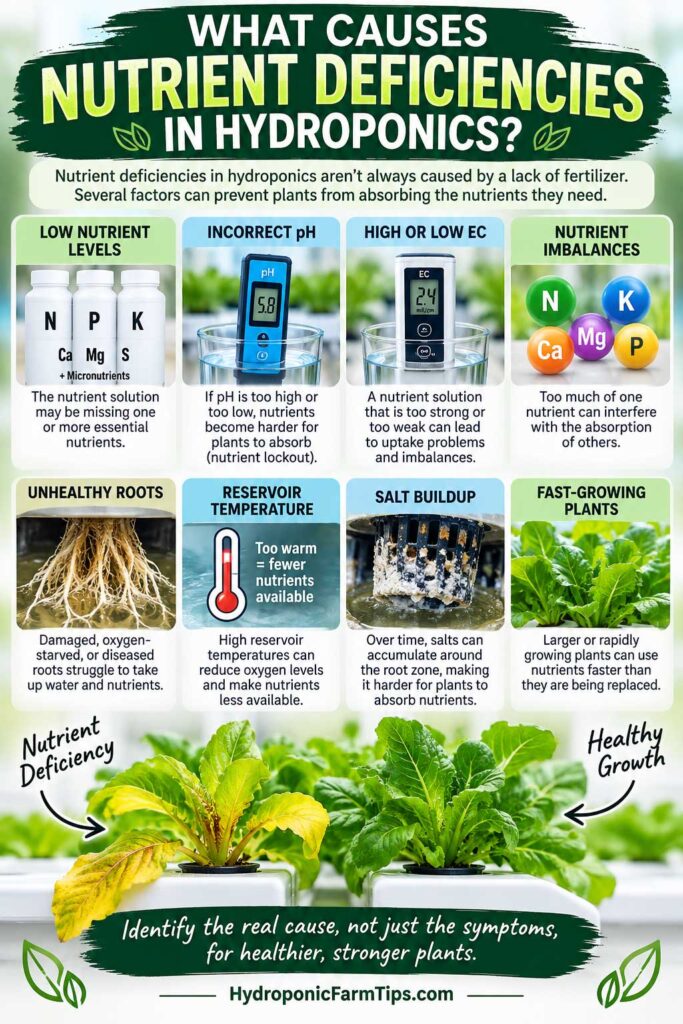
Hydroponic nutrient deficiencies do not always mean the reservoir is actually missing nutrients. In many cases, the nutrient is already present but the plant cannot absorb or use it properly.
That distinction matters because adding more fertilizer to the wrong situation can make the problem worse.
1. Incorrect pH
pH is one of the most common causes of apparent nutrient deficiencies in hydroponics.
When pH moves too far outside the preferred range, certain nutrients become less available to plant roots. This can create deficiency symptoms even when those nutrients are already present in the reservoir.
For many hydroponic crops, a pH somewhere around 5.5 to 6.5 works well, although the ideal target depends on the crop.
Micronutrients such as iron, manganese, and zinc are especially sensitive to pH changes.
2. Nutrient Solution That Is Too Weak
If the nutrient concentration is too low, plants may simply not receive enough minerals to support healthy growth.
This can happen when too much plain water is added, nutrients are under-measured, the reservoir goes too long without refreshing, or fast-growing plants consume nutrients faster than they are being replaced.
Checking EC can help you determine whether the overall nutrient concentration is lower than expected.
3. Nutrient Solution That Is Too Strong
More nutrients do not always mean healthier plants.
An overly concentrated reservoir can create high salt levels around the roots, making it harder for plants to absorb water and nutrients.
Possible signs include burned leaf tips, brown edges, wilting, slow growth, or deficiency-like symptoms despite a high EC reading.
If EC is already high, adding more fertilizer is unlikely to solve the problem.
4. Nutrient Imbalance
Plants need nutrients in the right proportions.
Excessive levels of one nutrient can interfere with the uptake of another. For example, too much potassium may contribute to problems with calcium or magnesium uptake.
This is why repeatedly adding individual supplements can gradually push a reservoir out of balance.
A complete hydroponic nutrient formula is usually safer than trying to correct every visible symptom with a separate additive.
5. Old Nutrient Solution
Plants do not absorb every nutrient at exactly the same rate.
Over time, the reservoir can become less balanced even when the EC still appears acceptable. Water may also evaporate while dissolved salts remain behind, further changing the concentration.
Periodic reservoir changes help restore a more predictable nutrient balance.
6. Root Problems
Healthy roots are essential for nutrient uptake.
Roots stressed by low oxygen, excessive heat, disease, or poor water quality may struggle to absorb nutrients even when the reservoir chemistry looks correct.
Watch for slimy roots, unpleasant odors, weak root growth, poor aeration, or excessively warm nutrient solution.
If roots are unhealthy, correcting the root-zone problem should usually take priority over adding more fertilizer.
7. Water Quality
Your starting water affects the final nutrient solution.
Hard water may already contain substantial amounts of calcium, magnesium, bicarbonates, and other dissolved minerals. Very soft or reverse-osmosis water, on the other hand, contains very little.
Either extreme can affect how your nutrient program behaves.
Water with high alkalinity may also cause pH to rise repeatedly after adjustment.
8. Temperature Problems
Extreme root-zone temperatures can interfere with nutrient uptake.
Cold conditions may slow nutrient absorption, especially phosphorus uptake, while excessively warm water can reduce dissolved oxygen and increase root stress.
Keeping reservoir temperature reasonably stable is an important part of preventing nutrient problems.
9. Incorrect Nutrient Mixing
Hydroponic concentrates should be mixed according to the manufacturer’s directions.
Avoid combining concentrated Part A and Part B nutrients directly together before diluting them in water unless the manufacturer specifically instructs you to do so.
Highly concentrated minerals can react with one another and form insoluble compounds, which may make some nutrients less available to plants.
Add each component separately to the reservoir water and mix thoroughly between additions.
10. Rapid Plant Growth
Sometimes nutrient demand simply increases faster than expected.
As plants get larger, their nutrient demand usually increases. A mature tomato loaded with fruit or a vigorously growing basil plant can draw far more from the reservoir than a young seedling.
That is why nutrient strength should generally be matched to the crop and its stage of growth, rather than using the same concentration from seedling to harvest.
The next important distinction is one that causes a lot of confusion in hydroponics: true nutrient deficiency vs. nutrient lockout.
Nutrient Deficiency vs. Nutrient Lockout
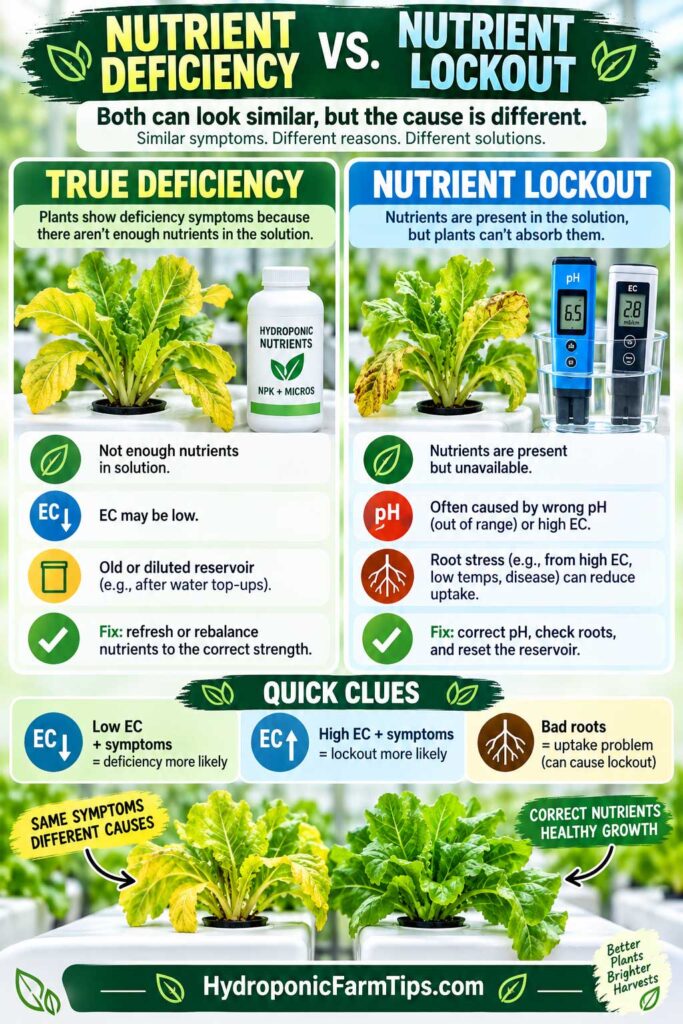
A true nutrient deficiency happens when the plant does not have access to enough of a specific nutrient.
Nutrient lockout, on the other hand, happens when nutrients are present in the reservoir but the plant cannot absorb them effectively.
These two problems can look almost identical, which is why checking the reservoir before adding more fertilizer is so important. In fact, many apparent hydroponic nutrient deficiencies are caused by nutrient lockout rather than a true shortage.
What Is a True Nutrient Deficiency?
A true deficiency may develop when the nutrient solution is too weak, one nutrient was left out or under-measured, the reservoir has become depleted, the fertilizer does not provide a complete nutrient profile, or the plants have outgrown the current feeding strength.
In that situation, correcting the nutrient concentration or replacing the reservoir with a properly balanced solution can often solve the problem.
What Is Nutrient Lockout?
Nutrient lockout means the nutrient is present in the solution, but conditions around the roots prevent normal uptake.
Common causes include pH that is too high or too low, excessive EC, salt buildup, nutrient imbalances, root damage, poor oxygenation, and stressful reservoir temperatures.
For example, a plant may show signs of iron deficiency even though the nutrient solution contains enough iron. If pH has drifted too high, that iron may simply be less available to the roots.
Adding more iron would not address the underlying cause.
How to Tell the Difference
Use your measurements and recent system history as clues.
| Situation | More Likely Problem |
|---|---|
| EC is unusually low | True nutrient shortage may be possible |
| EC is high but deficiency symptoms appear | Nutrient lockout or overfeeding is more likely |
| pH has drifted well outside the target range | Nutrient lockout is more likely |
| Nutrient solution is old or heavily diluted | Deficiency or nutrient imbalance is possible |
| Roots are brown, slimy, or unhealthy | Uptake problems are more likely |
| Symptoms improve after a fresh balanced reservoir | Nutrient depletion or imbalance was likely |
These are clues rather than absolute rules, but they can help prevent unnecessary nutrient additions.
Why Adding More Nutrients Can Make Lockout Worse
Suppose EC is already high and your plants begin showing symptoms that resemble magnesium deficiency.
Adding a magnesium supplement increases the concentration of dissolved salts even further. The plant may become more stressed, water uptake can become more difficult, and the original symptoms may continue.
In that situation, the better correction may be to restore the proper pH, reduce excessive nutrient strength, improve root-zone conditions, or replace the reservoir entirely.
A Better Troubleshooting Order
When you see possible deficiency symptoms, work through the problem in this order:
- Check pH
- Check EC
- Inspect the roots
- Check reservoir temperature and aeration
- Review how the nutrients were mixed
- Consider the age and condition of the nutrient solution
- Only then consider adding a specific supplement
This approach helps you treat the actual cause rather than reacting only to how the leaves look.
In many hydroponic systems, correcting the root-zone environment and nutrient balance is enough to restore normal uptake without adding extra fertilizer.
How pH Causes Nutrient Problems in Hydroponics
pH is one of the first things to check when diagnosing hydroponic nutrient deficiencies because it affects whether roots can access nutrients already dissolved in the reservoir.
Oklahoma State University notes that pH directly affects mineral nutrient availability in hydroponic systems and that EC provides an estimate of nutrient concentration.
A reservoir can contain the nutrients a plant needs and still produce deficiency-like symptoms if pH drifts too far outside the useful range.
What pH Range Is Best for Hydroponics?
For many hydroponic crops, a slightly acidic range of about 5.5 to 6.5 works well. If you want a deeper explanation of how pH affects nutrient availability, see our guide to What Is the Best pH for Hydroponics?
Within this range, most essential nutrients remain reasonably available to plant roots.
Different crops may prefer slightly different targets, so it is better to use a crop-specific recommendation when possible rather than treating one number as ideal for every plant.
You can compare crop ranges in our Hydroponic Nutrient & pH Chart.
What Happens When pH Is Too High?
When the nutrient solution becomes too alkaline, several micronutrients can become harder for plants to absorb.
These commonly include:
- Iron
- Manganese
- Zinc
- Copper
This is why high pH can produce symptoms such as pale or yellow new leaves.
A grower may assume the plant needs more iron when the real problem is that the iron already in the reservoir has become less available to the roots.
What Happens When pH Is Too Low?
Very low pH can create a different set of problems.
Some nutrients may become excessively available while the overall mineral balance becomes less stable, increasing the risk of toxicity, nutrient interactions, and root stress.
Extremely acidic conditions can also damage roots directly, which further reduces the plant’s ability to take up nutrients normally.
Why pH Changes Over Time
Some pH movement is normal in hydroponics.
As plants take up water and nutrients, the chemistry of the reservoir changes. Evaporation, reservoir top-offs, microbial activity, source-water alkalinity, plant growth, and changes in nutrient concentration can all cause pH to move over time.
A small amount of drift is not automatically a problem. The goal is to prevent pH from remaining far outside the recommended range for extended periods.
How Often Should You Check pH?
For small home hydroponic systems, regular pH checks are one of the easiest ways to catch nutrient problems early.
New systems and rapidly growing plants may need closer monitoring because pH can change more quickly.
If you notice yellow leaves, pale new growth, brown spots, slowed development, or unexplained deficiency symptoms, check pH before adding extra nutrients or supplements.
Adjust pH Gradually
If pH is outside the target range, avoid making a dramatic correction all at once.
Use a hydroponic pH Up or pH Down product according to the manufacturer’s directions, mix the reservoir thoroughly, allow the solution to stabilize, and then test again.
Large swings from very high to very low pH can stress roots and make troubleshooting more difficult.
pH Can Look Correct and Still Be Part of the Problem
A single good reading does not always tell the whole story.
For example, the reservoir may read pH 6.0 in the morning but climb significantly later in the day.
If deficiency symptoms keep returning, track pH over several days rather than relying on one measurement.
Consistent monitoring makes it much easier to determine whether the plant has a true nutrient shortage or an availability problem caused by pH drift.
Affiliate Disclosure: This page may contain affiliate links. If you purchase through one of these links, we may earn a commission at no additional cost to you.
Best Tools for Healthy Roots and Better Nutrient Uptake
Even a perfectly mixed nutrient solution will not help much if the roots are stressed. These tools can help you maintain better oxygenation, stable reservoir temperatures, and more reliable meter readings, all of which support healthy nutrient uptake.
| Product | Best For | Why It Helps | Buy |
|---|---|---|---|
| Hydroponic Air Pump | DWC and reservoir systems | Improves oxygen around the roots and supports more consistent nutrient uptake | Check Price |
| Air Stones | Increasing dissolved oxygen | Helps distribute fine bubbles throughout the root zone | Check Price |
| Digital Water Thermometer | Monitoring reservoir temperature | Helps catch overly warm nutrient solution before root stress develops | Check Price |
| pH Calibration Solution | Keeping pH meters accurate | Helps verify that your pH readings are reliable before adjusting the reservoir | Check Price |
| EC Calibration Solution | Accurate nutrient readings | Helps confirm that your EC/TDS meter is measuring nutrient strength correctly | Check Price |
How EC and Nutrient Strength Affect Deficiencies
EC, or electrical conductivity, gives you a general idea of how concentrated the dissolved salts are in your hydroponic nutrient solution.
Oklahoma State University also provides a useful guide to measuring EC and managing nutrient concentration in hydroponic systems.
It does not tell you exactly how much nitrogen, potassium, calcium, or another individual nutrient is present. However, it is very useful for spotting whether your reservoir may be too weak, too strong, or gradually drifting out of balance.
What a Low EC Can Mean
If EC is lower than the recommended range for your crop, the nutrient solution may be too dilute.
This can happen when too much plain water is added, nutrients are under-measured, plants consume nutrients quickly, or the reservoir goes too long without being refreshed. Fast-growing plants may also outgrow a nutrient strength that was adequate earlier.
A low EC combined with pale growth and other deficiency symptoms can suggest that the plants genuinely need a stronger nutrient solution.
What a High EC Can Mean
A high EC does not necessarily mean plants are well fed.
An excessively concentrated nutrient solution can make it harder for roots to take up water and may contribute to salt stress or nutrient-uptake problems.
Possible signs include burned leaf tips, crispy margins, wilting despite adequate water, curling leaves, slow growth, or deficiency-like symptoms even though the reservoir is highly concentrated.
If EC is already high, adding more fertilizer can make the problem worse.
Watch How EC Changes Over Time
One EC reading gives you a snapshot. Watching what happens over several days tells you much more.
If the water level falls while EC rises, the plants are probably using water faster than nutrients, leaving the reservoir more concentrated.
If the water level falls and EC also drops, nutrient uptake may be relatively strong.
And if EC remains fairly steady as the water level slowly declines, water and nutrient uptake may be reasonably balanced.
These patterns are often more useful than obsessing over a single EC reading.
EC Requirements Vary by Crop
Different plants prefer different nutrient strengths.
Leafy greens and herbs often perform well at lower EC levels than large fruiting crops such as tomatoes or cucumbers. Seedlings also generally need a weaker nutrient solution than mature plants.
That means there is no single perfect EC for every hydroponic garden.
Your Hydroponic Nutrient & pH Chart can help you compare suitable ranges for different crops and growth stages.
EC vs. PPM
Some meters display nutrient strength as PPM rather than EC.
PPM readings can be confusing because different meters may use different conversion scales, commonly 500, 640, or 700.
For that reason, EC is often easier to compare across different meters and nutrient recommendations.
If your meter displays PPM, make sure you know which conversion scale it uses before comparing your reading with a chart or fertilizer guide.
Don’t Chase the Exact Number
Small changes in EC are normal.
The goal is not to keep the reservoir at one exact number every hour. Instead, look for trends and stay within a reasonable range for the crop and growth stage.
If deficiency symptoms appear, interpret EC together with pH, leaf symptoms, root condition, reservoir age, water level, and plant growth stage.
Taken together, these clues provide a much more reliable diagnosis than EC alone.
How to Fix Hydroponic Nutrient Deficiencies Step by Step
When a hydroponic plant starts showing yellow leaves, brown spots, distorted growth, or other deficiency symptoms, avoid changing several things at once.
A simple troubleshooting sequence makes hydroponic nutrient deficiencies much easier to diagnose without changing several parts of the system at once.
1. Identify Where the Symptoms Started
Start with the plant itself.
Look at whether the problem began on older leaves or new growth, whether the veins remain green while the surrounding tissue turns yellow, and whether you see scorched edges, brown spots, curling, or damaged growing tips.
Where the symptoms appear can help narrow down which nutrient may be involved. For example, nitrogen and magnesium deficiencies usually begin on older leaves, while iron and calcium problems tend to affect newer growth first.
2. Check the pH
Before adding nutrients, test the reservoir pH.
For many hydroponic crops, a range around 5.5 to 6.5 provides good overall nutrient availability.
If pH is too high or too low, correct it gradually, allow the solution to mix thoroughly, and test again.
Sometimes restoring the proper pH is enough to correct an apparent deficiency.
3. Measure EC
Next, check nutrient strength.
If EC is unusually low, the nutrient solution may be too weak. If it is unusually high, the plants may actually be dealing with excessive dissolved salts rather than a nutrient shortage.
Compare your reading with the recommended range for the crop and growth stage instead of assuming that more nutrients are always better.
4. Inspect the Roots
Healthy roots are essential for nutrient uptake.
Look for roots that are firm, well developed, and free from slime or unpleasant odors. Some nutrient solutions can naturally stain roots, so color alone is not always enough to diagnose a problem.
Soft, slimy, deteriorating roots accompanied by a foul smell may indicate a more serious root-zone issue.
If you suspect root disease, our guide to Hydroponic Root Rot can help you troubleshoot the underlying problem.
5. Check Reservoir Temperature and Aeration
Roots need oxygen as well as nutrients. This is especially important in systems such as DWC, where the roots remain directly in the nutrient solution. See our guide to Hydroponic Growing Systems for more on how different systems deliver water, nutrients, and oxygen.
Warm nutrient solution holds less dissolved oxygen, while poor aeration can place additional stress on the root system.
Make sure the air pump is working, air stones are not clogged, water is circulating properly, and roots are not sitting in stagnant conditions.
Improving the root zone may restore nutrient uptake without changing the nutrient concentration.
6. Review How You Mixed the Nutrients
If you use a multi-part nutrient system, verify that every component was added in the correct amount.
Common mistakes include forgetting one part, using the wrong measurement, accidentally doubling a component, mixing concentrates together before dilution, or using a nutrient strength intended for seedlings on mature plants.
When using Part A and Part B nutrients, add each concentrate separately to water and mix thoroughly between additions.
7. Consider Replacing the Reservoir
If several readings look questionable or you are unsure what has accumulated in the solution, starting fresh is often simpler than trying to repair an unknown nutrient balance.
A reservoir change makes particular sense when the solution is old, pH or EC has become difficult to control, several supplements have been added, multiple deficiency symptoms are appearing, or salt buildup is suspected.
Refill with fresh water, add a complete hydroponic nutrient formula, set the nutrient strength, and then adjust pH.
8. Add Supplements Only When Necessary
Once pH, EC, root health, and nutrient mixing have been checked, consider whether a specific supplement is actually needed.
For example, calcium and magnesium supplementation may sometimes be useful with very soft or reverse-osmosis water.
Avoid adding several products at once. If you change calcium, magnesium, iron, potassium, and overall nutrient strength at the same time, it becomes very difficult to tell which adjustment actually helped.
9. Give the Plant Time to Respond
Do not expect damaged leaves to repair themselves overnight.
After correcting the problem, focus on new growth. Greener leaves, normal leaf shape, stronger stems, healthier roots, and the absence of new brown spots are better signs of recovery than the appearance of old damaged foliage.
Yellow, scorched, or distorted leaves may remain damaged even after the underlying problem has been solved.
10. Keep Monitoring
For the next several days, continue watching pH, EC, reservoir level, root condition, and new growth.
This helps confirm that the system is becoming stable rather than showing only a temporary improvement.
The goal is not simply to make one damaged leaf look better. It is to restore a balanced root environment where the plant can absorb nutrients normally.
Best Tools for Diagnosing Hydroponic Nutrient Deficiencies
Before adding more fertilizer, it helps to check what is actually happening in the reservoir. These tools can help you measure pH, EC, nutrient strength, and overall reservoir balance so you can troubleshoot the cause instead of guessing.
| Product | Best For | Why It Helps | Buy |
|---|---|---|---|
| Digital pH Meter | Checking nutrient availability | Helps identify pH problems that may be causing nutrient lockout | Check Price |
| EC/TDS Meter | Measuring nutrient strength | Shows whether the reservoir is too weak, too concentrated, or drifting out of range | Check Price |
| Complete Hydroponic Nutrient Set | Resetting an unbalanced reservoir | Provides a balanced mix of macro- and micronutrients instead of correcting nutrients individually | Check Price |
| Cal-Mag Supplement | RO or very soft water | Can help when calcium and magnesium levels are genuinely too low | Check Price |
| pH Up & pH Down Kit | Correcting pH drift | Makes it easier to bring the nutrient solution gradually back into the proper range | Check Price |
Should You Add More Nutrients?
Not necessarily.
One of the easiest mistakes to make in hydroponics is seeing yellow leaves or brown spots and immediately adding more fertilizer.
Sometimes the plant really does need a stronger nutrient solution. But in many cases, the reservoir already contains enough nutrients and the real problem is pH, high EC, root stress, or nutrient lockout.
When More Nutrients May Help
Adding nutrients may make sense when:
- EC is clearly below the recommended range
- The reservoir has become heavily diluted
- Plants are growing rapidly and consuming nutrients quickly
- The solution was accidentally mixed too weak
- The current nutrient formula is incomplete
- A fresh reservoir was prepared below the intended strength
In these situations, gradually bringing the nutrient solution back toward the recommended concentration may solve the problem.
When You Should Not Add More Nutrients
Avoid automatically increasing nutrient strength when:
- EC is already high
- Leaf tips are burned or crispy
- Roots are brown, slimy, or unhealthy
- pH is far outside the target range
- Several deficiency-like symptoms appear at once
- The reservoir already contains multiple supplements
- You are unsure what nutrients are currently in the solution
Adding more fertilizer under these conditions can raise salt concentration and make nutrient uptake even more difficult.
A Fresh Reservoir Is Often Safer
If you are unsure what is happening in the nutrient solution, replacing it with a fresh, correctly mixed reservoir is often more reliable than adding another supplement.
A fresh solution gives you a cleaner starting point by resetting the nutrient concentration, nutrient ratios, pH, EC, and accumulated salts. It also makes it easier to monitor how the plants respond afterward.
Avoid Treating Every Symptom With a Separate Bottle
A yellow leaf does not automatically mean you need nitrogen.
Brown spots do not automatically mean you need calcium.
Interveinal yellowing does not automatically mean you need magnesium.
Hydroponic deficiencies are often connected to the overall condition of the root zone rather than one missing ingredient.
Before reaching for another supplement, ask:
Is the nutrient actually missing, or can the plant simply not absorb what is already there?
Answering that question can prevent overfeeding and make hydroponic troubleshooting much easier.
How Long Does It Take Hydroponic Plants to Recover?
Recovery time depends on the nutrient involved, how severe the deficiency became, the crop, and how quickly the underlying cause was corrected.
Some plants begin producing healthier new growth within a few days, while more serious problems may take a week or longer to show clear improvement.
What You Should Expect After Correcting a Deficiency
Do not judge recovery only by damaged leaves.
Leaves that are already yellow, scorched, spotted, or distorted may never return to perfect condition. In many cases, the best sign of recovery is what happens next.
Look for:
- Healthy new leaves
- Greener new growth
- Normal leaf shape
- No new brown spots
- Stronger stems
- Faster growth
- Improved root development
If the symptoms stop spreading, that is usually a good sign even when older leaves still look damaged.
Mild Deficiencies May Improve Quickly
If the problem was caused by a small pH drift, slightly weak nutrient solution, or another minor imbalance, the plant may begin responding relatively quickly once conditions are corrected.
Within several days, you may notice better leaf color, firmer growth, less curling, or healthier new leaves.
Severe Deficiencies Take Longer
Plants that have been stressed for a longer period usually need more time to recover.
Severely damaged growing tips, large areas of dead tissue, root stress, prolonged nutrient lockout, or long-term pH problems can all slow recovery.
Some damaged leaves may eventually die and fall off even after the plant has started growing normally again.
Don’t Keep Changing the Reservoir Every Day
Once you have corrected pH, EC, nutrient balance, and root-zone conditions, give the plant time to respond.
Making major adjustments every few hours can create additional stress and make it harder to tell whether the original correction worked.
Instead, keep conditions stable and watch the trend in new growth.
When to Recheck Your Diagnosis
If new growth continues showing the same symptoms after several days while pH and EC remain stable, reconsider the original diagnosis.
The problem may involve a different nutrient deficiency, unhealthy roots, poor oxygenation, excessive nutrient strength, water quality, light or heat stress, or even pest damage.
Hydroponic troubleshooting works best when you treat symptoms as clues rather than absolute proof of one specific deficiency.
How to Prevent Nutrient Deficiencies in Hydroponics
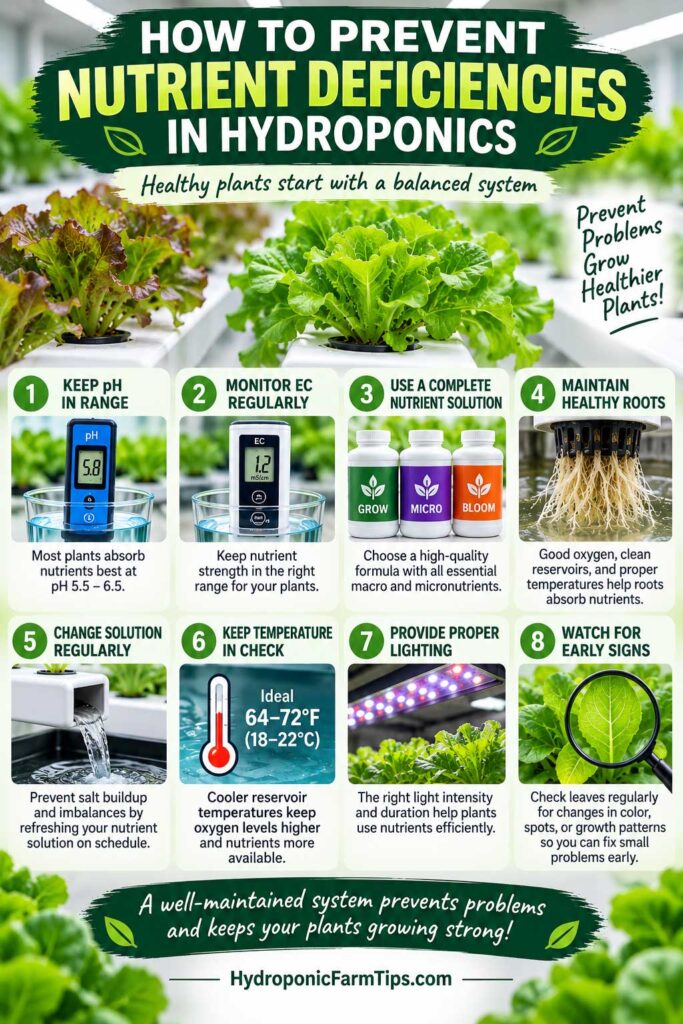
Preventing hydroponic nutrient deficiencies is usually easier than correcting them after plants begin showing visible damage. The goal is to keep the root zone stable enough that plants can absorb nutrients consistently.
Use a Complete Hydroponic Nutrient Formula
Choose a fertilizer designed specifically for hydroponic growing.
A complete formula should provide the major nutrients plants need along with essential micronutrients such as iron, manganese, zinc, boron, copper, and molybdenum.
Avoid relying on general-purpose garden fertilizer unless it is specifically suitable for hydroponics.
Keep pH in the Proper Range
Check pH regularly and correct it before it drifts too far.
For many hydroponic crops, a range around 5.5 to 6.5 provides good overall nutrient availability.
Crop requirements differ, so use your Hydroponic Nutrient & pH Chart when you need a more specific target.
Monitor EC Instead of Guessing
EC helps you see whether the nutrient solution is becoming too weak or too concentrated.
Track the trend over time instead of reacting to a single reading. A rising EC may indicate that plants are taking up water faster than nutrients, while a falling EC can suggest stronger nutrient uptake or a solution that is becoming diluted.
Refresh the Reservoir Regularly
Even when pH and EC look acceptable, nutrient ratios can gradually drift because plants do not absorb every mineral at the same rate.
Periodic reservoir changes help restore a more predictable balance. How often you need to replace the solution depends on the reservoir size, number and size of plants, crop type, water quality, hydroponic system, and nutrient program.
Protect Root Health
Healthy roots are much better at absorbing nutrients. Root-zone problems can quickly interfere with nutrient uptake, particularly in water-based systems such as DWC.
Maintain good oxygenation and water circulation, keep equipment reasonably clean, avoid excessively warm nutrient solution, and make sure the reservoir does not drop so low that roots are left in poor conditions.
If the root system becomes stressed, plants may develop deficiency-like symptoms even when the reservoir contains enough nutrients.
Mix Nutrients Correctly
Follow the nutrient manufacturer’s directions carefully.
For multi-part nutrients, fill the reservoir with water first, add each nutrient component separately, and mix thoroughly between additions. Once the nutrients are fully mixed, check the concentration with your EC meter and adjust pH last.
Do not mix concentrated Part A and Part B products directly together unless the manufacturer specifically instructs you to do so. Concentrated minerals can react with one another and become less available to plants.
Avoid Excessive Supplements
More additives are not necessarily better.
Repeatedly adding Cal-Mag, iron, potassium boosters, bloom supplements, and other products can make the reservoir increasingly difficult to manage.
Start with a balanced base nutrient and use additional supplements only when your water source, crop, or nutrient program gives you a clear reason to add them.
Match Nutrient Strength to Plant Growth
Seedlings usually need a weaker nutrient solution than mature plants, while large fruiting crops may require a stronger solution than young herbs or leafy greens.
Adjust nutrient strength based on the crop, plant age, growth stage, and growing conditions rather than using the same concentration from seedling to harvest.
This helps reduce the risk of both nutrient deficiencies and nutrient burn.
Keep Simple Records
A basic hydroponic log can make troubleshooting much easier.
Record:
- pH
- EC
- Reservoir changes
- Nutrient amounts
- Water additions
- Unusual plant symptoms
If a problem develops, you can look back and see what changed instead of trying to remember.
Consistent monitoring does not mean constantly adjusting the system. In fact, one of the best ways to prevent nutrient deficiencies is to maintain stable conditions and avoid unnecessary corrections.
Common Mistakes to Avoid When Fixing Hydroponic Nutrient Deficiencies
Nutrient problems often get worse because growers react too quickly or change too many things at once. A few common mistakes can turn a small deficiency into a much bigger reservoir imbalance.
Adding More Fertilizer Without Checking pH
This is one of the biggest mistakes.
If pH is outside the proper range, the plant may not be able to absorb certain nutrients even when they are already present in the reservoir.
Adding more fertilizer in that situation can raise EC and increase stress without fixing the underlying problem.
Always check pH first.
Treating Every Yellow Leaf as Nitrogen Deficiency
Yellow leaves can have many causes, including nitrogen, magnesium, or iron problems, root stress, high EC, incorrect pH, light stress, or simply the natural aging of older foliage.
Look at which leaves are affected first, how the yellowing develops, and whether other symptoms are present before deciding that nitrogen is the problem.
Adding Several Supplements at Once
It can be tempting to add Cal-Mag, iron, potassium, and extra nutrients at the same time.
The problem is that you will not know which adjustment helped. You may also create new nutrient interactions or push EC too high.
Make one correction at a time whenever possible.
Ignoring Root Health
A perfectly mixed nutrient solution will not help much if the roots are damaged.
Brown, slimy, oxygen-starved roots may struggle to absorb water and minerals properly. If the plant shows several deficiency-like symptoms at once, inspect the roots before assuming multiple nutrients are missing.
Chasing Exact pH and EC Numbers
Small fluctuations are normal.
Constantly adding pH Up, pH Down, nutrients, and water to chase one exact reading can create unnecessary instability.
Aim for a healthy range and pay more attention to the overall trend than to tiny changes.
Mixing Nutrient Concentrates Together
Concentrated nutrient parts can react with one another before they are properly diluted.
This can cause some minerals to precipitate out of solution and become less available to plants.
Add each nutrient concentrate separately to water and mix thoroughly between additions.
Using Too Much Cal-Mag
Cal-Mag can be useful, especially with certain water sources, but more is not always better.
Excess calcium or magnesium can interfere with the uptake of other nutrients and raise EC unnecessarily.
Use Cal-Mag only when your water source and nutrient program give you a clear reason to add it.
Diagnosing From One Damaged Leaf
One yellow or spotted leaf does not automatically mean the entire plant has a nutrient deficiency.
Older leaves naturally decline, while individual leaves can also be damaged by light, handling, pests, or environmental stress.
Look for a consistent pattern across several leaves and new growth before changing the reservoir.
Expecting Damaged Leaves to Heal
Brown spots, scorched margins, and badly distorted leaves usually do not repair themselves.
Do not keep adding nutrients simply because an old damaged leaf still looks bad.
Judge recovery by healthy new growth and whether the symptoms stop spreading.
Changing the Reservoir Too Aggressively
A fresh reservoir can be useful, but replacing the nutrient solution every time a leaf changes color can make troubleshooting harder.
Make measured corrections, keep simple records, and give the plant enough time to respond before changing another variable.
The best hydroponic troubleshooting usually comes from stable conditions, careful observation, and small adjustments rather than constant intervention.
Frequently Asked Questions About Hydroponic Nutrient Deficiencies
What is the most common nutrient deficiency in hydroponics?
There is no single deficiency that affects every hydroponic system, but nitrogen, magnesium, calcium, and iron-related symptoms are among the problems growers commonly notice.
Many apparent deficiencies, however, are actually caused by incorrect pH, high EC, or root stress rather than a true lack of nutrients.
How do I know which nutrient my hydroponic plant is missing?
Start by looking at where the symptoms appear first.
Older leaves are more likely to show problems with mobile nutrients such as nitrogen, phosphorus, potassium, or magnesium. New growth is more likely to show problems involving calcium, iron, boron, zinc, manganese, or copper.
Then check pH, EC, root health, and reservoir conditions before making any nutrient adjustments.
Can low pH cause nutrient deficiencies in hydroponics?
Yes.
Very low pH can disrupt nutrient balance, increase the availability of some elements too much, reduce the availability of others, and stress plant roots.
For many hydroponic crops, a pH around 5.5 to 6.5 provides good overall nutrient availability, although crop-specific requirements vary.
Can high pH cause yellow leaves?
Yes.
High pH can make several micronutrients, especially iron, manganese, zinc, and copper, less available to plants.
This often causes pale or yellow new growth even when those nutrients are already present in the reservoir.
Should I add Cal-Mag if my hydroponic leaves are yellow?
Not automatically.
Yellow leaves can result from nitrogen deficiency, magnesium deficiency, iron deficiency, incorrect pH, root problems, or excessive nutrient strength.
Check your pH, EC, water source, and base nutrient formula before adding Cal-Mag.
Can too many nutrients cause deficiency symptoms?
Yes.
An excessively strong nutrient solution can raise EC and make it harder for roots to absorb water and nutrients.
Too much of one mineral can also interfere with the uptake of another, creating symptoms that look like a deficiency.
What does nutrient lockout look like in hydroponics?
Nutrient lockout can look almost identical to a true deficiency.
You may see yellow leaves, interveinal chlorosis, brown spots, burned edges, distorted new growth, or slow growth.
The difference is that nutrients may already be present in the solution but are unavailable because of pH, excessive salts, poor root health, or nutrient imbalance.
How quickly can a nutrient deficiency appear?
Some hydroponic nutrient deficiencies can become visible within several days when plants are growing quickly or root-zone conditions change suddenly.
Others develop more gradually.
Hydroponic plants can respond quickly because their roots are in direct contact with the nutrient solution.
Will damaged leaves recover after I fix the deficiency?
Mildly affected leaves may improve, but severely yellowed, scorched, or distorted leaves often do not return completely to normal.
The best indicator of recovery is healthy new growth.
Should I remove leaves damaged by nutrient deficiencies?
Not necessarily.
If a leaf is still partly green, it may continue contributing to photosynthesis. Remove leaves that are completely dead, badly damaged, diseased, or interfering with airflow.
Avoid removing too much foliage at once from an already stressed plant.
How often should I change my hydroponic nutrient solution?
There is no universal schedule because it depends on reservoir size, plant type, water quality, system design, and nutrient program.
Many home growers periodically replace the reservoir rather than relying indefinitely on top-offs.
If pH and EC become difficult to stabilize or several deficiency symptoms appear at once, a fresh nutrient solution can provide a useful reset.
Can I fix nutrient deficiencies by foliar feeding?
Foliar feeding can sometimes provide nutrients through the leaves, but it should not replace correcting the underlying root-zone problem.
For most home hydroponic systems, the priority should be restoring pH, EC, nutrient balance, and root health.
What should I check first when my hydroponic plant turns yellow?
Start by checking pH and EC, then look at which leaves are affected first, inspect the roots, review reservoir temperature and aeration, and confirm that the nutrient solution was mixed correctly.
If the reservoir is old or its balance is uncertain, consider replacing it with a fresh nutrient solution before adding more fertilizer.
This approach is usually safer than immediately treating yellow leaves as a nutrient shortage.
Final Thoughts on Hydroponic Nutrient Deficiencies
Hydroponic nutrient deficiencies can look complicated at first, but most problems become much easier to diagnose when you follow a consistent process.
Start with the plant, but do not stop there.
Yellow leaves, brown spots, pale new growth, curled edges, and weak stems can all provide useful clues, yet those symptoms should always be considered alongside pH, EC, root health, reservoir condition, and nutrient strength.
The most important thing to remember is that a deficiency symptom does not automatically mean the reservoir needs more fertilizer.
Sometimes the nutrient is already present, but the plant cannot absorb it properly because of incorrect pH, excessive EC, salt buildup, root damage, poor oxygenation, nutrient imbalance, or stressful reservoir temperatures.
That is why the safest approach is to troubleshoot the system in a consistent order: check pH, check EC, inspect the roots, review reservoir temperature and aeration, confirm that nutrients were mixed correctly, and consider replacing an old or unbalanced solution before reaching for a separate supplement.
With regular monitoring and a complete hydroponic nutrient formula, many nutrient problems can be caught before they become severe.
And when a deficiency does occur, focus less on repairing old damaged leaves and more on what the plant does next.
If new growth begins emerging healthy, green, and normally shaped, that is one of the clearest signs that your hydroponic system is moving back into balance.
More Hydroponic Growing Guides You May Like
If you’re troubleshooting nutrient problems, these guides can help you understand pH, root health, nutrient strength, lighting, and other factors that affect hydroponic plant growth.
- Hydroponic Nutrient & pH Chart – Compare recommended pH and nutrient ranges for popular hydroponic vegetables, herbs, and fruits.
- Hydroponic Yellow Leaves: Causes & Fixes – Learn why hydroponic leaves turn yellow and how to tell whether the cause is nutrients, pH, roots, light, or environmental stress.
- Hydroponic Root Rot: Causes, Prevention & Treatment – Identify early root-rot symptoms and learn how oxygenation, temperature, cleanliness, and reservoir conditions affect root health.
- Best pH for Hydroponics – Understand how pH affects nutrient availability and how to keep your reservoir within a healthy range.
- Best pH Meters for Hydroponics – Compare reliable meters for checking and maintaining hydroponic pH accurately.
- Hydroponic Nutrients Guide – Learn what hydroponic nutrients do, how to mix them correctly, and how nutrient strength changes through different growth stages.
- Algae in Hydroponics: Causes, Prevention & How to Get Rid of It – Find out why algae develops in hydroponic systems and how to control it without harming your plants.
- 8 Best Hydroponic Systems for Home – Compare DWC, Kratky, NFT, Ebb and Flow, drip, aeroponics, wick systems, and Dutch Buckets.
- 10 Best Hydroponic Vegetables – Discover productive vegetables to grow hydroponically and learn which systems work well for different crops.
- 10 Best Hydroponic Herbs to Grow at Home – Choose herbs that perform especially well in indoor and home hydroponic systems.