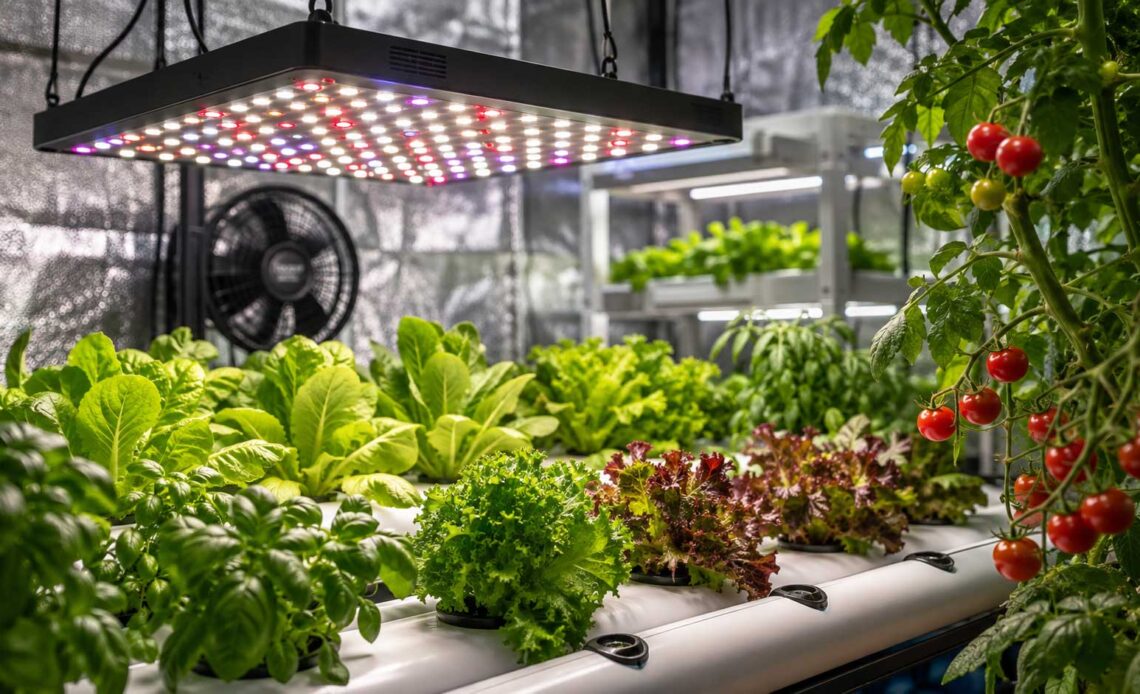
Choosing the right LED grow light for hydroponics can make a big difference in plant development, canopy quality, and overall growing performance. Whether you’re growing lettuce, basil, tomatoes, peppers, strawberries, or microgreens, a good full-spectrum LED can provide the light your plants need without the high heat and energy use associated with older grow-light technologies.
In this updated 2027 buying guide, we compare some of the best LED grow lights for hydroponic systems, from compact setups for herbs and leafy greens to powerful fixtures for larger grow tents and fruiting crops. We’ll look at light coverage, power consumption, spectrum, efficiency, useful features, and which models are best suited to different plants and growing spaces.
If you’re setting up your first indoor hydroponic garden or replacing an older light, this guide will help you narrow down your options and choose a grow light that fits your space, crops, and budget.
Quick Comparison: Best LED Grow Lights for Hydroponics (2027)
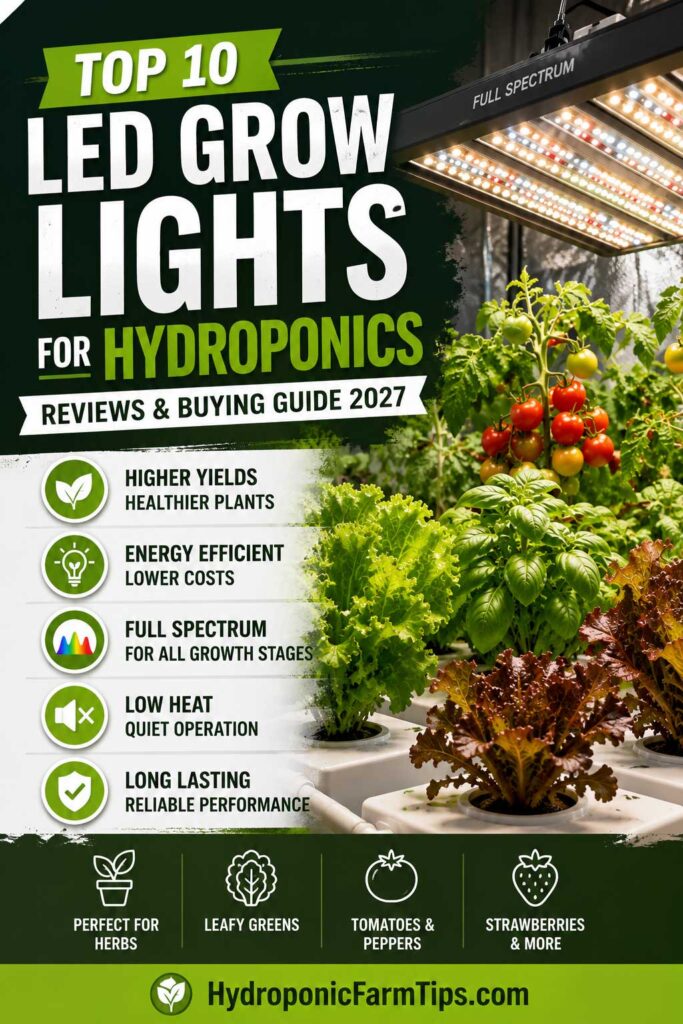
If you want the short version, here’s how our top LED grow light picks compare. Keep in mind that actual coverage can vary depending on the crop, growth stage, hanging height, and light intensity.
| Grow Light | Best For | Typical Coverage | Power | Key Features |
|---|---|---|---|---|
| Spider Farmer SF-1000 | Best Overall | 2 × 2 ft | 100W | Full spectrum, dimmable, efficient |
| VIPARSPECTRA XS1500 Pro | Best Value | 2 × 2 ft | 150W | 150W output, even coverage, dimmable |
| MARS HYDRO TS1000 | Best for Beginners | 2 × 2 ft | 150W | Easy setup, full spectrum, dimmable |
| HLG 100 Rspec | Herbs & Leafy Greens | 2 × 2 ft | 95W | High efficiency, compact design |
| AC Infinity IONBOARD S22 | Smart Grow Setups | 2 × 2 ft | 100W | Dimmable, controller compatibility |
| Spider Farmer SF-2000 | Larger Home Gardens | 2 × 4 ft | 200W | Wider coverage, full spectrum |
| MARS HYDRO FC-E3000 | High-Yield Gardens | 3 × 3 ft | 300W | Bar-style design, uniform coverage |
| VIPARSPECTRA KS3000 | Larger Indoor Gardens | 3 × 3 ft | 320W | Bar-style design, strong canopy coverage |
| HLG 350 Diablo | Premium Performance | 3 × 3 ft | 330W | High efficiency, premium construction |
| AC Infinity IONFRAME EVO6 | Large Grow Tents | 4 × 4 ft | 500W | High output, smart-controller compatibility |
Editor’s Choice: For a typical small home hydroponic garden, the Spider Farmer SF-1000 is our best overall pick. Its compact size, adjustable output, full-spectrum light, and relatively low power consumption make it especially well suited to herbs, lettuce, leafy greens, seedlings, and other plants grown in a roughly 2 × 2-foot area.
Coverage figures are general recommendations rather than guarantees. Always check the manufacturer’s current PPFD map and hanging-height recommendations before choosing a fixture.
Affiliate disclosure: This article may contain affiliate links. If you purchase through one of these links, we may earn a commission at no additional cost to you.
Our 3 Best LED Grow Light Deals to Check First
Want to check today’s prices? These are the three lights we’d look at first for most home hydroponic gardens.
| Grow Light | Best For | Why We Like It | Check Price |
|---|---|---|---|
| Spider Farmer SF-1000 | Best Overall | Compact, efficient choice for small gardens | Check Price on Amazon |
| VIPARSPECTRA XS1500 Pro | Best Value | More output while staying in the small-garden class | Check Price on Amazon |
| MARS HYDRO TS1000 | Beginners | Straightforward 150W option with room to experiment | Check Price on Amazon |
How We Chose the Best LED Grow Lights
To narrow down the best LED grow lights for hydroponics, we compared manufacturer specifications, power draw, recommended coverage, PPFD information, controls, fixture design, and suitability for different hydroponic crops.
Our main criteria included:
- Full-spectrum output: A useful spectrum for seedlings, vegetative growth, flowering, and fruiting.
- Light intensity (PPFD): Enough usable light for the crops and growing area the fixture is designed to cover.
- Energy efficiency: Strong light output without unnecessarily high electricity consumption.
- Coverage and uniformity: How effectively the fixture distributes light across its recommended growing area.
- Dimming and controls: Adjustable output and, where available, timers, controllers, or smart features.
- Heat management: Efficient passive cooling and a design that helps limit excess heat around the plants.
- Build quality: Durable components designed for long hours of indoor operation.
- Ease of use: Straightforward installation, adjustment, and operation for home growers.
- Overall value: The balance of performance, features, coverage, and price.
We also considered the types of plants each fixture is best suited for. Leafy greens and herbs generally need less intense light than fruiting crops such as tomatoes, peppers, cucumbers, and strawberries, so the most powerful grow light isn’t automatically the best choice for every hydroponic garden.
The goal of this guide is to help you match the right light to your plants and growing space, whether you’re running a small countertop system or a larger indoor hydroponic garden.
Why LED Grow Lights Work So Well for Hydroponics
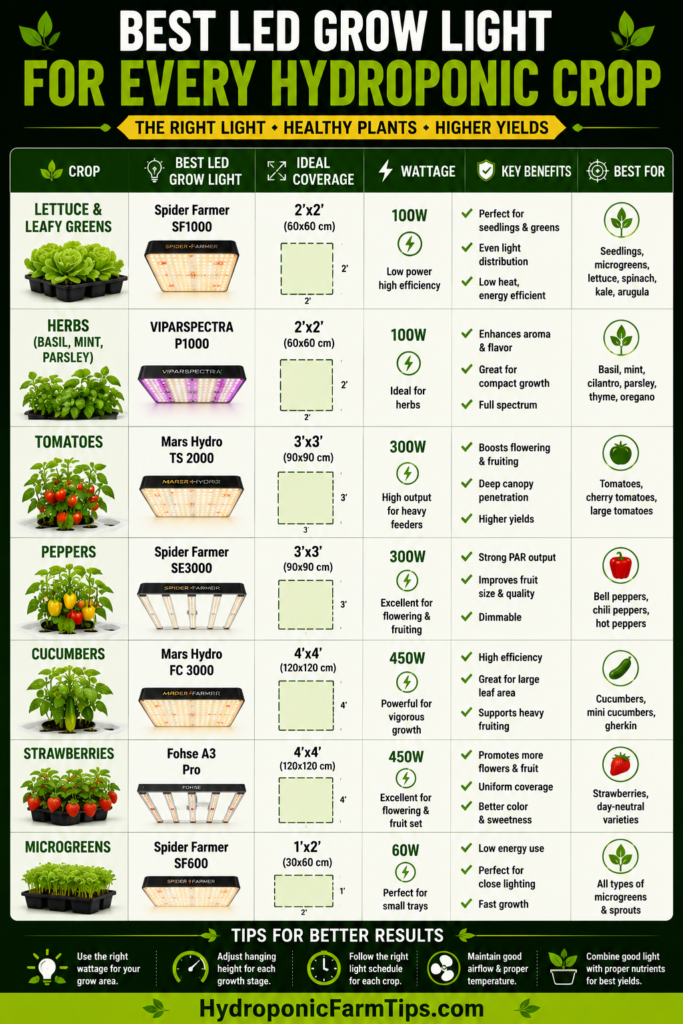
In a fully indoor hydroponic garden without sufficient sunlight, the grow light becomes one of the most important parts of the system. A good grow light does more than simply make the growing area brighter—it provides the wavelengths and intensity plants need for photosynthesis and healthy development.
Modern LED grow lights are particularly well suited to hydroponics because they can deliver high levels of usable light while consuming relatively little electricity and producing less heat than many traditional horticultural lighting systems.
The U.S. Department of Energy’s horticultural lighting research also highlights the efficiency, spectral control, and light-distribution advantages of modern LED systems.
Other types of grow lights are still available, including:
- High-pressure sodium (HPS)
- Metal halide (MH)
- Fluorescent T5 fixtures
- Compact fluorescent lamps (CFLs)
These technologies can grow plants successfully, but LEDs have become a popular choice for home hydroponic gardens because they combine energy efficiency, long operating life, relatively low heat output, dimming capabilities, and full-spectrum lighting in compact fixtures.
Today’s full-spectrum LEDs can support plants throughout their entire life cycle. Blue wavelengths are particularly important for vegetative development, while red wavelengths play an important role in photosynthesis and plant development, including flowering responses. Rather than switching between different bulbs as plants mature, most home growers can use one quality full-spectrum LED fixture from seedling to harvest.
LEDs also make it easier to control the growing environment. Many current fixtures allow you to adjust light intensity, and some can be connected to timers or smart controllers. That flexibility is especially useful in hydroponics, where lettuce and herbs may require considerably less light than tomatoes, peppers, cucumbers, and other fruiting crops.
LED technology isn’t new to plant research, either. NASA has studied the use of LEDs for growing plants in controlled environments and space-based food-production research for decades. That research helped demonstrate how carefully controlled artificial lighting can support plant growth where natural sunlight is limited or unavailable.
For most home hydroponic growers today, the question is no longer whether LEDs can grow healthy plants. The more important question is which LED grow light provides the right intensity and coverage for your particular crops and growing space.
If you’re still choosing the growing method itself, start with our guide to the best hydroponic systems for home.
1. Spider Farmer SF-1000 — Best Overall LED Grow Light for Hydroponics
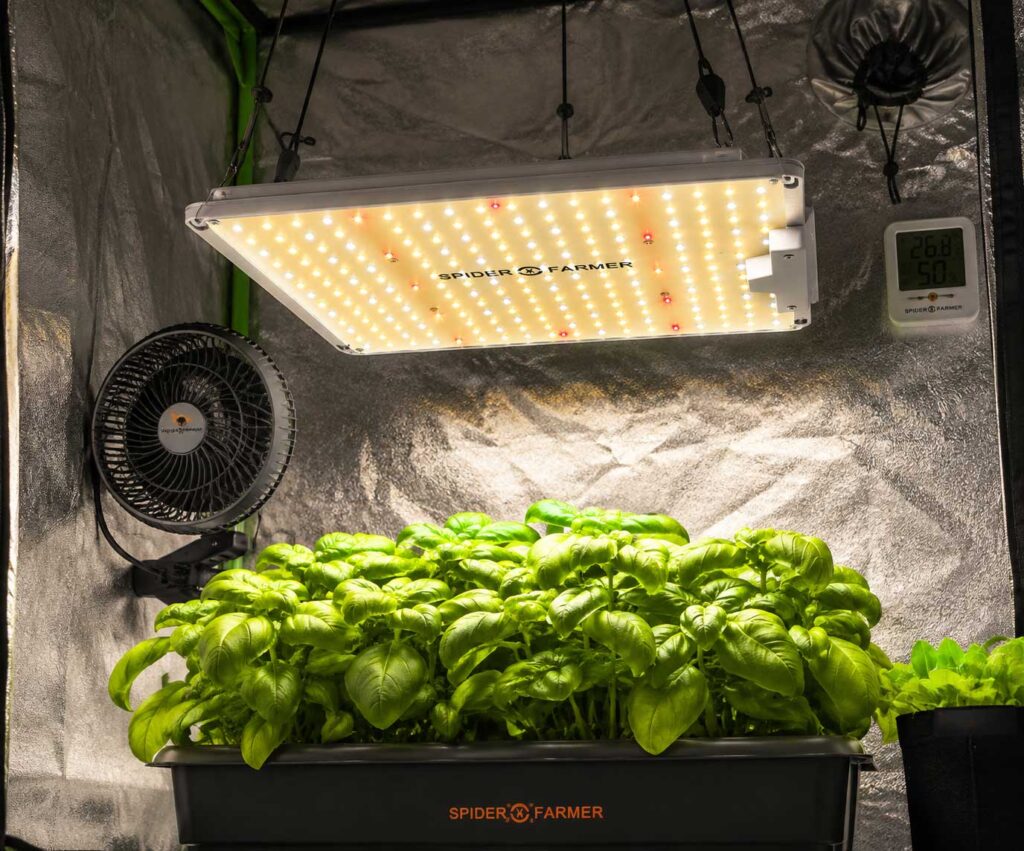
The Spider Farmer SF-1000 is our best overall pick for a small home hydroponic garden. With a 100W power draw, full-spectrum output, dimming control, and a compact footprint, it provides plenty of flexibility for growing herbs and leafy greens without moving up to a larger, higher-powered fixture.
Its fanless design is another advantage for indoor growing. Passive cooling keeps the fixture quiet, while the relatively low power draw makes heat easier to manage than with traditional HID grow lights.
Spider Farmer SF-1000 Pros and Cons
| Pros | Cons |
|---|---|
| ✓ Energy-efficient 100W design | ✗ Limited coverage for larger gardens |
| ✓ Full-spectrum output | ✗ More light than very small countertop systems need |
| ✓ Dimmable light intensity | ✗ Fruiting crops may require more intensity or coverage as they mature |
| ✓ Quiet, fanless cooling | |
| ✓ Compact and easy to hang |
Spider Farmer SF-1000 Specifications
| Feature | Details |
|---|---|
| Power Draw | 100W |
| Recommended Growing Area | Around 2 × 2 ft |
| Spectrum | Full spectrum |
| Dimmable | Yes |
| Cooling | Passive / fanless |
| Best For | Herbs, leafy greens, seedlings and compact hydroponic gardens |
What Can You Grow With It?
For a small hydroponic setup, the SF-1000 is particularly well suited to lettuce, basil, spinach, kale, pak choi, microgreens, and other leafy greens and herbs.
If herbs are your main focus, see our guide to the best herbs to grow hydroponically.
You can also use it with young tomatoes and peppers, although mature fruiting plants generally require greater light intensity than leafy greens. If tomatoes, peppers, cucumbers, or other high-light crops are your main focus, a larger fixture may be a better long-term choice.
The SF-1000 can work with DWC, Kratky, NFT, ebb-and-flow, and other indoor hydroponic systems. What matters more than the hydroponic method itself is matching the fixture’s illuminated footprint and intensity to your plant canopy.
Is the Spider Farmer SF-1000 Worth It?
Best for: Small home hydroponic gardens, herbs and leafy greens
Skip it if: You need to illuminate a large garden or several mature fruiting plants
The Spider Farmer SF-1000 earns our Best Overall spot because it hits a practical sweet spot for home growers. You get adjustable full-spectrum lighting, relatively low electricity consumption, quiet operation, and enough output for many of the crops beginners are most likely to grow.
For a roughly 2 × 2-foot hydroponic garden filled with lettuce, basil, herbs, or similar crops, it’s a strong all-around choice without paying for considerably more lighting capacity than you need.
2. VIPARSPECTRA XS1500 Pro — Best Value LED Grow Light
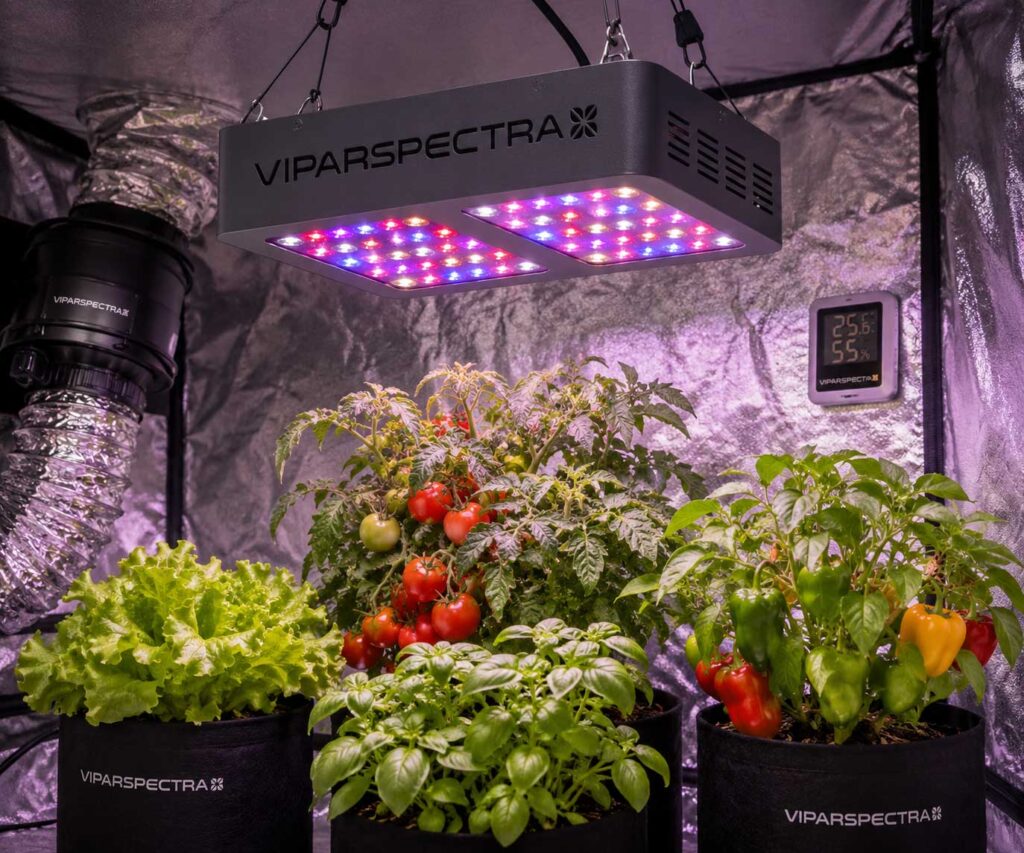
The VIPARSPECTRA XS1500 Pro is our value pick for growers who want more output than a typical 100W entry-level fixture without making the jump to a much larger grow light. With a 150W power draw, full-spectrum output, dimming control, and optics designed to spread light across the canopy, it’s a practical choice for small indoor hydroponic gardens.
The additional output also gives you more flexibility if you grow a mixture of leafy greens, herbs, and compact fruiting plants.
VIPARSPECTRA XS1500 Pro Pros and Cons
| Pros | Cons |
|---|---|
| ✓ Strong output for a 150W fixture | ✗ Designed primarily for smaller growing areas |
| ✓ Full-spectrum lighting | ✗ Less smart-control integration than some premium options |
| ✓ Dimmable output | |
| ✓ Fanless passive cooling | |
| ✓ Good canopy light distribution | |
| ✓ Strong performance for the price |
VIPARSPECTRA XS1500 Pro Specifications
| Feature | Details |
|---|---|
| Power Draw | 150W |
| Recommended Growing Area | Around 2 × 2 ft for higher-intensity growing; potentially larger for lower-light applications |
| Spectrum | Full spectrum |
| Dimmable | Yes |
| Cooling | Passive / fanless |
| Best For | Herbs, leafy greens and compact fruiting plants |
What Can You Grow With It?
The XS1500 Pro is a particularly good match for lettuce, basil, spinach, microgreens, and other herbs and leafy greens. Its higher output also gives growers more flexibility with compact tomatoes, peppers, strawberries, and similar fruiting plants when the fixture is appropriately positioned over the canopy.
As with any grow light, the usable coverage depends on what you’re growing. Leafy greens can thrive at lower light intensities, while flowering and fruiting plants generally require a smaller, more intensely illuminated footprint.
Why We Like the XS1500 Pro
One of the XS1500 Pro’s biggest strengths is its balance between light output, coverage, power consumption, and price. The fixture is designed to distribute light across the canopy rather than concentrating most of the intensity directly beneath the center of the light.
Its dimming control is also useful in hydroponics. You can reduce intensity for seedlings and young plants, then increase the output as the canopy develops rather than running the fixture at full power throughout the entire growing cycle.
Is the VIPARSPECTRA XS1500 Pro Worth It?
Best for: Growers looking for strong performance and flexibility at a reasonable price
Skip it if: You need to illuminate a large hydroponic garden or want extensive smart-home-style controls
The VIPARSPECTRA XS1500 Pro earns our Best Value position because it provides a useful step up in output while remaining compact and relatively energy efficient. For growers working with a small canopy who want enough flexibility for both leafy greens and some higher-light crops, it’s one of the most versatile options on our list.
3. MARS HYDRO TS1000 — Best LED Grow Light for Beginners
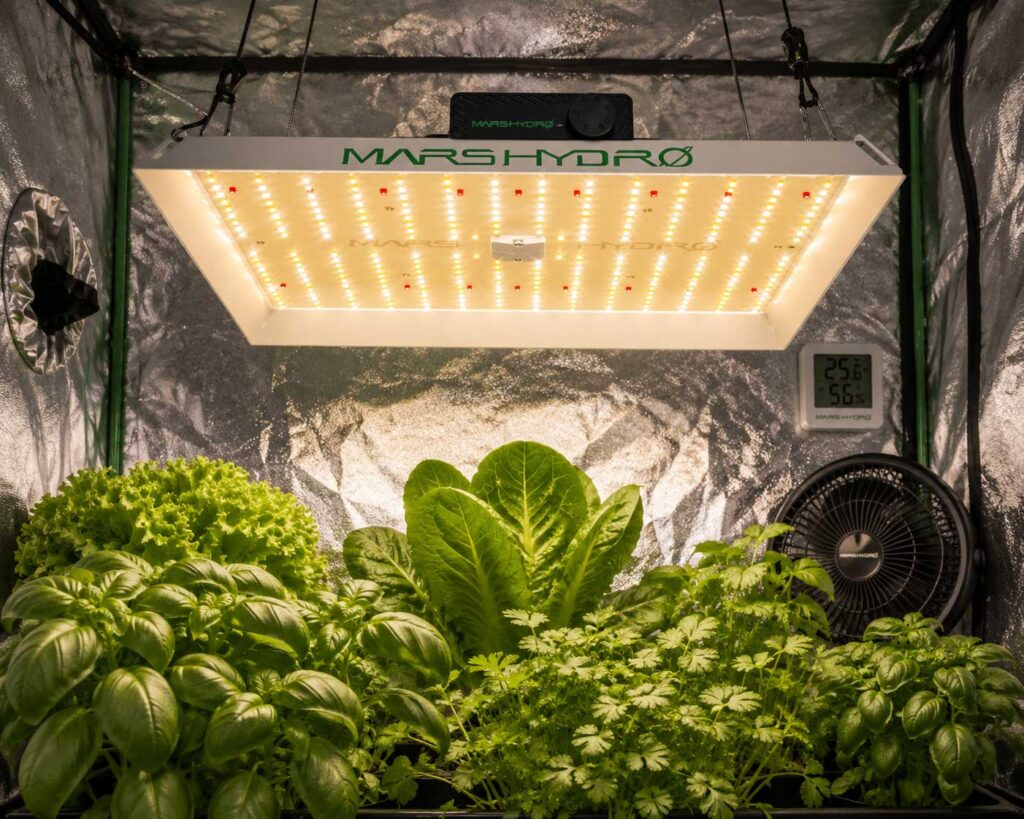
The MARS HYDRO TS1000 is a strong choice for beginners who want enough lighting capacity to grow more than just seedlings and a few herbs. Its 150W design, full-spectrum output, dimming control, and straightforward setup make it easy to use without sacrificing the features most home hydroponic growers actually need.
It also gives beginners room to experiment. You can start with lettuce and herbs, then move into strawberries, peppers, or compact tomatoes without immediately replacing your grow light.
MARS HYDRO TS1000 Pros and Cons
| Pros | Cons |
|---|---|
| ✓ Beginner-friendly setup | ✗ Limited coverage for larger gardens |
| ✓ 150W power draw | ✗ Large fruiting plants can quickly outgrow its effective footprint |
| ✓ Full-spectrum lighting | |
| ✓ Dimmable output | |
| ✓ Quiet, fanless cooling | |
| ✓ Good balance of price and performance |
MARS HYDRO TS1000 Specifications
| Feature | Details |
|---|---|
| Power Draw | 150W |
| Recommended Growing Area | Around 2 × 2 ft for higher-intensity growing; potentially larger for lower-light crops |
| Spectrum | Full spectrum |
| Dimmable | Yes |
| Cooling | Passive / fanless |
| Best For | Herbs, leafy greens, seedlings and compact fruiting plants |
What Can You Grow With It?
For hydroponics, the TS1000 is well suited to lettuce, basil, kale, spinach, arugula, microgreens, and other leafy greens and herbs. Its 150W output also gives you enough flexibility to experiment with strawberries and smaller tomato or pepper plants.
For mature fruiting crops, however, canopy size matters. A sprawling tomato or cucumber plant can require considerably more illuminated space and light intensity than a tray of lettuce, so larger gardens may need a more powerful fixture or multiple lights.
Why It’s a Good First Grow Light
The biggest advantage of the TS1000 for beginners is simplicity. You don’t need an elaborate lighting system to get started. The fixture can be hung above the canopy, connected to a timer, and dimmed as needed for different stages of plant development.
That dimming capability is particularly useful when you’re learning. Seedlings and young plants don’t need the same intensity as mature plants, so you can start lower and gradually increase the output as your garden develops.
Its passive cooling also eliminates the noise and maintenance associated with fixtures that rely on built-in cooling fans.
Is the MARS HYDRO TS1000 Worth It?
Best for: Beginners building their first small hydroponic garden
Skip it if: You’re planning a large garden dominated by mature tomatoes, peppers, cucumbers, or other high-light crops
The MARS HYDRO TS1000 earns our beginner pick because it keeps things relatively simple while providing enough flexibility to grow a wide variety of hydroponic crops. It’s a sensible middle ground between small seedling lights and the much larger fixtures designed for high-output indoor gardens.
For someone starting with a roughly 2 × 2-foot growing area, it’s a capable light that leaves room to expand beyond basic herbs and lettuce as your experience grows.
4. HLG 100 Rspec — Best Premium LED Grow Light for Herbs and Leafy Greens
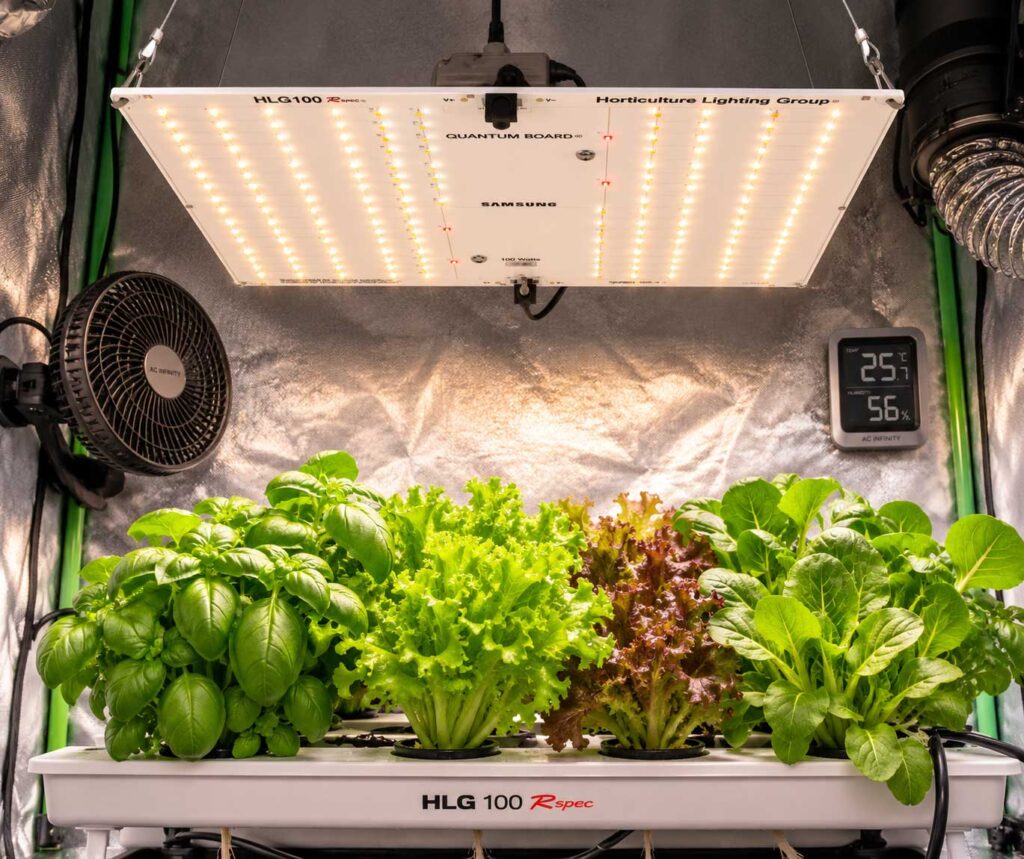
The HLG 100 Rspec is a compact grow light aimed at growers who care more about efficiency and build quality than getting the lowest possible purchase price. Its roughly 100W class output makes it particularly attractive for small hydroponic gardens filled with herbs, leafy greens, seedlings, and other relatively low-to-moderate-light crops.
Unlike buying a much larger fixture and running it well below capacity, a light in this size range can be a practical match for a dedicated lettuce or herb garden.
HLG 100 Rspec Pros and Cons
| Pros | Cons |
|---|---|
| ✓ Efficient, compact design | ✗ Higher upfront cost than many entry-level lights |
| ✓ Full-spectrum Rspec output | ✗ Limited coverage for larger gardens |
| ✓ Well suited to leafy greens and herbs | ✗ Fewer integrated smart features than some newer fixtures |
| ✓ Quiet passive cooling | |
| ✓ Compact form factor | |
| ✓ Premium construction |
HLG 100 Rspec Specifications
| Feature | Details |
|---|---|
| Power Draw | Approximately 95W |
| Recommended Growing Area | Around 2 × 2 ft for lower-to-moderate-light crops |
| Spectrum | Full spectrum / Rspec |
| Cooling | Passive / fanless |
| Best For | Herbs, lettuce, leafy greens, seedlings and propagation |
| Garden Size | Small indoor hydroponic setups |
Where the HLG 100 Rspec Makes the Most Sense
This light is particularly well matched to basil, lettuce, spinach, kale, Swiss chard, cilantro, mint, parsley, microgreens, and seedlings.
Its compact size also makes it useful for propagation areas and smaller growing shelves where installing a large 200–500W fixture would be unnecessary.
The key is matching the light to the crop. Leafy greens generally don’t require the same intensity as mature tomatoes or peppers, which makes an efficient fixture in this power range a better fit for growers primarily interested in greens and herbs.
Why Choose a Premium 100W-Class Light?
Efficiency matters when a grow light runs for 12, 14, or even 16 hours every day. A well-designed fixture can deliver useful photosynthetic light to the canopy without requiring the power consumption of a much larger unit.
The passive cooling design is another advantage in small indoor gardens. With no cooling fan built into the fixture, operation is quiet and there are fewer moving parts to maintain.
However, the HLG 100 Rspec isn’t intended to replace a high-output fixture in a large fruiting garden. If your main goal is growing several mature tomatoes, peppers, or cucumbers indoors, one of the larger lights later in this guide will generally be a better fit.
Is the HLG 100 Rspec Worth It?
Best for: Dedicated herb, lettuce, leafy-green and seedling gardens
Skip it if: You want maximum coverage per dollar or plan to grow several large fruiting plants
The HLG 100 Rspec earns its place as our premium pick for herbs and leafy greens because it focuses on what a small hydroponic garden actually needs: efficient output, a compact footprint, quiet operation, and quality construction.
It costs more than many entry-level fixtures in the same general power class, so it won’t be the right choice for every budget. But for growers building a dedicated greens or herb setup and willing to pay more for a premium fixture, it’s an option worth considering.
5. AC Infinity IONBOARD S22 — Best Smart LED Grow Light
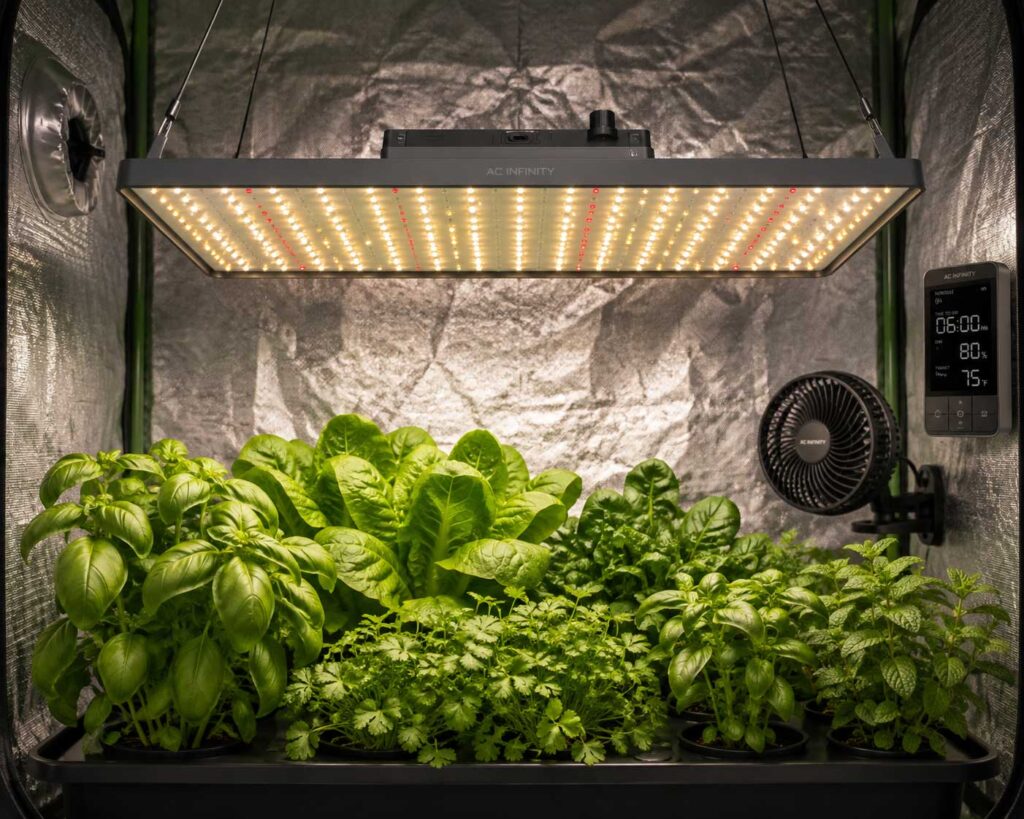
The AC Infinity IONBOARD S22 stands out for growers who want more control and automation from their indoor hydroponic setup. It’s a compact, full-spectrum LED fixture that can integrate with compatible AC Infinity controllers, making it easier to coordinate lighting with other equipment in the growing environment.
With a roughly 100W power draw, the S22 is best suited to smaller gardens rather than large fruiting canopies. Its combination of adjustable output, passive cooling, and smart-control potential makes it particularly appealing if you’re building an automated grow tent or indoor garden.
AC Infinity IONBOARD S22 Pros and Cons
| Pros | Cons |
|---|---|
| ✓ Full-spectrum LED lighting | ✗ Costs more than some basic 100W-class lights |
| ✓ Compatible with AC Infinity’s control ecosystem | ✗ Full automation may require additional equipment |
| ✓ Adjustable light intensity | ✗ Limited coverage for larger gardens |
| ✓ Quiet, fanless cooling | |
| ✓ Compact design | |
| ✓ Good choice for automated grow setups |
AC Infinity IONBOARD S22 Specifications
| Feature | Details |
|---|---|
| Power Draw | Approximately 100W |
| Recommended Growing Area | Around 2 × 2 ft |
| Spectrum | Full spectrum |
| Dimmable | Yes |
| Cooling | Passive / fanless |
| Smart Control | Compatible with select AC Infinity controllers |
| Best For | Herbs, leafy greens, seedlings and compact indoor gardens |
Where the IONBOARD S22 Works Best
The S22 is a good match for lettuce, basil, spinach, kale, mint, cilantro, microgreens, seedlings, and other relatively compact crops. It can also support smaller fruiting plants when the canopy remains within an appropriately illuminated area.
For a garden dominated by mature tomatoes, peppers, or cucumbers, however, we’d move up to a larger fixture rather than trying to stretch a 100W-class light across an oversized canopy.
Why Choose a Smart Grow Light?
The main reason to choose the IONBOARD S22 over a basic LED fixture is control.
When connected to compatible equipment in AC Infinity’s ecosystem, lighting can become part of a more automated indoor growing environment. Depending on the controller and equipment used, this can make it easier to manage lighting schedules alongside ventilation and other environmental controls.
That won’t necessarily make your plants grow better than they would under another properly sized LED light, but it can make the garden easier to manage consistently.
This is particularly useful for growers who already use AC Infinity fans, controllers, or other compatible equipment and want their lighting integrated into the same setup.
Is the AC Infinity IONBOARD S22 Worth It?
Best for: Small automated hydroponic gardens and growers already using the AC Infinity ecosystem
Skip it if: You only need a simple light and don’t plan to use its controller integration
The AC Infinity IONBOARD S22 earns our smart-light pick because its biggest advantage isn’t simply light output—it’s how easily it can fit into a more connected indoor growing setup.
If you just want affordable light over a tray of lettuce, there are less expensive options. But if automation and centralized environmental control are priorities, the S22 becomes a much more compelling choice.
6. Spider Farmer SF-2000 — Best LED Grow Light for Larger Hydroponic Gardens
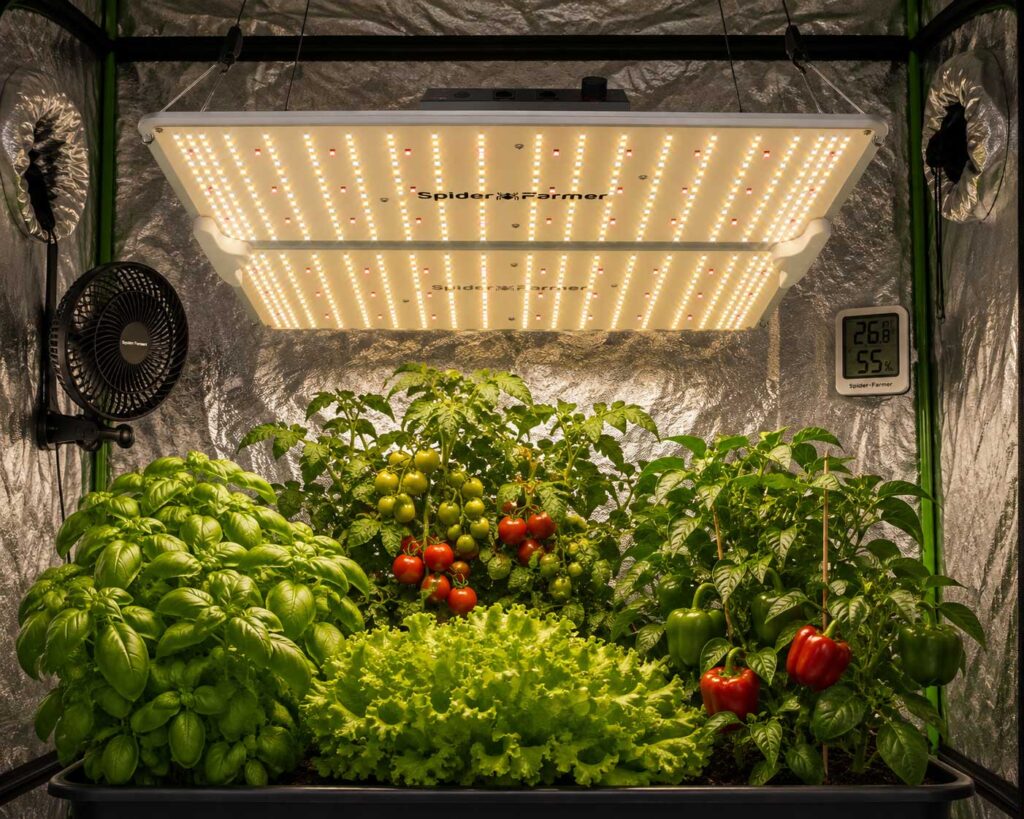
If a 100–150W light no longer covers your garden comfortably, the Spider Farmer SF-2000 is the next size I’d consider. With roughly 200W of power and a longer rectangular design, it can illuminate a wider canopy, making it useful for larger trays of leafy greens, multiple herbs, or a mixed hydroponic garden.
That extra capacity is especially helpful when several plants share the same growing area. Instead of trying to stretch a smaller fixture beyond its effective footprint, the SF-2000 provides more light across a longer growing space.
Spider Farmer SF-2000 Pros and Cons
| Pros | Cons |
|---|---|
| ✓ Wider coverage than compact 100W fixtures | ✗ Higher purchase price than entry-level lights |
| ✓ Full-spectrum output | ✗ Too large for many countertop gardens |
| ✓ Dimmable light intensity | ✗ Large fruiting plants may still require more lighting capacity |
| ✓ Quiet, fanless cooling | |
| ✓ Suitable for mixed-crop gardens | |
| ✓ Good step up for expanding growers |
Spider Farmer SF-2000 Specifications
| Feature | Details |
|---|---|
| Power Draw | Approximately 200W |
| Fixture Shape | Rectangular / extended coverage |
| Recommended Growing Area | Up to roughly 2 × 4 ft depending on crop and required intensity |
| Spectrum | Full spectrum |
| Dimmable | Yes |
| Cooling | Passive / fanless |
| Best For | Medium-sized hydroponic gardens and wider plant canopies |
What Can You Grow With It?
The SF-2000 is particularly useful when you want to grow larger quantities of lettuce, basil, spinach, kale, herbs, or other leafy greens under a single fixture.
Its additional output also makes it more practical than the smaller lights in this guide for strawberries, peppers, compact tomatoes, and other fruiting crops. You can also compare these crops in our guide to the best fruits to grow hydroponically. However, those plants generally require greater light intensity than leafy greens, so their effective growing footprint may be smaller.
This is why we wouldn’t treat the advertised coverage number as a guarantee. A 2 × 4-foot tray of lettuce and a 2 × 4-foot canopy of mature tomatoes can have very different lighting requirements.
Why Step Up to the SF-2000?
The biggest reason is canopy size.
A 100W light can work very well over a small garden, but adding more plants eventually creates areas where light intensity drops toward the edges. Moving to a longer 200W-class fixture gives you more usable illuminated space without immediately jumping to a large 300–500W grow light.
That makes the SF-2000 a useful middle ground for growers expanding beyond their first hydroponic system.
The dimming function also gives you flexibility when full output isn’t necessary. You can reduce intensity for seedlings or lower-light crops and increase it as the plants mature or the canopy fills in.
Is the Spider Farmer SF-2000 Worth It?
Best for: Medium-sized hydroponic gardens and growers moving beyond a small 2 × 2-foot setup
Skip it if: You have a tiny countertop garden or need enough intensity for a large canopy of mature fruiting plants
The Spider Farmer SF-2000 earns our larger-garden pick because it offers noticeably more growing capacity than the compact lights earlier in this guide without moving into the size and power consumption of a large commercial-style fixture.
For growers expanding their collection of herbs and leafy greens—or adding a few higher-light crops—the SF-2000 provides a practical middle step between a beginner light and the larger 300W+ fixtures coming next.
7. MARS HYDRO FC-E3000 — Best LED Grow Light for High-Yield Hydroponic Gardens
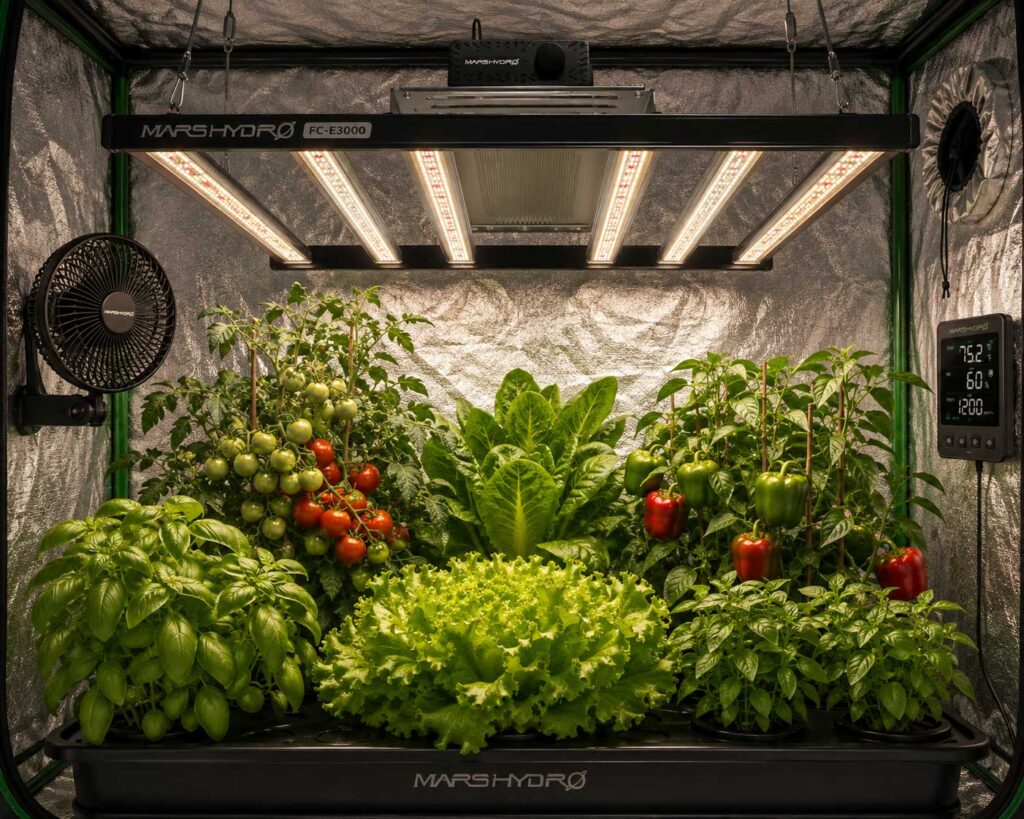
The MARS HYDRO FC-E3000 moves into a different class from the smaller panel-style lights earlier in this guide. With roughly 300W of power and a multi-bar design, it’s intended for growers who need higher light intensity across a larger canopy.
That makes it particularly interesting for hydroponic gardens containing tomatoes, peppers, strawberries, cucumbers, and other fruiting crops. The spaced LED bars help distribute light across the growing area rather than concentrating most of the output directly beneath the center of the fixture.
MARS HYDRO FC-E3000 Pros and Cons
| Pros | Cons |
|---|---|
| ✓ Bar-style design for broad canopy coverage | ✗ Higher upfront cost than smaller fixtures |
| ✓ Higher output for demanding crops | ✗ Too large and powerful for many countertop gardens |
| ✓ Full-spectrum lighting | ✗ Requires more electricity than 100–200W models |
| ✓ Dimmable output | |
| ✓ Passive cooling | |
| ✓ Well suited to medium-sized grow tents |
MARS HYDRO FC-E3000 Specifications
| Feature | Details |
|---|---|
| Power Draw | Approximately 300W |
| Recommended Growing Area | Around 3 × 3 ft, depending on crop and required intensity |
| Fixture Design | Multi-bar LED |
| Spectrum | Full spectrum |
| Dimmable | Yes |
| Cooling | Passive / fanless |
| Best For | Fruiting crops and medium-sized hydroponic gardens |
Where the FC-E3000 Works Best
The FC-E3000 makes the most sense when you’re moving beyond primarily growing herbs and lettuce and want enough lighting capacity for tomatoes, peppers, strawberries, cucumbers, and other higher-light crops.
It can certainly grow leafy greens and herbs too, but buying a 300W fixture solely for a small tray of lettuce would usually be unnecessary. Its real advantage appears when you have a larger canopy or plants that benefit from greater light intensity.
Why the Bar-Style Design Matters
Instead of placing all of the LEDs on one compact board, the FC-E3000 spreads them across multiple bars. This helps distribute light over a wider area and can reduce the extreme difference in intensity between the center and edges of the canopy.
That’s particularly useful in a densely planted hydroponic garden, where one plant shading another can become a problem as the canopy develops.
Bar-style fixtures can also provide more open space around individual LED sections for passive heat dissipation. However, a 300W fixture still adds heat to an enclosed growing area, so adequate ventilation remains important.
Why Step Up to a 300W Grow Light?
The biggest reason is higher-light crops.
Lettuce and many herbs can perform well under moderate light intensity. Fruiting plants such as tomatoes, peppers, cucumbers, and strawberries generally benefit from considerably more light as they mature.
Crop choice matters for more than lighting, especially if you’re growing to sell. See our guide to the most profitable hydroponic crops.
A 300W-class fixture gives you more capacity to maintain useful intensity across a larger canopy instead of pushing a smaller grow light beyond the area it can effectively illuminate.
The trade-off is straightforward: you’ll pay more upfront and use more electricity, so this level of lighting only makes sense if your garden can take advantage of the additional output.
Is the MARS HYDRO FC-E3000 Worth It?
Best for: Medium-sized hydroponic gardens with tomatoes, peppers and other higher-light crops
Skip it if: You’re growing only a small collection of herbs, seedlings or leafy greens
The MARS HYDRO FC-E3000 earns our high-yield garden pick because its 300W-class output and bar-style layout are better suited to demanding crops and larger canopies than the compact fixtures earlier in this guide.
For growers making the jump from a small hobby garden to a more productive indoor setup, the FC-E3000 provides useful additional lighting capacity without immediately moving into the much larger 500W+ category.
8. VIPARSPECTRA KS3000 — Best for a Wide Hydroponic Canopy
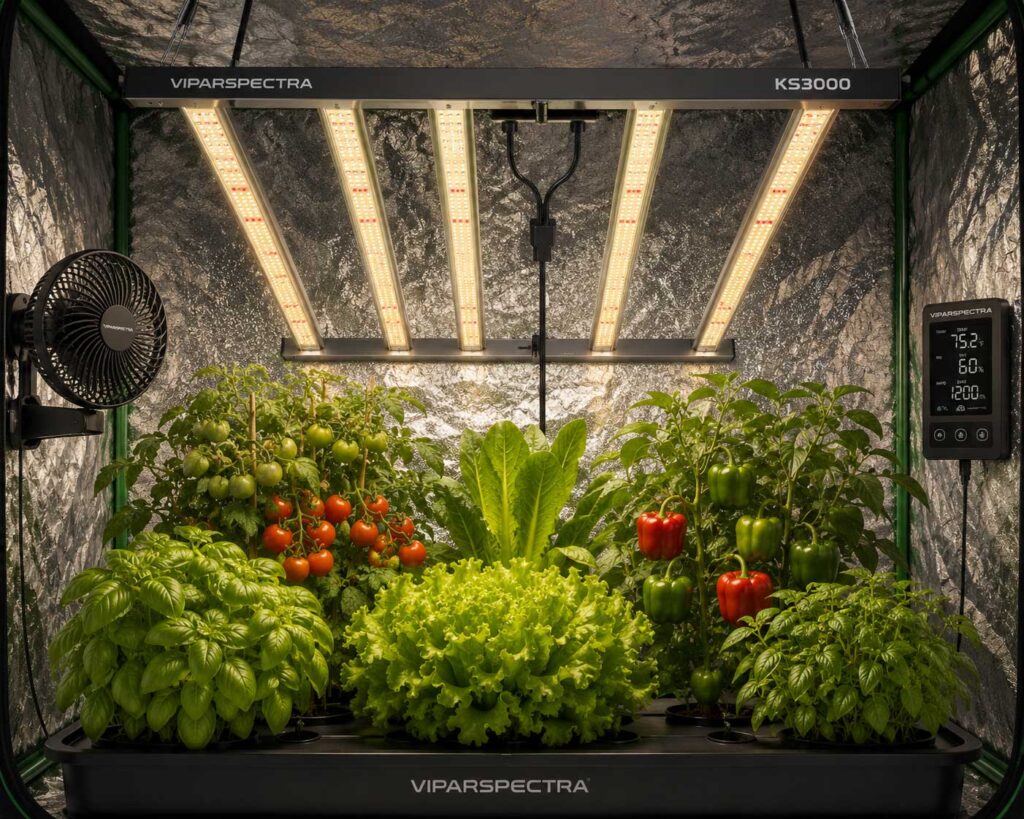
The VIPARSPECTRA KS3000 is designed for growers who need to spread substantial light across a wider indoor canopy. With roughly 320W of power and a multi-bar layout, it offers considerably more lighting capacity than the compact 100–200W fixtures earlier in this guide.
That makes it a good fit for larger mixed hydroponic gardens, particularly when several plants share the same growing area. The bar-style design spreads the LEDs across the fixture instead of concentrating them on a single compact board, helping distribute light toward the edges of the canopy.
VIPARSPECTRA KS3000 Pros and Cons
| Pros | Cons |
|---|---|
| ✓ Multi-bar design for broad coverage | ✗ Higher upfront cost |
| ✓ 300W+ output for higher-light crops | ✗ More power than small gardens need |
| ✓ Full-spectrum lighting | ✗ Requires adequate hanging and growing space |
| ✓ Dimmable output | |
| ✓ Passive, fanless cooling | |
| ✓ Good fit for larger mixed-crop gardens |
VIPARSPECTRA KS3000 Specifications
| Feature | Details |
|---|---|
| Power Draw | Approximately 320W |
| Recommended Growing Area | Around 3 × 3 ft for higher-intensity applications; potentially larger for lower-light crops |
| Fixture Design | Multi-bar LED |
| Spectrum | Full spectrum |
| Dimmable | Yes |
| Cooling | Passive / fanless |
| Best For | Larger mixed gardens and fruiting crops |
Where the KS3000 Works Best
The KS3000 is at its best over a larger, densely planted canopy. Tomatoes, peppers, eggplants, cucumbers, and strawberries can take advantage of its higher output, while lettuce, basil, spinach, Swiss chard, and other greens can be grown across a broader area at lower intensity.
This flexibility also makes it useful for mixed gardens. For example, you could dedicate part of the growing area to taller fruiting plants while using another section for shorter herbs or leafy greens, provided the canopy heights and light requirements are managed appropriately.
Why Canopy Coverage Matters
Coverage numbers can be misleading when comparing grow lights.
A manufacturer may describe the same fixture as suitable for a larger vegetative area and a smaller flowering footprint. That’s because coverage isn’t simply a measurement of how far the light reaches. What matters is whether enough photosynthetically active light reaches the entire canopy for the crops you’re growing.
A 4 × 4-foot area of young lettuce, for example, doesn’t necessarily require the same intensity as a 4 × 4-foot canopy filled with mature tomatoes.
For that reason, we consider the KS3000 primarily a 3 × 3-foot-class fixture for higher-intensity growing, with the potential to cover a larger area when growing crops with lower light requirements.
Why Choose the KS3000?
The KS3000 sits in a useful middle ground between smaller home grow lights and much larger 500W+ fixtures.
Its 320W-class output gives you enough capacity for demanding crops without automatically moving into the electricity consumption, physical size, and cost of a large commercial-style light.
The dimming function also adds flexibility. If you’re growing seedlings or leafy greens, you don’t necessarily need to run the fixture at maximum output. As plants mature or higher-light crops begin flowering and fruiting, the intensity can be increased.
Is the VIPARSPECTRA KS3000 Worth It?
Best for: Larger mixed hydroponic gardens and growers who need broad canopy coverage
Skip it if: Your garden is small enough to be handled by a 100–200W fixture
The VIPARSPECTRA KS3000 earns its place on our list because it combines a wider bar-style layout with enough output for both leafy crops and more light-demanding fruiting plants.
For growers who have outgrown a small hydroponic setup but don’t need a massive 500W+ fixture, the KS3000 provides a useful balance of coverage, output, adjustability, and power consumption.
9. HLG 350 Diablo — Best Premium LED Grow Light for Experienced Growers
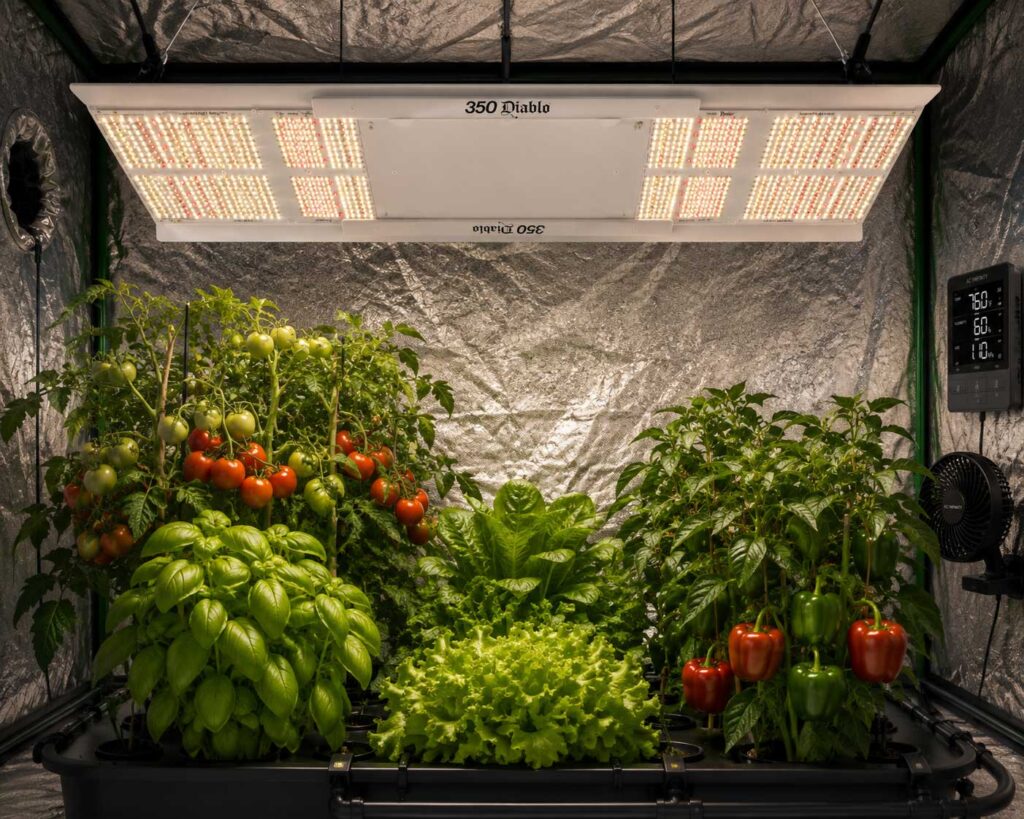
The HLG 350 Diablo is the premium option on our list for growers who prioritize light output, efficiency, and build quality over getting the lowest possible price. With roughly 330W of power, it’s designed for a substantially larger and more light-demanding canopy than HLG’s compact 100 Rspec featured earlier in this guide.
That extra capacity makes the 350 Diablo particularly appealing for mature tomatoes, peppers, cucumbers, strawberries, and other fruiting crops that generally require more light than herbs and leafy greens.
HLG 350 Diablo Pros and Cons
| Pros | Cons |
|---|---|
| ✓ High-output 300W+ design | ✗ Premium purchase price |
| ✓ Designed with efficiency in mind | ✗ More light than most beginner gardens need |
| ✓ Full-spectrum output | ✗ Smaller gardens can achieve good results with a less expensive fixture |
| ✓ Dimmable light intensity | |
| ✓ Passive, fanless cooling | |
| ✓ Compact, efficiency-focused design |
HLG 350 Diablo Specifications
| Feature | Details |
|---|---|
| Power Draw | Approximately 330W |
| Recommended Growing Area | Around 3 × 3 ft for higher-intensity growing; potentially larger for lower-light crops |
| Spectrum | Full spectrum |
| Dimmable | Yes |
| Cooling | Passive / fanless |
| Best For | Fruiting crops, experienced growers and high-output indoor gardens |
Where the HLG 350 Diablo Works Best
The 350 Diablo makes the most sense over a garden containing tomatoes, peppers, cucumbers, eggplants, strawberries, and other crops with relatively high light requirements.
You can certainly grow lettuce, basil, spinach, kale, and herbs beneath it as well, but a fixture this powerful may be unnecessary if leafy greens are all you plan to grow. In that situation, a smaller and less expensive light would usually make more sense.
This is a fixture for growers who can actually take advantage of its additional output.
Why Efficiency Matters More at Higher Wattages
Efficiency becomes increasingly important as grow-light power increases.
A small difference in efficiency might not seem significant with a light used occasionally, but indoor hydroponic fixtures can operate for thousands of hours over their lifetime. When you’re running a 300W+ fixture for many hours every day, converting more of that electrical energy into useful photosynthetic light becomes increasingly valuable.
That doesn’t mean wattage alone determines how well a light performs. PPFD distribution, hanging height, canopy size, spectrum, and the light requirements of your crops all matter when evaluating a fixture.
The 350 Diablo is therefore most attractive to experienced growers who understand their canopy’s lighting requirements and are willing to pay more for a premium fixture.
HLG 350 Diablo vs. Less Expensive 300W Grow Lights
The decision here isn’t simply about which fixture has the highest wattage.
Less expensive lights such as the MARS HYDRO FC-E3000 or VIPARSPECTRA KS3000 may provide everything many home hydroponic growers need. The HLG becomes more compelling when efficiency, component quality, and long-term use are higher priorities than minimizing the initial purchase price.
For a beginner growing lettuce and basil, we wouldn’t spend this much.
For an experienced grower running a high-output indoor garden regularly, the additional investment may be easier to justify.
Is the HLG 350 Diablo Worth It?
Best for: Experienced growers who prioritize efficiency, high output and premium construction
Skip it if: You’re building your first hydroponic garden or primarily growing herbs and leafy greens
The HLG 350 Diablo earns our premium pick because it targets growers who want more than simply the cheapest way to illuminate a 3 × 3-foot-class canopy.
Its relatively high output makes it suitable for demanding fruiting crops, while its efficiency-focused design is particularly relevant for growers who operate their lights for long periods throughout the year.
It’s not the best value for everyone—and that’s exactly the point. If affordability is your priority, there are better choices earlier in this guide. If you’re willing to pay more for a premium high-output fixture, the 350 Diablo deserves consideration.
10. AC Infinity IONFRAME EVO6 — Best for Large Smart Hydroponic Gardens
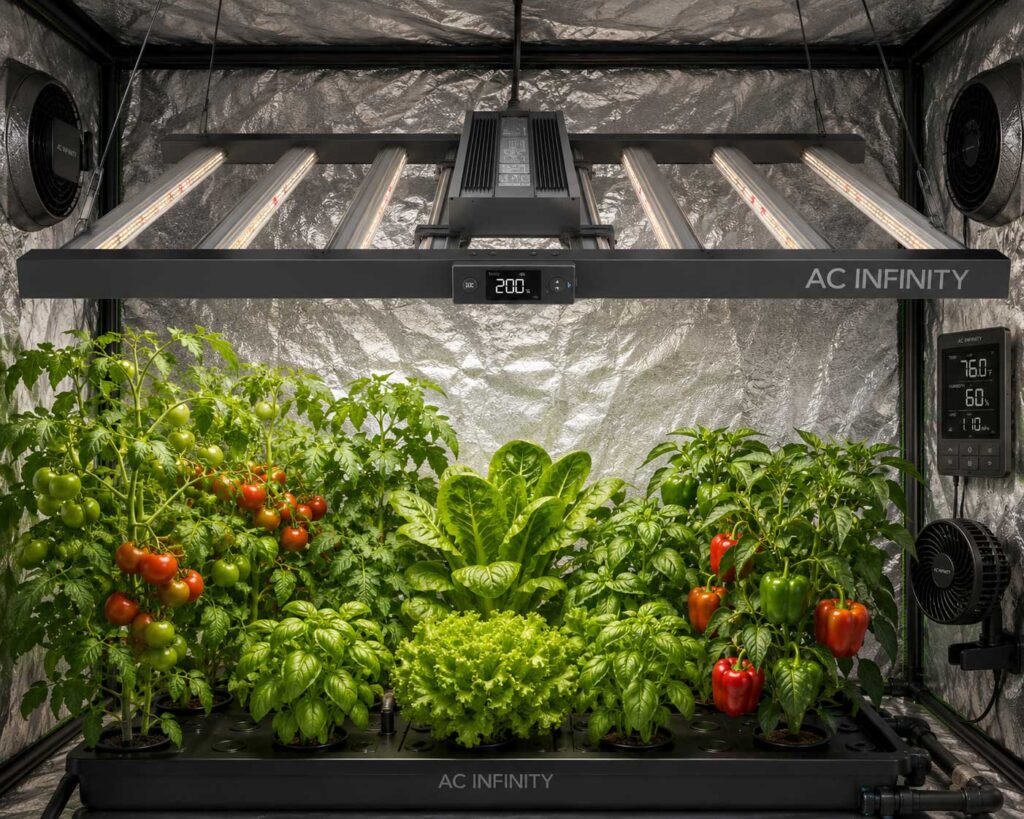
The AC Infinity IONFRAME EVO6 is the largest and most powerful fixture in our roundup. With roughly 500W of power, a multi-bar design, and compatibility with AC Infinity’s controller ecosystem, it’s designed for growers managing a substantially larger canopy than the compact lights earlier in this guide.
That combination makes the EVO6 particularly appealing for large indoor gardens filled with tomatoes, peppers, cucumbers, strawberries, and other light-demanding crops. It’s also one of the strongest options here if you want lighting to become part of a more automated growing environment.
AC Infinity IONFRAME EVO6 Pros and Cons
| Pros | Cons |
|---|---|
| ✓ High-output 500W-class fixture | ✗ Premium purchase price |
| ✓ Multi-bar design for broad canopy coverage | ✗ Far more light than most small gardens need |
| ✓ Full-spectrum lighting | ✗ Requires adequate growing and hanging space |
| ✓ Dimmable output | ✗ Higher electricity consumption than smaller fixtures |
| ✓ Smart-controller compatibility | |
| ✓ Passive, fanless cooling |
AC Infinity IONFRAME EVO6 Specifications
| Feature | Details |
|---|---|
| Power Draw | Approximately 500W |
| Recommended Growing Area | Around 4 × 4 ft for higher-intensity growing; potentially larger for lower-light applications |
| Fixture Design | Multi-bar LED |
| Spectrum | Full spectrum |
| Dimmable | Yes |
| Cooling | Passive / fanless |
| Smart Control | Compatible with select AC Infinity controllers |
| Best For | Large indoor gardens, fruiting crops and automated grow setups |
Where the IONFRAME EVO6 Works Best
The EVO6 is designed for a large, mature plant canopy, particularly when growing tomatoes, peppers, cucumbers, eggplants, strawberries, or other crops with relatively high light requirements.
It can certainly illuminate herbs and leafy greens, but buying a fixture this powerful solely for a few lettuce plants would be unnecessary. Growers focused primarily on greens would generally be better served by a smaller fixture—or by using the EVO6 over a substantially larger growing area at reduced intensity.
Why Move Up to a 500W-Class Grow Light?
At this point, you’re no longer choosing a light for a small countertop hydroponic system.
A fixture in the EVO6’s class is designed to provide substantial light across a much larger canopy. The multi-bar layout spreads the LEDs across the growing area, while dimming gives you control over how much of that capacity you’re actually using.
This becomes especially valuable with mature fruiting plants. Tomatoes, peppers, cucumbers, and similar crops can develop large canopies and generally require considerably more light than lettuce or herbs.
The trade-offs are equally important. A 500W fixture costs more to buy, consumes more electricity, and adds more heat to the growing environment than a 100–200W light. Your garden needs to be large enough to justify it.
Smart Control Is the EVO6’s Other Big Advantage
Like the smaller IONBOARD S22, the EVO6 can integrate with compatible equipment in the AC Infinity control ecosystem.
For growers already using compatible controllers, fans, and environmental equipment, this can simplify management by bringing lighting and other grow-room functions into a more centralized setup.
That makes the EVO6 especially interesting for growers who aren’t simply looking for more wattage—they want to build a larger, more automated indoor garden.
Is the AC Infinity IONFRAME EVO6 Worth It?
Best for: Large hydroponic gardens, demanding fruiting crops and automated indoor growing setups
Skip it if: You’re running a small garden or don’t need 500W-class lighting capacity
The AC Infinity IONFRAME EVO6 earns the final spot in our ranking because it combines the highest power level in this roundup with broad bar-style coverage and smart-control compatibility.
For a small home hydroponic garden, it’s unnecessary. But for growers expanding to a roughly 4 × 4-foot high-intensity canopy and looking for greater automation, the EVO6 offers capabilities the smaller fixtures on this list simply aren’t designed to provide.
Which LED Grow Light Should You Choose?
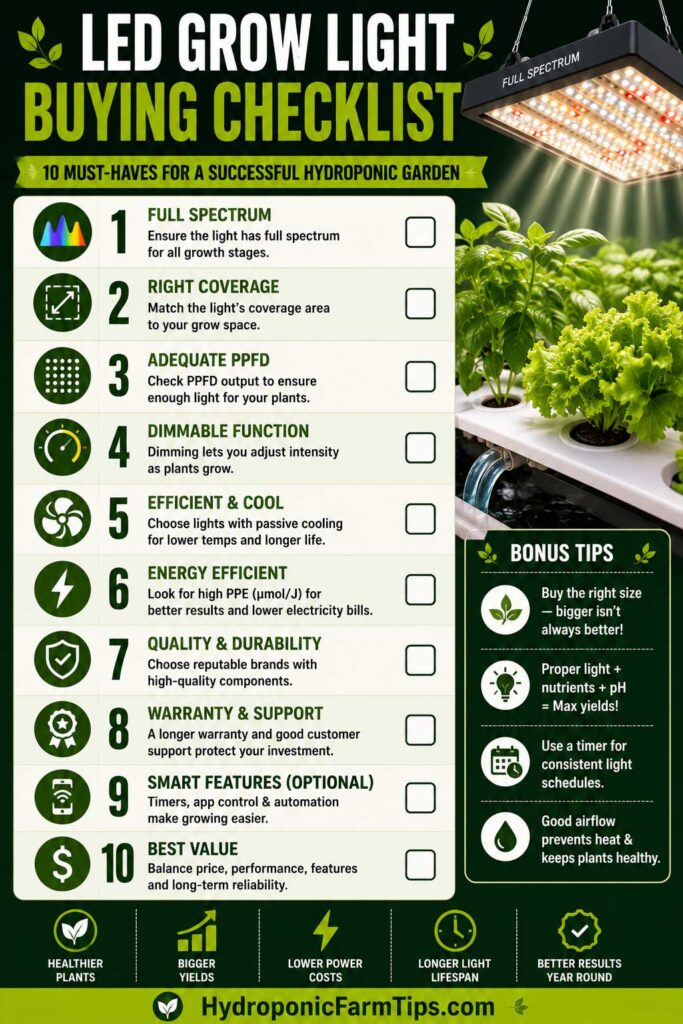
The best LED grow light isn’t necessarily the most powerful or expensive one. The right choice depends on your growing area, the crops you’re growing, and how much light those plants actually need.
Use this quick guide to narrow down the options:
| Your Priority | Recommended Grow Light | Why Choose It |
|---|---|---|
| Best Overall | Spider Farmer SF-1000 | Excellent balance of efficiency, price and performance |
| Best Value | VIPARSPECTRA XS1500 Pro | Strong output without a premium price |
| Best for Beginners | MARS HYDRO TS1000 | Affordable, straightforward and easy to use |
| Best for Herbs & Leafy Greens | HLG 100 Rspec | Efficient choice for lower-light crops |
| Best Smart Grow Light | AC Infinity IONBOARD S22 | Smart-controller compatibility in a compact fixture |
| Best for a Larger Home Garden | Spider Farmer SF-2000 | More coverage without jumping to a very large fixture |
| Best for High-Output Gardens | MARS HYDRO FC-E3000 | Strong 300W-class output with a bar-style design |
| Best for a Wide Canopy | VIPARSPECTRA KS3000 | Broad light distribution for larger mixed gardens |
| Best Premium Pick | HLG 350 Diablo | Premium option for experienced growers |
| Best for Large Smart Gardens | AC Infinity IONFRAME EVO6 | High output plus smart-control compatibility |
Choose Based on Your Garden Size
For a small hydroponic garden growing lettuce, basil, spinach, microgreens, or seedlings, a 100–150W-class fixture may provide all the light you need.
For a medium-sized garden or a setup containing tomatoes, peppers, strawberries, and other higher-light crops, moving into the 200–320W range gives you more usable output and canopy coverage.
A 500W-class fixture such as the AC Infinity IONFRAME EVO6 makes more sense for a large, high-intensity canopy where its additional output can actually be used.
Quick Tip: Don’t buy a grow light based on wattage alone. Check the manufacturer’s PPFD map, recommended hanging height, coverage area, dimming range, and actual power draw before choosing a fixture.
Also consider what you plan to grow six months from now. Buying a slightly larger dimmable fixture can make sense if you expect to expand your hydroponic garden, while an oversized light is usually unnecessary for a permanent countertop herb or lettuce setup.
Whichever model you choose, lighting is only one part of successful indoor growing. Maintaining the correct nutrient concentration, pH, water temperature, airflow, and daily light schedule will help you get much more from your LED grow light.
Best LED Grow Lights by Garden Size
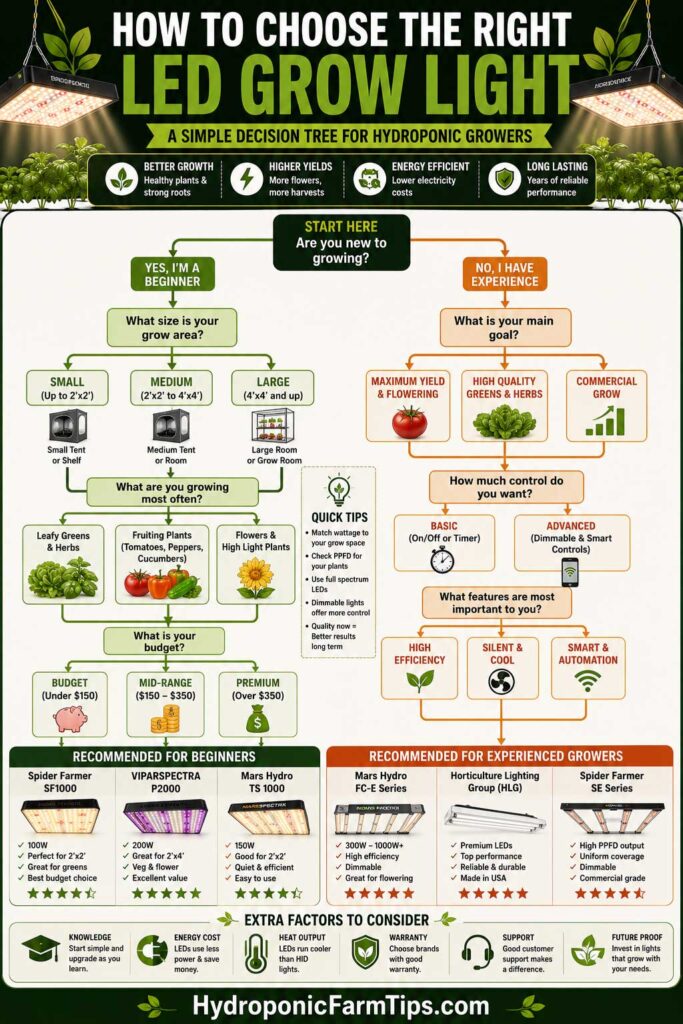
Match the light to your garden—not just your budget. If you’ve narrowed down your growing area, these are the models we’d compare first.
| Garden Size | Recommended Pick | Best Use | Check Price |
|---|---|---|---|
| Small / 2 × 2 ft | Spider Farmer SF-1000 | Herbs and leafy greens | Check Price |
| 2 × 2 ft with more output | VIPARSPECTRA XS1500 Pro | Mixed crops | Check Price |
| Larger home garden | Spider Farmer SF-2000 | Wider mixed canopy | Check Price |
| Around 3 × 3 ft | MARS HYDRO FC-E3000 | Fruiting crops | Check Price |
| Large smart garden | AC Infinity IONFRAME EVO6 | Large automated canopy | Check Price |
See also
How to Choose the Best LED Grow Light for Hydroponics
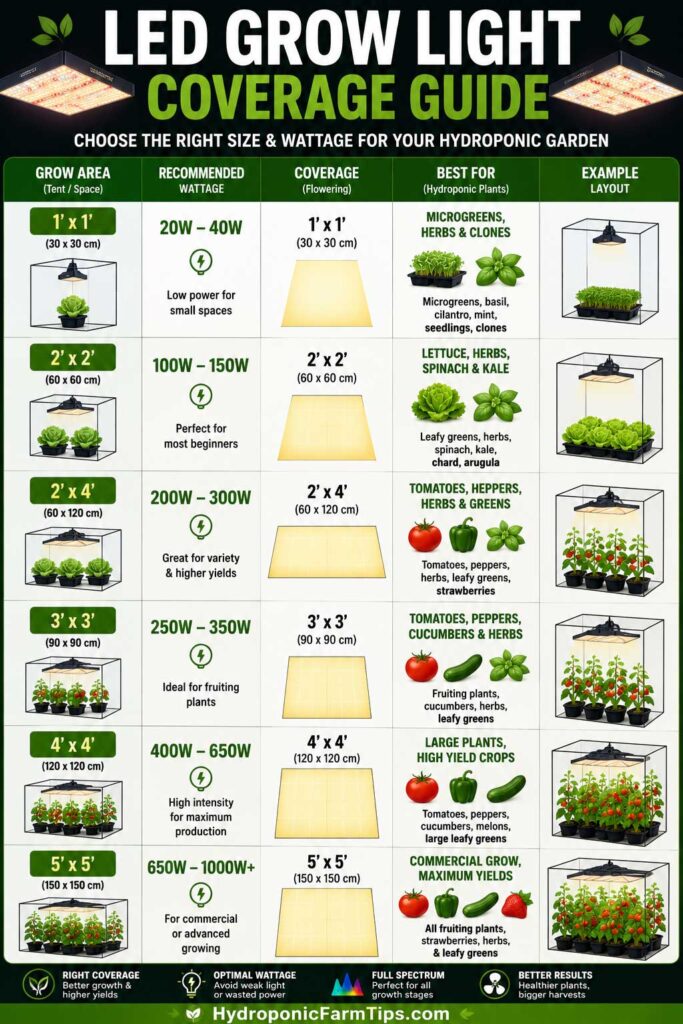
Choosing an LED grow light isn’t simply about buying the brightest fixture you can afford. The right light should match your growing area, crop type, required intensity, and budget.
Here are the factors that matter most.
1. Match the Light to Your Growing Area
Start with the size of the plant canopy you need to illuminate.
| Growing Area | Approx. Power Range | Best For |
|---|---|---|
| 1 × 1 ft | 30–60W | Seedlings, microgreens, small herbs |
| 2 × 2 ft | 90–150W | Lettuce, basil, leafy greens |
| 2 × 4 ft | 180–300W | Multiple herbs and vegetables |
| 3 × 3 ft | 250–350W | Tomatoes, peppers, strawberries |
| 4 × 4 ft | 400–650W | Larger fruiting crops and mixed gardens |
These are starting points rather than strict rules. Crop type, fixture efficiency, hanging height, and light distribution all affect how much power you’ll actually need.
Also be careful with manufacturer coverage claims. A fixture capable of illuminating a large area of leafy greens may need to cover a smaller area when used for light-hungry fruiting plants.
2. Consider What You’re Growing
Different crops need different amounts of light.
| Light Requirement | Typical Hydroponic Crops |
|---|---|
| Low to Moderate | Lettuce, spinach, arugula, mint, parsley, cilantro, microgreens |
| Moderate | Basil, kale, Swiss chard, pak choi, strawberries |
| High | Tomatoes, peppers, cucumbers, eggplants, melons |
If you’re deciding what to plant next, our guide to the best hydroponic vegetables compares more beginner-friendly options.
If you plan to grow several types of plants, a dimmable fixture gives you more flexibility.
3. Check Actual Power Draw
Don’t judge a grow light by its model name. Some fixtures use numbers such as “1000” or “2000” even though their actual electrical consumption is much lower.
Check the manufacturer’s actual power draw from the wall. This gives you a better idea of electricity consumption and helps when comparing fixtures.
4. Compare PPFD, Not Just Wattage
PPFD measures the amount of photosynthetically active light reaching the plant canopy.
Approximate starting ranges are:
| Crop or Growth Stage | Approx. PPFD |
|---|---|
| Seedlings | 100–300 µmol/m²/s |
| Herbs & leafy greens | 200–500 µmol/m²/s |
| Vegetative vegetables | 300–600 µmol/m²/s |
| Flowering & fruiting crops | 500–900 µmol/m²/s |
These are general ranges, not universal targets. Look at the manufacturer’s PPFD map to see how evenly the fixture distributes light across its advertised coverage area.
More light isn’t automatically better. Excessive intensity can stress plants while wasting electricity.
5. Choose Full-Spectrum and Dimmable Lighting
For most home hydroponic gardens, a quality full-spectrum LED fixture is the simplest option because it can support plants through multiple growth stages.
Dimming is equally useful. You can reduce intensity for seedlings and lower-light crops, then increase it as plants mature or begin flowering and fruiting.
6. Consider Efficiency and Heat
This metric is often referred to as photosynthetic photon efficacy, or PPE. Higher efficiency means the fixture produces more photosynthetically active light from the electricity it consumes.
This becomes increasingly important when lights operate for 12–18 hours per day.
LEDs also run cooler than many older HID systems, but powerful fixtures still add heat to the growing space. Enclosed grow tents may require additional airflow or exhaust ventilation.
7. Follow the Recommended Hanging Height
Hanging height affects both intensity and coverage.
| Growth Stage | General Starting Height |
|---|---|
| Seedlings | 24–36 inches |
| Vegetative growth | 18–24 inches |
| Flowering & fruiting | 12–20 inches |
Always prioritize the manufacturer’s recommendations because LED fixtures vary considerably in output and optics.
Bleached upper leaves or curling can indicate excessive light, while stretched, weak growth may indicate insufficient intensity.
8. Check Build Quality, Warranty and Controls
For a light that may operate thousands of hours, look for a sturdy frame, reliable driver, secure hanging hardware, clear warranty, and established manufacturer support.
Smart controls are optional, but they can be useful in larger gardens. Compatible systems may automate dimming, lighting schedules, ventilation, temperature, and humidity management.
Don’t Forget Electricity Cost
You can estimate monthly electricity consumption with:
Fixture kW × hours per day × 30 days = monthly kWh
For example, a 150W fixture running 16 hours per day uses:
0.15 kW × 16 × 30 = 72 kWh per month
Multiply 72 kWh by your electricity rate to estimate the monthly lighting cost.
Key Takeaway
The best LED grow light isn’t necessarily the largest or most expensive model. Look for the right combination of PPFD, canopy coverage, efficiency, spectrum, and adjustability for the plants you’re actually growing.
For lettuce, herbs, and microgreens, prioritize efficient, even coverage. For tomatoes, peppers, cucumbers, and other fruiting crops, you’ll generally need greater light intensity and enough output to maintain it across the entire canopy.
Recommended Daily Light Schedule for Hydroponic Plants
Choosing the right grow light is only half the equation. Hydroponic plants also need the right light intensity and daily photoperiod.
Most indoor growers use a timer to maintain a consistent day/night cycle. The ideal schedule varies by crop, growth stage, fixture intensity, and growing conditions.
Hydroponic Light Hours and PPFD Guide
| Plant | Light per Day | Approx. PPFD |
|---|---|---|
| Lettuce | 12–16 hours | 200–300 µmol/m²/s |
| Basil | 14–16 hours | 250–400 µmol/m²/s |
| Spinach | 12–14 hours | 200–350 µmol/m²/s |
| Kale | 14–16 hours | 300–500 µmol/m²/s |
| Swiss Chard | 14–16 hours | 300–500 µmol/m²/s |
| Arugula | 12–16 hours | 200–350 µmol/m²/s |
| Cilantro | 12–14 hours | 200–300 µmol/m²/s |
| Parsley | 12–16 hours | 200–350 µmol/m²/s |
| Mint | 12–16 hours | 200–350 µmol/m²/s |
| Strawberries | 14–16 hours | 400–600 µmol/m²/s |
| Tomatoes | 14–18 hours | 500–800 µmol/m²/s |
| Peppers | 14–18 hours | 500–800 µmol/m²/s |
| Cucumbers | 14–16 hours | 500–700 µmol/m²/s |
| Microgreens | 12–16 hours | 100–250 µmol/m²/s |
Note: These are general starting ranges rather than fixed requirements. Cultivar, growth stage, CO₂ level, temperature, photoperiod, and other growing conditions can change the amount of light a plant can use effectively.
Adjust Light as Plants Grow
Seedlings generally need lower intensity than mature plants. As plants develop, you can gradually increase light intensity while watching for signs of stress.
| Growth Stage | Typical Light Duration | Approx. PPFD |
|---|---|---|
| Seedlings | 14–16 hours | 100–300 µmol/m²/s |
| Vegetative Growth | 14–18 hours | 300–600 µmol/m²/s |
| Flowering & Fruiting | 14–16 hours | 500–900 µmol/m²/s |
Always use the grow-light manufacturer’s hanging-height recommendations as your starting point rather than relying on one universal distance.
Signs of Too Little vs. Too Much Light
| Too Little Light | Too Much Light |
|---|---|
| Long, stretched stems | Bleached or faded upper leaves |
| Plants leaning toward the light | Upward-curling leaves |
| Slow or weak growth | Crispy leaf edges |
| Small or pale leaves | Stress near the top of the canopy |
| Poor flowering or fruiting | Wilting despite adequate water |
If plants are stretching, you may need to increase intensity or move the fixture closer. If the upper leaves are bleaching or curling, reduce intensity or increase the distance between the fixture and canopy.
Should Hydroponic Grow Lights Stay On 24 Hours?
Usually, no.
Most hydroponic crops don’t need continuous lighting. A regular dark period is generally preferable to running the lights around the clock, and it also reduces unnecessary electricity consumption.
For many home hydroponic crops, 12–18 hours of light per day is a practical starting range. A simple outlet timer—or the scheduling function on a smart grow-light controller—makes maintaining a consistent photoperiod easy.
Key Takeaway
Match both light intensity and daily duration to the crop you’re growing. Leafy greens and herbs generally require less intense lighting than mature tomatoes, peppers, cucumbers, and other fruiting plants.
Rather than simply running your LEDs brighter or longer, monitor your plants and adjust the intensity, hanging height, and photoperiod together.
Editor’s Top LED Grow Light Picks for 2027
Still deciding? Here are our top LED grow light picks based on garden size, crop type, budget, and the features that matter most.
| Category | Our Pick | Best For | Why We Picked It |
|---|---|---|---|
| 🏆 Best Overall | Spider Farmer SF-1000 | Small home gardens, herbs, leafy greens | Excellent balance of output, efficiency, features, and value |
| 💰 Best for Beginners | MARS HYDRO TS1000 | First-time growers, small gardens | Straightforward setup with enough flexibility for several crops |
| ⭐ Best Value | VIPARSPECTRA XS1500 Pro | Mixed 2 × 2 gardens | Strong 150W-class performance at a competitive price |
| 🌿 Best for Herbs & Leafy Greens | HLG 100 Rspec | Lettuce, basil, greens, seedlings | Efficient premium fixture well suited to lower- and moderate-light crops |
| 🤖 Best Smart Pick | AC Infinity IONBOARD S22 | Automated small gardens | Compact fixture with compatible AC Infinity controller integration |
| 🌱 Best for a Larger Home Garden | Spider Farmer SF-2000 | Wider canopies and mixed crops | Steps up to roughly 200W with broader coverage |
| 🍅 Best for Fruiting Crops | MARS HYDRO FC-E3000 | Tomatoes, peppers, strawberries | Higher-output bar design suited to light-demanding crops |
| 🥒 Best for a Wide Canopy | VIPARSPECTRA KS3000 | Larger mixed gardens | Multi-bar design distributes light across a broader canopy |
| 💎 Best Premium Pick | HLG 350 Diablo | Experienced growers | Premium construction and efficiency for higher-output gardens |
| 🤖 Best for Large Smart Gardens | AC Infinity IONFRAME EVO6 | Large canopies and automated setups | 500W-class output combined with smart-controller compatibility |
Our Top Pick
For most home hydroponic growers, the Spider Farmer SF-1000 is our top overall choice. Its combination of manageable power consumption, full-spectrum output, dimming, and approximately 2 × 2-foot coverage makes it particularly well suited to herbs, lettuce, leafy greens, seedlings, and other compact crops.
For a larger canopy, the Spider Farmer SF-2000 provides a natural step up. Growers focusing on tomatoes, peppers, strawberries, and other higher-light crops should consider a higher-output fixture such as the MARS HYDRO FC-E3000.
Frequently Asked Questions About LED Grow Lights for Hydroponics
What Is the Best LED Grow Light for Hydroponics?
For most small home hydroponic gardens, the Spider Farmer SF-1000 offers a good balance of output, efficiency, coverage, and price. Larger gardens or light-demanding fruiting crops may require a 200–500W-class fixture.
How Many Hours Should Hydroponic Grow Lights Be On?
Most hydroponic crops can start with around 12–18 hours of light per day, depending on the plant and growth stage. Leafy greens generally require less light than mature tomatoes, peppers, and other fruiting crops.
Use a timer to maintain a consistent schedule.
Can You Leave LED Grow Lights On 24 Hours a Day?
Generally, there’s little reason to run hydroponic grow lights continuously. Most crops can be grown with a regular light/dark cycle, and turning the lights off also reduces electricity use.
For most home systems, 12–18 hours of light followed by a dark period is a better starting point.
What Color LED Light Is Best for Hydroponics?
A full-spectrum LED grow light is the easiest choice for most hydroponic gardens. It provides a broad spectrum that can support seedlings, vegetative growth, flowering, and fruiting without requiring separate fixtures.
How Far Should LED Grow Lights Be From Hydroponic Plants?
There is no universal distance because LED fixtures vary considerably in output and design.
As a rough starting point, seedlings may be 24–36 inches away, vegetative plants 18–24 inches, and flowering or fruiting plants 12–20 inches from the fixture.
Always follow the manufacturer’s recommendations first and adjust according to plant response and measured light intensity.
What Size LED Grow Light Do I Need?
A rough starting guide is:
| Growing Area | Approx. LED Power |
|---|---|
| 2 × 2 ft | 90–150W |
| 2 × 4 ft | 180–300W |
| 3 × 3 ft | 250–350W |
| 4 × 4 ft | 400–650W |
These ranges aren’t universal. Efficient fixtures may deliver more usable light per watt, while tomatoes and peppers generally require greater intensity than lettuce and herbs.
Do Hydroponic Herbs Need Powerful Grow Lights?
Usually not. Lettuce and many herbs can grow well under moderate light intensity, making a quality 100–150W full-spectrum fixture suitable for many small hydroponic gardens.
Larger gardens require additional coverage rather than simply more intensity in one spot.
Can LED Grow Lights Grow Tomatoes Indoors?
Yes. Tomatoes can be grown hydroponically under LEDs, but they require substantially more light than most herbs and leafy greens.
Choose a full-spectrum fixture capable of maintaining adequate intensity across the entire mature tomato canopy rather than selecting a light based on wattage alone.
Are LED Grow Lights Better Than Fluorescent Lights?
For most new hydroponic setups, modern LEDs are the better choice. They can provide high light output with good efficiency, offer convenient dimming and full-spectrum options, and are available in designs that distribute light evenly across larger canopies.
Fluorescent lights can still work for seedlings and low-light plants, but LEDs are generally more versatile.
How Much Electricity Does an LED Grow Light Use?
Multiply the fixture’s power in kilowatts by the number of hours it operates.
For example, a 150W light running 16 hours per day uses:
0.15 kW × 16 hours × 30 days = 72 kWh per month
Multiply 72 by your electricity rate per kWh to estimate the monthly cost.
How Long Do LED Grow Lights Last?
Many manufacturers rate LED grow lights for tens of thousands of operating hours, but that doesn’t mean every fixture will maintain its original output for that entire period.
Actual service life depends on LED quality, driver quality, operating temperature, ventilation, and how heavily the fixture is used. Check the manufacturer’s rated lifetime and warranty when comparing models.
The Right LED Grow Light Makes All the Difference
Choosing the right LED grow light for hydroponics comes down to matching the fixture to your crops, canopy size, and light requirements. You don’t need the biggest or most expensive light—you need one that provides adequate intensity and coverage without wasting electricity.
For most small home hydroponic gardens, the Spider Farmer SF-1000 is our top overall pick. Beginners who want a little more capacity should consider the MARS HYDRO TS1000, while growers with larger canopies and light-demanding crops can step up to fixtures such as the MARS HYDRO FC-E3000 or AC Infinity IONFRAME EVO6.
Before buying, compare the fixture’s actual power draw, PPFD map, recommended coverage, dimming options, and hanging-height recommendations. Most importantly, choose a light based on what you’re actually growing. Lettuce and herbs have very different lighting needs from mature tomatoes, peppers, and cucumbers.
Maintaining the best pH for hydroponics, along with proper nutrient management, water temperature, airflow, and system maintenance, is just as important as choosing a good light.
Happy growing!
Keep Your Hydroponic Garden Growing
Good lighting works best when the rest of your hydroponic setup is dialed in. Continue with these guides:
- Learn the best pH for hydroponics to keep nutrients available to your plants.
- Compare the best hydroponic systems for home if you’re building or upgrading your setup.
- Discover the most profitable hydroponic crops if you want to get more value from your growing space.
- Read are hydroponic vegetables less nutritious? for a closer look at hydroponic produce and nutrition.