Choosing the best hydroponic nutrients can make a noticeable difference in how quickly your plants grow, how healthy their roots stay, and how well crops like lettuce, basil, tomatoes, and peppers perform.
Unlike plants grown in soil, hydroponic plants depend almost entirely on the nutrient solution you provide. There is no soil acting as a backup source of minerals, so your fertilizer needs to supply the right balance of nitrogen, phosphorus, potassium, calcium, magnesium, sulfur, and essential micronutrients in forms the roots can absorb.
The tricky part is that hydroponic nutrients come in several different forms. Some are simple one-part liquids that are easy for beginners to use, while others use two- or three-part formulas that let you adjust feeding as plants move from leafy growth into flowering and fruit production. Dry nutrient powders can also be a more economical choice for larger systems.
In this guide, we’ll compare some of the best hydroponic nutrients for vegetables and herbs, explain which formulas work best for different crops and system types, and help you decide which option makes the most sense for your setup.
We’ll also look at liquid versus dry nutrients, one-part versus multi-part formulas, EC and pH management, proper mixing, and common feeding mistakes that can lead to slow growth, leaf damage, or stressed roots.
Whether you’re growing a few herbs in a countertop system or managing a larger DWC, NFT, or Dutch bucket setup, the goal is the same: give your plants complete nutrition without making nutrient management more complicated than it needs to be.
Quick Comparison: Best Hydroponic Nutrients for Vegetables and Herbs
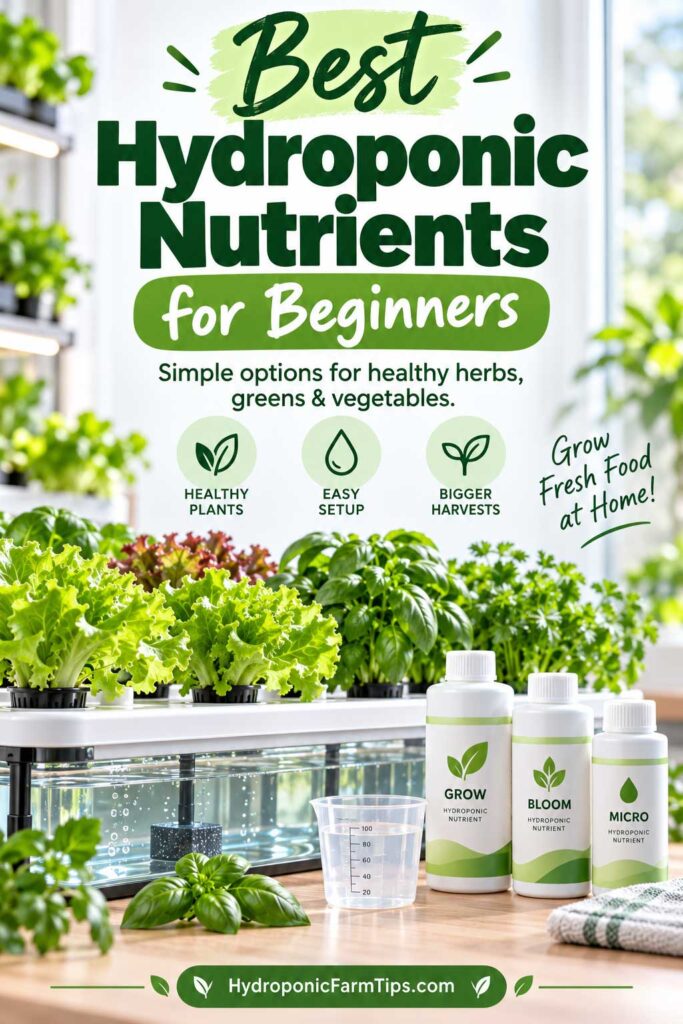
If you want to compare the top options quickly, the table below highlights some of the best hydroponic nutrients for vegetables and herbs based on ease of use, nutrient format, crop suitability, and overall value. We’ll look at each one in more detail below.
For most home setups, General Hydroponics FloraSeries is a strong all-around option because the three-part formula can be adjusted for leafy growth, flowering, and fruiting. MasterBlend 4-18-38 is especially appealing for larger gardens because dry nutrients are economical and work well for crops such as tomatoes, peppers, and leafy greens.
Affiliate Disclosure: This page may contain affiliate links. If you purchase through one of these links, we may earn a commission at no additional cost to you.
| Hydroponic Nutrient | Best For | Type | Ease of Use | Why It Stands Out | Buy |
|---|---|---|---|---|---|
| General Hydroponics FloraSeries | Best Overall | 3-part liquid | Easy–Moderate | Flexible feeding for herbs, greens, and fruiting vegetables | Check Price |
| MasterBlend 4-18-38 Kit | Best Value | Dry multi-part | Moderate | Economical choice for larger reservoirs and vegetable gardens | Check Price |
| Advanced Nutrients pH Perfect | Best for Easier pH Management | Multi-part liquid | Easy | Designed to reduce frequent pH correction | Check Price |
| FoxFarm Grow Big Hydroponic | Best for Vegetative Growth | Liquid | Easy | Convenient feeding for leafy crops and early plant growth | Check Price |
| General Hydroponics MaxiGro & MaxiBloom | Best Dry Option for Beginners | Dry powder | Easy | Simple stage-based alternative to more complex dry programs | Check Price |
| SuperThrive Foliage-Pro | Best Simple One-Part Liquid | One-part liquid | Very Easy | Straightforward feeding for herbs and leafy plants | Check Price |
| AeroGarden Liquid Plant Food | Best for Countertop Gardens | One-part liquid | Very Easy | Simple option for compact herb and lettuce systems | Check Price |
Not sure where to start? FloraSeries offers the most flexibility for a mixed home garden, while MasterBlend becomes especially attractive when reservoir size and ongoing nutrient cost start to matter. If simplicity is your priority, a one-part liquid formula is easier to manage.
Which Hydroponic Nutrient Should You Choose?
For your first hydroponic garden, it usually makes sense to start with a formula that is easy to measure and clearly labeled for hydroponic use. A complete liquid nutrient can simplify things while you’re learning how EC, pH, reservoir size, and plant growth all interact.
Larger systems can become more economical with powdered nutrients such as MasterBlend or MaxiGro and MaxiBloom. They require a little more measuring and mixing, but the cost per gallon of finished nutrient solution can be significantly lower.
Crop type matters too. Lettuce, basil, and other leafy crops generally need a milder nutrient solution than heavy-fruiting plants such as tomatoes, peppers, and cucumbers. A flexible feeding program lets you adjust nutrient strength and balance as plants mature.
Here’s how each option compares in real-world hydroponic use.
How We Chose the Best Hydroponic Nutrients
We compared these nutrient programs based on the factors that matter most in a home hydroponic garden: nutrient completeness, ease of mixing, crop versatility, compatibility with common hydroponic systems, cost as system size increases, and how easily the feeding program can be adjusted through different stages of growth.
We also reviewed current manufacturer instructions when evaluating mixing order, intended growth stages, and recommended uses. Because water quality, crop variety, reservoir size, and growing conditions vary, no single nutrient is the right choice for every hydroponic garden.
Our goal is to help you narrow the options based on the way you actually grow—not simply choose the product with the biggest nutrient numbers or the most bottles.
1. General Hydroponics FloraSeries — Best Overall
General Hydroponics FloraSeries is one of the most versatile nutrient systems for home hydroponic growers because it lets you adjust the nutrient balance as plants move through different stages of growth.
The system uses three separate liquid concentrates:
- FloraMicro supplies nitrogen, calcium, and essential micronutrients.
- FloraGro supports vigorous vegetative growth, including healthy stems and foliage.
- FloraBloom provides phosphorus, potassium, magnesium, and sulfur for flowering and fruiting stages.
Instead of using the same nutrient ratio throughout the entire growing cycle, you can change the proportions depending on what the plant needs. That makes FloraSeries useful for everything from lettuce and basil to tomatoes, peppers, cucumbers, and strawberries.
Why We Like It
The biggest advantage is flexibility.
Leafy greens and herbs generally spend most of their lives in vegetative growth, while fruiting crops eventually need a different balance of nutrients as they begin flowering and producing fruit. A three-part system makes it easier to adjust feeding without switching to a completely different fertilizer.
FloraSeries also works with most common hydroponic setups, including DWC, NFT, drip systems, ebb and flow, Dutch buckets, and aeroponics. That makes it especially useful if you grow several types of plants or expect your setup to expand over time.
Best Crops for FloraSeries
FloraSeries can be used with a wide range of hydroponic crops. It works well for leafy greens such as lettuce, kale, spinach, and Swiss chard; herbs including basil, parsley, cilantro, and mint; and fruiting crops such as tomatoes, peppers, cucumbers, eggplants, and strawberries.
The exact nutrient strength should still be adjusted for the crop, plant age, and growth stage rather than using one concentration for everything.
Pros and Cons
| Pros | Cons |
|---|---|
| Flexible three-part nutrient system | Requires more measuring than a one-part nutrient |
| Suitable for vegetables, herbs, and fruiting crops | Beginners need to learn the mixing order |
| Works with most common hydroponic systems | Three bottles can feel excessive for tiny countertop systems |
| Easy to adjust between vegetative and fruiting stages | Higher upfront cost than some powdered programs |
| Available in multiple bottle sizes | More steps than a simple one-part fertilizer |
Important Mixing Tip
When using FloraSeries, add each nutrient component to the water separately and mix thoroughly before adding the next one.
Do not pour the concentrated nutrients together before diluting them in water. Concentrated mineral salts can react with one another and form compounds that plants may not be able to absorb efficiently.
A common mixing sequence is:
FloraMicro → FloraGro → FloraBloom
General Hydroponics recommends adding FloraMicro first, FloraGro second, and FloraBloom third, mixing thoroughly between each addition.
After the nutrients are mixed, check the solution’s EC or PPM, then measure and adjust the pH if necessary.
Who Should Buy It?
FloraSeries is a good choice if you want one nutrient program that can handle several different crops and give you room to fine-tune feeding as your plants mature.
For a beginner growing only a few herbs, a one-part formula may be simpler. But if you expect to expand your hydroponic garden or grow both leafy and fruiting plants, FloraSeries gives you considerably more control.
Best for: Growers who want a flexible, all-purpose nutrient system for vegetables, herbs, and fruiting crops.
2. MasterBlend 4-18-38 — Best Value for Larger Hydroponic Gardens
MasterBlend 4-18-38 is a popular choice for growers who want a cost-effective dry nutrient program, especially for larger hydroponic systems where liquid concentrates can become expensive.
The 4-18-38 formula is commonly paired with calcium nitrate and magnesium sulfate (Epsom salt) to create a complete hydroponic nutrient solution. Because the ingredients come as dry powders, a relatively small amount can make a large volume of finished solution.
That makes MasterBlend especially appealing for bigger reservoirs, multiple buckets, Dutch bucket systems, and larger vegetable setups.
Why We Like It
Where MasterBlend really stands out is cost.
Dry nutrients are generally cheaper to store and transport than premixed liquids because you’re not paying for water. Once you become comfortable weighing the individual components, MasterBlend can provide excellent value per gallon of finished nutrient solution.
It works especially well for tomatoes, peppers, cucumbers, lettuce, leafy greens, and herbs, making it a strong fit for hydroponic gardens focused on food production.
How the MasterBlend System Works
MasterBlend 4-18-38 is typically used as part of a three-component nutrient program.
MasterBlend 4-18-38 supplies phosphorus, potassium, micronutrients, and some magnesium, while magnesium sulfate and calcium nitrate complete the commonly used three-component mix.
Keeping these components separate until they are diluted helps reduce the risk of unwanted reactions between concentrated minerals.
Important Mixing Tip
Do not dump all three dry ingredients into the reservoir at the same time.
A better approach is to dissolve each component completely before adding the next. This helps reduce nutrient precipitation, where minerals react and form insoluble compounds that plants cannot easily absorb.
A commonly used mixing sequence is:
MasterBlend → Magnesium Sulfate → Calcium Nitrate
MasterBlend’s official instructions use this same order and specify adding calcium nitrate last.
Allow each ingredient to dissolve fully before moving on to the next one.
The exact amount you use should depend on the crop, growth stage, water quality, and target EC rather than relying on one concentration for every plant.
Best Crops for MasterBlend
MasterBlend is especially useful for crops with moderate to high nutrient demands.
Tomatoes and peppers generally need a stronger solution than lettuce or young herbs, and a dry nutrient program makes it easy to scale the concentration up or down as needed.
It can also work very well for leafy greens and herbs when mixed at a lower strength.
Pros and Cons
| Pros | Cons |
|---|---|
| Very economical for larger reservoirs | Requires more measuring than a one-part liquid |
| Long shelf life when stored dry | Usually paired with calcium nitrate and magnesium sulfate |
| Excellent for tomatoes, peppers, and other vegetables | Powder must dissolve completely before use |
| Easy to scale for larger hydroponic gardens | Slightly steeper learning curve for beginners |
| Compact and easy to store | A digital scale is helpful for accurate dosing |
| Gives precise control over nutrient concentration | More mixing steps than a ready-to-use liquid |
Who Should Buy It?
MasterBlend is especially good for growers who have moved beyond a tiny countertop system and want to reduce ongoing nutrient costs.
If you’re maintaining a larger DWC reservoir, several Dutch buckets, or a productive tomato and pepper setup, the savings from a dry nutrient program can add up quickly.
It may be more than you need for two basil plants on a kitchen counter, but for a larger vegetable garden, it offers an excellent combination of control, scalability, and value.
Best for: Growers who want an economical dry nutrient program for larger hydroponic vegetable and herb gardens.
3. Advanced Nutrients pH Perfect — Best for Easier pH Management
Advanced Nutrients pH Perfect is designed for growers who want a liquid nutrient system with less day-to-day pH adjustment.
The main appeal is convenience. Hydroponic pH can drift as plants absorb water and minerals, and frequent correction can become one of the more tedious parts of reservoir management. The pH Perfect line is formulated to help keep the nutrient solution within a usable range when mixed according to the manufacturer’s directions.
Advanced Nutrients describes pH Perfect Grow, Micro, Bloom as a three-part base nutrient designed for hydroponic systems, with its pH Perfect technology intended to reduce the need for manual pH adjustment.
That does not mean you should stop checking pH entirely. Water quality, reservoir size, crop type, temperature, and nutrient concentration can all affect how stable the solution remains.
Why We Like It
For beginners, reducing the number of variables to manage can make hydroponics much easier.
Instead of constantly chasing small pH changes, a stabilized nutrient program can simplify routine maintenance, especially in small and medium-sized indoor systems.
It can be used with a wide range of crops, including lettuce, basil, parsley, cilantro, tomatoes, peppers, cucumbers, and strawberries.
Best for Growers Who Want Convenience
This nutrient line makes the most sense for growers who value ease of use more than the lowest possible cost per gallon.
It is particularly useful if you’re still learning how nutrients, EC, and pH interact and want to reduce the amount of manual adjustment you need to make.
More experienced growers may prefer a simpler dry fertilizer or a lower-cost base nutrient, especially when running large reservoirs.
Pros and Cons
| Pros | Cons |
|---|---|
| Designed to help stabilize nutrient-solution pH | Usually more expensive than dry nutrients |
| Beginner-friendly and convenient | Still requires regular pH monitoring |
| Liquid formula is easy to measure | Multi-part formulas require several bottles |
| Suitable for many vegetables and herbs | Less economical for very large reservoirs |
| Works well in common recirculating systems | Water chemistry can still affect final pH |
| Can reduce frequent pH corrections | More expensive than basic nutrient programs |
Important pH Note
Even when using a pH-stabilizing nutrient, keep a reliable pH meter nearby.
Hydroponic plants absorb nutrients most effectively within a suitable pH range. If the solution drifts too far outside that range, certain nutrients can become less available even when plenty of fertilizer is present in the reservoir.
Check the pH after mixing, then monitor it as part of your normal reservoir routine.
Who Should Buy It?
Advanced Nutrients pH Perfect is a good match for growers who want to simplify nutrient management and are willing to pay a little more for convenience.
It can be especially useful in indoor DWC, drip, and other recirculating systems where pH tends to require regular attention.
If your main priority is minimizing nutrient cost, a dry program such as MasterBlend may be a better fit. If your priority is making feeding easier, pH Perfect offers a more hands-off approach.
Best for: Growers who want a convenient liquid nutrient system with less frequent pH adjustment.
4. FoxFarm Grow Big Hydroponic — Best for Vegetative Growth
FoxFarm Grow Big Hydroponic is a liquid nutrient formulated for hydroponic growing and is especially useful during periods of active vegetative growth.
FoxFarm describes Grow Big Hydroponic as a 3-2-6 liquid concentrate for vegetative growth in hydroponic systems.
That makes it a good fit for leafy greens, herbs, and young vegetable plants that are focused on producing roots, stems, and foliage rather than flowers and fruit.
For crops such as basil, lettuce, kale, and young tomato or pepper plants, a vegetative-focused formula can support steady green growth before the plant transitions into a heavier flowering or fruiting stage.
Why We Like It
Grow Big Hydroponic is straightforward to measure and mix, which makes it more approachable than some dry multi-part nutrient systems.
It is especially useful for growers who want a liquid fertilizer for the vegetative stage without immediately committing to a more complicated nutrient program.
For leafy crops that are harvested before flowering, that simplicity can be particularly attractive.
Best Crops for Grow Big Hydroponic
This nutrient is a strong match for lettuce, basil, kale, Swiss chard, parsley, cilantro, mint, and other leafy crops.
It can also work well during the early growth stages of tomatoes, peppers, and cucumbers while the plants are concentrating on roots, stems, and foliage.
For fruiting crops, however, Grow Big is generally better viewed as part of the early-growth phase rather than the only nutrient used from seedling to harvest. As tomatoes, peppers, and cucumbers begin flowering and setting fruit, their nutrient needs change.
Where It Fits Best
Grow Big Hydroponic can be used in common indoor systems such as deep water culture, drip systems, ebb and flow, NFT, and small recirculating gardens.
It can be particularly useful when leafy greens and fruiting vegetables are grown in separate reservoirs. That allows lettuce and herbs to stay on a vegetative-focused feeding program while tomatoes and peppers receive a different nutrient balance as they mature.
Pros and Cons
| Pros | Cons |
|---|---|
| Easy-to-use liquid formula | Not the most economical choice for large reservoirs |
| Well suited to vegetative growth | Fruiting plants may need a different nutrient balance later |
| Good match for leafy greens and herbs | Less flexible than a three-part nutrient system |
| Useful during early growth of tomatoes and peppers | Requires careful dosing to avoid excessive EC |
| Simple to measure in small reservoirs | May require additional products for a full fruiting cycle |
| Formulated specifically for hydroponic growing | Less cost-efficient than dry nutrients at larger scale |
A Good Choice for Leafy Crops
One of the strongest reasons to consider Grow Big Hydroponic is if your garden is dominated by leafy crops.
Lettuce, basil, parsley, cilantro, and similar plants are harvested mainly for their foliage, so they do not require the same dramatic shift toward flowering and fruit production that crops such as tomatoes do.
That makes a vegetative-focused nutrient a practical option for growers who spend most of their time growing greens and herbs.
Who Should Buy It?
FoxFarm Grow Big Hydroponic is a good option for growers who want a convenient liquid nutrient for herbs, leafy greens, and young vegetable plants.
It is less attractive if your main goal is running a large tomato or pepper system from start to finish, where a more flexible or economical nutrient program may make more sense.
For smaller indoor gardens focused primarily on leafy growth, however, it offers a simple and practical feeding option.
Best for: Hydroponic growers focused on leafy greens, herbs, and vigorous vegetative growth.
5. General Hydroponics MaxiGro & MaxiBloom — Best Dry Nutrient for Beginners
General Hydroponics MaxiGro and MaxiBloom are dry, water-soluble nutrients that offer a simpler alternative to multi-bottle liquid programs.
The two formulas are designed for different stages of plant growth. General Hydroponics’ Maxi Series guide confirms that MaxiGro is used during seedling and vegetative growth, while MaxiBloom is used after plants transition into flowering and fruiting. MaxiGro is intended primarily for vegetative growth, while MaxiBloom is designed for flowering and fruiting stages.
That makes the pair a practical option for growers who want the lower cost and long shelf life of powdered nutrients without having to measure several separate dry ingredients every time they mix a reservoir.
Why We Like It
What makes MaxiGro and MaxiBloom appealing is how little there is to juggle.
Compared with a three-part dry program, MaxiGro and MaxiBloom are easier to manage because each growth stage uses a single main formula. You still need to measure carefully and monitor EC, but there are fewer components to keep track of.
They also store well, take up very little space, and can be more economical than liquid nutrients when you’re maintaining several reservoirs.
Best Crops for MaxiGro and MaxiBloom
MaxiGro is a strong fit for leafy greens and herbs such as lettuce, basil, kale, parsley, cilantro, and mint. It also works well during the early vegetative stage of tomatoes, peppers, and cucumbers.
MaxiBloom becomes more useful when fruiting crops begin flowering and setting fruit, including tomatoes, peppers, cucumbers, eggplants, and strawberries.
For leafy greens and herbs that are harvested before flowering, growers may spend most or all of the crop cycle using a vegetative-focused formula.
Dry Nutrients Can Be Easier Than They Look
Some beginners avoid powdered nutrients because they assume they are difficult to use.
In practice, the process becomes straightforward once you establish a routine. Measure the appropriate amount for your reservoir, dissolve the powder thoroughly, allow the solution to circulate, and then check the EC or PPM.
If the solution is too strong, dilute it gradually with water rather than trying to guess how much nutrient to remove. Once the nutrient concentration is where you want it, check and adjust the pH.
Pros and Cons
| Pros | Cons |
|---|---|
| More economical than many liquid nutrients | Requires accurate measuring |
| One dry formula for vegetative growth and another for flowering and fruiting | Powder must dissolve completely |
| Easy to store and takes up little space | Less convenient than a one-part liquid |
| Long shelf life when kept dry | Fruiting crops require a switch from MaxiGro to MaxiBloom |
| Works for both leafy and fruiting crops | Very small countertop systems may see little cost benefit |
| Good introduction to powdered nutrients | Still requires EC and pH monitoring |
You generally use MaxiGro or MaxiBloom according to the growth stage rather than mixing both as a two-part base nutrient.
MaxiGro vs. MasterBlend
Both can be good choices if you want to move away from liquid nutrients, but they suit slightly different growers.
MasterBlend offers excellent cost efficiency and control, but it is commonly used with calcium nitrate and magnesium sulfate, so there are more separate ingredients to measure.
MaxiGro and MaxiBloom simplify the process by using one main formula for vegetative growth and another for flowering and fruiting.
For that reason, MaxiGro and MaxiBloom can be an easier transition for someone who wants to try dry nutrients without jumping straight into a more complex multi-component program.
Who Should Buy It?
MaxiGro and MaxiBloom are a strong fit for growers who want the savings of powdered nutrients without the extra measuring involved in a three-component dry program.
They’re particularly useful for medium-sized DWC, drip, NFT, and other hydroponic systems where liquid nutrient costs begin adding up.
Best for: Beginners and intermediate growers who want an affordable, straightforward dry nutrient program for both vegetative and fruiting crops.
6. SuperThrive Foliage-Pro — Best Simple One-Part Liquid Nutrient
SuperThrive Foliage-Pro is a good option for growers who want to keep hydroponic feeding simple.
Instead of mixing several nutrient bottles or weighing multiple dry powders, this one-part liquid formula offers a more straightforward routine: measure the recommended amount, add it to the reservoir, mix thoroughly, then check EC and pH.
That simplicity makes it especially appealing for smaller indoor gardens, herbs, leafy greens, and growers who do not need a highly customized feeding program.
Why We Like It
Not every hydroponic setup needs a complicated nutrient schedule.
If you’re growing basil, mint, parsley, lettuce, kale, or other primarily vegetative crops, a complete one-part nutrient can be much easier to manage than a three-part system.
It can also reduce mixing mistakes because there are fewer concentrates to measure and fewer opportunities to combine components incorrectly.
Best Crops for Foliage-Pro
Foliage-Pro is particularly well suited to plants grown mainly for leaves and stems, including basil, mint, parsley, cilantro, lettuce, kale, Swiss chard, and other leafy greens.
It can also be used during the early stages of vegetable growth, although growers producing heavy-fruiting tomatoes, peppers, or cucumbers may eventually prefer a nutrient program that offers more control during flowering and fruit development.
Why One-Part Nutrients Are Useful
One-part nutrients are often underrated because they do not offer the same level of customization as multi-part systems.
For many home growers, though, that is actually part of the appeal.
If you have only one or two reservoirs, grow mostly herbs and leafy greens, or simply want to spend less time measuring and mixing, a one-part nutrient can make routine maintenance much easier.
The trade-off is flexibility. You give up some ability to fine-tune nutrient ratios, but in return you get a much simpler feeding routine.
Pros and Cons
| Pros | Cons |
|---|---|
| Simple one-part liquid formula | Less customizable than two- or three-part nutrients |
| Easy to measure and mix | Not ideal for heavy-fruiting crops |
| Good fit for herbs and leafy greens | Can cost more per gallon than dry nutrients |
| Fewer opportunities for mixing mistakes | Less economical for large reservoirs |
| Convenient for small systems | Limited flexibility across growth stages |
| Beginner-friendly | Advanced growers may want more control |
Who Should Buy It?
SuperThrive Foliage-Pro is best for growers who want a straightforward nutrient routine and are primarily growing leafy plants.
If your hydroponic garden is mostly basil, lettuce, parsley, mint, and similar crops, a one-part liquid fertilizer can keep feeding simple without requiring a complicated nutrient schedule.
For a large tomato or pepper system, I would lean toward a more adjustable program such as FloraSeries, MasterBlend, or a dedicated grow-and-bloom system.
Best for: Small hydroponic gardens, herbs, leafy greens, and growers who want the simplest possible nutrient routine.
7. AeroGarden Liquid Plant Food — Best for Small Herb and Countertop Gardens
AeroGarden Liquid Plant Food is designed for small indoor hydroponic gardens, making it a practical choice for countertop systems where simplicity matters more than fine-tuning nutrient ratios. AeroGarden describes its Liquid Plant Food as a complete nutrient blend for hydroponic growing, with a built-in pH buffering system.
It works especially well for herbs, lettuce, and other compact leafy crops grown in self-contained indoor units. The liquid format is easy to measure, and there is no need to manage several nutrient bottles or weigh dry powders.
That convenience makes it one of the easiest options on this list for anyone who wants fresh herbs at home without turning nutrient management into a complicated routine.
Why We Like It
Countertop gardens have very different needs from large DWC reservoirs or Dutch bucket systems.
They typically use a small reservoir, hold less water, support compact plants, and are designed for frequent harvests in limited indoor space. In that situation, a simple liquid nutrient often makes more sense than a highly customizable three-part program.
You measure the recommended amount, add it to the reservoir, and continue monitoring water level, plant growth, and overall system condition.
Best Crops for AeroGarden Liquid Plant Food
AeroGarden Liquid Plant Food is best suited to compact crops such as basil, mint, parsley, cilantro, dill, chives, lettuce, arugula, and other small leafy greens.
It can also support other plants grown in countertop hydroponic systems, although larger fruiting crops may eventually need more root space, stronger lighting, and more precise nutrient management than a small indoor unit can provide.
Best for Countertop Systems
One of the biggest advantages is that it matches the scale of the systems many beginners start with.
If you’re growing a handful of basil plants, lettuce, or herbs in the kitchen, buying multiple nutrient concentrates or weighing several dry ingredients is usually unnecessary.
A simple one-part liquid formula keeps feeding manageable and reduces the chance of dosing or mixing mistakes.
Pros and Cons
| Pros | Cons |
|---|---|
| Very easy to use | Less economical for larger systems |
| Excellent for beginners | Limited ability to customize nutrient ratios |
| Ideal for countertop hydroponic gardens | Not the best choice for large fruiting crops |
| Good for herbs and leafy greens | Growers may outgrow it as their systems expand |
| No complicated mixing process | Less flexible than multi-part nutrient programs |
| Convenient for very small reservoirs | Higher cost per gallon can matter at larger scale |
Who Should Buy It?
AeroGarden Liquid Plant Food is best for someone growing herbs or leafy greens in a small indoor system who wants feeding to be as simple as possible.
It is especially useful for beginners who are more interested in harvesting basil and lettuce than learning advanced nutrient formulation.
If your hydroponic garden eventually grows beyond the countertop stage, moving to a more flexible or economical nutrient program will usually make more sense.
Best for: Countertop hydroponic gardens, herbs, lettuce, and beginners who want maximum simplicity.
What Are Hydroponic Nutrients?
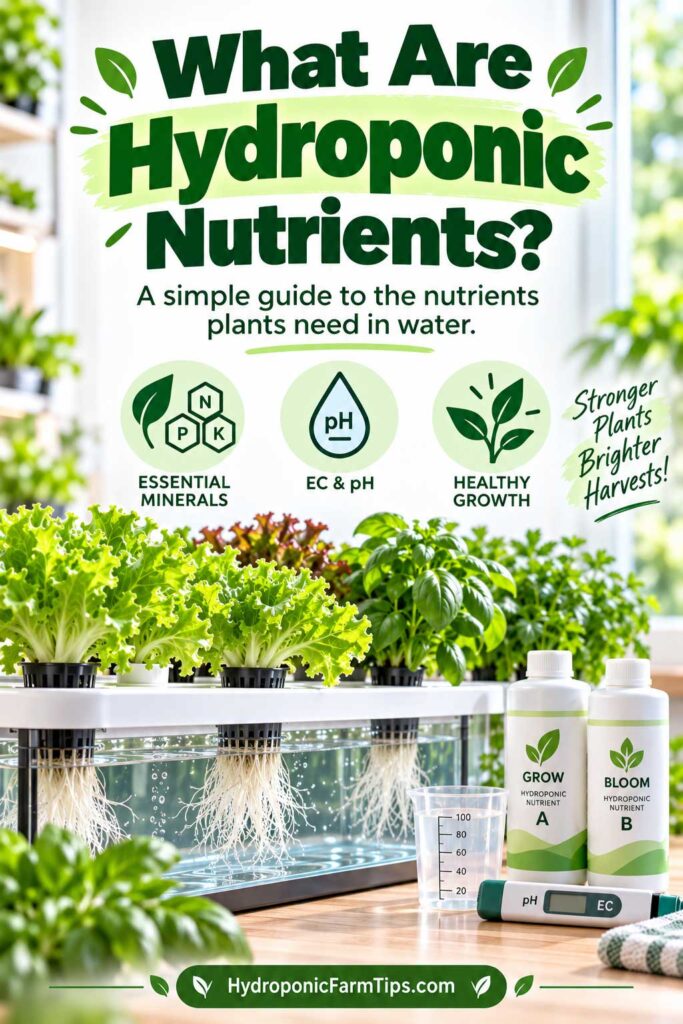
Hydroponic nutrients are water-soluble fertilizers that supply the mineral elements plants would normally get from soil.
In a hydroponic system, roots grow in water, an inert growing medium, or a combination of the two. Because there is little or no soil acting as a nutrient reserve, those minerals have to come from the nutrient solution in the reservoir.
A complete hydroponic fertilizer provides more than just nitrogen, phosphorus, and potassium. Plants also need calcium, magnesium, and sulfur, along with smaller amounts of micronutrients such as iron, manganese, zinc, boron, copper, and molybdenum.
The goal is not simply to add fertilizer to the water. Those nutrients need to stay dissolved and available to the roots, while the solution remains within an appropriate EC and pH range.
If the nutrient concentration is too weak, plants may grow slowly or begin showing deficiency symptoms. If it is too strong, excess salts can stress the roots, cause leaf-tip burn, and make it harder for plants to take up water.
That is why fertilizers made specifically for hydroponics are usually a better choice than ordinary garden fertilizers. They are designed to dissolve cleanly in water and provide a more complete mineral profile for plants growing without soil.
The right nutrient strength still depends on the crop, plant age, water quality, and growth stage. Lettuce and young herbs usually need a milder solution than mature tomatoes, peppers, or cucumbers that are actively flowering and producing fruit.
What Nutrients Do Hydroponic Plants Need?
Hydroponic plants need the same essential mineral nutrients as plants grown in soil. The difference is that in hydroponics, you are responsible for delivering those nutrients directly through the water.
A complete nutrient solution should provide primary macronutrients, secondary nutrients, and micronutrients. Plants need some in larger amounts and others only in trace quantities, but all of them contribute to healthy growth.
Primary Macronutrients
The three nutrients you will see most prominently on fertilizer labels are nitrogen, phosphorus, and potassium.
Nitrogen (N) supports leafy growth, chlorophyll production, and overall plant development. It is especially important for lettuce, basil, kale, and other crops grown mainly for their foliage.
Phosphorus (P) plays a role in energy transfer, root development, flowering, and fruit formation. Fruiting crops such as tomatoes and peppers need an appropriate supply as they mature.
Potassium (K) helps regulate water movement, enzyme activity, plant strength, and fruit quality. It becomes especially important as flowering and fruiting crops become more productive.
Together, these are represented by the familiar N-P-K numbers printed on fertilizer labels.
Secondary Nutrients
Plants also need calcium, magnesium, and sulfur in meaningful amounts.
Calcium supports cell walls, new growth, roots, and developing fruit. Problems can appear quickly in fast-growing hydroponic crops when nutrient balance, water movement, or environmental conditions interfere with calcium uptake.
Magnesium is a central component of chlorophyll and is essential for photosynthesis. A deficiency often appears as yellowing between the veins of older leaves.
Sulfur contributes to amino acids, proteins, enzymes, and healthy overall growth.
A good hydroponic nutrient program should supply these minerals in appropriate amounts rather than focusing only on N-P-K.
Micronutrients
Hydroponic plants also need small amounts of iron, manganese, boron, zinc, copper, and molybdenum.
Because plants require only tiny quantities, it is easy to underestimate their importance. A shortage of even one micronutrient can still cause noticeable growth problems when nitrogen, phosphorus, and potassium levels appear adequate.
Iron deficiency, for example, often shows up as yellowing in newer leaves while the veins remain comparatively green.
Nutrient Balance Matters More Than a High N-P-K Number
One of the most common beginner mistakes is choosing fertilizer mainly because it has high N-P-K numbers.
In hydroponics, stronger is not automatically better.
Plants need nutrients in the correct proportions and at a concentration appropriate for the crop and growth stage. A mature tomato plant producing fruit may require a much stronger solution than a young lettuce seedling.
Water quality, pH, EC, temperature, and root health also affect how efficiently plants can use the minerals that are already present.
That is why the best hydroponic nutrients are not simply the products with the highest nutrient percentages. A good formula provides a complete mineral profile that can be delivered at the right strength for the plants you are growing.
Liquid vs. Dry Hydroponic Nutrients — Which Is Better?
Both liquid and dry hydroponic nutrients can grow healthy plants. The better choice depends on the size of your system, how much measuring you want to do, and whether convenience or cost matters more to you.
Liquid nutrients are usually easier for beginners because they are already dissolved and can be measured directly into the reservoir. Dry nutrients take a little more preparation, but they are often more economical and easier to store.
| Liquid Hydroponic Nutrients | Dry Hydroponic Nutrients |
|---|---|
| Easy to measure and mix | Usually cheaper per gallon |
| Beginner-friendly | Excellent for larger systems |
| No powder to dissolve | Compact and easy to store |
| Convenient for small reservoirs | Long shelf life when kept dry |
| Often more expensive | Requires accurate measuring |
| Heavier to store and ship | Must dissolve completely before use |
Advantages of Liquid Hydroponic Nutrients
Liquid nutrients are convenient.
You measure the required amount, add it to water, mix thoroughly, and then check EC and pH. There is no need to weigh powders or wait for dry fertilizer to dissolve.
That makes liquid formulas especially useful for beginners, small DWC systems, countertop gardens, herb gardens, and anyone maintaining only one or two reservoirs.
Multi-part liquid systems can still provide plenty of control. Products such as FloraSeries allow you to adjust the ratio of different components as plants move through vegetative growth, flowering, and fruit production.
The main drawback is cost. Because liquid fertilizers contain water, they can become expensive when you’re feeding large reservoirs week after week.
Advantages of Dry Hydroponic Nutrients
Dry nutrients are usually the better value as the scale of your hydroponic garden increases.
A relatively small bag of concentrated powder can produce a large amount of nutrient solution, making dry formulas attractive for larger DWC systems, Dutch buckets, commercial-style setups, or growers running several reservoirs.
They are also compact and easy to store because you are not keeping large bottles of liquid fertilizer.
The trade-off is that accurate measuring becomes more important. A small digital scale is often useful, and each component needs to dissolve properly before you move on to the next step.
Are Dry Nutrients Harder to Use?
Not necessarily.
There is a slightly steeper learning curve, but once you know the correct amount for your reservoir, mixing dry nutrients becomes routine.
You weigh the required amount, dissolve it thoroughly in water, allow the solution to circulate, and then check EC before making any final adjustment.
The important part is not guessing. Whether you use liquid or dry nutrients, the final nutrient concentration matters more than the form the fertilizer came in.
Which Should You Choose?
Choose liquid hydroponic nutrients if you want the simplest setup, have a relatively small garden, or are still learning how nutrient strength and pH work.
Choose dry hydroponic nutrients if you have larger reservoirs, want to lower your cost per gallon, or are comfortable measuring ingredients more precisely.
Neither option is inherently better for plant growth. When mixed correctly, both can provide plants with complete and effective nutrition.
For most beginners, liquid nutrients are the easier place to start. Once your hydroponic garden becomes larger and nutrient costs begin to matter, switching to a dry formula can make a lot of sense.
One-Part vs. Two-Part vs. Three-Part Hydroponic Nutrients
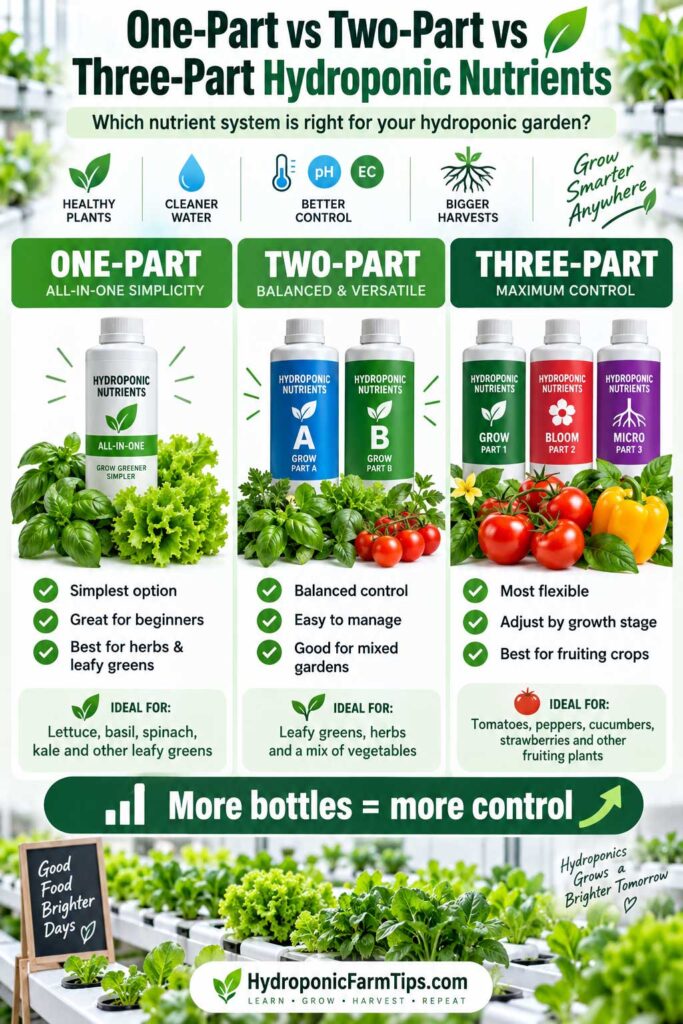
Hydroponic nutrients are often sold as one-part, two-part, or three-part systems. The main difference is how the minerals are separated and how much control you have over the final nutrient mix.
One-Part Nutrients
One-part nutrients are the simplest option.
You use a single formula instead of measuring several separate concentrates, which makes them convenient for beginners, small reservoirs, herbs, and leafy greens.
They are a good fit if you want feeding to stay simple and do not need to change nutrient ratios much during the crop cycle.
The trade-off is flexibility. A single formula may work very well for lettuce or basil, but fruiting crops such as tomatoes and peppers can benefit from a different nutrient balance as they move from vegetative growth into flowering and fruit production.
Two-Part Nutrients
Two-part systems separate certain minerals so they remain stable while concentrated.
Each component is added to the reservoir separately and mixed into the water before the final EC and pH are checked.
This approach offers a useful middle ground. You get more flexibility than a basic one-part formula without managing as many separate components as a three-part program.
For many home growers, that balance between control and simplicity is appealing.
Three-Part Nutrients
Three-part systems provide the greatest flexibility.
A product such as General Hydroponics FloraSeries separates the nutrient program into different concentrates that can be adjusted as the plant moves through different stages of growth.
That means you can emphasize vegetative nutrition while plants are producing leaves and stems, then modify the ratio as tomatoes, peppers, or cucumbers begin flowering and setting fruit.
The trade-off is extra measuring and mixing. You also need to follow the correct mixing order and avoid combining concentrated nutrient components directly before they are diluted in water.
One-Part vs. Two-Part vs. Three-Part at a Glance
| Nutrient Type | Best For | Main Advantage | Main Drawback |
|---|---|---|---|
| One-Part | Herbs, lettuce, small systems | Simplest to use | Least flexibility |
| Two-Part | Mixed home gardens | Good balance of simplicity and control | Requires separate components |
| Three-Part | Fruiting crops and advanced growers | Maximum control over feeding | More measuring and mixing |
Which Nutrient System Is Best?
For a small herb or lettuce garden, a one-part nutrient may be all you need.
For a mixed vegetable garden, a two-part system can provide a good balance between simplicity and flexibility.
If you grow several crops or want more control over vegetative and fruiting stages, a three-part nutrient system gives you the most room to fine-tune feeding.
There is no advantage to choosing a more complicated nutrient program simply because it has more bottles. The best choice is the one that matches your crops, reservoir size, experience level, and how much time you want to spend managing nutrients.
Best Hydroponic Nutrients by Crop
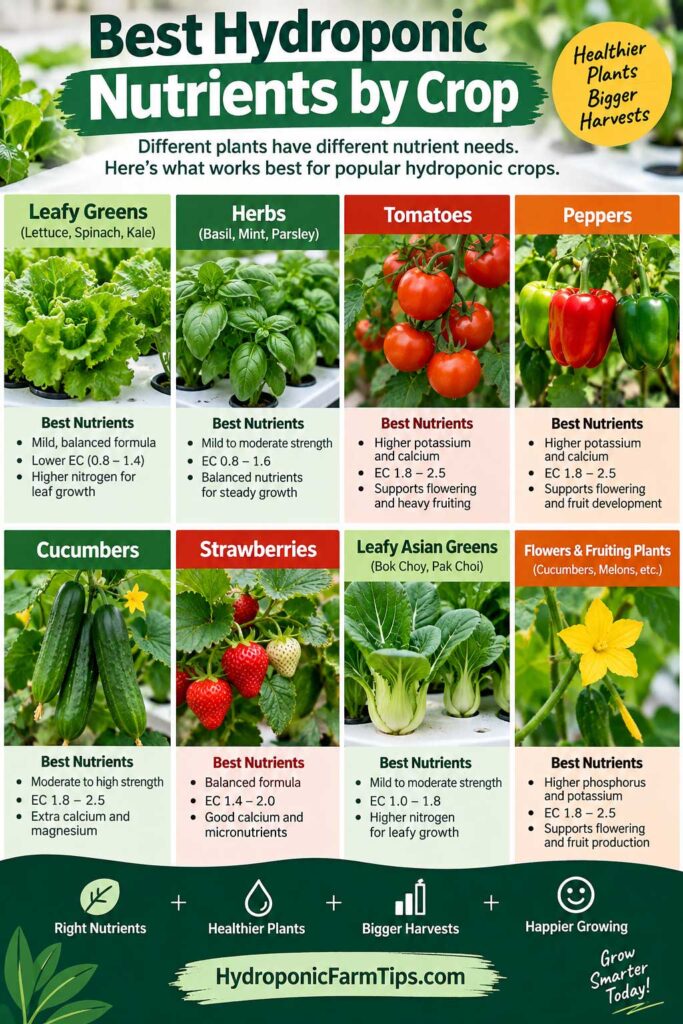
The best nutrient formula can change depending on what you’re growing. Leafy greens and herbs usually need a milder nutrient solution than mature fruiting crops, while tomatoes, peppers, and cucumbers often benefit from stronger feeding and a different nutrient balance later in the growing cycle.
You do not necessarily need a completely different fertilizer for every crop. In many cases, the same hydroponic nutrient can be used at different strengths or ratios.
Best Hydroponic Nutrients for Lettuce
Lettuce is one of the easiest crops to grow hydroponically because it has relatively modest nutrient requirements and a short growing cycle.
A complete vegetative formula works well, especially one that supplies adequate nitrogen, calcium, magnesium, and micronutrients without pushing EC too high.
Good options include General Hydroponics FloraSeries, MaxiGro, SuperThrive Foliage-Pro, and MasterBlend mixed at an appropriate leafy-green strength.
Because lettuce is harvested for its leaves, there is usually no need for a separate flowering or bloom-stage nutrient.
The bigger risk is overfeeding. An overly strong solution can contribute to tip burn, root stress, and poor water uptake, especially in young plants.
Best Hydroponic Nutrients for Basil and Herbs
Basil, parsley, cilantro, mint, dill, and similar herbs generally perform well with a balanced vegetative formula.
Basil is somewhat more nutrient-hungry than lettuce, but it still does not require the aggressive feeding levels used for mature tomatoes or peppers.
For small herb gardens, a simple one-part liquid nutrient can be enough. Larger systems may benefit from MaxiGro, FloraSeries, or a dry nutrient program because they are more economical.
For herbs, focus less on bloom boosters and more on maintaining steady vegetative growth, healthy roots, and consistent EC.
Best Hydroponic Nutrients for Tomatoes
Tomatoes have much heavier nutrient demands than lettuce or most herbs.
Young tomato plants need balanced vegetative nutrition while they establish roots and foliage, but their feeding needs change once flowering and fruit production begin.
That is where adjustable programs such as FloraSeries, MaxiGro and MaxiBloom, or MasterBlend become especially useful.
As tomato plants mature, potassium, calcium, magnesium, overall EC, stable pH, and water uptake all become important parts of nutrient management.
Do not assume that simply adding more fertilizer will produce more tomatoes. Excessive EC can reduce water uptake and stress the roots even when plenty of nutrients are present.
Best Hydroponic Nutrients for Peppers
Peppers have similar needs to tomatoes, although the ideal nutrient strength varies by variety and growth stage.
A balanced formula works well during vegetative growth, while flowering and fruiting plants benefit from a nutrient program that can be adjusted as their needs change.
FloraSeries, MasterBlend, and MaxiGro/MaxiBloom are all practical choices because they provide more control than a basic one-part countertop fertilizer.
Calcium and magnesium also deserve attention in productive pepper systems, especially when using reverse-osmosis or very soft water.
Best Hydroponic Nutrients for Cucumbers
Cucumbers are vigorous growers and can consume a surprising amount of water and nutrients once they begin producing vines and fruit.
They benefit from a complete nutrient program with adequate potassium, calcium, and magnesium, particularly during flowering and fruiting.
A multi-part liquid system or properly managed dry nutrient program is usually a better fit than a basic countertop fertilizer.
Because cucumbers grow quickly, monitor EC regularly. Nutrient concentration can change noticeably as the plants absorb water and minerals from the reservoir.
Best Hydroponic Nutrients for Strawberries
Strawberries generally prefer a more moderate nutrient strength than heavy-feeding tomato plants.
A complete formula with good calcium, potassium, magnesium, and micronutrient coverage works well.
Avoid pushing EC too high in an attempt to force faster growth. Strawberries can be sensitive to excessive salt concentration, and root-zone stress can reduce plant performance.
For small strawberry systems, a liquid multi-part nutrient provides convenient control. Larger setups may benefit from a carefully managed dry nutrient program.
One Nutrient Formula Can Often Grow Several Crops
If you are growing lettuce, basil, tomatoes, and peppers at the same time, you do not necessarily need four different nutrient brands.
What often matters more is the concentration and ratio used for each crop.
That is easiest when crops with very different needs have separate reservoirs. Lettuce and basil can receive a milder vegetative solution, while tomatoes and peppers can be fed at a strength better suited to flowering and fruit production.
If everything shares one reservoir, try to group crops with reasonably similar nutrient requirements whenever possible.
Hydroponic Nutrient Strength by Crop: EC and pH Chart
The nutrient formula you choose is only part of the equation. You also need to mix it at an appropriate strength for the crop you are growing.
In hydroponics, nutrient strength is commonly measured using EC, or electrical conductivity. In general, a higher EC means the solution contains a greater concentration of dissolved mineral salts.
Different crops prefer different ranges. Lettuce and many herbs usually perform well at lower EC levels, while mature fruiting crops such as tomatoes and peppers often require stronger nutrient solutions.
| Crop | Approx. EC Range | Typical pH Range |
|---|---|---|
| Lettuce | 0.8–1.2 | 5.5–6.5 |
| Basil | 1.0–1.6 | 5.5–6.5 |
| Parsley | 1.0–1.8 | 5.5–6.5 |
| Cilantro | 1.2–1.8 | 6.0–6.5 |
| Kale | 1.2–1.8 | 5.5–6.5 |
| Spinach | 1.8–2.3 | 5.5–6.5 |
| Tomatoes | 2.0–3.5 | 5.5–6.5 |
| Peppers | 1.8–2.8 | 5.5–6.5 |
| Cucumbers | 1.7–2.5 | 5.5–6.0 |
| Strawberries | 1.4–2.0 | 5.5–6.2 |
Treat these numbers as starting ranges rather than rigid targets. Variety, growth stage, water quality, temperature, lighting, and system type can all influence how plants respond.
Start Young Plants at a Lower EC
Seedlings and newly transplanted plants usually need a weaker nutrient solution than mature plants.
Starting too strong can stress young roots before they are developed enough to handle a higher mineral concentration.
A safer approach is to begin near the lower end of the crop’s range, watch how the plant responds, and gradually increase nutrient strength as growth accelerates.
EC Can Change Even When You Add Nothing
The reservoir does not stay at exactly the same concentration between water changes.
If plants absorb more water than nutrients, EC can rise because the remaining solution becomes more concentrated. If they absorb nutrients faster than water, EC may fall.
That is why checking EC regularly tells you much more than following a feeding chart once and assuming the reservoir will remain stable.
Watch the Trend, Not Just One Reading
A single EC reading is useful, but the direction it is moving can be even more informative.
If the water level is dropping while EC continues to rise, the solution may be stronger than the plants need. If the water level and EC are both falling, the plants may be consuming nutrients relatively quickly compared with the concentration being replaced.
Plant appearance matters too. Healthy roots, steady growth, good leaf color, and normal water uptake all provide useful context alongside the meter reading.
Don’t Ignore Your Starting Water
Tap water already contains dissolved minerals.
If your source water begins with a relatively high EC, part of the final reading comes from those minerals rather than the hydroponic fertilizer you added.
For example, if your starting water measures 0.4 mS/cm and the finished nutrient solution measures 1.6 mS/cm, not all of that final EC came from fertilizer.
Knowing your baseline makes it much easier to understand what is happening in the reservoir.
EC and pH Work Together
Correct EC does not guarantee that plants can use the nutrients effectively.
The best pH for hydroponics also affects nutrient availability, which is why both measurements should be part of normal reservoir maintenance.
You can have plenty of nutrients in the water and still see deficiency-like symptoms if the pH remains outside a suitable range for too long.
For a more detailed crop-by-crop reference, use our Hydroponic Nutrient & pH Chart to compare recommended EC, PPM, and pH ranges for common vegetables, herbs, and fruits.
How to Mix Hydroponic Nutrients Correctly
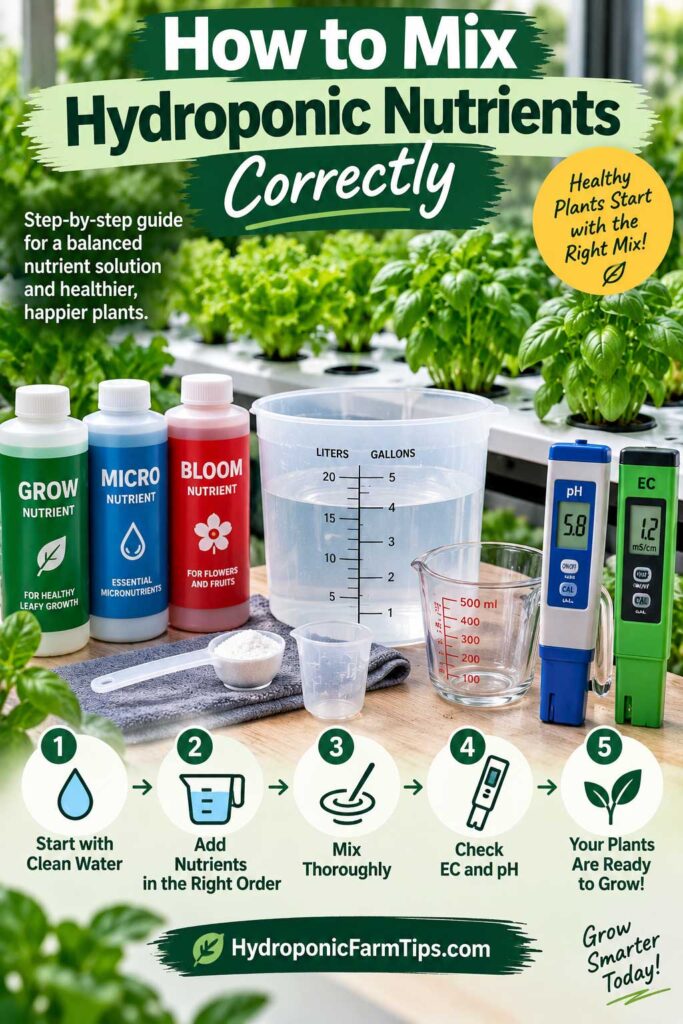
Mixing hydroponic nutrients becomes much easier once you follow the same order every time. The most important rule is to dilute each nutrient component in water before adding the next one.
Never mix concentrated nutrient liquids or powders directly together unless the manufacturer specifically says to do so. Highly concentrated minerals can react with one another and form insoluble compounds, making some nutrients less available to your plants.
1. Fill the Reservoir With Water
Start with the amount of water your system normally uses.
It is also helpful to know the EC or PPM of your source water before adding fertilizer. That gives you a baseline for comparing the final nutrient strength.
2. Measure Your Starting EC or PPM
Check the water before adding nutrients.
If your tap water already contains a noticeable amount of dissolved minerals, your starting EC may be higher than expected. That does not necessarily mean the water is unsuitable, but it should be taken into account when interpreting the final reading.
Reverse-osmosis water will usually begin with a much lower EC.
3. Add Nutrients One Component at a Time
Measure each nutrient according to the manufacturer’s instructions and the strength appropriate for your crop.
Add the first component, stir or circulate the water thoroughly, and only then add the next one.
For a three-part liquid system, do not combine all three concentrates in the same measuring cup before adding them to the reservoir.
The same principle applies to dry nutrients: dissolve each component fully before moving on to the next.
4. Let the Solution Mix Thoroughly
Give the reservoir enough circulation to distribute the nutrients evenly.
In a small container, stirring may be enough. In a larger system, running the circulation pump for several minutes can help produce a more consistent reading.
If you are using dry nutrients, make sure no undissolved powder is sitting at the bottom.
5. Check the EC or PPM
Once everything is mixed, measure the solution again.
If the EC is too high, dilute it gradually with plain water. If it is too low, add a small amount of nutrient solution, mix thoroughly, and test again.
Small corrections are easier to control than large ones.
6. Check the pH After Adding Nutrients
Nutrients can change the pH of your water, so it usually makes sense to adjust pH after the fertilizer has been mixed.
Use a calibrated meter and compare the reading with the range recommended for your crop.
If adjustment is needed, add a small amount of pH Up or pH Down, mix thoroughly, and test again before adding more.
7. Let the Reservoir Circulate
Once EC and pH are where you want them, allow the system to circulate normally.
After a short period, check both readings again. This is especially useful in larger systems where water moves through tubing, channels, buckets, or growing media before returning to the reservoir.
8. Keep Simple Mixing Notes
Record the reservoir volume, nutrient product, amount added, starting and final EC, final pH, and the crop or growth stage.
After a few reservoir changes, those notes become a useful reference for your own system and make future mixing much faster.
A Simple Mixing Order to Remember
For most hydroponic nutrient programs, use this general sequence:
Water → nutrients → mix thoroughly → check EC → adjust strength → check pH → adjust pH
The exact nutrient order can vary by product, so always follow the manufacturer’s instructions when they specify one.
The goal is not to hit a perfect number instantly. Consistent mixing, accurate measurements, and gradual adjustments matter much more than chasing tiny changes in EC or pH.
Hydroponic Nutrient Mixing Essentials
Choosing the right fertilizer is only part of nutrient management. These tools make it easier to mix accurately and keep the reservoir within a healthy EC and pH range.
| Product | Why You Need It | Best For | Buy |
|---|---|---|---|
| Digital EC/TDS Meter | Measures nutrient concentration so you can avoid overfeeding or underfeeding | Every hydroponic grower | Check Price |
| Digital pH Meter | Helps keep nutrient availability within the proper pH range | Every hydroponic system | Check Price |
| pH Up & pH Down Kit | Allows small corrections after nutrients are mixed | Reservoir maintenance | Check Price |
| Digital Gram Scale | Makes measuring powdered nutrients much more accurate | MasterBlend and dry nutrients | Check Price |
| Measuring Syringes | Makes small liquid doses easier and more repeatable | Liquid nutrient concentrates | Check Price |
| Graduated Measuring Cups | Useful for larger nutrient doses and reservoir mixing | Medium and large reservoirs | Check Price |
| Calibration Solution | Helps keep pH and EC meters accurate | Long-term meter maintenance | Check Price |
How Much Hydroponic Nutrient Should You Use?
The right amount of hydroponic nutrient depends on the crop, growth stage, reservoir size, and the strength of the product you are using.
A lettuce seedling may need only a mild nutrient solution, while a mature tomato plant producing fruit can handle a much stronger concentration. That is why the manufacturer’s feeding chart should be treated as a starting point, then confirmed with an EC or PPM meter.
Start Lower With Seedlings
Young plants have small, developing root systems and usually do not need full-strength nutrients.
Starting too strong can lead to leaf-tip burn, root stress, slower growth, wilting, or poor nutrient uptake.
A gentler solution is usually safer during the seedling and early transplant stages. As the plant becomes established, nutrient strength can be increased gradually.
Mature Plants Usually Need More
As plants grow larger, they use more water and minerals.
Leafy crops such as lettuce and herbs generally stay on the lower end of the nutrient-strength range, while fruiting vegetables such as tomatoes, peppers, and cucumbers often need stronger feeding once they are well established and begin flowering or producing fruit.
This is one reason adjustable nutrient systems can be useful. You can increase concentration or change nutrient ratios as plant demand changes.
Do Not Assume Full Strength Is Always Better
More fertilizer does not mean faster growth.
If the nutrient solution becomes too concentrated, the high salt level can make it harder for roots to absorb water. Plants may then show burned leaf tips, curled leaves, slowed growth, or other signs of stress even though the reservoir contains plenty of nutrients.
If EC is higher than the normal range for the crop, diluting the reservoir gradually with plain water is often the better response.
Use EC Instead of Guessing
Measuring fertilizer only by tablespoons or milliliters tells you how much product you added, but it does not tell you the final nutrient concentration in the reservoir.
Your source water may already contain dissolved minerals, and nutrient products vary in strength.
That is why checking EC after mixing is so useful.
If the manufacturer’s recommended dose produces an EC that is much higher than your crop normally tolerates, it may make sense to reduce the concentration rather than blindly following the label.
Top-Off Water Can Change Nutrient Strength
As plants use water, the reservoir level drops.
Do not automatically add more nutrients every time you top off the system.
There is no single dose that works for every plant. For a full maintenance schedule, see How Often Should You Change Hydroponic Water?.
If EC is already stable or rising, adding more fertilizer can gradually make the solution too concentrated. In that situation, plain water may be all that is needed.
Check EC first, then decide whether the reservoir actually needs more nutrients.
Increase Nutrient Strength Gradually
If plants are growing well but EC consistently drops between checks, they may be consuming nutrients faster than water.
In that case, you can increase nutrient strength slightly at the next adjustment or reservoir change.
Make small changes rather than jumping from a weak solution to a very strong one. Hydroponic plants generally respond better to steady conditions than frequent large adjustments.
Follow the Plant, Not Just the Feeding Chart
Feeding charts are useful starting points, but your plants provide additional information.
Healthy plants should show steady growth, good leaf color, healthy roots, and normal water uptake.
If those indicators look good and your EC and pH remain within an appropriate range, there is usually no reason to keep increasing nutrient concentration.
The goal is not to use the most fertilizer possible. It is to provide enough nutrients for healthy growth without creating unnecessary salt stress.
Signs Your Hydroponic Nutrient Solution Is Too Strong
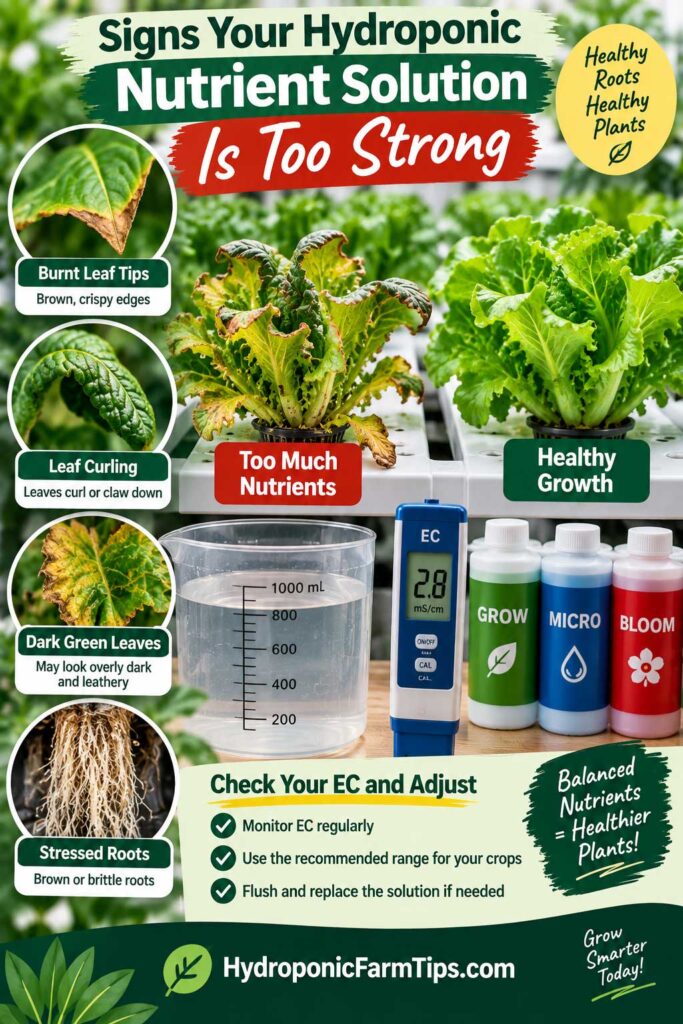
A hydroponic nutrient solution that is too concentrated can stress plants even when every essential mineral is technically present.
The problem is usually excessive dissolved salts. When EC rises too high, roots can have more difficulty taking up water, and plants may begin showing symptoms that look surprisingly similar to drought stress or nutrient deficiency.
Common signs include burned leaf tips, curled or brittle leaf edges, slowed growth, wilting despite plenty of water, and unusually high EC readings. In more severe cases, root health can decline and plant growth may stall.
If the roots themselves look brown, slimy, or unhealthy, also check for hydroponic root rot.
One of the clearest warning signs is a reservoir where the water level keeps dropping while EC continues to rise. This often means the plant is absorbing proportionally more water than nutrients, causing the remaining solution to become increasingly concentrated.
What Causes Nutrient Strength to Get Too High?
EC can climb for several reasons.
The nutrient mix may have started out too strong, fertilizer may have been added every time the reservoir was topped off, or evaporation may have concentrated the solution over time. Mineral-heavy source water and inaccurate measuring can also push EC higher than expected.
Another common issue is leaving the same nutrient solution in the reservoir for too long while repeatedly making small additions.
Small reservoirs are particularly sensitive because even a modest amount of evaporation or extra fertilizer can noticeably change the concentration.
How to Fix an Overly Strong Nutrient Solution
Start by checking the EC and comparing it with the normal range for your crop.
If the reading is clearly too high, gradually dilute the reservoir with plain water. Allow the system to circulate, then measure again before making another adjustment.
If the solution has become severely concentrated or has been in the reservoir for a long time, replacing it with a fresh nutrient mix may be the better option.
Avoid trying to correct stressed plants by adding supplements or more fertilizer. That can make an already concentrated solution even stronger.
Watch New Growth
Damaged leaves may not return to normal after the nutrient strength is corrected, so focus on what happens next.
If fresh leaves develop normally, roots remain healthy, and EC becomes more stable, the plant is likely recovering.
The best way to prevent overfeeding is simple: measure your nutrient solution, monitor EC trends, and make small adjustments instead of assuming more fertilizer will produce faster growth.
Signs Your Hydroponic Plants Aren’t Getting Enough Nutrients
When a hydroponic nutrient solution is too weak, plants may not receive enough minerals to support normal growth.
The symptoms can vary depending on which nutrient is lacking, but common signs include slow growth, pale leaves, yellowing, weak stems, smaller new leaves, and reduced flowering or fruit production.
If you’re trying to identify a specific problem, our guide to hydroponic nutrient deficiencies explains the symptoms of individual nutrient shortages and how to tell a true deficiency from nutrient lockout.
The important thing is not to assume every yellow leaf means the reservoir needs more fertilizer. If yellowing is the main symptom, our guide to hydroponic leaves turning yellow covers pH problems, root stress, lighting, oxygen, and other common causes. Incorrect pH, damaged roots, low oxygen, high water temperature, and nutrient lockout can produce very similar symptoms.
Low EC Can Be a Clue
If your plants are actively growing and the EC repeatedly drops below the normal range for the crop, the nutrient solution may be too weak.
For example, if the reservoir water level is falling and EC is also dropping, the plants may be taking up nutrients faster than they are being replaced.
That can be a useful sign that nutrient strength should be increased slightly.
Different Deficiencies Look Different
Some nutrient problems tend to appear in predictable parts of the plant.
A lack of nitrogen often causes older leaves to become pale or yellow because the plant can move nitrogen into newer growth.
Iron problems are more likely to appear first in young leaves, often as yellowing between the veins.
Magnesium deficiency commonly affects older leaves and can produce interveinal yellowing, while calcium problems usually appear in newer growth because calcium is not easily moved around inside the plant.
These patterns can help narrow down the problem, but they should always be considered alongside EC, pH, root health, and environmental conditions.
Check pH Before Adding More Nutrients
A reservoir can contain plenty of fertilizer while the plant still appears deficient.
If pH is outside the appropriate range, certain minerals may become harder for the roots to absorb. Adding more fertilizer in that situation can raise EC without fixing the underlying problem.
Before increasing nutrient strength, check the EC or PPM, pH, root condition, water temperature, and reservoir oxygenation.
If those factors are all in a healthy range and EC remains consistently low, then increasing nutrient concentration may be appropriate.
Increase Nutrient Strength Gradually
Avoid making a large correction all at once.
Add a small amount of nutrient, allow the reservoir to circulate, and check EC again. Continue gradually until you reach an appropriate range for the crop and growth stage.
Young plants should remain on the milder end of the range, while established fruiting crops generally require more.
Watch the New Growth
Like nutrient burn, deficiency damage does not always disappear from older leaves once the problem is corrected.
The best indicator is often what happens next.
If new leaves emerge with healthier color, growth resumes, and the reservoir behaves more predictably, the plant is likely responding to the correction.
The goal is to fix the cause of the deficiency, not simply add more fertilizer every time leaves begin to yellow.
Do Hydroponic Nutrients Expire?
Hydroponic nutrients can lose quality over time, but how long they last depends on whether you are using a liquid or dry formula and how it is stored.
In general, dry nutrients have a much longer storage life than liquid concentrates because they contain little or no water. If they are kept sealed, dry, and protected from humidity, they can remain usable for a long time.
Liquid nutrients are more sensitive to age, temperature, contamination, and repeated opening.
How Long Do Liquid Hydroponic Nutrients Last?
There is no single expiration period that applies to every brand.
Some manufacturers provide specific shelf-life recommendations, while others simply advise storing the product in a cool, dark place and using it within a reasonable period after opening.
Over time, liquid nutrients may separate, form sediment or crystals, change color, or lose their normal consistency. In some cases, contamination can also become a problem.
A small amount of settling is normal with certain products and does not automatically mean the nutrient has gone bad. Shake the bottle if the manufacturer recommends it and inspect the product before use.
How Long Do Dry Hydroponic Nutrients Last?
Dry nutrient powders are generally much more stable.
The biggest threat is moisture.
If humidity gets into the container, the powder can clump, harden, or begin reacting before you ever add it to the reservoir.
The best approach is to keep the container tightly sealed, store it somewhere cool and dry, avoid direct sunlight, and never return damp scoops or measuring tools to the package.
Properly stored dry nutrients are especially useful for growers who maintain larger systems or buy fertilizer in bulk.
What About Premixed Nutrient Solution?
A reservoir that has already been mixed is different from the concentrated nutrient in the original bottle.
Once nutrients are diluted in water, the solution is exposed to air, microorganisms, changing pH, plant roots, and temperature fluctuations.
For that reason, it should not be treated like a concentrate that can sit indefinitely.
If a mixed solution has been sitting unused for a long period, especially in warm conditions, preparing a fresh reservoir is usually the safer choice.
Signs a Nutrient Product May No Longer Be Good
Be cautious if you notice a strong or unusual odor, visible mold, obvious contamination, severe separation that will not remix, extensive crystallization, or damaged packaging.
Some physical changes can be harmless, so when in doubt, check the manufacturer’s storage guidance before deciding to discard an older product.
Best Way to Store Hydroponic Nutrients
Keep liquid nutrients in their original containers with the caps tightly closed.
Store them in a cool, dark location away from direct sunlight, heaters, extreme heat, and freezing temperatures.
Dry nutrients should be protected from humidity above all else.
Good storage can extend the usable life of your nutrients, reduce waste, and make buying larger quantities more economical.
Do You Need Cal-Mag in Hydroponics?
Not every hydroponic garden needs a separate Cal-Mag supplement.
A complete nutrient formula may already provide enough calcium and magnesium for the plants you are growing. Adding extra Cal-Mag automatically can sometimes push EC higher than necessary or upset the balance of the nutrient solution.
A better approach is to look at your water source, base nutrient, crop type, and plant symptoms before deciding whether you actually need it.
When Cal-Mag Can Be Helpful
A separate calcium and magnesium supplement can be useful when you are growing with reverse-osmosis water or very soft water, because these water sources contain very little calcium and magnesium naturally.
It may also make sense if your base nutrient is relatively low in either mineral, you are growing heavy-feeding fruiting crops, or you have confirmed symptoms of a calcium or magnesium deficiency.
Tomatoes, peppers, cucumbers, and other fast-growing fruiting crops deserve particular attention because their calcium demand can increase as growth accelerates.
Signs of Calcium Problems
Calcium problems usually affect new growth because calcium does not move easily from older leaves into newer tissues.
You may notice distorted young leaves, damaged growing tips, weak new growth, or problems developing in fruit.
However, low calcium in the reservoir is not always the real cause.
Poor water movement through the plant, high humidity, root stress, excessive EC, and other environmental conditions can interfere with calcium transport even when enough calcium is present in the nutrient solution.
That means adding more Cal-Mag may not solve the problem.
Signs of Magnesium Deficiency
Magnesium deficiency commonly appears on older leaves first.
The tissue between the veins may turn yellow while the veins remain greener. As the problem progresses, affected leaves can become increasingly pale or damaged.
Before adding a supplement, check pH and nutrient strength. A plant can show deficiency symptoms because it cannot absorb a nutrient effectively, not because the reservoir contains none of it.
Check Your Base Nutrient First
Before buying Cal-Mag, read the guaranteed analysis or nutrient information for your hydroponic fertilizer.
Some complete formulas already contain significant amounts of calcium and magnesium.
If your nutrient already supplies both and the plants look healthy, adding another supplement may provide little benefit.
More nutrients are not automatically better.
Water Quality Matters
Your source water can make a big difference.
Hard tap water may already contain substantial calcium and magnesium. Reverse-osmosis water, on the other hand, has had most dissolved minerals removed.
This is one reason two growers using the same nutrient formula can get different results.
Knowing the EC of your starting water and, when possible, reviewing your local water-quality report can help you understand what is already entering the reservoir.
Should Beginners Use Cal-Mag?
Do not make Cal-Mag an automatic part of your routine just because it is frequently recommended online.
Start with a complete hydroponic nutrient, keep pH and EC within an appropriate range, and watch how the plants respond.
If your water source or nutrient formula leaves you short on calcium or magnesium, then a supplement can be useful.
The goal is to correct an actual need, not add another bottle simply because it is popular.
Can You Use Regular Fertilizer in Hydroponics?
Regular garden fertilizer is generally not the best choice for hydroponic systems.
Soil fertilizers are designed to work with soil, organic matter, and microorganisms. Hydroponic plants, by contrast, depend on nutrients dissolved directly in water, so the fertilizer needs to be highly soluble and complete enough to supply everything the roots need.
Some conventional fertilizers can dissolve in water, but that does not automatically make them suitable for hydroponics.
Why Soil Fertilizers Can Cause Problems
Regular fertilizers may be missing nutrients that hydroponic plants need in meaningful amounts, particularly calcium, magnesium, or certain micronutrients.
Others may contain ingredients that do not dissolve completely, which can lead to sediment in the reservoir, clogged pumps or emitters, unbalanced nutrient ratios, unpredictable EC, micronutrient deficiencies, or salt buildup around the roots.
These problems can be especially troublesome in NFT, drip, and aeroponic systems where narrow tubing or small emitters need to stay clean.
Hydroponic Nutrients Are Designed to Stay Available in Water
A good hydroponic fertilizer is formulated so its mineral nutrients dissolve readily and remain available to plant roots.
Complete hydroponic formulas typically provide nitrogen, phosphorus, potassium, calcium, magnesium, sulfur, and essential micronutrients in forms intended for water-based growing.
That makes reservoir management more predictable and reduces the amount of guesswork involved.
What About Water-Soluble Garden Fertilizers?
A water-soluble garden fertilizer may work better than a granular soil fertilizer, but you still need to examine the formula carefully.
Look beyond the N-P-K numbers.
A product may provide plenty of nitrogen, phosphorus, and potassium while still lacking calcium or other essential nutrients needed for long-term hydroponic growth.
If the fertilizer is not designed for hydroponics, you may end up supplementing several missing minerals and making the feeding program more complicated than necessary.
Can Miracle-Gro Be Used in Hydroponics?
Some water-soluble Miracle-Gro products can technically supply plants with nutrients, and growers sometimes experiment with them in simple systems.
However, a general-purpose garden fertilizer would not be my first choice for a hydroponic vegetable or herb garden. Depending on the exact product, the nutrient profile may not be ideal for hydroponic crops, and additional calcium, magnesium, or micronutrient management may be necessary.
For beginners, a complete fertilizer specifically formulated for hydroponics is usually much easier to manage.
What About Kratky Systems?
Even simple passive systems such as Kratky benefit from proper hydroponic nutrients.
The lack of a pump does not change what the plant requires nutritionally. Lettuce growing in a Kratky jar still needs a complete, soluble nutrient solution at an appropriate concentration and pH.
When Could a Non-Hydroponic Fertilizer Work?
Experienced growers sometimes formulate their own nutrient solutions using individual fertilizer salts or agricultural products.
That is very different from simply pouring ordinary garden fertilizer into a reservoir.
Custom formulation requires an understanding of elemental nutrient concentrations, fertilizer compatibility, calcium and magnesium requirements, micronutrients, EC, pH, and crop-specific feeding needs.
It can work extremely well, but it requires more knowledge and precise measuring.
The Better Choice for Beginners
If you are new to hydroponics, use a nutrient clearly labeled for hydroponic growing.
That removes a major variable from the system and makes troubleshooting much easier.
When a plant develops yellow leaves, slow growth, or another problem, you already have enough factors to investigate without also wondering whether the fertilizer itself is incomplete.
For most home growers, a complete hydroponic nutrient is worth the small extra cost for the consistency and simplicity it provides.
Are Organic Nutrients Good for Hydroponics?
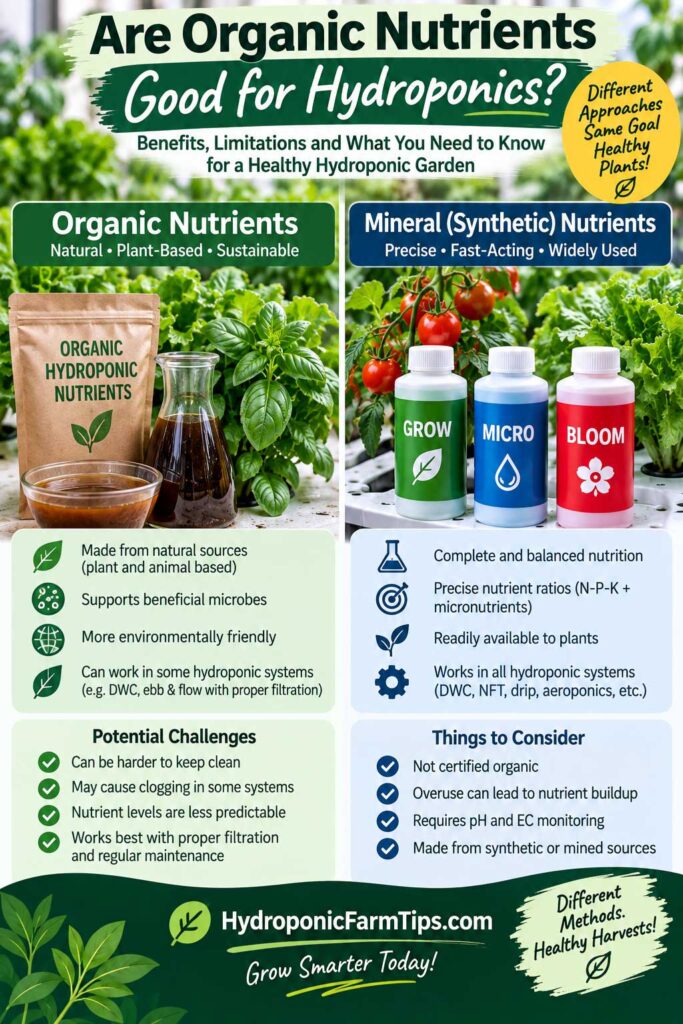
Organic nutrients can be used in hydroponics, but they are generally more complicated to manage than conventional mineral nutrients.
The main difference is that many organic fertilizers contain nutrient compounds that need to be broken down by microorganisms before plants can use them efficiently. In soil, this biological activity happens naturally. In a water-based hydroponic system, the microbial environment is very different.
That does not mean organic hydroponics is impossible. It simply requires more attention to filtration, oxygenation, biological activity, and system cleanliness.
Keeping light out of the reservoir also helps prevent algae in hydroponics, which can complicate nutrient management further.
Why Organic Nutrients Can Be More Difficult
Organic fertilizers may contain suspended particles or complex compounds that do not remain as cleanly dissolved as mineral salts.
Depending on the product and system, this can contribute to biofilm buildup, cloudy nutrient solution, clogged tubing or emitters, stronger odors, reduced oxygen levels, less reliable EC readings, and faster microbial growth.
These issues can be especially troublesome in NFT, aeroponic, and drip systems where narrow channels, tubing, or emitters need to stay clean.
Mineral Nutrients Are Usually Easier
Most conventional hydroponic fertilizers use mineral salts that dissolve readily in water and become directly available to plant roots.
That makes them easier to measure with an EC meter and generally more predictable in recirculating systems.
When you’re still learning EC and pH, that predictability makes troubleshooting a lot easier.
If you’re learning how to manage pH, EC, water temperature, oxygen, and reservoir changes at the same time, adding a more complex biological nutrient system can make troubleshooting harder.
Can You Grow Organic Hydroponic Vegetables?
Yes, plants can be grown hydroponically using organic nutrient sources, but the process may look different from a standard mineral-based setup.
Some growers use biological filtration or microbial systems that help convert organic compounds into plant-available nutrients.
Aquaponics is another example of a biologically driven growing system, where waste is processed by microorganisms and converted into nutrients plants can absorb.
These approaches can work well, but they require a better understanding of the biological side of nutrient cycling.
Which Hydroponic Systems Handle Organic Nutrients Better?
Systems with larger passages and fewer small emitters are generally easier to manage than systems that rely on very fine tubing or misting nozzles.
For example, some growers find larger DWC or media-based systems easier to adapt to biological nutrient programs than aeroponic systems with tiny spray nozzles.
Regardless of system type, strong aeration and good sanitation become especially important when organic matter is present in the reservoir.
Organic Does Not Automatically Mean Better for Plants
From the plant’s point of view, nutrients still have to reach the roots in forms the plant can absorb. The main difference is how those nutrients become available in the reservoir.
A mineral hydroponic fertilizer supplies many nutrients in immediately soluble forms, while organic materials may first require microbial processing.
That is why nutrient balance, oxygen, pH, root-zone conditions, and overall system management still matter more than whether the fertilizer is labeled organic.
Should Beginners Use Organic Hydroponic Nutrients?
For most beginners, I would start with a complete mineral hydroponic nutrient.
It is easier to measure, easier to troubleshoot, and generally produces a cleaner reservoir.
Once you are comfortable managing nutrient strength, pH, oxygen, and water quality, experimenting with organic or biologically active nutrient systems becomes much easier.
If your main goal is reliable vegetables and herbs with the least complicated nutrient routine, a complete mineral hydroponic fertilizer is usually the simpler choice.
Common Hydroponic Nutrient Mistakes to Avoid
Even a high-quality nutrient formula can produce poor results if it is mixed or managed incorrectly. Most hydroponic nutrient problems come from concentration, pH, water quality, or inconsistent reservoir maintenance rather than the fertilizer brand itself.
1. Starting Seedlings at Full Strength
Young plants usually need a much weaker nutrient solution than mature plants.
Using full-strength fertilizer too early can stress delicate roots, raise EC too quickly, and cause leaf-tip burn before the plant is established.
Start mild and increase nutrient strength gradually as the root system develops.
2. Mixing Concentrated Nutrients Together
Never combine concentrated nutrient components in the same measuring cup unless the manufacturer specifically instructs you to do so.
Certain minerals can react with one another at high concentration and form insoluble compounds.
Instead, add each component separately to water and mix thoroughly before adding the next.
3. Ignoring the EC of Your Starting Water
Tap water may already contain a significant amount of dissolved minerals.
If your source water begins at a relatively high EC, adding a full dose of fertilizer can push the final solution above the range your plants need.
Always check your baseline water when possible.
4. Adjusting pH Before Adding Nutrients
Nutrients often change the pH of the water.
If you adjust pH first and then add fertilizer, you may have to correct it again afterward.
A more efficient routine is:
Water → nutrients → EC adjustment → pH adjustment
5. Adding More Nutrients Without Checking EC
Yellow leaves or slow growth do not automatically mean your plants need more fertilizer.
Incorrect pH, root rot, low oxygen, high water temperature, nutrient imbalance, or excessive EC can all produce similar symptoms.
Adding more fertilizer without checking the reservoir can make the underlying problem worse.
6. Using the Same Nutrient Strength for Every Crop
Lettuce, basil, tomatoes, peppers, and cucumbers do not all need the same nutrient concentration.
Leafy greens usually perform well at a lower EC than mature fruiting crops.
If different plants share one reservoir, try to group crops with reasonably similar feeding requirements.
7. Adding Cal-Mag Automatically
Cal-Mag can be useful, but not every hydroponic garden needs it.
If your base nutrient already provides adequate calcium and magnesium, adding more may increase EC without solving anything.
Check your nutrient formula and water quality first.
8. Topping Off With Nutrients Every Time
As the reservoir level drops, many beginners automatically add more fertilizer.
That can slowly increase nutrient concentration over time.
If EC is stable or rising, plain water may be all you need for a top-off.
Measure first, then decide.
9. Ignoring Reservoir Changes
Hydroponic nutrient solutions do not stay chemically identical forever.
Plants remove some minerals faster than others, water evaporates, pH shifts, and organic material can accumulate.
Regular reservoir changes help restore nutrient balance instead of endlessly correcting an aging solution.
10. Chasing Perfect Numbers
Trying to hold EC or pH at exactly one number can lead to constant adjustments.
A healthy hydroponic system normally fluctuates somewhat throughout the day.
It is usually better to keep measurements within a suitable range and watch the overall trend rather than correcting every tiny change.
11. Forgetting to Calibrate Your Meters
A pH or EC meter is only useful if the reading is reasonably accurate.
Over time, probes can drift.
Calibrate your meter according to the manufacturer’s instructions and store the probe correctly. If readings suddenly stop making sense, verify the meter before changing the nutrient solution.
12. Assuming More Fertilizer Means Faster Growth
Higher EC does not automatically mean faster growth. Once nutrient concentration becomes excessive, plants can have more difficulty taking up water and may become stressed.
Aim for the appropriate range for your crop rather than the highest EC you can maintain.
Frequently Asked Questions About Hydroponic Nutrients
What are the best hydroponic nutrients for beginners?
For beginners, the best hydroponic nutrients are usually complete formulas that are easy to measure and clearly labeled for hydroponic use. One-part liquids are the simplest, while systems such as General Hydroponics FloraSeries offer more flexibility once you become comfortable adjusting nutrient ratios.
What nutrients are best for hydroponic vegetables?
Hydroponic vegetables need a complete nutrient solution containing nitrogen, phosphorus, potassium, calcium, magnesium, sulfur, and essential micronutrients.
Fruiting crops such as tomatoes, peppers, and cucumbers often benefit from a nutrient program that can be adjusted as plants move from vegetative growth into flowering and fruit production.
What nutrients are best for hydroponic herbs?
Herbs such as basil, parsley, cilantro, and mint generally perform well with a balanced vegetative nutrient.
A simple one-part liquid can work well for small herb gardens, while larger systems may benefit from more economical dry nutrients.
Can I use the same hydroponic nutrients for lettuce and tomatoes?
Yes, many nutrient products can be used for both lettuce and tomatoes, but they should not necessarily be mixed at the same strength.
Lettuce usually prefers a milder solution, while mature tomato plants typically need a higher EC and a different nutrient balance during flowering and fruit production.
If possible, grow crops with very different nutrient requirements in separate reservoirs.
How often should I add nutrients to hydroponic water?
There is no fixed schedule that works for every system.
Check the reservoir’s EC or PPM before adding more nutrients. If EC is falling and the plants are actively growing, additional nutrients may be needed. If EC is stable or rising, adding more fertilizer could make the solution too strong.
Periodic reservoir changes also help restore nutrient balance because plants do not absorb every mineral at exactly the same rate.
Should I add nutrients every time I add water?
No.
If the water level drops but EC stays the same or rises, plain water may be all you need.
Adding nutrients every time you top off the reservoir can gradually make the solution too concentrated, so check EC before deciding whether to add water, nutrients, or both.
Do hydroponic plants need Cal-Mag?
Not always.
Many complete hydroponic nutrients already contain calcium and magnesium. A separate Cal-Mag supplement may be useful with reverse-osmosis water, very soft water, a base nutrient that is low in calcium or magnesium, or when a genuine deficiency has been identified.
Are liquid or powdered hydroponic nutrients better?
Neither is inherently better for plant growth.
Liquid nutrients are usually more convenient and beginner-friendly, while dry nutrients are often cheaper per gallon, easier to store, and more practical for larger hydroponic systems.
Can I use Miracle-Gro in hydroponics?
Some water-soluble garden fertilizers can technically supply plants with nutrients, but they are not always formulated to provide everything a hydroponic plant needs.
For most beginners, a complete fertilizer made specifically for hydroponics is easier to manage and troubleshoot.
Do hydroponic nutrients affect pH?
Yes.
Adding nutrients can change the pH of your water, which is why it usually makes sense to mix the nutrients first, check EC, and then measure and adjust pH.
Because pH can continue to shift as plants absorb water and minerals, it should be monitored regularly rather than checked only when the reservoir is first mixed.
Final Thoughts: Choosing the Best Hydroponic Nutrients
The best hydroponic nutrient depends on what you’re growing, the size of your system, and how much control you want over feeding.
For most home growers who want flexibility, General Hydroponics FloraSeries is a strong all-around option because it can be adjusted for leafy growth, flowering, and fruiting.
If you’re running a larger vegetable garden and want to reduce nutrient costs, MasterBlend 4-18-38 is a practical choice, especially for crops such as tomatoes, peppers, cucumbers, and leafy greens.
For beginners who want the simplest routine, a one-part liquid nutrient can make reservoir maintenance much easier. If you want the savings of dry nutrients without managing several separate powders, MaxiGro and MaxiBloom offer a straightforward middle ground.
Whatever product you choose, correct use matters more than chasing the strongest formula. Keep EC within an appropriate range, monitor pH, avoid overfeeding, and adjust nutrient strength as plants mature.
Hydroponic plants do not need the strongest solution possible. They need a balanced, stable nutrient solution that matches the crop and its stage of growth.
If you’re unsure what EC, PPM, or pH to use for a particular plant, use our Hydroponic Nutrient & pH Chart for a quick crop-by-crop reference.
More Hydroponic Gardening Guides You May Like
If you are choosing nutrients or trying to keep your hydroponic plants healthy, these guides can help you manage feeding, pH, water quality, and common nutrient-related problems.
- Hydroponic Nutrient Deficiencies: Signs, Causes & Fixes — Learn how to recognize common nutrient deficiencies, tell them apart from nutrient lockout, and correct problems before plant growth is seriously affected.
- Hydroponic Nutrient & pH Chart — Compare recommended pH, EC, and nutrient ranges for popular hydroponic vegetables, herbs, and fruiting crops.
- Best pH for Hydroponics — Understand how pH affects nutrient availability and why maintaining the correct range is essential for healthy growth.
- How Often Should You Change Hydroponic Water? — Learn when to replace your nutrient solution, when to top off with water, and how reservoir changes help restore nutrient balance.
- Why Are My Hydroponic Leaves Turning Yellow? — Diagnose yellow leaves caused by nutrient problems, incorrect pH, root stress, lighting, oxygen issues, and other common causes.
- Hydroponic Root Rot: Causes, Symptoms & Treatment — Learn how root health, oxygen levels, water temperature, and sanitation can affect nutrient uptake and plant growth.
- Algae in Hydroponics: Causes, Prevention & How to Get Rid of It — Find out why algae develops in nutrient-rich water and how to keep reservoirs, trays, and growing media cleaner.