Getting the best pH for hydroponics is one of the most important parts of keeping your plants healthy. You can have the right nutrients, strong grow lights, and ideal temperatures, but if the pH drifts too far in either direction, your plants may still struggle.
That’s because hydroponic plants depend directly on the nutrient solution around their roots. When the pH is too high or too low, certain nutrients become harder for plants to absorb—even when plenty of those nutrients are already in the reservoir. The result can be yellowing leaves, slow growth, nutrient deficiencies, and disappointing harvests.
For most hydroponic plants, a pH between 5.5 and 6.5 is a good starting range, although the ideal level varies slightly by crop. In this guide, we’ll cover the best hydroponic pH ranges for popular plants, why pH changes, how to test and adjust it, and how to keep your nutrient solution more stable.
What Is pH?
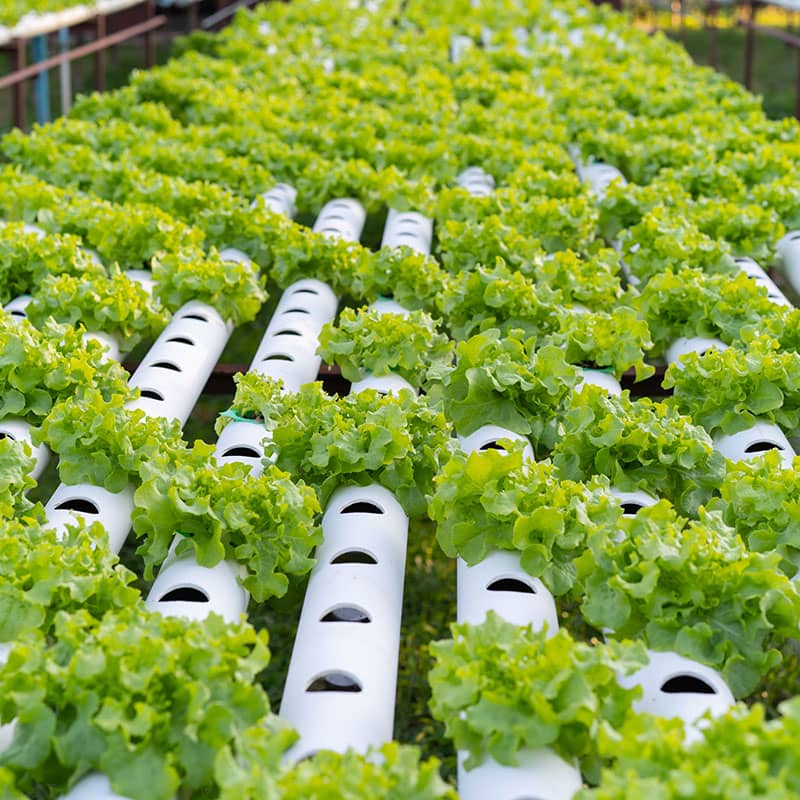
pH is a measure of how acidic or alkaline a solution is. The scale runs from 0 to 14, with 7 considered neutral.
| pH Range | Description |
|---|---|
| Below 7.0 | Acidic |
| 7.0 | Neutral |
| Above 7.0 | Alkaline |
In hydroponics, pH matters because it influences how easily plant roots can take up different nutrients from the nutrient solution.
When the pH moves too far outside a plant’s preferred range, certain nutrients can become less available. This can lead to nutrient deficiencies or nutrient lockout, where nutrients may be present in the reservoir but the plant has difficulty absorbing them efficiently.
That’s why keeping pH within the recommended range is just as important as providing the right amount of nutrients in the first place.
Why pH Matters in Hydroponics
Unlike soil, a hydroponic system has much less natural buffering around the roots. This means changes in the nutrient solution can affect the root zone more directly, making pH management especially important in hydroponics.
The right pH helps keep essential nutrients available for uptake. When the solution stays within the appropriate range, plants are better able to absorb nutrients such as nitrogen, phosphorus, potassium, calcium, magnesium, and iron.
Maintaining a suitable pH can help:
- Improve nutrient availability and uptake
- Support healthy root development
- Prevent or reduce nutrient deficiencies
- Encourage consistent growth
- Support flowering, fruiting, and overall yields
- Reduce stress caused by nutrient imbalances
Some pH movement is completely normal as plants take up water and nutrients. The goal isn’t to keep the reservoir at one exact number all the time, but to prevent pH from staying outside the recommended range for too long.
The Ideal Hydroponic pH Range
For most plants, the best pH for hydroponics is between 5.5 and 6.5. This slightly acidic range helps keep most essential nutrients available to plant roots.
Many growers aim for a narrower target of around 5.8–6.2, but you don’t need to keep the nutrient solution at one exact number. A gradual drift within the recommended range is normal and can even allow different nutrients to become more available at different points.
Quick answer: For most hydroponic plants, keep the nutrient solution between pH 5.5 and 6.5, with 5.8–6.2 serving as a useful general target.
The ideal pH can vary slightly depending on the crop, so lettuce, basil, tomatoes, strawberries, and other plants won’t necessarily share the exact same sweet spot. We’ll compare their recommended ranges below.
Why a pH of 5.5 to 6.5 Works Well
Plants need a combination of macronutrients—including nitrogen, phosphorus, potassium, calcium, and magnesium—as well as smaller amounts of micronutrients such as iron, manganese, zinc, copper, and boron.
The availability of these nutrients changes as the pH of the nutrient solution changes. For a crop-by-crop comparison, see our hydroponic nutrient and pH chart, which includes recommended pH and EC ranges for popular hydroponic plants. In hydroponics, keeping the root zone slightly acidic helps maintain a useful balance: most essential nutrients remain available without pushing the solution too far toward conditions where certain nutrients become harder for roots to take up.
For example, iron, manganese, and some other micronutrients generally become less available as pH rises, while very low pH can create its own nutrient imbalances and may increase the availability of some elements beyond desirable levels.
This is why growers generally work within a range rather than chasing one exact number. For many hydroponic crops, pH 5.5–6.5 provides a practical window for nutrient availability, although the best target still depends on the plant being grown.
Best pH for Different Hydroponic Crops
Although 5.5–6.5 is a useful general pH range for hydroponics, individual crops have slightly different preferences. Leafy greens and herbs often do well toward the lower end of the range, while many fruiting crops tolerate a somewhat broader range.
Use the chart below as a practical starting point rather than an absolute rule. Cultivar, nutrient formula, water quality, growth stage, and growing conditions can all influence how plants respond.
Hydroponic pH Chart
| Crop | Recommended pH Range |
|---|---|
| Lettuce | 5.5–6.0 |
| Spinach | 5.8–6.5 |
| Kale | 5.5–6.5 |
| Basil | 5.5–6.5 |
| Mint | 5.5–6.5 |
| Tomatoes | 5.5–6.5 |
| Peppers | 5.5–6.5 |
| Cucumbers | 5.5–6.5 |
| Strawberries | 5.5–6.5 |
Recommended pH ranges can vary somewhat among horticultural sources, nutrient programs, cultivars, and hydroponic systems, so use these values as practical starting points rather than rigid limits.
Lettuce
Lettuce generally prefers a slightly acidic nutrient solution. Keeping pH around 5.5–6.0 is a practical target for hydroponic lettuce and helps maintain good nutrient availability during its rapid vegetative growth.
Spinach
For hydroponic spinach, aim for approximately pH 5.8–6.5. Rather than trying to hold the reservoir at one exact number, focus on keeping conditions stable and monitoring the plants for signs of nutrient problems.
Kale
Kale is relatively adaptable and generally performs well around pH 5.5–6.5. Its broader working range makes it a fairly forgiving leafy green for hydroponic growers.
Basil
Hydroponic basil generally does well around pH 5.5–6.5. Maintaining the solution within this range helps keep essential nutrients available while the plant produces new leaves and stems.
Mint
Mint is another adaptable hydroponic herb and can generally be grown around pH 5.5–6.5. Because mint grows quickly under favorable conditions, regularly checking both pH and nutrient strength can help keep growth consistent.
If herbs are your main focus, our guide to the best hydroponic herbs to grow covers more options along with their growing requirements.
Tomatoes
Hydroponic tomatoes generally perform well around pH 5.5–6.5. Maintaining an appropriate pH is particularly important for keeping nutrients such as calcium available, although problems such as blossom-end rot can also be influenced by water uptake, root-zone conditions, and environmental stress.
Peppers
Bell peppers and hot peppers can generally be grown hydroponically around pH 5.5–6.5. Keeping the nutrient solution slightly acidic supports the availability of both macronutrients and micronutrients throughout vegetative growth, flowering, and fruit development.
Cucumbers
A practical target for hydroponic cucumbers is around pH 5.5–6.5. Cucumbers grow rapidly and use large amounts of water and nutrients, so pH should be checked regularly rather than relying on a single initial adjustment.
Strawberries
Hydroponic strawberries generally prefer a slightly acidic root zone, with pH 5.5–6.5 providing a useful working range. Consistent pH management supports nutrient availability, but fruit size, flavor, and yield also depend heavily on light, temperature, cultivar, pollination, and overall nutrition.
Strawberries are only one option for fruiting systems. See our guide to the best hydroponic fruits to grow for more crops you can try.
What Happens When Hydroponic pH Is Too Low?
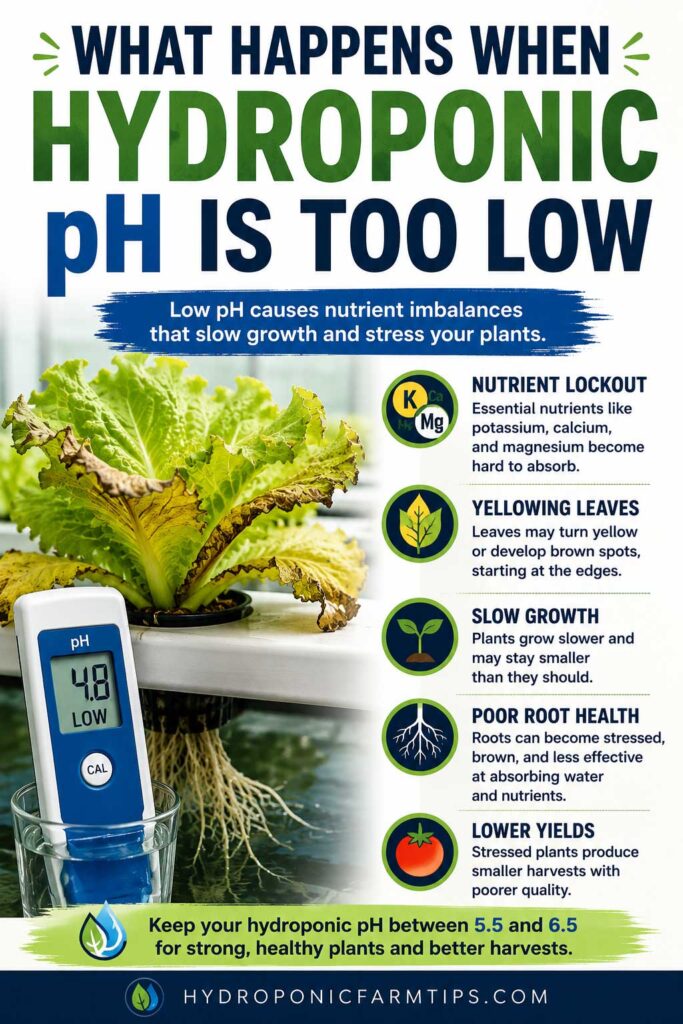
When hydroponic pH drops below the recommended range for your crop, the balance of nutrient availability begins to change. Some nutrients may become overly available, while the uptake of others can be disrupted.
Possible signs of prolonged low pH include:
- Slower or stunted growth
- Leaf discoloration or spotting
- Nutrient deficiency symptoms
- Nutrient imbalances
- Poor root development
- Increased plant stress
Very acidic conditions can also damage sensitive roots and interfere with normal nutrient uptake. However, these symptoms aren’t unique to low pH—they can also be caused by incorrect nutrient strength, root disease, temperature stress, or other growing problems.
If your plants suddenly begin showing deficiency symptoms, check the reservoir pH and EC before adding more nutrients. Correcting the root-zone conditions may solve the problem without increasing fertilizer strength.
See also
What Happens When Hydroponic pH Is Too High?
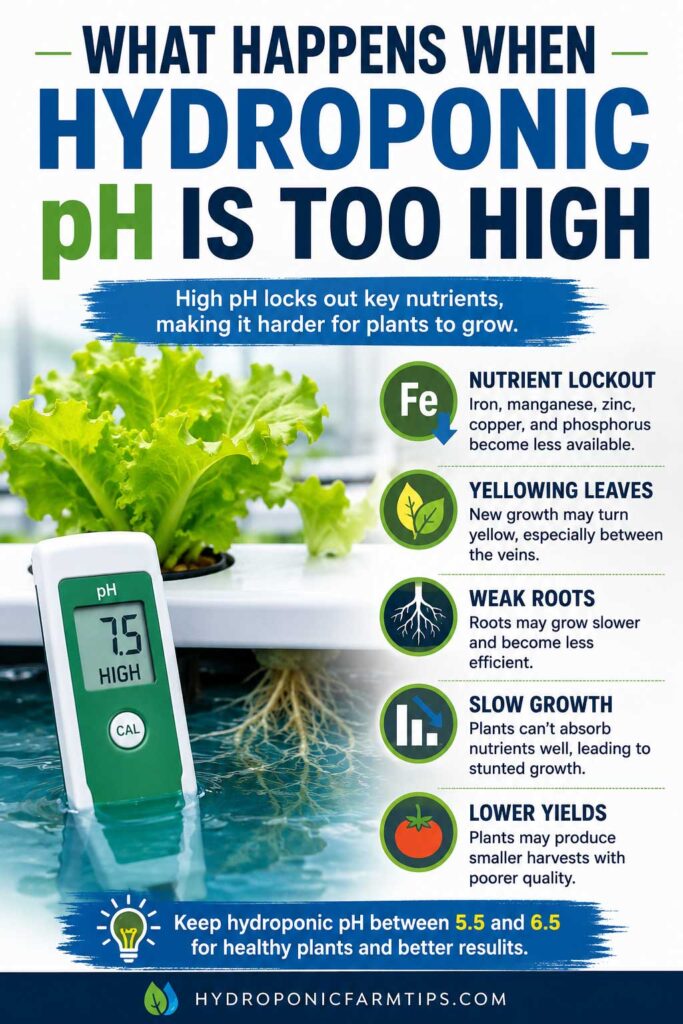
When hydroponic pH rises above the recommended range, some essential nutrients become less available to plant roots. This is especially true for several micronutrients, including iron and manganese.
If high pH continues for too long, plants may begin showing symptoms that look like a nutrient deficiency even when those nutrients are present in the reservoir.
One of the most common signs is interveinal chlorosis, where young leaves turn yellow while the veins remain greener. This is often associated with reduced iron availability. Other possible signs include:
- Yellowing or pale new growth
- Green veins surrounded by lighter leaf tissue
- Slow or uneven growth
- Nutrient deficiency symptoms that persist despite adequate fertilization
This is one reason adding more fertilizer isn’t always the right response to yellowing plants. If nutrients are already present but pH is limiting their availability, increasing the nutrient concentration may create additional problems.
Before adding more nutrients, check both the pH and EC of your nutrient solution. If the pH is too high for the crop you’re growing, gradually bring it back into the recommended range and continue monitoring the plant’s new growth.
Understanding Nutrient Lockout
Nutrient lockout happens when one or more nutrients are present in the hydroponic solution but the plant has difficulty absorbing or using them effectively. An incorrect pH is one of the most common reasons this can happen.
When pH moves too far outside the recommended range, the chemical form and availability of certain nutrients can change. As a result, plants may show deficiency symptoms even though the reservoir contains enough fertilizer.
Nutrient uptake problems can also be related to:
- Excessively high nutrient concentration
- Imbalances between nutrients
- Poor water quality
- Root damage, root rot, or disease
- Incorrect root-zone temperatures
- Low oxygen levels around the roots
Because several problems can produce similar symptoms, don’t automatically add more fertilizer when leaves begin yellowing or growth slows. Check pH and EC first, inspect the roots, and consider the overall condition of the nutrient solution.
If pH is the problem, gradually returning it to the appropriate range can restore nutrient availability, although visible plant recovery may take time.
How Often Should You Check Hydroponic pH?
For most home hydroponic systems, checking pH at least once a day is a good habit, especially when you’re learning how quickly your reservoir changes.
You may want to check more frequently when:
- Setting up a new nutrient solution
- Growing mature plants that consume lots of water
- Using a small reservoir
- Experiencing unusually rapid pH changes
- Adjusting pH Up or pH Down
- Troubleshooting nutrient deficiency symptoms
Once you understand how your system behaves, a stable reservoir may not require constant testing. Larger or automated hydroponic systems may also use continuous pH monitoring and dosing equipment to track changes throughout the day.
Remember that some pH drift is normal. Plants take up water and nutrients at different rates, and factors such as water quality, nutrient concentration, microbial activity, and reservoir conditions can all influence pH.
Rather than trying to hold the solution at one exact number, watch for trends and keep pH within the recommended range for the crop you’re growing.
How to Test Hydroponic pH

There are three common ways to test the pH of a hydroponic nutrient solution: a digital pH meter, liquid test drops, or pH test strips. Each can work, but they differ in precision, convenience, and cost.
Digital pH Meter
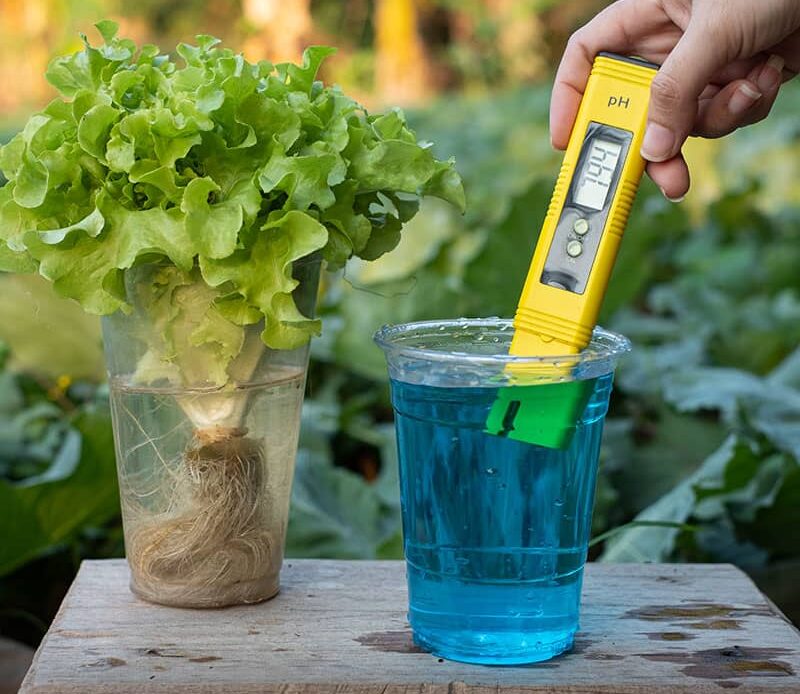
A digital pH meter is usually the most convenient choice if you test your reservoir regularly. Simply place the probe into a sample of the nutrient solution, allow the reading to stabilize, and record the result.
Digital meters provide precise readings when they are properly calibrated, cleaned, and stored according to the manufacturer’s instructions. However, even a good meter can give inaccurate results if the probe isn’t maintained or calibrated regularly.
Best for: Growers who want quick, repeatable readings and frequently monitor their reservoir.
pH Test Drops
Liquid pH test kits work by adding a few drops of indicator solution to a sample of nutrient solution. The resulting color is then compared with a reference chart to estimate the pH.
They’re inexpensive, require no calibration or batteries, and can also be useful as a backup if you suspect your digital meter is giving an incorrect reading.
The downside is that interpreting small differences in color can be difficult, especially when you need a precise measurement.
Best for: Beginners, small systems, and backup testing.
pH Test Strips
pH strips change color after being dipped into the nutrient solution. You compare the strip with the supplied color chart to estimate the pH.
They’re inexpensive and convenient, but many general-purpose strips cover such a wide pH range that they don’t provide much precision within the relatively narrow range used for hydroponics.
If you choose test strips, look for ones designed to measure a narrower acidic range appropriate for hydroponic growing.
Best for: Occasional checks and simple backup testing.
For growers who maintain a hydroponic system regularly, a quality digital pH meter is generally the most practical primary tool, while drops or strips can provide a useful backup.
Affiliate disclosure: This article may contain affiliate links. If you purchase through one of these links, we may earn a commission at no additional cost to you.
Make pH Testing Faster and More Reliable
You don’t need a shelf full of equipment to manage hydroponic pH. A dependable meter, calibration supplies, and a simple backup test can cover most home systems.
Recommended Tools for Testing Hydroponic pH
| Recommended Tool | Why It’s Useful | Best For | Amazon |
|---|---|---|---|
| Digital pH Meter | Gives quick, repeatable pH readings | Regular reservoir testing | Check Price |
| pH Calibration Solution | Helps keep digital meter readings accurate | Meter maintenance | Check Price |
| Liquid pH Test Kit | Simple testing without calibration or batteries | Beginners and backup testing | Check Price |
| Digital EC/TDS Meter | Helps measure nutrient-solution strength alongside pH | Troubleshooting and nutrient management | Check Price |
How to Lower pH in Hydroponics
If your nutrient solution’s pH is above the recommended range, the simplest approach is to use a commercial pH Down product designed for hydroponics. Many hydroponic pH-lowering products are acid-based, with phosphoric acid commonly used in formulations.
To lower the pH safely:
- Measure the current pH before making any adjustments.
- Add the hydroponic pH Down according to the manufacturer’s directions. Start with a small amount rather than trying to reach your target all at once.
- Allow the solution to circulate and mix thoroughly.
- Test the pH again after the solution is well mixed.
- If the pH is still too high, make another small adjustment and retest.
Avoid pouring concentrated pH adjuster directly onto plant roots, and never mix concentrated acids with other chemicals or nutrient concentrates. Follow the product label and use the recommended protective equipment when handling pH-adjusting products.
Most importantly, adjust gradually. It is much easier to lower the pH a little more than to repeatedly correct a reservoir that has been pushed too far in the opposite direction.
How to Raise pH in Hydroponics
If the pH of your nutrient solution falls below the recommended range, use a commercial pH Up product formulated for hydroponics. These products are commonly made with alkaline compounds such as potassium-based ingredients that raise pH in a controlled way.
To raise the pH:
- Test the current pH before making any adjustments.
- Add a small amount of pH Up according to the manufacturer’s directions.
- Allow the nutrient solution to circulate and mix thoroughly.
- Test the pH again once the solution is well mixed.
- Repeat with another small adjustment only if necessary.
Avoid adding concentrated pH Up directly onto plant roots, and never mix concentrated pH adjusters with nutrient concentrates or other chemicals.
Make corrections gradually. Large swings in pH can create more problems than a slightly low reading, so it is better to make small adjustments and retest than to overshoot your target.
Keep Small pH Problems From Becoming Big Ones
Once you can measure pH accurately, the next step is having the right supplies on hand to make small corrections without constantly fighting your reservoir.
Helpful Supplies for Adjusting Hydroponic pH
| Product | Why It’s Helpful | Best For | Amazon |
|---|---|---|---|
| Hydroponic pH Down | Gradually lowers nutrient-solution pH | High-pH reservoirs | Check Price |
| Hydroponic pH Up | Raises nutrient-solution pH when it falls too low | Low-pH reservoirs | Check Price |
| pH Up & Down Kit | Keeps both adjustment options available | New hydroponic growers | Check Price |
| pH Calibration & Storage Solution | Helps maintain digital pH probes | Long-term meter accuracy | Check Price |
Why Does Hydroponic pH Drift?
It is normal for the pH of a hydroponic nutrient solution to change over time. Plants continually remove water and nutrients from the reservoir, while water quality, microbial activity, and other root-zone conditions can also influence the solution.
Understanding why pH moves can help you distinguish normal drift from a problem that needs attention.
Plant Nutrient Uptake
Plants don’t absorb every nutrient at the same rate. As they take up different forms of nitrogen and other mineral ions, the chemical balance around the roots changes, which can cause the reservoir pH to gradually rise or fall.
This is one reason a slowly changing pH isn’t automatically a sign that something is wrong.
Water Quality and Alkalinity
Your source water can have a major effect on pH stability. Water containing higher levels of bicarbonates and other alkaline compounds can resist pH adjustments and cause the reservoir pH to rise again after you lower it.
This is why knowing your water’s alkalinity can be just as useful as knowing its starting pH.
Some growers use filtered or reverse osmosis (RO) water when their tap water makes nutrient and pH management difficult. However, RO water isn’t necessary for every hydroponic system.
Microbial Activity
Microorganisms living in the nutrient solution and around the roots can also influence pH as they break down organic material and carry out biological processes.
Sudden or unusual pH changes combined with discolored, slimy, or foul-smelling roots may indicate a root-zone problem rather than normal pH drift.
Changes in the Reservoir
As plants consume water and nutrients, the concentration and composition of the remaining solution changes. Evaporation can also concentrate dissolved minerals, particularly in warm or uncovered reservoirs.
Topping off the reservoir appropriately, checking pH and EC, and periodically replacing the nutrient solution can make these changes easier to manage.
The key is to watch the direction and speed of pH changes. Slow movement within the recommended range is usually manageable, while rapid or repeated swings may indicate a problem with your source water, nutrient concentration, reservoir, or root health.
Four Things That Make Hydroponic pH Easier to Manage
You don’t need to constantly adjust your reservoir to keep pH under control. Instead, pay attention to the main factors that influence how your nutrient solution behaves:
- Source water: Its starting mineral content and alkalinity can affect how easily pH changes.
- Nutrient solution: Adding nutrients can shift pH, so always test the solution after everything is properly mixed.
- Reservoir conditions: Water level, temperature, plant uptake, and other changes in the reservoir can influence pH over time.
- Crop requirements: Different plants have slightly different preferred pH ranges, so adjust your target for what you’re actually growing.
Once you understand how these factors interact in your own system, it becomes much easier to recognize normal pH drift and know when an adjustment is actually needed.
Tips for Maintaining Stable Hydroponic pH
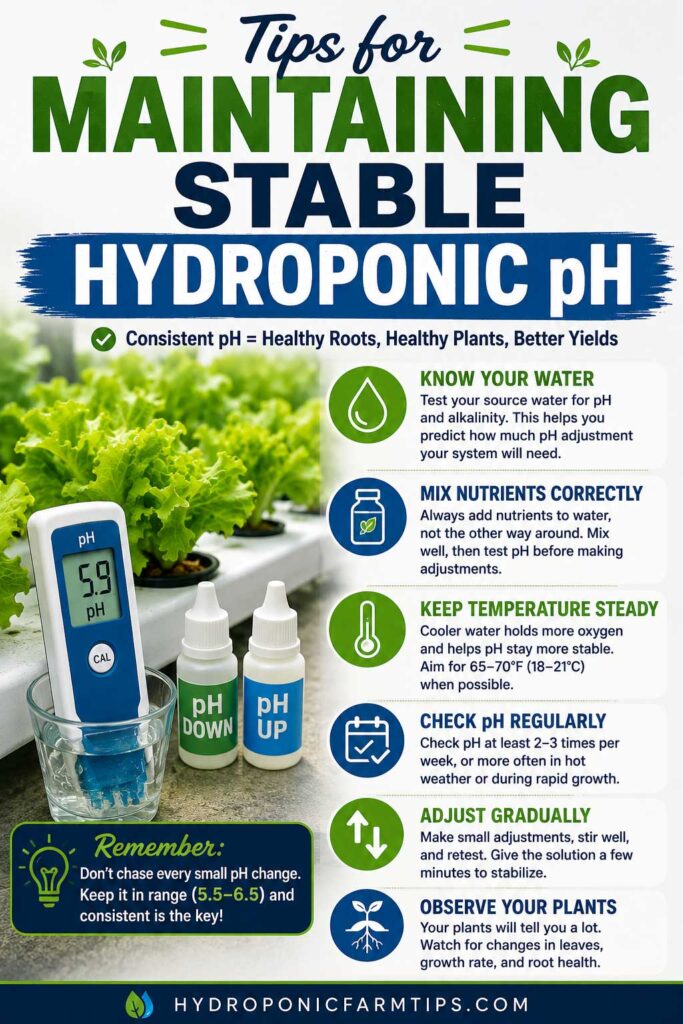
You don’t need to keep your reservoir at one exact pH every minute of the day. The goal is to keep changes manageable and prevent the nutrient solution from remaining outside the recommended range for your plants.
Here are some practical ways to keep hydroponic pH more stable.
Know Your Source Water
Start by testing the water you use to mix your nutrient solution. Tap water can work perfectly well for hydroponics, but its mineral content and alkalinity can affect how easily you can adjust and maintain pH.
For larger or more demanding systems, a laboratory water analysis can provide useful information about pH, alkalinity, EC, and mineral levels that a basic pH meter alone can’t show.
If your source water has high alkalinity or creates persistent nutrient problems, filtered or reverse osmosis (RO) water may provide greater control. RO water isn’t necessary for every grower, however, and its very low mineral content may require appropriate nutrient management.
Use Nutrients Designed for Hydroponics
Choose a complete fertilizer formulated specifically for hydroponic growing rather than a general-purpose soil fertilizer.
Hydroponic nutrients are designed to supply essential elements in forms suitable for a soilless root environment. Always mix them according to the manufacturer’s directions and check the solution before making additional pH adjustments.
Keep the Reservoir Temperature Consistent
Large changes in nutrient-solution temperature can affect the root environment and overall system stability.
Many hydroponic crops perform well with nutrient solutions somewhere around 65–72°F (18–22°C), although the ideal root-zone temperature varies by crop and growing conditions.
Keeping the reservoir out of direct light and away from major heat sources can help reduce temperature swings.
Top Off the Reservoir as Needed
Plants continually remove water from the reservoir, and evaporation can also reduce the solution volume.
Check the water level regularly and top off appropriately. Keep an eye on EC as well as pH, because adding water changes the concentration of dissolved nutrients.
Calibrate and Maintain Your pH Meter
A digital pH meter is only useful when it gives you an accurate reading.
Follow the manufacturer’s instructions for calibration, probe cleaning, and storage. Calibration frequency depends on the meter and how often you use it, so don’t assume a meter remains accurate indefinitely.
Don’t Chase Every Small pH Change
Some pH drift is normal in an active hydroponic system. If your solution moves slightly while remaining within an appropriate range for the crop, you usually don’t need to immediately add pH Up or pH Down.
Frequent corrections can cause unnecessary swings and make the reservoir harder to manage. Instead, watch the overall trend, make gradual adjustments when necessary, and focus on keeping conditions reasonably stable over time.
Common Hydroponic pH Mistakes Beginners Make
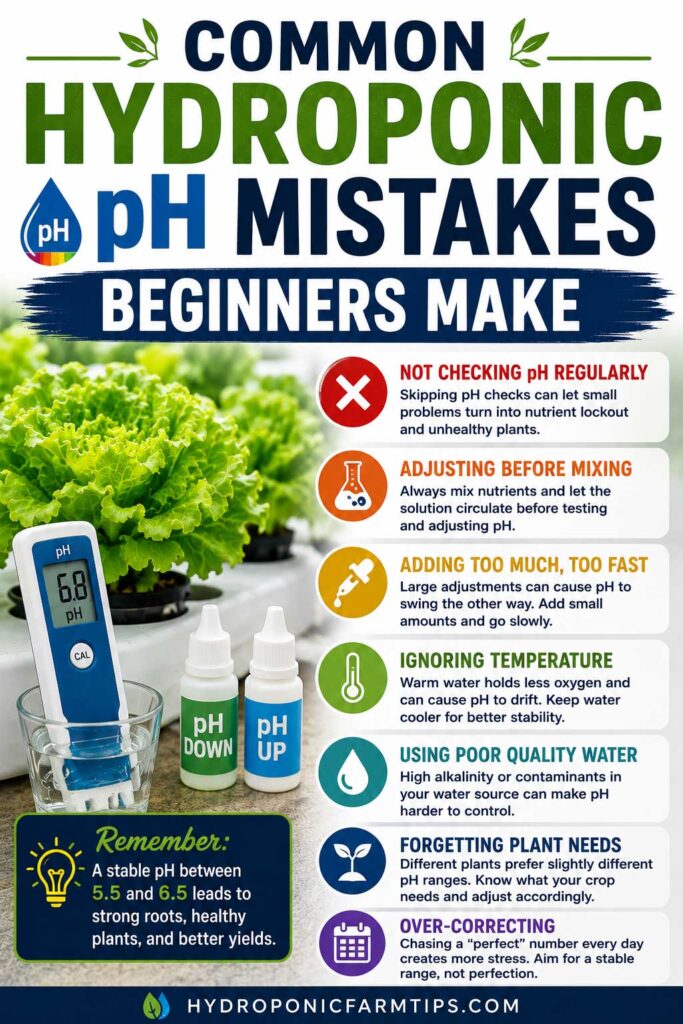
Managing pH becomes much easier once you stop trying to make the reservoir perfect. Most beginner problems come from overcorrecting, inaccurate testing, or changing too many things at once.
Chasing an Exact Number
If your target is around 5.8, don’t panic because the meter reads 5.9 or 6.0. Small changes are normal in an active hydroponic system.
Focus on keeping pH within an appropriate range for the crop you’re growing rather than constantly adjusting the reservoir to hit one exact number.
Forgetting to Calibrate the pH Meter
Digital pH meters can gradually lose accuracy. If the meter is giving you an incorrect reading, you may unknowingly adjust a perfectly good nutrient solution in the wrong direction.
Calibrate and maintain your meter according to the manufacturer’s instructions, especially if the readings suddenly seem unusual.
Making Large pH Corrections
Adding too much pH Up or pH Down at once can cause you to overshoot your target and create unnecessary swings.
Make small adjustments, mix thoroughly, and retest before adding more.
Adjusting pH Before Adding Nutrients
Nutrients can change the pH of your water after they are added. If you adjust plain water first, you may have to correct the pH all over again after mixing the fertilizer.
Unless your nutrient manufacturer’s instructions say otherwise, mix your nutrients first, allow the solution to circulate, and then test and adjust the final pH.
Adding pH Up and pH Down Repeatedly
If you accidentally lower the pH too far, it’s tempting to immediately add pH Up—and then add more pH Down if you overshoot again.
Repeatedly correcting in both directions adds unnecessary compounds to the reservoir. Make small adjustments and give the solution enough time to mix before deciding whether another correction is necessary.
Testing Too Infrequently
A reservoir can change as plants consume water and nutrients. Regular testing helps you notice a developing trend before pH moves far outside the desired range.
This is particularly important with small reservoirs and fast-growing mature plants, where conditions can change relatively quickly.
Assuming Every Deficiency Is a Fertilizer Problem
Yellow leaves or slow growth don’t automatically mean your plants need more nutrients. Incorrect pH, excessive nutrient concentration, root problems, temperature stress, and other issues can produce similar symptoms.
Before adding more fertilizer, check pH and EC and inspect the root system. Finding the actual cause is better than treating the symptoms.
Frequently Asked Questions About Hydroponic pH
Is 7.0 pH Too High for Hydroponics?
For most hydroponic crops, pH 7.0 is higher than the preferred range. As pH rises, nutrients such as iron and manganese can become less available to plants. Most hydroponic crops are generally grown in a slightly acidic nutrient solution, often somewhere around pH 5.5–6.5.
What Is the Best pH for Hydroponics?
For most crops, the best pH for hydroponics is generally between 5.5 and 6.5. A target around 5.8–6.2 works well as a starting point for many plants, but the ideal range varies by crop.
Is 5.5 pH Too Low for Hydroponics?
Not necessarily. A pH of 5.5 is within the commonly used range for many hydroponic crops. However, allowing the solution to remain much lower than the recommended range can affect nutrient availability and eventually stress plants.
Can Hydroponic Plants Grow Outside the Ideal pH Range?
Yes. A brief movement outside the preferred range doesn’t mean your plants will immediately suffer. Problems are more likely when pH remains too high or too low for an extended period or repeatedly swings outside the appropriate range.
How Quickly Should I Adjust Hydroponic pH?
Adjust pH gradually rather than making one large correction. Add a small amount of pH Up or pH Down according to the product directions, allow the nutrient solution to mix thoroughly, and test again before making another adjustment.
Does pH Affect Hydroponic Plant Growth and Yield?
Yes, but indirectly. pH affects the availability and uptake of essential nutrients, which can influence plant health, growth, and productivity. However, yield also depends on factors such as light, temperature, oxygen, nutrient concentration, cultivar, and overall growing conditions.
Should I Check pH Before or After Adding Hydroponic Nutrients?
In most cases, add and mix your hydroponic nutrients first, then measure and adjust the pH. Nutrients can change the pH of the source water, so adjusting beforehand may result in unnecessary additional corrections. Follow the nutrient manufacturer’s mixing instructions when they specify a particular procedure.
Why Does My Hydroponic pH Keep Rising?
A gradually rising pH can occur as plants take up water and nutrients. Source-water alkalinity, especially bicarbonates, can also cause pH to rise or rebound after adjustment. If the increase is rapid or persistent, check your water quality, EC, reservoir conditions, and root health.
Can I Use Tap Water for Hydroponics?
Yes, many growers successfully use tap water. However, its mineral content and alkalinity vary by location. If your tap water makes pH difficult to control, testing its alkalinity and mineral content can help determine whether filtration or reverse osmosis water would be useful.
Keep Your Hydroponic pH in the Right Range
For most plants, the best pH for hydroponics falls between 5.5 and 6.5, with roughly 5.8–6.2 providing a useful starting target for many crops. You don’t need to keep the reservoir locked at one exact number—small changes within the appropriate range are normal.
What matters most is monitoring the overall trend. Check your pH regularly, keep your meter calibrated, and make gradual adjustments when the solution moves outside the recommended range for your crop. If plants begin showing nutrient deficiency symptoms, check both pH and EC before assuming they need more fertilizer.
Once you understand how your reservoir behaves, pH management becomes much easier. Keep the nutrient solution within a suitable range, watch your plants and roots, and adjust only when necessary. Your plants don’t need a perfect number—they need a stable, well-managed root environment.
Keep Learning About Hydroponic Nutrients and Plant Health
Getting pH right is only one part of maintaining a healthy hydroponic system. These guides can help you fine-tune your nutrient solution, choose suitable crops, and troubleshoot common growing problems:
- Hydroponic Nutrient and pH Chart — Compare recommended pH, EC, and nutrient ranges for popular hydroponic crops.
- How to Prevent and Treat Root Rot in Hydroponics — Learn how temperature, oxygen levels, and root-zone conditions affect plant health.
- Best Hydroponic Systems for Home Growing — Compare popular hydroponic systems and find the right setup for your plants.
- Best Hydroponic Herbs to Grow — Discover beginner-friendly herbs and their growing requirements.
- Best Hydroponic Fruits to Grow — Compare fruiting crops that can thrive in hydroponic systems.