Growing fresh herbs and vegetables indoors doesn’t have to mean building a hydroponic system from scratch. Today’s indoor hydroponic garden systems combine many of the essentials—grow lights, water circulation, plant holders, and automated lighting—into one compact setup designed for the home.
That convenience is a big part of their appeal. Instead of choosing a reservoir, pump, net pots, grow light, and timer separately, you can start with a ready-made system and focus on the plants. Some models are small enough for a kitchen counter, while larger systems provide the height and growing space needed for lettuce, herbs, strawberries, and even compact varieties of tomatoes and peppers.
But these gardens aren’t all interchangeable. Light output, plant capacity, maximum growing height, reservoir size, replacement-pod availability, noise, and ongoing costs can make a big difference once you’ve been using a system for a few months. A garden advertised with more planting sites isn’t necessarily the better buy if mature plants become overcrowded or quickly outgrow the light.
In this guide, we’ll compare 8 of the best indoor hydroponic garden systems, looking beyond the marketing claims to see what each one actually offers. We’ll cover the best options for beginners, herbs, leafy greens, small spaces, larger plants, and growers who want more control over their indoor garden.
Whether you want fresh basil within reach of the kitchen or a larger indoor garden you can use throughout the year, the goal is simple: find a hydroponic system you’ll actually enjoy using—and one that gives your plants enough room and light to grow well.
Quick Comparison of the 8 Best Indoor Hydroponic Garden Systems
Before looking at each system in detail, here’s how our top choices compare. We’ve included everything from affordable countertop gardens to larger vertical and DWC systems, so you can choose based on your space, experience level, and the plants you actually want to grow.
| Indoor Hydroponic Garden System | Our Award | Type | Best For | Skill Level |
|---|---|---|---|---|
| LetPot LPH-SE | 🏆 Best Overall | 12-pod countertop | Herbs, lettuce & everyday indoor growing | Beginner |
| Ahopegarden Hydroponic Growing System | 💰 Best Budget | Countertop | Herbs & leafy greens | Beginner |
| Sainlogic Smart Hydroponics Growing System | 📱 Best Smart Value | 12-pod smart countertop | Herbs, greens & app-controlled growing | Beginner |
| iDOO Hydroponics Growing System | 🌱 Best for Beginners | Countertop | First indoor hydroponic garden | Beginner |
| Gardyn Home 4.0 | 🌿 Best Premium Vertical Garden | 30-plant vertical | Large variety in limited floor space | Beginner–Intermediate |
| Lettuce Grow Farmstand | 🥬 Best for Lots of Leafy Greens | Vertical tower | Lettuce, greens & herbs | Beginner–Intermediate |
| Aerospring Indoor Hydroponic System | 🌶️ Best for Serious Indoor Growing | Large vertical system | Herbs, greens & larger indoor harvests | Intermediate |
| VIVOSUN DWC Hydroponics Grow System | 🍅 Best for Larger Plants | DWC bucket system | Tomatoes, peppers & larger crops | Intermediate |
A Quick Note Before You Buy
Don’t choose an indoor hydroponic garden based on the number of planting sites alone. A 12-pod garden doesn’t necessarily mean you’ll comfortably grow 12 mature basil plants, and tomatoes or peppers can require considerably more room than lettuce or small herbs.
For most countertop systems, think of the advertised pod capacity as the maximum number of planting positions, not necessarily the ideal number of mature plants.
We’ll look at that distinction—as well as lighting, growing height, automation, ongoing costs, and plant compatibility—as we compare each system below.
See also
The 8 Best Indoor Hydroponic Garden Systems We Recommend
Ready-made indoor hydroponic gardens vary considerably in size, growing capacity, lighting, automation, and price. For this comparison, we focused on more than the advertised pod count. Usable plant space, lighting, reservoir size, maintenance, replacement supplies, controls, and realistic crop compatibility all matter once the garden is in regular use.
We’ve also included more than countertop herb gardens. Some of our picks are designed for a few herbs and heads of lettuce, while others provide the space needed for larger indoor harvests or fruiting plants. That way, you can choose a system based on what you want to grow and how much space you’re willing to dedicate to it, rather than simply buying the model with the longest feature list.
1. LetPot LPH-SE — Best Overall Indoor Hydroponic Garden System
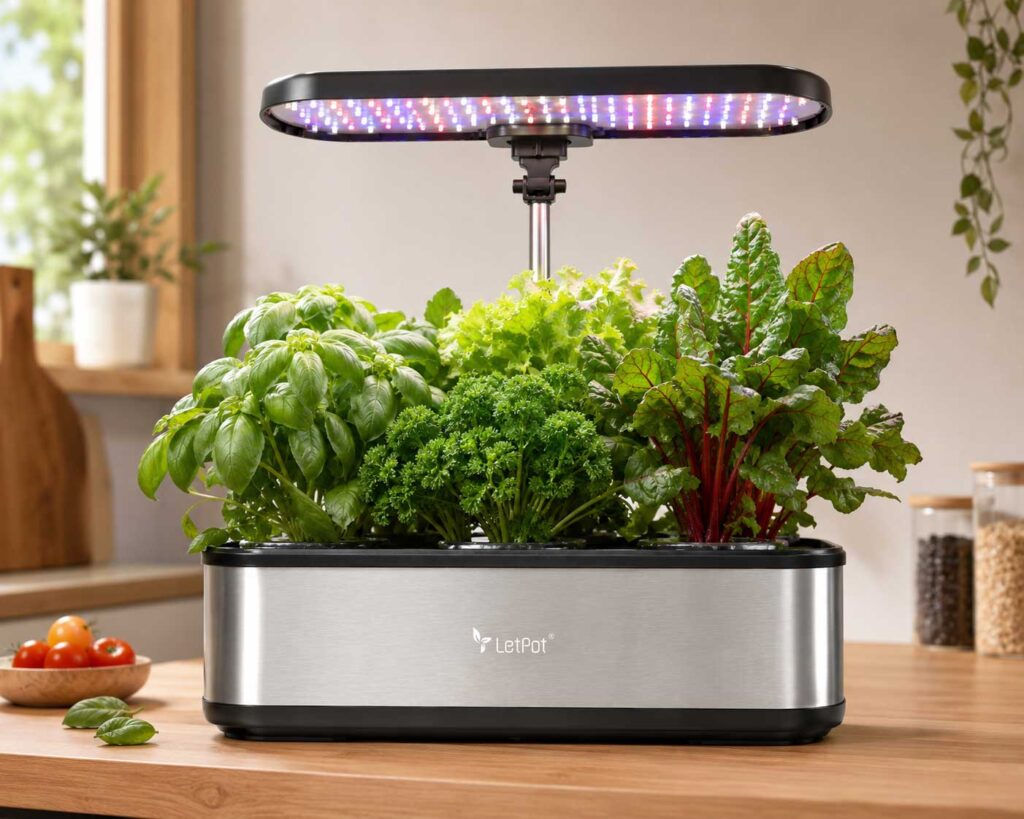
The LetPot LPH-SE earns our Best Overall pick because it strikes a good balance between capacity, automation, growing height, and price without taking over the kitchen. It has 12 planting sites, a 24W full-spectrum LED grow light, a 5.5-liter reservoir, app control, and onboard touch controls. The current model’s light can also be raised up to 30 inches, giving taller herbs and compact vegetables more room than many small countertop gardens.
It’s especially well suited to basil, lettuce, parsley, cilantro, bok choy, and other herbs and leafy greens. You can experiment with compact peppers or tomatoes, but larger plants need more space, so don’t expect to fill all 12 openings with mature fruiting plants.
| LetPot LPH-SE at a Glance | Details |
|---|---|
| Planting sites | 12 |
| Water tank | 5.5 L |
| Grow light | 24W full-spectrum LED |
| Maximum light height | Up to 30 in. |
| Controls | LetPot app + touch panel |
| Growing modes | Veggies & Herbs / Fruits & Flowers |
| Best for | Herbs, lettuce and leafy greens |
| Skill level | Beginner |
What We Like About the LetPot LPH-SE
One of its strongest features is that you aren’t forced to control everything through your phone. The LetPot app lets you customize lighting schedules, receive water reminders, and keep track of your plants, while the physical touch panel handles basic controls directly on the garden.
We also like the 5.5-liter reservoir. It doesn’t eliminate refilling—mature plants can become surprisingly thirsty—but it gives you more breathing room than very small countertop gardens.
The pump is designed to circulate water automatically, and LetPot states that it operates below 20 dB under its specified test conditions. That’s useful for a system likely to live in a kitchen, home office, or other occupied room.
Pros and Cons
| Pros | Cons |
|---|---|
| 12 planting positions | 12 mature plants can become overcrowded |
| 24W full-spectrum grow light | Larger tomatoes and peppers still need more room |
| Large 5.5 L reservoir for a countertop garden | No built-in circulation fan |
| Adjustable light height | App adds complexity if you prefer basic controls |
| App and physical touch controls | You’ll generally supply your own seeds |
| Quiet automatic pump | Requires periodic cleaning like any reservoir system |
| Two lighting/growing modes | Fruiting crops may need more attention than herbs and greens |
Recent hands-on reviews have also pointed out the pod-spacing issue: although there are 12 openings, filling every site with large basil plants or other vigorous crops can lead to crowding and shading. That’s why we’d treat 12 as the system’s planting capacity rather than a promise that 12 full-size plants will always fit comfortably.
What Can You Grow in It?
For the easiest first crop, we’d start with:
- Basil
- Lettuce
- Parsley
- Cilantro
- Chives
- Bok choy
- Kale or other compact leafy greens
Once you’re comfortable managing the garden, you can experiment with strawberries, compact peppers, or dwarf tomato varieties. Just leave unused pod openings around larger plants so their leaves and roots have room to develop.
Who Should Buy the LetPot LPH-SE?
The LetPot LPH-SE is a good fit if you want something more capable than a tiny entry-level herb garden but aren’t ready to dedicate floor space to a large vertical system.
It also works well for someone who wants automation without being locked into a completely proprietary gardening experience. LetPot sells replacement sponges, baskets, nutrients, and other supplies, while the garden allows you to choose what seeds you want to grow. LetPot also sells replacement sponges, baskets, nutrients, and other supplies for the system.
Who Should Skip It?
Skip the LPH-SE if your primary goal is growing large tomatoes, cucumbers, or peppers indoors. A DWC bucket, Dutch Bucket, or larger indoor system will give those plants considerably more root and canopy space.
It’s also more system than you need if you only want two or three small kitchen herbs. One of the cheaper compact gardens later in this guide would make more sense.
Our Verdict
For most people who want a ready-made indoor garden for fresh herbs, lettuce, and leafy greens, the LetPot LPH-SE offers one of the better combinations of usable capacity and smart features without moving into the price or footprint of a large vertical garden.
Best for: Home growers who want a smart, beginner-friendly countertop garden with enough room to grow a useful rotation of herbs and leafy greens.
2. Ahopegarden Hydroponic Growing System — Best Budget Indoor Hydroponic Garden
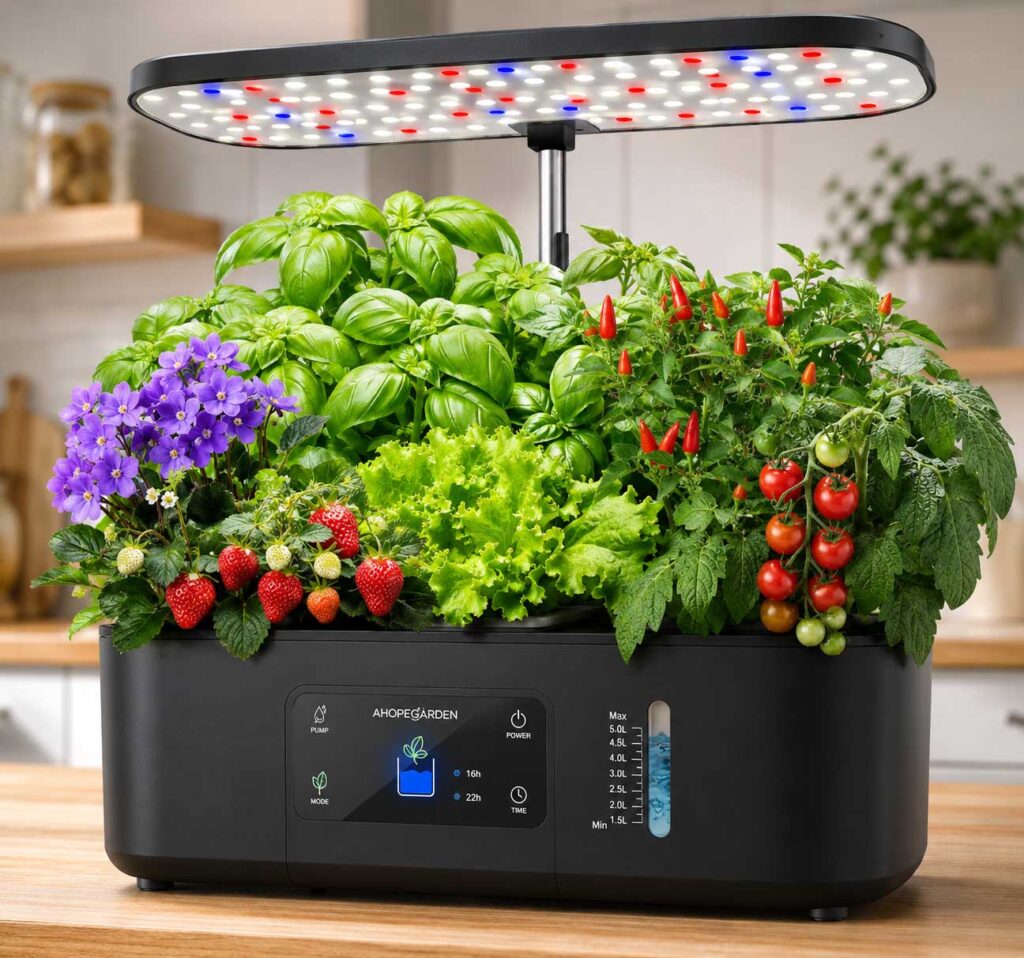
The Ahopegarden Hydroponic Growing System is our budget pick for growers who want the convenience of an all-in-one countertop garden without paying for features they may never use. It combines a built-in LED grow light, water circulation, adjustable light height, and multiple planting sites in a compact system that’s easy to fit on a kitchen counter or shelf.
It’s best suited to basil, lettuce, parsley, cilantro, chives, and other compact herbs and leafy greens. Some models are also marketed for tomatoes and peppers, but—as with most countertop gardens—you’ll get better results by leaving extra space around larger plants rather than filling every available pod.
| Ahopegarden at a Glance | Details |
|---|---|
| Type | Countertop hydroponic garden |
| Planting capacity | Varies by model |
| Grow light | Built-in full-spectrum LED |
| Water circulation | Built-in pump |
| Light height | Adjustable |
| Best for | Herbs and leafy greens |
| Skill level | Beginner |
| Our award | 💰 Best Budget |
What We Like About Ahopegarden
Ahopegarden gets the basics right without adding much complexity. You get the main components needed for a small indoor hydroponic garden in one unit instead of purchasing a grow light, reservoir, pump, timer, and planting deck separately.
It’s also a practical first system if you’re unsure whether indoor hydroponics will become a long-term hobby. You can learn how quickly different plants grow, how often the reservoir needs attention, and how plants respond to an indoor grow light without making a large initial investment.
We also like that you can choose what to plant rather than being tied to expensive pre-seeded pods.
Pros and Cons
| Pros | Cons |
|---|---|
| Affordable entry into indoor hydroponics | Features vary between Ahopegarden models |
| Built-in LED grow light | Limited space for mature plants |
| Integrated water circulation | Reservoir requires routine cleaning |
| Compact countertop footprint | Not intended for large crops |
| Beginner-friendly controls | Less sophisticated than premium smart gardens |
| Grow your own seed varieties | Crowding can become an issue when every pod is used |
| Good for herbs and leafy greens | Large fruiting plants may outgrow the light |
What Can You Grow in It?
Ahopegarden systems make the most sense for crops that remain relatively compact and don’t require a large root zone.
Good choices include:
- Basil
- Lettuce
- Parsley
- Cilantro
- Chives
- Mint
- Arugula
- Bok choy
- Other compact leafy greens
You can also experiment with dwarf tomatoes or compact peppers in models with enough light height. If you do, use fewer planting sites so the plants aren’t competing for light and space as they mature.
Who Should Buy an Ahopegarden?
Choose Ahopegarden if you’re looking for an affordable first indoor hydroponic garden and primarily want fresh herbs or leafy greens.
The self-contained design also works well in kitchens, apartments, and home offices where a DIY reservoir, separate light, and exposed plumbing would be inconvenient.
Who Should Skip It?
Skip this type of countertop system if you’re planning to grow full-size tomatoes, cucumbers, or several large peppers. Those crops need substantially more canopy space and plant support than a compact countertop garden provides.
You may also want one of our premium picks if app control, extensive automation, a larger reservoir, or a much larger growing capacity is important to you.
Our Verdict
Ahopegarden doesn’t need to compete with expensive smart gardens feature for feature. Its appeal is much simpler: it gives beginners the basic equipment needed to start growing herbs and leafy greens indoors at an accessible price.
Best for: Beginners and budget-conscious growers who want a compact indoor garden for herbs, lettuce, and other leafy greens.
3. Sainlogic Smart Hydroponics Growing System — Best Smart Value
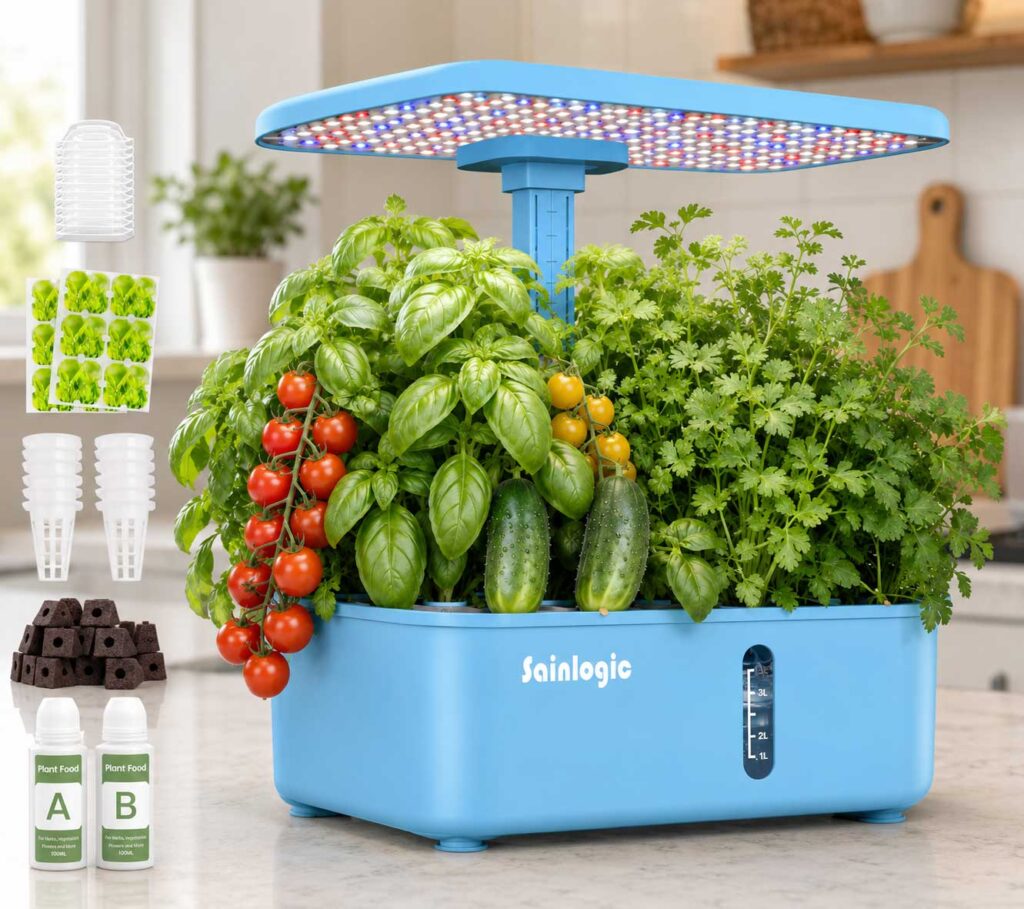
The Sainlogic Smart Hydroponics Growing System is our pick for growers who want smart controls without jumping to the price of a premium vertical garden. It combines an integrated LED grow light, circulating water pump, adjustable light height, and app-based controls in a compact countertop design.
It’s best suited to basil, lettuce, parsley, cilantro, chives, and other herbs and leafy greens. You can also experiment with dwarf tomatoes and compact peppers, but larger plants need more room, so leaving some planting sites unused will help reduce crowding.
| Sainlogic at a Glance | Details |
|---|---|
| Type | Smart countertop hydroponic garden |
| Planting capacity | 12 pods |
| Grow light | Built-in full-spectrum LED |
| Water circulation | Built-in pump |
| Light height | Adjustable |
| Smart controls | Wi-Fi/app control |
| Best for | Herbs and leafy greens |
| Skill level | Beginner |
| Our award | 📱 Best Smart Value |
What We Like About Sainlogic
Sainlogic makes the most sense if you like the countertop format but want a little more control over it. The app lets you manage features such as the lighting schedule and pump operation without adding separate timers or smart plugs.
That extra control can be useful if your indoor garden isn’t somewhere you check constantly. You can establish a consistent lighting routine without adding separate timers or smart plugs to the setup.
We also like that Sainlogic doesn’t limit the garden to one type of crop. The system includes different lighting modes for vegetative crops and flowering or fruiting plants, giving you more flexibility if you want to move beyond lettuce and herbs.
Pros and Cons
| Pros | Cons |
|---|---|
| Wi-Fi and app controls | App connectivity adds another layer of setup |
| 12 planting sites | Using every site can overcrowd mature plants |
| Built-in LED grow light | Countertop size still limits larger crops |
| Integrated water circulation | Pump and reservoir require routine cleaning |
| Adjustable light height | Fruiting plants require more attention |
| Different growing/light modes | Not necessary if you only want a few herbs |
| Use your own seed varieties | Large tomatoes and cucumbers can quickly outgrow it |
What Can You Grow in It?
The Sainlogic system works best when you take advantage of its planting capacity for a mixture of herbs and compact greens.
Good choices include:
- Basil
- Lettuce
- Parsley
- Cilantro
- Chives
- Mint
- Dill
- Arugula
- Bok choy
- Other compact leafy greens
Dwarf tomatoes, strawberries, and compact peppers are possible too, but give them extra spacing as they mature.
Who Should Buy a Sainlogic?
Choose the Sainlogic if you want a smart indoor hydroponic garden at a reasonable price and like the convenience of controlling or scheduling parts of the system from your phone.
It’s also a good option for someone who wants to grow several herbs at once but would appreciate more control than a basic entry-level countertop garden provides.
Who Should Skip It?
Skip the Sainlogic if you don’t care about Wi-Fi or app controls. A simpler system such as the Ahopegarden may give you the core growing features you need without paying for connectivity.
It’s also not the right choice if your primary goal is producing large quantities of tomatoes, peppers, or cucumbers. Those crops are better matched to the larger DWC and vertical systems later in this guide.
Our Verdict
Sainlogic sits in a useful middle ground between inexpensive countertop gardens and much more expensive smart-growing systems. You get the convenience of an all-in-one indoor garden plus additional control over lighting and circulation without dedicating a large amount of floor space to hydroponics.
Best for: Home growers who want a compact smart hydroponic garden for herbs and leafy greens with Wi-Fi/app control.
4. iDOO 12-Pod Indoor Garden Kit — Best for Beginners
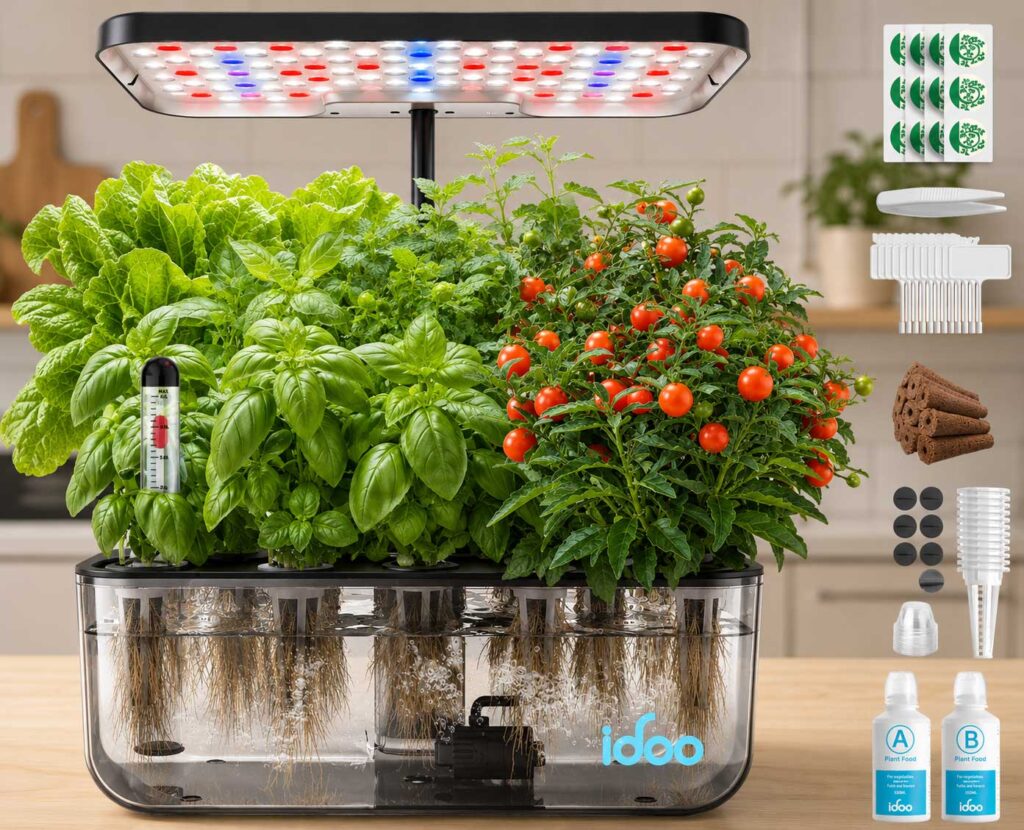
The iDOO 12-Pod Indoor Garden Kit is our beginner pick because it keeps the growing process straightforward while including the main equipment needed to start an indoor hydroponic garden. The 12-pod version combines a 36W LED grow light, 4-liter water tank, circulating pump, built-in fan, adjustable lamp, and automatic lighting cycle in one countertop unit.
Unlike the smart systems above, the standard 12-pod Home Garden Kit doesn’t depend on an app. That’s actually an advantage for beginners who would rather fill the reservoir, plant their seeds, choose a growing mode, and let the built-in timer handle the lighting schedule.
| iDOO 12-Pod at a Glance | Details |
|---|---|
| Type | Countertop hydroponic garden |
| Planting capacity | 12 pods |
| Grow light | 36W LED |
| Water tank | 4 L |
| Water circulation | Built-in pump |
| Fan | Built in |
| Growing modes | Vegetables / Flower & Fruit |
| App control | No |
| Best for | Herbs, lettuce & beginner growing |
| Skill level | Beginner |
| Our award | 🌱 Best for Beginners |
iDOO currently offers several hydroponic gardens, including 12-, 15-, and 20-pod configurations, so make sure the Amazon listing you link to corresponds to the 12-pod Home Garden Kit we’re reviewing here.
What We Like About iDOO
What makes the iDOO particularly beginner-friendly is what it leaves out: there’s no Wi-Fi setup and no app to learn. The lighting operates on a 16-hours-on, 8-hours-off cycle, with separate Vegetable and Flower & Fruit modes.
We also like the built-in fan. It can help move air around the foliage, and iDOO specifically includes it to help with heat dispersion and pollination when flowering plants are being grown.
The 4-liter reservoir is reasonably sized for a countertop garden, although mature plants can consume water quickly. A viewing window lets you check the water level without opening the tank.
Pros and Cons
| Pros | Cons |
|---|---|
| Simple controls for beginners | No app control on this model |
| 12 planting positions | 12 mature plants may become crowded |
| 36W LED grow light | Light height is limited compared with larger systems |
| Built-in circulating pump | Pump and tank require periodic cleaning |
| Integrated fan | Fan adds another component to maintain |
| Two growing/light modes | Not intended for full-size fruiting plants |
| Automatic lighting schedule | Less customizable than smart systems |
| Use your own seeds | Large crops can quickly outgrow the countertop format |
What Can You Grow in It?
The iDOO is easiest to manage with compact crops that don’t require a large canopy or extensive plant support.
Good choices include:
- Basil
- Lettuce
- Parsley
- Cilantro
- Chives
- Mint
- Dill
- Arugula
- Bok choy
- Other leafy greens
You can experiment with dwarf tomatoes or compact peppers, especially using the Flower & Fruit mode, but don’t assume all 12 pod positions should be occupied. Fruiting plants need substantially more space than lettuce or small herbs.
Who Should Buy an iDOO?
Choose the iDOO if this is your first ready-made indoor hydroponic garden and you want something more automated than a DIY Kratky or DWC setup without needing to configure Wi-Fi or manage another app.
It also makes sense for households that mainly want a steady supply of fresh kitchen herbs and greens. The automatic light cycle and circulating reservoir handle much of the routine operation while still giving you the hands-on experience of starting seeds, adding nutrients, pruning plants, and managing the reservoir.
Who Should Skip It?
Skip this model if app control and customizable schedules are priorities. Sainlogic or LetPot are better matches for that kind of grower.
You should also look at the larger systems later in this guide if tomatoes, cucumbers, peppers, or substantial harvests are your main goal. The iDOO’s compact format is much better suited to herbs and greens than large mature plants.
Our Verdict
The iDOO 12-Pod doesn’t try to turn indoor gardening into a complicated smart-home project. That’s exactly why we’ve chosen it for beginners. It combines the light, reservoir, circulation, timer, and planting deck into a manageable countertop system while leaving you free to concentrate on learning how the plants grow.
Best for: First-time indoor hydroponic growers who want an easy-to-manage countertop garden for herbs, lettuce, and other leafy greens.
5. Gardyn Home 4.0 — Best Premium Vertical Indoor Garden
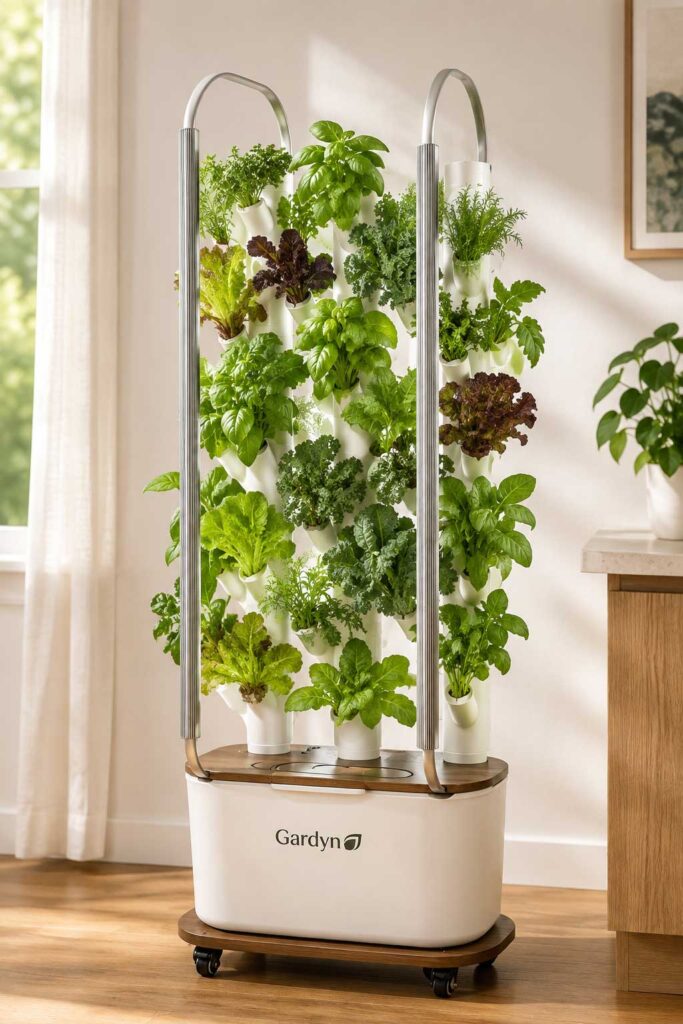
The Gardyn Home 4.0 is our premium pick for growers who want to move beyond a countertop garden and produce a much larger variety of plants indoors. Its vertical design supports up to 30 plants while using roughly two square feet of floor space, making it particularly appealing when growing capacity matters more than keeping the initial cost low.
Unlike the smaller systems above, Gardyn is designed to become a substantial part of your indoor growing setup. The integrated LED grow lights, automatic irrigation, cameras, sensors, and optional Gardyn app features reduce much of the day-to-day guesswork while giving plants considerably more vertical growing room.
| Gardyn Home 4.0 at a Glance | Details |
|---|---|
| Type | Vertical indoor hydroponic garden |
| Planting capacity | Up to 30 plants |
| Floor space | About 2 sq. ft. |
| Grow lights | Two integrated full-spectrum LED grow lights |
| Water tank | 5 gallons |
| Watering | Automated recirculating irrigation |
| Smart features | Cameras, sensors & app |
| Best for | Large variety of greens, herbs & compact produce |
| Skill level | Beginner–Intermediate |
| Our award | 🌿 Best Premium Vertical Garden |
What We Like About Gardyn Home 4.0
Gardyn’s real selling point is vertical space. Instead of spreading planting sites across a counter or shelving unit, it fits up to 30 positions across three growing columns while occupying roughly two square feet of floor space.
That makes a mixed garden much more realistic. You could dedicate different sections to lettuce, basil, herbs, leafy greens, and selected fruiting plants instead of squeezing everything beneath one small countertop light.
Gardyn also incorporates cameras and environmental sensors into the system. Its optional Kelby smart-growing features can use information from the garden to provide plant-care recommendations and automate parts of the growing process.
The 5-gallon reservoir is another meaningful upgrade over the small tanks found in countertop gardens. You’ll still need to monitor and replenish water—especially with a mature garden—but the larger capacity better matches a system designed to support dozens of plants.
Pros and Cons
| Pros | Cons |
|---|---|
| Holds up to 30 plants | Considerably more expensive than countertop gardens |
| Uses only about 2 sq. ft. of floor space | Requires dedicated floor and vertical space |
| Integrated full-spectrum lighting | Some advanced features are tied to membership |
| Automated irrigation | More components to clean and maintain |
| Cameras and sensors | Proprietary plant cubes add ongoing cost |
| Large 5-gallon reservoir | Overkill if you only want a few kitchen herbs |
| Attractive vertical design | Plants still require pruning and routine care |
| Supports a wider range of plants | Larger crops can shade neighboring plants |
What Can You Grow in It?
Gardyn’s larger growing area gives you more freedom in what you plant than a countertop system.
Good choices include:
- Lettuce
- Basil
- Kale
- Arugula
- Swiss chard
- Cilantro
- Parsley
- Mint
- Bok choy
- Strawberries
- Cherry tomatoes
- Compact peppers
You don’t need to fill all 30 positions immediately. Starting with fewer plants gives you time to learn how quickly different varieties grow and which ones compete for light.
Who Should Buy a Gardyn Home 4.0?
Choose Gardyn if you want an indoor hydroponic garden to be more than an occasional source of countertop herbs.
It makes the most sense for households that expect to harvest greens and herbs regularly and want enough planting capacity to grow several varieties simultaneously. Its narrow footprint is particularly useful when you have vertical space available but don’t want shelving, buckets, reservoirs, and separate grow lights occupying an entire room.
The automation is also attractive if you like smart-home technology and want more guidance than a basic pump-and-light garden provides.
Who Should Skip It?
Skip Gardyn if you’re experimenting with hydroponics for the first time and aren’t sure you’ll stick with it. Spending this much to grow a few heads of lettuce doesn’t make much sense when the countertop systems earlier in this guide can introduce you to hydroponics for substantially less.
It’s also not our first choice for someone whose main objective is large tomato, cucumber, or pepper plants. A dedicated DWC or other larger-root-zone system gives those crops more freedom.
Our Verdict
Gardyn Home 4.0 is expensive, but you’re paying for something fundamentally different from a 12-pod countertop garden. Its combination of 30 growing positions, vertical design, integrated lighting, larger reservoir, and smart monitoring makes it one of the more complete options for someone serious about growing a meaningful amount of food indoors.
Best for: Home growers who want a premium, space-efficient vertical garden capable of producing a rotating selection of herbs, leafy greens, and compact vegetables throughout the year.
6. Lettuce Grow Indoor Farmstand — Best for Growing Lots of Leafy Greens
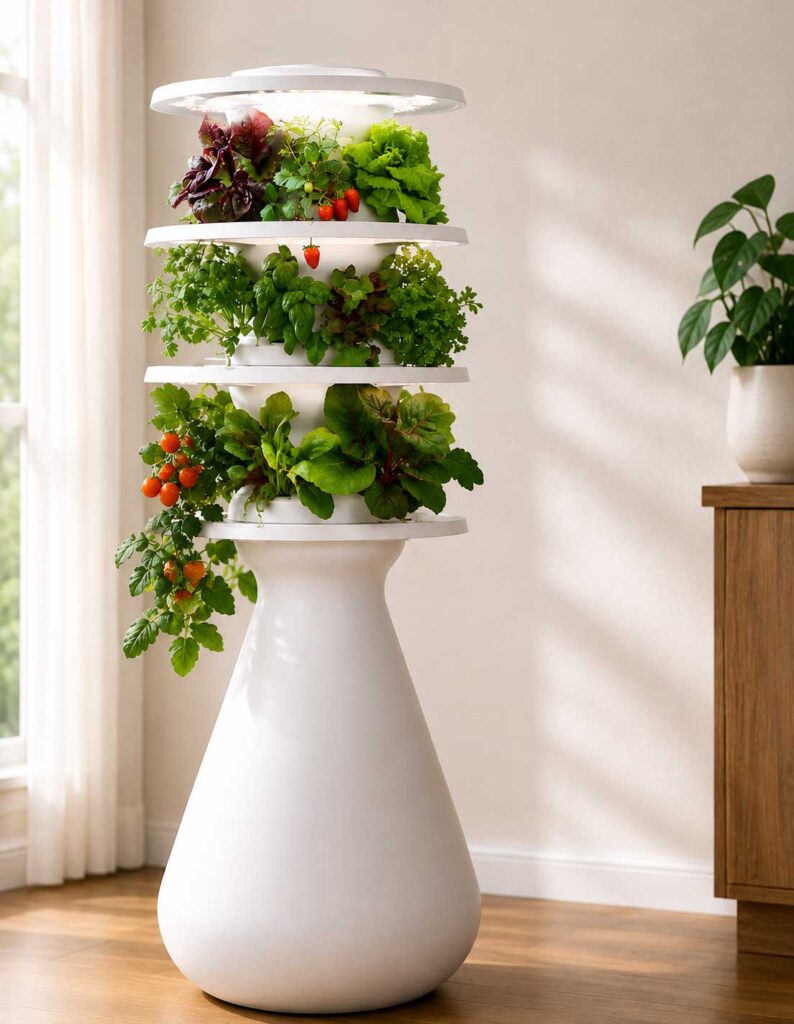
The Lettuce Grow Indoor Farmstand is our pick for households that want to grow a much larger supply of lettuce, herbs, and greens than a countertop system can realistically handle. Its vertical tower is available with 18, 24, or 36 planting sites, while the indoor version adds LED Glow Rings so the garden can operate year-round without relying on a sunny window.
What separates the Farmstand from Gardyn is its emphasis on high-capacity, relatively straightforward growing. It uses a large 20-gallon reservoir and circulating pump to move nutrient solution through the tower, and its modular design lets you add or remove levels as your needs change.
| Lettuce Grow Indoor Farmstand at a Glance | Details |
|---|---|
| Type | Vertical hydroponic tower |
| Planting capacity | 18, 24 or 36 plants |
| Grow lights | LED Glow Rings |
| Reservoir | 20 gallons |
| Footprint | About 22 in. diameter |
| Water circulation | Integrated pump |
| Design | Modular/expandable |
| Best for | Lettuce, herbs & leafy greens |
| Skill level | Beginner–Intermediate |
| Our award | 🥬 Best for Growing Lots of Leafy Greens |
What We Like About the Lettuce Grow Farmstand
This is the system we’d look at when a countertop garden simply isn’t producing enough greens for the household. Each level holds six plants, with configurations ranging from 18 to 36 planting positions.
The modular design is another feature we like. You don’t necessarily have to commit to the largest tower immediately. Lettuce Grow currently offers small, medium, and large configurations with 18, 24, and 36 sites, respectively.
For indoor use, the Glow Rings provide dedicated lighting around the tower rather than relying on a single overhead fixture. The indoor version includes these lights, while the outdoor Farmstand can be converted for indoor growing by adding them later.
Lettuce Grow also offers pre-sprouted seedlings. That’s convenient for someone who would rather skip germination, although it does create an ongoing supply cost that DIY-minded growers may prefer to avoid.
Pros and Cons
| Pros | Cons |
|---|---|
| Grows 18–36 plants | Expensive compared with countertop systems |
| Excellent capacity for greens and herbs | Requires about four square feet of floor space |
| 20-gallon reservoir | Large reservoir can be awkward to fill and clean indoors |
| Integrated LED Glow Rings | More components than a simple countertop garden |
| Modular, expandable design | Pre-grown seedlings add ongoing cost |
| Can be used indoors year-round | Pump/water movement may be noticeable in quiet rooms |
| Large variety of compatible crops | Large fruiting vegetables aren’t its strongest use case |
| Free companion app for growing guidance | Mature plants still need pruning and harvesting |
A hands-on WIRED review of the 24-site indoor version found assembly relatively straightforward and reported strong production. The reviewer noted noticeable water noise and initially encountered pests on some pre-grown seedlings, although WIRED later reported that Lettuce Grow had introduced a quarantine process for incoming plants.
What Can You Grow in It?
The Farmstand is particularly well suited to plants that can be harvested regularly without developing enormous canopies.
Good choices include:
- Lettuce
- Kale
- Arugula
- Swiss chard
- Bok choy
- Basil
- Cilantro
- Parsley
- Dill
- Mint
- Strawberries
- Compact tomatoes
Lettuce Grow says its indoor Farmstand can grow its broader plant menu except for large vegetables.
Who Should Buy a Lettuce Grow Farmstand?
Choose the Indoor Farmstand if your goal is to harvest greens and herbs in meaningful quantities, rather than simply keeping a few basil plants on the kitchen counter.
It makes particular sense for a household that eats lettuce and leafy greens regularly. With 18–36 growing positions, you can stagger planting and harvesting rather than having every plant reach maturity at the same time.
It’s also a good option if you like the idea of starting with live seedlings instead of germinating everything yourself.
Who Should Skip It?
Skip the Farmstand if you only want a handful of kitchen herbs. A LetPot, Ahopegarden, Sainlogic, or iDOO will take up less room and cost considerably less.
I’d also choose something else if large tomatoes, cucumbers, or peppers are your main priority. The Farmstand can accommodate an impressive variety of crops, but its strongest use is producing greens, herbs, and other relatively compact plants.
Our Verdict
The Lettuce Grow Indoor Farmstand is a substantial jump from the countertop gardens earlier in this guide. Its 18–36 planting sites, modular tower, 20-gallon reservoir, and dedicated indoor lighting make it much better suited to households that want regular harvests rather than a few occasional herbs.
Best for: Households that want to grow a large rotation of lettuce, herbs, and leafy greens indoors without dedicating an entire room to hydroponics.
7. Aerospring Indoor Hydroponic System — Best for Serious Indoor Growing
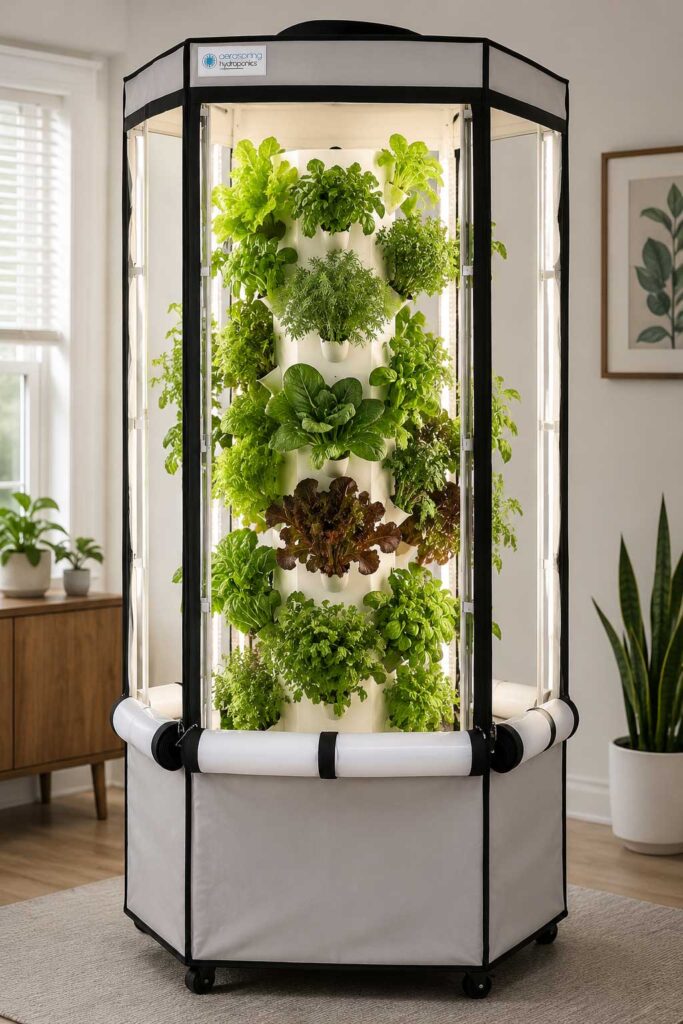
The Aerospring Indoor Hydroponic System is our pick for growers who want something closer to a dedicated indoor growing station than a countertop appliance. It combines a 27-plant vertical tower, 20-gallon reservoir, full-spectrum grow lights, circulation pump, fan, grow tent, timers, and wheeled base into a system designed for year-round indoor production.
Aerospring uses low-pressure aeroponics rather than keeping the roots continuously submerged. Nutrient solution is pumped from the reservoir to the top of the tower and flows over the exposed roots before returning to the reservoir.
| Aerospring Indoor at a Glance | Details |
|---|---|
| Type | Vertical low-pressure aeroponic system |
| Planting capacity | 27 plants |
| Reservoir | 20 gallons / 75 L |
| Grow lights | Integrated full-spectrum LED |
| Lighting power | 138W |
| Water circulation | 23W pump |
| Indoor enclosure | Grow tent + ventilation fan |
| Automation | Wi-Fi timers for irrigation & lighting |
| Best for | Serious year-round indoor growing |
| Skill level | Intermediate |
| Our award | 🌶️ Best for Serious Indoor Growing |
Aerospring says the Indoor system measures approximately 77 inches tall and 34 inches corner-to-corner, so this is a much more substantial installation than the countertop gardens earlier in our guide.
What We Like About Aerospring
Aerospring is where this list moves from indoor garden appliances into dedicated growing equipment. You’re getting the tower, lighting, irrigation, airflow, reflective enclosure, and timers as one coordinated setup.
The grow tent is particularly useful. Aerospring says it blocks about 95% of the grow-light output from escaping into the surrounding room, while the ventilation fan helps remove warm air and maintain circulation around the plants.
We also like the 20-gallon reservoir. Twenty-seven mature plants can consume plenty of water, and a large reservoir reduces the constant refilling you’d encounter if a system of this size used a small countertop-style tank.
The system is also more flexible in crop choice. Aerospring lists leafy greens, herbs, cherry tomatoes, peppers, strawberries and numerous other crops among the plants that can be grown hydroponically in its systems.
Pros and Cons
| Pros | Cons |
|---|---|
| Holds up to 27 plants | Much more expensive than countertop gardens |
| Large 20-gallon reservoir | Requires significant vertical space |
| Full-spectrum grow lights included | Indoor assembly can take 2–3 hours |
| Enclosed grow tent | More equipment to clean and maintain |
| Integrated ventilation fan | Requires regular pH and EC management |
| Automated lighting and irrigation | Higher electricity use than small gardens |
| Wheeled base included | Too large for many kitchens and apartments |
| Suitable for a broad range of crops | More hands-on than highly automated smart gardens |
What Can You Grow in It?
Aerospring gives you considerably more flexibility than the smaller systems in this guide.
Good choices include:
- Lettuce
- Spinach
- Kale
- Arugula
- Bok choy
- Basil
- Cilantro
- Parsley
- Mint
- Rosemary
- Strawberries
- Cherry tomatoes
- Peppers
- Eggplants
Aerospring actually lists more than 200 varieties across vegetables, herbs, brassicas, fruits, and flowers in its growing resources.
That doesn’t mean every combination should be planted simultaneously. Larger crops can shade neighboring plants, so you’ll generally get better results by planning the tower around the mature size of each crop.
Who Should Buy an Aerospring?
Choose Aerospring if you’ve already decided that indoor food growing is going to be a serious hobby, rather than something you’re merely trying for the first time.
It’s particularly appealing if you want to grow throughout the year but don’t want to design a grow tent, lighting system, vertical tower, irrigation system, ventilation setup, and timers separately.
You’ll still need to manage the garden. Aerospring recommends monitoring EC and pH, topping up the reservoir as plants consume water, pruning plants, and maintaining the system.
Who Should Skip It?
Skip Aerospring if you’re primarily interested in keeping a few basil or lettuce plants in the kitchen. LetPot, Ahopegarden, Sainlogic, or iDOO can accomplish that with considerably less expense and equipment.
It’s also not the best choice if you want a nearly hands-off smart appliance. Despite its automated irrigation and lighting, Aerospring is closer to real hydroponic gardening, where monitoring nutrients, pH, plant growth, and equipment remains part of the experience.
Our Verdict
Aerospring isn’t really competing with the countertop gardens at the top of this list. It’s closer to a complete indoor hydroponic grow station, with 27 growing sites, a large reservoir, dedicated lighting, ventilation, a grow tent, and automated irrigation.
Best for: Serious home growers who want a complete, high-capacity indoor system for year-round herbs, leafy greens, strawberries, and selected fruiting crops.
8. VIVOSUN 4-Bucket DWC Hydroponics Grow System — Best for Larger Plants
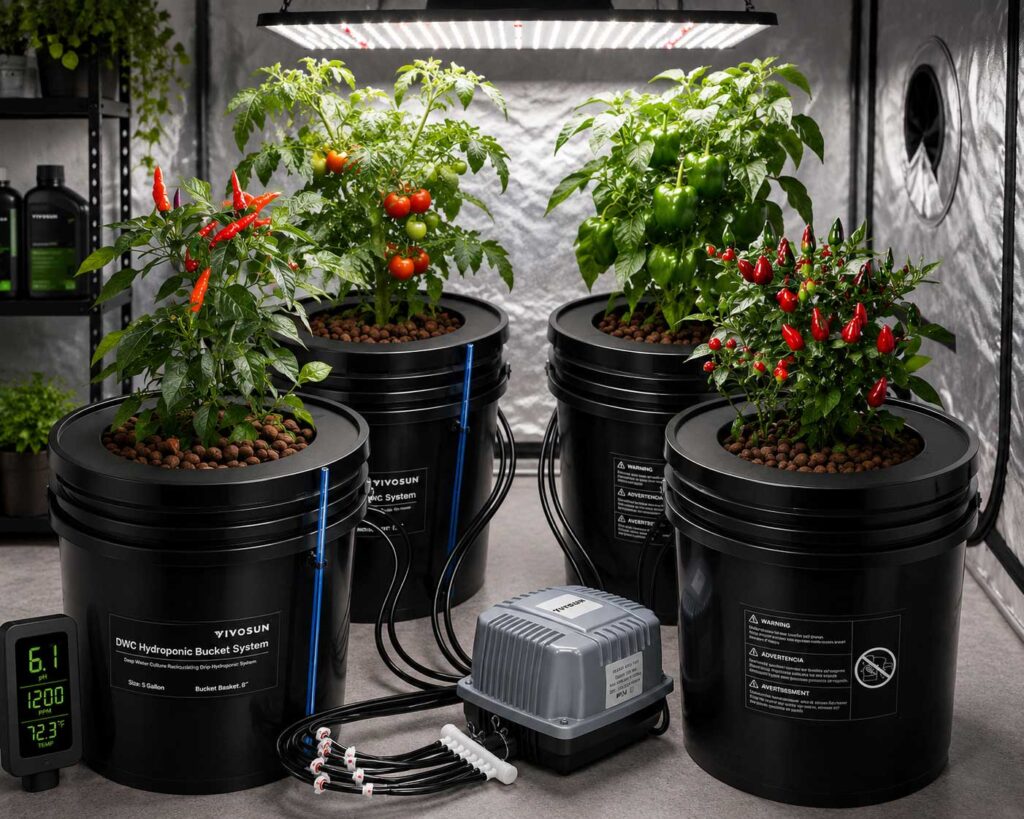
The VIVOSUN DWC Hydroponics Grow System is our pick for growers who want to move beyond countertop gardens and give individual plants significantly more root space. Instead of fitting many plants into one compact reservoir, this system uses separate grow buckets connected to an air supply, creating a straightforward Deep Water Culture setup suitable for larger vegetables.
This is a very different product from LetPot, Ahopegarden, or iDOO. There is no integrated grow light or decorative countertop enclosure. You’re getting the hydroponic growing system itself, which gives you much more flexibility to choose your own lighting, tent, plant spacing, and support structure.
| VIVOSUN DWC at a Glance | Details |
|---|---|
| Type | Deep Water Culture (DWC) |
| Growing containers | 4 individual buckets |
| Bucket size | 5 gallons each |
| Growing baskets | 8-inch |
| Aeration | External air pump |
| Grow light | Not included |
| Best for | Tomatoes, peppers & larger plants |
| Skill level | Beginner–Intermediate |
| Our award | 🍅 Best for Larger Plants |
What We Like About VIVOSUN DWC
The biggest advantage is root space.
Countertop hydroponic gardens are excellent for lettuce and herbs, but their small reservoirs become restrictive when you’re trying to grow a mature tomato or pepper plant. A bucket-style DWC system gives each plant substantially more room for its root mass to develop.
The concept is also relatively simple. Plant roots extend into nutrient solution while an air pump continuously sends air through air stones in the buckets. That aeration helps maintain oxygen around the submerged roots.
You’re also free to build the rest of the setup around the plants. Choose your own grow light, adjust bucket spacing, add a tent if needed, and use stakes, cages, or trellises as the plants mature.
Pros and Cons
| Pros | Cons |
|---|---|
| Plenty of root space | Grow lights sold separately |
| Better suited to larger plants | Takes more floor space |
| Straightforward DWC design | Air pump must operate continuously |
| Individual growing buckets | More exposed equipment than an all-in-one garden |
| Can support fruiting vegetables | Requires regular pH and nutrient monitoring |
| Easy to pair with a grow tent | Water temperature needs attention |
| Expandable growing setup | Buckets need periodic cleaning |
| Good transition into traditional hydroponics | Less appliance-like than countertop systems |
What Can You Grow in It?
This is where the VIVOSUN system fills an important gap in our list.
Good choices include:
- Tomatoes
- Cherry tomatoes
- Bell peppers
- Chili peppers
- Eggplants
- Cucumbers
- Basil
- Kale
- Swiss chard
- Other larger herbs and vegetables
You can certainly grow lettuce in DWC, but buying a large bucket system just for a few heads of lettuce usually isn’t the best use of the available space.
For tomatoes, peppers, and cucumbers, you’ll also need appropriate plant support. Hydroponics supports the roots; it doesn’t eliminate the need to support a heavy mature plant above the reservoir.
Who Should Buy a VIVOSUN DWC System?
Choose VIVOSUN if you’re ready to move from an indoor garden appliance to a more traditional hydroponic setup.
It’s especially appealing if your goal is growing tomatoes or peppers indoors and you’ve discovered that countertop gardens simply don’t provide enough room.
This setup also gives you more freedom to build around your growing environment. You can select the grow light you want, place the buckets inside a grow tent, adjust plant spacing, and change other components later without replacing the entire system.
Who Should Skip It?
Skip VIVOSUN DWC if you want something you can put on the kitchen counter, plug in, and start growing.
You’ll need separate lighting for indoor use, and you’ll be responsible for monitoring nutrients, pH, water level, water temperature, and aeration. It’s not difficult once you understand DWC, but it requires more involvement than an all-in-one countertop garden.
Apartment growers with very limited space may also be happier with LetPot, Ahopegarden, Sainlogic, or iDOO.
Our Verdict
The VIVOSUN DWC system earns its place in this guide because it solves a problem the smaller gardens can’t: giving larger plants enough root space to develop properly.
If your goal has progressed from harvesting countertop basil to growing tomatoes, peppers, cucumbers, or other substantial plants indoors, a bucket-style DWC system is a logical next step.
Best for: Home growers who want a traditional hydroponic setup with enough root space for tomatoes, peppers, cucumbers, and other larger plants.
Which Indoor Hydroponic Garden System Should You Choose?
After comparing all eight systems, the best choice comes down to how much you want to grow, how much space you have, and how involved you want to be in managing the garden. A small countertop unit is usually the better choice for herbs and occasional lettuce, while larger vertical and DWC systems make more sense when you want regular harvests or larger plants.
| If You Want… | Our Pick | Why |
|---|---|---|
| 🏆 Best overall balance | LetPot LPH-SE | Smart features, compact size, and enough capacity for everyday indoor growing |
| 💰 Lowest-cost countertop option | Ahopegarden Hydroponic Growing System | Simple, affordable way to start growing herbs and greens |
| 📱 Smart features for the money | Sainlogic Smart Hydroponics Growing System | Wi-Fi/app controls without moving into premium pricing |
| 🌱 Easiest first system | iDOO 12-Pod Indoor Garden Kit | Straightforward controls and useful automation without requiring an app |
| 🌿 Premium vertical garden | Gardyn Home 4.0 | Up to 30 plants with a small floor footprint and extensive smart features |
| 🥬 Lots of leafy greens | Lettuce Grow Indoor Farmstand | High planting capacity that’s particularly useful for greens and herbs |
| 🌶️ Serious year-round indoor growing | Aerospring Indoor Hydroponic System | Complete vertical setup with lighting, enclosure, airflow, and a large reservoir |
| 🍅 Tomatoes, peppers & larger plants | VIVOSUN 4-Bucket DWC System | Large individual root zones and much more flexibility for fruiting crops |
Our Top Pick for Most Homes
For most people looking for one of the best indoor hydroponic garden systems without dedicating a large area of the house to growing, we’d start with the LetPot LPH-SE. It offers a good balance between automation, planting capacity, size, and ease of use.
If budget matters more than smart features, Ahopegarden is the more practical choice. If you specifically want app-based control while keeping the system relatively affordable, Sainlogic is worth the upgrade.
The decision changes once you want substantially more food. Gardyn and Lettuce Grow use vertical space to increase growing capacity, while Aerospring moves closer to a complete indoor growing environment.
And if your real goal is tomatoes, peppers, or other larger fruiting plants, we’d skip the countertop appliances entirely. The VIVOSUN 4-Bucket DWC system gives those plants the root space and flexibility they need, provided you’re comfortable supplying your own grow lights and managing the nutrient solution.
The important thing is not to buy the system with the most features. Choose the one that matches what you’ll actually grow. A compact 12-pod garden can be more useful than a 30-plant tower if all you want is fresh basil, parsley, and lettuce in the kitchen.
What to Look for When Buying an Indoor Hydroponic Garden
The best indoor hydroponic garden isn’t necessarily the system with the most pods, strongest light, or longest list of smart features. Before buying, think about what you realistically want to grow and where the garden will live in your home. A few practical differences can have a much bigger impact on your experience than the features highlighted on the box.
1. Growing Capacity
More planting sites sound better, but pod count can be misleading. Twelve lettuce plants may fit comfortably in a garden that becomes badly overcrowded with twelve tomato or basil plants.
| What You Want to Grow | Suggested Capacity |
|---|---|
| A few kitchen herbs | 6–12 sites |
| Herbs + leafy greens | 10–20 sites |
| Regular salad harvests | 18–36 sites |
| Large mixed indoor garden | 24–30+ sites |
| Tomatoes & larger peppers | Fewer plants with larger root zones |
For countertop systems, we’d rather grow six healthy, well-spaced plants than twelve plants competing for light.
2. Grow Light and Height Adjustment
Most all-in-one indoor gardens include an LED grow light, but pay attention to how high that light can be raised.
Lettuce stays relatively compact. Basil, tomatoes, and peppers don’t.
An adjustable light gives plants more room as they mature and makes the garden useful for a wider range of crops. If you plan to grow fruiting plants, also look for a system with a dedicated flower/fruit lighting mode or sufficient light output for those crops.
3. Reservoir Size
A larger reservoir generally means fewer emergency refills, especially once plants mature.
Small countertop gardens are convenient, but a full canopy of basil or lettuce can consume water surprisingly quickly. Larger systems such as the Gardyn, Lettuce Grow, and Aerospring use substantially larger reservoirs because they’re supporting many more plants.
Whatever size you choose, don’t assume the reservoir can simply be filled and forgotten. Check the water level regularly, particularly during warm conditions and periods of rapid growth.
4. Pump and Water Circulation
Most of the systems in this guide actively circulate nutrient solution.
Look for a pump that’s easy to access because pumps eventually need cleaning. Roots, nutrient deposits, and organic material can accumulate around pumps and plumbing over time.
For DWC systems such as the VIVOSUN buckets, aeration is even more important because the roots remain in nutrient solution. The air pump and air stones need to operate reliably to keep the root zone oxygenated.
5. Smart Features
Wi-Fi and app controls can be useful, but don’t buy a smart garden simply because it has an app.
Features worth considering include:
- Adjustable lighting schedules
- Pump controls
- Water-level reminders
- Vacation settings
- Plant-care reminders
- Remote monitoring
If you enjoy automation, systems such as LetPot, Sainlogic, and Gardyn become more attractive. If you simply want fresh basil on the counter, those features may not justify paying more.
6. Seed and Pod Flexibility
Check whether the garden allows you to use your own seeds or expects you to continue purchasing proprietary seed pods or plant cubes.
Being able to choose your own seeds gives you access to far more varieties and can reduce ongoing costs. This becomes especially valuable if you want unusual basil varieties, specialty lettuce, dwarf tomatoes, or peppers selected specifically for indoor growing.
7. Cleaning and Maintenance
This is one feature that’s easy to overlook while shopping.
Eventually you’ll need to clean the reservoir, pump, planting deck, tubing, baskets, or tower. A beautiful system can become frustrating if accessing those components requires dismantling half the garden.
Before buying, consider:
Can I easily reach the reservoir and pump?
That’s more important over several growing cycles than many flashy smart features.
8. Replacement Parts and Supplies
Indoor hydroponic gardens contain components that won’t necessarily last forever. Pumps, grow sponges, baskets, lights, tubing, and other parts may eventually need replacement.
For that reason, we’d favor an established system with readily available replacement parts and growing supplies over an obscure garden that happens to cost $20 less.
9. Available Space
Don’t look only at the product’s dimensions when it’s empty.
Think about its size after the plants are mature.
A countertop garden can become considerably wider once basil, lettuce, and tomatoes spread beyond the planting deck. Vertical gardens require enough clearance above and around the tower for plants, lighting, pruning, and maintenance.
Measure your intended growing area before ordering, especially for Gardyn, Lettuce Grow, Aerospring, or a multi-bucket DWC setup.
10. Total Cost, Not Just Purchase Price
Finally, consider what you’ll need after buying the garden.
Depending on the system, ongoing or additional expenses may include hydroponic nutrients, seeds or seedlings, grow sponges, replacement pumps, pH testing supplies, electricity, and replacement components.
A less expensive garden isn’t necessarily a better value if it depends heavily on proprietary supplies. Likewise, an expensive system may make sense if you’ll actually use its larger capacity throughout the year.
For most first-time growers, we’d prioritize reliable lighting, good water circulation, easy cleaning, adjustable plant height, and readily available supplies before paying extra for advanced automation.
Are Indoor Hydroponic Garden Systems Worth It?
For many home growers, indoor hydroponic garden systems are worth it for convenience rather than pure cost savings. Having basil, lettuce, parsley, or other greens growing a few steps from the kitchen is useful, especially during winter when an outdoor garden isn’t an option.
That doesn’t mean every system will save you money. A premium vertical garden can cost hundreds of dollars before you harvest your first salad, and you’ll still have ongoing expenses for electricity, nutrients, seeds, grow sponges, and replacement parts. If your only goal is finding the cheapest possible lettuce, buying it at the grocery store will usually make more sense.
Where these systems become more appealing is when you value freshness, year-round availability, control over what you grow, and the experience of producing food at home.
When an Indoor Hydroponic Garden Makes Sense
An indoor system may be a good investment if you:
- Regularly buy fresh herbs or leafy greens
- Want to grow food throughout the winter
- Don’t have a yard or outdoor gardening space
- Want fresh herbs available whenever you cook
- Enjoy gardening but want less mess than soil containers
- Want to experiment with unusual varieties
- Prefer harvesting only what you need
- Want a gardening project you can manage indoors
For someone who buys packaged basil only to use half of it before the rest wilts, having a living basil plant available in the kitchen can be particularly convenient.
When It May Not Be Worth It
You may be better off with a simpler DIY hydroponic setup—or traditional gardening—if your main priority is producing food as cheaply as possible.
A ready-made indoor garden may also disappoint you if you’re expecting a small countertop unit to provide a household’s entire vegetable supply. These systems have physical limits.
A 12-pod garden can produce an impressive amount of herbs and greens for its size, but 12 planting sites don’t equal 12 full-size vegetable plants. Tomatoes, peppers, basil, and similar crops can quickly occupy the space intended for several smaller plants.
Countertop vs. Vertical vs. DWC: Which Gives You More for Your Money?
| Type | Best Value When You Want… | Main Trade-Off |
|---|---|---|
| Countertop garden | Fresh herbs and occasional greens | Limited growing space |
| Vertical garden | More plants in a small footprint | Higher purchase price |
| Indoor tower + enclosure | Serious year-round production | Cost, size and maintenance |
| DWC bucket system | Larger plants and maximum flexibility | Requires separate lighting and more hands-on care |
For most beginners, we’d start with a countertop garden rather than immediately spending hundreds of dollars on a large vertical system. Complete a few growing cycles first. You’ll quickly learn whether you enjoy maintaining the reservoir, checking plants, pruning roots, adding nutrients, and harvesting regularly.
If you find yourself constantly wishing you had more planting space, that’s when upgrading to Gardyn, Lettuce Grow, Aerospring, or a larger DIY system begins to make more sense.
Don’t Buy One Expecting “Free Vegetables”
This is an important distinction.
Hydroponics can use water and growing space efficiently, but indoor growing still requires electricity, nutrients, equipment, and your time. Fruiting plants can also require stronger lighting and longer growing periods than lettuce and herbs.
Think of an indoor hydroponic garden as a small home food-growing system, not a machine that automatically produces cheaper groceries.
For the right household, the real payoff is being able to walk over to the garden and cut fresh basil for dinner, harvest lettuce when you need it, or grow varieties that aren’t always available at the supermarket.
That’s where an indoor hydroponic garden can become genuinely useful rather than another appliance sitting unused on the counter.
Frequently Asked Questions
Here are answers to some of the most common questions people have before buying an indoor hydroponic garden system.
What is the best indoor hydroponic garden system for beginners?
For beginners, we like the LetPot LPH-SE, Ahopegarden, and iDOO 12-Pod systems. They combine the reservoir, grow light, pump, and planting area into one unit, so you don’t have to build a hydroponic setup from separate components.
If you want the simplest affordable option, Ahopegarden is a good place to start. If you want more automation and smart features, LetPot is our better all-around choice.
What can you grow in an indoor hydroponic garden?
Most indoor hydroponic gardens are particularly good for:
- Lettuce
- Basil
- Parsley
- Cilantro
- Mint
- Chives
- Dill
- Arugula
- Kale
- Bok choy
- Swiss chard
Larger systems can also accommodate strawberries, dwarf tomatoes, compact peppers, and other fruiting crops.
The important factor isn’t simply whether a plant can grow hydroponically. You also need enough light, root space, canopy space, and physical support for the plant once it reaches maturity.
Do indoor hydroponic gardens need sunlight?
No. An indoor hydroponic garden with an appropriately sized LED grow light can grow plants without direct sunlight.
In fact, many of the systems in this guide are designed specifically for rooms where natural light is limited. Their integrated lights provide a controlled daily lighting cycle regardless of the weather or season.
You still need to position the garden somewhere with suitable temperatures and enough ventilation around the plants and equipment.
How often should I add water?
There’s no universal schedule because water consumption changes dramatically as plants grow.
Small seedlings may use very little water, while a mature garden filled with basil, lettuce, tomatoes, or peppers can empty a reservoir surprisingly quickly.
Instead of refilling on a fixed schedule, check the water-level indicator regularly. You’ll usually need to monitor it more frequently as the plants become larger.
How often should I change the nutrient solution?
Follow the instructions provided by the manufacturer of your garden and hydroponic nutrients rather than relying on one schedule for every system.
You’ll need to monitor the reservoir, replenish water and nutrients appropriately, and periodically clean the system. Larger DIY-style systems may also benefit from monitoring pH and EC so you can see what’s happening in the nutrient solution rather than guessing.
Do hydroponic gardens attract bugs?
They can.
Growing without soil eliminates some soil-related pest problems, but it doesn’t make plants immune to aphids, fungus gnats, spider mites, whiteflies, thrips, or other indoor plant pests.
Inspect new seedlings before putting them near your garden, remove damaged or dying plant material, keep the growing area clean, and check the undersides of leaves regularly. Catching a pest problem early is much easier than dealing with one after it has spread through a densely planted indoor garden.
Can I use my own seeds?
With many systems, yes.
This is something we’d check before buying, because using your own seeds gives you much more freedom to choose varieties suited to indoor growing.
Look especially for compact cultivars such as dwarf tomatoes, miniature peppers, compact basil, and smaller lettuce varieties when space beneath the grow light is limited.
How long do plants take to grow hydroponically?
It depends heavily on the crop, variety, temperature, lighting, nutrients, and growing conditions.
Fast-growing leafy greens and herbs may provide harvestable leaves relatively quickly, while tomatoes and peppers require much longer to mature and produce fruit.
Rather than focusing on marketing claims such as “grows X times faster,” judge a system by whether it provides the light, root space, water, nutrients, oxygen, and environmental conditions the crop needs.
Can I leave an indoor hydroponic garden while I’m on vacation?
Possibly, but it depends on the system, plant size, reservoir capacity, and how long you’ll be away.
Smart reminders and automated lighting don’t solve the biggest issue: plants continue consuming water.
Before leaving, check the reservoir, nutrient solution, pump, lights, and plant health. For a longer trip, having someone check the garden is much safer than assuming automation will handle every possible problem.
Are expensive smart hydroponic gardens better?
Not necessarily.
Premium systems generally give you more growing capacity, automation, sensors, app features, or better space efficiency, but those features only have value if you’ll actually use them.
For someone who wants basil and lettuce in the kitchen, a $100–$200 countertop garden may be far more practical than a large premium tower.
For a household that wants dozens of plants growing year-round, the economics and convenience of a larger system begin to make more sense.
The best indoor hydroponic garden system is ultimately the one that fits your crops, available space, budget, and how much maintenance you’re willing to do.
Final Thoughts: Choosing the Right Indoor Hydroponic Garden
The best indoor hydroponic garden isn’t necessarily the largest or most expensive one. Start with a simpler question: what do you actually want to harvest?
For herbs and leafy greens, a countertop garden will satisfy most home growers without taking up much space. Larger vertical systems make more sense when you want regular harvests from many plants, while a bucket-style DWC setup is better suited to tomatoes, peppers, cucumbers, and other crops that need substantial root and canopy space.
Whichever route you take, resist the temptation to fill every planting site on day one. Start with crops you actually eat, learn how quickly they consume water and nutrients, and see how much room they occupy at maturity. Your second growing cycle will almost certainly be better planned than your first.
A good indoor hydroponic garden should make growing food at home more convenient, not more complicated. Choose a system that fits your space and routine, keep it clean, and grow plants you’ll genuinely enjoy harvesting.
Whichever system you choose, resist the temptation to fill every available planting site on day one. Start with a few crops you actually eat, learn how quickly they consume water and nutrients, and see how much space they occupy when mature. You can always add more plants during the next growing cycle.
A good indoor hydroponic garden should make growing food at home more convenient, not more complicated. Choose a system that fits your space and routine, keep it clean, and start with plants you’ll genuinely enjoy harvesting.
More Indoor Hydroponic Gardening Guides You May Like
If you’re planning an indoor garden, these guides can help you choose what to grow, manage your system, and avoid some of the most common problems.
- 8 Best Hydroponic Systems for Home – Compare DWC, Kratky, NFT, Ebb and Flow, drip, aeroponics, wick systems, and Dutch Buckets to understand which growing method fits your needs.
- 10 Best Hydroponic Vegetables – Find productive vegetables for your new indoor hydroponic garden and learn which systems work best for different crops.
- Best Hydroponic Herbs to Grow at Home – Choose herbs that perform well indoors, from basil and mint to parsley and cilantro.
- Hydroponic Nutrient & pH Guide – Learn how nutrient concentration and pH affect plant growth and how to keep your reservoir balanced.
- Are Hydroponic Vegetables Less Nutritious? – See what research says about the nutritional quality of hydroponic produce compared with soil-grown vegetables.
- Hydroponic Root Rot Guide – Learn how to recognize unhealthy roots, understand what contributes to root problems, and protect your indoor garden.
- How to Transfer Plants From Hydroponics to Soil – Follow the process of moving a hydroponically grown plant into soil while minimizing transplant stress.