How high should grow lights be above hydroponic plants? For most home setups, LED grow lights are often positioned about 12 to 24 inches above the plant canopy, while seedlings usually need a little more distance.
That range is only a starting point. The ideal grow light height for hydroponics depends on the strength of your fixture, the crop you’re growing, the plant’s growth stage, and how much light actually reaches the leaves.
If the light is too far away, plants may stretch, develop weak stems, and grow slowly. If it is too close, the upper leaves can become pale, curled, bleached, or stressed.
Start with the manufacturer’s recommended hanging height, then fine-tune it as your plants grow. If you have access to PPFD measurements, they can help you dial in the distance more accurately. If you’re still choosing a fixture, our guide to the best LED grow lights for hydroponics can help you match the light to your growing area.
In this guide, you’ll learn how far grow lights should be from seedlings and mature hydroponic plants, how distance changes by crop and fixture type, and how to tell when your lights are too close or too far away.
Quick Grow Light Height Chart
The table below gives you a practical starting point for common hydroponic crops and growth stages. These ranges are not universal, so always compare them with your grow light manufacturer’s recommended hanging height.
| Plant or Growth Stage | Typical LED Grow Light Distance |
|---|---|
| Seedlings | 18–30 inches |
| Young plants | 16–24 inches |
| Lettuce & leafy greens | 12–24 inches |
| Basil & herbs | 12–24 inches |
| Tomatoes | 12–24 inches |
| Peppers | 12–24 inches |
| Fruiting or flowering plants | 12–20 inches |
A stronger LED fixture may need to sit farther from the canopy, while a lower-output light may need to be closer. There is no single perfect height. What matters is giving the canopy enough light without causing stretching, bleaching, curling, or heat stress.
Use these distances as a baseline, then adjust as the plants grow. PPFD readings can help confirm whether the canopy is actually getting the right amount of light.
Why Grow Light Height Matters in Hydroponics
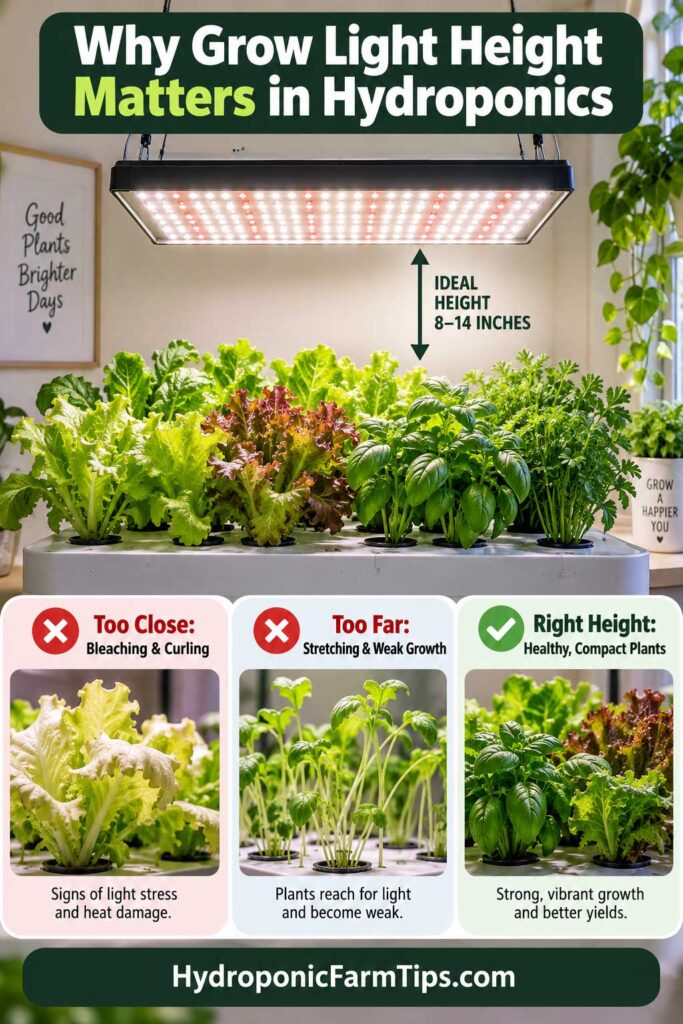
Grow light height directly affects how much usable light reaches your hydroponic plants. Even a few inches can make a noticeable difference, especially with powerful LED fixtures.
Closer Lights Increase Intensity
Move the light closer to the canopy and plants generally receive more intense light. Raise it higher and the intensity drops while the light spreads across a wider area.
Ideally, the canopy should receive enough light for compact, steady growth without pushing the plants into light or heat stress.
Too High vs. Too Close
If a grow light is too high, plants may begin stretching toward it. Stems can become thin, the spaces between leaves may increase, and overall growth can slow.
If the light is too close, the upper leaves may curl, bleach, develop dry edges, or appear unusually pale.
This is why grow light height for hydroponics should be adjusted as plants grow, rather than setting the fixture once and leaving it in the same position for the entire growing cycle.
Fixture Power Changes the Ideal Height
The fixture itself also matters. A compact 30-watt LED and a powerful 300-watt grow light can require very different hanging heights, even when they are being used for the same crop.
For the best results, consider grow light height together with:
- light intensity
- daily lighting duration
- fixture output
- canopy coverage
- plant species
- growth stage
Light intensity and duration work together, so getting the height right is only part of the setup. Our guide to how many hours grow lights should be on for hydroponics explains how lighting schedules change for seedlings, leafy greens, herbs, and fruiting crops.
Recommended Grow Light Distance by Plant Growth Stage
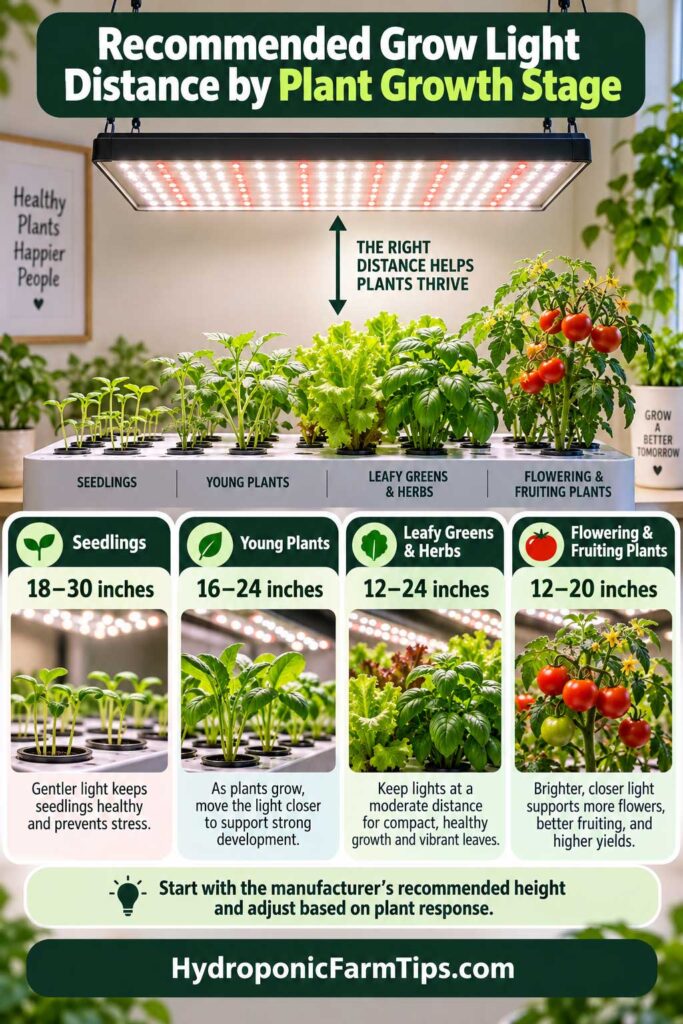
The ideal grow light distance changes as hydroponic plants mature. Seedlings usually need gentler light, while established plants can handle—and often benefit from—higher intensity.
Grow Light Height for Seedlings
Young seedlings are especially sensitive to excessive light because their leaves are small and their root systems are still developing.
For many LED grow lights, a good starting point is 18 to 30 inches above seedlings.
If seedlings become tall, thin, or stretched, the light may be too far away. If the leaves begin to bleach, curl, or develop dry edges, the light may be too close or too intense.
With seedlings, it is usually better to start a little higher and bring the light down gradually if they begin to stretch.
Grow Light Height for Young Hydroponic Plants
Once seedlings have developed several sets of true leaves and stronger roots, they can usually tolerate more light.
For many LED setups, 16 to 24 inches above the canopy is a practical starting range.
At this stage, aim for compact, steady growth rather than plants stretching upward toward the fixture. Keep the light centered over the growing area so the canopy receives reasonably even coverage.
Grow Light Height for Mature Leafy Greens and Herbs
Established lettuce, spinach, basil, cilantro, parsley, and similar crops often perform well with LEDs positioned about 12 to 24 inches above the canopy.
Leafy greens generally do not need the same light intensity as fruiting crops, so there is usually no benefit to pushing a powerful fixture extremely close.
Instead, look for healthy leaf expansion, compact growth, and even color across the canopy.
Grow Light Height for Flowering and Fruiting Plants
Tomatoes, peppers, strawberries, cucumbers, and other fruiting hydroponic crops typically need stronger light than leafy greens.
Depending on the fixture, mature plants may grow well with LEDs positioned roughly 12 to 20 inches above the canopy.
However, powerful commercial-style LEDs may need to remain farther away. Always compare these general ranges with the manufacturer’s recommended hanging height and, when possible, use PPFD measurements instead of relying on distance alone.
As the canopy rises, move the fixture with it so the plants do not slowly grow into an intensity level that is too high. In fast-growing hydroponic systems, checking the canopy every few days can prevent plants from getting unexpectedly close to the light.
Recommended Grow Light Distance by Crop
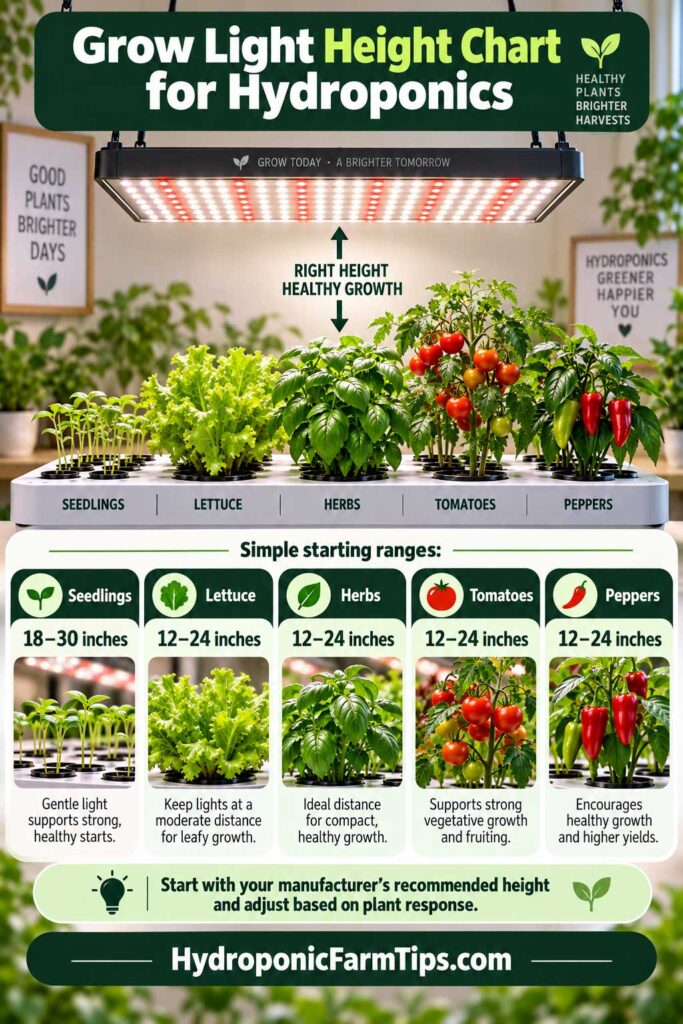
Different hydroponic crops have different light requirements, so the ideal grow light height can vary even when you use the same fixture. Leafy greens generally need less intense light than fruiting crops such as tomatoes and peppers.
If you’re deciding what to grow under your lights, our 10 best hydroponic vegetables guide covers beginner-friendly crops and their growing requirements.
Grow Light Distance for Lettuce
Lettuce prefers moderate light and usually does not need a powerful fixture positioned extremely close to the canopy.
With a typical home LED, somewhere in the 12-to-24-inch range is often a sensible place to begin.
If the light is too weak or too far away, lettuce may grow slowly or begin to stretch. If it is too intense, the leaves may become pale, curled, or stressed.
Grow Light Distance for Basil
Basil typically handles somewhat stronger light than lettuce and often responds well to bright, consistent lighting.
With many home LED fixtures, basil does well somewhere around 12 to 24 inches above the canopy.
Watch the newest leaves near the top of the plant. If they begin to bleach, curl upward, or develop dry edges, raise the fixture or reduce its intensity.
For more options beyond basil, see our guide to the 10 best hydroponic herbs.
Grow Light Distance for Spinach and Leafy Greens
Spinach, kale, arugula, Swiss chard, cilantro, and similar leafy crops often grow well with LEDs positioned around 12 to 24 inches above the canopy.
Because these plants are grown mainly for foliage, they generally do not require the same light intensity as mature fruiting crops.
Aim for compact growth, healthy color, and even coverage across the growing area.
Grow Light Distance for Tomatoes
Hydroponic tomatoes are high-light crops, especially once they begin flowering and producing fruit.
Many LED fixtures are positioned around 12 to 24 inches above the top of the canopy, although powerful grow lights may need to remain farther away.
Tomatoes can grow quickly, so check the distance regularly. A fixture that was safely positioned above the canopy a week ago may suddenly be much closer as new growth develops.
Grow Light Distance for Peppers
Peppers have lighting needs similar to tomatoes and generally benefit from stronger light once they become established.
Mature peppers often do well with the fixture roughly 12 to 24 inches above the canopy, depending on output.
Increase light intensity gradually as the plants mature rather than moving a powerful fixture very close all at once.
Grow Light Distance for Strawberries
Hydroponic strawberries usually perform well under moderate to fairly strong light.
With many LED setups, strawberries can be kept roughly 12 to 24 inches below the fixture.
Because strawberry plants stay relatively compact, maintaining an even canopy makes it easier to provide consistent light across the entire growing area.
Quick Grow Light Distance by Crop
| Hydroponic Crop | Typical LED Distance | Relative Light Demand |
|---|---|---|
| Lettuce | 12–24 in | Low to moderate |
| Spinach | 12–24 in | Low to moderate |
| Kale | 12–24 in | Moderate |
| Cilantro | 12–24 in | Moderate |
| Basil | 12–24 in | Moderate |
| Strawberries | 12–24 in | Moderate to high |
| Tomatoes | 12–24 in | High |
| Peppers | 12–24 in | High |
These distances are starting points, not fixed rules. The actual grow light height depends on fixture output, optics, dimmer setting, canopy coverage, growth stage, and the manufacturer’s recommended hanging height.
Two crops may use the same physical distance but still receive very different amounts of light if the fixture intensity or dimmer setting changes. That is why distance should be considered together with PPFD and plant response.
How Grow Light Type Changes the Recommended Height
The type of grow light you use can significantly change the ideal distance above hydroponic plants. Two fixtures that look almost identical can deliver very different amounts of light at canopy level.
LED Grow Light Height
LEDs are the most common choice for home hydroponic gardens because they are efficient, relatively cool-running, and available in a wide range of sizes and power levels.
For many setups, LED grow lights are positioned around 12 to 24 inches above established plants and somewhat higher above seedlings.
High-output LEDs may need to stay farther from the canopy, especially when running at full intensity.
If your fixture includes a dimmer, you may be able to keep the light at a convenient fixed height and adjust intensity instead of constantly raising and lowering the fixture.
Fluorescent Grow Light Height
T5 fluorescent lights and compact fluorescent fixtures generally produce less intense light than modern LED panels.
Because of that, they can often be positioned closer to plants—roughly 4 to 12 inches above the canopy.
Fluorescent lights are especially useful for seedlings, lettuce, herbs, and other compact leafy crops.
The trade-off is that their light output falls off quickly as you move them farther from the canopy.
HID Grow Light Height
High-intensity discharge lights, including metal halide and high-pressure sodium fixtures, produce substantially more heat than most LEDs.
Depending on wattage and fixture design, they may need to remain about 18 to 36 inches or more above the canopy.
With HID lighting, ventilation and canopy temperature are especially important because plants can experience heat stress even when light intensity is otherwise suitable.
LED Bar and Strip Light Height
LED bars and strip-style grow lights are popular for shelves, vertical gardens, and multi-tier hydroponic systems.
Because individual bars often have lower power density than large LED panels, they may be positioned around 6 to 18 inches above plants, depending on the fixture.
They work particularly well for lettuce, herbs, seedlings, and compact hydroponic systems where vertical space is limited.
A Simple Rule to Remember
As a general rule, higher-output fixtures usually need more distance from the canopy, while lower-output lights can often sit closer.
But wattage alone does not determine the correct height. Fixture efficiency, diode layout, optics, beam spread, dimmer setting, canopy coverage, and plant type all affect how much light actually reaches the leaves.
For the best results, use the manufacturer’s recommended hanging height as your starting point, then fine-tune it using plant response and PPFD measurements when possible.
Affiliate Disclosure: This page may contain affiliate links. If you purchase through one of these links, we may earn a commission at no additional cost to you.
Best Grow Lights for Easier Height Control
Choosing the right fixture makes grow-light height much easier to manage. These options are best suited to home hydroponic setups where you want adjustable intensity, good canopy coverage, and enough flexibility to raise or dim the light as plants grow.
| Product | Best For | Why It Stands Out | CTA |
|---|---|---|---|
| Dimmable Full-Spectrum LED | Most home hydroponic gardens | Lets you fine-tune intensity without constantly moving the fixture | Check Price |
| LED Grow Light Bar | Shelves, NFT, herbs, lettuce | Slim profile and even spread for compact systems | Check Price |
| High-Output LED Panel | Tomatoes, peppers, fruiting crops | Stronger output for larger plants and higher-light crops | Check Price |
| Compact LED Panel | Seedlings and small systems | Easier to use in tight spaces and lower-height setups | Check Price |
Signs Your Grow Light Is Too Close to Hydroponic Plants
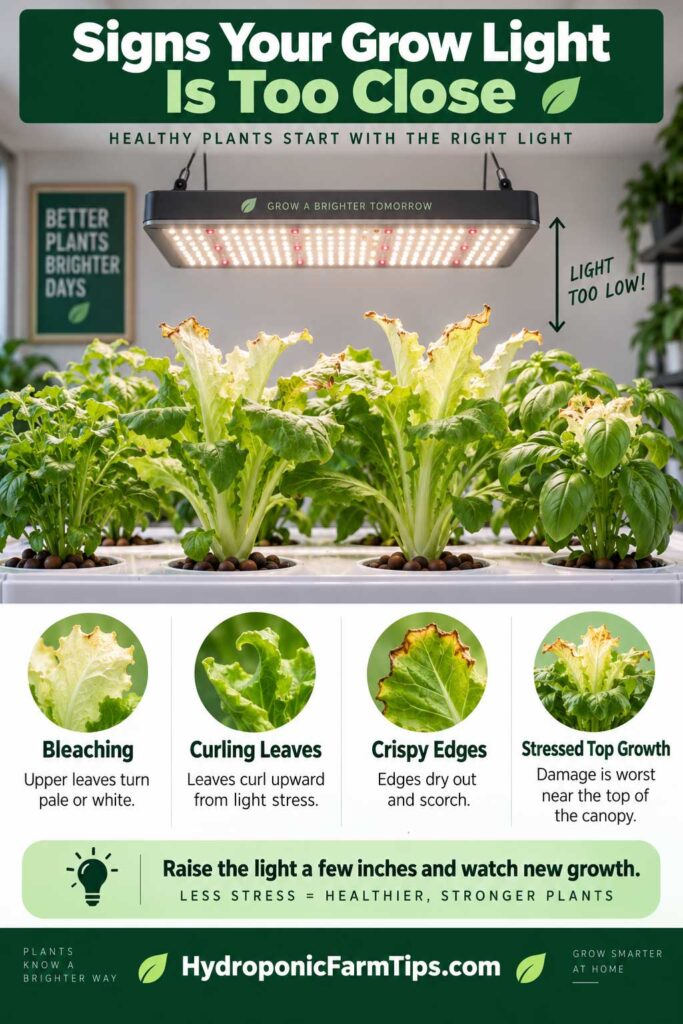
When a grow light is positioned too close to the canopy, plants can receive more light than they can comfortably use. This is especially common with powerful LEDs, which may deliver very high intensity without producing the obvious heat associated with older lighting systems.
One of the easiest signs to spot is bleaching near the top of the plant. Leaves closest to the fixture may become unusually pale, yellowish, or almost white while lower leaves remain normal.
You may also notice upward-curling leaves, dry or crispy edges, brown patches near the top of the canopy, or slowed new growth. Often, the worst damage shows up directly beneath the brightest part of the fixture.
How to Tell Light Stress From Other Problems
Light stress can resemble hydroponic nutrient deficiencies, especially when leaves become pale or develop brown areas. The location of the symptoms can provide an important clue.
If the damage is strongest on the newest upper leaves closest to the grow light while lower growth remains relatively healthy, excessive light intensity is more likely. Nutrient problems often follow a different pattern depending on which nutrient is involved.
What to Do If the Light Is Too Close
Raise the fixture by a few inches or reduce the dimmer setting, then watch the newest growth over the next several days.
Avoid making large changes unless the plants are showing severe stress. Smaller adjustments make it easier to see whether excessive light was actually the cause.
It is also worth checking the temperature at canopy level. Even efficient LEDs can create a warmer zone directly beneath the fixture, especially in small grow tents or enclosed hydroponic systems.
Older bleached or damaged leaves may not fully recover, so judge improvement by the appearance of new growth rather than expecting affected leaves to return to normal.
Signs Your Grow Light Is Too Far Away
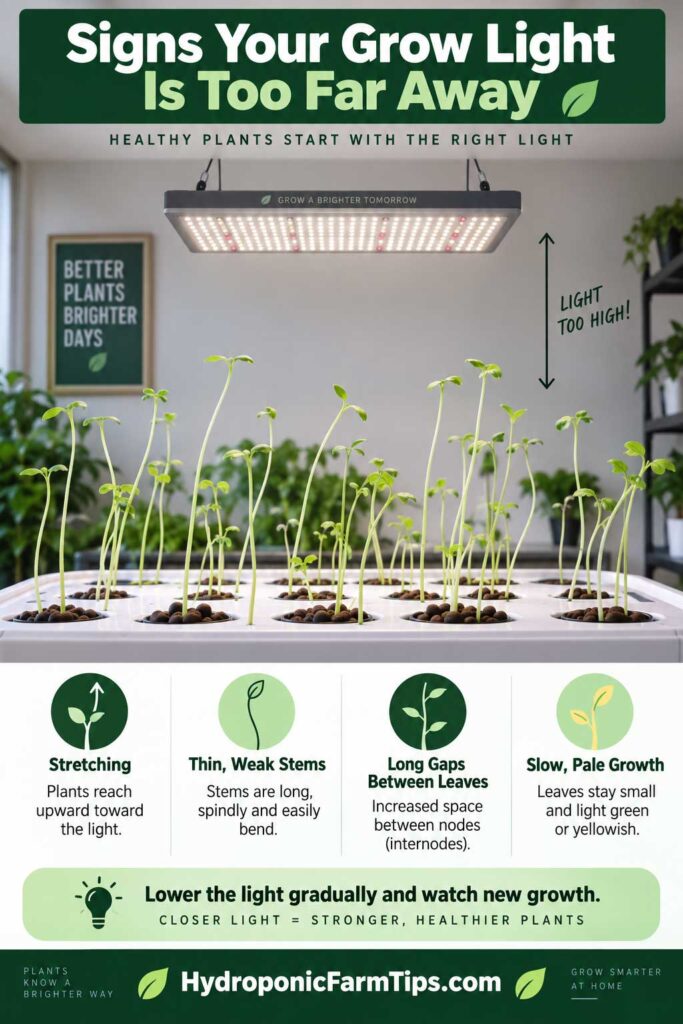
When a grow light is positioned too high above hydroponic plants, the canopy may not receive enough usable light for compact, healthy growth.
One of the clearest signs is stretching. Plants may grow taller with thinner stems and wider spaces between leaves as they reach toward the light. Seedlings can become especially tall and spindly instead of staying short and sturdy.
Slower growth, smaller leaves, and plants leaning toward the fixture can point in the same direction. Sometimes the issue is distance; other times the fixture simply does not have enough output or coverage.
What to Do If the Light Is Too Far Away
Lower the fixture gradually rather than making one large adjustment. Moving it about 2 to 4 inches closer at a time gives you a chance to watch how the plants respond without suddenly exposing them to excessive intensity.
If your grow light has a dimmer, you can also increase output while keeping the same hanging height.
Pay attention to coverage as well. Sometimes the center of the garden receives enough light while plants near the edges remain underlit. In that case, repositioning the fixture or improving coverage may work better than simply lowering it.
The goal is steady, compact growth with healthy color and no obvious stretching. If new growth becomes stronger and more balanced after an adjustment, the light was likely too far away.
How to Measure the Right Grow Light Height More Accurately
Using inches is a useful starting point, but the best grow light height depends on how much usable light actually reaches the plant canopy.
That is where PPFD becomes more useful than distance alone.
What Is PPFD?
PPFD stands for photosynthetic photon flux density. It measures how much photosynthetically active light reaches a given area each second and is expressed as µmol/m²/s.
Michigan State University’s indoor lighting guide explains PPFD as a useful way for growers to evaluate light intensity at plant height.
In simple terms, PPFD tells you how intense the grow light is where your plants are actually growing.
General PPFD Starting Ranges
The ranges below are general working ranges rather than universal targets. Exact requirements vary by crop, cultivar, growth stage, photoperiod, environment, and lighting system.
| Growth Stage or Crop Type | Approximate PPFD Range |
|---|---|
| Seedlings | 100–300 µmol/m²/s |
| Lettuce & leafy greens | 150–350 µmol/m²/s |
| Herbs | 200–400 µmol/m²/s |
| Vegetative tomatoes & peppers | 300–500 µmol/m²/s |
| Fruiting tomatoes & peppers | 400–700+ µmol/m²/s |
How to Check PPFD
The most accurate option is a dedicated PAR meter. Take readings at canopy level in several areas rather than measuring only directly beneath the center of the fixture.
Check the brightest part of the canopy, the edges, and any areas where plants appear weaker or more stretched. A few readings across the canopy will quickly show whether you have bright hot spots or weak areas around the edges.
Smartphone light-meter apps can be useful for rough comparisons, but they are generally better for spotting relative differences than for replacing a properly calibrated PAR meter.
Don’t Forget DLI
PPFD measures light intensity at a specific moment, while DLI, or Daily Light Integral, represents the total amount of photosynthetically active light a plant receives over the course of a day.
That means grow light height and lighting duration should be considered together.
For example, moderate PPFD delivered over a longer photoperiod can sometimes provide a similar daily light total to stronger PPFD delivered for fewer hours.
This is why grow light height for hydroponics should not be adjusted in isolation. Light intensity, distance, and daily lighting hours all work together to determine how much light your plants actually receive.
Best Tools for Measuring Grow Light Intensity
If you want to stop guessing about grow-light height, measuring canopy-level light is the most useful upgrade you can make. A good PAR meter helps you see whether plants are actually receiving too much, too little, or uneven light.
| Tool | Best For | Why It Helps | CTA |
|---|---|---|---|
| PAR Meter | Accurate PPFD readings | Measures usable plant light directly at canopy level | Check Price |
| Quantum Light Meter | Serious growers | Useful for checking several points across a larger canopy | Check Price |
| Digital Light Meter | Budget monitoring | Good for comparing brighter and darker areas | Check Price |
| Light Meter App + Sensor | Beginners | Simple option for rough comparisons before buying a PAR meter | Check Price |
How to Adjust Grow Light Height as Plants Grow
Hydroponic plants can grow quickly once their roots are established and the system is running well. That means the ideal distance between the canopy and the grow light can change within just a few days.
Instead of setting the fixture once and leaving it there, check the distance regularly—especially with fast-growing crops such as basil, tomatoes, cucumbers, and peppers.
As plants get taller, raise the fixture when needed so the canopy continues receiving appropriate light intensity.
Measure From the Top of the Canopy
Always measure grow light distance from the highest healthy leaves, not from the reservoir, growing tray, or base of the plant.
If the canopy is uneven, use the tallest section as your reference point while also watching shorter plants for signs that they are receiving too little light.
Keep the Canopy Even
An even canopy makes grow-light management much easier.
Pruning, spacing, training, or repositioning plants can help prevent one tall stem from getting too close to the fixture while shorter plants remain underlit.
This is especially useful with tomatoes, peppers, and cucumbers, which can quickly outgrow compact hydroponic systems.
Make Small Height Adjustments
Large changes are rarely necessary.
Moving the fixture about 2 to 4 inches at a time is usually enough to fine-tune the distance without suddenly changing the amount of light your plants receive.
After each adjustment, watch the newest growth. Healthy plants should remain compact and vigorous without stretching, bleaching, curling, or developing dry leaf edges.
If your fixture has a dimmer, you can also fine-tune intensity without changing the physical height every time. We’ll look at when it makes more sense to raise the light versus dim it later in this guide.
Increase Light Gradually
When seedlings move under a stronger fixture or fruiting plants need more intensity, make the change gradually. Lower the fixture or increase the dimmer in small steps, then watch the newest growth for bleaching, curling, or other signs of stress.
How Light Intensity and Daily Light Hours Work Together
Grow light height is only part of the equation. The total amount of light your hydroponic plants receive also depends on how long the fixture runs each day.
Moderate light delivered for 16 hours can sometimes add up to a similar daily light total as stronger light delivered for fewer hours. This is why PPFD and DLI should be considered together.
PPFD vs. DLI
PPFD tells you how intense the light is at the canopy at a given moment.
DLI, or Daily Light Integral, tells you how much photosynthetically active light the plant receives over the entire day.
Michigan State University explains that DLI combines light intensity with the length of the photoperiod, which is why PPFD and daily lighting hours should be considered together.
A simple way to think about it is:
PPFD = light intensity right now
DLI = total usable light received during the day
If you lower a grow light and increase PPFD, you may not need an especially long photoperiod. A lower-intensity setup, on the other hand, may rely on more lighting hours to reach a suitable daily total.
Example DLI Calculation
You can estimate DLI with this formula:
DLI = PPFD × lighting hours × 3,600 ÷ 1,000,000
For example, if lettuce receives about 250 µmol/m²/s for 16 hours per day:
250 × 16 × 3,600 ÷ 1,000,000 = 14.4 mol/m²/day
Light requirements also vary considerably by crop. Purdue Extension’s DLI reference shows why one daily light target should not be applied to every plant.
This is why simply asking how many inches a grow light should be above a plant does not tell the whole story. Distance affects intensity, while the photoperiod determines how long that intensity is delivered.
Don’t Use Longer Light Hours to Fix Poor Placement
Running grow lights longer is not always the best way to compensate for weak intensity.
If a fixture is too far from the canopy, plants may still stretch or grow slowly even with a long photoperiod. In that case, lowering the light, increasing output, or improving coverage is usually more effective.
Plants also generally benefit from a regular dark period rather than continuous 24-hour lighting.
For crop-specific schedules, see our guide to how many hours grow lights should be on for hydroponics, which covers seedlings, herbs, leafy greens, tomatoes, peppers, and other common crops.
Common Grow Light Height Mistakes to Avoid
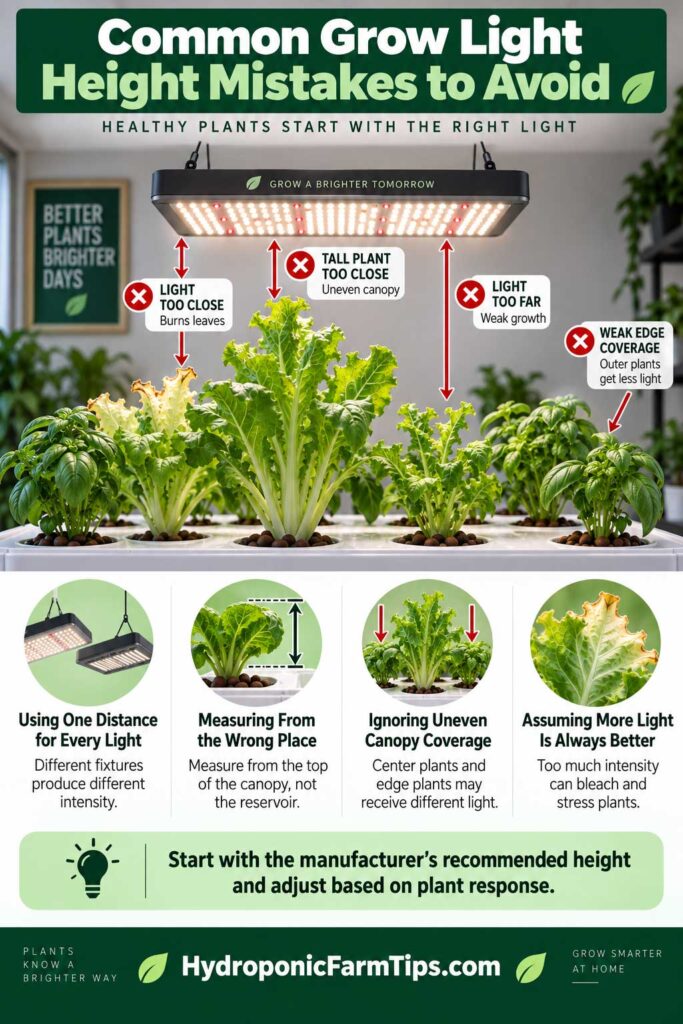
Even with a good LED fixture, poor positioning can reduce growth or create unnecessary stress. Most problems happen when growers treat light height as a fixed number instead of something that changes with the fixture, crop, and growth stage.
1. Using the Same Distance for Every Grow Light
Not all LEDs should be hung at 12, 18, or 24 inches.
A low-power seedling light and a high-output full-spectrum fixture can produce very different intensity at the same distance. Use the manufacturer’s recommended hanging range as your starting point. Then watch what the newest leaves are telling you.
2. Measuring From the Wrong Reference Point
Grow light distance should be measured from the top of the plant canopy to the fixture, not from the reservoir, shelf, or base of the plant.
As plants grow taller, that distance changes even if the light itself never moves.
3. Lowering the Light Too Aggressively
If plants are stretching, moving the light closer can help, but lowering a powerful fixture too much at once can create a different problem.
Move the light a little, give the plants time to respond, and only then decide whether another adjustment is needed.
4. Ignoring Uneven Canopy Coverage
Light intensity is usually strongest beneath the center of the fixture and weaker toward the edges.
If the middle plants look healthy while those around the outside are stretching, the problem may be coverage rather than overall height. Repositioning the fixture, raising it slightly for a wider spread, or adding another light may work better than simply lowering it.
5. Relying on the Hand Test
The traditional hand test may help you notice excessive heat, but it does not tell you how much photosynthetically useful light is reaching the canopy.
Modern LEDs can deliver strong light intensity without producing the same radiant heat as older HID fixtures. Manufacturer specifications, plant response, and PPFD measurements are much more useful.
6. Assuming More Light Is Always Better
Moving the fixture closer does not automatically produce faster growth.
Once plants are receiving enough light, pushing intensity higher can increase stress, electricity use, and heat without providing a meaningful benefit.
The goal is not to get the grow light as close as possible. It is to provide appropriate, even light across the entire canopy.
Does Hydroponic System Type Affect Grow Light Height?
The hydroponic system itself does not usually determine the ideal light height. Crop type, fixture output, plant height, and canopy coverage matter more, although the system layout can make even lighting easier—or harder—to achieve.
If you’re still deciding between DWC, NFT, Kratky, drip, or another setup, see our guide to the 8 best hydroponic systems for home for a full comparison.
DWC and Kratky Systems
DWC and Kratky setups are often used for lettuce, basil, and other compact crops with relatively even canopies.
Because the plants tend to stay at similar heights, it is usually easy to position a grow light evenly above the entire growing area.
NFT Systems
NFT systems often use long channels filled with leafy greens or herbs.
Here, coverage across the full length of the channel can matter more than choosing one exact hanging distance. A fixture that is too low may create a bright center while leaving the ends underlit.
LED bars or multiple fixtures can help provide more even coverage across longer NFT systems.
Ebb and Flow Systems
Ebb and flow trays may contain several plant types or plants at different stages of growth.
If the canopy becomes uneven, taller plants can receive too much light while shorter plants receive too little. Keeping crops with similar heights together makes lighting easier to manage.
Drip and Dutch Bucket Systems
Drip systems and Dutch buckets are commonly used for larger crops such as tomatoes, peppers, and cucumbers.
These plants can grow tall quickly, so vertical clearance and adjustable lighting become especially important. Pruning and training can also help maintain an even canopy and prevent individual shoots from growing too close to the fixture.
Regardless of the hydroponic system, measure grow light distance from the top of the canopy, follow the fixture manufacturer’s recommendations, and adjust based on actual light intensity and plant response.
How to Set Grow Light Height When You Don’t Have a PAR Meter
A PAR meter is helpful, but you can still set grow light height reasonably well without one.
Start with the manufacturer’s recommended hanging height, then fine-tune the position based on how the plants respond.
Step 1: Start Near the Higher End
If you are unsure, begin near the upper end of the recommended range.
For example, if the manufacturer suggests 12 to 24 inches, starting around 20 to 24 inches gives plants time to adjust before you increase intensity.
Step 2: Watch the Newest Growth
Over the next several days, pay attention to the newest leaves and overall plant shape.
Healthy plants should generally remain compact, upright, and evenly colored. Seedlings should develop sturdy stems rather than becoming tall and thin.
If plants begin stretching, move the light slightly closer. If upper leaves become pale, curled, dry, or bleached, raise the fixture or reduce the dimmer setting.
Step 3: Make Small Adjustments
Move the fixture only 2 to 4 inches at a time.
Small changes make it easier to see whether the adjustment helped without suddenly exposing plants to much stronger or weaker light.
After each change, watch the newest growth before adjusting the fixture again.
Step 4: Check the Entire Canopy
Do not judge the setup only from the plant directly beneath the center of the light.
If center plants look healthy but plants near the edges are stretching, the problem may be uneven coverage rather than incorrect height.
In that case, repositioning the fixture, raising it slightly for a wider spread, or adding another light may work better than simply lowering it.
This method is less precise than measuring PPFD, but it works surprisingly well when you make small adjustments and pay attention to new growth.
Grow Light Height Troubleshooting Chart
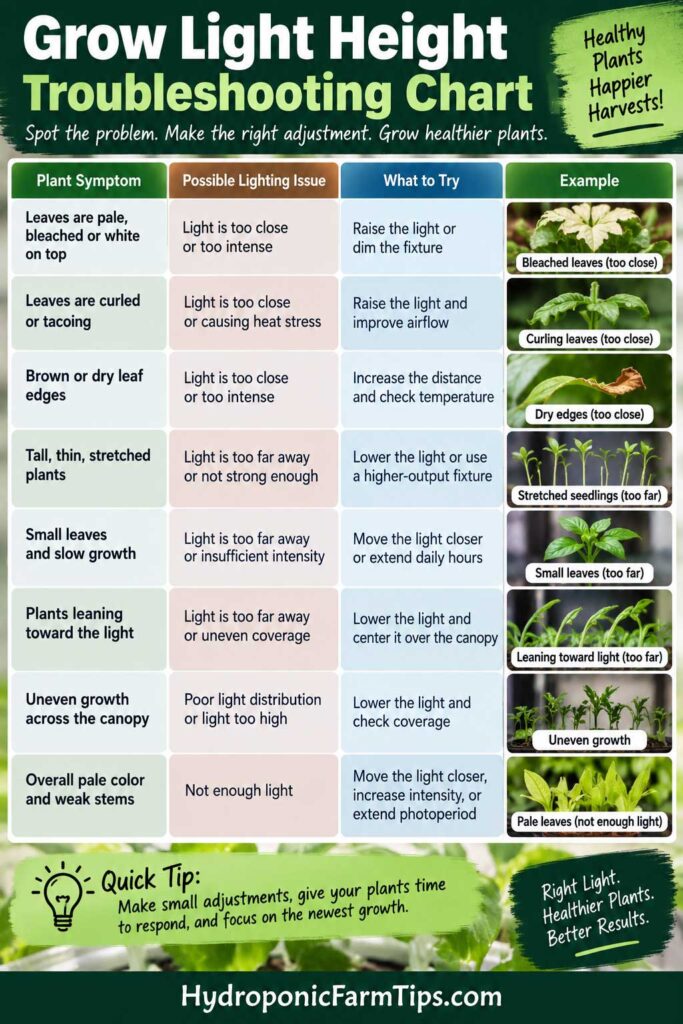
When hydroponic plants start looking stressed, grow light height is one of the first things worth checking. This chart can help you narrow down whether the fixture may be too close, too far away, or covering the canopy unevenly.
| Plant Symptom | Possible Lighting Issue | What to Try |
|---|---|---|
| Tall, thin seedlings | Light too far away or too weak | Lower the light gradually or increase intensity |
| Long spaces between leaves | Insufficient light | Move the fixture closer and check coverage |
| Plants leaning toward the light | Uneven or weak lighting | Recenter the fixture or improve coverage |
| Pale upper leaves | Light may be too intense | Raise the fixture or reduce output |
| White or bleached areas | Excessive light intensity | Increase distance and lower intensity |
| Upward-curling leaves | Possible light or heat stress | Raise the light and check canopy temperature |
| Crispy upper leaf edges | Light may be too close | Increase distance and monitor new growth |
| Slow, weak growth | Light may be insufficient | Lower the fixture or verify PPFD |
| Center plants healthy, edge plants weak | Poor light spread | Reposition or raise the fixture for wider coverage |
| Upper growth stressed, lower growth healthy | Excessive intensity at canopy level | Raise or dim the light |
Rule Out Other Hydroponic Problems
Lighting symptoms can overlap with nutrient, pH, root, and temperature problems.
Yellow leaves may be related to insufficient light, but nutrient problems, incorrect pH, or root stress can produce similar symptoms. Our guide to yellow leaves in hydroponics covers these causes in more detail.
If adjusting the grow light does not improve new growth, check the rest of the hydroponic system. Start with reservoir pH and EC; our hydroponic nutrient and pH chart provides crop-specific reference ranges. Then inspect root health, water temperature, and oxygenation.
If changing the light does not improve the newest growth, the real problem may be elsewhere in the system.
Grow Light Height by Wattage: Very Rough Starting Ranges
Wattage can give you a rough clue about hanging height, but it cannot tell you the correct distance by itself. Two LEDs with the same wattage can deliver very different intensity because of differences in efficiency, diode layout, optics, beam spread, and fixture design.
Treat the ranges below as rough examples for common home LED fixtures—not universal recommendations.
As a broad starting point:
| LED Grow Light Power | Approximate Starting Height |
|---|---|
| 20–50 watts | 8–18 inches |
| 50–100 watts | 12–20 inches |
| 100–200 watts | 14–24 inches |
| 200–300 watts | 16–30 inches |
| 300+ watts | 18–36+ inches |
These ranges are intentionally broad. A modern 100-watt LED may produce more canopy-level intensity than an older or less efficient 150-watt fixture.
Lower-power lights are often used for lettuce, herbs, seedlings, and compact shelf systems, where the fixture can usually sit relatively close to the canopy.
Medium- and high-output LEDs are more common for larger growing areas and fruiting crops such as tomatoes and peppers. These fixtures often need more distance, especially when operated at full intensity.
For powerful LEDs, manufacturer PPFD maps are especially useful because they show how light intensity changes at different hanging heights.
Think of wattage as a rough clue, not a hanging-height rule. Use the manufacturer’s recommended height first, then fine-tune it with PPFD measurements and plant response.
Should You Raise the Light or Dim It?
With modern LED grow lights, you usually have two ways to reduce intensity: raise the fixture or turn down the dimmer. Both can work, but they affect the growing area differently.
Raise the Light for Better Coverage
Raising the fixture reduces intensity while also spreading light across a wider area.
This is often the better choice when plants directly beneath the center of the fixture are receiving too much light while plants near the edges are still underlit. It can also help when the canopy is getting physically too close to the light or when heat is building up near the tallest leaves.
Dim the Light When Height Is Limited
Dimming lowers intensity without changing the physical position of the fixture.
This works well in compact hydroponic systems, shelving setups, and grow tents where vertical clearance is limited. It is also useful for seedlings or young plants that need gentler light even though the fixture is already positioned at a good height for coverage.
Dimming can also reduce electricity use when the plants do not need the fixture running at full output.
Sometimes Use Both
In practice, you may end up adjusting both.
For example, you might raise the fixture slightly to improve light spread, then adjust the dimmer to bring canopy intensity back into the desired range.
Make one small change at a time and watch how the plants respond before adjusting again. The goal is even coverage and appropriate intensity, not simply getting the light as close to the canopy as possible.
Best Grow Light Hangers and Height-Adjustment Accessories
A good grow light is much easier to use when you can raise or lower it quickly. Adjustable hangers are inexpensive, but they make one of the biggest practical differences when plants begin growing toward the fixture.
| Accessory | Best For | Why It Helps | CTA |
|---|---|---|---|
| Ratchet Rope Hangers | Most LED grow lights | Makes small height adjustments fast and easy | Check Price |
| Heavy-Duty Light Hangers | Larger LED panels | Better support for heavier fixtures | Check Price |
| Adjustable Grow Light Stand | Countertops and small systems | Useful when ceiling mounting is not practical | Check Price |
| Timer Plug | Consistent photoperiod | Keeps daily lighting hours automatic and repeatable | Check Price |
How Often Should You Check Grow Light Height?
Grow light height is not something you should set once and forget. Hydroponic plants can grow quickly, so the distance between the canopy and the fixture may change noticeably within a few days.
For most home systems, checking the height two or three times per week is usually enough. Fast-growing crops such as tomatoes, cucumbers, basil, and peppers may need attention every couple of days once growth accelerates.
When to Check More Often
Check the fixture more frequently during rapid growth, after increasing the dimmer setting, after lowering the light, or whenever the canopy starts becoming uneven.
Check more often when tomatoes, peppers, or cucumbers enter a fast growth phase, because the top of the canopy can move several inches surprisingly quickly.
Leafy greens such as lettuce usually require fewer adjustments because they tend to stay more compact.
Keep a Record of What Works
Once you find a setup that performs well, write it down.
For example:
Basil — 18 inches — 70% intensity — 16 hours/day
Recording the crop, light height, dimmer setting, and photoperiod gives you a useful starting point for future grows.
Over time, your own notes will become more valuable than generic distance recommendations because they reflect your specific fixture, growing space, and hydroponic setup.
Frequently Asked Questions About Grow Light Height
How high should LED grow lights be above hydroponic plants?
For many home hydroponic systems, LED grow lights are positioned about 12 to 24 inches above established plants. Seedlings often need more distance, while high-output fixtures may also need to hang farther away.
How high should grow lights be above seedlings?
A practical starting range for many LEDs is 18 to 30 inches above seedlings. If seedlings stretch, the light may be too weak or too far away. If the upper leaves bleach or curl, it may be too intense.
How far should grow lights be from hydroponic lettuce?
For many LED fixtures, 12 to 24 inches above the lettuce canopy is a useful starting point. Lettuce generally needs less light intensity than tomatoes or peppers.
How far should grow lights be from basil?
Hydroponic basil often performs well with LEDs positioned around 12 to 24 inches above the canopy. Adjust the height based on fixture output and plant response.
How far should grow lights be from tomatoes?
Many LED setups use a distance of roughly 12 to 24 inches above mature tomato plants. Powerful fixtures may need more distance, especially when operating at full intensity.
Is 12 inches too close for an LED grow light?
Sometimes. A low-output LED may work well at 12 inches, while a powerful fixture could provide excessive intensity at the same distance.
Always compare the distance with the manufacturer’s recommendations and, when possible, PPFD measurements.
Is 24 inches too far from plants?
Not necessarily. Twenty-four inches can be appropriate for powerful LEDs or young plants, but weaker fixtures may provide too little light at that height.
Actual light intensity matters more than distance alone.
Should grow lights be closer during flowering and fruiting?
Not automatically. Fruiting crops generally need more light, but that can come from higher fixture output, a closer hanging height, or both.
The goal is adequate intensity without creating light or heat stress.
Do grow lights need to move as plants grow?
Usually, yes. As plants get taller, the canopy moves closer to the fixture.
Raise the light when necessary or adjust intensity so the distance and light level remain appropriate.
Can I leave my grow light at one height and use the dimmer instead?
Yes. If coverage is already good, adjusting the dimmer can be easier than constantly moving the fixture.
Final Takeaway: How High Should Grow Lights Be Above Hydroponic Plants?
For most home hydroponic gardens, a practical starting point is to keep LED grow lights about 12 to 24 inches above established plants and roughly 18 to 30 inches above seedlings.
From there, let the fixture and the plants guide you. A powerful light may need more distance, while a smaller fixture may need to sit closer to the canopy.
If plants begin stretching or developing weak stems, the light may be too far away or too weak. If the upper leaves bleach, curl, or develop dry edges, the fixture may be too close or too intense.
The best approach is to start with the manufacturer’s recommended hanging height, make small adjustments, and use PPFD measurements when possible.
When the height is right, plants should stay compact, evenly colored, and vigorous without bleaching or stretching.
Finally, remember that grow light height and photoperiod work together. Once the fixture is positioned correctly, make sure your plants are also receiving an appropriate number of light hours each day.
More Hydroponic Lighting Guides You May Like
If you’re fine-tuning your hydroponic setup, these guides can help you manage lighting, plant health, and growing conditions more effectively.
- How Many Hours Should Grow Lights Be On for Hydroponics? — Learn how long to run grow lights for seedlings, leafy greens, herbs, tomatoes, peppers, and other crops.
- 8 Best Hydroponic Systems for Home You Can Buy — Compare popular hydroponic systems and find the best setup for your crops and available space.
- Best 10 Hydroponic Vegetables You Can Grow — Discover productive vegetables that grow well in indoor hydroponic systems.
- 10 Best Hydroponic Herbs — Explore herbs such as basil, mint, parsley, cilantro, and oregano that work well in hydroponics.
- Hydroponic Nutrient & pH Chart — Check nutrient, pH, and growing ranges for popular hydroponic crops.
- Hydroponic Nutrient Deficiencies: Signs, Causes & Fixes — Learn how to recognize nutrient problems and distinguish them from lighting-related stress.
- Why Are My Hydroponic Leaves Turning Yellow? — Troubleshoot lighting, nutrients, pH, root health, and other common causes of yellow leaves.
- Best LED Grow Lights for Hydroponics — Compare LED grow lights for leafy greens, herbs, seedlings, tomatoes, peppers, and larger hydroponic setups.
These guides work together to help you balance grow light height, light duration, nutrients, pH, and overall plant health throughout the growing cycle.