- Synergy Research reported that IBM had 7 percent of the cloud infrastructure market
- These major platforms probably only went all-in on flexbox fairly recently
Hydroponics gives growers something traditional gardening often can’t: more control over how, where, and when crops are produced. With the right setup, you can grow fresh vegetables, herbs, and fruits year-round while carefully managing water, nutrients, light, and growing conditions.
But if your goal is to make money, choosing what to grow matters just as much as choosing the right hydroponic growing system. A crop that takes months to mature and sells cheaply may occupy valuable growing space, while a fast-growing herb or leafy green can potentially be harvested and sold several times in the same period.
The most profitable hydroponic plants tend to combine a few important traits: strong local demand, relatively short growing cycles, good yields, efficient use of space, and a selling price that makes sense compared with production costs.
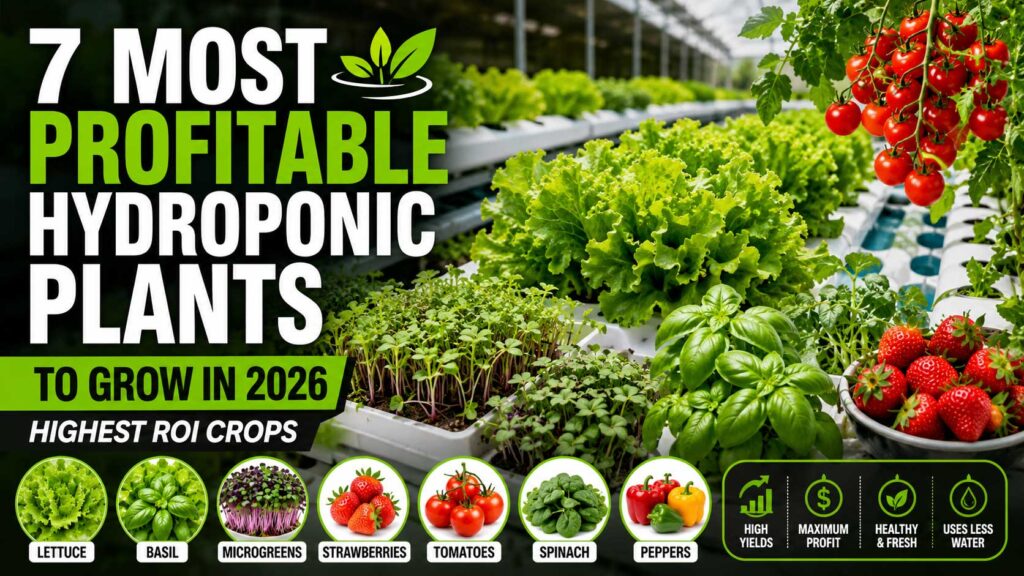
Below, we’ll look at 7 profitable plants to grow hydroponically, from quick-turnover crops like microgreens and lettuce to higher-value fruits such as strawberries. We’ll also compare their growing time, suitable hydroponic systems, market potential, and what makes each one worth considering.
Important: There isn’t one crop that’s automatically the most profitable everywhere. Electricity, labor, nutrients, local selling prices, available space, and whether you sell wholesale or directly to customers can completely change the numbers.
Why Some Hydroponic Plants Are More Profitable Than Others
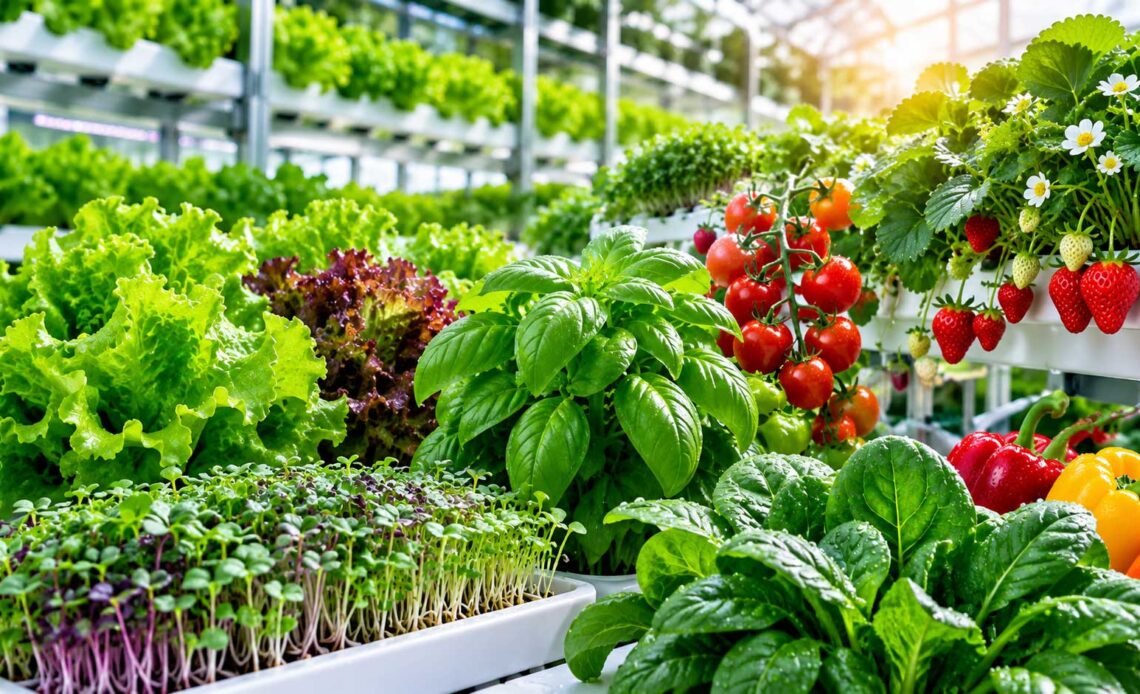
Even the most profitable hydroponic plants can produce very different results from one operation to another. How quickly a plant grows matters, but it’s only one part of the equation. You also have to consider how much space the crop uses, what it costs to produce, how often it can be harvested, and—most importantly—whether people in your area are willing to buy it.
Profitable hydroponic crops usually share several characteristics:
- Short growing cycles: Faster crops can free up growing space for the next planting sooner.
- Strong local demand: A high-value crop isn’t very useful if you can’t find customers for it.
- Good selling price: The price needs to justify expenses such as seeds, nutrients, electricity, labor, and packaging.
- Multiple harvests: Crops such as basil can be cut repeatedly rather than replaced after every harvest.
- Efficient use of space: Compact plants can produce more marketable crops per square foot.
- Manageable production needs: Crops requiring extensive pruning, pollination, support, or climate control can increase labor and operating costs.
- Consistent quality: Reliable size, appearance, flavor, and freshness can make it easier to build repeat business.
This is why leafy greens, microgreens, and culinary herbs are attractive to many hydroponic growers. Their relatively short production cycles can provide frequent harvests without requiring the space needed by larger fruiting plants.
Tomatoes, peppers, and strawberries are different. They take longer to reach production and generally require more light, space, support, and maintenance, but their higher selling value can still make them worthwhile—particularly when sold directly to consumers, restaurants, or specialty markets.
The key isn’t simply growing the crop with the highest selling price. It’s finding the best balance between production cost, growing time, yield, available space, and what your local market will actually pay.
Affiliate disclosure: This article may contain affiliate links. If you purchase through one of these links, we may earn a commission at no additional cost to you.
Want to Start Growing These Crops at Home?
You don’t need a commercial greenhouse to experiment with profitable hydroponic crops. A few basic tools make it easier to control nutrients, lighting, and growing conditions while you learn which plants perform best in your setup.
Hydroponic Growing Essentials for Beginners
| What You’ll Need | Why It’s Useful | Best For | Buy |
|---|---|---|---|
| Hydroponic Growing Kit | Provides an easy all-in-one starting setup | Lettuce, basil and herbs | Check Price on Amazon |
| Digital pH Meter | Helps monitor nutrient-solution pH | All hydroponic crops | Check Price on Amazon |
| EC/TDS Meter | Helps monitor nutrient concentration | Nutrient management | Check Price on Amazon |
| Hydroponic Nutrients | Supplies essential mineral nutrients | General hydroponic growing | Check Price on Amazon |
| LED Grow Light | Provides supplemental light indoors | Indoor crops | Check Price on Amazon |
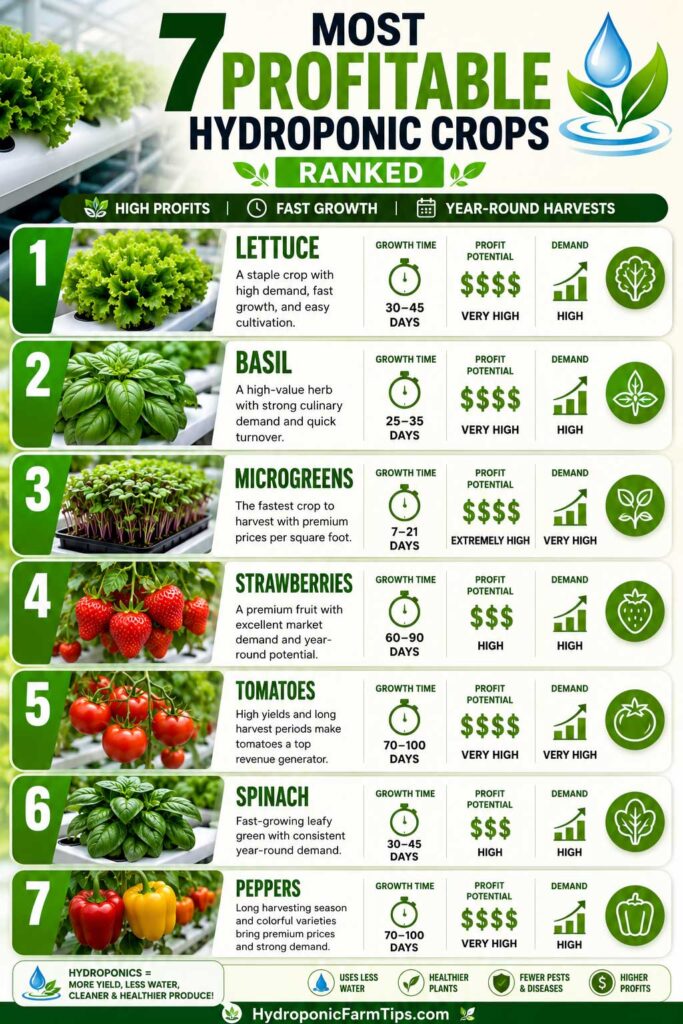
7 Most Profitable Hydroponic Plants to Grow
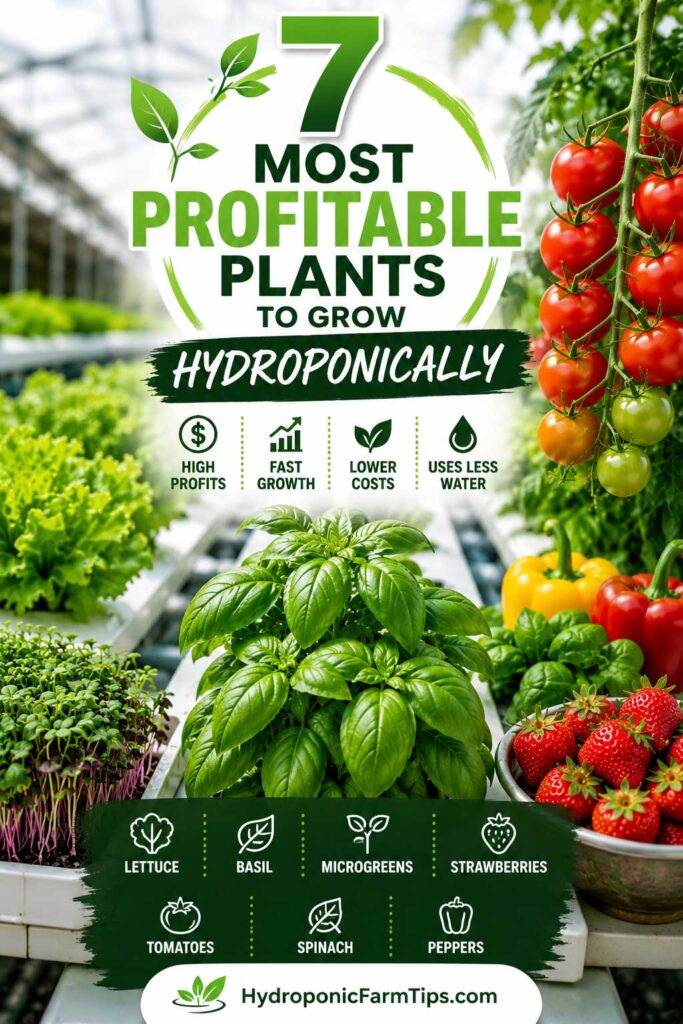
The best crop for your hydroponic setup depends on your available space, growing system, operating costs, experience, and—most importantly—your local market. A crop that performs well for a large greenhouse may not make sense for someone growing on a few indoor racks.
The seven crops below stand out because they combine characteristics that can make hydroponic production financially attractive, such as fast growth, efficient use of space, repeat harvests, strong demand, or higher selling value. We’ll start with one of the easiest crops for new growers and then move into herbs, microgreens, and higher-value fruiting plants.
1. Lettuce – A Profitable Hydroponic Crop for Beginners
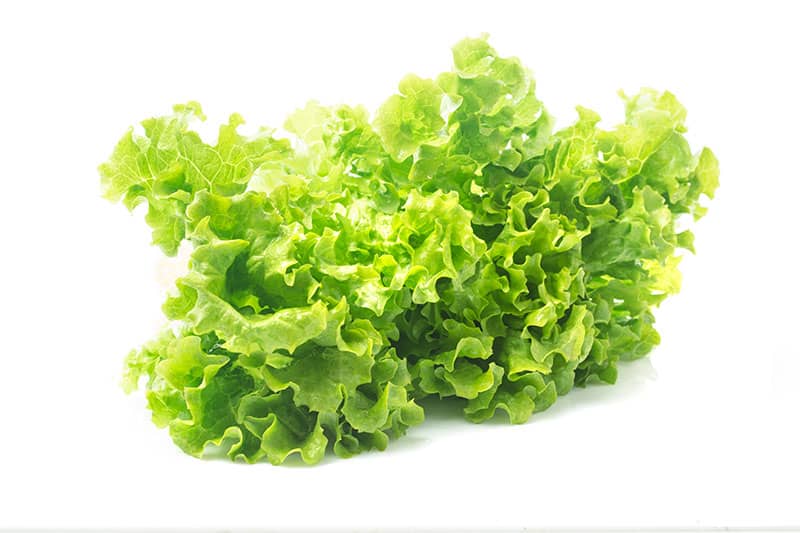
Fresh lettuce is one of the easiest crops to grow hydroponically, and its short production cycle makes it an attractive option for growers interested in selling their harvests. It requires relatively little space, works well in several hydroponic systems, and has familiar year-round consumer demand.
Many varieties can reach harvestable size in roughly 30–45 days, depending on the cultivar and growing conditions. That quick turnaround also makes staggered planting possible, so growers can harvest one batch while the next is already developing.
Why Lettuce Can Be Profitable
Lettuce’s biggest advantage isn’t necessarily a high selling price—it’s production efficiency. Compared with tomatoes or peppers, lettuce doesn’t require months of growth, extensive trellising, or pollination before producing a marketable crop.
Its short crop cycle, compact size, relatively simple care requirements, and broad consumer appeal make it well suited to repeated hydroponic production. Growers can also sell it in different forms, including whole heads, living lettuce with roots attached, baby greens, and mixed salad blends.
Best Hydroponic Systems for Lettuce
Lettuce performs particularly well in Nutrient Film Technique (NFT), Deep Water Culture (DWC), floating raft systems, and some vertical hydroponic systems.
NFT and raft systems are especially useful when growing larger quantities because they allow many plants to share the same nutrient-delivery system while using growing space efficiently.
Popular Lettuce Varieties
Butterhead, Bibb, romaine, green leaf, red leaf, and oak leaf lettuce can all work well hydroponically. Instead of assuming one variety will be the most profitable, consider testing several cultivars in small batches.
A colorful combination of red and green varieties may also be more attractive for salad mixes or direct-to-consumer sales than a single standard variety.
Growing Tips for Better Yields and Quality
For consistent, marketable lettuce:
- Keep nutrient-solution pH around 5.5–6.5.
- Avoid excessively warm nutrient solution.
- Provide adequate light and airflow.
- Monitor EC as plants develop.
- Stagger plantings for more regular harvests.
- Keep reservoirs, channels, tools, and harvesting equipment clean.
Lettuce prefers relatively cool growing conditions. Excessive heat can contribute to bolting, bitterness, and reduced crop quality.
Lettuce Profit Potential
Lettuce earns its place among the most profitable hydroponic plants primarily because growers can produce a large number of plants in a relatively small area and turn that growing space over quickly.
Actual margins depend on production costs and where the crop is sold. Direct sales through farmers markets, restaurants, CSA boxes, or local customers may provide more pricing flexibility than selling commodity lettuce wholesale.
Specialty products such as living lettuce, baby greens, and colorful salad mixes can also help distinguish your crop from standard supermarket lettuce.
Pro Tip: Test the market before scaling up. Grow small batches of several lettuce varieties and track not only yield, but also growing time, losses, selling price, and which varieties customers actually buy. The highest-yielding lettuce isn’t necessarily the one that leaves you with the best margin.
2. Basil – A High-Value Hydroponic Herb
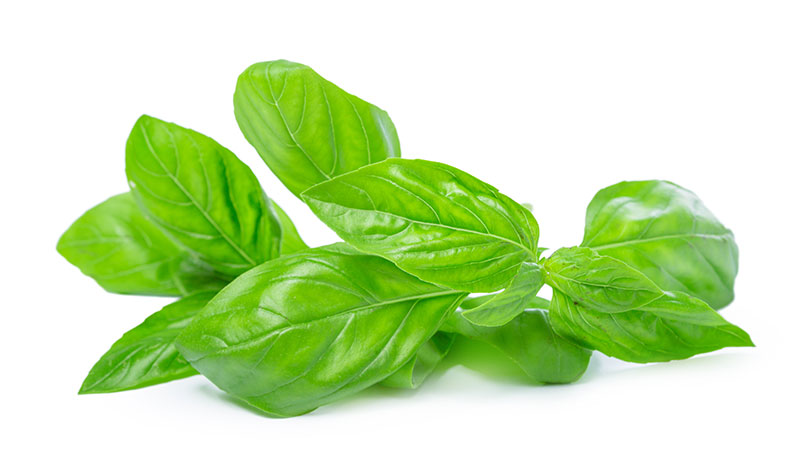
Basil is one of the most attractive herbs to grow hydroponically because it combines relatively fast growth with repeat harvesting and strong culinary demand. It’s widely used in Italian, Mediterranean, and Asian cooking, giving growers several potential markets ranging from home consumers to restaurants and farmers markets.
Unlike lettuce, which is commonly harvested as an entire head, basil can continue producing after each cut. With careful pruning, one healthy plant can provide multiple harvests before it needs to be replaced.
Why Basil Can Be Profitable
Basil’s value comes from a useful combination of compact growth, repeat harvests, and a relatively high selling price for fresh herbs. Depending on the variety and growing conditions, plants may be ready for an initial harvest in roughly four to six weeks.
After that, regular harvesting encourages branching and new leaf production. This means the same growing space can continue producing marketable leaves without starting a completely new crop after every harvest.
Freshness can also be an advantage for local growers. Basil is delicate after harvest, so being able to supply customers with freshly cut or living plants may help differentiate your product from herbs that have spent days in transportation and storage.
Best Hydroponic Systems for Basil
Basil grows well in Nutrient Film Technique (NFT), Deep Water Culture (DWC), and vertical hydroponic systems. Drip systems using an appropriate growing medium can also work well, particularly for larger plants.
The best choice depends on how much basil you’re producing and how long you intend to keep each plant. Whatever system you choose, the roots need reliable access to nutrients, water, and oxygen.
Popular Basil Varieties
Genovese and sweet basil are familiar choices, but they aren’t your only options. Thai basil, lemon basil, purple basil, and Greek basil can give growers additional flavors, colors, and potential markets.
Before filling an entire system with specialty varieties, however, find out whether customers actually want them. Standard Genovese basil may outsell a more unusual variety even if the specialty basil commands a higher price.
If herbs are your main focus, our guide to the best hydroponic herbs to grow compares basil with mint, cilantro, chives, oregano, and other popular choices.
Growing Tips for Better Yields and Quality
To keep basil productive:
- Maintain nutrient-solution pH around 5.8–6.2.
- Provide plenty of light when growing indoors.
- Maintain good airflow around dense foliage.
- Begin pruning once plants are established to encourage branching.
- Cut stems just above a node so the plant can produce new shoots.
- Remove flower buds if your goal is continued leaf production.
- Harvest regularly rather than allowing plants to become tall and woody.
Frequent, strategic pruning encourages a bushier plant with more growing tips—the parts of the plant that ultimately produce your next harvest.
Basil Profit Potential
Basil can be particularly attractive for growers who have access to customers who value freshness and consistent supply. Restaurants, farmers markets, CSA customers, and local grocery stores are potential outlets, but pricing can vary considerably between markets.
You can also experiment with selling basil as freshly cut bunches, living plants, or as part of mixed herb packages. Before investing heavily in production, compare your expected selling price with the actual cost of seeds, nutrients, lighting, labor, packaging, and delivery.
That calculation tells you far more about profitability than the retail price of basil alone.
Pro Tip: Track yield per plant rather than just the number of plants you’re growing. A well-pruned basil plant can develop several productive branches, so improving harvest weight from your existing plants may be more profitable than simply squeezing additional plants into the system.
3. Microgreens – A Fast Crop With High Profit Potential
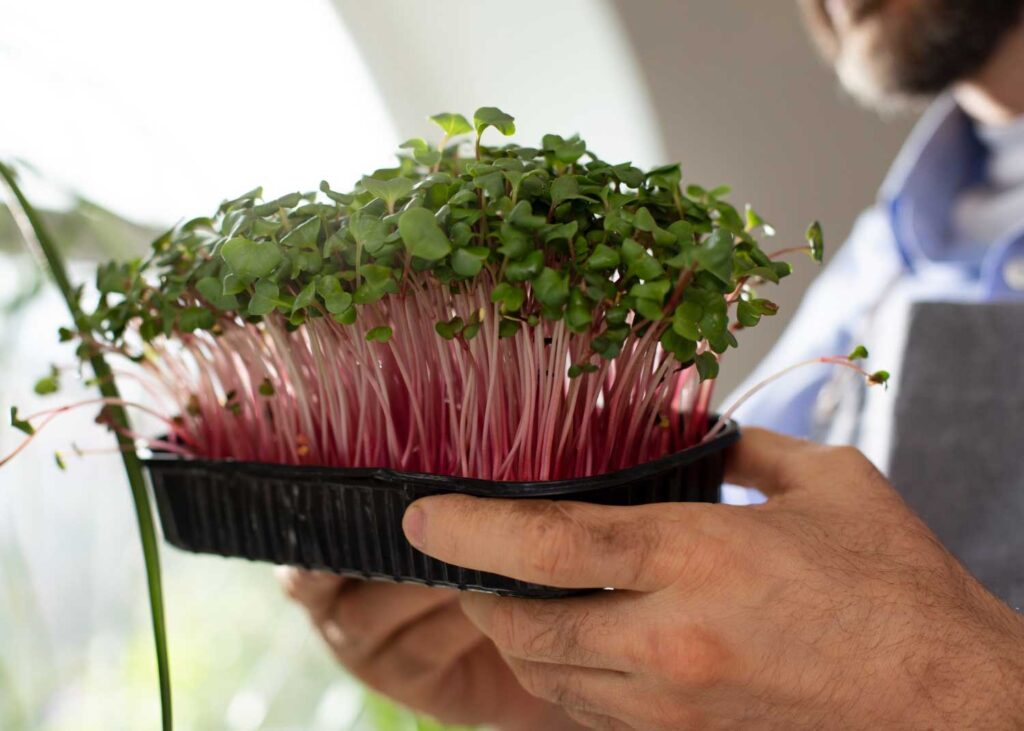
Microgreens are attractive to small hydroponic growers because they combine a very short production cycle with relatively high selling value. Microgreens are young vegetable and herb seedlings harvested after the cotyledons have developed and, depending on the crop, around the time the first true leaves begin to appear.
Many varieties can be ready in roughly 7–21 days, although slower-growing types may take longer. That quick turnaround allows growers to produce frequent batches without dedicating growing space to a crop for months.
Why Microgreens Can Be Profitable
Microgreens can generate substantial revenue from a relatively small growing area, but their real advantage is speed and space efficiency. Shallow trays can be grown on vertical racks under lights, making them particularly suitable for indoor operations where floor space is limited.
The economics aren’t automatic, though. Seeds can represent a significant production cost, and microgreens have a short shelf life. A grower with regular restaurant orders or direct customers may have a very different result from someone growing trays before finding buyers.
Best Hydroponic Systems for Microgreens
Microgreens don’t need the same type of hydroponic system used for mature lettuce or tomatoes. They’re commonly produced in shallow trays using soilless growing mats or other suitable media, with water and nutrients supplied from below when appropriate.
Flood-and-drain setups can automate larger operations, while simple bottom-watered trays work well at smaller scales. Vertical racks equipped with grow lights can further increase production per square foot.
Popular Microgreens to Grow
There’s a surprisingly large selection to choose from. Radish, broccoli, mustard, kale, arugula, red cabbage, pea shoots, sunflower, beet, and cilantro are among the crops growers commonly experiment with.
They don’t all behave the same way. Radish can be relatively quick and straightforward, while crops such as cilantro may require more time and patience. Testing several varieties before scaling up helps reveal which ones perform reliably in your particular setup.
Growing Tips for Better Yields and Quality
Because microgreens are densely seeded and harvested young, sanitation and crop management deserve particular attention.
- Start with seed intended and suitable for microgreen production.
- Follow crop-specific seeding densities rather than overcrowding trays.
- Maintain good airflow and avoid keeping foliage unnecessarily wet.
- Provide adequate light once seedlings are ready for it.
- Keep trays and reusable equipment clean between crops.
- Harvest with clean tools and handle the finished product carefully.
- Keep records of seed weight, germination, harvest weight, losses, and growing time.
Those records are especially valuable with microgreens because even small differences in seed cost, germination, and usable harvest weight can change the economics of an entire tray.
Microgreens Profit Potential
Microgreens can be an excellent crop when you have customers willing to pay for freshness, specialty varieties, and reliable supply. Restaurants, farmers markets, local food businesses, and direct-to-consumer sales can all be potential outlets.
But don’t judge profitability by the price of a small retail container. Calculate what each tray actually costs to produce—including seed, growing media, electricity, water, packaging, labor, and unsold product—and compare that with your usable harvest and selling price.
A crop that sells for more per ounce isn’t necessarily more profitable if its seeds are expensive, germination is inconsistent, or much of the harvest goes unsold.
Pro Tip: Find buyers before dramatically increasing production. With a crop that can be ready in only a couple of weeks and doesn’t store indefinitely, predictable demand is extremely valuable. Start with a few varieties, record which ones customers reorder, and scale the winners rather than growing dozens of trays simply because you have the space.
4. Strawberries – A Premium Hydroponic Fruit

Strawberries take more time and attention than lettuce, basil, or microgreens, but they can be an attractive crop for growers targeting premium local markets. Fresh berries have broad consumer appeal, and protected hydroponic production can help extend the growing season beyond what would normally be possible outdoors.
Hydroponics also keeps the fruit off the soil and gives growers greater control over irrigation and nutrition. That can result in clean, attractive berries, but hydroponics doesn’t automatically make strawberries larger, sweeter, or more flavorful. Variety, ripeness, light, temperature, nutrition, and overall growing conditions all play a role.
Why Strawberries Can Be Profitable
Strawberries have something many leafy crops don’t: strong consumer recognition combined with premium-product potential. Locally grown berries harvested close to peak ripeness can be particularly appealing when customers value freshness and flavor.
Day-neutral cultivars can also produce flowers and fruit over an extended period under suitable conditions. Instead of harvesting the entire crop at once, growers may be able to pick marketable berries repeatedly from established plants.
The trade-off is higher production complexity. Strawberries require more attention to flowering, pollination, temperature, pests, diseases, and fruit quality than most leafy greens.
Best Hydroponic Systems for Strawberries
Strawberries are commonly grown using drip irrigation in substrate-filled containers, troughs, gutters, or elevated growing systems. Some growers also use vertical systems where space is limited.
Whatever the design, good drainage and root-zone aeration are important. Elevated gutters or troughs can also make harvesting and plant inspection easier while keeping berries away from the floor or soil.
Best Strawberry Varieties
Variety selection can have a major impact on production. Albion, Seascape, San Andreas, and Monterey are examples of day-neutral cultivars worth researching, while other cultivars may perform better depending on your climate and production system.
Don’t select a variety based on yield alone. Flavor, berry size, firmness, disease susceptibility, shelf life, and customer preference can all affect how profitable the finished crop becomes.
Growing Tips for Better Yields and Fruit Quality
Strawberries require closer management than the first three crops on our list. Pay particular attention to:
- Keep nutrient-solution pH around 5.5–6.5, adjusting within that range for your cultivar, nutrient program, and water quality.
- Provide adequate light for healthy flowering and fruit development.
- Maintain good airflow around foliage and fruit.
- Avoid keeping the crown excessively wet.
- Remove damaged or diseased plant material promptly.
- Monitor flowers and fruit regularly for pests and disease.
- Provide adequate pollination when natural pollinators aren’t present.
Indoor pollination is particularly important. Gentle air movement can help, but growers may need additional pollination methods depending on the size and design of the operation.
Strawberry Profit Potential
The opportunity with hydroponic strawberries is less about producing the cheapest berry and more about producing a high-quality product customers are willing to seek out.
Direct sales through farmers markets, farm stands, CSA programs, local retailers, restaurants, and bakeries may offer opportunities to differentiate freshly harvested berries from fruit that has traveled through a longer supply chain.
However, strawberries also have significant costs. Plants, lighting, climate control, labor, pollination, packaging, and crop losses all need to be included when calculating actual profit.
That makes strawberries potentially rewarding, but they’re generally a more demanding crop than lettuce or basil for someone starting a hydroponic business.
Strawberries aren’t the only option. See our guide to the best fruits to grow hydroponically for more fruiting crops and system recommendations.
Pro Tip: Choose strawberry varieties based on your intended market, not just total yield. A firm berry with good shelf life may work better for retail sales, while exceptional flavor and aroma could matter more when selling directly to customers or chefs. For extended production, day-neutral cultivars are often worth considering.
5. Tomatoes – A Proven Commercial Hydroponic Crop
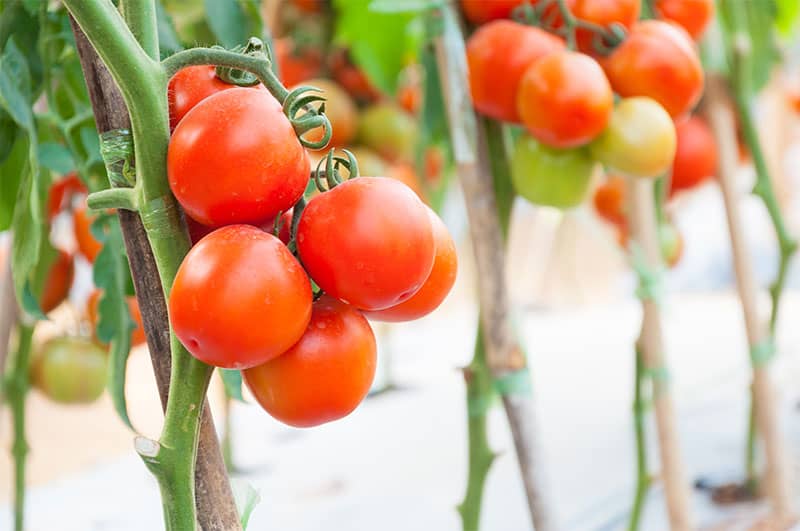
Tomatoes are one of the most recognizable crops in commercial hydroponic production. They require more space, time, and hands-on care than lettuce, basil, or microgreens, but productive plants can continue producing fruit over a long harvest period.
That extended production window is one of their biggest advantages. Instead of replacing the crop after a single harvest, growers can pick ripe tomatoes repeatedly from established plants when light, temperature, nutrition, pollination, and plant health are properly managed.
Commercial greenhouse operations can maintain tomato crops over extended production periods; Penn State Extension provides a useful real-world greenhouse tomato production example.
Why Tomatoes Can Be Profitable
Tomatoes combine strong consumer demand, repeat harvests, and opportunities for premium pricing. Specialty cherry, cocktail, vine-ripened, and unusual varieties can be especially attractive for growers selling directly to restaurants or consumers.
The trade-off is higher production cost and labor. Tomato plants need more growing space and typically require support, training, pruning, pollination management, and frequent harvesting. For that reason, a high yield doesn’t automatically translate into a high profit margin.
Best Hydroponic Systems for Tomatoes
Tomatoes work particularly well with drip irrigation systems using coco coir, perlite, rockwool, or another suitable growing medium. Dutch bucket systems are also a popular option because individual plants have plenty of root space while excess nutrient solution can drain away efficiently.
Larger indeterminate varieties need strong physical support. In greenhouse production, plants are often trained vertically using strings, trellises, or clips so the vines can continue growing and producing fruit throughout an extended season.
Best Tomato Varieties
Cherry, grape, cocktail, Roma, beefsteak, and specialty tomatoes can all be grown hydroponically. Which one makes the most sense depends on your growing system and, more importantly, what your customers want to buy.
Cherry and cocktail tomatoes are worth considering for direct sales because their flavor, appearance, and convenient size can help differentiate them from standard supermarket tomatoes. Larger slicing varieties may make more sense for other markets.
Disease resistance, growth habit, fruit quality, cracking resistance, shelf life, and expected yield should all be considered when choosing a cultivar.
Growing Tips for Better Yields and Quality
Tomatoes need more active management than most leafy crops:
- Maintain nutrient-solution pH around 5.5–6.5, depending on your nutrient program.
- Provide strong, consistent light for flowering and fruit development.
- Support plants with strings, trellises, or tomato clips.
- Maintain good airflow and avoid excessive humidity.
- Adjust nutrient strength as plants mature and begin producing fruit.
- Make sure flowers are adequately pollinated in indoor or protected environments.
- Train and prune plants according to the cultivar and growing method.
For indeterminate tomatoes, regular training can help manage vigorous growth and improve access to light and airflow. Pruning shouldn’t be identical for every tomato, however, because determinate and indeterminate varieties grow differently.
Tomato Profit Potential
Tomatoes can produce a large amount of fruit from each plant, but they’re also a longer-term use of valuable hydroponic space. When comparing them with faster crops, look beyond revenue per plant and calculate production costs over the entire growing period.
Selling standard tomatoes into a competitive wholesale market may leave relatively little room for premium pricing. Smaller growers may have better opportunities with locally harvested cherry tomatoes, specialty cultivars, unusual colors, or varieties selected primarily for flavor.
Farmers markets, restaurants, CSA programs, local retailers, and direct-to-consumer sales can all provide potential markets, but actual profitability depends on your local prices and production costs.
Pro Tip: Don’t compete with commodity tomatoes on price if you don’t have to. Test a few specialty varieties with different colors, sizes, and flavors and see what customers come back for. A smaller harvest of tomatoes that earns a strong margin may be more valuable than a much larger harvest that has to compete on price.
6. Spinach – A Fast-Growing Crop With Consistent Demand
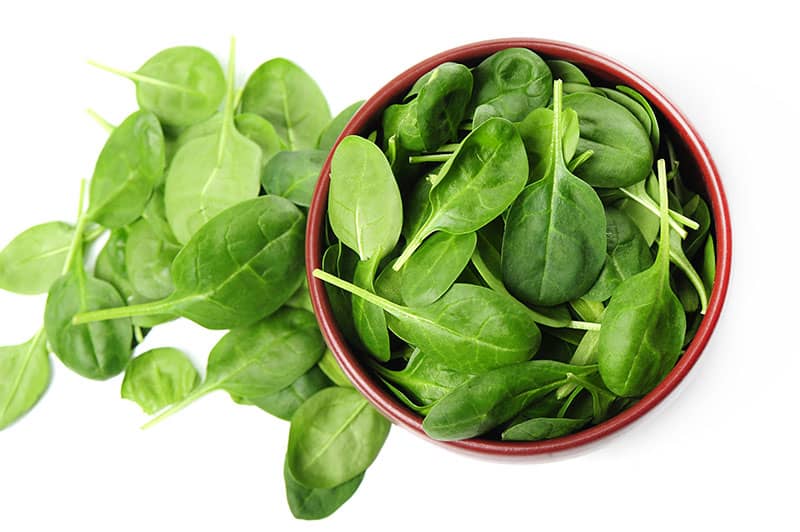
Spinach is another crop worth considering when growing hydroponically for profit. It has a relatively short production cycle, uses space efficiently, and is familiar to consumers as a salad green, cooking ingredient, and smoothie staple.
It also prefers cooler conditions than fruiting crops such as tomatoes and peppers, which can make spinach useful for growers already producing lettuce and other cool-season greens. Depending on the variety, growing conditions, and desired harvest stage, spinach may be ready to harvest in roughly 30–45 days.
Why Spinach Can Be Profitable
Spinach’s main advantage is the combination of quick production and an established market. Baby spinach can be harvested relatively young, while plants grown longer can produce larger leaves for bunching or other uses.
It also occupies much less space than fruiting crops and doesn’t require trellising or pollination. However, spinach can be sensitive to high temperatures, and germination can sometimes be more challenging than with lettuce. Those factors need to be managed carefully when planning year-round production.
Best Hydroponic Systems for Spinach
Spinach can be grown successfully in Nutrient Film Technique (NFT), Deep Water Culture (DWC), floating raft systems, and suitable vertical systems.
NFT can work particularly well for compact leafy-green production, while raft systems provide a relatively stable root-zone environment. Regardless of the system, adequate root oxygenation and temperature management are important for healthy growth.
Best Spinach Varieties
Bloomsdale, Space, Corvair, Seaside, and other cultivars can be considered for hydroponic production. Rather than choosing solely by name, look for characteristics that fit your growing environment, such as bolt resistance, disease resistance, leaf shape, growth rate, and suitability for baby-leaf production.
This becomes particularly important when temperatures rise because spinach naturally tends to bolt as conditions become warmer and days lengthen.
Growing Tips for Better Yields and Quality
Spinach generally performs best under relatively cool, stable conditions:
- Keep nutrient-solution pH roughly around 5.8–6.5.
- Maintain cooler growing conditions and watch for heat stress.
- Provide adequate light without allowing the crop to become excessively warm.
- Maintain good airflow around dense foliage.
- Monitor EC and nutrient balance as plants develop.
- Keep growing channels, reservoirs, and harvesting equipment clean.
- Harvest at the stage that best matches your intended market.
For baby spinach production, growers may harvest the crop differently than they would plants intended to produce larger individual leaves, so your harvest strategy should match the product you’re selling.
Spinach Profit Potential
Spinach can be attractive because growers have several ways to market the harvest. Baby spinach, mature leaves, and mixed salad greens can target different customers without requiring an entirely different crop.
Restaurants, farmers markets, CSA programs, and local retailers are possible sales channels, but spinach can also face strong competition from inexpensive commercially packaged greens. Smaller growers therefore need to consider whether freshness, local production, specialty varieties, or direct sales provide enough differentiation to justify their costs.
As with lettuce, quick turnover helps—but the real measure is the margin left after seeds, nutrients, lighting, labor, packaging, and crop losses are accounted for.
For more leafy greens and fruiting vegetables, compare our best hydroponic vegetables and their growing requirements.
Pro Tip: Don’t automatically assume repeated leaf harvesting will be the most profitable approach. Compare the yield, labor, quality, and turnaround time of cut-and-come-again harvesting with harvesting an entire baby-leaf crop and immediately replanting the space. For a commercial grower, faster turnover can sometimes be more valuable than keeping the same plants alive for another harvest.
7. Peppers – High-Value Crops for Long-Term Production
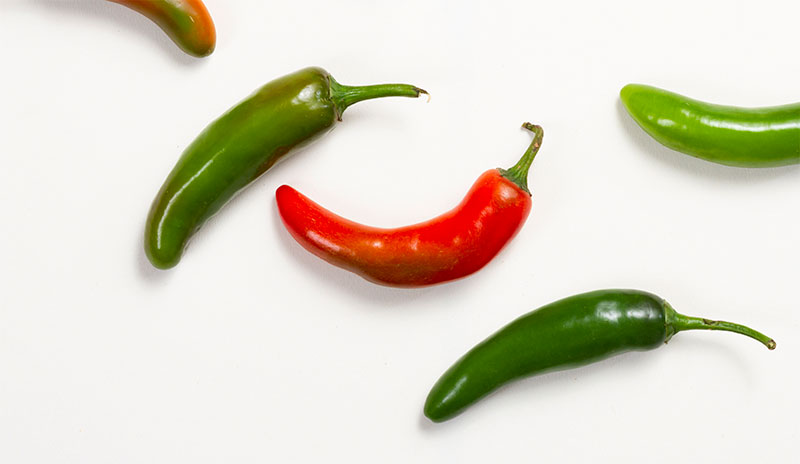
Peppers take longer to establish than leafy greens and herbs, but once healthy plants begin fruiting, they can continue producing over an extended period. That makes both sweet and hot peppers worth considering for growers who have the space and time for a longer-term hydroponic crop.
Another advantage is variety. Growers can choose from colorful bell peppers, mini sweets, jalapeños, serranos, habaneros, and many specialty cultivars. This creates opportunities to target different customers rather than competing with a single commodity product.
Why Peppers Can Be Profitable
Peppers combine repeat harvests with opportunities for premium pricing, particularly when growing colorful or specialty varieties that aren’t always readily available in local stores.
Unlike lettuce or microgreens, however, peppers occupy growing space for much longer before producing the first marketable harvest. They also require more light, support, and crop management. Profitability therefore depends on whether the eventual yield and selling price justify those additional production costs.
For smaller growers, specialty peppers can sometimes be more interesting than standard green bell peppers because unusual colors, flavors, and heat levels provide a way to differentiate the crop.
Best Hydroponic Systems for Peppers
Peppers work particularly well with drip irrigation using coco coir, perlite, or another suitable growing medium. Dutch bucket systems are another practical option because they provide individual plants with plenty of root space and good drainage.
Whichever system you choose, mature pepper plants need adequate physical support. Fruit-loaded branches can become surprisingly heavy, so stakes, strings, cages, or trellising may be necessary.
Best Pepper Varieties
Bell peppers, mini sweets, jalapeños, serranos, cayenne, habaneros, and banana peppers can all be considered for hydroponic production.
Your market should help determine what you plant. Restaurants may be interested in specialty chilies, while farmers-market customers might respond better to colorful mixed peppers or unusual varieties they can’t easily find at a supermarket.
Also consider growth habit, disease resistance, fruit size, days to maturity, expected yield, and how well a cultivar performs under protected growing conditions.
Growing Tips for Better Yields and Fruit Quality
Peppers need consistent conditions throughout their relatively long production cycle:
- Maintain nutrient-solution pH around 5.8–6.5.
- Provide strong, consistent light for flowering and fruit development.
- Support heavily loaded branches before they begin breaking or bending.
- Maintain good airflow and manage excessive humidity.
- Monitor nutrient strength as plants move into flowering and fruiting.
- Keep moisture and nutrient availability consistent, particularly during fruit development.
- Make sure flowers are adequately pollinated when growing indoors.
Peppers are self-pollinating, but gentle air movement or vibration can help move pollen within the flowers in protected indoor environments.
Pepper Profit Potential
Peppers can be attractive because the same established plants may provide multiple harvests over an extended production period. However, the economics can differ dramatically between a standard bell pepper and a specialty chili.
Green bell peppers are harvested before reaching their fully mature color, while red, yellow, orange, and other colored peppers generally remain on the plant longer. Those extra days need to be considered alongside any higher selling price.
Specialty hot peppers offer another possibility. Unusual cultivars may appeal to restaurants, hot-sauce makers, farmers-market shoppers, or customers looking for specific flavors and heat levels.
Instead of assuming the most expensive pepper is automatically the most profitable, track days to harvest, yield per plant, growing-space requirements, labor, losses, and actual selling price.
Pro Tip: Compare profit per growing space over time, not simply price per pepper. A fully colored bell pepper may sell for more than a green one, but it also occupies the plant longer before harvest. Likewise, a specialty chili may command a premium but have a smaller pool of buyers. The best choice is the variety that gives you the strongest combination of yield, production time, and real customer demand.
See also
Ready to Build a More Controlled Growing Setup?
Once you’ve chosen what to grow, reliable monitoring and environmental control become increasingly important. These tools can help you maintain more consistent conditions and catch problems before they affect an entire crop.
Useful Tools for Managing a Hydroponic Garden
| Tool | What It Helps You Manage | Especially Useful For | Buy |
|---|---|---|---|
| Digital pH Meter | Nutrient-solution acidity | Every hydroponic system | Check Price on Amazon |
| EC/TDS Meter | Nutrient strength | All seven crops | Check Price on Amazon |
| Digital Water Thermometer | Root-zone temperature | Lettuce, spinach, strawberries | Check Price on Amazon |
| Indoor Thermometer/Hygrometer | Air temperature and humidity | Tomatoes, peppers, strawberries | Check Price on Amazon |
| Grow Light Timer | Consistent lighting schedules | Indoor production | Check Price on Amazon |
| Pruning Shears | Clean harvesting and pruning | Basil, tomatoes and peppers | Check Price on Amazon |
Other Profitable Hydroponic Crops Worth Considering

The seven crops above aren’t your only options. Depending on your local market, several other herbs and specialty crops may also be worth testing in a hydroponic system.
Cilantro
Fresh cilantro has strong culinary demand and a relatively short production cycle, making it worth considering for growers supplying restaurants, farmers markets, or customers who regularly cook Mexican, Latin American, Asian, and other cuisines.
Cilantro can be somewhat trickier than basil because germination and bolting need to be managed carefully, so test it on a small scale before dedicating substantial growing space to it.
Mint
Mint grows vigorously and can provide repeated harvests once established. Its familiar flavor and wide culinary use make it another potential crop for direct-market growers.
Because mint grows aggressively, hydroponic production can also help keep its root system contained rather than allowing it to spread through a garden.
Chives
Chives take up relatively little horizontal space and can regrow after cutting, giving growers the possibility of multiple harvests from established plants. Fresh chives may appeal to restaurants, farmers-market shoppers, and customers looking for locally grown culinary herbs.
Dill
Dill is another specialty herb worth testing, particularly when you already have customers buying other fresh herbs. It can become considerably taller than basil or chives, however, so its use of vertical growing space should be considered when calculating profitability.
Before adding any specialty crop, test demand first. An herb with a high retail price isn’t necessarily profitable if you can only sell a small portion of what you grow.
What About Ginseng?
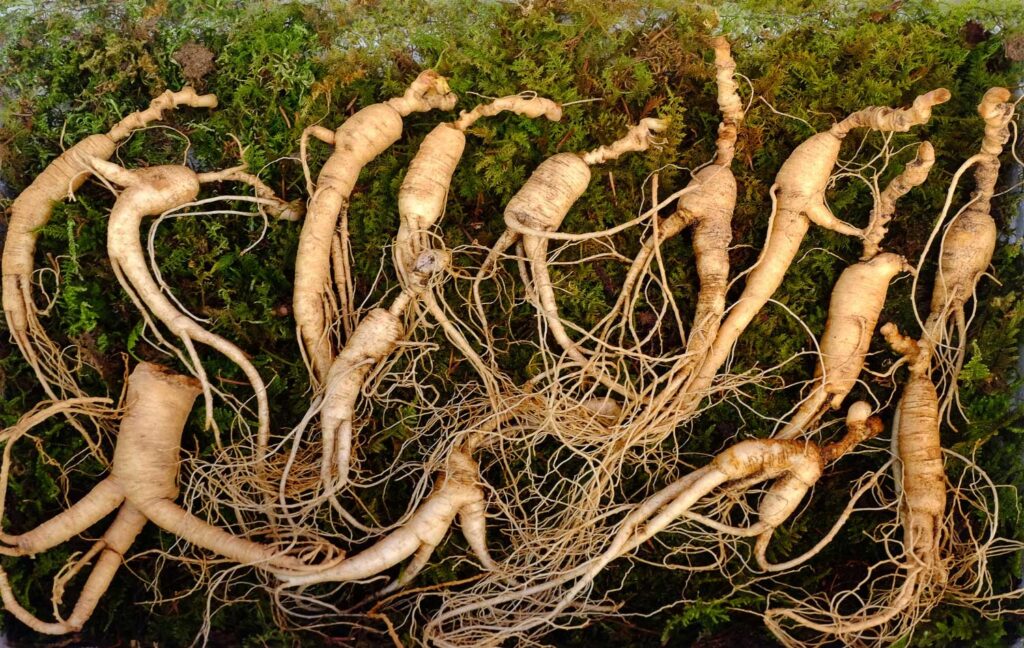
Ginseng frequently appears on lists of high-value crops because mature roots can command high prices. However, that doesn’t necessarily make it one of the best crops for a typical hydroponic business.
Unlike lettuce, basil, or microgreens, ginseng is a long-term crop. It requires specialized growing conditions and considerably more time before producing a valuable harvest. That means your growing space and resources can be tied up for years rather than weeks or months.
Ginseng prices also vary dramatically depending on the species, age, quality, growing method, and whether the roots are cultivated, wild-simulated, or wild. For that reason, impressive price-per-pound figures found online shouldn’t be used to estimate hydroponic profitability without considering exactly what type of ginseng is being sold.
For experienced growers interested in unusual high-value crops, ginseng may be worth researching separately, but it shouldn’t be treated as a direct substitute for fast-turnover hydroponic crops such as lettuce, basil, or microgreens.
Pro Tip: Don’t confuse a high-value crop with a high-profit crop. If a plant takes years to reach its valuable harvest stage, calculate how much growing space, labor, equipment, and energy it will consume during that entire period.
Common Mistakes That Can Reduce Hydroponic Profits
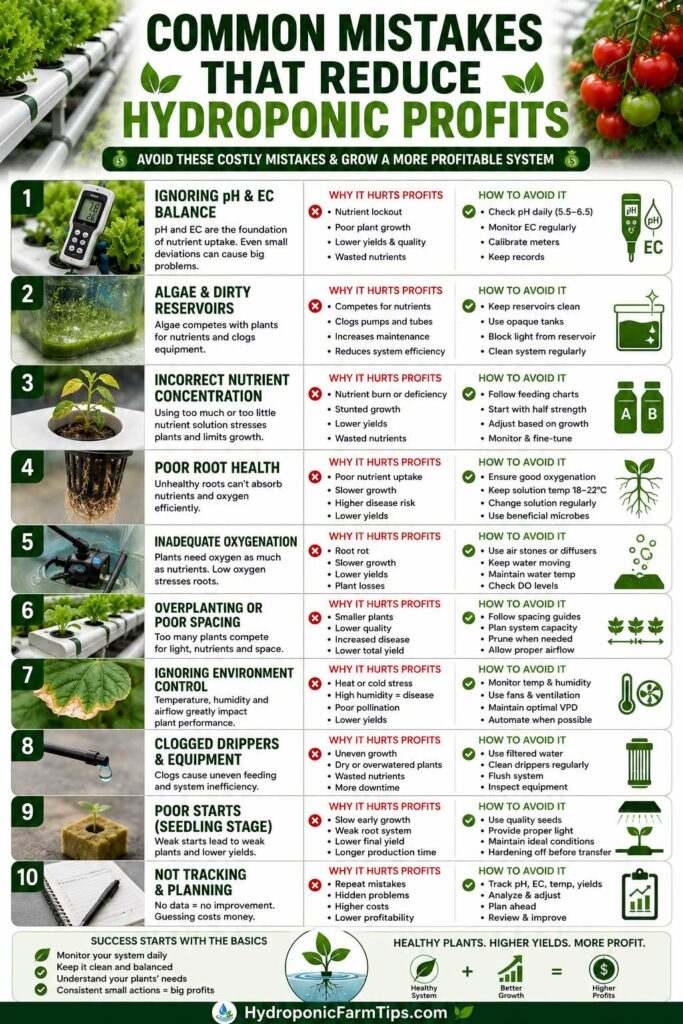
Growing a high-value crop doesn’t automatically make a hydroponic operation profitable. Small mistakes with crop selection, operating costs, or plant management can quickly reduce your margins—even when the plants themselves are growing well.
Here are some of the biggest problems to watch for.
Growing Before Researching the Market
One of the easiest mistakes is choosing a crop because it’s considered profitable without checking whether people nearby actually want to buy it.
Research local prices, talk to potential customers, and test small quantities before expanding production. Reliable demand is more valuable than an impressive selling price with no buyers.
Ignoring the True Cost of Production
Revenue and profit aren’t the same thing. Seeds, nutrients, electricity, water, growing media, labor, packaging, equipment, and delivery all affect what you actually earn.
Keep records for each crop so you can compare its total production cost with the revenue it generates.
Letting pH and EC Drift
Poor nutrient management can slow growth, reduce quality, and eventually cost you marketable produce. Use our hydroponic nutrient and pH chart as a starting reference, then check pH and EC regularly as plants consume water and nutrients.
Penn State Extension also explains how hydroponic nutrient solutions are formulated and managed for crops such as lettuce.
Don’t make large corrections automatically. Sudden changes can create additional stress for the plants. For a deeper look at nutrient problems, Penn State Extension explains how pH and nutrient imbalances can contribute to common hydroponic deficiencies.
Overcrowding the Growing Area
Adding more plants doesn’t always mean producing more saleable food. Crowded plants compete for light and can restrict airflow, creating conditions that favor disease.
Use spacing appropriate for the crop’s mature size, not just the size of the seedlings when they’re transplanted.
Underestimating Lighting and Environmental Costs
Indoor hydroponic crops need enough light to grow efficiently, so choosing the right LED grow lights for hydroponics can have a major effect on both plant performance and operating costs. Fruiting crops generally have much greater light and environmental demands than leafy greens.
Temperature, humidity, airflow, and nutrient-solution temperature can also affect growth and crop quality, so they shouldn’t be treated as an afterthought.
Producing More Than You Can Sell
A full growing room isn’t profitable if part of the harvest ends up being discarded. This is particularly important with highly perishable crops such as microgreens, herbs, leafy greens, and strawberries.
Match production to realistic sales forecasts and increase planting volumes as your customer base grows.
Neglecting Cleaning and Crop Health
Disease problems can spread quickly when plants share water, equipment, or growing channels. Regular cleaning, removal of unhealthy plant material, good airflow, and routine root inspections can help catch problems before they affect a larger portion of the crop.
Failing to Keep Records
This is one of the most overlooked mistakes.
Track days to harvest, seed and nutrient costs, crop losses, harvest weight, selling price, and how long each crop occupies valuable growing space. Over several growing cycles, those numbers will show you which crops are actually profitable in your system—not simply which ones are supposed to be profitable.
How to Maximize Hydroponic Farm Profits
Choosing the most profitable hydroponic plants for your market is only the beginning. Once your system is running, your results depend on how efficiently you use your growing space, how well you control production costs, and whether you can consistently sell what you harvest.
For growers considering a larger protected setup, Penn State Extension’s overview of commercial greenhouse production also covers year-round production, irrigation, ventilation, and other operating considerations.
Track the Real Cost of Each Crop
Don’t judge a crop by its selling price alone. Track what you spend on seeds, nutrients, electricity, growing media, labor, packaging, and other recurring expenses.
Then compare those costs with the amount of marketable produce you actually harvest and sell. This makes it much easier to identify which crops deserve more growing space.
Stagger Plantings for Regular Harvests
Instead of planting everything at once, divide production into smaller batches. For fast-growing crops such as lettuce, basil, and microgreens, staggered planting can provide fresh produce on a more predictable schedule.
This also reduces the risk of having a large harvest ready before you have enough customers to buy it.
Grow What Your Customers Actually Want
A crop isn’t profitable simply because it has a high retail price. Talk with local restaurants, farmers-market customers, retailers, and other potential buyers to learn which products they regularly purchase.
Start with smaller test batches and increase production once you know there’s consistent demand.
Consider Specialty and Premium Varieties
Smaller growers may have difficulty competing with large commercial farms on price. Specialty products can provide another way to stand out.
Colorful lettuce, unusual basil varieties, flavorful cherry tomatoes, specialty chilies, and other less-common cultivars may offer better opportunities when customers value freshness, flavor, or local production.
Reduce Waste and Crop Losses
Every plant you lose represents seeds, nutrients, electricity, space, and labor that won’t generate revenue. Good sanitation, proper environmental control, healthy roots, and early detection of problems can help protect more of your crop.
Reducing losses by even a small percentage can improve profitability without adding a single new growing channel or rack.
Measure Profit per Square Foot Over Time
This may be the most useful comparison of all.
A high-priced crop that occupies your system for several months isn’t necessarily more profitable than a cheaper crop you can harvest and replant several times during the same period.
Instead of asking “Which plant sells for the most?”, ask:
“Which crop produces the best profit from this growing space over the course of a year?”
That question gives you a much better way to compare the most profitable hydroponic plants for your own operation.
Frequently Asked Questions About Most Profitable Hydroponic Plants
What is the most profitable plant to grow hydroponically?
There isn’t one hydroponic crop that’s always the most profitable. Lettuce, basil, and microgreens are strong candidates because they grow relatively quickly and use space efficiently, while tomatoes, strawberries, and peppers can offer higher-value harvests but require more time and resources.
The best choice depends on your local selling prices, production costs, available space, and access to customers. A crop with a high retail price won’t be profitable if it costs too much to produce or you can’t sell it consistently.
Which hydroponic crop grows the fastest?
Microgreens are among the fastest crops on this list, with many varieties reaching harvestable size in roughly 7–21 days. Some radish and mustard microgreens can be particularly quick.
Lettuce, spinach, and basil take longer but still have relatively short production cycles compared with fruiting crops such as tomatoes, strawberries, and peppers.
Can you make money with a hydroponic farm?
Yes, a hydroponic farm can be profitable, but hydroponics doesn’t guarantee a profit. Successful growers need to balance crop yield and selling price against expenses such as seeds, nutrients, electricity, labor, equipment, packaging, and distribution.
Finding customers before expanding production can be just as important as choosing the right crop.
Are herbs more profitable than vegetables?
Sometimes. Fresh culinary herbs such as basil can have high value relative to the amount of growing space they require, and some can be harvested repeatedly.
However, profitability depends on the specific herb and market. A fast-growing vegetable with reliable customers could generate a better return than an expensive herb with limited demand.
What hydroponic system is best for commercial farming?
There is no single best commercial hydroponic system because different crops have different requirements. NFT and raft systems are commonly associated with leafy greens, while drip irrigation with substrate is widely used for larger fruiting crops such as tomatoes and peppers.
Commercial growers should choose a system based on the crop, available space, climate, labor requirements, water quality, energy costs, and desired production scale.
What is the easiest hydroponic plant for beginners?
Lettuce is one of the easiest hydroponic crops for beginners. It grows relatively quickly, doesn’t require pollination or trellising, and performs well in simple systems such as DWC.
Basil is another beginner-friendly option if you’d prefer an herb that can provide repeated harvests.
Which Hydroponic Crop Is Most Profitable for You?
There isn’t one crop that will be the most profitable for every hydroponic grower. The best choice depends on your growing space, production costs, experience, local demand, and how you plan to sell your harvest.
For beginners, lettuce, basil, spinach, and microgreens can be good places to start because they have relatively short production cycles and don’t require the extensive support and management of larger fruiting crops.
Tomatoes, strawberries, and peppers require more time, space, and attention, but they can open the door to higher-value and specialty markets once you’re comfortable managing a more demanding crop.
The biggest lesson from these most profitable hydroponic plants is that selling price alone doesn’t determine profitability. A crop needs to produce enough marketable yield, in a reasonable amount of time, at a cost that leaves you with a worthwhile margin.
Start small, keep records, learn what customers in your area actually buy, and expand the crops that consistently perform well. The most profitable hydroponic crop for your farm will ultimately be the one that grows reliably in your system and sells reliably in your market.
More Hydroponic Growing Guides
Once you’ve narrowed down what you want to grow, these guides can help you plan the rest of your system:
- Best Hydroponic Growing Systems – Compare the major hydroponic methods and find a system that fits your crops.
- Hydroponic Nutrient & pH Chart – Check recommended pH, EC, and PPM ranges for popular hydroponic plants.
- 10 Best Hydroponic Herbs – Compare basil and other herbs suitable for soil-free growing.
- Best Hydroponic Fruits – Explore strawberries and other fruiting crops that can be grown hydroponically.
- Best Hydroponic Vegetables – Find more vegetables suitable for different hydroponic systems.
- Best LED Grow Lights for Hydroponics – Learn what to consider when lighting an indoor hydroponic garden.