
If you’re looking for the best pH meters for hydroponics, accuracy matters—but so does consistency. A meter that gives you a slightly different reading every time can cause more problems than it solves, especially when you are trying to keep your nutrient solution within a narrow pH range.
In hydroponics, pH directly affects how easily plants can absorb nutrients. If you want a deeper explanation of target ranges, see our Best pH for Hydroponics guide. When the solution drifts too far outside the ideal range, plants may begin showing yellow leaves, slow growth, brown spots, or other symptoms that look like nutrient deficiencies—even when the nutrients are already present in the reservoir.
If your plants are already showing symptoms, our Hydroponic Nutrient Deficiencies: Signs, Causes & Fixes guide can help you separate pH problems from actual nutrient shortages.
That is why a dependable pH meter quickly becomes one of the most useful tools in a hydroponic setup.
The problem is that there are dozens of inexpensive pH pens online, and they are not all equally reliable. Some are perfectly fine for a small beginner system, while others are better suited to growers who test daily and want features such as automatic temperature compensation, multi-point calibration, replaceable probes, or combined pH and EC testing.
In this guide, we compare 7 of the best pH meters for hydroponics, from affordable beginner-friendly options to more advanced meters for serious home growers. We’ll look at their strengths, limitations, and best uses so you can choose a meter that fits your system without paying for features you do not actually need.
We’ll also cover how often to check pH, how to calibrate your meter correctly, how to store the probe, and what really matters when comparing hydroponic pH meters.
Quick Comparison: 7 Best pH Meters for Hydroponics
Not sure which meter fits your setup? Here’s the short version.
For most home hydroponic growers, the Apera Instruments PH20 is the strongest all-around choice because it combines reliable everyday testing, easy calibration, waterproof construction, and a reasonable price.
If you test frequently, the Bluelab pH Pen is a stronger premium option. The Hanna GroLine HI98118 makes sense if you want a meter designed specifically for hydroponic nutrient solutions, while the Apera GroStar GS4 is the better fit if you want to measure both pH and EC with one device.
For a smaller setup or tighter budget, the VIVOSUN Digital pH Meter and Milwaukee PH600 can both handle routine spot checks without the higher cost of a premium meter.
Affiliate Disclosure: This page may contain affiliate links. If you purchase through one of these links, we may earn a commission at no additional cost to you.
Our Top pH Meter Picks for Hydroponics
| Our Pick | Best For | Why We Like It | Buy |
|---|---|---|---|
| 🏆 Apera Instruments PH20 | Best Overall | Easy calibration, waterproof design, ATC, excellent balance of features and price | Check Price on Amazon → |
| ⭐ Bluelab pH Pen | Best Premium | Built for growers, waterproof, pH + temperature, simple 2-point calibration | Check Price on Amazon → |
| 🌱 Hanna GroLine HI98118 | Best for Hydroponics | Purpose-built for nutrient solutions, replaceable electrode, stability indicator | Check Price on Amazon → |
| 💰 VIVOSUN Digital pH Meter | Best Budget | Low-cost entry point for beginners and small hydroponic systems | Check Price on Amazon → |
| 🔬 Apera SX620 | Best for Higher Resolution | 0.01 pH resolution, replaceable electrode, multi-point calibration | Check Price on Amazon → |
| 📊 Apera GroStar GS4 | Best pH + EC Meter | One device for pH, EC, 500 ppm, 700 ppm, and temperature | Check Price on Amazon → |
| 💵 Milwaukee PH600 | Best Affordable Alternative | Simple, inexpensive pH testing without unnecessary extras | Check Price on Amazon → |
Prices and availability can change. Check the retailer for current details.
1. Apera Instruments PH20 — Best Overall
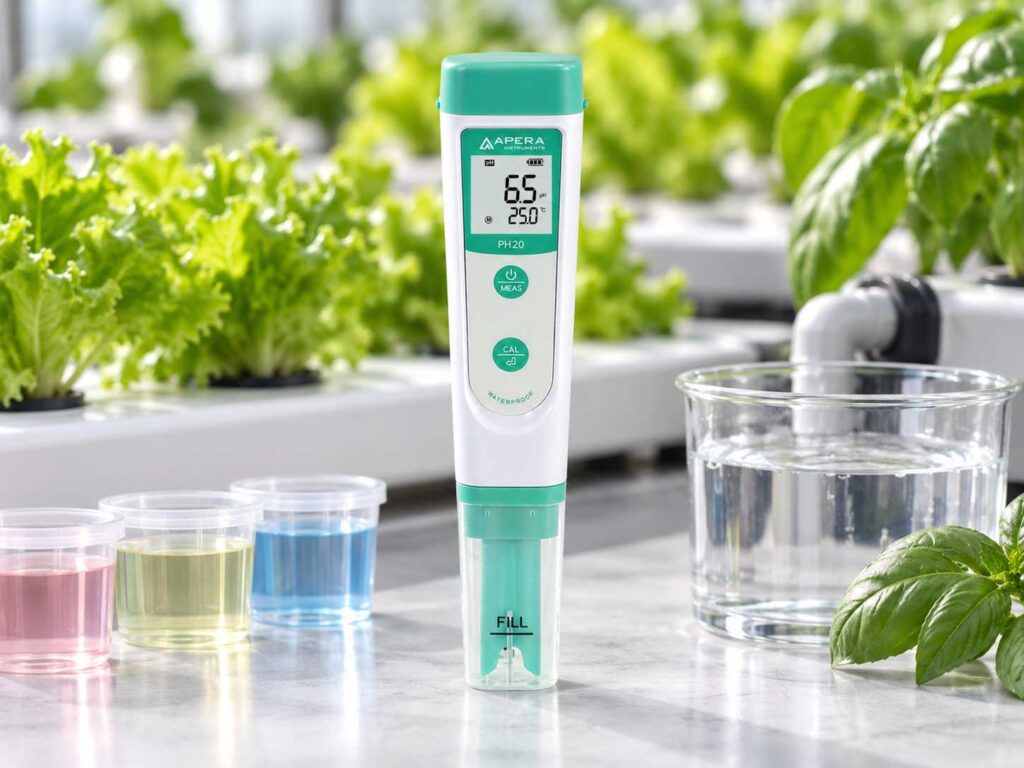
The Apera Instruments PH20 is our best overall pick for most home hydroponic growers because it gets the important things right: dependable readings, easy calibration, automatic temperature compensation, and a waterproof design.
It is not the most advanced meter on this list, but that is part of the appeal. If you mainly need a reliable tool for checking a nutrient reservoir a few times per week, the PH20 gives you the features you are likely to use without pushing you into premium pricing.
Apera rates the PH20 for ±0.1 pH accuracy with 0.1 pH resolution. For routine home hydroponic testing, that level of accuracy is sufficient for keeping the reservoir within its target range.
Key Features
- pH range: 0.0 to 14.0
- ±0.1 pH accuracy
- 0.1 pH resolution
- Automatic temperature compensation
- Automatic one- to three-point calibration
- IP67 waterproof construction
- Stable-reading indicator
- Automatic buffer recognition
- Auto shutoff
- Replaceable AAA batteries
- Calibration supplies included with the standard kit
Why We Like It
The PH20 is easy to live with day to day.
Once the meter is calibrated, rinse the probe, place it in your nutrient solution, gently move it through the water, and wait for the reading to stabilize. The stable-reading indicator is particularly helpful for beginners because you do not have to guess when the number on the display is ready to trust.
The IP67 waterproof construction also makes sense around a hydroponic reservoir. Wet hands, splashes, and the occasional accidental drop are simply part of working around water.
Automatic temperature compensation is another useful feature. Your reservoir temperature can change during the day, and ATC helps the meter compensate for temperature-related effects during measurement.
Pros and Cons
| Pros | Cons |
|---|---|
| Accurate enough for most home hydroponic systems | Displays pH in 0.1 rather than 0.01 increments |
| Easy for beginners to use and calibrate | Less advanced than premium hydroponic meters |
| Automatic temperature compensation | Not the best choice if a replaceable electrode is a priority |
| IP67 waterproof construction | Costs more than ultra-budget pH pens |
| Stable-reading indicator | |
| Automatic calibration and buffer recognition | |
| Useful calibration supplies included | |
| Good balance of price and features |
Best For
The Apera PH20 is best for beginner to intermediate growers who want a dependable pH meter without overcomplicating reservoir testing.
It is a particularly good match for DWC buckets, Kratky systems, countertop gardens, herb setups, and small to medium reservoirs growing crops such as lettuce, basil, strawberries, peppers, or tomatoes. If you are still choosing a setup, compare the 8 Best Hydroponic Systems for Home.
If you are maintaining one or a few home hydroponic systems, the PH20 is a strong place to start because it covers the features most growers actually need without adding unnecessary complexity.
2. Bluelab pH Pen — Best Premium pH Meter
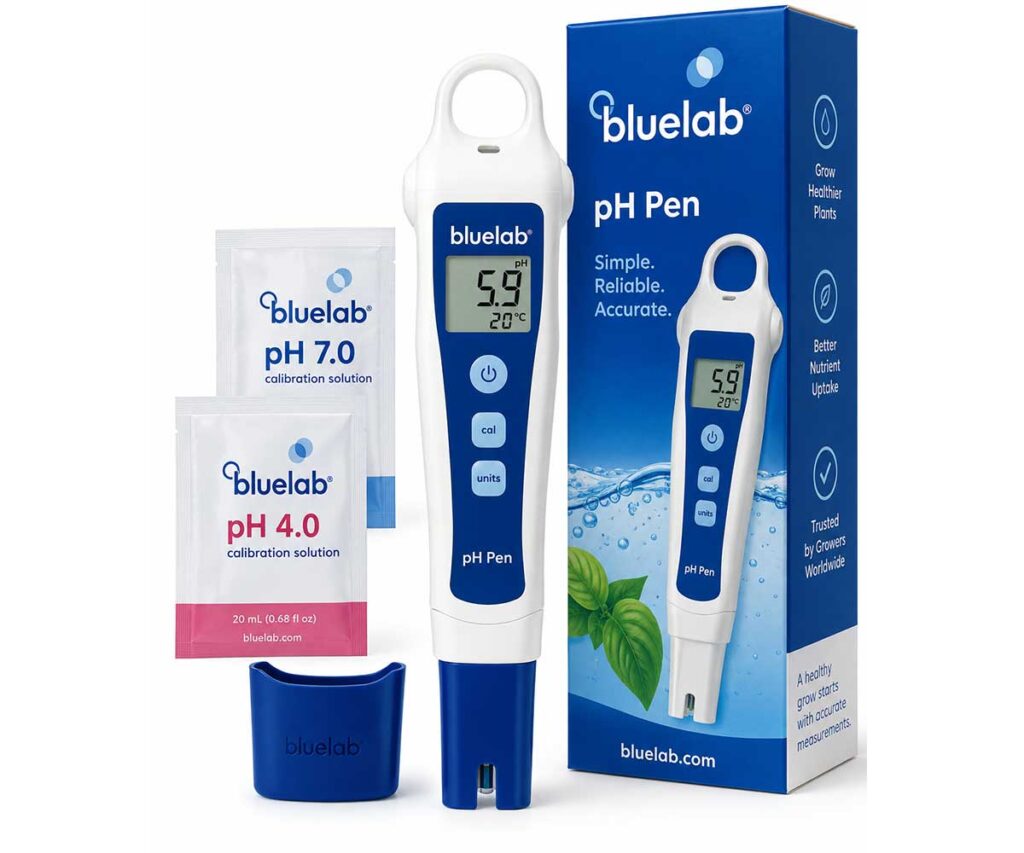
The Bluelab pH Pen is a premium option for growers who test nutrient solution frequently and want a meter built specifically for growing environments.
It measures both pH and temperature, uses automatic temperature compensation, and has a waterproof body that can float if accidentally dropped into a reservoir. Bluelab rates it for ±0.1 pH accuracy at 25°C with 0.1 pH resolution.
For growers checking several reservoirs or testing every day, that combination of durability, simple calibration, and an easy-to-read display makes it a noticeable step up from basic pH pens.
Key Features
- pH range: 0.0 to 14.0
- ±0.1 pH accuracy at 25°C
- 0.1 pH resolution
- Measures pH and temperature
- Automatic temperature compensation
- Two-point pH calibration
- 30-day calibration reminder
- Waterproof and designed to float
- Bright backlit display
- Hold-reading function
- Auto shutoff
- Replaceable AAA battery
Bluelab uses a two-point calibration process and recommends calibrating with pH 7.0 plus either pH 4.0 or pH 10.0 depending on your working range. For hydroponics, pH 4.0 is the more relevant second point because nutrient solutions are generally kept below neutral.
Why We Like It
What makes the Bluelab pH Pen appealing is convenience.
The display is bright and easy to read, and the hold function lets you lock the measurement on screen before removing the probe from the reservoir. That can be useful when the reservoir is low to the ground or tucked underneath a grow setup.
The 30-day calibration reminder is another practical feature. It does not replace good maintenance habits, but it makes it harder to forget that your meter is due for recalibration.
We also like that Bluelab includes temperature measurement in the same pen. Reservoir temperature is worth keeping an eye on because unusually warm nutrient solution can contribute to root-zone problems.
Pros and Cons
| Pros | Cons |
|---|---|
| Designed specifically for growing and nutrient solutions | More expensive than entry-level pH meters |
| ±0.1 pH accuracy at 25°C | 0.1 rather than 0.01 pH resolution |
| Measures pH and temperature | Requires proper probe storage in KCl solution |
| Automatic temperature compensation | More meter than many small countertop systems need |
| Waterproof and floats | Standard pH Pen does not offer the replaceable probe found on the newer PenPlus |
| Bright backlit display | |
| Hold-reading function | |
| 30-day calibration reminder | |
| Straightforward two-point calibration |
Best For
The Bluelab pH Pen is best for growers who test frequently and are willing to pay more for convenience, durability, and a grower-focused design.
It makes particular sense if you run several DWC buckets, a larger reservoir, or multiple hydroponic systems and want a meter you will use regularly rather than occasionally.
If you only maintain one small countertop garden, the extra cost may be difficult to justify. But for growers who check pH several times per week, the Bluelab pH Pen is a solid upgrade from a basic budget tester.
3. Hanna GroLine HI98118 — Best Hydroponics-Specific Meter
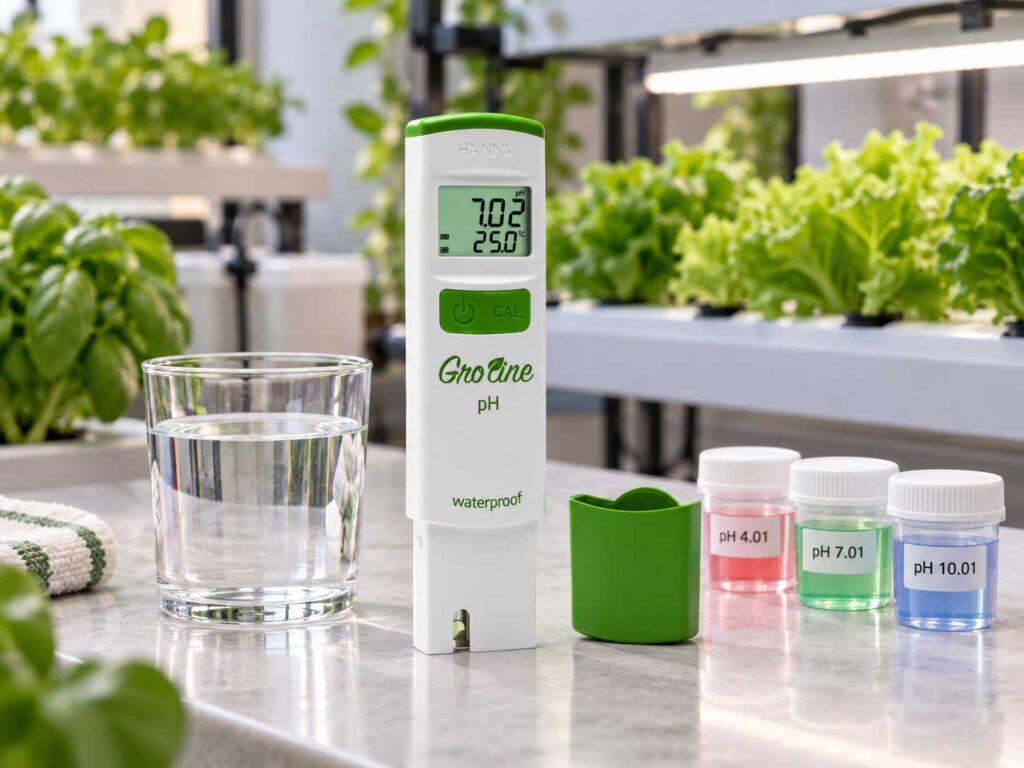
The Hanna Instruments GroLine HI98118 is one of the most hydroponics-focused meters in this roundup. Hanna designed it specifically for nutrient solutions, which makes it a natural fit for growers who want something more purpose-built than a general water tester.
It displays pH to 0.01, includes automatic temperature compensation, and uses automatic one- or two-point calibration. One important detail, though: Hanna lists the HI98118 with ±0.2 pH accuracy, so the extra decimal place should be viewed as higher display resolution rather than greater measurement accuracy. The electrode is also replaceable.
Key Features
- pH range: 0.00 to 14.00
- 0.01 pH resolution
- ±0.2 pH accuracy
- Automatic temperature compensation
- Automatic one- or two-point calibration
- Stability indicator
- Automatic shutoff
- Replaceable pH electrode
- Designed specifically for hydroponic nutrient solutions
Why We Like It
What stands out about the HI98118 is how specifically it is designed for hydroponic nutrient solutions.
The replaceable electrode is especially valuable. pH probes eventually age, slow down, or become harder to calibrate, and being able to replace only the electrode can extend the useful life of the meter instead of replacing the whole unit.
The stability indicator is useful too. It helps you know when the reading has settled, which makes routine reservoir checks easier and reduces the temptation to record a number too quickly.
The 0.01 display resolution also makes it easier to watch small pH movements over time. Just remember that you do not need to chase every hundredth of a pH point in a home hydroponic system.
Pros and Cons
| Pros | Cons |
|---|---|
| Designed specifically for hydroponic nutrient solutions | More expensive than basic pH pens |
| 0.01 pH resolution | Listed accuracy is ±0.2 pH |
| Replaceable electrode can extend the life of the meter | Requires proper probe storage and maintenance |
| Automatic temperature compensation | Extra decimal place may be more detail than many home growers need |
| Automatic one- or two-point calibration | |
| Stability indicator | |
| Good fit for frequent reservoir testing |
Best For
The Hanna GroLine HI98118 is best for growers who want a hydroponics-specific meter with a replaceable electrode and easy day-to-day testing.
It makes particular sense for larger reservoirs, fruiting crops, or growers who test regularly and want a meter that can be maintained over time instead of treated as disposable.
If your priority is a purpose-built hydroponic design rather than simply getting the cheapest workable pH pen, the HI98118 is a strong option.
4. VIVOSUN Digital pH Meter — Best Budget Option
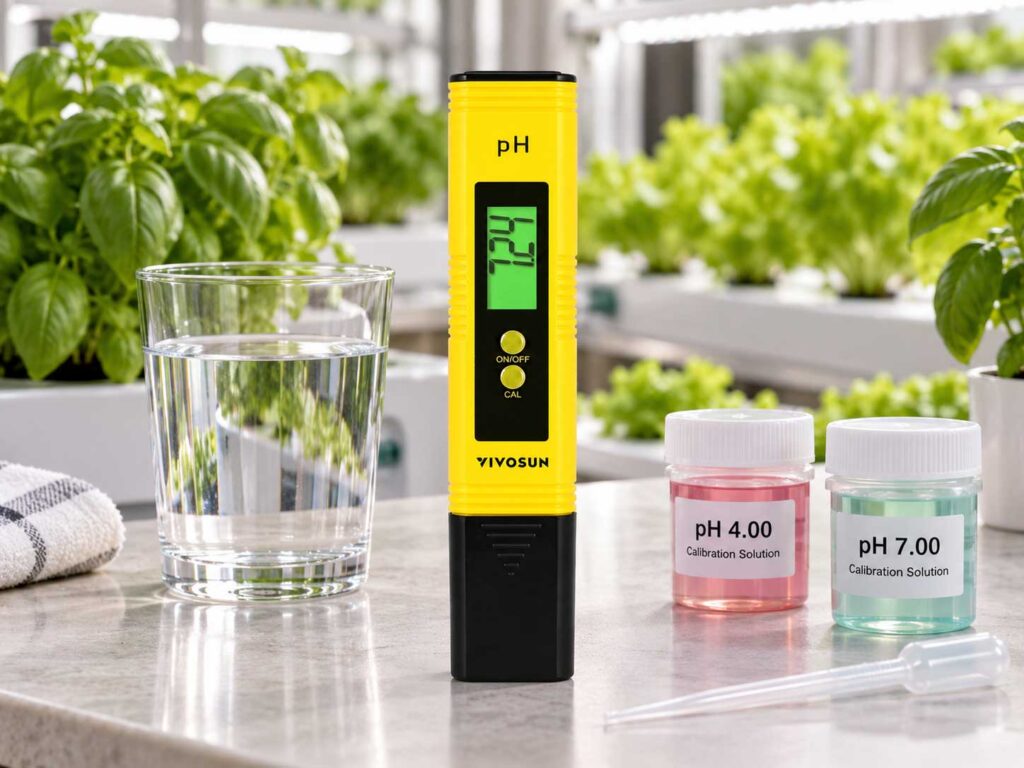
The VIVOSUN Digital pH Meter is our budget pick for growers who want a simple digital tester without spending much on their first pH meter.
Despite its low price, the current VIVOSUN 305141-PEN includes several features you would normally expect from more expensive models, including automatic temperature compensation, automatic calibration, a backlit display, and 0.01 pH resolution. VIVOSUN lists its reading accuracy at ±0.1 pH.
That makes it a surprisingly capable option for small hydroponic systems, beginners learning reservoir management, or anyone who wants an inexpensive backup meter.
Key Features
- pH range: 0.00 to 14.00
- 0.01 pH resolution
- ±0.1 pH accuracy
- Automatic temperature compensation
- Automatic one-, two-, or three-point calibration
- Calibration points at pH 4.00, 6.86, and 9.18
- Backlit LCD display
- Hold-reading function
- Memory function
- Automatic shutoff
- Compact pen-style design
- Buffer powder packs included for calibration
Why We Like It
The appeal here is simple: it costs very little compared with the premium meters above.
It gives new growers a low-cost way to move beyond test strips or liquid color kits while still getting a numerical pH reading.
The automatic calibration is especially useful at this price level. Instead of adjusting a calibration screw manually, you place the meter in the correct buffer solution and use the calibration function to set the meter.
The hold button is another small but useful feature. You can lock the measurement on the screen before removing the pen from the reservoir, which is handy when testing buckets or containers in awkward locations.
For a small Kratky setup, countertop herb garden, or basic DWC bucket, it may provide everything a beginner actually needs.
Pros and Cons
| Pros | Cons |
|---|---|
| Extremely affordable | Build quality is more basic than premium meters |
| ±0.1 pH stated accuracy | Long-term durability may not match Apera, Bluelab, or Hanna |
| 0.01 pH display resolution | Probe is not intended as a premium replaceable-electrode system |
| Automatic temperature compensation | Budget meters benefit from frequent calibration checks |
| Automatic 1–3 point calibration | Less suitable for growers who depend on one meter for multiple high-value reservoirs |
| Backlit display | |
| Hold-reading function | |
| Calibration buffers included | |
| Useful as both a starter and backup meter |
Best For
The VIVOSUN Digital pH Meter is best for beginners, small hydroponic systems, and growers who want to keep the initial cost as low as possible.
It is a good fit for Kratky jars, small DWC buckets, countertop systems, seedlings, and herb gardens where you are learning how pH behaves without investing heavily in equipment.
It can also make sense as a backup meter. If your primary tester suddenly gives you an unusual reading, having a second calibrated pen available can help you decide whether the reservoir changed or the first meter needs attention.
For larger systems or growers testing several reservoirs every day, we would still lean toward a more durable meter from Apera, Bluelab, or Hanna. But for the money, the VIVOSUN offers considerably more functionality than its basic appearance suggests.
5. Apera Instruments SX620 — Best for Higher-Resolution Readings
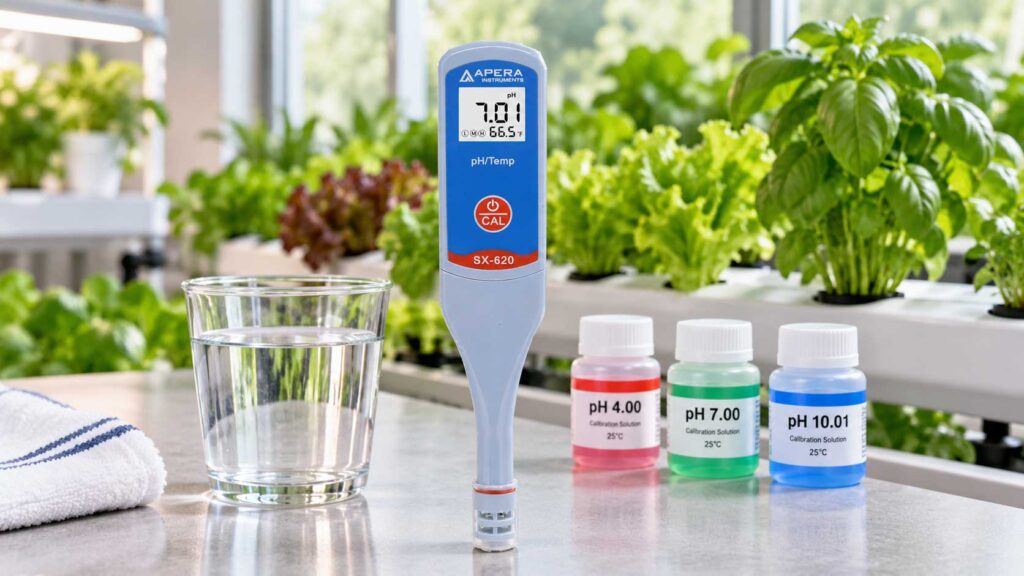
The Apera Instruments SX620 is a step up from basic pocket testers for growers who want finer readings and a meter they can keep using as the probe ages.
It displays pH to 0.01, includes automatic temperature compensation, and uses a replaceable SX625 pH probe rather than forcing you to replace the entire meter when the electrode eventually wears out. Apera currently sells that replacement probe separately.
That combination makes the SX620 especially appealing to growers who test regularly and want something easier to keep in use long term than a disposable-style pH pen.
Key Features
- 0.01 pH resolution
- Automatic temperature compensation
- Multi-point calibration
- Replaceable SX625 pH electrode
- Stable-reading indicator
- Digital display
- Designed for general water-solution testing
- Suitable for hydroponic nutrient solutions
Apera notes that its regular glass-bulb pH electrodes are suitable for hydroponics and other general water-testing applications, which fits the way most growers would use the SX620.
Why We Like It
Where the SX620 earns its place is the replaceable probe.
pH electrodes are consumable parts. Over time, they can respond more slowly, become harder to calibrate, or stop holding accurate readings. With the SX620, you can replace the probe instead of discarding the entire meter.
That makes it more attractive if you plan to test nutrient solution for several growing seasons.
The 0.01 display resolution is useful as well because it makes smaller pH movements easier to see. That does not mean you should constantly adjust your reservoir over changes of a few hundredths, but it can help you follow trends more closely than a meter that only displays one decimal place.
Pros and Cons
| Pros | Cons |
|---|---|
| 0.01 pH resolution | Costs more than entry-level pH testers |
| Replaceable probe makes long-term ownership easier | More features than a very small system may need |
| Automatic temperature compensation | Replacement probe adds to long-term ownership cost |
| Multi-point calibration | Requires proper electrode storage and maintenance |
| Suitable for regular hydroponic testing | Less beginner-focused than simpler budget pens |
| Good choice for growers who test frequently |
Best For
The Apera SX620 is best for intermediate and advanced home growers who want finer readings and a replaceable electrode.
It makes the most sense if you run multiple reservoirs, test frequently, or simply prefer equipment that can be maintained rather than replaced when the probe reaches the end of its useful life.
For a single small Kratky jar or countertop system, the extra cost may not be necessary. But for growers who expect pH testing to remain part of their regular routine, the SX620 makes more sense than a disposable-style budget pen.
6. Apera GroStar GS4 — Best pH + EC Meter
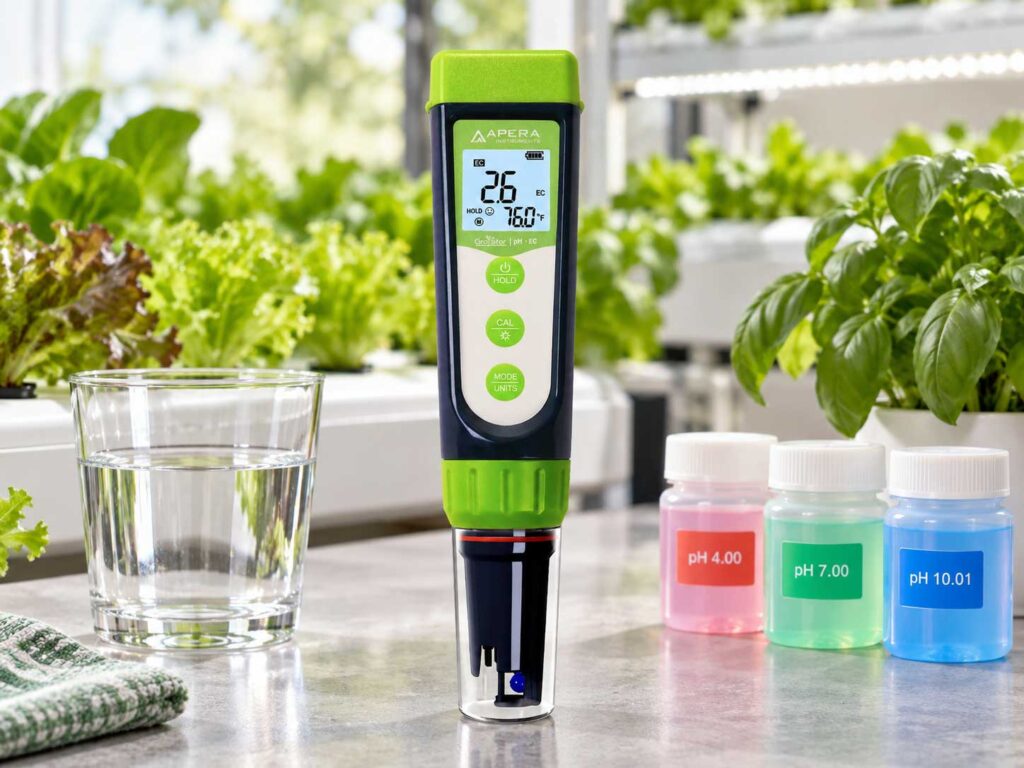
The Apera GroStar GS4 is the most versatile option on this list because it combines pH testing with EC and nutrient-strength readings in one handheld device.
For hydroponic growers, that is a useful combination. pH helps you understand whether nutrients are available to the roots, while EC helps you monitor how concentrated the nutrient solution is.
Instead of keeping separate pH and EC pens beside the reservoir, the GS4 lets you check both with one meter.
Apera currently lists the GroStar GS4 Gen II as a 5-in-1 tester for pH, EC, 500 ppm, 700 ppm, and temperature. It also uses a replaceable pH/EC combo probe, so you can replace the sensor instead of the entire meter when the probe eventually wears out.
Key Features
- Measures pH
- Measures EC
- Displays nutrient concentration in 500 ppm
- Displays nutrient concentration in 700 ppm
- Measures temperature
- Automatic temperature compensation
- Replaceable pH/EC combo probe
- Automatic calibration
- Backlit digital display
- Designed specifically for growers and hydroponic water testing
Why We Like It
The GS4 becomes especially useful when you want to check pH and nutrient strength with one device.
In hydroponics, checking pH without EC only tells you part of what is happening in the reservoir. Your pH can be perfectly acceptable while the nutrient solution is too weak or too concentrated. For crop-specific targets, our Hydroponic Nutrient & pH Chart gives you pH and nutrient ranges for popular crops.
That is especially useful when mixing fresh nutrients, topping off a reservoir, or trying to understand why plants are behaving differently even though the pH appears normal.
The replaceable pH/EC combo probe is another major advantage. Apera currently sells the replacement GS4-E probe separately, so you do not necessarily have to replace the whole meter when the sensor reaches the end of its useful life.
The GS4 is also designed around growers rather than general household water testing, which makes its combination of pH, EC, ppm, and temperature especially relevant for hydroponics.
Pros and Cons
| Pros | Cons |
|---|---|
| Measures pH and EC with one device | Considerably more expensive than a basic pH pen |
| Displays both 500 ppm and 700 ppm scales | More features than many beginners need |
| Measures temperature | Requires calibration and proper probe care |
| Automatic temperature compensation | If you already own a reliable EC meter, the extra cost may be harder to justify |
| Replaceable pH/EC combo probe | More expensive replacement probe than a simple pH-only electrode |
| Designed specifically for growers | |
| Reduces the need for multiple handheld meters | |
| Good fit for frequent reservoir monitoring |
Best For
The Apera GroStar GS4 is best for serious home growers, larger hydroponic setups, and anyone who wants to monitor pH and nutrient strength with one device.
It makes particular sense if you are building your testing kit from scratch and would otherwise need to buy both a pH meter and an EC meter.
For a small Kratky jar or countertop herb garden, the GS4 is probably more meter than you need. But if you run multiple reservoirs, mix nutrients regularly, or closely track both pH and EC, the convenience of having everything in one pen can be worth the higher price.
7. Milwaukee PH600 — Best Affordable Alternative
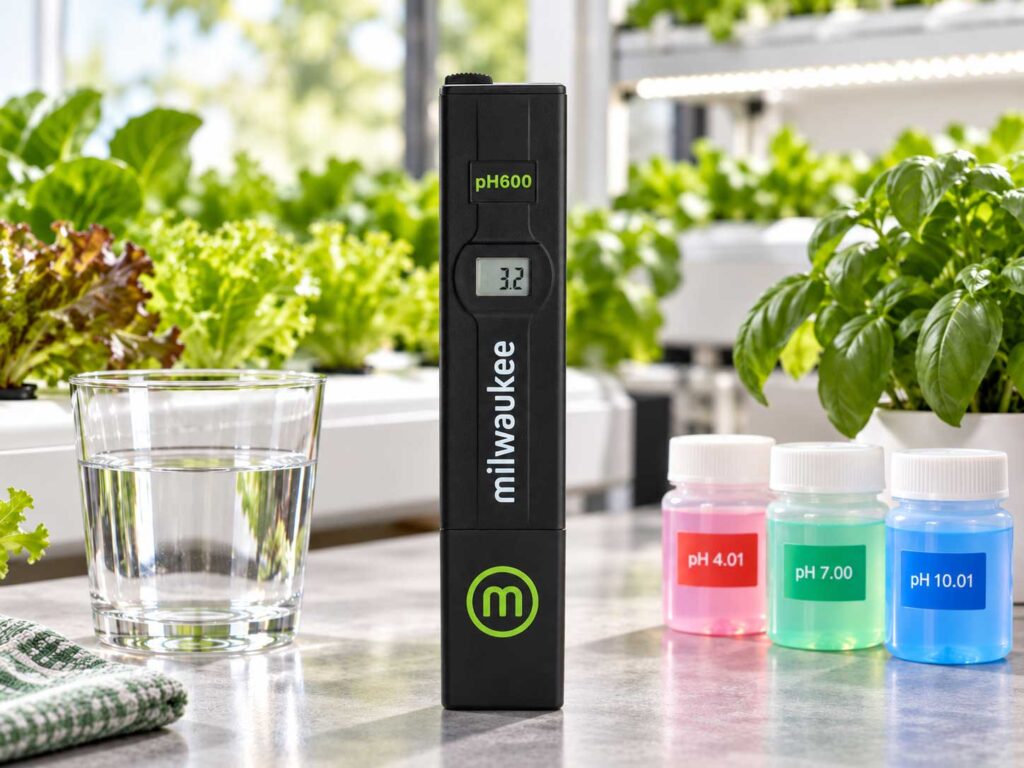
The Milwaukee PH600 is a straightforward pH tester for growers who want something more established than a generic bargain pen but still want to keep costs low.
It does not have automatic calibration, temperature compensation, or multi-parameter testing. Instead, it focuses on one job: giving you a basic pH reading without a lot of extra features.
Milwaukee lists the PH600 with a 0.0 to 14.0 pH range, 0.1 pH resolution, and ±0.1 pH accuracy at 25°C. Calibration is manual and performed at one point.
Key Features
- pH range: 0.0 to 14.0
- 0.1 pH resolution
- ±0.1 pH accuracy at 25°C
- Manual one-point calibration
- Compact pen-style design
- Simple digital display
- Lightweight and portable
- Suitable for routine hydroponic water testing
Why We Like It
The PH600 is easy to understand.
There are no extra modes, multiple measurements, or complicated menus. If you mainly want to dip a meter into your nutrient solution, check the pH, and move on, that simplicity can actually be a benefit.
It also fills a useful middle ground in this roundup. The VIVOSUN is our lowest-cost option, while the PH600 may appeal more to growers who prefer a basic meter from a long-established water-testing brand.
The tradeoff is calibration. Because the PH600 uses manual calibration, you need to adjust it yourself using a proper buffer solution. That adds a little more work compared with meters that automatically recognize calibration buffers.
Pros and Cons
| Pros | Cons |
|---|---|
| Affordable | Manual calibration |
| ±0.1 pH stated accuracy at 25°C | No automatic temperature compensation |
| Very simple to operate | Only 0.1 pH resolution |
| Compact and easy to store | No EC or temperature measurement |
| Good option for small hydroponic systems | Fewer convenience features than premium meters |
| Useful as a backup meter | Requires more hands-on calibration |
Best For
The Milwaukee PH600 is best for budget-conscious growers who want a basic, no-frills pH meter for occasional reservoir checks.
It is well suited to small DWC systems, Kratky containers, seedling setups, and growers maintaining only one or two reservoirs.
If you expect to test pH every day or manage several hydroponic systems, spending more on automatic calibration, temperature compensation, or a replaceable probe may make your routine easier. But for simple spot testing, the PH600 remains an affordable and uncomplicated option.
Why Accurate pH Measurement Matters in Hydroponics
In hydroponics, your plants depend on the nutrient solution for virtually everything they need. That makes pH especially important because it affects how easily roots can take up different nutrients.
Most hydroponic crops prefer a slightly acidic nutrient solution, commonly somewhere around pH 5.5 to 6.5, although the exact target varies by crop. See our guide to the best pH for hydroponics for crop-specific ranges.
If pH drifts too far outside that range, certain nutrients become harder for roots to absorb even when they are still present in the reservoir. Plants may respond with yellowing leaves, slower growth, brown spots or scorched edges, weak roots, and poor flowering or fruit development. In other words, a pH problem can look a lot like a nutrient deficiency even when plenty of fertilizer is already present.
If you are troubleshooting visible symptoms, see Why Are My Hydroponic Leaves Turning Yellow? and Hydroponic Nutrient Deficiencies.
That is why a dependable pH meter is not just another gadget. It helps you catch problems before you start changing nutrients unnecessarily.
You Do Not Need to Chase One Exact Number
A common beginner mistake is trying to keep the reservoir at one exact pH reading all day.
That is rarely necessary.
Hydroponic pH naturally moves as plants absorb water and nutrients, and a small shift from 5.8 to 6.0 is normally far less concerning than a reservoir that has climbed to 6.8 or 7.0.
The goal is to keep pH within a healthy range and watch the overall trend.
In fact, allowing pH to move gradually within the recommended range can be useful because different nutrients are absorbed more readily at slightly different pH levels.
An Inaccurate Meter Can Create More Problems
A poorly calibrated meter can lead you in the wrong direction.
Imagine your nutrient solution is actually at pH 6.0, but the meter reads 6.7. If you trust that reading and add a large amount of pH down, you may push the real pH much lower than intended.
This is why calibration and probe care matter just as much as the meter itself.
If a reading suddenly looks unusual, it is often better to verify it before making a major correction.
Check pH Together With EC
pH tells you whether the nutrient solution is in a suitable range for nutrient uptake, but it does not tell you how strong that solution is.
That is where EC, or electrical conductivity, becomes useful. Our Hydroponic Nutrient & pH Chart includes crop-specific pH and EC guidance.
| Measurement | What It Helps You Monitor |
|---|---|
| pH | Acidity or alkalinity and nutrient availability |
| EC | Overall nutrient concentration |
| Water temperature | Root-zone and reservoir conditions |
Looking at these measurements together gives you a much better picture of what is happening inside the reservoir.
You do not need an expensive all-in-one meter to do this. Separate pH and EC meters work perfectly well for most home hydroponic growers.
What matters more is consistency: test regularly, record unusual changes, and pay attention to trends instead of reacting to every small fluctuation.
What to Look for in a Hydroponic pH Meter
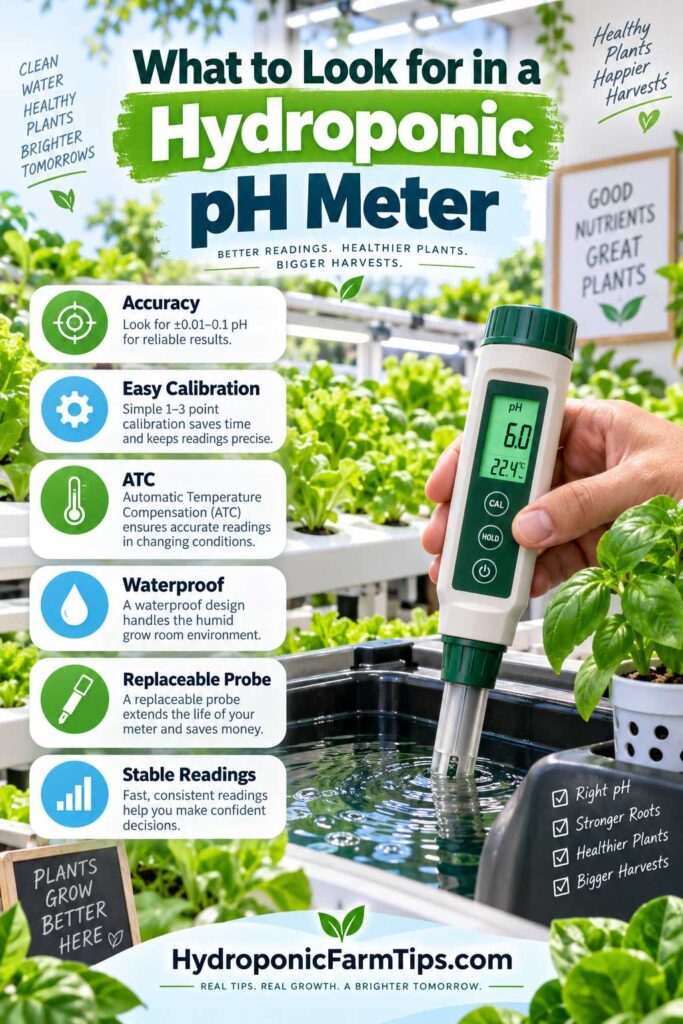
The best pH meter for hydroponics is not necessarily the most expensive one.
What matters more is whether the meter gives you consistent readings, is easy to calibrate, and matches how often you actually test your reservoir. A small countertop system has very different needs from a grower managing several DWC buckets or a larger nutrient reservoir.
Here are the features that matter most.
Accuracy vs. Resolution
These two specifications are easy to confuse.
Accuracy tells you how close the meter is expected to be to the true pH value.
Resolution tells you how many decimal places the display shows.
For example, a meter may display pH to 0.01 but still have an accuracy rating of ±0.1 or ±0.2 pH. That extra decimal place does not automatically make it more accurate.
For most home hydroponic systems, ±0.1 pH accuracy is usually sufficient for routine reservoir testing.
Automatic Temperature Compensation
Many better pH meters include automatic temperature compensation, or ATC.
This helps the meter account for temperature-related effects while taking a measurement. Since hydroponic reservoir temperatures can change during the day, ATC makes routine testing easier and reduces one more variable you would otherwise need to think about.
It is not a substitute for monitoring water temperature, but it is a useful feature to have.
Easy Calibration
Every digital pH meter needs calibration.
The easiest models automatically recognize standard buffer solutions and guide you through the process. Others require manual adjustment.
For hydroponic use, a meter that supports calibration around pH 7.0 and pH 4.0 is usually practical because your nutrient solution typically sits on the acidic side of neutral.
If you are new to pH testing, automatic calibration is worth paying a little extra for.
Replaceable Probe
The electrode is usually the part of the meter that wears out first.
Over time, a probe may become slow, unstable, or difficult to calibrate. On inexpensive pens, that often means replacing the whole meter.
Higher-end models may use a replaceable electrode, which allows you to keep the meter body and replace only the worn sensor.
This matters most if you test frequently and plan to use the meter for several years.
Waterproof Construction
Hydroponics and water go together, so waterproofing is more useful than it might sound.
Wet hands, nutrient splashes, condensation, and accidental drops are common around reservoirs.
A meter with an IP67 or IP68 rating offers extra protection and can be a smart choice if you test regularly.
Stability Indicator
A stability indicator tells you when the reading has settled.
That may sound minor, but it is one of the most useful convenience features for beginners.
Instead of staring at a number that keeps moving slightly and wondering when to record it, you can wait until the meter confirms the reading is stable.
What Comes in the Kit?
Do not look only at the meter itself.
A complete starter kit may include:
| Included Item | Why It Matters |
|---|---|
| Calibration solution | Needed to calibrate the meter correctly |
| Storage solution | Keeps the electrode hydrated between uses |
| Calibration cups | Helps prevent contamination of buffer bottles |
| Cleaning solution | Useful when nutrient residue builds up on the probe |
| Replacement batteries | Convenient for long-term use |
| Carrying case | Protects the meter and keeps supplies together |
A slightly more expensive kit can sometimes be better value if it includes the supplies you would otherwise need to buy separately.
pH-Only vs. Combination Meters
A dedicated pH pen is perfectly fine if that is the only measurement you need.
However, hydroponic growers often monitor both pH and EC, so a combination meter can be convenient if you are starting from scratch. If you are still learning how nutrient concentration works, start with our Hydroponic Nutrients for Beginners guide.
A combo meter reduces the number of tools you need to keep near the reservoir, but it usually costs more.
If you already own a good EC meter, there is little reason to replace it just to get an all-in-one device.
Price vs. Long-Term Value
A budget meter can be completely adequate for a small system.
But the lowest purchase price does not always mean the best long-term value.
Paying more can buy you better waterproofing, easier calibration, a replaceable electrode, stronger build quality, or the convenience of measuring both pH and EC with one device. Whether those upgrades are worth it depends on how often you test and how large your system is.
For one small Kratky container or countertop garden, a basic meter may be all you need.
For multiple reservoirs or a hydroponic garden you manage year-round, paying more for durability and easier maintenance can make much more sense.
How Often Should You Check pH in a Hydroponic System?
For most home hydroponic systems, checking pH once a day or every other day is a good starting point.
How often you need to test depends on reservoir size, crop type, water use, and how stable your nutrient solution tends to be.
A Simple pH Testing Schedule
| Situation | How Often to Check |
|---|---|
| New hydroponic system | Daily for the first 1–2 weeks |
| Small reservoir or DWC bucket | Daily |
| Larger, stable reservoir | Every 1–3 days |
| After adding nutrients | Check after mixing |
| After topping off water | Recheck pH and EC |
| After adjusting pH | Recheck once the solution is well mixed |
| Plants showing stress | Check immediately |
Reservoir maintenance also affects how stable those readings stay; see How Often Should You Change Hydroponic Water? for a complete water-change schedule.
This is not a rigid schedule. Once you understand how your system behaves, you can adjust the routine.
Small Reservoirs Can Change Quickly
A small reservoir has less water to buffer changes, so pH can move faster than it does in a larger system.
Countertop gardens, Kratky containers, and individual DWC buckets often benefit from daily checks, especially when plants are large, temperatures are warm, or water use is increasing quickly.
Larger Reservoirs Are Often More Stable
Larger reservoirs usually change more gradually.
Once you know the normal pattern of your system, checking every one to three days may be enough.
Even a normally stable reservoir deserves another check after adding nutrients, topping off with water, replacing the solution, adjusting pH, or noticing new plant stress.
Test More Often When the System Is New
During the first week or two, daily testing can teach you a lot about your setup.
You may notice that pH slowly rises each day, stays surprisingly stable, or shifts more dramatically after topping off the reservoir.
Once you recognize that pattern, you can stop testing quite as often and settle into a routine that fits your system.
Do Not Chase Every Small Change
A reservoir moving from pH 5.8 to 6.0 does not automatically need correction.
Small changes are normal as plants take up water and nutrients.
Constantly adding pH up or pH down can sometimes create more instability than simply allowing the solution to move within an acceptable range.
Focus on overall trends and the recommended range for your crops, not one perfect number.
Keep a Simple Reservoir Log
Tracking a few measurements can make troubleshooting much easier.
A simple log does not need to be complicated. Record the date, pH, EC or PPM, water temperature, any water or nutrients added, and whether you used pH up or pH down.
After a few weeks, patterns often become obvious.
For example, you may notice that pH consistently rises as the reservoir level drops, or that EC increases when plants are drinking water faster than they are taking up nutrients.
That kind of information is much more useful than reacting to one isolated reading.
For most home growers, consistent testing beats constant testing. Learn how your reservoir behaves, watch for meaningful changes, and adjust only when the numbers actually call for it.
How to Calibrate a Hydroponic pH Meter
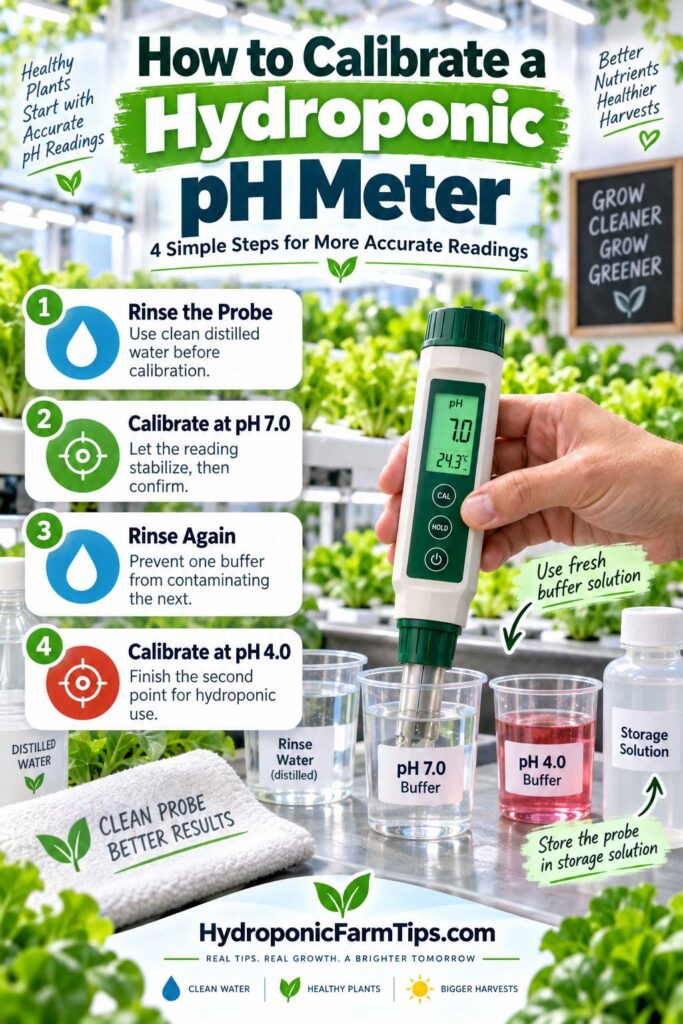
Even a good pH meter can give unreliable readings if it is not calibrated correctly. Calibration teaches the meter what known pH values look like so it can measure your hydroponic nutrient solution more accurately.
Always follow the instructions for your specific meter, but the basic process is usually similar.
What You Need
Before you start, gather:
- pH 7.00 calibration solution
- pH 4.00 calibration solution
- Clean calibration cups or small containers
- Distilled or deionized water for rinsing
- Electrode storage solution
- Your pH meter
Pour a small amount of buffer solution into a clean container instead of calibrating directly in the original bottle. This helps prevent contamination.
Step 1: Rinse the Probe
Rinse the electrode gently with distilled or deionized water.
Do not scrub the glass bulb. If you need to remove excess water, lightly blot the probe with a clean, lint-free tissue rather than wiping it.
Step 2: Calibrate at pH 7.00
Place the probe in the pH 7.00 buffer solution.
Gently move the meter through the solution and wait for the reading to stabilize.
Start the calibration mode according to the manufacturer’s instructions. Many newer meters automatically recognize the buffer and confirm when the calibration point has been accepted.
Step 3: Rinse Before the Second Buffer
Remove the probe from the pH 7.00 solution and rinse it again with distilled or deionized water.
This helps prevent one buffer from contaminating the next.
Step 4: Calibrate at pH 4.00
For hydroponics, pH 4.00 is usually the most useful second calibration point because nutrient solutions are generally maintained on the acidic side of neutral. Once the meter is calibrated, compare the reading with the crop targets in our Hydroponic Nutrient & pH Chart.
Place the probe in the pH 4.00 buffer, allow the reading to stabilize, and complete the second calibration point.
Some meters support three-point calibration, but most home hydroponic growers do not need to calibrate at every available buffer each time.
How Often Should You Calibrate?
There is no single schedule that works for every meter.
For frequent hydroponic testing, calibrating weekly or every few weeks is a practical routine. Some meters also provide automatic calibration reminders.
Recalibrate sooner if the reading suddenly looks unusual, the probe has dried out or been cleaned, the meter has been dropped, calibration is taking unusually long, or the device itself shows a calibration reminder.
The manufacturer’s instructions should always take priority if they recommend a different schedule.
Do Not Reuse Calibration Solution
Once buffer solution has been used for calibration, do not pour it back into the original bottle.
Even a small amount of contamination can affect future calibrations.
Use a fresh portion when needed, keep the main bottle tightly sealed, and replace old buffer if you are unsure whether it is still reliable.
Check the Reading After Calibration
After calibration, you can place the probe back into a fresh sample of known buffer solution.
If the reading is close to the expected value, the meter is ready to use.
If it remains noticeably off, clean the electrode, use fresh buffer, and repeat the calibration process. A meter that repeatedly fails calibration or responds very slowly may have an aging or damaged probe.
A few minutes spent calibrating your pH meter can prevent much bigger mistakes later. It is far better to verify the meter first than to adjust an entire nutrient reservoir based on a bad reading.
Useful pH Meter Supplies for Hydroponic Growers
A pH meter needs regular calibration and proper probe storage to stay dependable. These inexpensive supplies are worth keeping with your hydroponic testing kit.
| What You Need | Why You Need It | Our Tip | Buy |
|---|---|---|---|
| pH 4.00 Calibration Solution | Provides an acidic calibration point close to the range used in hydroponics | Buy premixed solution for convenient routine calibration | Check Price → |
| pH 7.00 Calibration Solution | Provides the standard neutral calibration point | Keep the bottle tightly closed and never return used solution | Check Price → |
| pH Probe Storage Solution | Keeps the glass electrode hydrated between uses | Never substitute distilled water for long-term storage | Check Price → |
| pH Electrode Cleaning Solution | Helps remove nutrient salts and residue from the probe | Useful when readings become slow or unstable | Check Price → |
| Small Calibration Cups | Prevent contamination of your main buffer bottles | Pour out only what you need for each calibration | Check Price → |
How to Store and Maintain a pH Meter
A good pH meter can last much longer if you store and clean it properly.
The glass electrode at the tip needs to stay hydrated. If it dries out, readings may become slow, unstable, or difficult to calibrate.
Keep the Probe Moist
Most pH meters should be stored with the sensing tip in electrode storage solution.
Many pen-style meters use a protective cap with a small sponge or reservoir inside. Add enough solution to keep the electrode moist without flooding the cap.
Do not store the probe dry unless the manufacturer specifically recommends it.
Never Store It in Distilled Water
Distilled or deionized water is useful for rinsing the probe, but it is generally not appropriate for long-term storage.
Leaving the electrode in distilled water can affect its internal chemistry and shorten its useful life.
Use the storage solution recommended for your meter instead.
Rinse After Every Test
After checking your nutrient reservoir, rinse the probe gently with distilled or deionized water.
This helps remove fertilizer salts and residue before they dry on the glass bulb.
Avoid rubbing or scrubbing the electrode. The sensing surface is delicate, and aggressive cleaning can damage it.
Clean the Probe When Readings Become Slow
Over time, nutrient salts, minerals, or organic residue can build up on the electrode.
If the meter becomes noticeably slower, starts drifting, or suddenly becomes difficult to calibrate, residue on the electrode may be part of the problem.
Use a dedicated pH-electrode cleaning solution and follow the manufacturer’s instructions rather than experimenting with household cleaners.
After cleaning, recalibrate the meter before using it to adjust your reservoir.
Keep Buffer and Storage Solutions Fresh
Calibration and storage solutions can become contaminated over time.
Keep the bottles tightly sealed and pour only what you need into a separate cup. Never return used calibration solution to the original bottle.
If a solution looks contaminated, has been left open for a long time, or you are unsure how old it is, replacing it is usually safer than trusting a questionable calibration.
Know When the Probe Is Wearing Out
pH electrodes do not last forever.
Even with proper care, the sensor eventually becomes slower and less responsive.
Signs that replacement may be needed include:
| Warning Sign | What It May Mean |
|---|---|
| Very slow readings | Electrode may be aging or dirty |
| Calibration repeatedly fails | Probe may no longer respond correctly |
| Reading keeps drifting | Sensor may be contaminated or worn |
| Large differences between repeated tests | Calibration or electrode problem |
| Buffer solutions read incorrectly | Probe may need cleaning or replacement |
If your meter has a replaceable electrode, you may only need a new probe rather than a completely new meter.
Keep a Backup Way to Check pH
A second testing method can be useful when a reading looks suspicious.
That could be another calibrated digital meter or a simple liquid pH test kit.
If your normal meter suddenly shows a major shift, confirming the result before adding a large amount of pH up or pH down can prevent a bad reservoir adjustment.
Good meter care does not take much time. Rinse after testing, keep the electrode moist, use fresh calibration solution, and recalibrate when readings start behaving differently. Those simple habits can make a big difference in how consistently your pH meter performs.
Digital pH Meter vs. pH Test Strips — Which Is Better for Hydroponics?
Both digital pH meters and pH test strips can tell you whether your nutrient solution is acidic or alkaline, but they are not equally useful for hydroponics.
For most growers, a digital pH meter is the better long-term choice because it gives you a numerical reading and makes it much easier to track small changes over time.
Digital Meter vs. Test Strips
| Feature | Digital pH Meter | pH Test Strips |
|---|---|---|
| Reading type | Numerical display | Color comparison |
| Precision | Generally higher | Lower |
| Easy to track small changes | Yes | Not very well |
| Calibration required | Yes | No |
| Maintenance | Probe must be rinsed and stored correctly | Almost none |
| Initial cost | Higher | Very low |
| Best for frequent testing | Yes | No |
| Useful as a backup | Yes | Yes |
| Long-term convenience | Better | More limited |
Why Digital pH Meters Work Better for Regular Hydroponics
A digital meter gives you a direct pH reading on the screen.
That makes it much easier to see whether your reservoir is at pH 5.8, 6.1, or 6.4 instead of trying to decide which color on a test strip looks closest.
This becomes especially useful when you test several times per week and want to watch how your reservoir changes over time.
Many digital meters also include features such as automatic temperature compensation, calibration reminders, and stability indicators that make routine testing easier.
The tradeoff is maintenance. A digital meter needs regular calibration, proper storage, and eventually a new electrode or replacement meter.
When pH Test Strips Still Make Sense
Test strips are cheap, simple, and require almost no maintenance.
You dip the strip into the nutrient solution, wait for the color to develop, and compare it with the supplied chart.
They can work for a very small experimental setup, but they are harder to use when you need to distinguish relatively small pH differences.
Color interpretation can also be subjective, especially if the nutrient solution itself has some color.
For that reason, we see test strips more as a backup tool than a primary testing method for an established hydroponic garden.
What About Liquid pH Test Kits?
Liquid indicator kits are another inexpensive option.
You place a small sample of nutrient solution into a vial, add indicator drops, and compare the resulting color with a reference chart.
They still do not give you the same level of detail as a digital meter, but they can be useful for confirming whether a suspicious digital reading is at least in the correct general range.
Which One Should You Use?
For occasional experimentation, test strips or a liquid kit may be enough.
For regular hydroponic growing, a digital pH meter is usually the more practical choice. A reliable meter becomes even more useful when paired with a consistent feeding routine, which we cover in Hydroponic Nutrients for Beginners.
A good setup is to use a calibrated digital meter for routine testing and keep an inexpensive liquid test kit as a backup. If the digital meter suddenly shows an unexpected result, the backup can help you decide whether the reservoir has really changed or whether the meter needs cleaning or recalibration.
You do not need the most expensive meter available. A well-maintained mid-range model will usually be far more useful than a premium meter that is rarely calibrated or stored correctly.
Do You Need Both a pH Meter and an EC Meter?
For most hydroponic growers, yes—using both a pH meter and an EC meter is useful because they tell you two different things about the nutrient solution.
A pH meter tells you how acidic or alkaline the solution is. An EC meter helps estimate how concentrated the dissolved nutrients are.
You can have the correct pH but still be feeding too weakly or too strongly. You can also have an acceptable EC reading while pH has drifted outside the range where nutrients are easiest for plants to absorb.
pH Meter vs. EC Meter
| Meter | What It Measures | Why It Matters |
|---|---|---|
| pH meter | Acidity or alkalinity | Helps you keep nutrients available to the roots |
| EC meter | Electrical conductivity | Helps estimate overall nutrient concentration |
For many hydroponic crops, pH is commonly managed somewhere around 5.5 to 6.5, although the ideal target depends on the plant. You can compare crop-specific targets in our Hydroponic Nutrient & pH Chart.
EC targets vary even more because they depend on the crop, growth stage, nutrient formula, and growing conditions.
What pH Tells You
pH helps you understand whether the nutrient solution is sitting within a suitable range for nutrient uptake.
If it drifts too far in either direction, certain nutrients become harder for roots to absorb, even when those nutrients are already present in the reservoir.
That is why a plant can show deficiency symptoms without actually needing more fertilizer.
What EC Tells You
EC, or electrical conductivity, measures how well the nutrient solution conducts electricity.
Dissolved fertilizer salts increase conductivity, so EC gives you a practical way to monitor nutrient strength.
A lower-than-expected EC may mean the solution is too dilute for the crop or growth stage. A rising EC can indicate that the reservoir is becoming more concentrated as plants use water.
Why Watching Both Is More Useful
Looking at pH and EC together gives you more context.
The relationship between the two measurements can tell you quite a bit. If EC rises while the water level falls, for example, the reservoir may be becoming more concentrated because plants are using water faster than nutrients. If EC falls steadily, nutrient uptake may be relatively strong. And if EC looks normal but the plants still struggle, pH, root health, water temperature, or lighting may be the real issue.
Neither measurement tells the whole story on its own.
Separate Meters or a Combination Meter?
Both approaches work well.
| Setup | Advantages | Best For |
|---|---|---|
| Separate pH + EC meters | Easier to replace one meter, often cheaper to upgrade individually | Growers who already own one good tester |
| Combination meter | One device for routine reservoir checks | Growers starting from scratch or testing frequently |
If you already own dependable separate meters, there is little reason to replace them just to get an all-in-one device.
But if you are buying your first testing kit, a combination meter such as the Apera GroStar GS4 can reduce the number of tools you need beside the reservoir.
What Beginners Actually Need
If your budget is limited, start with a reliable pH meter.
For a simple Kratky setup using a proven nutrient formula, you may not need to monitor EC constantly at first.
EC becomes more valuable once you begin mixing nutrients yourself, growing fruiting crops such as tomatoes or peppers, running larger reservoirs, adjusting feeding through different growth stages, or troubleshooting nutrient problems. For the actual mixing process, see Hydroponic Nutrients for Beginners.
For long-term hydroponic growing, pH and EC work best together. pH helps you understand nutrient availability, while EC helps you understand nutrient strength.
FAQs About pH Meters for Hydroponics
What is the best pH meter for hydroponics?
For most home growers, the Apera Instruments PH20 is a strong all-around choice because it combines simple calibration, waterproof construction, dependable readings, and a reasonable price.
Growers who want more advanced features may prefer options from Bluelab, Hanna Instruments, or Apera’s higher-end range.
How accurate should a hydroponic pH meter be?
For most home hydroponic systems, about ±0.1 pH accuracy is usually sufficient.
Keep in mind that resolution and accuracy are different. A meter may display readings to 0.01 pH without actually being more accurate than a meter that displays only one decimal place.
How often should I calibrate a hydroponic pH meter?
Frequent users may calibrate weekly or every few weeks, but the manufacturer’s instructions should always come first.
Recalibrate sooner if readings look unusual, the probe has been stored for a long time, or the meter becomes slow or inconsistent.
Can I use an aquarium pH meter for hydroponics?
Yes. Many aquarium pH meters can also test hydroponic nutrient solutions.
However, hydroponic-focused meters may offer features that are more useful for regular reservoir testing, such as waterproofing, easier calibration, replaceable probes, or pH and EC monitoring.
Are cheap pH meters accurate enough for hydroponics?
Some budget pH meters work well for small or beginner systems, especially when they are calibrated regularly.
The main differences usually show up in build quality, long-term stability, calibration convenience, and probe durability.
Can I leave a pH meter in a hydroponic reservoir?
Most handheld pH pens are designed for short-term testing only, not continuous immersion.
Only leave a probe in the reservoir if the manufacturer specifically says it is designed for continuous monitoring.
Why does my pH meter give different readings each time?
Inconsistent readings can come from a dirty or dry probe, contaminated buffer solution, poor mixing, or an aging electrode.
Rinse the probe, recalibrate with fresh buffer, and wait for the reading to stabilize. If the problem continues, clean the electrode or replace it if your meter allows.
Should I test hydroponic pH before or after adding nutrients?
Test pH after adding and thoroughly mixing your nutrients.
Nutrients can change the pH of the water, so adjusting pH first may create unnecessary extra corrections. Once everything is mixed, check the final pH and adjust only if needed.
Which pH Meter Should You Choose?
The best pH meter for your hydroponic setup depends on how often you test, how much control you want, and whether you need pH alone or pH plus EC.
For most home growers, the Apera Instruments PH20 is the best all-around choice. It is easy to calibrate, waterproof, accurate enough for routine hydroponic use, and reasonably priced.
If you test frequently and want a more premium grower-focused meter, the Bluelab pH Pen is a strong upgrade.
Growers who prefer a hydroponic-specific design with a replaceable electrode may prefer the Hanna GroLine HI98118.
For beginners on a tighter budget, the VIVOSUN Digital pH Meter offers a low-cost way to start monitoring nutrient-solution pH without relying on strips or color kits.
And if you want to monitor both pH and nutrient strength with one device, the Apera GroStar GS4 is the most versatile option in this guide.
Quick Pick by Grower Type
| If You Are… | Best Choice |
|---|---|
| Most home hydroponic growers | Apera Instruments PH20 |
| Testing several times per week | Bluelab pH Pen |
| Wanting a hydroponic-specific meter | Hanna GroLine HI98118 |
| Shopping on a tight budget | VIVOSUN Digital pH Meter |
| Wanting pH + EC in one device | Apera GroStar GS4 |
| Wanting a simple affordable alternative | Milwaukee PH600 |
| Wanting finer 0.01 pH readings with a replaceable probe | Apera Instruments SX620 |
No matter which meter you choose, calibration and probe care matter just as much as the brand.
A premium meter stored dry or calibrated with contaminated buffer can still give poor readings. A well-maintained mid-range meter can be more useful than a premium model that is poorly calibrated or stored incorrectly.
The goal is not to chase one perfect pH number all day. It is to keep your nutrient solution within a healthy range, recognize meaningful trends, and make adjustments only when they are actually needed.
More Hydroponic Growing Guides You May Like
Now that you know how to choose and use a reliable pH meter, these guides can help you manage nutrients, understand pH and EC, troubleshoot plant problems, and keep your hydroponic garden running smoothly.
- Hydroponic Nutrient & pH Chart – Compare recommended pH and nutrient ranges for popular hydroponic vegetables, herbs, and fruits.
- Best pH for Hydroponics – Learn why pH matters, what range most hydroponic plants prefer, and how to correct pH that drifts too high or too low.
- Hydroponic Nutrients Guide – Understand the essential nutrients plants need, how hydroponic fertilizers work, and how to manage your nutrient solution.
- 8 Best Hydroponic Systems for Home – Compare DWC, Kratky, NFT, Ebb and Flow, drip, aeroponics, wick systems, and Dutch Buckets.
- 10 Best Hydroponic Vegetables – Discover productive vegetables for hydroponic growing and learn which systems work well for different crops.
- 10 Best Hydroponic Herbs to Grow at Home – Choose beginner-friendly herbs such as basil, mint, parsley, and cilantro for your indoor hydroponic garden.
- Why Are My Hydroponic Plant Leaves Turning Yellow? – Troubleshoot common causes of yellow leaves, including nutrient problems, pH imbalance, lighting issues, and root stress.
Keeping pH, nutrient strength, water temperature, and reservoir conditions within healthy ranges gives your plants a much better chance of producing vigorous growth and consistent harvests.