Healthy roots are the foundation of every successful hydroponic garden. When roots stay white, firm, and well-oxygenated, plants can absorb water and nutrients efficiently. But when hydroponic root rot develops, healthy plants can quickly begin to wilt, turn yellow, and stop growing.
Root rot in hydroponics is often linked to low oxygen levels, warm nutrient solution, poor sanitation, and root-zone pathogens such as Pythium. In systems where multiple plants share the same nutrient solution, a root problem can become serious surprisingly quickly.
Catching hydroponic root rot early gives you a much better chance of saving the plant and correcting the problem before it spreads. In this guide, you’ll learn how to recognize the first signs of root rot, identify what’s causing it, treat affected roots, and create conditions that help prevent the problem from returning.
We’ll also cover water temperature, dissolved oxygen, reservoir maintenance, healthy vs. unhealthy roots, and the mistakes that commonly lead to root disease in hydroponic systems.
What Is Root Rot in Hydroponics?
Root rot can occur in several hydroponic growing systems, especially when the root zone becomes stressed by low oxygen, high water temperatures, poor sanitation, or disease-causing microorganisms. Because hydroponic roots spend much of their time directly exposed to nutrient solution, changes in the reservoir can affect them quickly.
Pythium species are among the best-known pathogens associated with root rot in hydroponics. These water molds can spread through contaminated water, equipment, growing media, or infected plants and become especially troublesome when conditions in the root zone favor disease.
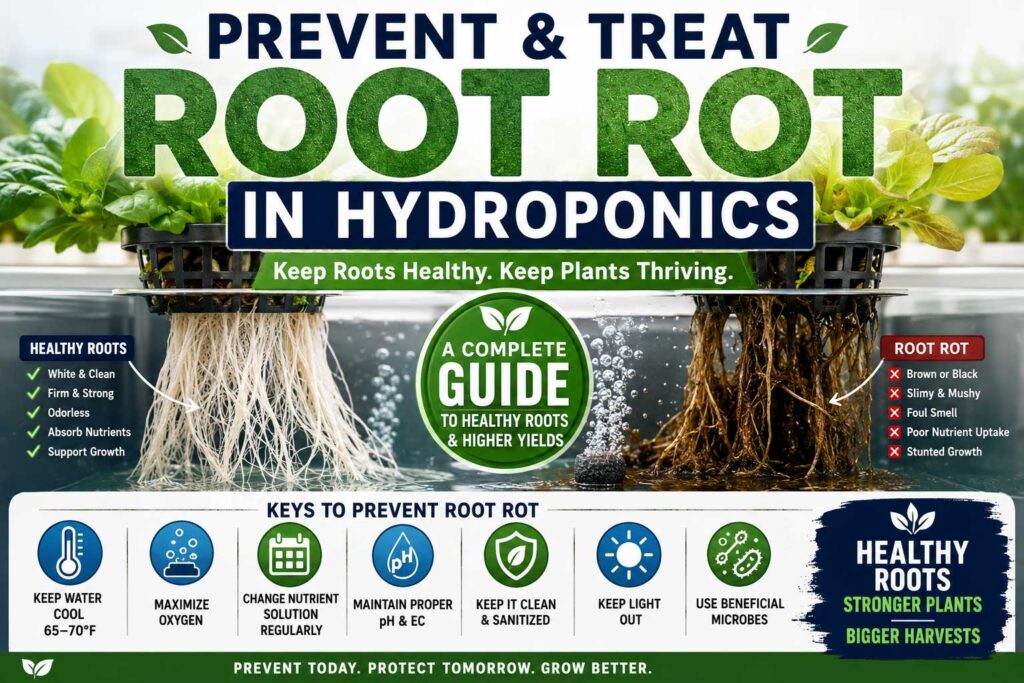
Healthy hydroponic roots typically have:
- White to cream-colored roots, although some nutrients can cause staining
- Firm root tissue rather than a mushy texture
- No slippery or slimy coating
- Little to no unpleasant odor
- Fresh root tips and fine secondary roots
Roots affected by rot may develop:
- Tan, brown, or darkened areas
- Soft or mushy tissue
- A slippery or slimy coating
- An unpleasant or sour odor
- Roots that break apart easily
- Increasing amounts of dead root material
Color alone isn’t enough to diagnose hydroponic root rot. Some nutrient solutions and additives can stain otherwise healthy roots. Texture, smell, plant performance, and whether the discoloration is spreading provide much better clues.
As root damage progresses, the plant becomes less effective at taking up water and nutrients. This can lead to wilting, yellowing, stalled growth, and symptoms that resemble nutrient deficiencies—even though plenty of water and nutrients are available in the reservoir.
Why Root Rot Is So Dangerous
Root rot in hydroponics can become a serious problem because damaged roots interfere with the plant’s ability to take up water and nutrients. In systems where multiple plants share a recirculating nutrient solution—such as NFT, Ebb and Flow, and Recirculating Deep Water Culture (RDWC)—root-zone pathogens can also move through the water from one plant to another.
As root damage progresses, you may notice:
- Stunted or unusually slow growth
- Yellowing leaves
- Wilting even when water is readily available
- Poor flowering or fruit development
- Reduced yields
- Severe plant decline or crop loss
The real advantage comes from catching the problem early. A few discolored roots are much easier to investigate than a large, slimy root mass accompanied by wilting plants and an unpleasant reservoir odor.
Regularly inspect the roots and pay attention to water temperature, aeration, cleanliness, and changes in root texture or smell. If several warning signs appear together, check the entire system rather than treating the affected plant alone.
Pro Tip: Inspect visible roots about once a week and whenever a plant begins wilting unexpectedly. Don’t diagnose root rot from color alone—nutrient staining can darken healthy roots. Sliminess, soft tissue, unpleasant odor, and declining plant growth are stronger warning signs.
Signs and Symptoms of Root Rot
Root rot in hydroponics is much easier to manage when you catch it early, but the first warning signs aren’t always obvious. A plant may begin to wilt, lose color, or grow more slowly even though the reservoir contains plenty of water and nutrients. These symptoms can easily be mistaken for a nutrient deficiency, especially if you haven’t inspected the roots recently.
The best way to determine what’s happening is to look at the plant and the root zone rather than relying on a single symptom.
Above-Ground Symptoms
Above the reservoir, one of the first things you may notice is a plant that looks unusually tired. Leaves can begin to droop or turn pale, and new growth may slow considerably. In more advanced cases, leaf tips may brown, older foliage may yellow, and flowering or fruiting plants may begin dropping blossoms or producing smaller harvests.
Wilting is particularly worth investigating when the plant has constant access to water. Damaged roots cannot move water and nutrients through the plant efficiently, so a plant with root rot can look thirsty even while its roots are sitting in nutrient solution.
These symptoms don’t automatically mean root rot, however. Incorrect pH, nutrient imbalance, heat stress, and other hydroponic problems can produce similar changes. That’s why the next step should always be to examine the roots.
What Root Rot Looks and Smells Like
Healthy hydroponic roots are generally light-colored and firm, with fresh root tips and fine secondary roots. Depending on the nutrients and additives you’re using, perfectly healthy roots can also develop some tan or brown staining.
Roots affected by rot are different. The tissue may become soft, slippery, or mushy rather than simply changing color. As the condition progresses, sections of the root system can turn increasingly dark, lose their structure, and break apart when handled.
Smell can provide another useful clue. Healthy roots and nutrient solution shouldn’t have a strong rotten odor. A sour, swampy, or decaying smell combined with slimy roots and declining plant growth deserves immediate attention.
Early vs. Advanced Root Rot
| Early Signs | Advanced Signs |
|---|---|
| Small areas of discoloration | Extensive brown or dark root tissue |
| Slight wilting or drooping | Persistent or severe wilting |
| Slower new growth | Growth largely stops |
| Beginning changes in root texture | Soft, slimy or deteriorating roots |
| Mild unusual odor | Strong foul or rotten odor |
| Healthy new roots may still be present | Large portions of the root system are damaged |
There isn’t always a clean dividing line between early and advanced root rot. What matters most is whether the symptoms are progressing. A small stained area that remains firm and odor-free may simply be nutrient staining, while discoloration that becomes slimy and spreads through the root mass is much more concerning.
Are Some Hydroponic Plants More Susceptible?
Root rot in hydroponics can affect virtually any crop, from leafy greens and herbs to larger fruiting plants. Many of the best vegetables for hydroponic growing, including lettuce, spinach, tomatoes, peppers, and cucumbers, can develop root problems when conditions in the system deteriorate.
Rather than focusing on a particular plant as being “root-rot prone,” pay attention to the conditions around its roots. Dense mature root systems, warm nutrient solution, inadequate aeration, accumulated organic debris, and poor water circulation can increase the risk regardless of what you’re growing.
Large plants can create an additional challenge because an extensive root mass may restrict water movement and make it harder to maintain consistent oxygen levels throughout the root zone.
Fruiting crops can present their own challenges as plants mature. If you’re planning a larger system, compare the best fruits to grow hydroponically and their growing requirements before deciding how much reservoir and root space you’ll need.
Quick Tip: Don’t diagnose hydroponic root rot from brown roots alone. Check the texture, smell, rate of discoloration, and condition of the plant. Brown but firm, odor-free roots may simply be stained; brown roots that are slimy, soft, foul-smelling, and deteriorating are much more likely to indicate a serious root problem.
What Causes Root Rot in Hydroponics?
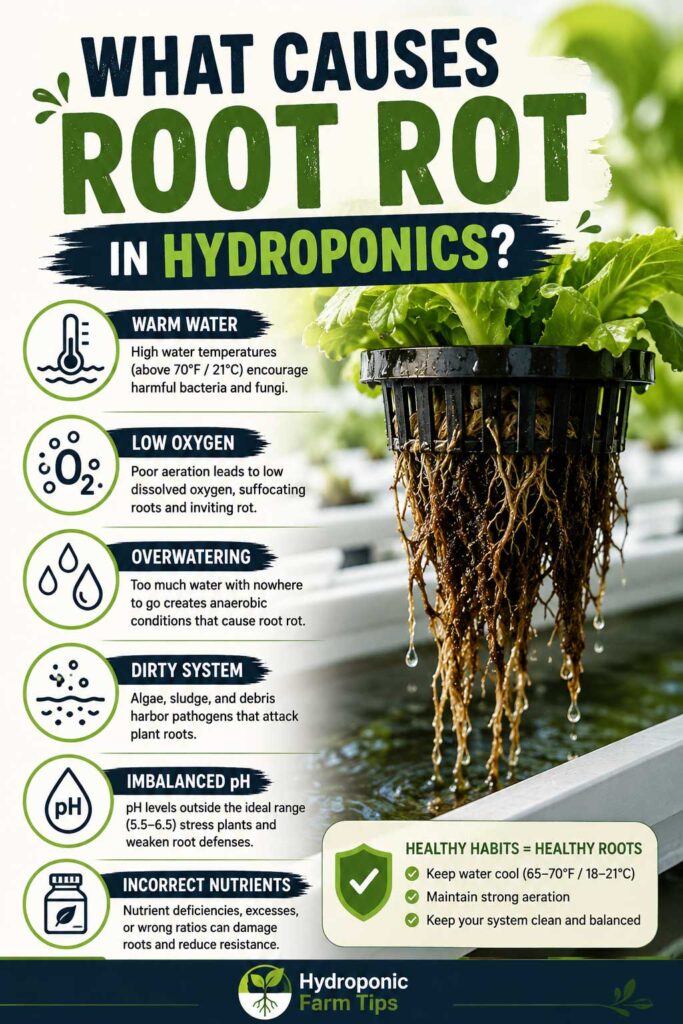
Hydroponic root rot rarely comes down to one mistake. More often, conditions in the root zone gradually become less favorable for the plant and more favorable for opportunistic pathogens. Warm water, inadequate oxygen, accumulated organic matter, and poor circulation can all play a role.
Understanding those conditions is important because treating damaged roots without correcting the underlying problem often leads to root rot returning.
1. Warm Nutrient Solution
Water temperature has a direct effect on the root environment. As nutrient solution becomes warmer, its capacity to hold dissolved oxygen decreases. At the same time, warmer conditions can favor the development of some root-zone pathogens.
For many commonly grown hydroponic crops, keeping the nutrient solution around 65–70°F (18–21°C) provides a useful target.
| Nutrient Solution Temperature | General Guidance |
|---|---|
| 65–70°F (18–21°C) | Good target for many hydroponic crops |
| 70–72°F (21–22°C) | Usually manageable with good aeration |
| Above 72°F (22°C) | Pay closer attention to oxygen and root health |
| 75°F+ (24°C+) | Root-zone problems may become more likely, depending on the crop and system |
These aren’t hard boundaries. A well-aerated system at 72°F isn’t automatically unhealthy, just as cooler water won’t compensate for poor sanitation or inadequate circulation.
Reservoir temperatures are most likely to climb during summer, in warm indoor grow rooms, inside greenhouses, or when pumps and grow lights add heat to the surrounding environment.
Indoor growers should also consider heat output when choosing LED grow lights for hydroponics, particularly when the reservoir sits inside the same enclosed growing area.
2. Low Dissolved Oxygen
Roots require oxygen for normal respiration. When dissolved oxygen becomes limited, root function suffers and plants become less resilient to other stresses.
The exact cause depends on the hydroponic system. In DWC or RDWC, an undersized air pump or clogged air stone may be responsible. In other systems, poor water movement, pump failure, or a dense root mass can create areas where oxygen availability is lower.
Warm water compounds the problem because it naturally holds less dissolved oxygen than cooler water. Water temperature and aeration therefore need to be considered together, rather than treated as separate issues.
3. Poor Reservoir Hygiene
Dead roots, fallen leaves, algae, and other organic material can gradually build up in a hydroponic system. As this material decomposes, it can contribute to biofilm and make conditions around the roots less stable.
The reservoir doesn’t need to remain sterile at all times. What matters is keeping excessive organic buildup under control.
Pay particular attention to areas that are easy to overlook, including tubing, pump housings, filters, corners of the reservoir, and surfaces underneath lids and net pots.
4. Root-Zone Pathogens
Pythium is frequently associated with root disease in hydroponically grown crops. These organisms can enter a growing system through contaminated plant material, water, equipment, growing media, or movement between systems.
Their presence doesn’t necessarily mean every plant will develop root rot. Environmental conditions matter greatly. Healthy plants growing in a well-managed root zone are better positioned to tolerate microbial pressure than roots already stressed by heat, poor oxygenation, or physical damage.
Shared recirculating water also provides a route for pathogens to move between plants, which is why an outbreak in NFT or RDWC deserves attention beyond the first plant showing symptoms.
5. Light Entering the Reservoir
Hydroponic roots don’t need light. When light reaches nutrient-rich water, however, algae can begin growing on reservoir walls, tubing, growing media, and other wet surfaces.
Heavy algae growth can interfere with system cleanliness and contribute organic material as it dies and decomposes. In some situations, biological activity associated with algae can also affect oxygen conditions in the water.
An opaque reservoir, covered openings, and light-proof tubing make algae much easier to control.
6. Poor Water and Nutrient Management
Water quality can influence root health even when it isn’t the direct cause of root rot. Very hard source water, excessive nutrient concentration, unstable pH, or an inappropriate EC can stress roots and make it harder for plants to perform normally.
If maintaining the right acidity is giving you trouble, our guide to the best pH for hydroponics explains the ideal range and how pH affects nutrient availability.
Test your source water if you’re repeatedly struggling to keep pH or EC under control. Reverse osmosis water can be useful where tap water contains unusually high levels of dissolved minerals, but RO water isn’t necessary for every hydroponic garden.
What matters more is keeping the source water, nutrient concentration, pH, and EC within appropriate ranges for the crop you’re growing.
7. Dense or Damaged Root Systems
A large root system is normally a sign of a healthy plant, but roots can eventually become so dense that water movement through parts of the root mass is reduced.
Dead or damaged tissue trapped inside that mass can make matters worse. Instead of routinely pruning healthy roots, remove clearly dead material when necessary and make sure the reservoir and circulation system are appropriately sized for mature plants.
Physical root damage during transplanting, cleaning, or maintenance can also leave plants temporarily more vulnerable to infection.
8. Inconsistent System Maintenance
Root problems often become noticeable only after several smaller issues have accumulated. A partially blocked air stone may not cause an immediate problem. Neither will a small amount of dead plant material or a slightly warmer reservoir. Combine those conditions for several days, however, and the root environment can deteriorate considerably.
Regularly check the reservoir temperature, pH, EC, water level, pumps, aeration, and visible roots. Also pay attention to changes from one inspection to the next. A root system becoming progressively darker or developing a new odor tells you more than a single measurement taken in isolation.
Pro Tip: Think of root rot as a root-zone management problem, not simply a disease that needs a treatment. Cool water, sufficient oxygen, good circulation, appropriate nutrients, and routine cleaning work together. Correcting those conditions is what makes long-term prevention possible.
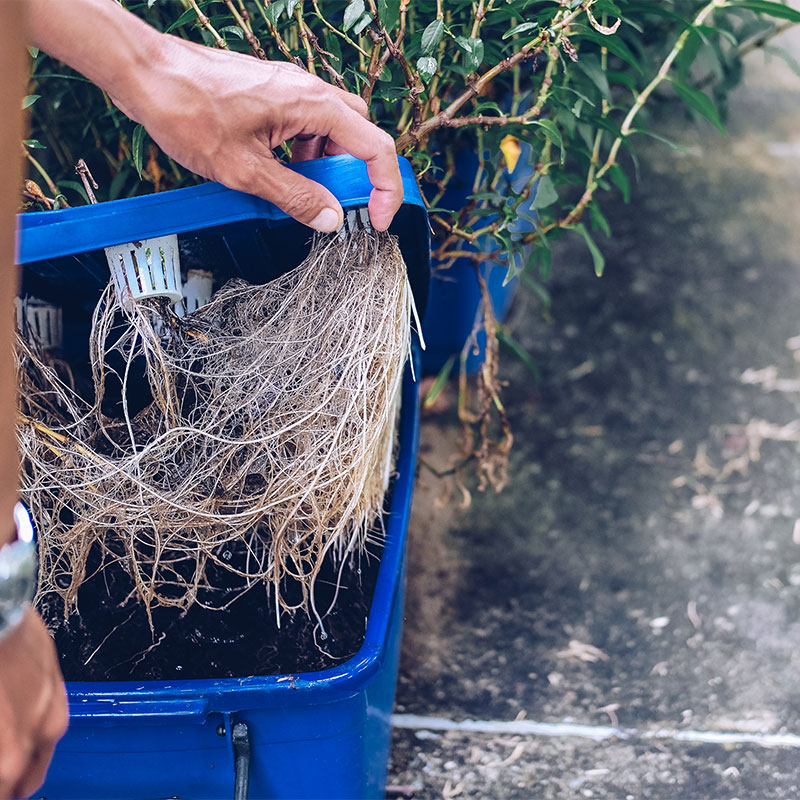
How to Prevent Root Rot in Hydroponics
Preventing root rot in hydroponics comes down to maintaining a root zone where plants can function well and disease is less likely to gain a foothold. There isn’t one additive or treatment that replaces good system management. Temperature, oxygen, cleanliness, water movement, and plant health all work together.
1. Keep the Nutrient Solution at a Suitable Temperature
For many hydroponic crops, a nutrient solution around 65–70°F (18–21°C) is a useful target. Cooler water can hold more dissolved oxygen than warmer water, which benefits root respiration and helps reduce one of the stresses associated with root disease.
Keep the reservoir out of direct sunlight and away from equipment that produces significant heat. Insulating exposed reservoirs or tubing can also help where room temperatures fluctuate.
Frozen water bottles can provide temporary cooling during an unusually hot day, but keep the outside of the bottles clean before placing them in or near the reservoir. If high water temperatures are an ongoing problem, improving room ventilation, relocating the reservoir, or using a properly sized water chiller provides a more consistent solution.
2. Provide Adequate Oxygen and Water Movement
How you oxygenate the root zone depends on the type of hydroponic system.
DWC and RDWC systems typically rely heavily on air pumps and air stones, while NFT and other circulating systems gain oxygen through water movement and exposure to air. Whatever the design, roots shouldn’t spend long periods in stagnant, oxygen-poor solution.
Check air stones for declining output, make sure pumps are operating correctly, and look for areas where dense roots are interfering with circulation. Mature plants may require more aeration and water movement than seedlings did when the system was first set up.
3. Manage the Nutrient Solution Instead of Following a Fixed Calendar
You’ll often see advice telling growers to replace hydroponic nutrient solution every one or two weeks. That can be a reasonable starting point for some small systems, but it isn’t a universal rule.
Reservoir size, plant number, crop maturity, nutrient formulation, water quality, and system design all affect how quickly a solution changes.
Monitor pH, EC, water level, temperature, and the condition of the solution. Top up water as plants consume it and replace or refresh the nutrient solution according to the needs of your particular system rather than waiting for visible problems to appear.
If the reservoir develops an unusual odor, excessive debris, persistent instability, or contamination, don’t wait for the normal maintenance interval.
4. Keep pH and EC Appropriate for the Crop
Root health isn’t determined by pH or EC alone, but large or prolonged deviations can stress plants.
The ideal pH varies by crop, with many commonly grown hydroponic plants falling somewhere within roughly pH 5.5–6.5. EC requirements vary even more, so use recommendations appropriate for the crop you’re growing rather than applying one target to every plant.
For a quick reference while checking your reservoir, see our hydroponic nutrient and pH chart for common crops and growing conditions.
Watch the trend as well as the number. A reservoir that suddenly begins drifting in pH or EC can indicate changing plant uptake, water-quality issues, nutrient imbalance, or another developing problem in the system.
5. Keep Light Out of the Root Zone
Light and nutrient-rich water encourage algae growth, so reservoirs should be as light-proof as practical.
Opaque reservoirs and lids make this relatively easy. Cover unused planting holes and prevent light from entering through gaps around net pots or plumbing. Clear tubing that carries nutrient solution may also need to be covered or replaced with opaque tubing.
Keeping the root zone dark won’t prevent every root problem, but it removes one common source of algae and unnecessary organic buildup.
6. Keep the System Clean
Hydroponic sanitation doesn’t mean obsessively sterilizing every surface during an active grow. It means preventing dead plant material, heavy biofilm, algae, and other debris from accumulating unchecked.
Remove fallen leaves and dead roots when you find them. Between crops, clean reservoirs, trays, net pots, pumps, tubing, and other reusable components before introducing new plants.
Pruning scissors and other tools that contact roots should also be cleaned, particularly when moving between healthy and potentially diseased plants.
7. Introduce Healthy Plants
A clean hydroponic system can still develop problems when contaminated plant material or growing media is introduced.
Look at the roots before transplanting seedlings into a shared system. Some discoloration may simply be staining, but seedlings with soft, slimy, deteriorating, or foul-smelling roots shouldn’t be added alongside healthy plants.
Reusable net pots and other equipment should be cleaned between crops, and questionable plants are better kept separate until you’re confident they’re healthy.
8. Decide How You’ll Manage Root-Zone Microbiology
Some growers use beneficial microbial products as part of a biologically active root-zone strategy. Depending on the organisms and product, these inoculants may be intended to colonize the root environment and compete with undesirable microorganisms.
They aren’t a substitute for adequate oxygen, appropriate temperatures, or sanitation, and results depend on the product and growing conditions.
If you choose this approach, follow the manufacturer’s instructions carefully. Avoid casually adding hydrogen peroxide or another oxidizing sanitizer at the same time, because these treatments can also damage the microorganisms you’re intentionally introducing.
9. Learn What Healthy Roots Look Like in Your System
Weekly root inspections are useful, but don’t focus on color alone.
Learn the normal appearance of roots grown with your nutrient formulation and additives. Some products naturally stain roots tan or brown. Firm texture, healthy new root tips, normal plant growth, and the absence of slime or a foul odor are more informative than whiteness by itself.
Also watch for change. Roots that looked normal several days ago but are now becoming soft, slimy, or increasingly discolored deserve investigation even if the foliage still looks healthy.
Root Rot Prevention Checklist
A quick inspection of the system can catch many problems before they become difficult to manage:
- Check nutrient solution temperature
- Confirm pumps, air stones, and circulation are working properly
- Monitor pH and EC for unusual changes
- Keep the reservoir and root zone protected from light
- Remove dead roots, fallen leaves, and accumulated debris
- Look for slime, soft tissue, or unusual odors
- Inspect tubing, pumps, and other equipment for buildup or blockages
- Check mature root systems for restricted water movement
- Investigate unexpected wilting or stalled growth promptly
Pro Tip: Don’t aim for perfectly white roots or a perfectly sterile-looking reservoir. Learn what’s normal for your system and watch for changes in root texture, smell, plant growth, water temperature, and circulation. A change from the plant’s normal condition is often more useful than any single measurement.
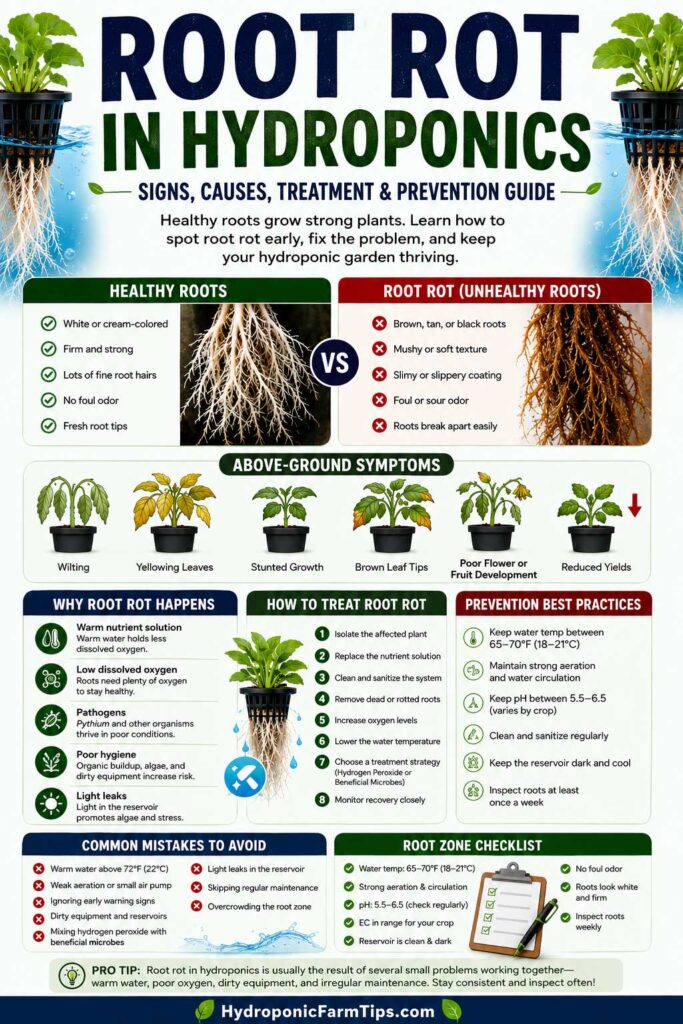
How to Treat Root Rot in Hydroponics
If you suspect hydroponic root rot, act quickly—but don’t start cutting roots or adding treatments based on discoloration alone. First confirm that you’re seeing several signs consistent with root damage, such as soft or slimy tissue, an unpleasant odor, deteriorating roots, and unexplained plant decline.
Once root rot appears likely, treatment should accomplish two things: reduce the immediate problem and correct the conditions that allowed it to develop.
Step 1: Separate the Affected Plant When Possible
In a system where plants share recirculating nutrient solution, an affected plant may expose the rest of the crop to the same root-zone pathogens.
If the system design allows it, separate a severely affected plant while you inspect the others. In NFT, RDWC, Ebb and Flow, and other shared-water systems, also assume that the reservoir and plumbing may have been exposed even when neighboring plants still look healthy.
Individual DWC containers are different. If each plant has its own isolated reservoir, removing one plant won’t necessarily require treating every other container as infected.
Step 2: Inspect the Entire Root Zone
Before deciding what to remove, look closely at the roots.
Don’t cut tissue simply because it’s tan or brown. Nutrient solutions and supplements can stain healthy roots. Tissue that is soft, slimy, deteriorating, or easily separating from the root system is much more concerning.
Also smell the root zone and inspect the crown or base of the plant. A strong sour or decaying odor, particularly when combined with deteriorating tissue, strengthens the case that you’re dealing with more than harmless nutrient staining.
Step 3: Remove Clearly Dead or Decaying Material
If sections of the root system are obviously dead and decomposing, they can be carefully removed with clean scissors.
Don’t aggressively cut away every discolored root. Removing too much functioning root tissue places additional stress on a plant that is already struggling.
Clean or disinfect your cutting tool before moving to another plant so you don’t carry contaminated material around the system.
Step 4: Refresh the Reservoir and Clean the System
For a significant root-rot outbreak, replacing the nutrient solution is often a sensible precaution because it removes suspended debris and gives you an opportunity to inspect and clean the reservoir.
Organic material and biofilm often collect in pump housings, tubing, filters, channels, reservoir corners, net pots, and surfaces beneath lids.
If you use a disinfectant, choose one appropriate for hydroponic equipment and follow its label directions for concentration, contact time, and rinsing. Don’t guess at hydrogen peroxide dilution rates, since commercial peroxide products are sold at very different concentrations.
Step 5: Correct Temperature, Aeration, and Circulation
If you clean the roots but return them to the same stressful environment, the problem may return.
Check the nutrient solution temperature and determine whether it has been running warmer than usual. For many hydroponic crops, approximately 65–70°F (18–21°C) is a useful target, although requirements vary by crop.
Next, verify that the root zone is receiving adequate oxygen and water movement. Check air stones, pumps, tubing, filters, and the root mass itself for anything restricting flow.
Don’t simply add more equipment without investigating. A clogged air stone or partially blocked pump can sometimes be the real problem.
Step 6: Check pH, EC, and the New Nutrient Solution
Once the system has been cleaned or refreshed, mix nutrients appropriate for the crop and verify pH and EC before returning the plant to normal operation.
A recovering plant already has a compromised root system, so this isn’t the time to compensate by making the nutrient solution unusually strong. Keep conditions stable and appropriate for the crop rather than trying to force faster recovery.
Step 7: Decide Whether a Root-Zone Treatment Is Appropriate
Growers generally encounter two different approaches here: oxidizing/sanitation treatments and biological products containing beneficial microorganisms.
Hydrogen Peroxide and Other Oxidizing Treatments
Hydrogen peroxide is sometimes used in hydroponic systems to increase oxygen temporarily and as part of a sanitation strategy. However, concentration matters enormously. A product intended for household use and a concentrated horticultural product cannot be treated as interchangeable.
Too much peroxide can damage living root tissue, and peroxide can also affect beneficial microorganisms in the system.
For that reason, use only a product suitable for the intended application and follow its label instructions rather than relying on a universal “milliliters per gallon” recipe found online.
Beneficial Microbes
Some hydroponic growers use microbial inoculants intended to establish beneficial organisms around the root zone. Depending on the formulation, these products may help support root health or compete with undesirable microorganisms.
They aren’t an instant cure for severely decayed roots, and they won’t compensate for hot, stagnant, poorly maintained nutrient solution.
If you’re intentionally maintaining a biologically active system, avoid simultaneously using oxidizing sanitizers unless the product instructions specifically indicate compatibility.
Step 8: Watch for New Healthy Growth
Don’t expect damaged roots to suddenly become white again. Recovery is better judged by what happens next.
Look for fresh root tips, firm new roots, improved leaf posture, resumed growth, and the disappearance of slime or unpleasant odors. Water temperature, pH, EC, aeration, and circulation should also remain stable rather than drifting back toward the conditions present before treatment.
Check recovering plants frequently at first. Once the root zone stabilizes and healthy new growth is established, you can return to your normal inspection schedule.
When Is a Plant Too Far Gone to Save?
Sometimes removing a severely affected plant is the better decision, particularly in a shared recirculating system.
A plant has a poor outlook when most of its functional root system has deteriorated, decay has reached the crown or stem, new roots aren’t developing, or the plant continues to decline after the root-zone conditions have been corrected.
The decision also depends on the crop. Replacing a young lettuce seedling may make more sense than spending days trying to rescue it, while an established fruiting plant may justify a greater recovery effort.
If the plant has recovered but you no longer want to keep it in the affected system, you may also consider transferring the plant from hydroponics to soil once it has enough healthy roots to handle the transition.
Pro Tip: Don’t judge treatment success by whether old brown roots become white again. Watch for new, firm root growth and improving plant performance. Recovery is about producing healthy new tissue while preventing further decay.
Common Mistakes That Lead to Root Rot
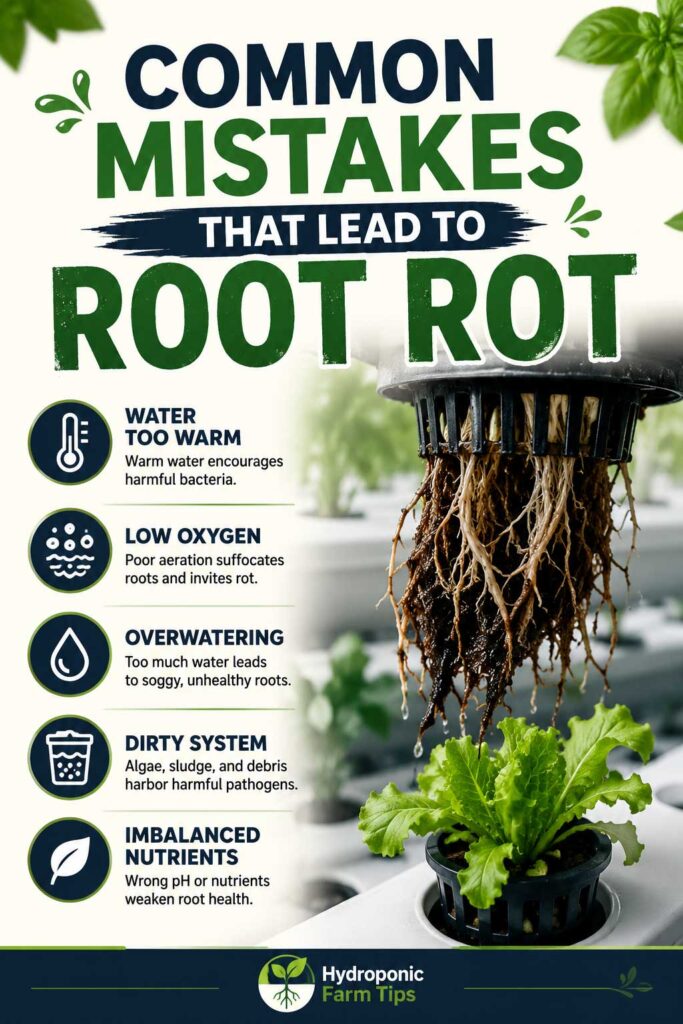
Root rot in hydroponics doesn’t always result from an obvious equipment failure. Sometimes the system appears to be running normally while several smaller problems gradually put the roots under stress.
1. Treating 72°F as a Magic Cutoff
72°F (22°C) is sometimes presented as the point where hydroponic root rot suddenly becomes a problem, but there isn’t a single temperature at which root rot begins.
As water warms, its ability to hold dissolved oxygen decreases, and certain pathogens may become more troublesome. But a reservoir reaching 72°F doesn’t automatically mean the roots will rot.
Look at temperature together with aeration, water movement, crop type, and root condition. A gradual temperature increase accompanied by declining aeration is far more concerning than briefly crossing a single number.
2. Assuming the Air Pump Is Still Performing Well
An air pump can be running without providing the same aeration it delivered when it was new. Air stones become clogged, tubing can kink, connections loosen, and mature root systems can change how water and bubbles move through a reservoir.
Don’t rely only on the sound of the pump. Check what’s actually happening inside the reservoir and whether aeration is reaching the root mass effectively.
The same principle applies to circulating systems: a pump that is technically running may still have reduced flow because of buildup, restricted tubing, or roots interfering with circulation.
3. Diagnosing Root Rot by Color Alone
This is one of the easiest mistakes to make.
Brown roots look alarming, but hydroponic nutrients and supplements can stain otherwise healthy root tissue. Immediately treating every discolored root as an infection can lead to unnecessary chemical treatments and additional plant stress.
Instead, consider texture, smell, new root growth, plant performance, and whether the discoloration is spreading. Firm, odor-free roots with healthy new growth tell a very different story from soft, slimy roots that are beginning to deteriorate.
4. Treating the Roots but Not the Cause
Adding hydrogen peroxide, a biological product, or another root treatment may appear to improve the situation temporarily. If the reservoir is still too warm, circulation remains poor, or decaying material is still present, however, the problem can return.
When root rot appears, ask what changed.
Did the grow room become hotter? Has the root mass grown considerably? Is an air stone producing fewer bubbles? Has organic debris accumulated somewhere you normally don’t inspect?
Correcting the environment is usually more important than repeatedly adding another treatment.
5. Combining Products That Work Against Each Other
Beneficial microbial products and oxidizing sanitizers such as hydrogen peroxide are generally intended for different root-zone management approaches.
Adding beneficial microorganisms and then routinely dosing the same reservoir with an oxidizer can undermine what you’re trying to accomplish.
Choose a strategy appropriate for your system and follow the directions for the specific products you’re using. More products don’t necessarily provide more protection.
6. Waiting for the Plant to Look Seriously Ill
By the time a plant is severely wilted and much of its root system is soft or deteriorating, recovery becomes more difficult.
This is why occasional root inspection matters. You’re looking for changes from normal, not just dramatic symptoms. A new odor, unusual slime, declining water movement, softening root tissue, or unexplained wilting can justify a closer look before the problem becomes severe.
The same applies between crops. Starting a new grow with old root fragments, heavy biofilm, dirty tubing, or contaminated equipment gives the next plants an unnecessary disadvantage.
Pro Tip: When root rot keeps returning, don’t immediately reach for a stronger treatment. Look for the recurring condition behind it—temperature, aeration, circulation, sanitation, plant density, or system design. Fixing that weakness is more useful than repeatedly treating the symptoms.
Look at this
Recommended
Frequently Asked Questions About Root Rot in Hydroponics
Can a hydroponic plant recover from root rot?
Yes. Recovery is possible, especially when enough healthy root tissue remains and the problem is caught early. Correct the underlying conditions, remove clearly dead or decaying tissue when appropriate, and watch for new, firm root growth rather than expecting damaged roots to return to their original appearance.
What color should healthy hydroponic roots be?
Healthy roots are often white or cream-colored, but color alone isn’t a reliable test. Nutrients and supplements can stain healthy roots tan or brown. Firm texture, healthy new root tips, normal plant growth, and the absence of slime or a foul odor are better indicators of root health.
What causes root rot in hydroponics?
Hydroponic root rot is commonly associated with a combination of root-zone stress and disease pressure. Warm nutrient solution, inadequate dissolved oxygen, poor circulation, decaying organic material, sanitation problems, and pathogens such as Pythium can all contribute.
It’s usually more useful to investigate the entire root environment than to search for a single cause.
What water temperature helps prevent hydroponic root rot?
For many hydroponic crops, 65–70°F (18–21°C) is a useful nutrient-solution target. As water becomes warmer, its capacity to hold dissolved oxygen decreases.
Risk doesn’t suddenly change at 72°F (22°C). Crop type, aeration, circulation, sanitation, and pathogen pressure all influence how plants respond to warmer nutrient solution.
Can hydrogen peroxide cure hydroponic root rot?
Hydrogen peroxide is an oxidizer that some growers use as part of a sanitation strategy, but it shouldn’t be viewed as a stand-alone cure for root rot.
If poor aeration, excessive heat, decaying material, or another underlying problem remains, root trouble can return. Hydrogen peroxide can also damage roots or beneficial microorganisms when used incorrectly, so follow the directions for the specific product and concentration you’re using.
Should I use beneficial microbes or hydrogen peroxide?
Beneficial microbes and hydrogen peroxide serve very different purposes in a hydroponic system. Beneficial microbial products are intended to introduce or support selected microorganisms, while hydrogen peroxide is an oxidizer that can affect microorganisms it contacts.
Because peroxide may also damage organisms you’re deliberately introducing, avoid combining the two casually. Follow the directions and compatibility guidance provided with the specific products you use.
Can root rot in hydroponics spread from one plant to another?
It can. In systems where plants share circulating nutrient solution—such as NFT, RDWC, and many Ebb and Flow setups—water can provide a route for root pathogens to move through the system.
Individual DWC buckets aren’t necessarily connected, so the risk of plant-to-plant spread depends on the system design as well as shared tools, water, and handling.
How often should I inspect hydroponic roots?
A weekly inspection is a practical starting point for many home systems. Check more frequently when temperatures rise, plants begin behaving unusually, or you’re monitoring a plant recovering from root problems.
You’re looking primarily for changes from normal: new slime, soft tissue, unusual odors, deteriorating roots, or unexpected wilting.
Can algae contribute to root rot in hydroponics?
Not directly. Algae is better viewed as a sign that light is reaching nutrient-rich water and as another source of biological activity and organic material within the system.
Heavy algae growth can complicate root-zone management, so blocking light from reservoirs, tubing, and other wet surfaces is still an important preventive measure.
Can you eat vegetables from a plant with root rot?
Root rot affects the plant’s root system, but whether harvested produce is suitable to eat depends on the condition of the edible portion and the cause and extent of the plant’s decline.
Don’t eat produce that is visibly spoiled, moldy, rotten, unusually discolored, or otherwise questionable. Also discard produce if it may have contacted contaminated water or a treatment product not intended for food-contact use. When the cause of severe plant decay is uncertain, taking the cautious approach is sensible.
Keep Your Hydroponic Roots Healthy and Rot-Free
Knowing how to prevent and treat root rot in hydroponics starts with recognizing when conditions around the roots have changed. Water temperature, oxygen, circulation, sanitation, and the condition of the roots themselves often tell you more than any single treatment or additive.
If you notice brown roots, don’t assume immediately that the plant has root rot. Check their texture, smell, new root growth, and the condition of the plant. When roots become soft or slimy, develop an unusual odor, and the plant begins to decline, it’s time to investigate the entire system.
When root rot is confirmed, deal with the damaged tissue—but also find out why it happened. Correcting poor aeration, excessive heat, restricted circulation, accumulated debris, or another underlying problem is what helps keep the rot from returning.
Get familiar with what healthy roots look, feel, and smell like in your own hydroponic setup. Once you know what’s normal, changes are much easier to spot while there’s still time to do something about them.