
Choosing one of the best air pumps for hydroponics can make a real difference in root health, especially if you’re growing with Deep Water Culture (DWC) or another system where roots spend long periods submerged in nutrient solution.
Plant roots need oxygen just as much as they need water and nutrients. In DWC, an air pump pushes air through tubing to an air stone, creating bubbles that circulate the reservoir and help keep oxygen available around the root zone. When aeration is too weak, roots can become stressed, nutrient uptake may slow, and the risk of hydroponic root rot and other root problems can increase.
The tricky part is choosing the right pump. A single 5-gallon bucket does not need the same airflow as a four- or eight-bucket DWC setup, and buying the biggest pump you can find is not always the best answer. Airflow, number of outlets, noise, power consumption, water depth, and reservoir size all matter.
In this guide, we’ll compare 7 of the best air pumps for hydroponics, from compact models for small indoor gardens to powerful multi-outlet pumps for larger DWC systems. We’ll also explain how much airflow you may need, how to size an air pump for your reservoir, and what features are worth paying attention to before you buy.
Whether you’re building your first DWC bucket or upgrading an underpowered pump, the goal is simple: give your roots steady, reliable aeration without adding unnecessary noise, heat, or complexity.
Quick Look: The 7 Best Air Pumps for Hydroponics
Affiliate Disclosure: This page may contain affiliate links. If you purchase through one of these links, we may earn a commission at no additional cost to you.
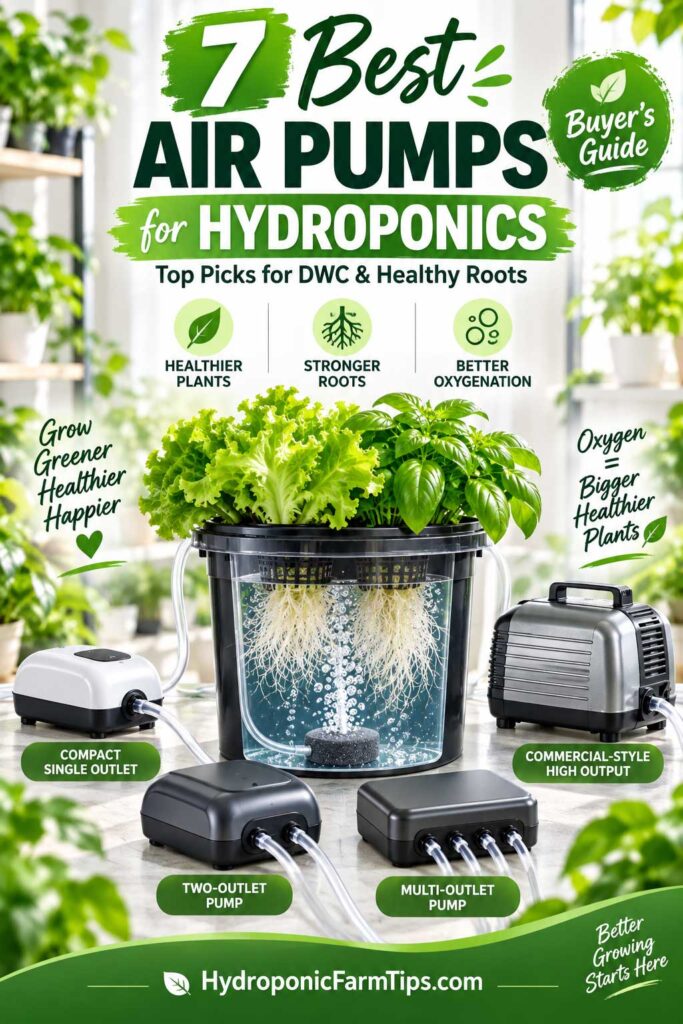
Not every hydroponic setup needs the same amount of aeration. A single DWC bucket may only need a compact pump, while a larger multi-bucket system benefits from higher airflow and multiple outlets.
Best Air Pumps for Hydroponics
Short on time? These are our top air-pump picks for different hydroponic setups, from a single DWC bucket to larger multi-site systems. Use the table below to quickly match your setup with the pump that makes the most sense.
| Hook | Product | Best For | Why We Like It | Buy |
|---|---|---|---|---|
| 🏆 Best Overall | Active Aqua AAPA15L | Most home DWC growers | 15 L/min, 4 outlets, low 6W power draw, and plenty of flexibility | Check Price → |
| 🌱 Best for One Bucket | Active Aqua AAPA3.2L | Single DWC bucket | Compact 3.2 L/min output, simple setup, and very low power use | Check Price → |
| 🌿 Best for Two Buckets | Active Aqua AAPA7.8L | Small 2-site DWC systems | Two dedicated outlets and enough airflow without unnecessary capacity | Check Price → |
| 🔇 Best Quiet Pick | Tetra Whisper 100 | Small indoor gardens | Designed to reduce vibration and noise in living spaces | Check Price → |
| 🪴 Best for Multiple Buckets | Active Aqua AAPA25L | Larger home DWC systems | 25 L/min and 8 outlets make multi-bucket aeration easier | Check Price → |
| ⚡ Best High-Airflow Value | VIVOSUN 25W Commercial Air Pump | Larger DWC setups | Strong airflow with 6 adjustable outlets | Check Price → |
| 💪 Best Heavy-Duty Pick | EcoPlus Commercial Air 1 | Grow rooms and larger reservoirs | High-output design that can feed multiple air stones through a manifold | Check Price → |
The four Active Aqua pumps cover a useful range of home hydroponic systems. Hydrofarm’s Active Aqua specifications rate the lineup from 3.2 L/min with one outlet up to 25 L/min with eight outlets, while power consumption ranges from only 2 to 12 watts.
For growers who need considerably more airflow, the VIVOSUN 25W Commercial Air Pump provides six adjustable outlets and is designed for hydroponic and aquarium aeration. VIVOSUN lists pressure above 0.03 MPa and noise below 60 dB, although its published airflow figures are inconsistent.
The EcoPlus Commercial Air 1 uses one main high-output connection and includes a six-outlet manifold. Its rated airflow is 793 GPH, or roughly 50 L/min, making it better suited to growers who want to distribute a stronger air supply across several air stones or reservoirs.
Our Top Pick
For most home hydroponic growers, the Active Aqua AAPA15L offers the best balance of airflow, efficiency, and flexibility.
Its four outlets let you aerate several air stones without immediately stepping up to a larger commercial-style pump. At 15 L/min and only 6 watts, it provides plenty of flexibility for a small or medium DWC garden while keeping power consumption low.
That said, bigger is not automatically better. The right air pump depends on your reservoir volume, water depth, number of buckets, air-stone resistance, tubing length, and how much airflow actually reaches each root zone.
Later in this guide, we’ll show you how reservoir size, water depth, air-stone resistance, and the number of grow sites affect the pump size you actually need.
Why Hydroponic Plants Need Oxygen
Hydroponic plants need oxygen around their roots just as soil-grown plants do. In soil, small air pockets naturally help oxygen reach the root zone. In hydroponics, especially in systems where roots stay submerged in nutrient solution, growers have to make sure enough oxygen remains available in the water.
Roots use oxygen for respiration, which helps them release energy for growth and hydroponic nutrient uptake. When the root zone becomes poorly oxygenated, plants may grow more slowly, wilt even when plenty of water is available, or develop weak, unhealthy roots.
This is especially important in Deep Water Culture (DWC) systems because the roots remain underwater for long periods. An air pump connected to an air stone keeps the nutrient solution moving and improves gas exchange by sending a steady stream of bubbles through the reservoir.
Water temperature matters too. Cooler water can generally hold more dissolved oxygen than warmer water, so a reservoir that gets too warm can put additional stress on the roots.
Good aeration helps support healthy white roots, steady nutrient uptake, better circulation, and fewer stagnant areas in the reservoir.
It is also worth noting that the benefit does not come simply from bubbles touching the roots. Much of the oxygenation happens because the bubbles move the water and increase gas exchange at the reservoir surface.
For DWC growers in particular, steady aeration is one of the simplest ways to create a healthier, more stable environment around submerged roots.
Do You Need an Air Pump for Hydroponics?
Whether you need an air pump depends on the type of hydroponic system you are using.
In Deep Water Culture (DWC), an air pump is usually essential because the roots remain submerged in nutrient solution. Without enough aeration, dissolved oxygen can drop and the root zone can become stressed.
Other hydroponic systems may rely more on flowing water, drainage cycles, or exposed roots for oxygen.
| Hydroponic System | Air Pump Needed? | Why |
|---|---|---|
| DWC | Usually yes | Roots stay submerged and need continuous aeration |
| Kratky | Usually no | An air gap develops as the nutrient level drops |
| NFT | Sometimes | Flowing nutrient solution and exposed roots provide oxygen |
| Ebb and Flow | Usually optional | Roots receive fresh air when the grow bed drains |
| Drip Systems | Depends | Reservoir aeration can improve circulation |
| Dutch Bucket | Often beneficial | Can help aerate the shared nutrient reservoir |
| Aeroponics | Usually no separate air pump | Roots are suspended in air and periodically misted |
Why DWC Systems Need the Most Aeration
DWC is the system where choosing the right air pump matters most.
The roots hang directly in the reservoir, so most of the root mass stays underwater. An air pump pushes air through tubing to an air stone, creating bubbles that circulate the nutrient solution and improve gas exchange.
For most DWC gardens, the air pump should run 24 hours a day, not just when the grow lights are on. Roots continue respiring at night, so they still need oxygen after the lights switch off.
What About Kratky Hydroponics?
Kratky systems are different because they are designed to work without an air pump.
As the plant uses nutrient solution, the water level gradually drops and creates a humid air gap inside the container. Part of the root system remains exposed to this oxygen-rich zone while the lower roots stay in the nutrient solution.
Adding an air pump can still work, but at that point the setup begins to function more like DWC than traditional passive Kratky hydroponics.
Can Reservoir Aeration Help Other Hydroponic Systems?
Yes.
Even when an air pump is not strictly necessary, aerating the main reservoir can improve circulation and reduce stagnant areas.
This can be useful in larger drip, Dutch bucket, NFT, and other recirculating systems where nutrient solution spends time in a central reservoir before returning to the plants.
However, aeration is only one part of root-zone health. Water temperature, nutrient strength, pH, cleanliness, and overall circulation all matter too.
If you are growing with DWC, though, reliable aeration should be treated as core equipment rather than an optional extra.
1. Active Aqua AAPA15L – Best Overall
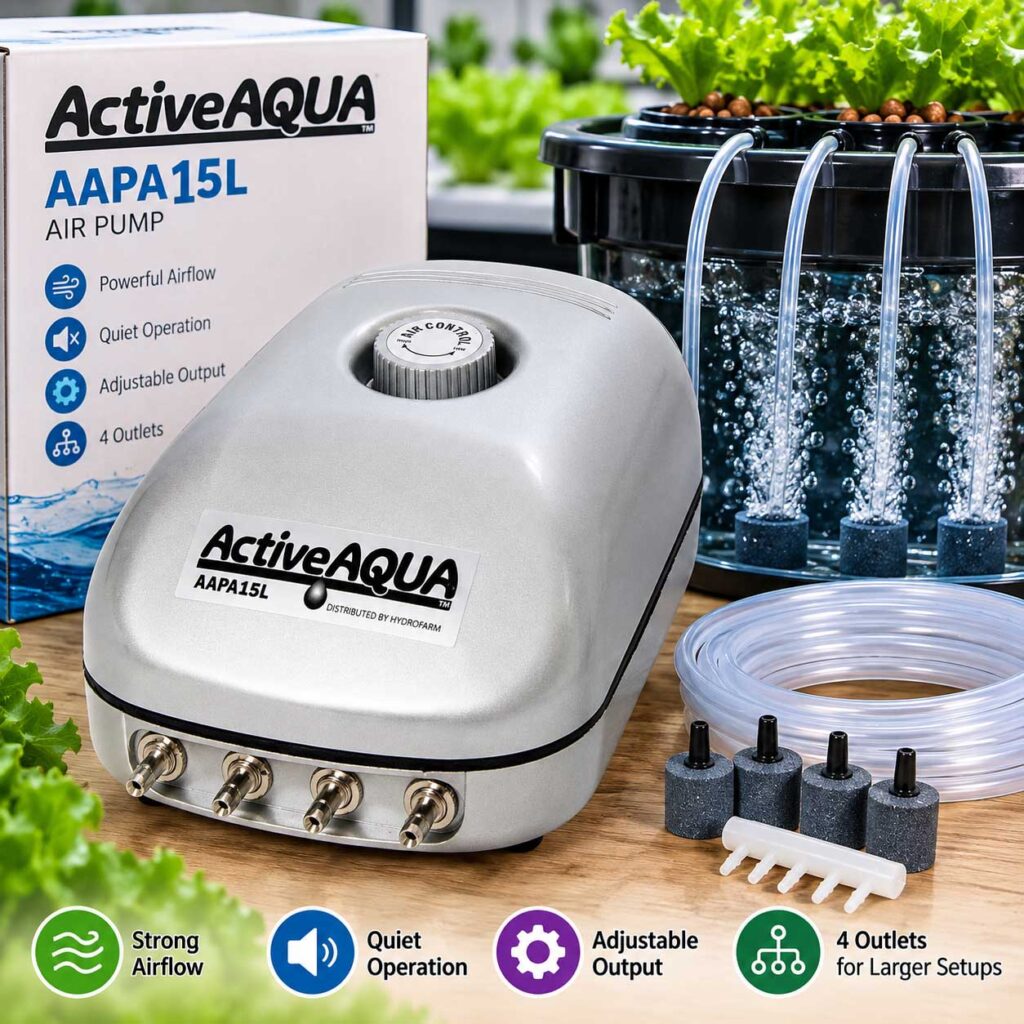
For most home hydroponic growers, the Active Aqua AAPA15L is our best overall pick because it balances strong airflow, multiple outlets, low power use, and enough flexibility for a small to medium DWC setup.
Hydrofarm rates this model at 15 L/min, with four air outlets and a power draw of just 6 watts. That gives it much more capacity than a basic aquarium pump without stepping all the way up to a larger commercial unit.
Key Specs
- Airflow: 15 L/min
- Outlets: 4
- Power: 6W
- Best for: Small to medium DWC systems, multiple air stones, and expanding home gardens
Why We Like It
What makes this model especially useful is its flexibility.
With four outlets, you can run separate airlines to several air stones instead of repeatedly splitting one weak line. That setup works especially well if you’re starting with one or two DWC buckets but expect to add more later.
The 15 L/min output also gives you some breathing room for longer tubing, deeper reservoirs, or larger air stones where resistance can reduce real-world airflow.
Another benefit is efficiency. At only 6 watts, it uses relatively little electricity for a pump that may run continuously. Since DWC aeration is usually left on day and night, that low power draw is worth considering.
Potential Drawbacks
This pump may be more than you need for a very small single-bucket setup. If you’re growing one lettuce plant or a few herbs in a compact DWC container, the smaller Active Aqua model later in this guide may make more sense.
On the other hand, growers running several larger buckets may eventually outgrow four outlets and need an eight-outlet or commercial-style pump.
Actual airflow will also depend on factors such as water depth, tubing length, air-stone resistance, and how evenly the air is distributed.
Best Fit
The AAPA15L is especially well suited to a small to medium DWC garden, particularly if you want several dedicated air lines and some room to expand.
It gives you considerably more flexibility than a basic aquarium pump without the added noise and power draw of a larger commercial unit. For most home growers who are unsure which size to choose, this is the most versatile place to start.
2. Active Aqua AAPA3.2L – Best for a Single DWC Bucket
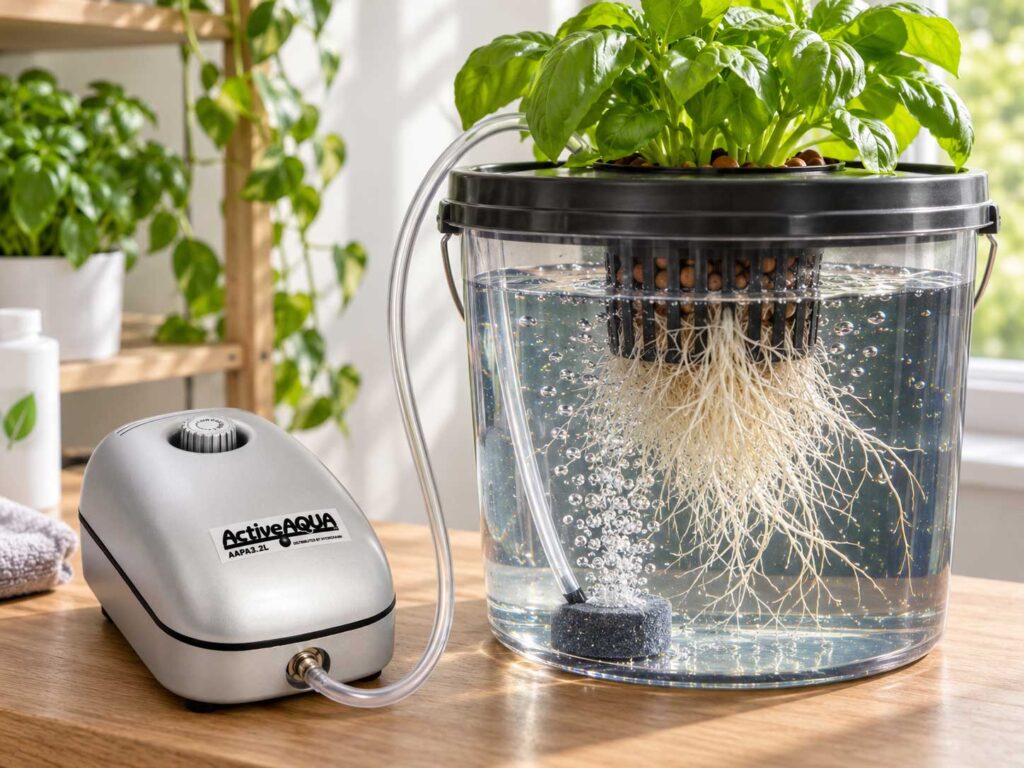
If you’re running one small DWC bucket or a compact countertop hydroponic setup, the Active Aqua AAPA3.2L is a better fit than buying a larger multi-outlet pump you may never fully use.
Hydrofarm rates this model at 3.2 L/min, with a single outlet and a power draw of just 2 watts. It is the smallest Active Aqua model in this guide, making it especially practical for simple one-reservoir systems.
Key Specs
- Airflow: 3.2 L/min
- Outlets: 1
- Power: 2W
- Best for: One DWC bucket, small reservoirs, herbs, lettuce, and beginner setups
Why We Like It
Its appeal is really its simplicity.
With one outlet, you can connect the pump directly to a single air stone and keep the setup easy to manage. For one bucket, there is usually no reason to pay for six or eight outlets you are not going to use.
The 2-watt power draw is another plus for a pump that may run continuously. It also makes this a practical entry-level option for growers who are trying DWC for the first time.
Potential Drawbacks
The main limitation is the single outlet.
If you add another bucket, you would need to split the airline, add a second pump, or upgrade to a larger model. Splitting a small pump between several air stones can also reduce the airflow reaching each one.
For that reason, this is not the best choice if you already know you want to build a multi-bucket system.
Best Fit
The AAPA3.2L makes the most sense for a single DWC bucket or small reservoir.
It is simple, inexpensive to run, and avoids paying for outlets you do not need. If you are confident your system will stay small, it is a very practical choice. If a second bucket is already in your plans, moving up to the AAPA7.8L is easier than splitting this small pump later.
3. Active Aqua AAPA7.8L – Best for Two DWC Buckets
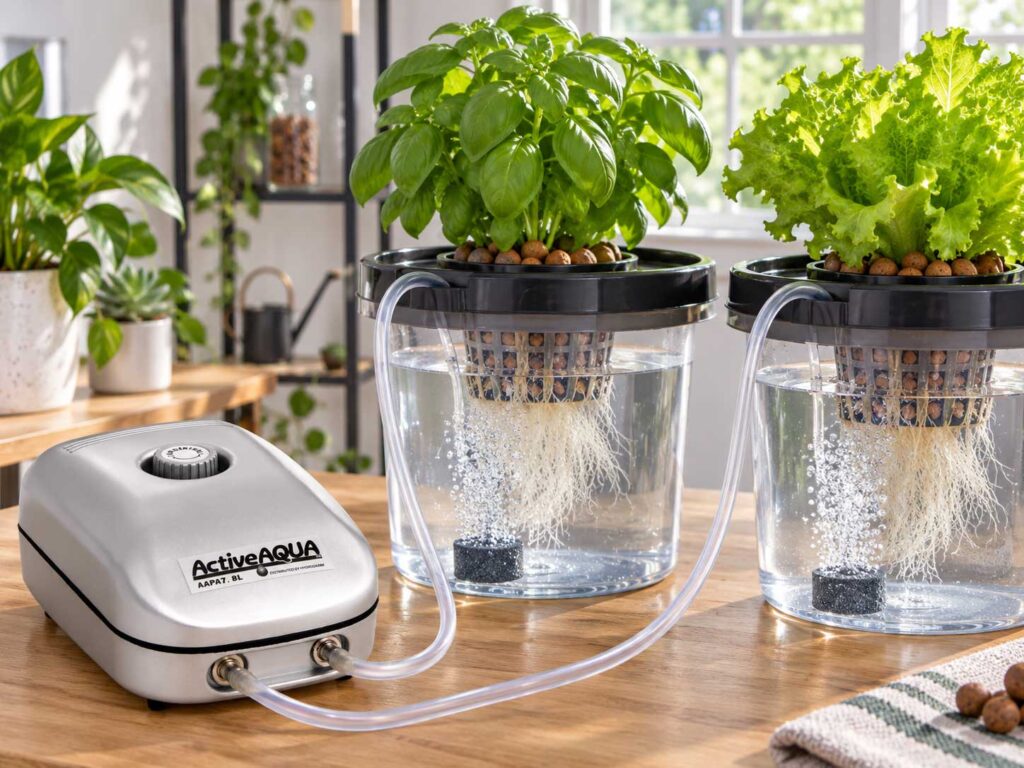
The Active Aqua AAPA7.8L is a practical middle-ground option for growers who need more capacity than a single-outlet pump but do not need a larger four- or eight-outlet model.
Hydrofarm rates it at 7.8 L/min, with two outlets and a power draw of just 3 watts. That makes it a good fit for two DWC buckets, two air stones in one reservoir, or a compact system where you want a little extra aeration without stepping up to a larger pump.
Key Specs
- Airflow: 7.8 L/min
- Outlets: 2
- Power: 3W
- Best for: Two DWC buckets, small multi-container systems, and compact indoor gardens
Why We Like It
The two-outlet design is what makes this model practical.
You can run a separate airline to each bucket instead of splitting one line and hoping the airflow stays balanced. That makes the setup cleaner and gives you better control over how air is distributed.
The 7.8 L/min output also gives you more headroom than a small single-bucket pump, which can be useful with larger air stones, deeper reservoirs, or slightly longer tubing runs.
At only 3 watts, it remains very efficient for a pump that may run continuously.
Potential Drawbacks
The main limitation is future expansion.
Two outlets are ideal for a small two-site system, but if you already plan to grow into four, six, or eight buckets, you may outgrow this pump fairly quickly.
Splitters and manifolds can extend its usefulness, but each additional branch divides the available airflow and adds resistance. If expansion is already part of your plan, starting with a larger pump may be simpler.
Best Fit
This pump fits a two-bucket DWC setup particularly well because each bucket can have its own dedicated airline.
It gives you more airflow than a basic single-outlet model while remaining compact and efficient. If you expect to stay with one or two grow sites, it is a sensible middle ground; if four buckets are likely, the AAPA15L gives you more room to grow.
4. Tetra Whisper 100 – Best Quiet Air Pump
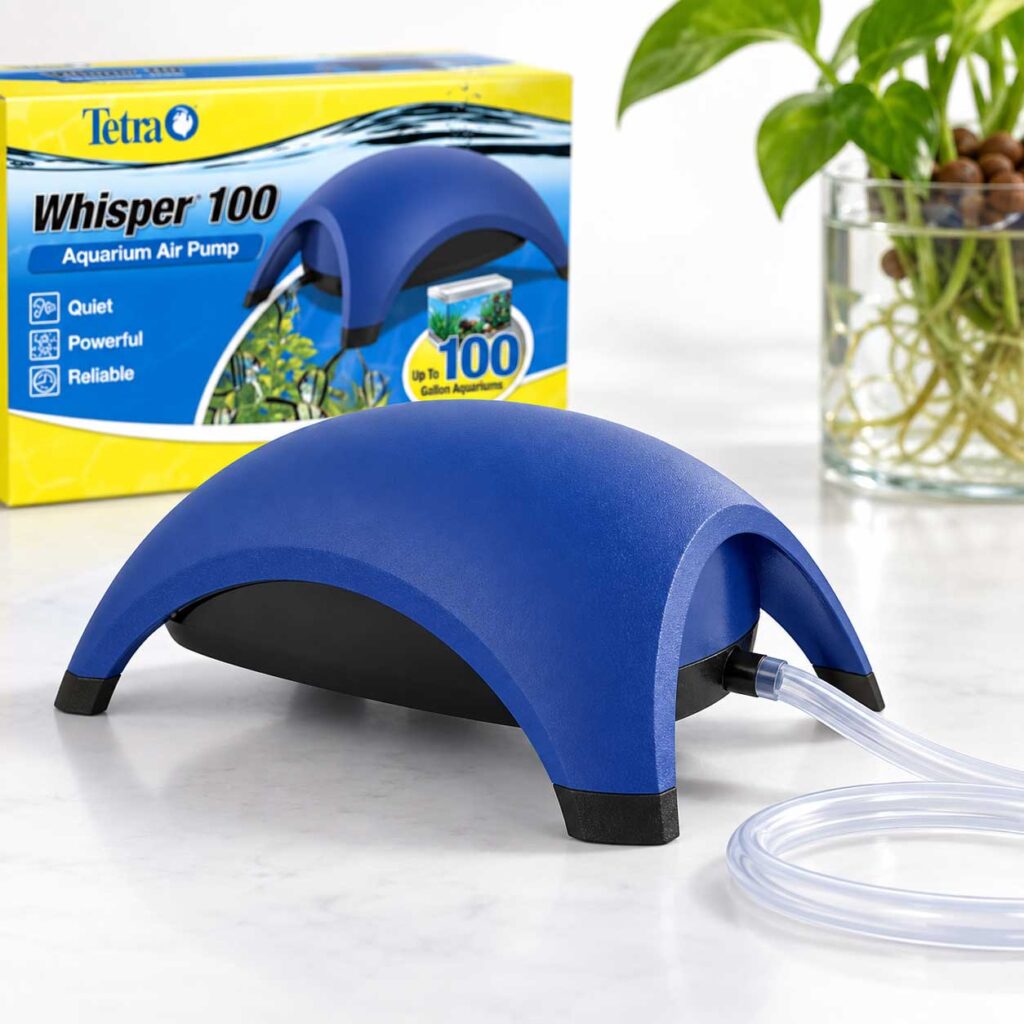
If noise is one of your biggest concerns, the Tetra Whisper 100 is a good fit for a small indoor hydroponic setup where you do not need commercial-level airflow.
Tetra rates the Whisper 100 at 3.3 L/min with the two outlets combined using the included T-connector. The Whisper line is designed to reduce vibration and reflected sound with a dome-shaped housing, sound-dampening chambers, rubber feet, and a suspended motor.
Key Specs
- Airflow: 3.3 L/min with outlets T-ed
- Outlets: 2
- Best for: Small indoor hydroponic systems where noise matters
- Design: Rubber feet and sound-dampening housing
- Maximum supported depth: Up to 8 feet, according to Tetra
Why We Like It
Commercial hydroponic air pumps can provide excellent airflow, but they can also produce a noticeable mechanical hum. That may not matter in a basement or greenhouse, but it can become distracting in a kitchen, office, bedroom, or living area.
The Whisper 100 is designed with quieter operation in mind.
Its housing helps reduce vibration and reflected sound, while the rubber feet limit how much vibration transfers into a shelf or countertop.
The two outlets also give you some flexibility. You can use them separately or combine them with the supplied T-connector depending on how you want to route your airline.
Potential Drawbacks
The trade-off is airflow.
At 3.3 L/min, the Whisper 100 produces much less air than the Active Aqua AAPA15L or the larger commercial pumps in this guide.
That makes it better suited to a small reservoir or modest DWC setup than a large multi-bucket system.
Also remember that Tetra sells this as an aquarium air pump, not a hydroponic-specific model. Airline tubing, air stones, and check valves may need to be purchased separately.
If the pump sits below the reservoir waterline, use a properly installed check valve to reduce the risk of back-siphoning.
Best Fit
The Whisper 100 is most appealing when your hydroponic garden shares space with you.
For a small DWC setup in a bedroom, office, kitchen, or living area, its quieter design can matter more than having maximum airflow. It is not the pump I would choose for a large multi-bucket garden, but for modest indoor systems where noise is important, it fills a useful niche.
5. Active Aqua AAPA25L – Best for Multiple DWC Buckets
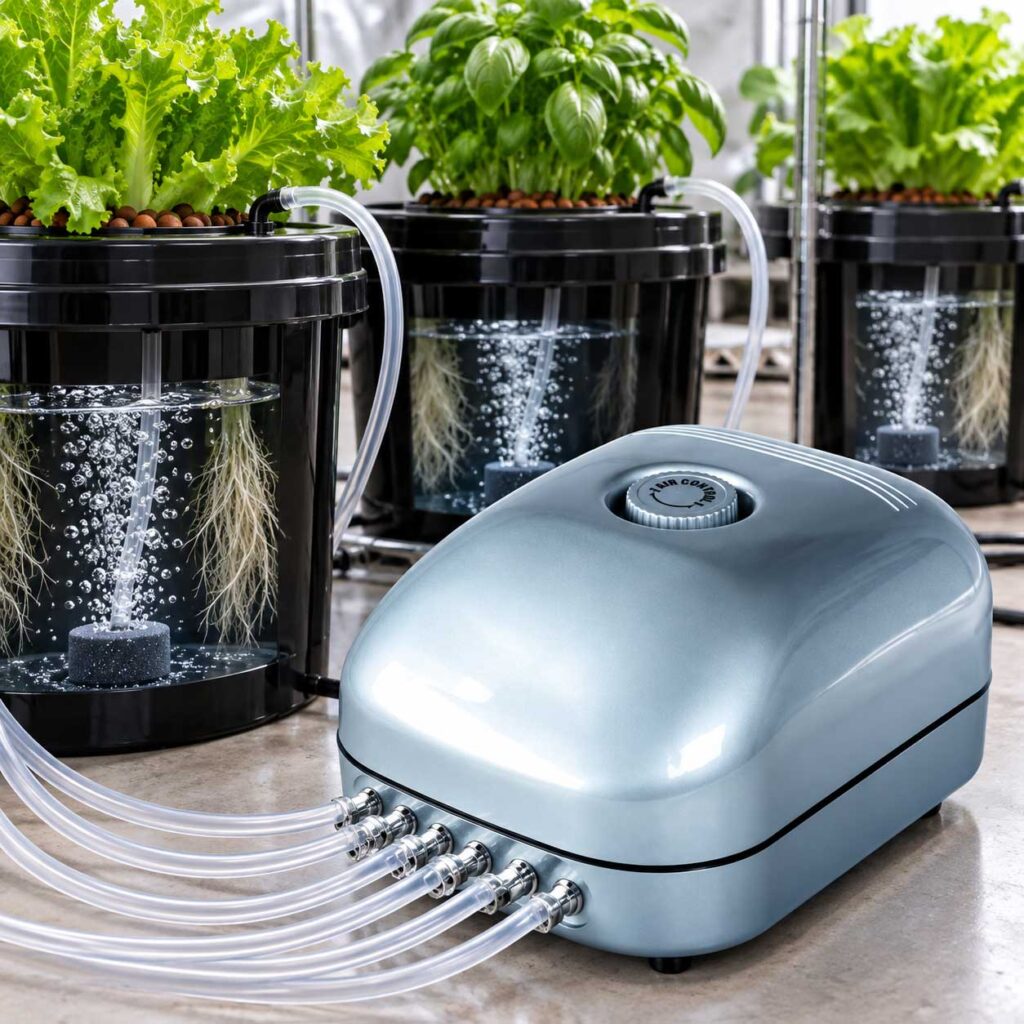
The Active Aqua AAPA25L is a strong choice for growers running several DWC buckets or multiple air stones from one pump.
Hydrofarm rates this model at 25 L/min, with eight outlets and a power draw of 12 watts. That gives it substantially more capacity than the smaller Active Aqua models and makes it much better suited to multi-site hydroponic systems.
Key Specs
- Airflow: 25 L/min
- Outlets: 8
- Power: 12W
- Best for: Multi-bucket DWC systems and larger reservoirs
Why We Like It
Where this pump stands out is the eight-outlet layout.
Instead of building a complicated network of splitters and manifolds, you can run dedicated airlines directly to multiple buckets or air stones. That keeps the system cleaner and makes airflow easier to manage.
The 25 L/min output also gives you more headroom for deeper reservoirs, longer tubing runs, larger air stones, and several grow sites operating at the same time.
For growers who already know they want to expand beyond two or four buckets, this model offers plenty of flexibility without immediately stepping up to a larger commercial-style pump.
Potential Drawbacks
For a small setup, this pump may simply be more than you need.
If you only have one or two DWC buckets, you probably will not take full advantage of eight outlets or the extra airflow. A smaller Active Aqua model will usually be simpler and more efficient.
The AAPA25L may also produce more noticeable vibration than a compact aquarium-style pump, especially on a hard shelf or floor.
Placing it on a rubber or foam pad can help reduce vibration noise.
Best Fit
The AAPA25L becomes especially useful once your garden grows beyond a couple of buckets.
Its eight outlets are the real advantage here, allowing you to run several dedicated airlines without building a complicated network of splitters. For a larger home DWC system, it offers useful capacity while still being simpler than stepping up to a full commercial pump.
6. VIVOSUN 25W Commercial Air Pump – Best High-Airflow Value
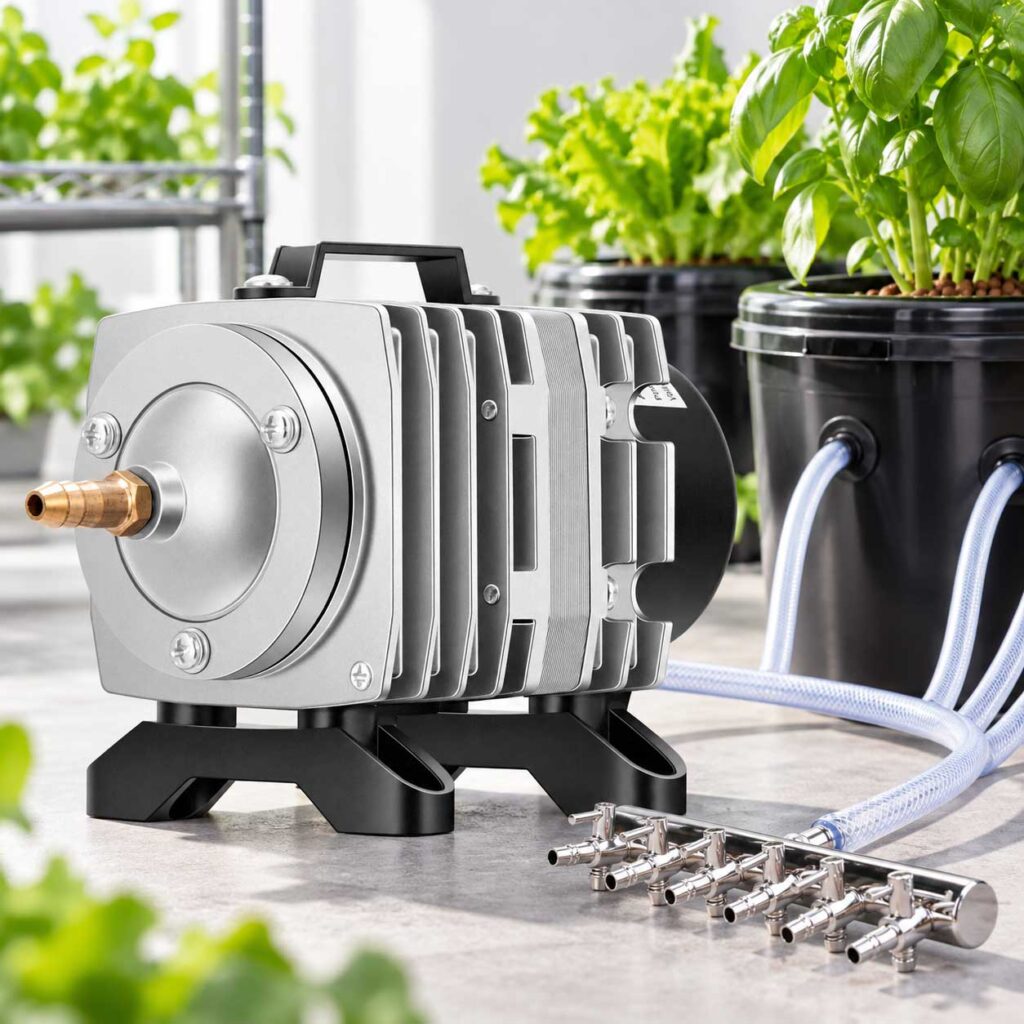
If you need substantially more airflow than a small diaphragm pump can provide, the VIVOSUN 25W Commercial Air Pump is one of the stronger value options in this guide.
VIVOSUN currently lists this model as a 40 L/min, 634 GPH pump with six adjustable outlets. However, the same product page also states that it can pump up to 60 L/min. Because those figures conflict, we use the more conservative 40 L/min rating for comparison.
Key Specs
- Listed airflow: 40 L/min
- Outlets: 6 adjustable valves
- Power: 25W
- Pressure: More than 0.03 MPa
- Best for: Larger DWC systems and multi-bucket setups
Why We Like It
What stands out here is the amount of airflow packed into a relatively compact unit.
Its six adjustable outlets let you distribute air across several DWC buckets or multiple air stones while controlling individual lines from the manifold. That can be especially useful when one bucket or reservoir needs slightly more airflow than another.
VIVOSUN also uses an aluminum-alloy housing designed to help dissipate heat and an oil-free electromagnetic motor. The manufacturer says the pump is suitable for continuous 24/7 operation, which fits the way most DWC systems are aerated.
Strong Airflow for Larger Systems
Compared with the smaller pumps earlier in this guide, the VIVOSUN offers a substantial jump in capacity.
That extra airflow becomes useful when you are running several DWC buckets, larger air stones, deeper reservoirs, longer airline runs, or multiple diffusers at the same time. The six adjustable valves also make it easier to balance airflow between different grow sites.
Potential Drawbacks
Higher-output pumps usually come with more noise and vibration.
VIVOSUN rates this model at under 60 dB and recommends it for outdoor use, so it may not be the best choice for a bedroom, office, or other quiet living area.
For a basement, greenhouse, grow room, or dedicated gardening area, that is much less of a concern.
The conflicting 40 L/min and 60 L/min figures are another reason not to size your entire system around the theoretical maximum output.
Best Fit
The VIVOSUN is better suited to growers who have moved beyond a small hobby setup and need substantially more airflow across several grow sites.
Its six adjustable outlets make it easier to balance multiple buckets or diffusers, but the extra capacity comes with more noise and vibration. It makes the most sense in a basement, greenhouse, or dedicated grow area rather than a quiet living space.
7. EcoPlus Commercial Air 1 – Best Heavy-Duty Air Pump
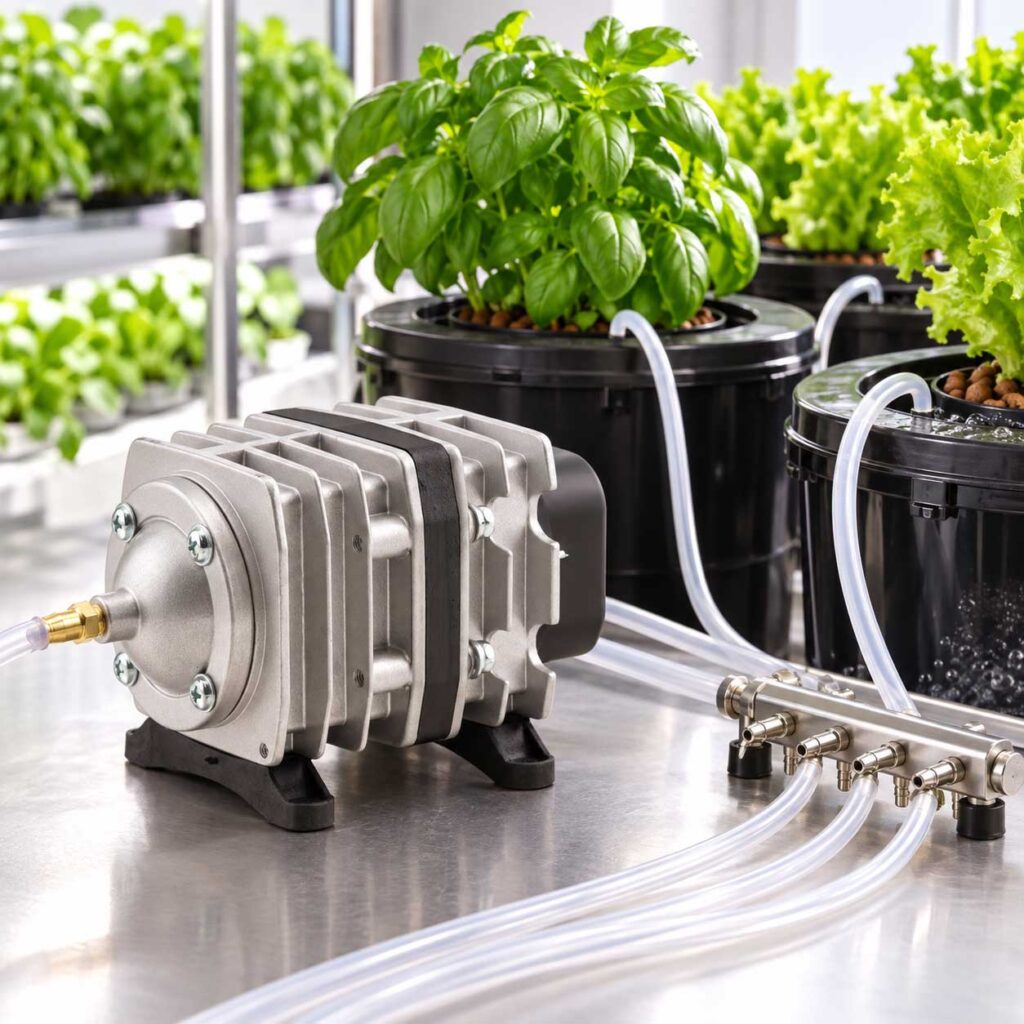
For growers who want a more rugged, commercial-style air pump, the EcoPlus Commercial Air 1 is our heavy-duty pick.
The Commercial Air 1 is rated at 793 GPH, or roughly 50 L/min, while drawing 18 watts. Manufacturer documentation lists operating pressure at 2.90 psi, and the pump uses a piston-and-cylinder design rather than the smaller diaphragm-style design found in many aquarium pumps.
Key Specs
- Airflow: 793 GPH, or about 50 L/min
- Power: 18W
- Pressure: 2.90 psi
- Distribution: Single outlet with manifold support
- Best for: Larger DWC systems and multiple air stones
Why We Like It
The main reason to consider the EcoPlus is its concentrated airflow, delivered through an oil-free piston-and-cylinder design.
Instead of building several small outlets directly into the pump, the EcoPlus sends air through one high-output connection. A manifold can then divide that airflow between several individual lines.
That setup works well when one pump needs to supply multiple DWC buckets, several air stones, or a larger central reservoir.
The 793 GPH output also gives it much more capacity than the smaller Active Aqua pumps earlier in this guide.
The Manifold Adds Flexibility
Although the pump itself has one main outlet, the Commercial Air 1 is commonly paired with a six-outlet manifold.
That allows one pump to supply multiple DWC buckets, several air stones in a larger reservoir, or separate reservoirs in the same grow area. Individual manifold valves also make it easier to balance airflow between lines.
Potential Drawbacks
This is a commercial-style pump, so quiet operation is not its main strength.
The piston mechanism can create more noticeable vibration than a compact diaphragm pump, especially when the unit sits directly on a hard shelf or floor. A rubber vibration pad can help reduce that noise.
It is also easy to buy more pump than you need. For one small DWC bucket, a quieter and lower-output model will usually make more sense.
And remember that 793 GPH refers to airflow, not reservoir capacity. It does not mean the pump is automatically appropriate for a 793-gallon hydroponic reservoir.
Best Fit
The EcoPlus Commercial Air 1 is aimed at larger DWC systems where one pump needs to feed several air stones or reservoirs.
Its high-output design and manifold compatibility give you much more capacity than the smaller pumps in this guide. For one or two buckets it is unnecessary, but once airflow demand becomes the priority, this is where a heavier-duty pump begins to earn its place.
How to Choose an Air Pump for Hydroponics
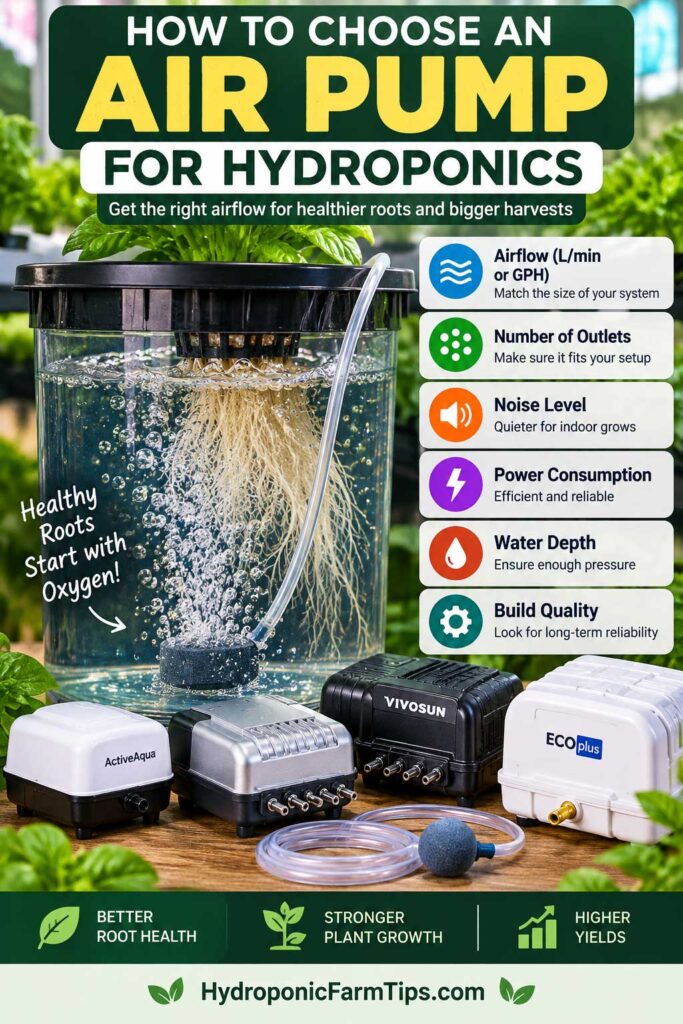
Choosing the right air pump is not just about buying the model with the highest airflow. The best option depends on your reservoir size, number of buckets, water depth, air stones, noise tolerance, and whether you plan to expand later.
Here are the main factors to compare before buying.
Airflow Capacity
Airflow is usually listed in liters per minute (L/min) or gallons per hour (GPH).
Higher airflow gives you more capacity for larger reservoirs, multiple DWC buckets, bigger air stones, deeper water, longer tubing runs, and multi-outlet manifolds.
More is not always better, though. A single-bucket system may work perfectly well with a compact pump, while an oversized commercial unit can add unnecessary noise, vibration, and power use.
Reservoir Depth and Air-Stone Resistance
A deeper reservoir requires more pressure because the pump has to push air farther down through the water column. Air stones add resistance too, especially larger discs and fine-pore diffusers.
As stones collect mineral deposits, nutrient residue, algae, or biofilm, that resistance can increase further. This is why a pump that performs well in a shallow bucket may feel underpowered in a deeper reservoir with a larger diffuser.
Number of Buckets and Outlets
If you are running several DWC buckets, the number of outlets becomes important.
Dedicated outlets make the system easier to organize and help avoid repeatedly splitting one airline.
As a rough guide:
- 1 bucket: One outlet may be enough
- 2 buckets: Two outlets are convenient
- 4 buckets: Four dedicated outlets simplify the setup
- 6–8 buckets: Consider an eight-outlet pump or a commercial pump with a manifold
Splitters can work, but every split divides the available airflow and adds resistance.
Noise and Vibration
Noise matters much more if your hydroponic garden is in a bedroom, office, kitchen, or living area.
Smaller diaphragm pumps are often better suited to indoor spaces, while larger piston or electromagnetic pumps may produce more mechanical noise and vibration.
To reduce vibration, place the pump on a rubber or foam pad, keep it away from walls, and make sure the tubing is not pulling against the housing.
Efficiency and Reliability
Because DWC pumps often run 24 hours a day, power consumption matters. A correctly sized pump usually wastes less electricity than an oversized commercial model running far below its capacity.
Reliability matters just as much. If aeration stops, dissolved oxygen can fall quickly in warm reservoirs with mature plants. For larger DWC gardens, keeping a spare pump or backup aeration option nearby is a sensible precaution.
Backflow Protection and Room to Expand
If the pump sits below the waterline, use a properly oriented check valve to help prevent water from siphoning backward through the airline. Whenever possible, placing the pump above the reservoir adds another layer of protection.
At the same time, avoid sizing the pump right at the minimum. A little extra capacity gives you room for deeper water, larger air stones, longer tubing, denser root systems, or another bucket later.
What Size Air Pump Do You Need for Hydroponics?
There is no single perfect air-pump size for every hydroponic system. Airflow needs change with reservoir volume, water depth, root mass, air-stone resistance, and the number of grow sites.
A good starting point is a pump that keeps the reservoir visibly moving and well aerated without creating excessive splashing or turbulence.
Practical Airflow Guide
| Reservoir Size | Practical Starting Range |
|---|---|
| 5 gallons | About 2–4 L/min |
| 10 gallons | About 3–5 L/min |
| 20 gallons | About 6–10 L/min |
| 30 gallons | About 8–12 L/min |
| 40 gallons | About 10–16 L/min |
| 50+ gallons | Consider a larger multi-outlet or commercial pump |
These are practical starting ranges, not strict requirements. Water depth, diffuser resistance, crop size, root mass, and tubing length can all change how much airflow works best in a real system.
A shallow reservoir with one small air stone may need less pressure than a deep bucket using a large fine-pore diffuser. A mature tomato or cucumber plant with a dense root mass may also benefit from more aeration than a young lettuce plant in the same amount of water.
A Simple Rule for DWC
For small home DWC systems, a commonly used starting point is roughly:
1 liter of air per minute for every 2–5 gallons of nutrient solution
That gives you a practical baseline, but the actual reservoir should still guide your decision.
If bubbling looks weak, circulation is uneven, or the root mass becomes very dense, you may need more airflow.
Examples by DWC System Size
One 5-gallon bucket. A compact pump in roughly the 2–4 L/min range can be a practical starting point, depending on water depth and air-stone resistance. This is where a model such as the Active Aqua AAPA3.2L fits well.
Four 5-gallon buckets. A nominal 20-gallon setup will usually contain somewhat less nutrient solution once net pots and roots are in place. Around 10–20 L/min gives you more flexibility, and a four-outlet pump such as the AAPA15L lets you run one airline to each bucket.
Six to eight buckets. At this size, both airflow and distribution become more important. Roughly 20–40+ L/min may be more practical depending on water depth, diffuser size, and tubing length, which is where an eight-outlet or commercial-style pump becomes useful.
Leave Room for Mature Plants
As plants mature, their roots can fill much more of the reservoir and restrict water movement. Tomatoes, peppers, cucumbers, and other hydroponic vegetables can develop very different root masses compared with compact lettuce and herbs.
Different crops also have different nutrient and pH requirements, so our Hydroponic Nutrient & pH Chart can help when you’re dialing in the rest of the reservoir.
Choosing a pump with some reserve capacity helps compensate for that increasing root mass as well as longer tubing, deeper water, air-stone resistance, and gradual mineral buildup. It also makes future expansion easier without forcing you to replace the pump immediately.
Watch the Reservoir, Not Just the Specification
Pump ratings are useful, but what happens inside the reservoir matters more than the number printed on the box.
You should see steady bubbling and movement across the root zone rather than a weak stream concentrated in one corner.
If you run several buckets, check each one individually. Different tubing lengths, clogged air stones, or uneven resistance can cause one bucket to receive much less air than another.
The goal is not violent bubbling. It is consistent aeration and circulation throughout the root zone.
Match Your Air Pump to Your Hydroponic Setup
Still deciding which pump fits your setup? Start with the number of DWC buckets you run, then consider noise, water depth, air-stone resistance, and whether you plan to expand. Here’s the simplest way to narrow down your options.
| Hook | Your Setup | Recommended Pick | Why It Fits | Buy |
|---|---|---|---|---|
| 🌱 Keep It Simple | 1 DWC Bucket | Active Aqua AAPA3.2L | Compact single-outlet option for a basic setup | View Price → |
| 🌿 Perfect Pair | 2 DWC Buckets | Active Aqua AAPA7.8L | Two dedicated outlets keep the setup simple | View Price → |
| 🏆 Sweet Spot | 3–4 DWC Buckets | Active Aqua AAPA15L | Good balance of airflow, efficiency, and expansion room | View Price → |
| 🪴 Ready to Expand | 5–8 DWC Buckets | Active Aqua AAPA25L | Eight outlets simplify larger multi-site setups | View Price → |
| 🔇 Keep It Quiet | Small Indoor Garden | Tetra Whisper 100 | Better suited to rooms where noise matters | View Price → |
| ⚡ Need More Air | Larger DWC System | VIVOSUN 25W | Higher airflow with adjustable distribution | View Price → |
| 💪 Heavy-Duty Setup | Grow Room / Larger Reservoir | EcoPlus Commercial Air 1 | Strong output for multiple air stones | View Price → |
How Much Air Does a DWC System Need?
Deep Water Culture depends heavily on aeration because the roots remain submerged in nutrient solution for most of the grow cycle.
The exact amount of air you need depends on reservoir size, water depth, crop type, root mass, air-stone resistance, and water temperature. There is no single airflow number that works for every DWC setup.
Once you have a rough pump size in mind, the next question is whether that airflow is creating good circulation and aeration throughout the root zone. In DWC, reservoir circulation, root mass, water temperature, and air-stone performance matter just as much as the pump’s advertised output.
Why DWC Needs Strong Aeration
In soil, roots can access oxygen from air spaces between soil particles. In DWC, most of the root mass stays underwater, so enough oxygen has to remain dissolved in the nutrient solution.
An air pump and air stone help by moving water through the reservoir and improving gas exchange at the surface.
When aeration is too weak, you may notice slower growth, wilting despite plenty of water, darker or weaker roots, and stagnant areas in the reservoir.
One Air Stone per Bucket Is a Good Starting Point
For a typical 5-gallon DWC bucket, one properly sized air stone connected to a capable pump is often enough.
The goal is steady bubbling across a reasonable portion of the root zone rather than one weak stream concentrated in a corner.
Larger buckets or reservoirs may benefit from a bigger diffuser, two smaller air stones, or multiple air lines to spread circulation more evenly.
Water Temperature Matters
Warm nutrient solution holds less dissolved oxygen than cooler water.
That means a pump that seems adequate under cooler conditions may become less effective during hot weather or in a warm grow room.
Increasing airflow can help, but it does not replace proper temperature management. If the reservoir is running too warm, address the heat source as well.
Should a DWC Air Pump Run 24/7?
In most DWC systems, yes.
Roots continue to respire when the grow lights turn off, so aeration should normally continue day and night.
Long periods without airflow can allow dissolved oxygen to fall, especially in warm reservoirs with mature plants and dense root systems.
Can You Give DWC Too Much Air?
In most home systems, too little aeration is more common than too much.
However, extremely aggressive bubbling can create unnecessary splashing, noise, and turbulence.
The goal is not maximum bubbling. You want steady, well-distributed aeration that keeps the nutrient solution moving and supports healthy roots without turning the reservoir into a rolling boil.
Air Pump vs. Air Stone: What’s the Difference?
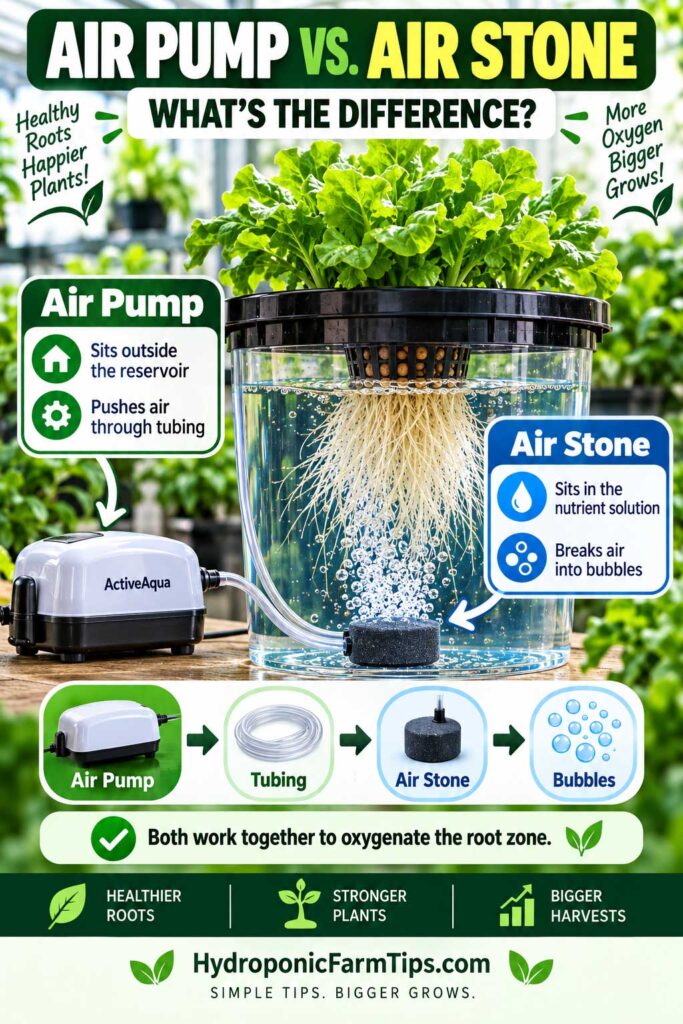
An air pump and an air stone work together, but they do different jobs.
The air pump creates the airflow, while the air stone sits inside the reservoir and breaks that airflow into many smaller bubbles.
What the Air Pump Does
The air pump sits outside the reservoir and pushes air through flexible tubing.
Its job is to provide enough airflow and pressure to overcome resistance from the tubing, water depth, check valves, splitters, manifolds, and the air stone itself.
A stronger pump can usually support more air stones, deeper reservoirs, or several DWC buckets at the same time.
What the Air Stone Does
The air stone is submerged in the nutrient solution.
As air passes through its porous material, it creates many smaller bubbles instead of one large stream. Those bubbles help move the nutrient solution, improve circulation around the roots, and increase gas exchange at the surface.
Air stones come in several shapes and sizes, including small cylindrical stones, round discs, long bars, and flexible diffusers. Larger models can spread bubbles across more of the reservoir, but they may also require more pressure from the pump.
Which One Matters More?
Both matter.
A powerful pump connected to a clogged or poorly matched air stone can still produce weak aeration. Likewise, a large diffuser connected to an underpowered pump may barely bubble at all.
The best setup matches the pump and air stone so you get steady, even aeration across the root zone.
Do Smaller Bubbles Add More Oxygen?
Smaller bubbles provide more surface area relative to their volume, but bubble size is only part of the picture.
In hydroponics, much of the benefit comes from the way bubbles move water, reduce stagnant areas, disturb the surface, and improve gas exchange between the reservoir and the surrounding air.
So you do not need to chase the smallest bubbles possible. Consistent circulation throughout the root zone matters more.
When Should You Replace an Air Stone?
Air stones gradually become clogged with mineral deposits, nutrient residue, algae, and biofilm.
If bubbling becomes noticeably weaker, uneven, or concentrated in only one part of the stone, it may be time to clean or replace it. A clogged diffuser can also increase back pressure and make the pump work harder.
If cleaning does not restore normal airflow, replacement is usually inexpensive and simpler than trying to force more air through a blocked stone.
Simple DWC Air Pump Setup
For a basic DWC bucket, the setup is simple:
Air pump → airline tubing → check valve → air stone
Place the air stone near the bottom of the reservoir so the bubbles rise through as much of the nutrient solution as possible.
Keep the pump outside the reservoir and ideally above the waterline. If it sits below the water level, use a properly installed check valve to help prevent back-siphoning.
Where Should You Place an Air Pump?
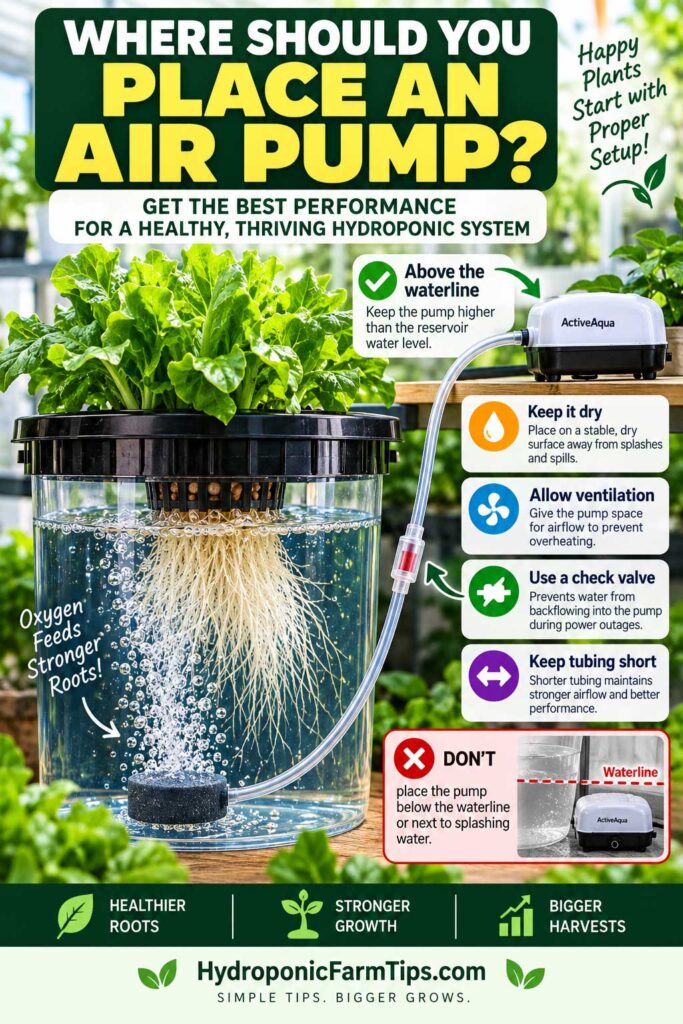
Air-pump placement matters more than it may seem.
A good location helps protect the pump from water, reduces vibration, and keeps airflow more consistent.
Keep the Pump Above the Waterline
Whenever possible, place the air pump above the level of the nutrient solution.
This reduces the risk of water siphoning backward through the airline if the pump loses power or shuts off.
If the pump has to sit below the reservoir, install a properly oriented check valve in the airline.
Keep the Pump Dry and Well Ventilated
Air pumps should stay away from splashes, leaks, condensation, and nutrient spills.
A dry shelf above or beside the system is usually safer than placing the pump directly next to an open reservoir.
Air pumps can also generate some heat during continuous operation, so avoid covering the pump or placing it inside a tightly enclosed cabinet. Leave enough open space around the housing for heat to escape.
Reduce Vibration and Keep Tubing Short
Even a relatively quiet pump can sound much louder if vibration transfers into a wall, shelf, cabinet, or lightweight plastic surface.
Place the pump on a stable surface and use a rubber or foam pad underneath it if needed. Make sure the tubing is not pulling against the pump or causing it to shift.
Keep airline runs reasonably short because long tubing adds resistance and can reduce airflow at the air stone. In multi-bucket systems, keeping tubing lengths fairly balanced can also help distribute airflow more evenly.
Air pumps are designed to remain outside the reservoir. Only the airline tubing and air stone belong in the nutrient solution.
Best Placement for a DWC System
For most DWC setups, a simple arrangement works well:
Air pump above the reservoir → check valve → airline tubing → air stone near the bottom of the bucket
This keeps the pump protected while allowing bubbles to rise through as much of the nutrient solution as possible.
If the pump has several outlets, keep the tubing organized and avoid sharp bends or pinched lines that can restrict airflow.
How to Make a Hydroponic Air Pump Quieter
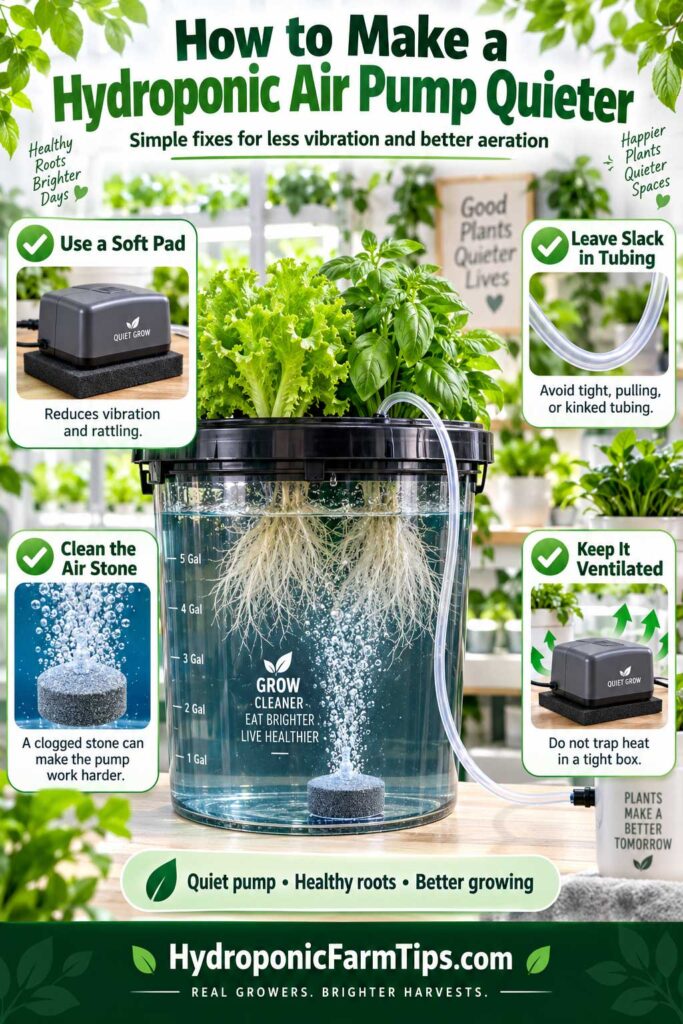
Even a good hydroponic air pump can become annoying if vibration transfers into a shelf, cabinet, or floor.
A surprising amount of air-pump noise comes from vibration rather than the motor itself, so a few small changes can often make the setup noticeably quieter.
Reduce Vibration and Rattling
Place the pump on a rubber, silicone, or dense foam pad to absorb vibration before it transfers into a shelf, cabinet, or floor.
Keep the pump slightly away from walls and other equipment, leave some slack in the airline, and make sure fittings or manifolds are not rattling against hard surfaces.
A few small adjustments here can make a surprisingly noticeable difference in overall noise.
Check for Airflow Restrictions
A clogged air stone increases resistance.
As the pump works against that restriction, it may become louder or vibrate more than usual.
If bubbling has become weak or uneven, clean or replace the air stone before assuming the pump itself is failing.
Balance the Airflow
On multi-outlet pumps, closing too many valves can increase back pressure.
If you are only using part of the pump’s capacity, follow the manufacturer’s instructions for unused outlets rather than simply blocking everything off.
A properly balanced manifold will usually run more smoothly than one with heavily restricted airflow.
Keep the Pump Ventilated
It can be tempting to put the pump inside a closed box to reduce noise, but that may trap heat.
Air pumps need ventilation, especially when they run 24 hours a day. If you use any kind of sound-dampening enclosure, make sure air can still circulate freely around the pump.
Choose the Right Pump Size
An oversized commercial pump may provide far more airflow than a small system actually needs.
For a bedroom, office, or living space, a smaller diaphragm-style pump is often more comfortable than a high-output piston or electromagnetic model.
In a basement, grow room, or greenhouse, however, stronger airflow may matter more than near-silent operation.
When a Pump Suddenly Gets Louder
If the noise remains after those checks, the pump may have worn internal components or be approaching the end of its service life. A healthy pump should produce a fairly consistent hum rather than sudden rattling, knocking, or changes in pitch.
Common Hydroponic Air Pump Mistakes
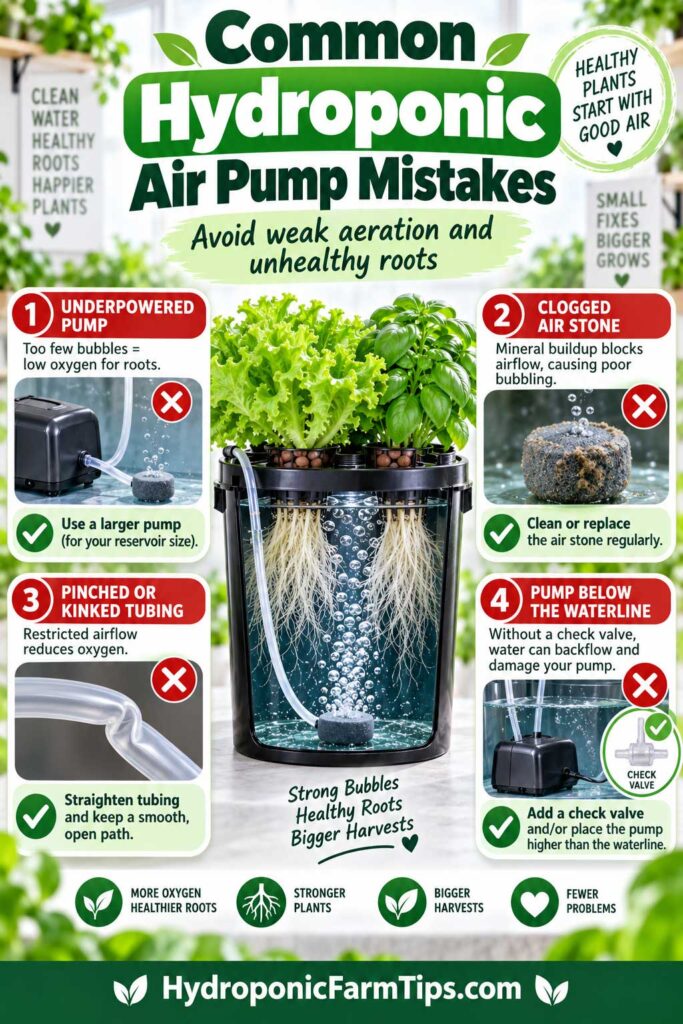
Even a good air pump can underperform if the rest of the aeration setup is poorly matched or maintained.
Here are some of the most common mistakes to avoid.
Choosing a Pump That Is Too Small
An undersized pump may still produce bubbles, but not enough airflow to circulate the reservoir effectively.
This often happens when growers add more buckets, larger air stones, or longer tubing without increasing pump capacity.
Airline splitters can make the problem worse because every split divides the available airflow. For a multi-bucket system, a pump with several dedicated outlets or a properly sized manifold is usually easier to manage.
Ignoring Water Depth and Air-Stone Resistance
The deeper the air stone sits, the more pressure the pump needs to push air through the water.
A pump that works well in a shallow reservoir may struggle in a deeper bucket, especially when paired with a large or fine-pore diffuser.
Clogged air stones create even more resistance. If bubbling becomes weak or uneven, clean or replace the stone before assuming you need a stronger pump.
Installing the Pump Without Backflow Protection
If the air pump sits below the nutrient level, water can potentially siphon backward through the airline when the pump shuts off.
Whenever possible, position the pump above the reservoir. If that is not practical, install a properly oriented check valve in the airline.
This is a simple precaution that can help protect the pump from water damage.
Turning the Pump Off or Restricting It Too Much
For most DWC systems, the air pump should run continuously rather than following the grow-light schedule. Roots continue to respire at night and still need oxygen when the lights are off.
Also be careful about closing too many outlets on an adjustable pump. Excessive restriction can increase back pressure, so follow the manufacturer’s instructions for unused ports.
Assuming More Air Is Always Better
The reservoir does not need to look like a rolling boil.
Extremely aggressive bubbling can create extra noise, splashing, and turbulence without necessarily improving plant growth.
The goal is steady, well-distributed aeration throughout the root zone.
It is also important not to choose a pump based on GPH alone. Air-pump GPH measures airflow, not the size of reservoir the pump can support. Water depth, pressure, tubing length, air-stone resistance, crop size, and the number of outlets all affect real-world performance.
Finally, remember that aeration cannot fully compensate for an overheated reservoir. Warm water holds less dissolved oxygen, so root-zone temperature still matters even when you are using a powerful air pump.
Keep a Backup for Larger DWC Systems
In DWC, the air pump is critical equipment.
For larger gardens, keeping a spare pump, extra air stone, tubing, and check valve nearby can make an unexpected failure much easier to handle.
A little redundancy is especially useful once plants are mature and heavily dependent on continuous aeration.
Frequently Asked Questions About Hydroponic Air Pumps
How Big of an Air Pump Do I Need for Hydroponics?
The right size depends on reservoir volume, water depth, number of buckets, tubing length, and air-stone resistance.
For small home DWC systems, a practical starting point is around 1 liter of air per minute for every 2–5 gallons of nutrient solution. A little extra capacity is usually better than choosing a pump that is already working at its limit.
Can You Have Too Much Air in Hydroponics?
Yes, although too little aeration is more common.
Extremely aggressive bubbling can create unnecessary splashing, noise, and turbulence. The goal is steady circulation and good oxygenation, not the strongest bubbling possible.
Should a Hydroponic Air Pump Run 24/7?
For DWC, usually yes.
Roots continue to respire when the lights are off, so aeration should normally continue day and night.
Can I Use an Aquarium Air Pump for Hydroponics?
Yes.
Aquarium air pumps can work well for small DWC systems as long as they provide enough airflow and pressure for the reservoir and air stone.
Larger multi-bucket systems usually benefit from higher-output pumps with multiple outlets.
What Happens If a Hydroponic Air Pump Stops?
If a DWC air pump stops, dissolved oxygen can begin to fall, especially in warm water or a reservoir with mature plants.
There is no universal safe outage time, so restore aeration as soon as possible.
Do Hydroponic Roots Need Bubbles Touching Them?
No.
Roots benefit from dissolved oxygen in the water. The bubbles mainly help by moving the nutrient solution and improving gas exchange at the surface.
Good circulation matters more than directing bubbles at every root.
Can One Air Pump Run Multiple DWC Buckets?
Yes, as long as the pump provides enough total airflow and pressure.
Multi-outlet pumps and manifolds make distribution easier, but check each bucket individually because different tubing lengths and air stones can create uneven airflow.
Is a Bigger Air Pump Better for Hydroponics?
Not always.
A larger pump gives you more reserve capacity, but it may also create more noise, vibration, power use, and unnecessary turbulence.
Choose a pump that comfortably handles your system with a little room for expansion.
How Often Should You Replace an Air Stone?
There is no fixed schedule.
Clean or replace the air stone when bubbling becomes weak, uneven, or noticeably reduced. Mineral buildup, nutrient residue, algae, and biofilm can gradually clog the pores.
Do Air Pumps Raise Water Temperature?
Usually not by much, but they can add some warmth indirectly if they draw hot room air or operate in a poorly ventilated area.
If reservoir temperatures are too high, address the heat source rather than relying on extra aeration alone.
Choosing the Best Air Pump for Your Hydroponic System
The best air pump depends mostly on the size of your hydroponic system and how much airflow you actually need.
For most home growers, the Active Aqua AAPA15L offers one of the most balanced combinations of airflow, outlet capacity, and power consumption without stepping up to a larger commercial-style pump.
For a single DWC bucket, the Active Aqua AAPA3.2L keeps things simple and efficient. If you are running two buckets, the AAPA7.8L gives you two dedicated outlets and a little more flexibility.
If quiet operation matters most, the Tetra Whisper 100 is better suited to small indoor setups where the pump sits in a kitchen, office, bedroom, or living space.
For larger systems, the Active Aqua AAPA25L offers eight outlets, while the VIVOSUN 25W Commercial Air Pump and EcoPlus Commercial Air 1 provide much stronger airflow for multi-bucket setups and larger reservoirs.
The goal is to avoid both extremes. An undersized pump may struggle to provide enough aeration, while an oversized commercial pump can add unnecessary noise, vibration, and power consumption.
Choose a pump that comfortably handles your current setup, leaves a little room for expansion, and provides steady, well-distributed airflow throughout the root zone.
For DWC growers especially, a reliable air pump is core equipment for maintaining a healthy, well-aerated root zone.
More Hydroponic Growing Guides You May Like
If you’re setting up or improving a hydroponic system, these guides can help you manage the root zone, choose the right equipment, and avoid common growing problems.
- Hydroponics for Beginners – Learn how hydroponics works, what equipment you need, and how to start your first system at home.
- 8 Best Hydroponic Systems for Home – Compare DWC, Kratky, NFT, Ebb and Flow, drip, aeroponics, wick systems, and Dutch Buckets.
- Hydroponic Root Rot: Causes, Signs & How to Fix It – Learn how low oxygen, warm water, and poor reservoir conditions can contribute to unhealthy roots.
- Hydroponic Nutrients Guide – Understand what hydroponic nutrients do, how to mix them, and how to avoid common feeding mistakes.
- Hydroponic Nutrient & pH Chart – Check recommended pH and nutrient ranges for common hydroponic crops.
- Best pH for Hydroponics – Learn why pH matters and how to keep your nutrient solution in the right range.
- Best Hydroponic Vegetables to Grow – Find productive crops that perform well in home hydroponic systems.
- Best Hydroponic Herbs to Grow at Home – Choose herbs that work well in DWC and other indoor hydroponic setups.