Algae in hydroponics can seem harmless at first. You might notice a thin green film on your growing media, a slippery coating inside the reservoir, or green buildup along tubing and channels. If the conditions stay favorable, that small patch can spread surprisingly quickly.
Algae thrives when light reaches nutrient-rich water or other damp, nutrient-containing surfaces. Because hydroponic systems already contain water and dissolved plant nutrients, even a small amount of light entering the reservoir or reaching wet surfaces can create ideal conditions for growth.
A little algae is not usually an emergency, but heavy buildup can cause problems. It can contribute to lower oxygen levels, use some of the same nutrients as your plants, clog irrigation components, attract pests, and create unpleasant odors.
Fortunately, algae is usually manageable once you understand what is causing it.
In this guide, you’ll learn what causes algae in hydroponic systems, how to remove existing growth, and—most importantly—how to prevent it from coming back.
What Is Algae in Hydroponics?
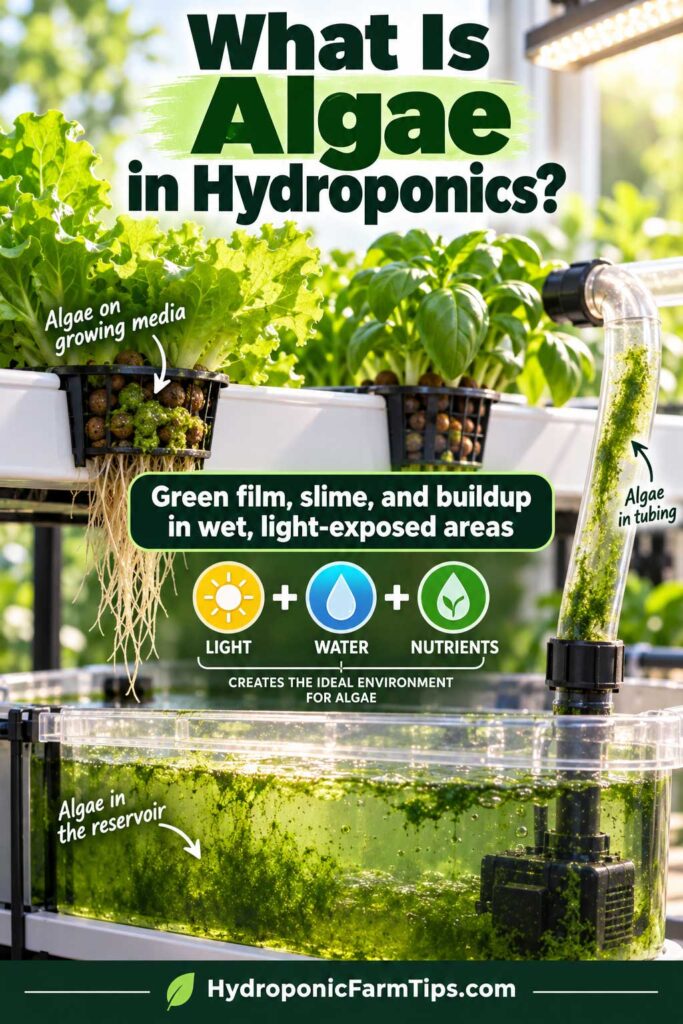
Algae are photosynthetic organisms that thrive when they have access to light, water, and nutrients. A hydroponic system can provide all three, which is why algae sometimes appears around reservoirs, grow trays, tubing, channels, net pots, and exposed growing media.
Algae in hydroponics most often appears as a green, slippery film, although it may also look brown, reddish, or darker depending on the type and growing conditions.
Unlike your hydroponic plants, algae does not need soil or a traditional root system. It can grow directly in the nutrient solution or spread across damp surfaces exposed to light.
You might find it coating reservoir walls, growing across wet rockwool or clay pebbles, collecting around net pots, or developing inside water-carrying tubing and channels. It can also appear as a thin film floating on the nutrient solution.
In most cases, visible algae is telling you one thing: light is reaching an area that stays wet and contains nutrients.
A small amount is not usually an emergency. But if it spreads, algae can make the system harder to manage and contribute to oxygen, water-flow, and root-zone problems.
The sooner you catch it, the easier it is to control. The best long-term fix is simply to keep light away from the nutrient solution and other wet surfaces.
What Does Hydroponic Algae Look Like?
Algae in hydroponics does not always look exactly the same. The classic sign is a green, slippery coating, but you may also notice green-tinted water, darker buildup on wet surfaces, floating particles, or a slimy layer inside channels and tubing.
On growing media, algae often looks like a green stain or film spreading across damp rockwool, clay pebbles, coco, or grow sponges. When growth becomes heavy, the system may also develop a musty or swamp-like smell.
Clear tubing and translucent reservoirs are especially easy places to spot it because light reaches the nutrient-rich water inside.
Algae vs. Healthy Hydroponic Roots
Healthy hydroponic roots are generally white to cream-colored and firm, although nutrients can sometimes stain them slightly tan or brown.
Algae looks different. It usually coats wet surfaces rather than forming structured roots.
If your roots become dark, mushy, slimy, or foul-smelling, you may be dealing with something more serious than algae alone. Those symptoms can point to root disease or poor oxygen conditions.
For more help identifying unhealthy roots, see our guide to hydroponic root rot.
What Causes Algae in Hydroponic Systems?
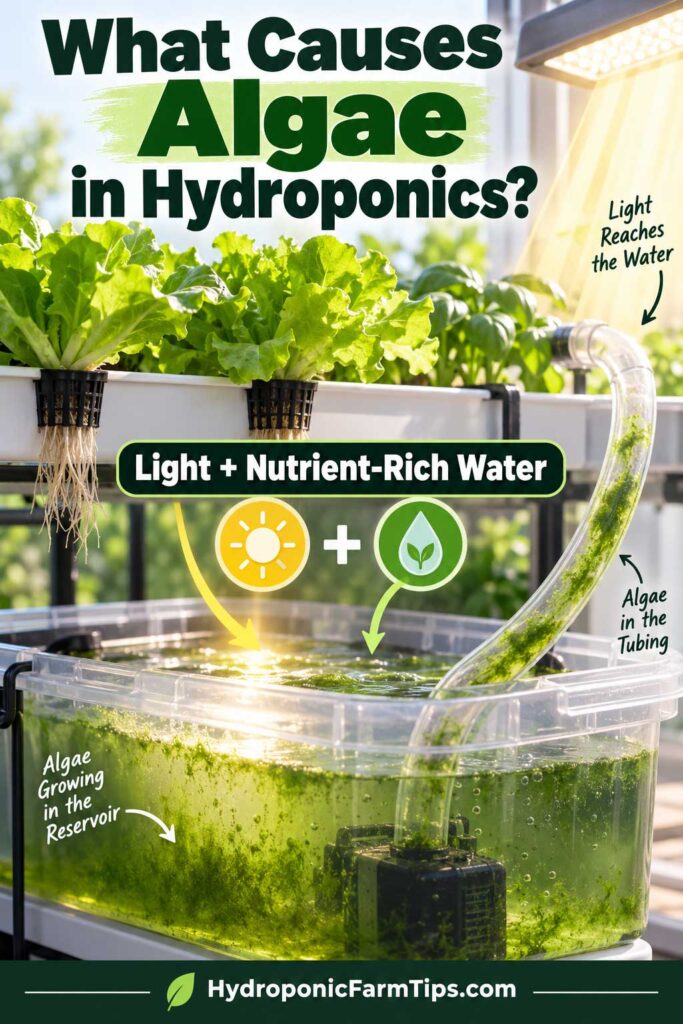
Algae needs three basic things to grow: water, nutrients, and light. Hydroponic systems already provide water and dissolved nutrients, so light exposure is usually the factor that allows algae to become established.
Understanding what causes algae in hydroponics makes prevention much easier because most outbreaks come back to the same combination of moisture, nutrients, and light.
The University of New Hampshire Extension also notes that algae thrives where sunlight, moisture, and fertilizer are available, and recommends excluding light from the nutrient solution whenever possible.
Several conditions can make the problem worse.
1. Light Reaching the Nutrient Solution
This is the most common cause of algae in hydroponics.
If light reaches your reservoir, tubing, grow tray, or nutrient channels, algae can begin growing quickly. Even small gaps around net pots or planting holes may expose enough nutrient solution for algae to develop.
Clear and translucent containers are especially prone to this problem.
2. Warm Reservoir Temperatures
Algae often grows more quickly in warm conditions.
Higher nutrient-solution temperatures can also reduce dissolved oxygen, which may place additional stress on plant roots.
For many hydroponic crops, a reservoir temperature around 65–72°F (18–22°C) is a useful general range, although the ideal temperature depends on the crop and system.
3. Nutrient-Rich Water
Hydroponic nutrient solutions contain nitrogen, phosphorus, potassium, and other minerals that support plant growth.
Algae can use many of those same nutrients.
That does not mean you should dilute the nutrient solution simply to control algae. A better approach is to keep light away from the water while maintaining the correct nutrient strength for your plants. You can compare recommended ranges for common crops in our hydroponic nutrient and pH chart.
4. Poor System Sanitation
Algae can remain on reservoirs, pumps, tubing, trays, and other equipment between growing cycles.
If those surfaces are not cleaned thoroughly, algae can return quickly once fresh nutrient solution and light are available.
Regular cleaning is especially important in systems where algae has already been a recurring problem.
5. Light Leaks Around Net Pots and Openings
Even when the reservoir itself is opaque, small openings can still let light into the system.
Gaps around net pots, unused planting holes, loose reservoir lids, transparent water lines, and exposed sections of growing channels are all common trouble spots. Wet growing media can become another algae-friendly area when strong grow lights shine directly onto it.
You do not need a large opening to develop a problem. Even a small patch of nutrient-rich water exposed to light can eventually turn green.
In most cases, the real problem is not that the nutrient solution is “too rich.” It is that light is reaching a wet, nutrient-rich area where algae can grow.
Is Algae Harmful to Hydroponic Plants?
A small amount of algae in hydroponics is not always an immediate threat, but heavy growth can create several problems inside the system.
The main concern is that heavy algae growth can make root-zone conditions harder to keep stable.
Algae Can Reduce Available Oxygen
Algae produces oxygen during photosynthesis, but it also uses oxygen during respiration, especially when the lights are off. As algae dies and decomposes, microorganisms breaking it down can consume even more dissolved oxygen.
In a heavily affected reservoir, this can contribute to lower oxygen levels around plant roots.
Roots that receive too little oxygen may grow more slowly and become more vulnerable to stress.
Algae Can Compete for Nutrients
Algae can use nutrients from the same solution feeding your plants.
In a small outbreak, the effect is usually minor. But when algae becomes widespread, it can contribute to less predictable nutrient conditions and make reservoir management more difficult.
Algae Can Affect pH Stability
Rapid algae growth can also contribute to changes in water chemistry.
Because algae absorbs carbon dioxide and nutrients while it grows, the pH of the nutrient solution may fluctuate, especially when algae buildup is significant.
If your reservoir pH becomes unusually difficult to stabilize, algae may be one factor to investigate. If you’re having trouble keeping your readings in range, see our guide to the best pH for hydroponics.
Algae Can Clog Hydroponic Equipment
Thick algae can build up inside drip emitters, pumps, filters, tubing, NFT channels, and irrigation lines. Over time, this buildup can restrict water flow and make the system harder to maintain.
In NFT and drip systems, clogged components may also prevent some plants from receiving enough nutrient solution.
Algae Can Encourage Other Problems
Algae-covered surfaces can stay damp and may attract pests such as fungus gnats. Dead algae also adds organic matter to the system, which can support additional microbial growth.
That does not mean algae automatically causes disease, but a severe outbreak can create conditions that are less favorable for healthy roots.
For that reason, it is best to treat visible algae as an early warning sign and correct the underlying conditions before the problem becomes more difficult to manage.
If insects are appearing around damp growing media, our guide to common hydroponic pests explains how to identify and control fungus gnats, aphids, whiteflies, and other pests.
Can Algae Cause Root Rot?
Algae does not directly cause root rot, but a heavy algae problem can create conditions that make root problems more likely.
Severe algae in hydroponics can also make it harder to maintain the clean, oxygen-rich root zone that healthy plants need.
One of the main concerns is reduced dissolved oxygen. When algae dies, microorganisms begin breaking it down. That decomposition process uses oxygen in the nutrient solution, leaving less available for plant roots.
Warm water can make the situation worse because warmer nutrient solutions naturally hold less dissolved oxygen.
Together, low oxygen, warm water, and excess organic material can stress the root zone and create conditions where root pathogens are more likely to become a problem.
Signs the Problem May Be More Than Algae
If your plants begin looking unhealthy, check the roots closely.
Possible warning signs include:
- Brown or darkened roots
- Soft or mushy root tissue
- Slimy roots
- A foul or rotten smell
- Wilting even when plenty of water is available
- Slow or stunted growth
- Yellowing leaves
- Roots that break apart easily
Healthy hydroponic roots are usually firm and white to cream-colored, although some nutrient solutions can stain them slightly tan or brown.
If the roots become dark, slimy, soft, and unpleasant-smelling, you may be dealing with root rot rather than algae alone.
See our complete guide to hydroponic root rot for help identifying the problem and improving root-zone conditions.
The best approach is to control algae before it becomes severe. Blocking light from the nutrient solution, maintaining good aeration, controlling reservoir temperature, and keeping the system clean can all help protect the root zone.
How to Get Rid of Algae in Hydroponics
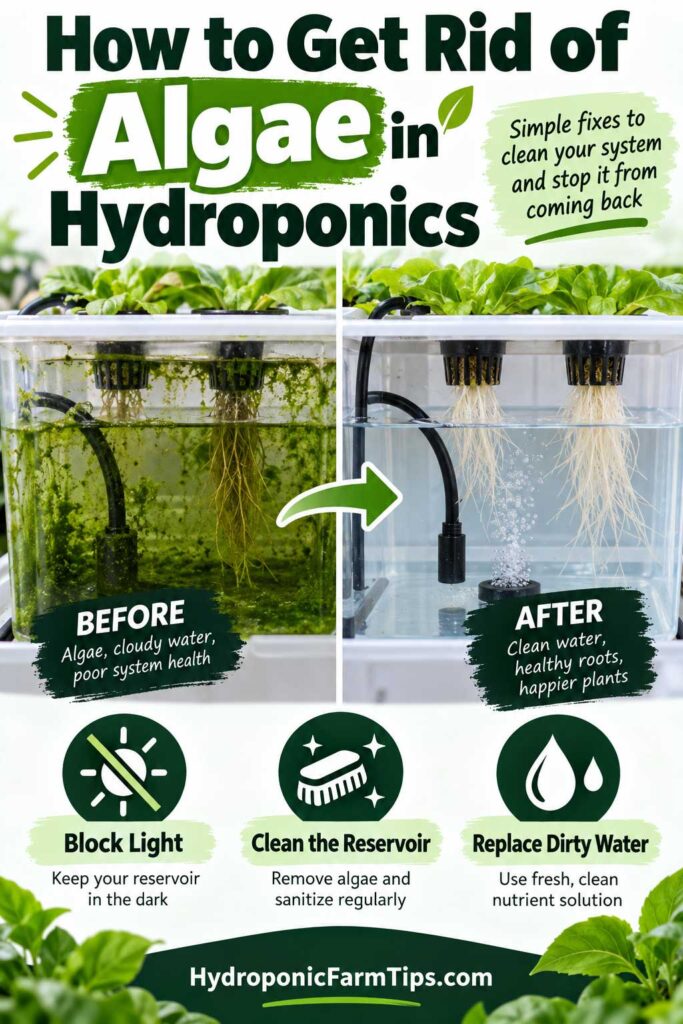
If you’re trying to get rid of algae in hydroponics, removing what you can see is only part of the solution. You also need to correct the conditions that allowed it to grow.
In most cases, that means blocking light, cleaning affected surfaces, and restoring stable reservoir conditions.
1. Block Light From Reaching the Nutrient Solution
Start by inspecting the reservoir lid, net pot openings, tubing, growing channels, trays, and exposed growing media. Look for any place where grow lights or sunlight can reach nutrient-rich water.
Cover or replace anything that allows light to reach the water. Opaque materials work best.
This is the most important step because algae often returns when even small light leaks remain.
2. Remove Visible Algae
Wipe or scrub visible algae from reservoir walls, lids, trays, channels, net pots, tubing, and other accessible equipment. Be careful around established plants and avoid disturbing healthy roots more than necessary.
If algae is growing on rockwool or another growing medium, gently remove the surface buildup when practical, then shade the area so it is less likely to return.
3. Replace Heavily Contaminated Nutrient Solution
If the reservoir is heavily discolored, smells unpleasant, or contains large amounts of floating algae, replacing the nutrient solution is often the simplest option.
Drain the old solution, clean the reservoir, then refill it with fresh water and nutrients at the correct strength for your plants.
If you’re unsure when a full reservoir change is actually necessary, see our guide on how often to change hydroponic water.
This gives the system a cleaner starting point instead of trying to stabilize badly affected water.
4. Improve Aeration
If you use DWC or another aerated system, make sure the air pump and air stones are working properly.
Good aeration helps maintain oxygen around the roots and supports a healthier root zone.
Check air stones for algae or mineral buildup and clean or replace them when airflow starts to weaken.
If your DWC system needs stronger airflow, see our guide to the best air pumps for hydroponics.
5. Check Reservoir Temperature
Warm nutrient solution can encourage algae growth while also reducing dissolved oxygen. According to the University of Missouri Extension, warmer nutrient solution holds less dissolved oxygen, which is especially important in DWC systems where roots remain submerged.
Keep the reservoir away from direct sunlight, hot grow lights, heating vents, and other heat sources whenever possible.
For many common hydroponic crops, a nutrient solution temperature around 65–72°F (18–22°C) is a useful general target.
6. Clean Pumps, Tubing, and Irrigation Components
Algae can remain inside equipment even after the reservoir looks clean.
Inspect pumps, tubing, filters, drip emitters, and channels for buildup. If algae remains inside these parts, it can quickly spread back through the system.
7. Watch for Regrowth
After cleaning, check the system closely over the next several days.
Pay special attention to the areas where algae first appeared. If it returns quickly, there is probably still a light leak, excess moisture, or another favorable condition that has not been corrected.
The key is to fix the conditions that allowed the algae to grow, not just scrub away what you can see. Once the cause is corrected, keeping algae under control becomes much easier.
Affiliate Disclosure: This page may contain affiliate links. If you purchase through one of these links, we may earn a commission at no additional cost to you.
Helpful Tools for Cleaning Up Hydroponic Algae
If algae keeps returning, a few simple equipment upgrades can make cleanup easier and help eliminate the conditions that allowed it to grow.
| Product | Best For | Why It Helps | Buy |
|---|---|---|---|
| Opaque Hydroponic Reservoir | Blocking light | Helps prevent light from reaching nutrient solution, one of the main causes of algae growth | Check Price |
| Black Hydroponic Tubing | Replacing clear tubing | Reduces light exposure inside irrigation lines where algae commonly develops | Check Price |
| Hydroponic Cleaning Brush Set | Reservoirs & tubing | Makes it easier to scrub algae from corners, tubing, fittings, and equipment | Check Price |
| Replacement Air Stones | Improving aeration | Helps maintain steady oxygenation when old air stones become clogged or coated | Check Price |
How to Clean an Algae-Infested Hydroponic System
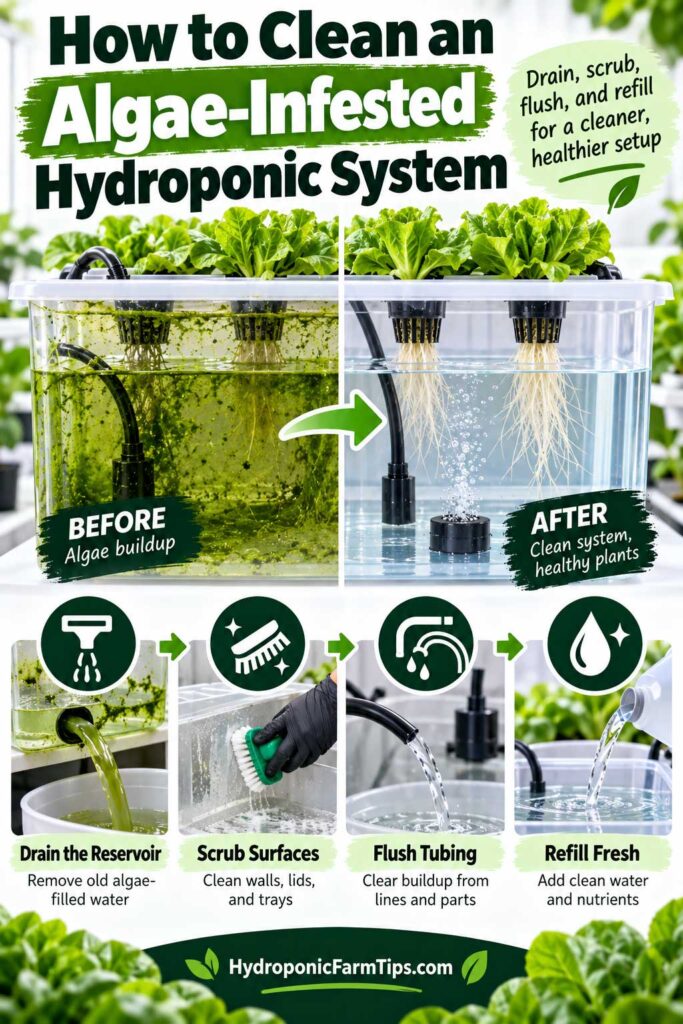
If algae has spread beyond a small patch, a more thorough cleaning may be necessary. The goal is to remove algae from the reservoir and equipment without damaging your plants or leaving buildup behind.
Step 1: Drain the Reservoir
Remove the old nutrient solution if it contains heavy algae growth, floating debris, or an unpleasant odor.
If plants are still growing in the system, make sure the roots do not dry out while you clean.
Step 2: Remove Loose Debris
Take out any visible algae, dead roots, plant material, or sediment you can safely remove.
Pay close attention to corners, seams, tubing connections, and areas around pumps where buildup often collects.
Step 3: Scrub the Reservoir
Use a clean brush or sponge to scrub algae from the reservoir walls, lid, and other accessible surfaces.
If plants are still in the system, avoid using household soap or cleaners that could leave residue in the root zone.
Step 4: Clean Removable Components
If possible, remove and clean air stones, pumps, filters, tubing, net pots, drip lines, and irrigation fittings. Algae can remain in small crevices and quickly return even after the reservoir itself looks clean.
Step 5: Flush the System
For NFT, drip, ebb-and-flow, and other circulating systems, flushing helps remove loosened algae and debris from channels and irrigation lines.
Continue until the water running through the system looks clean and little visible debris remains.
Step 6: Refill With Fresh Nutrient Solution
Once the system is clean, refill the reservoir with fresh water and nutrients.
Check the pH and nutrient concentration before returning the system to normal operation.
Step 7: Fix the Light Leak
This step is essential.
Cleaning alone will not solve recurring algae if light can still reach the water. Cover clear tubing, close gaps around net pots, use an opaque reservoir, and block any other areas where grow lights or sunlight can reach the nutrient solution.
A thorough cleaning combined with light control is much more effective than repeatedly treating algae after it appears.
How to Prevent Algae in Hydroponics
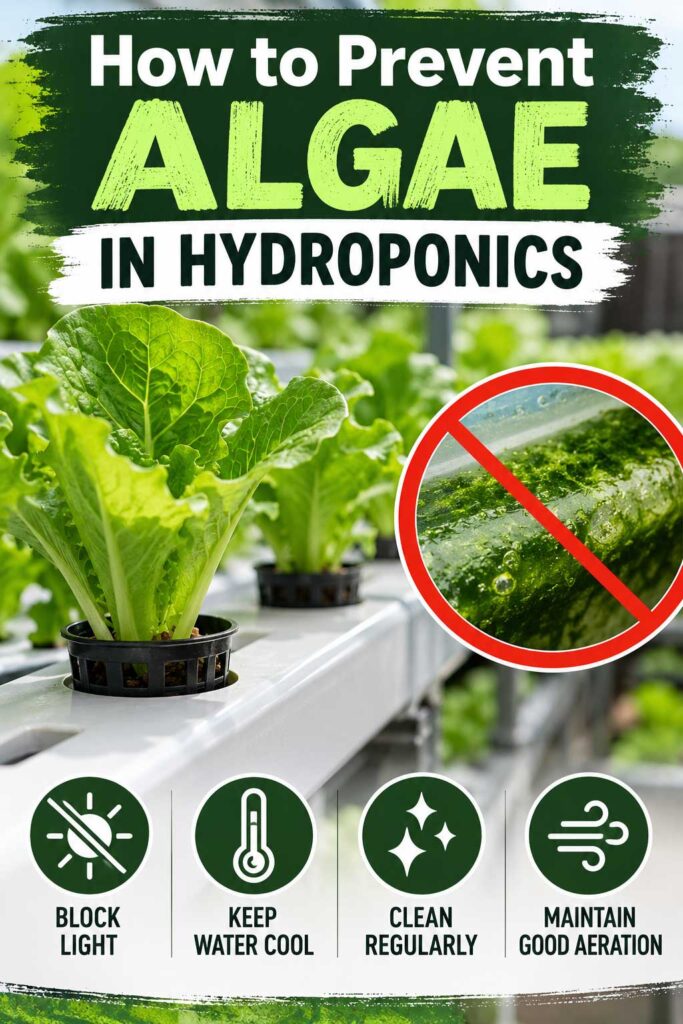
Preventing algae in hydroponics is usually much easier than removing a mature outbreak. Since algae depends heavily on light, the most effective strategy is to keep nutrient solution and other wet surfaces as dark as possible.
Use an Opaque Reservoir
Avoid clear or translucent containers for hydroponic nutrient solution.
Choose a reservoir that blocks light completely. Oklahoma State University Extension likewise recommends covering hydroponic tanks to prevent light from reaching the nutrient solution. If your current container lets light through, cover the outside with an opaque material.
Even small amounts of light can encourage algae over time.
Cover Unused Openings
Empty planting holes, gaps around net pots, and loose-fitting lids can all let light into the system.
Cover unused openings and make sure reservoir lids fit securely.
For net pots, collars or light-blocking covers can help shade the water below.
Keep Growing Media Shaded
Moist rockwool, clay pebbles, coco, and other growing media can develop algae when exposed to grow lights.
Keep the wet portion of the medium shaded whenever possible. A suitable cover around the plant base can reduce surface algae significantly.
Just avoid trapping excessive moisture directly against the stem.
Use Opaque Tubing
Clear tubing can also encourage algae, so use opaque irrigation or water lines anywhere they are exposed to light.
Control Reservoir Temperature
Keep the reservoir away from direct sunlight, hot grow lights, heating vents, and other heat sources.
For many hydroponic crops, a nutrient solution temperature around 65–72°F (18–22°C) is a useful general target, although ideal temperatures vary by crop.
Maintain Good Aeration
In systems such as DWC, good aeration helps support healthy roots and stable root-zone conditions.
Inspect air stones and pumps regularly to make sure airflow has not dropped because of algae, mineral deposits, or equipment wear.
Clean Between Growing Cycles
After harvest, clean the reservoir and reusable equipment before starting the next crop.
Removing old roots, biofilm, plant debris, and algae residue makes it harder for algae to become established again.
Check Your System Regularly
Make algae inspection part of your normal hydroponic maintenance.
During routine checks, look for green patches on growing media, slime around net pots, algae inside tubing, reservoir discoloration, clogged emitters or filters, and any cracks or openings that let light into the system.
Catching a small patch early is much easier than dealing with a full outbreak later.
The simplest rule is this: keep nutrient-rich water out of the light. If the wet parts of your hydroponic system stay dark, clean, and well aerated, algae becomes much easier to prevent.
Best Tools for Preventing Algae From Coming Back
The most effective algae-control products are often the simplest ones: tools that keep light out, improve aeration, and make reservoir conditions easier to monitor.
| Product | Best For | Why We Like It | Buy |
|---|---|---|---|
| Light-Blocking Reservoir Cover | Existing reservoirs | An easy way to shade reservoirs that are letting too much light through | Check Price |
| Net Pot Covers / Clone Collars | DWC & Kratky | Helps block light around planting holes and the base of plants | Check Price |
| Black Vinyl Tubing | Pumps & irrigation | Better than clear tubing for reducing algae inside water lines | Check Price |
| Digital Water Thermometer | Monitoring reservoir temperature | Makes it easy to spot excessively warm nutrient solution before problems build | Check Price |
| Air Pump + Air Stone Kit | DWC systems | Supports stronger aeration and healthier root-zone conditions | Check Price |
How to Keep Light Out of Your Reservoir
You can have an opaque reservoir and still develop algae if light is sneaking in through small openings.
Start by checking the reservoir while your grow lights are running. Look around net pots, lid edges, air-line openings, fill ports, drain fittings, tubing entrances, and unused planting holes. If you can see light reaching the nutrient solution, that spot can support algae growth.
Your reservoir should block light completely. If the container glows when held against a bright light, cover it with an opaque material or replace it.
Net pot openings are another common trouble spot. Use properly sized pots, collars, or covers to shade the nutrient solution without pressing tightly against plant stems.
Empty planting holes should also be covered. A simple opaque plug or removable cover is usually enough.
If algae repeatedly forms inside water-carrying clear tubing, switching to opaque tubing is one of the easiest long-term improvements you can make.
Finally, keep the reservoir out of direct sunlight whenever possible. Even an opaque container can absorb heat from the sun, raising the nutrient-solution temperature and making root-zone conditions harder to manage.
A few minutes spent finding these small light leaks can prevent a lot of algae cleanup later.
Algae in Different Hydroponic Systems
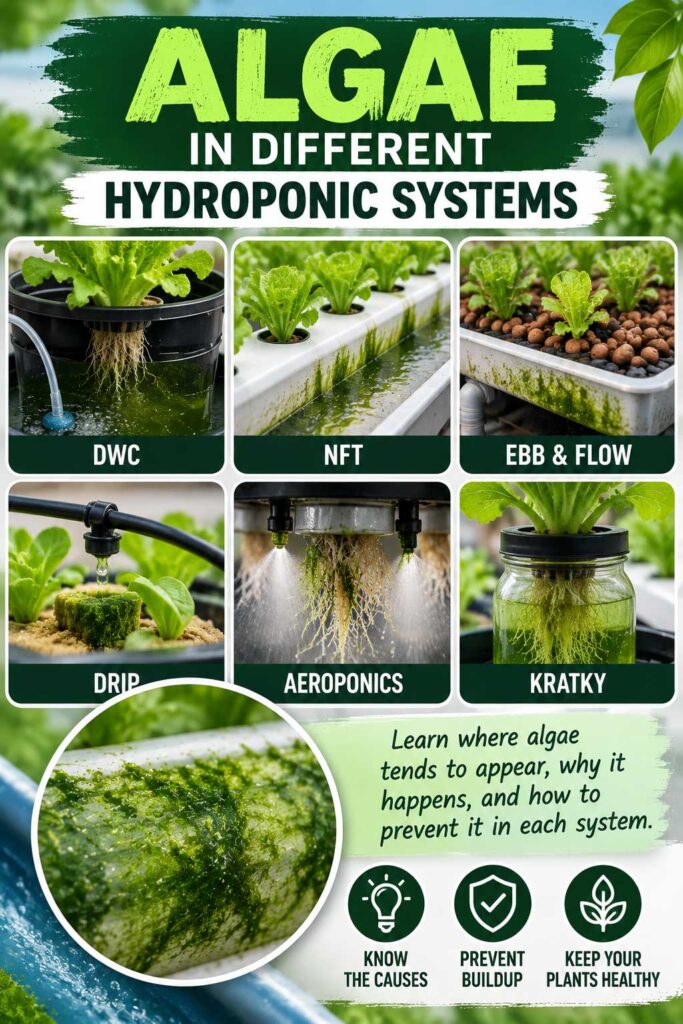
Algae can develop in almost any hydroponic setup, but the most common problem areas depend on the type of system you use.
Knowing where algae is most likely to appear makes it easier to prevent.
Algae in DWC Systems
In Deep Water Culture (DWC), plant roots remain suspended directly in aerated nutrient solution. Algae usually starts where light reaches the bucket or reservoir through gaps around net pots, translucent containers, or wet clay pebbles near the surface.
Use opaque buckets or containers, keep planting openings shaded, and maintain steady aeration.
Algae in Kratky Systems
Kratky systems can develop algae quickly when light reaches the reservoir. Since the nutrient solution may remain in place for long periods, even a small light leak can lead to noticeable green growth.
Clear jars, uncovered net pot openings, direct sunlight, and exposed nutrient solution are the most common trouble spots. Using an opaque container or a light-blocking sleeve can greatly reduce algae problems in Kratky setups.
Algae in NFT Systems
In Nutrient Film Technique (NFT) systems, a thin stream of nutrient solution flows continuously through growing channels.
Algae often develops inside translucent channels, around planting holes, near drains, or anywhere water collects in shallow pockets. Heavy buildup can eventually restrict flow, so keeping channels shaded is especially important.
Use opaque channels whenever possible and cover unused planting sites.
Algae in Ebb-and-Flow Systems
Ebb-and-flow systems repeatedly flood and drain the grow tray, which means some surfaces stay damp for long periods.
Algae commonly appears on growing media, tray surfaces, drain fittings, reservoir walls, or low spots where water remains after draining. Better drainage and shading exposed wet surfaces can help prevent recurring growth.
Algae in Drip Systems
Drip systems are especially vulnerable around emitters and consistently damp growing media. Algae may develop around drip points, on rockwool or coco, inside clear irrigation tubing, or in runoff trays.
Use opaque irrigation lines and avoid leaving large areas of wet growing media exposed to strong light.
No matter which system you use, the same rule applies: algae thrives where nutrient-rich water and light meet. Finding and blocking those exposed areas is usually the most reliable long-term solution.
Algae on Rockwool, Clay Pebbles, and Growing Media
Algae does not only grow inside reservoirs. It can also develop on rockwool, clay pebbles, coco, grow sponges, and other moist growing media when those surfaces are exposed to light.
This is especially common around seedlings and young plants because the growing medium often stays damp while receiving strong light from above.
Surface growth is one of the most common forms of algae in hydroponics, especially in systems where the growing media stays wet under strong grow lights.
Why Algae Grows on Growing Media
Algae needs moisture, nutrients, and light.
Problems are most likely when the surface stays constantly wet, nutrient solution reaches the top of the media, grow lights shine directly onto it, or splashing repeatedly wets the upper surface.
A thin green layer may be mostly cosmetic at first, but heavier growth can create a slimy coating and keep the area around the plant stem wetter than necessary.
Algae on Rockwool
Rockwool is especially prone to surface algae because it holds moisture very well.
If the top of the cube stays wet and exposed to light, a green film can begin developing fairly quickly.
To reduce the problem:
- Keep the nutrient level below the top of the cube when possible
- Avoid keeping the rockwool constantly saturated
- Shade exposed rockwool with a light-blocking cover
- Reduce splashing around the cube
Make sure any cover leaves enough space around the stem and does not trap excessive moisture against it.
Algae on Clay Pebbles
Clay pebbles can also develop algae when the upper layer remains wet.
In DWC systems, this often happens when the water level is too high or strong aeration continually splashes nutrient solution onto the surface.
If algae appears, check whether the solution is reaching higher into the net pot than necessary.
Keeping the upper layer of clay pebbles relatively dry and shaded makes it much harder for algae to become established.
If you’re still choosing a setup, our guide to the best hydroponic systems for home compares DWC, Kratky, NFT, ebb and flow, drip, and other common systems.
Should You Remove Algae From Growing Media?
Small amounts of algae can often be gently removed from the surface.
Avoid aggressive scraping around delicate stems or roots. The more important step is correcting the conditions that allowed it to grow.
Once the surface receives less light and is no longer staying unnecessarily wet, algae usually becomes much easier to control.
If it keeps returning, check for excess moisture, splashing, overly high water levels, or light reaching areas that should stay shaded.
Should You Use Hydrogen Peroxide for Hydroponic Algae?
Hydrogen peroxide is sometimes used in hydroponics to help clean equipment and reduce algae or microbial buildup, but it should not be treated as the main solution.
If light is still reaching the nutrient solution, algae will usually return.
How Hydrogen Peroxide Works
Hydrogen peroxide acts as an oxidizer and eventually breaks down into water and oxygen. At the right concentration, it can help remove algae and organic buildup from hydroponic equipment and surfaces.
However, stronger concentrations can damage plant roots, sensitive seedlings, beneficial microorganisms, and some system materials.
For that reason, avoid guessing at peroxide strength or adding concentrated hydrogen peroxide directly to the root zone.
When Hydrogen Peroxide Can Be Useful
Hydrogen peroxide may be useful for:
- Cleaning an empty reservoir between crops
- Sanitizing pumps, tubing, trays, and removable equipment
- Cleaning algae-covered surfaces away from live roots
- Preparing reusable equipment before the next growing cycle
It is generally safer and easier to use peroxide during a full system cleaning than to rely on repeated treatments in a reservoir containing live plants.
Be Careful With Active Hydroponic Systems
If you use hydrogen peroxide in a running system, follow the product concentration and manufacturer directions carefully.
Hydrogen peroxide is sold in very different strengths, so advice based only on “tablespoons per gallon” can be misleading unless the exact concentration is known. Oklahoma State University Extension cautions that algae-control rates vary by product and crop and that overly strong treatments can injure plants, so product-label directions matter.
Also avoid mixing hydrogen peroxide with other sanitizers or chemical treatments unless the product directions specifically allow it.
What About Beneficial Microbes?
Hydrogen peroxide does not distinguish between unwanted microorganisms and beneficial ones.
If you intentionally use microbial inoculants or biological root products, peroxide may interfere with them. In that type of setup, routine peroxide use can work against the biological approach you are trying to maintain.
The Better Long-Term Solution
Peroxide can help with cleanup, but it does not correct the conditions that caused the algae.
Long-term control still comes down to blocking light, maintaining good aeration, controlling reservoir temperature, keeping equipment clean, and shading wet growing media.
Think of hydrogen peroxide as a cleaning aid, not a replacement for good hydroponic system design and maintenance.
Useful Supplies for Deep Cleaning
Physical cleaning and light control should do most of the work. If you use hydrogen peroxide or another sanitizer, follow the product directions carefully rather than guessing at a dose.
| Product | Best For | Important Note | Buy |
|---|---|---|---|
| 3% Hydrogen Peroxide | Cleaning empty equipment | Use only according to product directions and appropriate hydroponic cleaning guidance | Check Price |
| Nitrile Cleaning Gloves | System sanitation | Useful when cleaning reservoirs or handling sanitizing products | Check Price |
| Bottle Cleaning Brushes | Tubing & narrow fittings | Helps physically remove algae and biofilm from hard-to-reach areas | Check Price |
Common Mistakes That Make Algae Worse
Recurring algae in hydroponics often happens because the visible growth gets cleaned while the underlying cause remains.
Avoiding these common mistakes can make algae much easier to control.
1. Cleaning Algae Without Blocking the Light
This is one of the most common mistakes.
You can scrub the reservoir completely clean, but if light still reaches the nutrient solution, algae may return quickly.
Check transparent reservoir walls, lid gaps, unused planting holes, clear tubing, and exposed growing media for light leaks.
Fixing the light exposure is usually more important than repeatedly cleaning the same algae.
2. Using Clear Containers
Clear jars, bottles, and reservoirs make it easy to see the water level, but they also allow light into the nutrient solution.
That creates favorable conditions for algae.
If you use a clear container, cover it with an opaque material or replace it with a light-blocking reservoir.
3. Keeping Growing Media Too Wet
If the surface of rockwool, clay pebbles, coco, or grow sponges stays constantly wet, algae can develop around the base of the plant.
This often happens when the water level is too high, irrigation runs too frequently, aeration splashes solution upward, or drainage is poor.
Keeping the upper surface slightly drier can greatly reduce algae growth.
4. Ignoring Warm Reservoir Temperatures
Warm nutrient solution can encourage algae growth while also reducing dissolved oxygen.
Keep the reservoir away from direct sunlight, heating vents, and other major heat sources whenever possible.
5. Overusing Chemical Treatments
More peroxide, sanitizer, or another treatment does not necessarily mean faster results.
Overuse can damage roots, disrupt beneficial microorganisms, and add unnecessary stress to plants.
Treatments should never replace basic prevention practices such as blocking light, improving cleanliness, and maintaining good reservoir conditions.
6. Forgetting to Clean Tubing and Equipment
Algae can remain inside pumps, filters, air stones, irrigation lines, and tubing even after the reservoir looks clean.
That hidden buildup can quickly spread again.
During a serious outbreak, clean the entire water path rather than focusing only on the reservoir.
7. Allowing Plant Debris to Accumulate
Dead roots, fallen leaves, and other organic material can collect in the reservoir or grow tray.
This debris does not directly cause algae, but it can reduce water quality and increase unwanted microbial activity.
Remove dead plant material as part of routine maintenance.
8. Trying to Eliminate Every Tiny Trace of Algae
A tiny patch of algae does not mean the entire system needs aggressive treatment. Correct the light or moisture problem, clean the affected area, and watch for regrowth. The goal is to keep algae from spreading enough to affect roots, water quality, or equipment.
Frequently Asked Questions About Algae in Hydroponics
Is a Little Algae Okay in Hydroponics?
A small amount of algae in hydroponics is usually not an emergency. A thin green film on the surface of growing media or in one small area of the system may have little immediate effect on your plants.
However, it is still worth fixing the cause early. Algae can spread quickly when light continues reaching nutrient-rich water.
Does Algae Steal Nutrients From Hydroponic Plants?
Algae can use some of the same nutrients that your plants depend on.
In a mild outbreak, the effect may be small. In a heavily affected system, algae can contribute to nutrient instability and make reservoir management more difficult.
Does Algae Lower Oxygen in Hydroponics?
It can.
Algae produces oxygen during photosynthesis, but it also consumes oxygen during respiration. When algae dies and begins decomposing, microorganisms use additional dissolved oxygen.
Heavy algae growth can therefore contribute to lower oxygen levels around plant roots.
Why Is My Hydroponic Water Turning Green?
Green nutrient solution usually means algae is growing in the water.
The most common reason is that light is reaching the reservoir through transparent walls, gaps in the lid, unused planting holes, or clear tubing.
Blocking that light is the first thing to check.
Can Algae Kill Hydroponic Plants?
Algae itself does not usually kill healthy plants overnight, but a serious infestation can create stressful root-zone conditions.
Heavy algae can contribute to lower dissolved oxygen, clogged irrigation components, pH instability, poorer water quality, and increased organic buildup. If those conditions become severe, plant health can decline.
Why Does Algae Keep Coming Back After I Clean It?
Recurring algae usually means the underlying problem has not been corrected.
Check the reservoir, nutrient channels, net pot openings, clear tubing, and wet growing media for places where light is still getting through.
Cleaning removes existing algae, but blocking light prevents the next outbreak.
Can I Cover Algae on Rockwool?
Yes, shading the surface can be an effective way to reduce algae on rockwool.
Use a suitable light-blocking cover around the plant while leaving enough space around the stem for airflow.
Also check whether the rockwool is staying wetter than necessary.
Should I Change My Nutrient Solution if I Have Algae?
Not always.
A small patch of algae may only require cleaning and better light control. However, if the nutrient solution is heavily green, cloudy, foul-smelling, or filled with algae debris, replacing it after cleaning the system is usually a good idea.
Does Algae Mean My Nutrients Are Too Strong?
Not necessarily.
Algae needs nutrients, but excessive nutrient strength is usually not the primary cause. In most hydroponic systems, light exposure is the key factor that allows algae to grow.
Do not automatically reduce nutrients below the level your plants need just to control algae. For more help separating nutrient problems from other plant stress, see our guide to hydroponic nutrient deficiencies.
Can I Prevent Algae Completely?
Complete elimination is difficult because algae spores are common in the environment. What you can do is make the system a poor place for algae to grow.
Keep nutrient-rich water dark, maintain good aeration, control excessive heat, and clean equipment regularly. When those conditions are right, algae usually remains a minor maintenance issue rather than a recurring problem.
Final Thoughts on Algae in Hydroponics
Algae in hydroponics is common, but it is usually a sign that light is reaching nutrient-rich water or another consistently wet part of the system.
The best long-term solution is not to keep treating algae after it appears. Instead, focus on changing the conditions that allow it to grow.
In practice, prevention comes down to keeping nutrient-rich water out of the light and maintaining a clean, well-aerated root zone.
If algae has already spread, remove the visible growth, clean affected equipment, replace heavily contaminated nutrient solution when necessary, and then find the light leak that caused the problem.
A small amount of algae is rarely a disaster, but catching it early can help you avoid clogged equipment, unstable reservoir conditions, and additional stress on plant roots.
Once the wet parts of your hydroponic system stay dark, clean, and well maintained, algae becomes much easier to control.
More Hydroponic Gardening Guides You May Like
If you are troubleshooting your hydroponic garden, these guides can help you diagnose related problems and keep your system running smoothly.
- Hydroponic Nutrient Deficiencies: Signs, Causes & Fixes — Learn how to recognize common nutrient deficiencies and correct them before they seriously affect plant growth.
- Why Are My Hydroponic Leaves Turning Yellow? — Diagnose yellow leaves caused by pH problems, nutrient issues, root stress, lighting, and other common causes.
- Hydroponic Root Rot: Causes, Symptoms & Treatment — Identify unhealthy roots and learn how oxygen, water temperature, and sanitation affect root health.
- How Often Should You Change Hydroponic Water? — Learn when to replace your nutrient solution and how to maintain a cleaner, more stable reservoir.
- Best pH for Hydroponics — Understand how pH affects nutrient availability and why maintaining the correct range is important for healthy plants.
- Hydroponic Nutrient & pH Chart — Compare recommended pH and nutrient ranges for popular hydroponic vegetables, herbs, and fruiting crops.