Hydroponic basil is one of the easiest and fastest-growing herbs to cultivate indoors, and basil is also among the most profitable plants to grow hydroponically for growers interested in high-value herbs. But even a healthy basil plant can eventually outgrow its original space. As the roots expand and the foliage becomes fuller, moving the basil to a larger hydroponic container or system can give it more room to grow and make routine maintenance easier.
Replanting hydroponic basil is a little different from transplanting a plant grown in soil. The roots are often long, exposed, and surprisingly delicate, so pulling or twisting the plant out of its net pot can cause unnecessary damage. The new setup also needs the right water level, nutrient concentration, oxygen, and pH so the plant can adjust without excessive stress.
You might need to replant basil because it has outgrown a small countertop garden, because several seedlings are crowded into one pod, or because you’re moving a young plant into a larger Deep Water Culture (DWC) system. Whatever the reason, the basic goal is the same: disturb the roots as little as possible while giving the plant a better place to continue growing.
In this guide, we’ll walk through how to replant hydroponic basil step by step, including when to make the move, what you’ll need, how to handle tangled roots, and what to do afterward to help your basil settle in and return to active growth.
Quick Answer: Can You Replant Hydroponic Basil?
Yes. Learning how to replant hydroponic basil mainly comes down to protecting the roots and preparing the new setup before you make the move. If your basil has healthy roots, you can move it into a larger hydroponic system or transplant it into soil. This works especially well with living basil sold with its roots attached at some grocery stores and farmers’ markets.
For the best chance of success:
- Choose basil with firm stems, healthy leaves, and pale or white roots.
- Prepare the new growing container before removing the plant.
- Keep the roots moist while you’re working.
- Handle tangled roots gently rather than pulling them apart.
- Keep the crown of the plant above the water or growing medium.
- Use a properly mixed hydroponic nutrient solution if you’re keeping the basil in hydroponics.
- Give the plant a few days to adjust before heavy pruning or harvesting.
A little wilting immediately after the move isn’t necessarily a problem. What matters is whether the plant begins producing healthy new growth as it establishes itself.
Can You Replant Hydroponic Basil From the Grocery Store?
Yes—if the basil you buy still has a healthy root system attached, you may be able to keep it growing instead of using the leaves once and throwing the plant away.
If you’ve been wondering how to replant hydroponic basil from the grocery store, the process is much the same as transferring basil from a countertop garden. The important distinction is that you’re looking for living basil with its roots still attached, not a package of cut basil stems.
Once you bring the plant home, you can transfer it to a larger hydroponic setup or, if you prefer, transplant it into potting soil.
The key is to check the plant before you start. Look for firm green stems, healthy leaves, and pale or white roots without a slimy texture or unpleasant odor. A severely wilted plant or one with damaged roots will be much harder to establish successfully.
If you’re not ready to transplant immediately, you can temporarily keep the exposed roots moist in clean water. However, plain water isn’t a good long-term substitute for a properly balanced hydroponic nutrient solution if you want the basil to continue producing vigorous new growth.
Sweet basil (Ocimum basilicum) belongs to the mint family, Lamiaceae, and naturally responds well to regular pruning. Once your grocery-store basil establishes itself in its new system, harvesting the growing tips can encourage branching and give you a fuller plant rather than a single bunch of basil that disappears after dinner.
Quick Tip: Grocery-store basil pots are often crowded with multiple plants. You don’t necessarily need to keep the entire clump together. If the roots can be separated without excessive tearing, you can divide healthy plants and give them their own growing sites.
When to Replant Hydroponic Basil
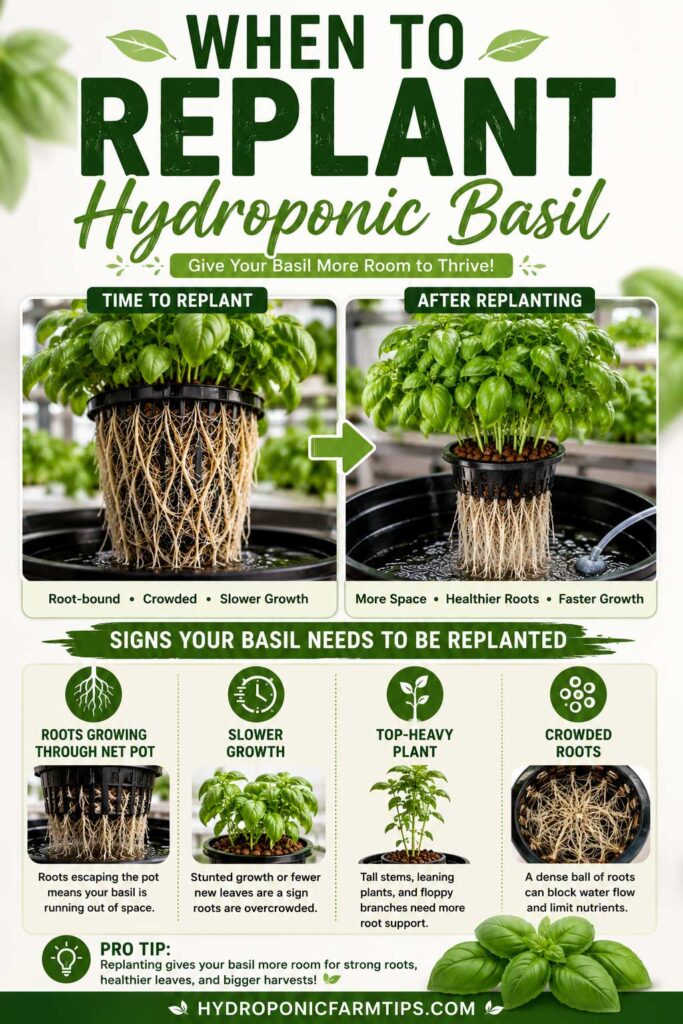
Before learning how to replant hydroponic basil, it helps to know whether the plant actually needs to be moved. There’s no single size or age when basil must be replanted. Instead, look at whether the plant has outgrown its current setup or is ready to move from a temporary container into its permanent hydroponic system.
Here are the signs that it may be time.
You Bought Living Basil With Roots Attached
If you bought living basil from a grocery store or farmers’ market and the roots are still attached, you don’t need to wait for the plant to become larger before replanting it.
Check the roots first. Healthy roots should generally be light-colored and firm rather than slimy, mushy, or foul-smelling. If the plant looks healthy, you can prepare its new hydroponic container and make the move soon after bringing it home.
The Plant Has Outgrown a Small Countertop Garden
Countertop hydroponic gardens are excellent for starting basil, but mature plants can become large enough to crowd neighboring plants, block their light, or become difficult to support.
At that point, moving the basil to a larger DWC, Kratky, drip, or one of these hydroponic growing systems can give both the roots and foliage more room.
Several Basil Plants Are Crowded Together
Grocery-store basil and hydroponic seed pods sometimes contain several plants growing close together.
You don’t always have to separate them, but overcrowding can become a problem as the plants mature. If you decide to divide them, do it while the roots can still be teased apart with minimal damage rather than waiting until they form a tightly intertwined mass.
The Plant Is Becoming Difficult to Support
A mature basil plant can develop a surprisingly large canopy. If stems are leaning heavily, neighboring plants are being shaded, or the original growing site can no longer support the plant comfortably, a larger setup may make ongoing care easier.
Before transplanting, however, consider whether pruning the basil will solve the problem. A top-heavy plant doesn’t necessarily need a larger hydroponic system.
The Roots Are Crowding a Small Reservoir
Long roots hanging below a net pot are completely normal in hydroponics and aren’t, by themselves, a reason to transplant basil.
The problem comes when a large root mass begins interfering with a small system—such as wrapping around a pump, restricting water movement, making the reservoir difficult to clean, or competing with the roots of several neighboring plants.
In those situations, moving the basil to a roomier system can make maintenance easier.
You’re Moving Basil Into Its Permanent System
If you started basil in a seedling tray, propagation unit, or small countertop garden, you may simply be ready to move it into the hydroponic system where you plan to grow it to maturity.
Young basil is generally easier to transfer once it has enough established roots to stay secure while you handle it.
Tip: Don’t wait for basil to become severely root-bound before making a planned transfer. If you know you’re moving a young plant into a larger system, doing it while the plant is healthy and actively growing is usually easier than untangling a massive root system later.
Tools and Supplies You’ll Need
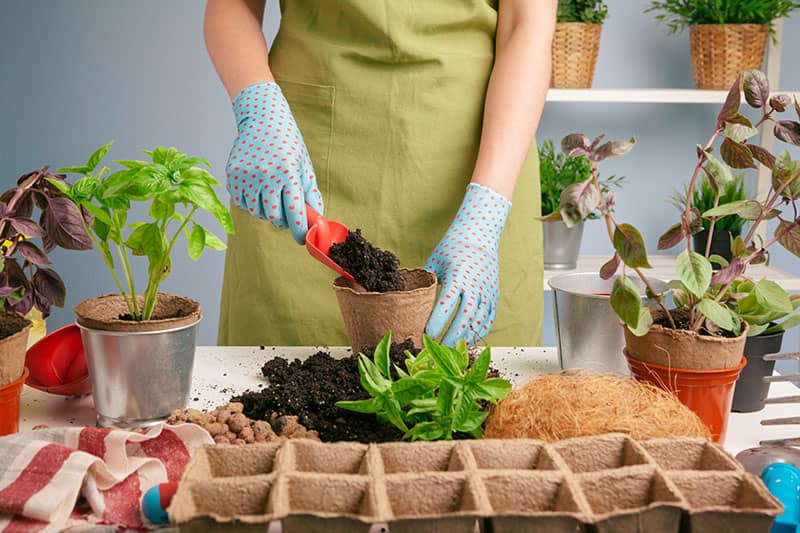
Before you replant hydroponic basil, get the new setup completely ready. Hydroponic roots can dry surprisingly quickly when exposed to air, so having everything within reach makes the transfer easier on the plant.
You won’t necessarily need every item below. What you use depends on whether you’re moving grocery-store basil, transferring a plant from a countertop garden, or upgrading to a larger hydroponic system.
A Suitable Net Pot or Plant Holder
Choose a net pot that fits your new hydroponic system and can securely support the basil.
If the plant is already growing in a reusable net pot that fits the new system, there may be no reason to remove it. Keeping the plant in its existing net pot can prevent unnecessary disturbance to established roots.
Clean Growing Medium
You may need a small amount of hydroponic growing medium to stabilize the plant in its new net pot. Common options include:
- Clay pebbles (LECA)
- Grow sponges or plugs
- Rockwool
- Other inert media designed for hydroponic systems
The goal is to support the stem and crown—not to tightly pack the roots. Mature roots should have room to extend naturally into the system.
A Clean Reservoir or Growing Container
Clean the new reservoir before transplanting and remove any algae, old root material, or mineral deposits.
Fill it with water and prepare the system before you take the basil out of its existing setup.
Hydroponic Nutrients
If the basil will continue growing hydroponically, you’ll need a complete hydroponic nutrient solution rather than plain water for long-term growth.
Follow the nutrient manufacturer’s mixing directions and avoid assuming that more fertilizer will help the plant recover faster. An overly concentrated solution can create additional stress.
pH Meter or Test Kit
A digital pH meter or liquid test kit makes it easier to monitor the nutrient solution after the move.
Basil is commonly grown hydroponically in a slightly acidic nutrient solution. Our hydroponic nutrient and pH chart explains how pH, EC, and nutrient levels vary among commonly grown hydroponic plants.
EC or TDS Meter — Optional
An EC or TDS meter isn’t essential for making a simple basil transfer, but it’s useful if you want better control over nutrient concentration.
This becomes particularly helpful in larger recirculating systems where nutrient strength changes as plants consume water and minerals.
Clean Scissors
Keep a clean pair of scissors nearby in case you find genuinely dead or damaged roots.
Long or tangled roots usually don’t need trimming. Healthy hydroponic roots are valuable, and unnecessary root pruning adds stress to the transplant.
Clean Water and a Small Container
Keep clean water nearby in case the roots need to remain exposed while you’re working. A small bowl or container can temporarily hold the roots and keep them moist during a more complicated transfer.
A spray bottle can also be useful for briefly misting exposed roots.
Plant Support — If Needed
A large basil plant may need temporary support after being moved. A soft plant tie or small stake can help keep long stems upright without damaging them.
Pro Tip: Prepare the reservoir, nutrient solution, aeration, net pot, and growing medium before touching the basil. Ideally, the roots should move directly from the old environment into the new one rather than sitting exposed while you finish setting everything up.
Step-by-Step: How to Replant Hydroponic Basil
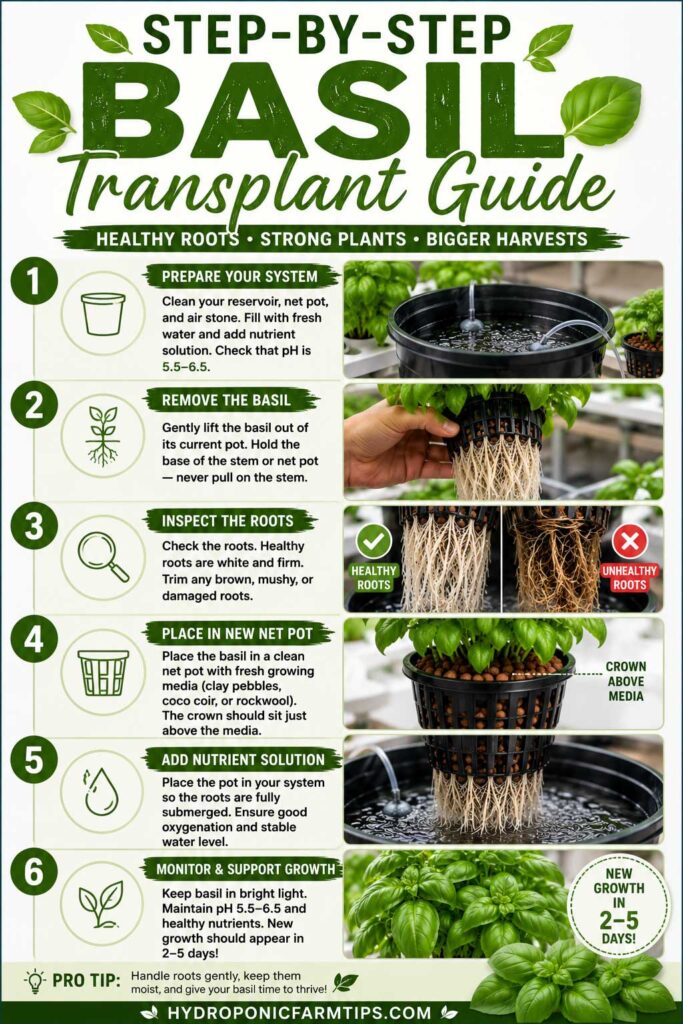
Once everything is prepared, the transfer itself is mostly a matter of careful root handling. Keep the roots moist, disturb them as little as possible, and move the plant directly into its new setup.
The exact process will vary slightly depending on whether you’re moving grocery-store basil, transferring a plant from a countertop garden, or placing a young plant into a larger hydroponic system.
Step 1: Prepare the New Hydroponic System
Get the new system running before removing the basil from its current container.
- Fill the reservoir with clean water.
- Add a complete hydroponic nutrient solution according to the manufacturer’s directions.
- Check and adjust the pH.
- Start the air pump if you’re using DWC.
- Make sure pumps and irrigation are operating correctly in recirculating systems.
- Set the appropriate water level for your system.
This way, the basil can go directly into its new home without its roots sitting exposed while you finish preparing the reservoir.
Step 2: Examine How the Basil Is Currently Growing
Before trying to remove anything, look at the roots and growing container.
If the basil is already in a net pot that fits your new system, leave it there whenever practical. There’s little benefit in removing a healthy plant from a usable net pot simply to put it into another one.
For grocery-store basil, gently remove any wrapping or container around the root mass and determine whether you’re dealing with one plant or several plants growing together.
Step 3: Remove the Basil Without Pulling the Roots
Support the plant near its base and handle the root system gently.
If you’re removing basil from a small pod, sponge, or growing basket, don’t pull hard on the stem to free it.
More importantly, don’t try to force a large mass of established roots backward through small net-pot openings. If the existing net pot is compatible with the new system, transferring the entire pot is usually safer.
If a disposable container absolutely must be removed, it may be better to carefully cut the container away than sacrifice a large portion of healthy roots trying to pull them through it.
Step 4: Keep the Roots Moist
Don’t leave exposed hydroponic roots sitting on a counter while you work.
Move the plant directly into the new system whenever possible. If you need additional time to prepare or separate plants, temporarily place the roots in clean water or keep them consistently moist.
This is especially important when dealing with the fine roots of young basil plants.
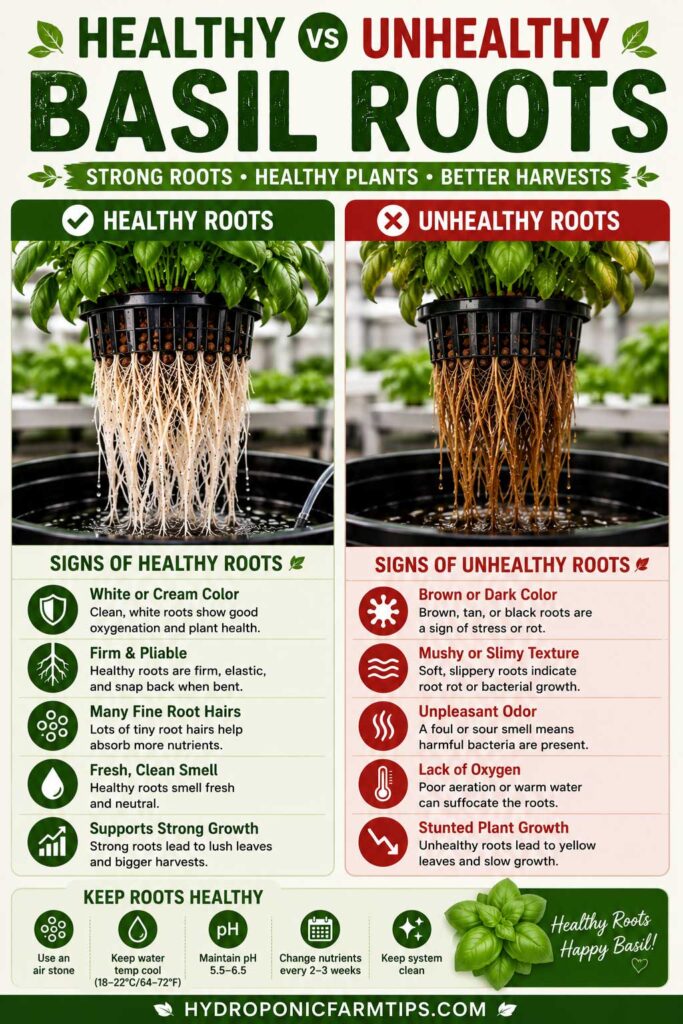
Step 5: Inspect the Roots
Take advantage of the transfer to check the condition of the root system.
Healthy hydroponic basil roots are generally light-colored and firm, although nutrient solutions and growing media can sometimes stain otherwise healthy roots.
Watch for more concerning signs such as:
- Soft or mushy roots
- Slimy root surfaces
- Sections of roots breaking apart easily
- An unpleasant or rotten odor
These symptoms can point to developing root problems. If you’re seeing them, our guide to root rot in hydroponics explains the common causes, warning signs, prevention, and treatment in more detail.
Don’t trim roots simply because they’re long, tangled, or darker than expected. Remove tissue only when you’re confident it’s dead or badly damaged.
Step 6: Separate Multiple Basil Plants Only If Necessary
Grocery-store basil and hydroponic seed pods may contain several plants growing together.
Roots that separate easily can be teased apart and placed in individual growing sites.
If the roots are heavily intertwined, however, don’t aggressively rip them apart just to create individual plants. Keeping a small cluster together may cause less damage than forcing apart an established root mass.
Step 7: Position the Basil in Its New Growing Site
Place the plant into the new net pot or growing site and add only enough growing medium to keep it stable.
Keep the crown and lower stem above the nutrient solution rather than burying or continuously submerging them.
Clay pebbles can be particularly useful for supporting a mature basil plant because they hold the stem upright while allowing plenty of open space around the root zone.
Step 8: Set the Correct Water Level
Water level depends on the hydroponic system you’re using.
In DWC, established roots can extend directly into the aerated nutrient solution while the crown remains above it.
For a young transplant whose roots haven’t yet reached the reservoir, bubbling and splashing from the air stone can help keep the lower growing medium moist until the roots extend farther downward.
In NFT, drip, and other systems, make sure the roots are positioned where they’ll reliably receive moisture according to the way that particular system operates.
Step 9: Return the Basil to Suitable Growing Conditions
Once the plant is secure, return it to appropriate light and normal growing conditions.
You don’t automatically need to place every transplanted basil plant in low light. However, if you’ve moved it from a relatively dim grocery store or indoor location directly beneath a powerful grow light, increase the light exposure gradually rather than making a dramatic change all at once.
Try to avoid changing several environmental conditions simultaneously. Stable temperature, light, water, and nutrient conditions make it easier for the plant to adjust.
Step 10: Watch the Basil Closely for the Next Several Days
Some temporary drooping after a difficult transfer isn’t necessarily a sign that the plant is failing.
Instead, watch what happens over the following days. Good signs include:
- Leaves remaining firm or regaining firmness
- Stems staying upright
- Healthy root tips developing
- New leaves beginning to form
- No spreading yellowing or tissue collapse
If the plant continues to wilt or deteriorate, check the basics first: water availability, root-zone aeration, nutrient concentration, pH, temperature, and light intensity.
Pro Tip: Resist the temptation to “help” a struggling transplant by changing everything at once. Constantly adjusting nutrients, pH, water level, and lighting can make troubleshooting harder. Keep the growing environment stable, observe the plant, and correct a specific problem when you identify one.
How to Replant Hydroponic Basil in Soil
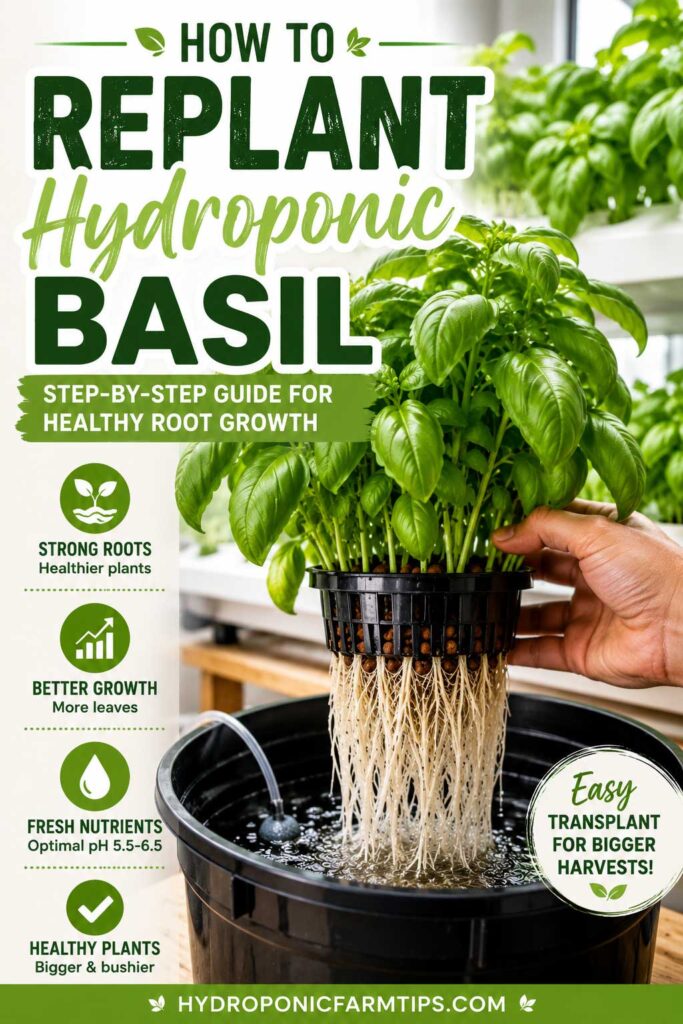
You don’t have to keep your basil in a hydroponic system. If you bought living basil with roots attached or would rather grow it in a regular pot, you can move it into soil instead.
The transition requires a little extra attention because roots that developed in water are moving into a very different environment. The goal is to keep the roots moist while they begin adapting to the potting mix.
1. Choose a Pot With Drainage
Select a container large enough to comfortably hold the roots without folding them into a tight ball. Make sure the bottom has drainage holes so excess water can escape.
2. Use a Light, Well-Draining Potting Mix
Fill the container partially with a quality potting mix. You don’t need to use garden soil or cover the roots with dry dirt before planting.
A loose potting mix gives the roots a better balance of moisture and air as they adjust to their new environment.
3. Keep the Roots Moist During the Transfer
Remove the basil from its hydroponic setup only after the pot is ready.
Handle the roots gently and avoid allowing them to dry out while you’re working. There’s no need to scrub or aggressively clean roots that were already growing in a clean hydroponic system.
4. Position the Basil at the Correct Depth
Hold the plant upright in the center of the pot and gently spread the roots rather than forcing them into a compact mass.
Add potting mix around the roots until they’re covered, but keep the crown of the basil around the same level it was growing previously. Don’t bury a large portion of the stem.
5. Water Thoroughly
Water the potting mix after planting so it settles naturally around the roots and eliminates large air pockets.
Allow excess water to drain from the bottom of the container. The goal is evenly moist soil, not permanently saturated soil.
6. Give the Plant Time to Adjust
A newly transferred basil plant may temporarily droop while its roots adjust from a hydroponic environment to potting mix.
Keep the soil reasonably moist during this transition, but a drooping leaf isn’t, by itself, a signal to water again. Check the moisture in the potting mix first.
Avoid heavy pruning or other major changes until you see the plant returning to active growth.
7. Acclimate It Before Moving Outdoors
If the basil has been growing indoors, don’t move it directly into intense outdoor sun for an entire day.
Introduce it gradually to outdoor conditions over several days, increasing its exposure to sunlight and wind as it adjusts. This hardening-off process reduces the chance of leaf scorch and environmental stress.
Tip: If your only goal is to grow basil in soil, starting from seed or taking a basil cutting can sometimes be easier than converting a large, established hydroponic plant. But healthy rooted grocery-store basil is certainly worth trying rather than throwing it away.
How to Reduce Transplant Shock When Moving Basil to Soil
Moving basil from hydroponics into potting mix is a bigger adjustment than transferring it between two hydroponic systems. Some temporary drooping or slower growth can happen while the roots adapt to a different balance of moisture and oxygen.
For the first several days, keep conditions as steady as you can. Avoid heavy pruning, sudden changes in light, repeatedly moving the plant, or keeping the potting mix waterlogged. If the basil is going outdoors, gradually introduce it to stronger sunlight and wind rather than putting it directly into full exposure.
A little drooping doesn’t necessarily mean the transfer failed. Watch the newest leaves and stems for signs that the plant is settling in.
Want to move other plants out of your hydroponic system? See our complete guide on how to transfer plants from hydroponics to soil for a more detailed look at the process.
Common Mistakes to Avoid
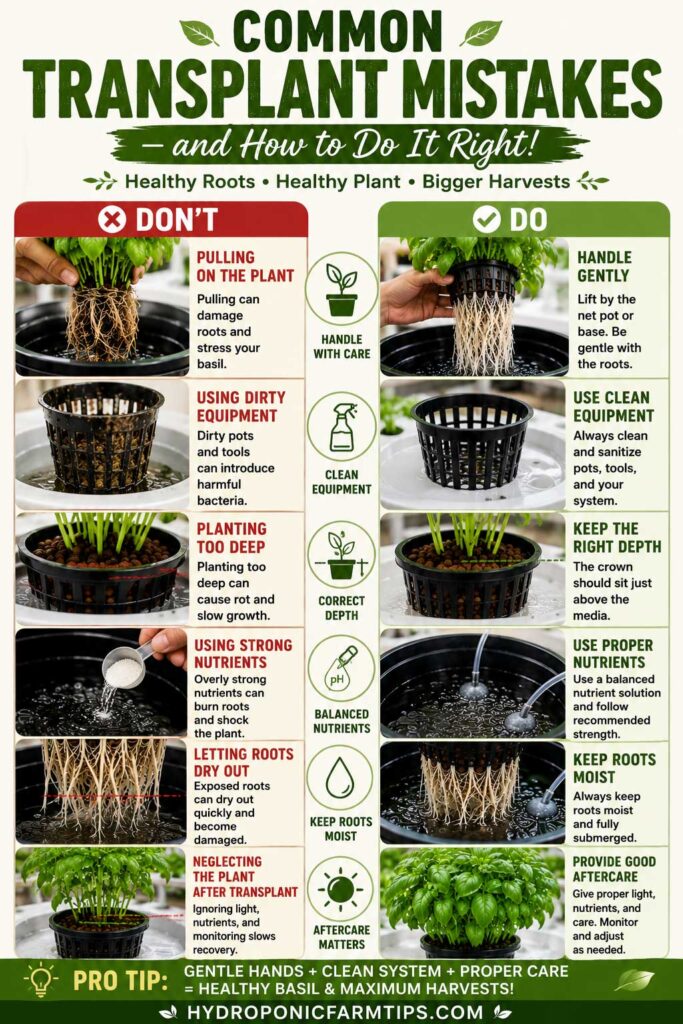
Hydroponic basil usually handles a move well when its roots stay healthy and growing conditions remain stable. Most transplant problems come from unnecessary root damage or changing too many things at the same time.
Pulling the Plant Out by the Stem
Never yank basil out of a growing pod or net pot by its stem. The stem can bruise or snap, and pulling can tear fine roots below the surface.
Support the plant near its base and move the existing net pot with it whenever possible.
Forcing Roots Through a Net Pot
This is an easy mistake to make with mature hydroponic basil. Once roots have grown extensively through the openings of a net pot, trying to pull them backward through those holes can cause significant damage.
When the existing net pot fits the new system, leave the basil in place and transfer the entire pot. If a disposable container has to come off, carefully cutting the container away may be safer than forcing the roots through it.
Trimming Healthy Roots
Long or tangled roots don’t automatically need pruning. A large root system is normal for mature hydroponic basil.
Also, don’t judge root health by color alone. Nutrients and growing media can stain roots. Texture and smell can tell you more: slimy, mushy, deteriorating, or foul-smelling roots deserve closer attention.
Letting Exposed Roots Dry Out
Prepare the new system before you remove the basil from its old one.
If the transfer takes longer than expected, keep exposed roots moist with clean water. Don’t leave them lying uncovered while you mix nutrients or adjust the new reservoir.
Separating Crowded Plants Too Aggressively
Several basil plants may be growing together, particularly in grocery-store pots and densely seeded hydroponic pods.
Separate them only when the roots can be teased apart reasonably easily. Aggressively ripping apart a mature root mass may cause more harm than leaving a small group together.
Submerging the Crown
The roots need reliable access to water, but the base of the stem shouldn’t remain submerged in the nutrient solution.
Position the basil securely so the roots can reach moisture while the crown stays above the waterline.
Mixing an Overly Strong Nutrient Solution
Adding extra fertilizer won’t make a transplanted plant establish faster.
Use a complete hydroponic nutrient according to the manufacturer’s directions and monitor the plant before making major adjustments.
Overlooking Root-Zone Conditions
Temperature, oxygenation, water movement, nutrient concentration, and pH all affect the root environment.
This is particularly important in DWC, where adequate aeration helps maintain a healthy root zone. If the basil begins deteriorating after the move, check the growing environment rather than immediately assuming the transplant itself failed.
Changing Too Many Things at Once
Moving the basil is already a significant change. At the same time, avoid unnecessarily giving it stronger nutrients, dramatically brighter lighting, a different temperature, heavy pruning, and a completely different water level.
Stable conditions make it easier for the plant to adjust—and much easier for you to identify the cause if something does go wrong.
Harvesting Heavily Immediately After the Move
You don’t need to follow an arbitrary seven-day waiting period, but a major harvest immediately after a difficult transplant isn’t helpful either.
Give the plant time to settle in. Once it looks firm and you see healthy new growth, you can gradually return to your normal pruning and harvesting routine.
Pro Tip: New growth is one of the best signs that your basil has adjusted successfully. Instead of watching the calendar, watch the plant. Firm foliage, healthy roots, and developing leaves tell you far more than whether three, five, or seven days have passed.
Pro Tips for Healthy Hydroponic Basil
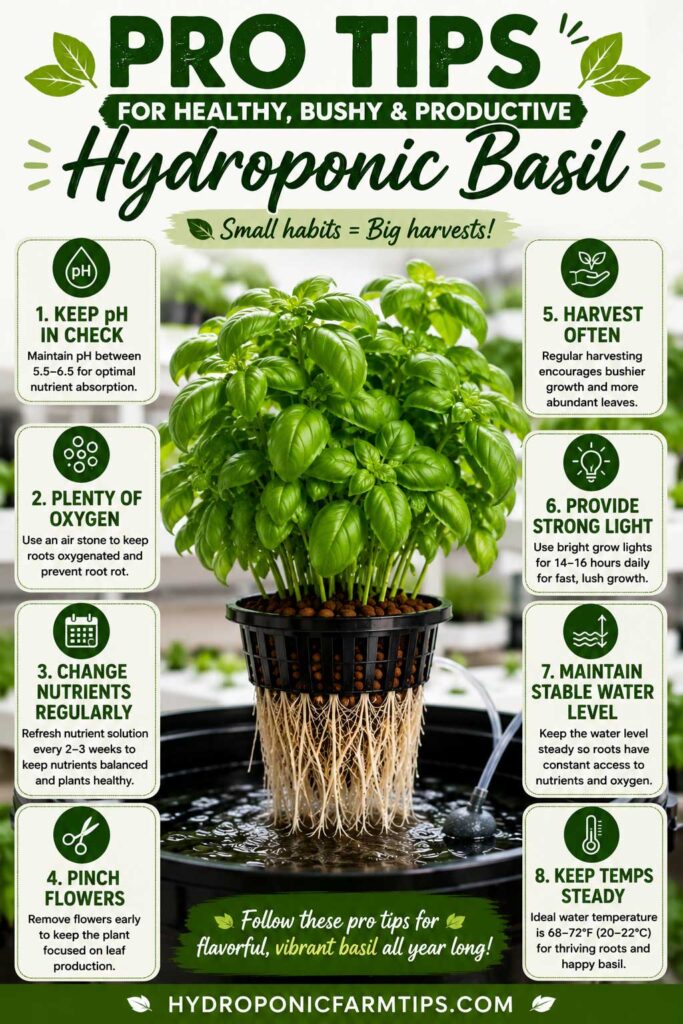
Once your basil has settled into its new growing space, a few simple habits can help keep it compact, leafy, and productive. At this point, the focus shifts from transplanting to maintaining steady growth.
Let the Plant Tell You When It Has Recovered
Don’t rely on a fixed number of days after transplanting. Look for firm leaves, upright stems, healthy roots, and—most importantly—new growth.
Once new leaves begin developing normally, the basil is usually settling into its new environment.
Don’t Keep Disturbing the Roots
After the transfer, leave healthy roots alone as much as possible. There’s no need to untangle them, straighten them, or routinely trim them just because they look crowded.
In hydroponics, a large mass of roots below the net pot can be completely normal.
Prune for a Bushier Plant
Once the basil is actively growing again, pinch or cut the main growing tip just above a leaf node. The buds at that node can develop into new branches, creating a fuller plant with more growing tips to harvest later.
Repeat this as new branches mature rather than allowing one tall central stem to dominate the plant.
Harvest From the Top
It can be tempting to pick the biggest leaves from the bottom first, but regular top pruning generally does a better job of shaping the plant.
Cutting stems above healthy nodes allows the remaining branches to continue developing while keeping the basil from becoming tall and leggy.
Remove Flower Buds Early
Basil eventually tries to flower, especially as the plant matures or experiences environmental stress.
If you’re growing primarily for leaves, pinch off developing flower spikes when you notice them. This won’t prevent flowering forever, but it can help keep the plant focused on vegetative growth for longer.
Give Mature Basil Enough Space Above the Reservoir
We often think about root space when moving basil, but canopy space matters too.
A mature plant can shade smaller herbs growing beside it. Prune regularly and give larger basil plants enough room so leaves aren’t constantly pressed against neighboring plants or grow lights.
Keep the Reservoir Routine Simple
Check the reservoir regularly rather than waiting for the basil to show obvious stress. Monitor water level, nutrient concentration, pH, aeration, and general cleanliness according to the needs of your particular system.
Avoid chasing tiny fluctuations with constant adjustments. Consistency is usually more useful than repeatedly trying to hit a perfect number.
Watch the New Growth
Older leaves can retain damage or discoloration from conditions that existed before the transplant.
Pay particular attention to the newest leaves and root tips. Healthy new growth is often a better indication of how the basil is responding to its current environment than an old damaged leaf that isn’t going to repair itself.
Expert Tip: Mature basil doesn’t need to look perfect to keep producing. A few damaged older leaves aren’t necessarily a reason to change your nutrient solution, adjust the pH, trim the roots, and move the lights all at once. Watch the new growth and make one correction at a time when there’s a clear problem.
Frequently Asked Questions
Can you replant hydroponic basil?
Yes. Hydroponic basil can be moved into another hydroponic system as long as the roots are handled carefully and the new growing environment is prepared beforehand.
If the plant is already growing in a net pot that fits the new system, you may be able to transfer the entire net pot without disturbing the roots at all.
Can you replant hydroponic basil from the grocery store?
Yes, provided the living basil still has a healthy root system attached. Some grocery stores sell basil as a living plant rather than as cut stems, and these plants may be suitable for continued growing at home.
Check the roots and foliage before replanting. Firm stems, healthy leaves, and roots without a slimy texture or rotten odor are good signs.
How do I know when hydroponic basil needs more space?
Don’t use roots growing through the bottom of a net pot as your only indicator. That’s normal in hydroponics.
Consider moving the plant when its size begins causing practical problems—for example, when it crowds neighboring plants, becomes difficult to support, interferes with equipment, or fills a small reservoir to the point that maintenance becomes difficult.
Will replanting shock my basil?
It can. The amount of stress depends on how much the roots are disturbed and how different the new conditions are.
A simple transfer of an intact net pot may cause very little noticeable stress, while separating several tangled plants or removing an established root system from its container can cause temporary wilting.
Should I trim the roots before replanting basil?
Usually not.
Leave firm, intact roots alone whenever possible. Consider trimming only tissue that is clearly dead or deteriorating, such as roots that are mushy, slimy, breaking apart, or associated with a rotten odor.
Remember that root color alone doesn’t always indicate disease. Nutrient solutions and growing media can stain otherwise healthy roots.
Can I separate grocery-store basil into several plants?
Sometimes. What looks like one large grocery-store basil plant may actually be several individual plants growing closely together.
If their roots separate relatively easily, you can divide them into individual growing sites. If the root mass is heavily intertwined, forcing the plants apart may cause more damage than leaving a small cluster together.
What pH does hydroponic basil prefer?
Basil generally performs well in a slightly acidic hydroponic nutrient solution. The exact target can vary depending on the nutrient program and growing system, so monitor pH regularly and follow recommendations for the nutrients you’re using.
How long does basil take to recover after being replanted?
There’s no exact recovery period. A plant moved with minimal root disturbance may barely react, while a basil plant whose roots had to be separated or handled extensively may take longer to resume vigorous growth.
Rather than counting days, look for firm foliage, healthy root tips, and developing new leaves.
Should I add nutrients immediately after replanting?
If you’re moving basil into a hydroponic system, it should have access to a properly prepared complete hydroponic nutrient solution.
Follow the nutrient manufacturer’s directions rather than adding extra fertilizer in an attempt to speed up recovery.
Can I move soil-grown basil into a hydroponic system?
It’s possible, but it’s more complicated than transferring a plant that was already growing hydroponically.
Soil needs to be removed carefully from the roots before placing the plant into the system. Introducing soil and organic debris into a hydroponic reservoir can also create maintenance and sanitation problems.
If you have the choice, starting new basil from seed or cuttings is often simpler than converting an established soil-grown plant to hydroponics.
Why is my basil wilting after I replant it?
Some wilting can occur after significant root disturbance, but continued wilting means you should check the growing conditions.
Make sure the roots have reliable access to moisture, the plant isn’t experiencing an abrupt increase in light or heat, and the hydroponic system is operating correctly. In DWC, check aeration as well.
Why are my basil leaves turning yellow after replanting?
Yellow leaves don’t necessarily mean the basil needs more fertilizer.
Yellowing can have several causes, including transplant stress, root problems, nutrient imbalance, unsuitable pH, environmental changes, or normal aging of older leaves.
Pay particular attention to where the yellowing occurs and what the new growth looks like before making major changes to the system.
How often should I change the nutrient solution?
There isn’t one replacement schedule that works for every hydroponic system.
Reservoir size, plant number, water quality, nutrient formulation, temperature, and whether the system recirculates all affect maintenance. Follow the nutrient and system manufacturer’s recommendations while monitoring water level, pH, nutrient concentration, cleanliness, and plant health.
Can hydroponic basil keep producing after it is replanted?
Yes. Once established, basil can continue producing new stems and leaves as long as growing conditions remain favorable.
Regular pruning and harvesting above healthy nodes encourages branching, while removing developing flower spikes can help maintain leafy growth. Eventually, however, productivity can decline, so it isn’t necessary to keep the same basil plant indefinitely.
What is the easiest way to replant hydroponic basil?
The easiest method is to prepare the new system first and transfer the basil with as little root disturbance as possible. If the existing net pot fits the new setup, moving the whole net pot is often safer than removing the plant and untangling its roots.
Keep Your Hydroponic Basil Growing After Replanting
If your basil still has a healthy root system, there’s no reason its growing journey has to end when it outgrows a countertop garden—or when you bring a living basil plant home from the grocery store.
The most important thing to remember when learning how to replant hydroponic basil is to protect the roots during the move. Prepare the new system first, keep exposed roots moist, avoid unnecessary trimming or untangling, and don’t force an established root mass through a net pot.
Once the basil is in its new home, give it time to adjust and watch the new growth. Healthy new leaves and root tips are better indicators of recovery than following an exact number of days.
After you’ve had success with basil, there are plenty of other herbs you can grow hydroponically, including mint, parsley, cilantro, chives, and oregano.
More Hydroponic Growing Guides
Ready to keep growing? These guides cover everything from choosing your next plant to keeping your hydroponic garden healthy:
- Hydroponic Herbs for Beginners — Go beyond basil with other beginner-friendly herbs that grow well in indoor hydroponic systems.
- How to Start a Hydroponic Garden — Build your first setup step by step, from choosing a system to planting your first crops.
- Best Plants to Grow Hydroponically — Find out which herbs, leafy greens, vegetables, and fruits are best suited to hydroponic growing.
- How to Grow Hydroponic Basil — Take your basil from seedling to harvest with practical tips for feeding, pruning, lighting, and ongoing care.
- Hydroponic Nutrient & pH Guide — Learn how to manage nutrients, pH, and EC so your plants get what they need without overcomplicating things.
- How to Prevent Root Rot in Hydroponics — Learn what healthy roots should look like, what causes root problems, and what to do when something looks wrong.
- Best LED Grow Lights for Hydroponics — Compare lighting options for herbs, leafy greens, vegetables, and other plants grown in indoor hydroponic systems.