If you’re wondering how many hours should grow lights be on for hydroponics, the short answer is usually 12 to 18 hours per day. The catch is that there’s no single schedule that works equally well for every plant. Lettuce, basil, tomatoes, seedlings, and flowering crops can all have different light requirements.
In an indoor hydroponic garden, grow lights replace much of the sunlight plants would normally receive outdoors. If you’re still choosing a fixture, our LED grow light guide explains what to look for when comparing lights for different hydroponic setups. Getting the schedule right matters because light drives photosynthesis, while a regular dark period gives plants time to carry out other important biological processes.
More light isn’t always better, either. Leaving grow lights on for too long can waste electricity and may stress plants, especially when the light is already intense. On the other hand, too few hours of light can contribute to slow growth, stretching, and disappointing yields.
In this guide, we’ll break down hydroponic grow light hours for seedlings, leafy greens, herbs, tomatoes, peppers, and other popular crops. We’ll also look at why the strength and position of your grow light matter just as much as the number of hours on the timer.
How Many Hours Should Grow Lights Be On for Hydroponics?
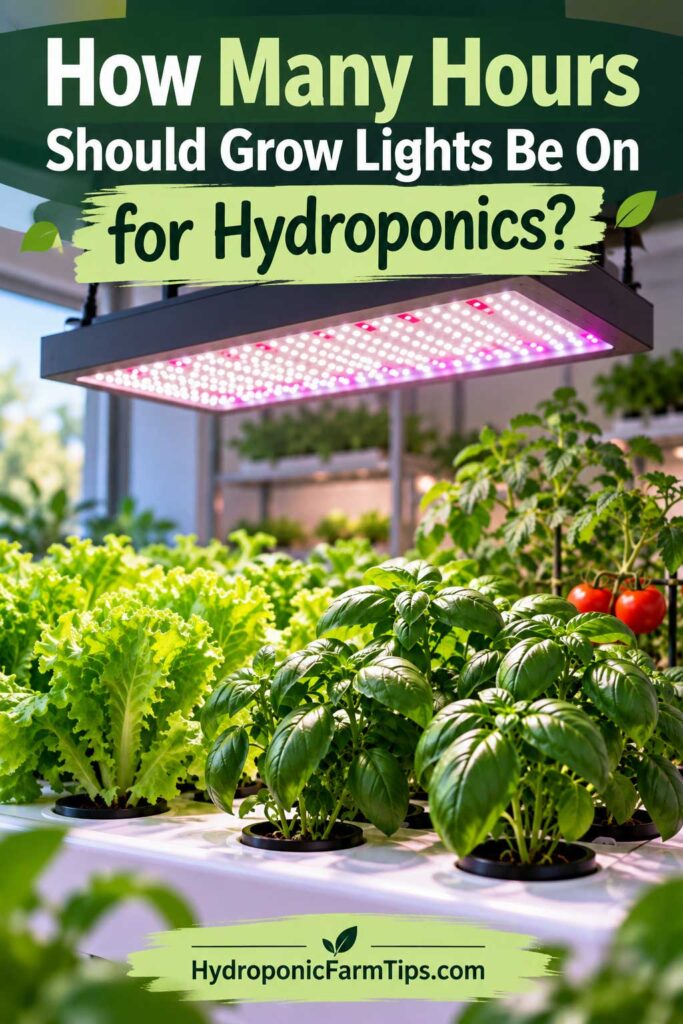
Most hydroponic plants need around 12 to 18 hours of grow light per day, followed by a period of darkness. The ideal schedule depends on the type of plant, its growth stage, and the intensity of your grow lights.
Leafy greens and herbs often perform well with 14 to 16 hours of light, while seedlings may receive 16 to 18 hours. Fruiting plants such as tomatoes, peppers, and strawberries typically need strong, consistent lighting, but their exact schedule can vary as they mature.
Here is a practical starting point for hydroponic grow light hours in a home hydroponic garden:
| Plant Type | Grow Light Hours Per Day | Dark Period |
|---|---|---|
| Seedlings | 16–18 hours | 6–8 hours |
| Lettuce & leafy greens | 14–16 hours | 8–10 hours |
| Basil & most herbs | 14–16 hours | 8–10 hours |
| Tomatoes | 14–18 hours | 6–10 hours |
| Peppers | 14–18 hours | 6–10 hours |
| Cucumbers | 14–16 hours | 8–10 hours |
| Strawberries | 12–16 hours | 8–12 hours |
| Hydroponic houseplants | 12–16 hours | 8–12 hours |
These ranges are starting points rather than strict rules. A powerful LED running for 14 hours can provide more usable light than a weaker fixture running for 18 hours. That’s why the number of hours alone doesn’t tell the whole story.
The goal is to provide enough light over the course of the day without unnecessarily extending the photoperiod. Later in this guide, we’ll look at how light intensity, plant type, and growth stage work together so you can fine-tune your own hydroponic lighting schedule.
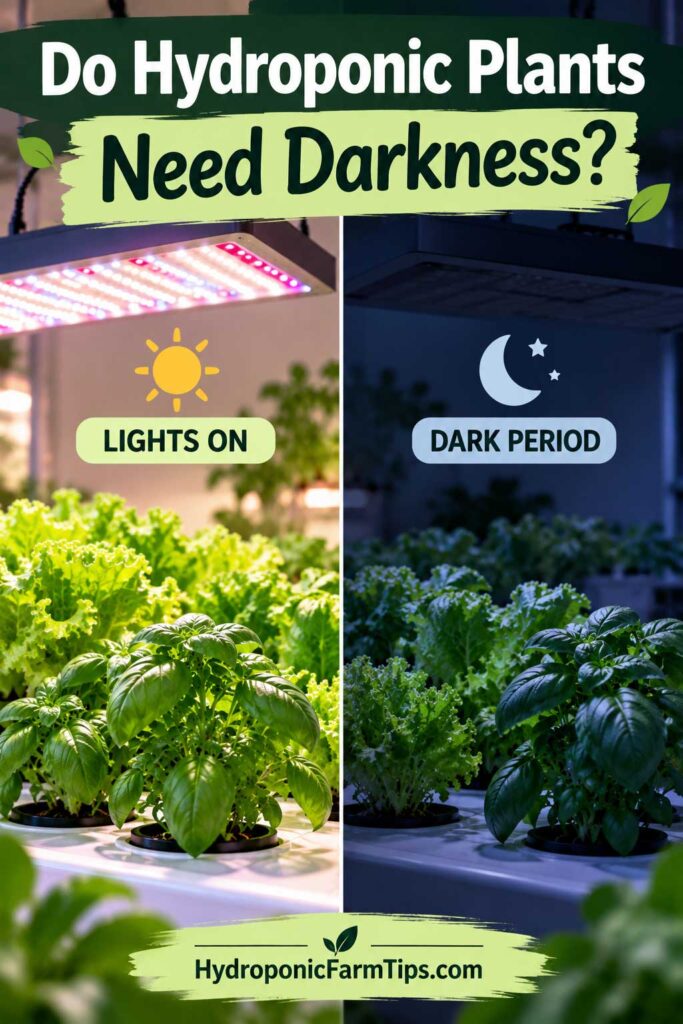
Why Hydroponic Plants Need a Dark Period
It can be tempting to think that leaving your grow lights on longer will make hydroponic plants grow faster. After all, plants use light for photosynthesis. For most crops grown in home hydroponic systems, a regular dark period is a sensible part of the lighting schedule.
Plants don’t simply shut down when the lights go off. During the dark period, they continue important processes involving respiration, energy use, growth, and their internal day-night rhythm. Providing a predictable light and dark cycle more closely resembles the conditions plants experience in nature.
For many hydroponic crops, a schedule such as 16 hours of light followed by 8 hours of darkness is a practical starting point. Some crops may perform well with slightly shorter or longer photoperiods depending on their growth stage and the amount of light they receive while the fixture is on.
Should Grow Lights Be Left On 24 Hours a Day?
For most home hydroponic gardens, there is little reason to run grow lights 24 hours a day.
Continuous lighting increases electricity use and can make temperature management more difficult. Depending on the crop and light intensity, an excessively long photoperiod may also contribute to plant stress rather than producing better growth.
Instead, use a timer to create a consistent schedule. For example, you might run your lights from 6:00 a.m. to 10:00 p.m. for a 16-hour photoperiod and leave them off for the remaining eight hours.
Consistency is more useful than constantly changing the schedule. Once you’ve chosen an appropriate photoperiod, watch how your plants respond and adjust the light duration or intensity when necessary.
Grow Light Hours for Hydroponic Seedlings
Hydroponic seedlings generally do well with about 16 to 18 hours of light per day, followed by 6 to 8 hours of darkness. Young plants need dependable light to develop compact, sturdy growth, but they don’t necessarily need the same light intensity as mature plants. The right hydroponic grow light hours for seedlings also depend on the intensity and position of the fixture.
One of the most common signs that seedlings aren’t getting enough light is stretching. The stems become long and thin as the young plants reach toward the light source. Increasing light intensity, extending the photoperiod within a reasonable range, or positioning the fixture correctly can help.
However, avoid assuming that moving the light as close as possible is always better. A powerful LED placed too close to tender seedlings may cause bleaching, curling, or other signs of light stress.
A Simple Seedling Light Schedule
For many indoor hydroponic setups, you can start with:
16 hours ON → 8 hours OFF
For example, set your timer to turn the grow lights on at 6:00 a.m. and off at 10:00 p.m.
If the seedlings appear healthy, compact, and evenly colored, there’s usually no reason to increase the lighting period. If they’re stretching, first consider whether the light intensity or fixture height is the problem rather than simply adding more hours.
As seedlings mature, you can adjust the lighting schedule based on what you’re growing. Leafy greens and herbs, for example, may stay close to a 14–16 hour schedule, while larger fruiting crops will need enough overall light to support more demanding growth.
Grow Light Hours for Lettuce and Leafy Greens
Lettuce and other leafy greens are among the easiest crops to grow hydroponically. They’re fairly forgiving under artificial light, which is one reason they’re so popular with home growers. In many indoor setups, 14–16 hours per day works well for lettuce, spinach, kale, arugula, Swiss chard, and bok choy.
For lettuce and other leafy greens, hydroponic grow light hours usually fall within a fairly predictable range.
If you’re deciding what else to grow, see our 10 Best Hydroponic Vegetables for more indoor crop ideas.
A simple 16-hours-on, 8-hours-off schedule is especially convenient for an indoor garden because it’s easy to automate with a timer.
How Much Light Does Hydroponic Lettuce Need?
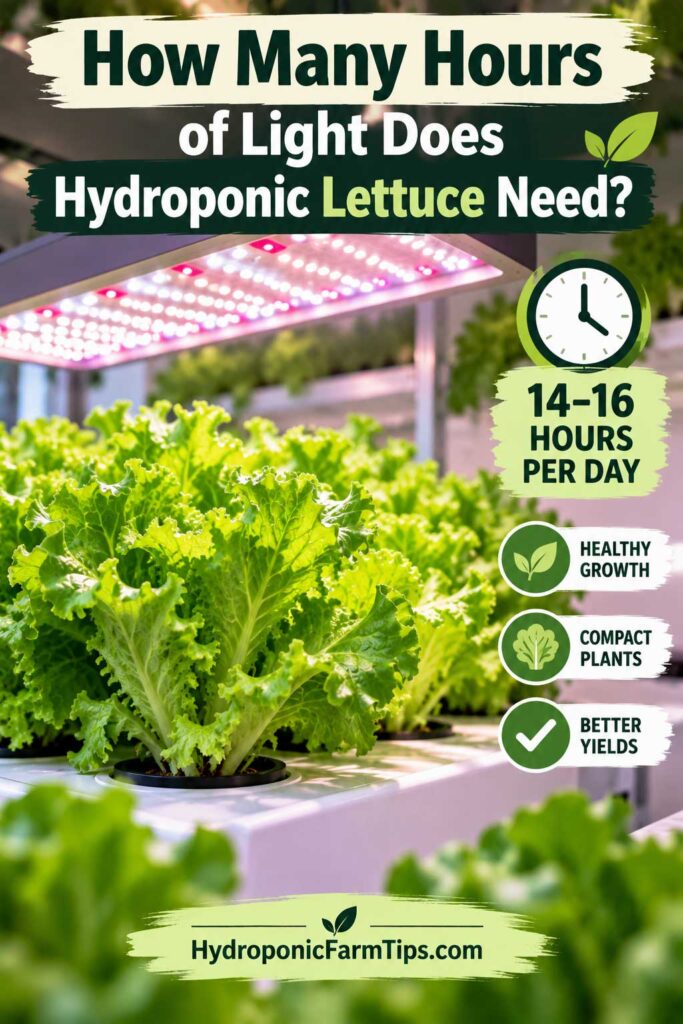
Hydroponic lettuce typically performs well with a long photoperiod combined with moderate light intensity. Because lettuce is grown primarily for its leaves rather than flowers or fruit, you don’t need to push the plants with extremely powerful lighting.
Watch the plants as they grow. Stretching or leaning toward the fixture can point to inadequate light, while pale or bleached upper leaves may indicate that the fixture is too intense or too close.
If growth seems slow, don’t automatically extend the photoperiod. Check the fixture height and intensity along with water temperature, nutrient concentration, and pH before adding more hours.
For most home hydroponic lettuce gardens, 14–16 hours per day is a practical place to start.
Grow Light Hours for Hydroponic Herbs
Herbs are another good fit for indoor hydroponics. Basil, mint, dill, chives, and many other culinary herbs can be grown successfully under a consistent daily lighting schedule.
| Hydroponic Herb | Suggested Light Schedule |
|---|---|
| Basil | 14–16 hours |
| Mint | 14–16 hours |
| Parsley | 12–16 hours |
| Cilantro | 12–16 hours |
| Dill | 14–16 hours |
| Chives | 14–16 hours |
| Oregano | 14–16 hours |
| Thyme | 14–16 hours |
The best hydroponic grow light hours vary somewhat between basil, mint, parsley, cilantro, and other herbs.
For more options, explore our 10 Best Hydroponic Herbs to Grow at Home.
These ranges aren’t rigid rules. The amount of usable light reaching the leaves matters just as much as the number of hours your fixture stays on.
How Many Hours of Light Does Hydroponic Basil Need?
Basil is one of the most popular herbs for hydroponic growing, and 14 to 16 hours of light per day is a practical starting point for indoor plants.
Healthy basil grown under adequate light should remain relatively compact, with good leaf development and short spaces between nodes. Long, thin stems can indicate insufficient light, while pale or curling upper leaves may point to excessive intensity.
Before changing the timer, check the fixture’s height and output. For a mixed hydroponic herb garden, 16 hours on and 8 hours off is a simple schedule to begin with.
Grow Light Hours for Tomatoes, Peppers, and Fruiting Plants
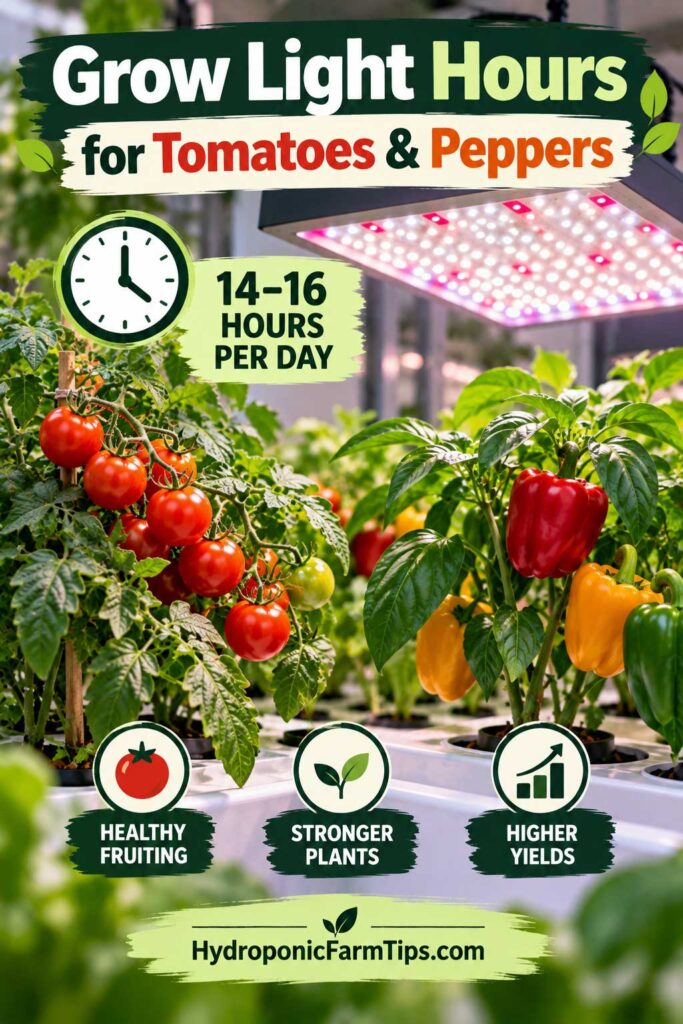
Fruiting hydroponic plants generally need more total light than leafy greens and herbs. Tomatoes, peppers, cucumbers, and strawberries must produce enough energy not only for leaves and roots but also for flowering and fruit development.
That doesn’t necessarily mean they need dramatically longer days. In many cases, they need more light during those hours.
For many indoor setups, 14 to 18 hours of grow light per day is a useful starting range for tomatoes and peppers. Cucumbers often perform well around 14 to 16 hours, while strawberries may be grown with roughly 12 to 16 hours, depending on the variety, growth stage, and lighting conditions.
Tomatoes and peppers may use similar hydroponic grow light hours to leafy crops, but they generally need stronger light during those hours.
Hydroponic Tomato Light Schedule
Hydroponic tomatoes are demanding plants, especially once they begin flowering and setting fruit. A common starting schedule is:
16 hours ON → 8 hours OFF
The bigger challenge with tomatoes is often not extending the photoperiod but providing enough light intensity across the entire canopy.
A weak grow light left on for 18 hours may still provide less daily light than a properly sized fixture operated for 14 or 16 hours. As tomato plants become larger, good fixture coverage becomes increasingly important because lower and outer leaves can easily become shaded.
Hydroponic Pepper Light Schedule
Peppers have similar lighting needs. Start with approximately 14 to 18 hours of light per day, with 16 hours being an easy schedule for many indoor systems.
Watch the plants rather than relying solely on the timer. Thin, stretched growth may suggest insufficient light, while bleaching or curling near the top of the canopy can indicate excessive intensity or heat.
What About Cucumbers and Strawberries?
Hydroponic cucumbers can generally start around 14 to 16 hours of light per day. Because cucumber vines grow quickly, maintaining even light coverage becomes important as the canopy expands.
Strawberries are a little more complicated because varieties can respond differently to day length. A range of approximately 12 to 16 hours can be used as a starting point for indoor hydroponic growing, but variety-specific recommendations should take priority.
With fruiting crops in particular, don’t judge your lighting setup by hours alone. Light intensity, fixture efficiency, canopy coverage, and total daily light exposure all influence how well the plants grow, flower, and produce fruit.
Does Grow Light Type Change the Lighting Schedule?
The type of grow light you use can influence your hydroponic lighting schedule, but light intensity and efficiency matter more than the technology name alone.
The University of Minnesota Extension also explains how light quality, intensity, and duration affect indoor plant growth.
Modern full-spectrum LED grow lights are popular for hydroponics because they can provide strong plant-usable light while producing less radiant heat than many older lighting systems. However, two LED fixtures can have very different outputs, so simply knowing that a light is an LED doesn’t tell you how long it should run.
LED Grow Lights
For most home hydroponic gardens, LED fixtures can be operated for approximately 12 to 18 hours per day, depending on the crop and light intensity.
Leafy greens and herbs may need less total light than tomatoes and peppers. A powerful LED may deliver enough light with a shorter photoperiod, while a lower-output fixture may need to run longer.
Fluorescent Grow Lights
Fluorescent lights, including T5 fixtures, can still work well for seedlings, herbs, and leafy greens. Because their output is generally lower than that of many modern horticultural LEDs, they may need to run toward the longer end of the recommended photoperiod.
They can be particularly useful for seedlings because young plants don’t require extremely intense light.
HID Grow Lights
High-intensity discharge (HID) systems such as metal halide (MH) and high-pressure sodium (HPS) lights can provide strong illumination, but they also produce considerable heat.
If you’re using HID lighting, pay close attention to fixture distance, canopy temperature, ventilation, and electricity use. Extending the photoperiod isn’t necessarily beneficial if the plants are already receiving plenty of light.
Ultimately, don’t choose your hydroponic grow light hours based only on whether you’re using LED, fluorescent, or HID lighting. The better approach is to consider the crop, growth stage, light intensity, fixture height, and total amount of light the plants receive each day.
How Light Intensity Affects Grow Light Hours
When setting hydroponic grow light hours, the number of hours your lights stay on is only part of the equation. Light intensity matters just as much as photoperiod when deciding how much light hydroponic plants receive each day.
Think of it this way: a weak grow light running for 16 hours and a powerful grow light running for 16 hours aren’t giving your plants the same amount of light.
This is why simply increasing your timer from 14 to 18 hours may not fix poor growth. If the fixture is too weak, positioned too far above the plants, or doesn’t adequately cover the canopy, the plants may still receive insufficient light.
Understanding PPFD and DLI
When comparing hydroponic grow lights, you’ll often see two terms:
PPFD (Photosynthetic Photon Flux Density) describes how much photosynthetically active light reaches a particular area of the plant canopy each second.
DLI (Daily Light Integral) represents the total amount of photosynthetically active light the plants receive over an entire day.
For a deeper explanation, Michigan State University Extension offers a helpful resource on understanding and managing daily light integral.
You don’t need to calculate these numbers every time you adjust your hydroponic garden, but understanding the relationship is useful:
In simple terms, DLI combines how intense the light is with how long the plants receive it. The actual calculation uses PPFD and the length of the photoperiod, but you don’t need to do the math every time you adjust a home system.
If you want to go deeper into the numbers, Purdue Extension also explains daily light integral and supplemental lighting.
For example, increasing the intensity can increase daily light exposure without increasing the number of hours the fixture operates. Likewise, running a lower-intensity light longer can increase total daily exposure—but only within reasonable limits for the crop.
Why More Hours Aren’t Always Better
Suppose your plants are already receiving plenty of light during a 16-hour schedule. Extending that schedule to 20 hours doesn’t automatically mean faster or healthier growth. It may simply waste electricity, add heat to the growing area, and expose plants to more light than they need while shortening their normal dark period.
This is especially important with powerful modern LED grow lights. Rather than running them for as many hours as possible, aim for a balance between light intensity, fixture height, and photoperiod.
If your plants are growing compactly, producing healthy leaves, and showing no signs of light stress, your current schedule may already be doing exactly what it needs to do.
Signs Your Hydroponic Plants Are Getting Too Much Light
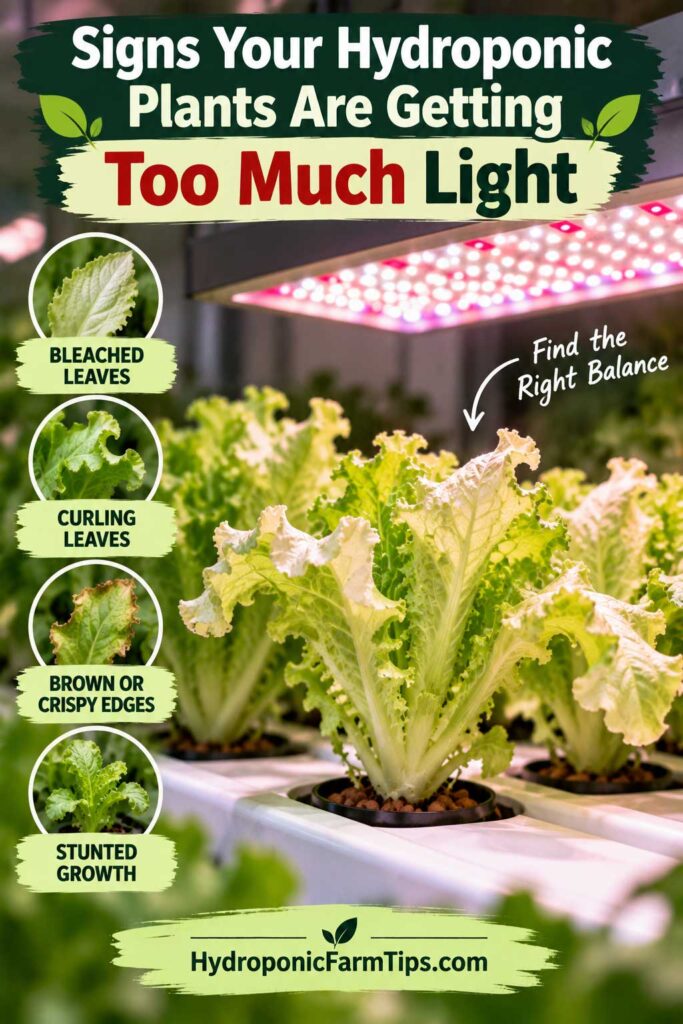
Leaving grow lights on longer doesn’t always produce faster growth. If the photoperiod is too long, the fixture is too intense, or the plants are too close to the light, they may begin showing signs of stress.
Common signs that hydroponic plants may be receiving too much light include:
- Bleached or unusually pale upper leaves
- Leaves curling upward or around the edges
- Dry or crispy patches near the top of the plant
- Leaf edges becoming brown or scorched
- Wilting even when the roots have adequate water
- Excessive heat around the plant canopy
- Problems concentrated on leaves closest to the grow light
Light stress can sometimes look similar to nutrient deficiencies, pH problems, or heat stress, so don’t assume the grow light is automatically responsible.
What to Do If Your Grow Lights Are Too Intense
Start by checking the distance between the fixture and the top of the plant canopy. Grow-light manufacturers often provide recommended hanging heights for seedlings, vegetative growth, and flowering or fruiting plants.
If your fixture has a dimmer, you can also reduce its intensity rather than immediately shortening the photoperiod.
For example, if your plants are healthy on a 16-hour light schedule but the upper leaves begin bleaching after you lower the fixture, increasing the hanging height or reducing intensity may make more sense than cutting several hours from the schedule.
Also check the temperature around the canopy. Even efficient LEDs produce some heat, and a poorly ventilated indoor garden can become warmer while the lights are operating.
Make one adjustment at a time whenever possible. That makes it much easier to determine whether light duration, intensity, fixture height, temperature, or another growing condition was actually causing the problem.
Signs Your Hydroponic Plants Aren’t Getting Enough Light
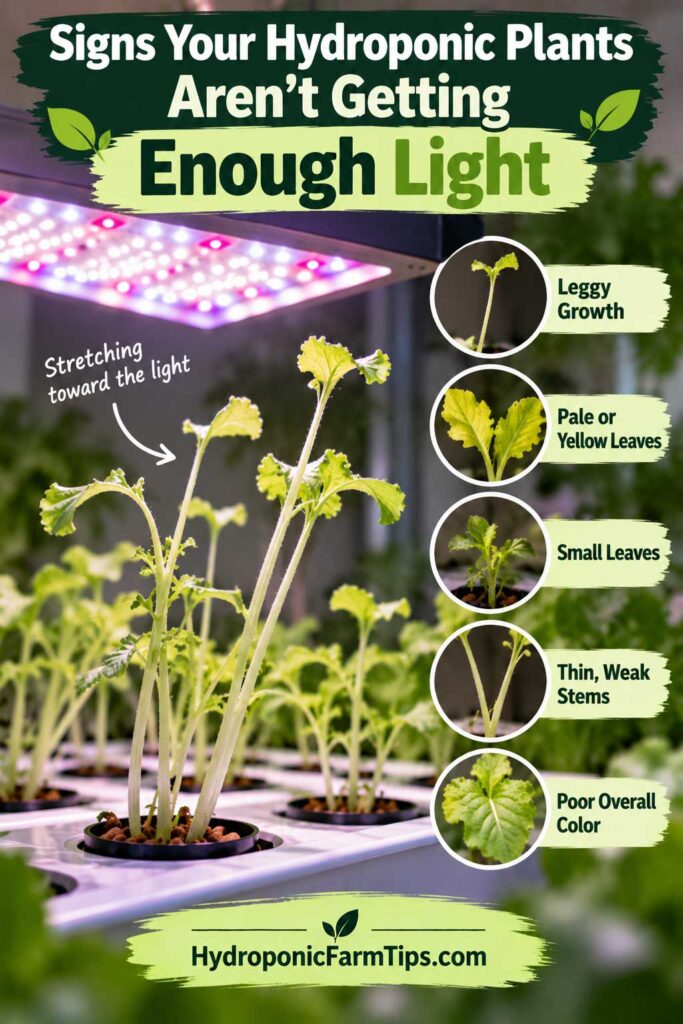
Hydroponic plants that receive too little light often grow, but they may grow slowly, weakly, or unevenly. This can happen when the grow-light schedule is too short, the fixture isn’t powerful enough, or the light is positioned too far above the canopy.
Common signs of insufficient light include:
- Long, thin, stretched stems
- Large gaps between leaves or nodes
- Plants leaning toward the grow light
- Slow growth or undersized leaves
- Pale, weak-looking foliage
- Poor flowering or fruit production
Seedlings are especially prone to stretching when light levels are too low. Lettuce and herbs may also become loose and elongated instead of developing the compact growth you want in an indoor hydroponic garden.
Should You Leave the Grow Lights On Longer?
Possibly—but don’t automatically add more hours.
If your lights are running for only 10 or 12 hours per day, increasing the photoperiod toward the recommended range for your crop may help. For example, leafy greens receiving 10 hours could potentially benefit from a schedule closer to 14 to 16 hours.
But if your lights already run for 16 hours and the plants are still stretching, the problem is more likely to involve light intensity, fixture height, or canopy coverage.
Check whether the fixture can be moved closer within the manufacturer’s recommended range or whether its intensity can be increased. In larger gardens, you may need better canopy coverage or an additional fixture. Training or pruning large plants can also prevent them from shading smaller ones.
Remember that pale or slow-growing plants aren’t always suffering from inadequate lighting. Nutrient deficiencies, incorrect pH, root problems, temperature, and other environmental conditions can produce similar symptoms.
If lighting seems adequate, use our Hydroponic Nutrient & pH Chart to check whether your crop is within an appropriate pH and nutrient range.
Look at the entire hydroponic system before making major changes to your lighting schedule.
Best Time of Day to Run Hydroponic Grow Lights
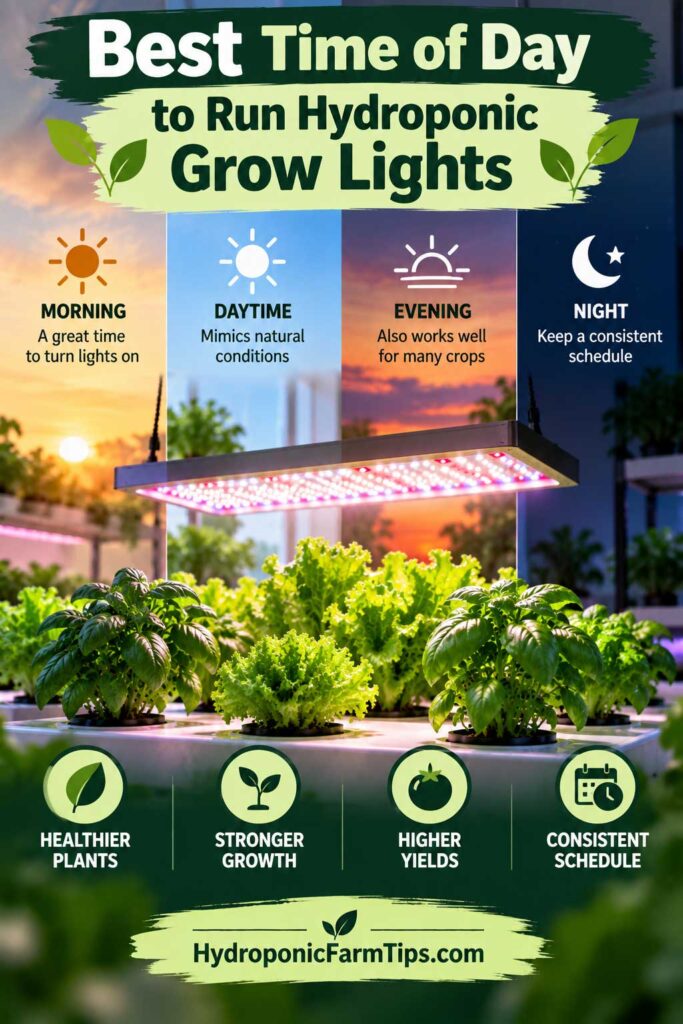
For an indoor hydroponic garden, the exact time your grow lights turn on matters less than maintaining a consistent daily schedule. In a fully indoor setup, you generally have flexibility over when the artificial day begins, as long as the schedule remains consistent.
That flexibility can actually be useful.
If electricity rates are lower during off-peak hours where you live, you may be able to schedule part of the lighting period accordingly. Running lights during cooler hours can also help control temperatures in grow rooms that tend to become warm.
For a typical 16-hour photoperiod, you could use a schedule such as:
6:00 a.m. ON → 10:00 p.m. OFF
Or, if nighttime operation works better for your setup:
4:00 p.m. ON → 8:00 a.m. OFF
Either schedule provides 16 hours of light and 8 hours of darkness.
Keep the Lighting Schedule Consistent
Once you’ve chosen a schedule, keep it reasonably consistent from day to day. A small occasional change isn’t likely to matter, but repeatedly shifting the light and dark periods makes the setup harder to manage.
The easiest solution is automation. A basic timer or smart plug can handle the schedule for you, which we’ll cover next.
For most home growers, the simplest approach is to choose the appropriate number of grow-light hours for the crop, set a timer, and let it handle the schedule automatically.
How to Set Up an Automatic Grow Light Timer
An automatic timer is one of the simplest upgrades you can make to an indoor hydroponic garden. Instead of remembering to switch the lights on and off every day, the timer keeps your chosen hydroponic lighting schedule consistent.
You can use a basic mechanical outlet timer, a digital timer, or a compatible smart plug. Whatever you choose, make sure it’s rated to handle the electrical load of your grow-light setup.
Once you’ve chosen your hydroponic grow light hours, a timer makes it much easier to maintain the same schedule every day.
Setting Up Your Timer
First, decide how many hours of light your crop needs. For example, if you’re growing lettuce, basil, and other leafy crops, you might start with a 16-hour light and 8-hour dark cycle.
Then:
- Choose the light and dark schedule for your crop.
- Program the ON and OFF times.
- Connect the grow light and activate automatic mode.
- Check it the next day to confirm the schedule is working correctly.
Once everything is working, you shouldn’t need to adjust the timer frequently unless you change crops or intentionally modify your lighting strategy.
Don’t Forget About Power Outages
After a power outage, check your timer. Some digital timers and smart devices retain their programming, while others may reset or lose track of the correct time.
It’s a small detail, but an unnoticed timer reset can leave your hydroponic plants receiving far fewer—or far more—hours of light than you intended.
A timer won’t determine the perfect lighting schedule for you, but once you’ve chosen the right photoperiod, it makes consistent grow-light hours much easier to maintain.
Common Hydroponic Lighting Mistakes
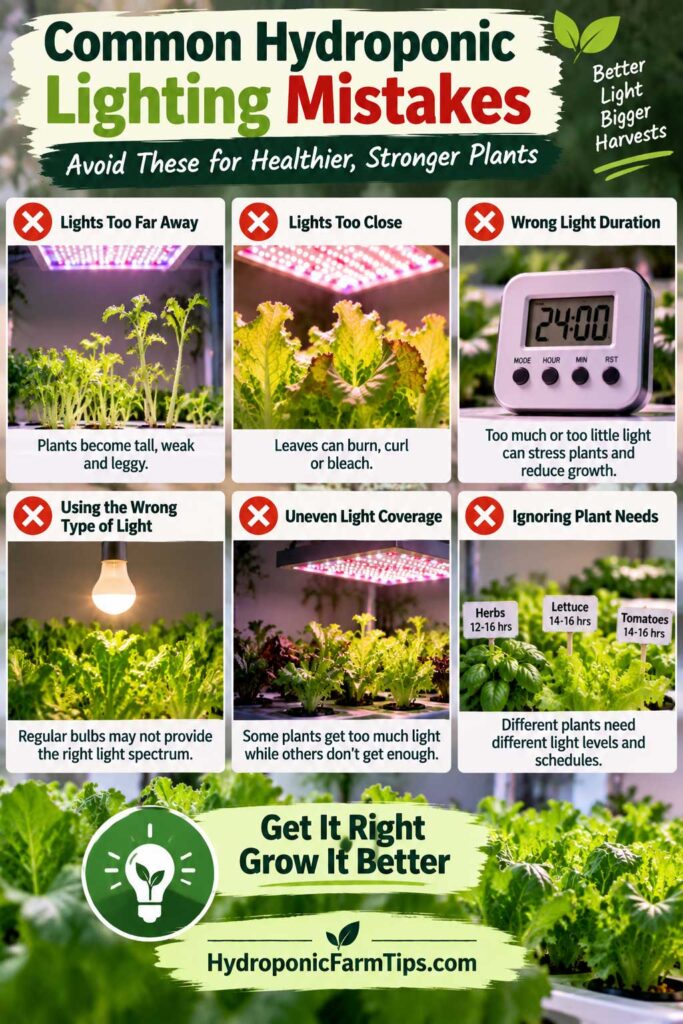
Even with a good grow light, a few simple mistakes can reduce plant growth or waste electricity. Most lighting problems come down to choosing the wrong schedule, using the wrong intensity, or failing to adjust the setup as plants grow.
1. Using the Same Light Schedule for Every Plant
Not every hydroponic crop has identical lighting needs. Seedlings, lettuce, basil, tomatoes, and strawberries can respond differently to photoperiod and light intensity.
Use crop-specific recommendations as your starting point rather than automatically running every grow light for the same number of hours.
2. Assuming More Hours Always Means More Growth
Longer photoperiods aren’t automatically better. Once plants receive enough daily light, extending the schedule may simply increase electricity use without improving growth.
3. Positioning the Light Incorrectly
A fixture that’s too high may not deliver enough usable light to the canopy, while one that’s too close can expose plants to excessive intensity or heat. Follow the manufacturer’s recommendations as a starting point and adjust as your plants grow.
4. Ignoring Canopy Coverage
A grow light may provide plenty of intensity directly underneath the fixture while plants around the edges receive much less.
This becomes particularly important with larger hydroponic systems and fruiting plants. Arrange your lights and plants so the entire growing area receives reasonably even coverage.
5. Never Adjusting the Lights as Plants Grow
A lighting setup that works perfectly for small seedlings may not work once those plants are several times larger.
Plant height, canopy density, and light requirements change throughout the growing cycle. Check your fixture height and coverage regularly rather than setting everything once and forgetting about it.
6. Changing Several Things at Once
If your plants start looking unhealthy, avoid changing the light schedule, nutrient strength, pH, fixture height, and water temperature all at the same time.
Make one or two carefully considered adjustments and watch how the plants respond. This makes it much easier to identify what was actually causing the problem.
Getting your hydroponic grow light hours right doesn’t have to be complicated. Start with an appropriate schedule for your crop, provide enough intensity and coverage, and adjust based on plant growth rather than chasing a perfect number of hours.
FAQs About Hydroponic Grow Light Hours
How many hours should grow lights be on for hydroponics?
Recommended hydroponic grow light hours generally fall between 12 and 18 hours per day for most crops. Leafy greens and herbs commonly receive 14–16 hours, while seedlings are often grown under 16–18 hours of light. The ideal schedule also depends on light intensity, crop type, and growth stage.
Is 12 hours of grow light enough for hydroponics?
It can be. Some plants can grow successfully with 12 hours of artificial light, particularly when the fixture provides adequate intensity. However, many indoor leafy greens, herbs, and seedlings are commonly grown with longer photoperiods of around 14–18 hours.
Is 16 hours of grow light too much?
For many hydroponic crops, 16 hours of light followed by 8 hours of darkness is a practical schedule. It works well as a starting point for seedlings, lettuce, herbs, tomatoes, peppers, and several other indoor crops when light intensity is appropriate.
Can I leave my hydroponic grow lights on 24/7?
It’s generally unnecessary for a home hydroponic garden. Most plants benefit from a regular light-dark cycle, and running lights continuously also increases electricity use and heat. A scheduled dark period is usually the better approach.
Do hydroponic plants need darkness?
Most hydroponic crops should receive a regular dark period. Darkness is part of the plant’s normal daily cycle, so a schedule such as 16 hours of light and 8 hours of darkness is commonly used rather than continuous illumination.
Should seedlings get 18 or 24 hours of light?
A schedule of around 16–18 hours of light with 6–8 hours of darkness is a practical starting point for many hydroponic seedlings. If seedlings are stretching despite receiving 18 hours of light, check the fixture’s intensity and height instead of immediately extending the photoperiod.
How far should grow lights be from hydroponic plants?
There isn’t one correct distance for every grow light. Fixture output, plant type, growth stage, and manufacturer recommendations all matter. Powerful LEDs may need to be positioned farther from the canopy than lower-output lights.
Do LED grow lights use a lot of electricity if they run 16 hours a day?
Electricity consumption depends primarily on the fixture’s actual wattage and operating time. For example, a 100-watt grow light running for 16 hours consumes about 1.6 kWh per day. Multiply your fixture’s daily kWh consumption by your electricity rate to estimate the operating cost.
Should I change grow-light hours when plants start flowering?
It depends on the crop. Some plants respond strongly to day length, while many commonly grown hydroponic vegetables are managed primarily by providing adequate daily light. Follow recommendations for the specific crop and variety rather than automatically changing the timer when flowers appear.
Getting Your Hydroponic Grow Light Schedule Right
So, how many hours should grow lights be on for hydroponics? For most home hydroponic gardens, somewhere between 12 and 18 hours per day is a good starting range, with many leafy greens and herbs doing well around 14–16 hours. Finding the right hydroponic grow light hours comes down to balancing the needs of your crop with light intensity, fixture position, and a consistent dark period.
But the timer is only one part of a successful lighting setup. The right schedule also depends on light intensity, fixture height, canopy coverage, crop type, and growth stage.
Instead of assuming that more light is always better, watch how your plants respond. Compact, healthy growth usually tells you more than the number displayed on a timer. Stretching may point to insufficient light, while bleaching or curling near the canopy can suggest excessive intensity.
For many home growers, the simplest approach is also the most practical: choose a suitable schedule for your crop, automate it with a timer, maintain a regular dark period, and make small adjustments as your plants grow.
Once you have the timing dialed in, the next important question is how high your grow lights should be above your hydroponic plants—because even a perfect 16-hour schedule won’t help much if the fixture is positioned incorrectly.
More Hydroponic Growing Guides You May Like
Now that you know how many hours grow lights should be on for hydroponics, these guides can help you choose the right lighting setup, decide what to grow, manage your system, and keep your hydroponic plants healthy.
- Best LED Grow Lights for Hydroponics – Compare LED grow lights for different garden sizes, crops, and budgets, and learn what features matter when choosing a light for your hydroponic setup.
- Hydroponic Nutrient & pH Chart – Compare recommended pH and nutrient ranges for popular hydroponic vegetables, herbs, and fruits.
- 8 Best Hydroponic Systems for Home – Compare DWC, Kratky, NFT, Ebb and Flow, drip, aeroponics, wick systems, and Dutch Buckets to find the right setup for your garden.
- 10 Best Hydroponic Vegetables – Discover productive vegetables to grow hydroponically and learn which systems work well for different crops.
- 10 Best Hydroponic Herbs to Grow at Home – Choose beginner-friendly herbs such as basil, mint, parsley, and cilantro for your indoor hydroponic garden.
- Hydroponic Root Rot Guide – Learn how to recognize unhealthy roots, understand common causes of root problems, and protect your plants before serious damage occurs.
- How to Transfer Plants From Hydroponics to Soil – Follow the process of moving hydroponically grown plants into soil while reducing transplant stress.