Growing plants without soil might sound complicated at first, especially when you start hearing terms like NPK, EC, PPM, micronutrients, and nutrient solutions. But hydroponic nutrients for beginners don’t have to be confusing. Once you understand what your plants need and how to provide it, feeding a hydroponic garden becomes a fairly simple routine.
In a traditional garden, plant roots obtain many essential nutrients from the soil. Hydroponic plants don’t have that nutrient reserve. Instead, you provide the minerals they need directly through the water using a carefully balanced hydroponic nutrient solution.
That gives you more control over what reaches the roots, but it also means getting the basics right matters. Nutrient strength, water quality, pH, and the way you mix your solution can all affect how well your plants grow.
The good news is that you don’t need to become a plant scientist to get started.
This guide walks you through the parts that actually matter: what hydroponic nutrients contain, what NPK means, how much to use, how to mix them safely, and how pH, EC, and PPM help you keep the reservoir balanced. We’ll also cover the feeding mistakes and deficiency symptoms you’re most likely to encounter when you’re starting out.
Choosing hydroponic nutrients for beginners becomes much easier once you understand nutrient strength, pH, and a few basic mixing rules.
By the end, you’ll have a much clearer idea of how to feed your hydroponic plants confidently—without turning every reservoir change into a chemistry experiment.
Hydroponic Nutrients for Beginners: The Short Version
If you’re just getting started, choose a complete hydroponic nutrient formula, mix it according to the manufacturer’s directions, and start young plants at a mild concentration. After mixing, check the EC or PPM first and pH second. Many hydroponic crops grow well around pH 5.5–6.5, but nutrient strength varies considerably by crop and growth stage.
You don’t need a shelf full of supplements. A complete base nutrient, suitable pH, healthy roots, and consistent reservoir maintenance are enough to grow many hydroponic vegetables and herbs successfully.
What Are Hydroponic Nutrients?
Hydroponic nutrients are water-soluble minerals formulated to provide plants with the essential elements they would normally obtain from soil. Because hydroponic plants grow with their roots in water or an inert growing medium, these nutrients must be added directly to the water.
Think of the nutrient solution as the plant’s mineral supply. The roots absorb water along with dissolved nutrients, while the plant uses light, carbon dioxide, and water to produce the energy-rich compounds that fuel growth.
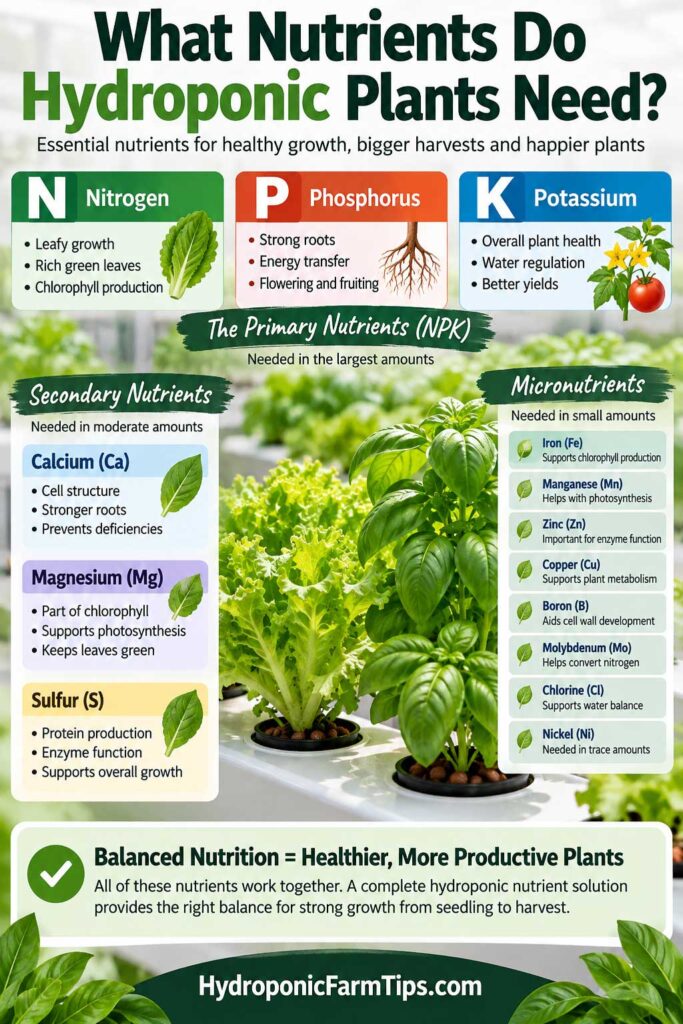
A complete hydroponic nutrient formula typically provides three primary macronutrients:
- Nitrogen (N) – supports leafy growth and the production of chlorophyll.
- Phosphorus (P) – plays an important role in root development, energy transfer, flowering, and fruiting.
- Potassium (K) – supports overall plant function, water regulation, and healthy growth.
These three nutrients are commonly referred to as NPK, but they’re only part of the picture.
Plants also require secondary nutrients such as calcium, magnesium, and sulfur, along with much smaller amounts of micronutrients including iron, manganese, zinc, copper, boron, molybdenum, chlorine, and nickel.
The best approach to hydroponic nutrients for beginners is therefore to start with a complete formula and learn how to maintain it before experimenting with supplements.
The key word here is balance. Adding more nutrients doesn’t automatically produce faster or larger plants. A solution that’s too concentrated can damage roots and cause nutrient burn, while a solution that’s too weak may lead to slow growth or nutrient deficiencies.
That’s why successful hydroponic feeding isn’t about giving plants as much fertilizer as possible. It’s about providing the right nutrients at an appropriate concentration for the crop and its stage of growth.
Why Hydroponic Plants Need Added Nutrients
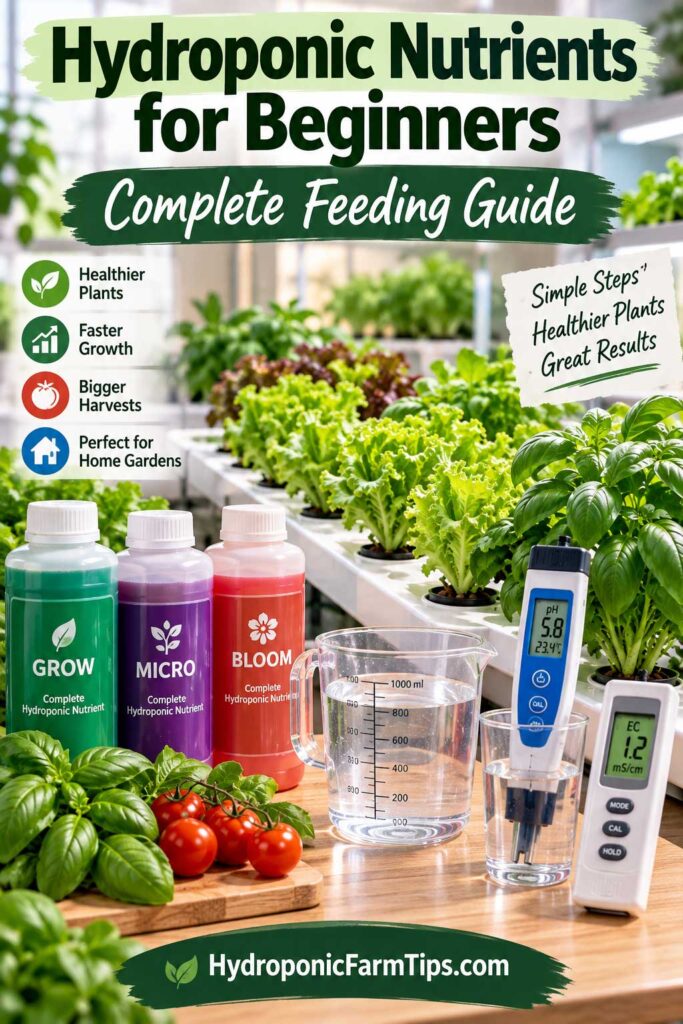
In a traditional garden, soil acts as both an anchor and a nutrient reservoir. Organic matter, minerals, microorganisms, and fertilizers can all contribute nutrients that plant roots absorb over time.
Hydroponics works differently because there is little or no soil to act as a nutrient reservoir. Plants depend on you to supply nearly all of their essential mineral nutrients through the water. Oklahoma State University Extension explains that hydroponic nutrient management depends on factors including total salt concentration, pH, water quality and nutrient balance.
If your plants are already showing discoloration or unusual growth, our Hydroponic Nutrient Deficiencies: Signs, Causes & Fixes guide can help you narrow down what may be happening.
Materials such as rockwool, perlite, clay pebbles, and other inert media mainly support the root system and help manage moisture and air. They aren’t a substitute for a complete nutrient solution.
A properly prepared hydroponic nutrient solution gives the roots direct access to the minerals they need. This is one reason hydroponics can produce vigorous growth when conditions are well managed: roots don’t have to search through a large volume of soil for available nutrients.
However, that direct access also means mistakes can affect plants quickly.
If the nutrient solution becomes too concentrated, roots may struggle to take up water and can suffer fertilizer stress. If it’s too dilute, plants may not receive enough of one or more essential elements. Even when plenty of nutrients are present, an unsuitable pH can make certain nutrients harder for the plant to absorb, a problem commonly called nutrient lockout.
For beginners, four factors are especially important:
- Nutrient concentration – how strong the solution is.
- pH – influences nutrient availability to the roots.
- Water quality – the starting water can contribute minerals and affect your final solution.
- Plant requirements – lettuce, basil, tomatoes, strawberries, and other crops don’t necessarily thrive at the same nutrient strength.
You don’t need to adjust these factors constantly. The goal is to keep the root environment reasonably stable and make corrections based on measurements and how your plants are responding.
Once you understand that basic relationship between water, nutrients, pH, and the roots, hydroponic feeding becomes much easier to manage.
Understanding NPK: Nitrogen, Phosphorus & Potassium
If you’ve looked at a bottle of hydroponic nutrients, you’ve probably noticed three numbers on the label, such as 4-3-6 or 5-4-8. These numbers represent the fertilizer’s guaranteed analysis: nitrogen (N), available phosphate expressed as P₂O₅, and soluble potash expressed as K₂O. In other words, the second and third numbers aren’t simply percentages of elemental phosphorus and potassium.
All three are important, but they perform different roles in plant growth.
Nitrogen (N)
Nitrogen is especially important during vegetative growth. Plants use it to produce amino acids, proteins, and chlorophyll—the green pigment involved in photosynthesis.
Plants receiving adequate nitrogen generally develop healthy green foliage and vigorous stems. Too little nitrogen can cause older leaves to become pale or yellow and may slow overall growth.
Too much isn’t better, though. Excessive nitrogen can encourage overly lush foliage and may interfere with balanced growth, particularly in flowering and fruiting crops.
Phosphorus (P)
Phosphorus is involved in several essential plant processes, including energy transfer, root development, and reproduction.
It’s often associated with flowering and fruit production, but plants need phosphorus throughout their life cycle—not only when they begin producing flowers.
A phosphorus deficiency can contribute to slow or stunted growth, although visible symptoms vary by crop and growing conditions.
Potassium (K)
Potassium helps regulate water movement within the plant and supports numerous enzyme-driven processes. It also contributes to overall plant vigor and is particularly important as many crops mature and produce flowers or fruit.
When potassium is insufficient, plants may develop weak growth or leaf-edge discoloration and scorching. These symptoms can resemble other hydroponic problems, so it’s better to check pH and nutrient strength before assuming a specific deficiency.
What Do the NPK Numbers Actually Mean?
The three numbers on a fertilizer label indicate the guaranteed percentage by weight of nitrogen, available phosphate, and soluble potash.
For example, a fertilizer labeled 5-4-8 contains:
- 5% nitrogen
- 4% available phosphate (P₂O₅)
- 8% soluble potash (K₂O)
The remaining material includes water, other nutrients, and ingredients used to formulate the product.
There’s usually no need to calculate individual NPK ratios yourself. A complete hydroponic nutrient formula designed for the crops you’re growing is much easier and safer to use.
And remember: NPK isn’t the whole nutrient story. Healthy hydroponic plants also depend on calcium, magnesium, sulfur, and several micronutrients, which we’ll look at next.
Secondary Nutrients and Micronutrients
Nitrogen, phosphorus, and potassium get most of the attention, but plants need a much broader range of mineral nutrients to grow properly. A good hydroponic formula should also provide the necessary secondary nutrients and micronutrients.
Plants require these elements in smaller quantities than the primary macronutrients, but that doesn’t make them optional.
Secondary Nutrients
The three secondary macronutrients are calcium, magnesium, and sulfur.
Calcium (Ca) plays an important role in building and maintaining plant cell walls and membranes. Because calcium isn’t easily redistributed from older tissue to new growth, deficiencies often appear first in developing leaves, growing tips, or fruit. In tomatoes and peppers, inadequate calcium reaching developing fruit is associated with blossom-end rot.
Magnesium (Mg) is a central component of the chlorophyll molecule and is therefore essential for photosynthesis. A shortage may cause yellowing between the veins of older leaves while the veins remain greener.
Sulfur (S) is needed for certain amino acids, proteins, enzymes, and other plant compounds. Deficiency is relatively uncommon when you’re using a complete hydroponic fertilizer according to its directions.
Essential Micronutrients
Hydroponic plants also require very small amounts of several micronutrients, including:
- Iron (Fe) – involved in chlorophyll formation and important metabolic processes.
- Manganese (Mn) – supports photosynthesis and enzyme activity.
- Boron (B) – contributes to cell-wall development and growing tissues.
- Zinc (Zn) – involved in enzyme function and growth regulation.
- Copper (Cu) – supports several enzymatic and metabolic processes.
- Molybdenum (Mo) – helps plants use nitrogen efficiently.
- Chlorine (Cl) – required in tiny amounts for normal plant function.
- Nickel (Ni) – needed only in trace quantities but still considered essential.
You don’t usually need to purchase each of these separately. Most complete hydroponic nutrient systems are formulated to provide the major, secondary, and micronutrients plants require.
In fact, adding individual supplements without a clear reason can make nutrient management more difficult. Too much of one element may interfere with the availability or uptake of another.
For a beginner hydroponic garden, the simpler approach is usually the better one: start with a complete nutrient formula, follow the manufacturer’s mixing instructions, and monitor pH and nutrient strength before adding extra supplements.
For a deeper look at the role of individual elements, Penn State Extension’s guide to essential plant nutrients explains nutrient functions along with common deficiency and excess symptoms.
One-Part vs. Two-Part vs. Three-Part Hydroponic Nutrients
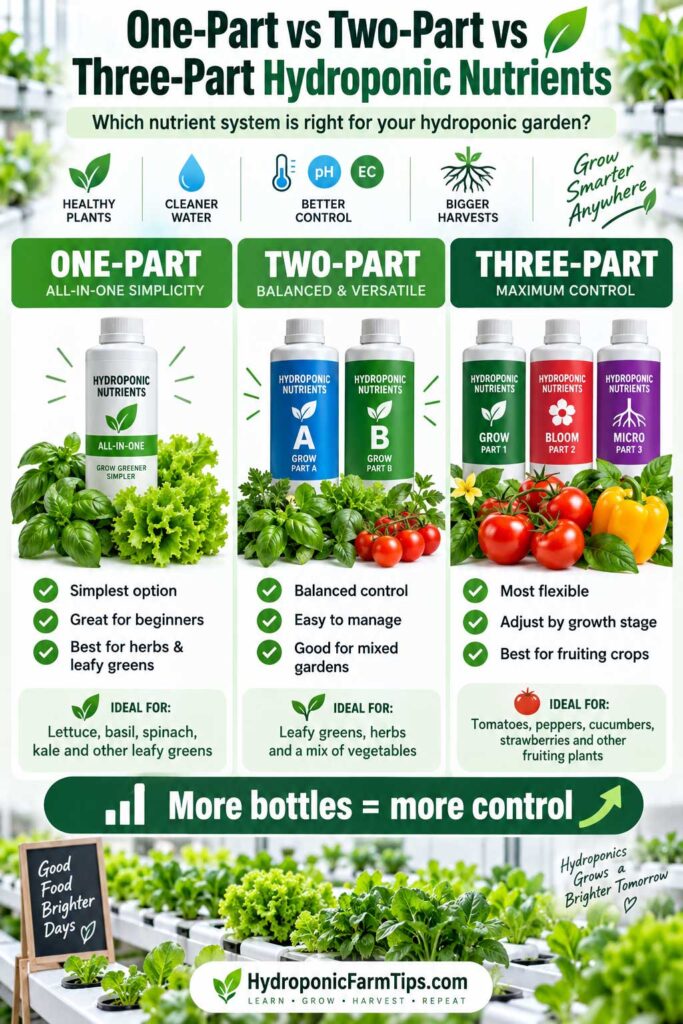
When shopping for hydroponic nutrients, you’ll quickly notice that some products come in a single bottle while others use two or three separate components. All of these systems can work well, but they differ in convenience and flexibility.
One-Part Hydroponic Nutrients
A one-part nutrient system packages the base feeding formula into a single product rather than requiring you to measure multiple components. Depending on the product, it may come as a liquid or dry powder that you mix with water.
For beginners, the biggest advantage is simplicity. There are fewer measurements to make and fewer bottles to keep organized.
One-part nutrients can be a good choice for:
- Lettuce and other leafy greens
- Basil and many culinary herbs
- Small countertop hydroponic gardens
- Kratky and simple DWC systems
- Growers who want an uncomplicated feeding routine
The tradeoff is that you generally have less control over changing the nutrient ratio as plants move through different growth stages.
Two-Part Hydroponic Nutrients
Two-part nutrients are usually labeled something like Part A and Part B.
Manufacturers separate certain mineral salts because some concentrated nutrients can react with each other when stored or mixed together at high concentrations. Calcium, for example, can combine with phosphates or sulfates and form insoluble precipitates.
Separating the concentrates helps keep those nutrients available until they’re diluted in the reservoir.
The important rule is:
Never mix concentrated Part A directly with concentrated Part B.
Instead, add the recommended amount of Part A to your reservoir water and mix thoroughly. Then add Part B and mix again. Always follow the specific manufacturer’s directions because mixing order can vary by product.
Two-part formulas require one extra mixing step, but separating the concentrates allows manufacturers to keep potentially incompatible mineral salts apart until they’re diluted in the reservoir.
Three-Part Hydroponic Nutrients
Three-part systems divide the nutrient formula into three components, often designed around different aspects or stages of plant growth.
The exact formulation varies by manufacturer, but the separate components allow growers to adjust the proportions as plants progress from seedlings and vegetative growth to flowering and fruiting.
That flexibility can be useful for crops such as:
- Tomatoes
- Peppers
- Cucumbers
- Strawberries
- Other flowering and fruiting plants
The downside is that there are more measurements to make, which creates more opportunities for mixing errors.
Which Is Best for Beginners?
You don’t need the most complicated nutrient system to grow healthy hydroponic plants.
For a first garden, a complete one-part or straightforward two-part hydroponic nutrient is usually enough. Once you’re comfortable measuring pH, monitoring EC or PPM, and maintaining your reservoir, you can experiment with more adjustable feeding programs if your crops would benefit from them.
Choose nutrients based on your plants and system—not on the number of bottles included in the package.
Affiliate Disclosure: This page may contain affiliate links. If you purchase through one of these links, we may earn a commission at no additional cost to you.
How to Choose Hydroponic Nutrients for Beginners
Walking into a hydroponics store—or browsing nutrients online—can make feeding plants seem far more complicated than it needs to be. You’ll find base nutrients, bloom boosters, Cal-Mag supplements, root enhancers, enzymes, beneficial microbes, and plenty of other additives.
As a beginner, you don’t need most of them to get started.
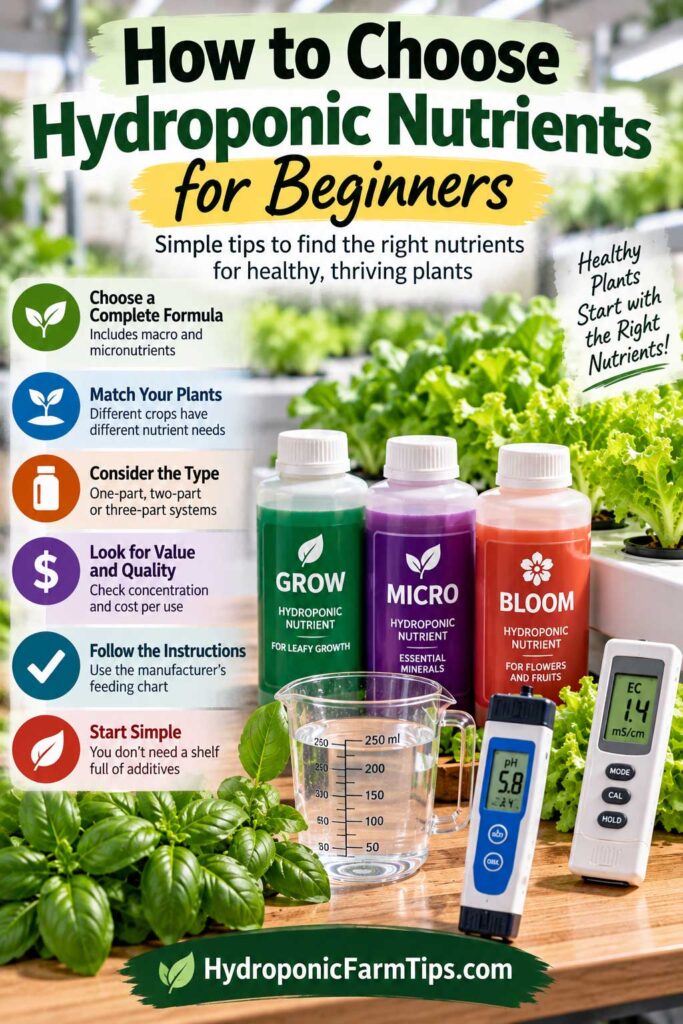
The easiest approach is to choose a complete hydroponic nutrient formula designed specifically for growing plants without soil.
Look for a Complete Nutrient Formula
Check the label to make sure the product provides more than just nitrogen, phosphorus, and potassium. A suitable hydroponic fertilizer should also supply secondary nutrients and essential micronutrients. Penn State Extension describes several approaches to hydroponic nutrient solutions, including complete fertilizers, fertilizer programs and crop-specific nutrient recipes.
Depending on the formulation, these may include calcium, magnesium, sulfur, iron, manganese, boron, zinc, copper, and molybdenum.
A fertilizer designed only for conventional soil gardening isn’t automatically suitable for hydroponics. Hydroponic formulas are designed to provide nutrients in forms that can remain available in a water-based root environment.
Match the Nutrients to What You’re Growing
Different crops have different nutritional requirements.
Leafy greens and herbs such as lettuce, spinach, and basil generally perform well with relatively mild nutrient solutions and formulas intended for vegetative growth.
If you’re still deciding what to grow, see our guides to the best hydroponic vegetables and best hydroponic herbs for beginner-friendly crop ideas.
Fruiting crops such as tomatoes, peppers, cucumbers, and strawberries typically require stronger nutrition as they mature and may benefit from formulas designed to support flowering and fruit development.
If you’re growing several types of plants in the same reservoir, choose crops with reasonably similar nutrient and pH requirements whenever possible.
Consider Your Hydroponic System
Most quality hydroponic nutrients can be used in several types of systems, including DWC, NFT, drip systems, and ebb-and-flow setups.
Not sure which setup fits your space or experience level? Compare the 8 best hydroponic systems for home, including DWC, Kratky, NFT, drip, aeroponics and more.
However, always check the manufacturer’s instructions. Nutrient concentrations and reservoir-management recommendations can differ depending on the product and growing method.
Simple systems such as Kratky or small DWC gardens are often easiest to manage with straightforward one-part or two-part nutrients.
Liquid vs. Dry Hydroponic Nutrients
Liquid nutrients are convenient because they’re easy to measure and dissolve quickly. This makes them particularly beginner-friendly.
Dry nutrients are usually more concentrated, lighter to store and ship, and can be economical for larger gardens. However, they need to be measured accurately and dissolved thoroughly.
For a small first garden, convenience may matter more than getting the lowest possible cost per gallon.
Don’t Buy Every Supplement at Once
One of the easiest beginner mistakes is assuming that more products will produce better plants.
They won’t necessarily.
Start with a complete base nutrient and learn how your plants respond. Monitor pH and EC or PPM, maintain the reservoir properly, and only consider supplements when you have a specific reason to use them.
A healthy hydroponic garden can be surprisingly simple. Good water, a complete nutrient formula, proper concentration, suitable pH, adequate light, and oxygen around the roots will take you much further than a shelf full of additives.
Hydroponic Nutrients for Beginners: 4 Options to Consider
If you’re buying hydroponic nutrients for the first time, don’t feel like you need the most complicated feeding program. A complete, well-labeled formula that’s easy to measure is usually a better place to start. Here are a few popular nutrient systems worth comparing based on your crop, system size, and how much control you want over feeding.
| Product | Best For | Type | Why Consider It | Buy |
|---|---|---|---|---|
| General Hydroponics FloraSeries | Flexible feeding | 3-part liquid | Lets you adjust feeding through different growth stages | Check Price |
| MasterBlend 4-18-38 Kit | Vegetables & larger gardens | Multi-part dry | Concentrated and economical | Check Price |
| General Hydroponics MaxiGro | Greens & herbs | Dry nutrient | Simple option for vegetative crops | Check Price |
| AeroGarden Liquid Plant Food | Small countertop systems | Liquid | Easy to measure and convenient for small gardens | Check Price |
These products use different feeding systems and concentrations, so always follow the directions for the specific formula you choose rather than applying the dosage from one brand to another.
Beginner tip: Don’t choose a nutrient system just because it includes more bottles or additives. Check whether it’s suitable for the plants you’re growing, then follow that manufacturer’s feeding instructions rather than mixing recommendations from different brands.
What You Actually Need to Manage Hydroponic Nutrients
Despite all the nutrient products and accessories available, a beginner setup can be surprisingly small:
- A complete hydroponic nutrient formula
- An EC or TDS meter
- A reliable pH meter or test kit
- pH adjustment solution when needed
- A clean measuring syringe, cup, or cylinder
- A container or reservoir large enough for your system
That’s enough to measure, mix, and maintain nutrient solution for many beginner hydroponic gardens. Supplements can come later if your water, crop, or nutrient program gives you a specific reason to use them.
See also
How to Mix Hydroponic Nutrients Correctly
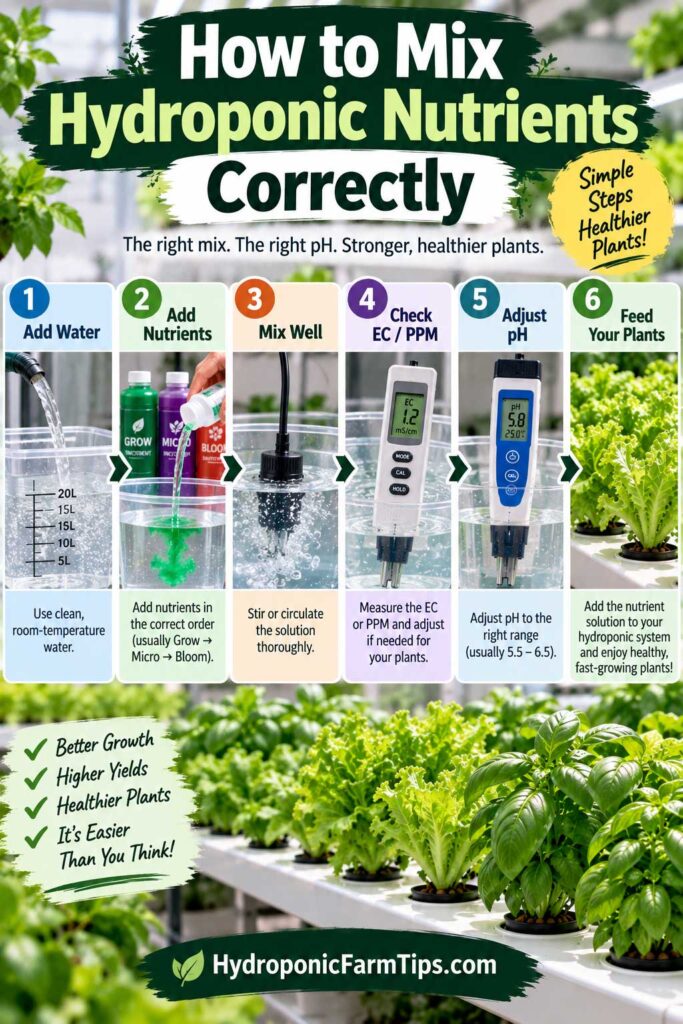
Mixing hydroponic nutrients isn’t difficult, but the order and concentration matter. A few simple habits can prevent precipitation, nutrient imbalances, and accidental overfeeding.
When using hydroponic nutrients for beginners, careful measuring and the correct mixing order matter more than complicated feeding techniques.
Always start with the directions provided for your particular nutrient product. Concentrations vary considerably between brands, so there isn’t one universal number of milliliters or teaspoons that works for every fertilizer.
Step 1: Start With Fresh Water
Fill your reservoir with the amount of water you need before adding concentrated nutrients.
If you’re using tap water, it’s helpful to know its starting EC or PPM, especially if your water contains a significant amount of dissolved minerals. Very hard water can make nutrient management more challenging because some minerals are already present before fertilizer is added.
Step 2: Measure Each Nutrient Separately
Use a clean measuring syringe, cup, or graduated cylinder to measure the recommended amount.
For beginners, starting near the lower end of the manufacturer’s recommended feeding range is often sensible, particularly for seedlings and young plants.
You can increase nutrient strength gradually as plants mature and you learn how they respond.
Step 3: Add Nutrients One at a Time
If you’re using a one-part fertilizer, add it to the water and mix thoroughly.
For multi-part systems, add each component separately, stirring or circulating the reservoir thoroughly between additions.
For example:
Water → Part A → mix thoroughly → Part B → mix thoroughly
If your product has a third component, add it according to the manufacturer’s specified order.
Never combine concentrated Part A and Part B together before adding them to the water. Highly concentrated mineral salts can react and form solids, making some nutrients less available to your plants.
Step 4: Check the EC or PPM
Once everything is thoroughly mixed, measure the nutrient solution with an EC or TDS meter.
This tells you how concentrated the dissolved salts are and helps you determine whether the solution is appropriate for your crop and growth stage.
Don’t keep adding fertilizer simply because the water doesn’t look different. Hydroponic nutrient solutions can appear almost clear while still containing plenty of dissolved minerals.
Step 5: Check and Adjust the pH
Measure pH after the nutrients have been added and mixed, since fertilizer can change the pH of your water.
Many hydroponic crops perform well somewhere around pH 5.5–6.5, although the preferred range varies by plant.
If adjustment is necessary, use a product intended for hydroponic pH management and make small changes at a time. Mix thoroughly before testing again.
For crop-specific targets, keep our Hydroponic Nutrient & pH Chart handy when mixing and adjusting your reservoir.
Step 6: Add the Solution to Your System
Once nutrient strength and pH are within suitable ranges, the solution is ready for your plants.
Record your measurements if possible. Keeping a simple note of the amount of nutrients added, EC, pH, and date makes it much easier to understand how your reservoir changes over time.
A Simple Beginner Mixing Rule
Remember this sequence:
Water → nutrients → mix → EC/PPM → pH → plants
Don’t chase perfect numbers with constant adjustments. Consistency matters more. Measure carefully, make small corrections, and give the reservoir time to stabilize before changing it again.
How Much Hydroponic Nutrient Should You Use?
One of the most common questions beginners ask is, “How much hydroponic nutrient should I add?”
There isn’t one amount that works for every garden. The correct dose depends on the nutrient product, crop, growth stage, water quality, and target nutrient strength.
That’s why it’s better to think in terms of concentration rather than simply adding a certain amount of fertilizer per plant.
Start With the Manufacturer’s Feeding Instructions
Your nutrient label should provide a mixing rate, often expressed as milliliters per liter or milliliters per gallon.
Use that as your starting point rather than copying the dosage from another nutrient brand. Concentrations vary significantly between products.
For seedlings and newly transplanted plants, growers commonly use a milder solution than they would for established plants. Increase the concentration gradually as the crop develops rather than immediately feeding at maximum strength.
University of Georgia Cooperative Extension recommends following the selected fertilizer’s directions and starting toward the lighter recommended rate when setting up a small hydroponic garden.
Don’t Assume More Nutrients Mean Faster Growth
Plants can only use nutrients within an appropriate range.
Making the solution excessively concentrated can make it harder for roots to take up water and may lead to symptoms commonly described as nutrient burn, including browning or damaged leaf tips and margins.
On the other hand, a solution that’s consistently too weak may contribute to pale foliage, slow growth, or nutrient deficiencies.
The goal is not maximum fertilizer. It’s an appropriate nutrient concentration for the plant.
Use EC or PPM Instead of Guessing
An EC or TDS meter is one of the most useful tools for determining whether your nutrient solution is too weak or too concentrated.
For example, young plants and leafy greens generally tolerate lower nutrient concentrations than mature fruiting crops such as tomatoes and cucumbers.
Rather than repeatedly adding fertilizer based on appearance alone, measure the reservoir and compare the reading with an appropriate range for the crop you’re growing.
Reservoir Size Matters Too
A larger reservoir doesn’t necessarily mean each plant receives “more food.” It simply provides a larger volume of nutrient solution.
Larger reservoirs can actually be easier to manage because pH, nutrient concentration, and water temperature often change more gradually than they do in very small containers.
As plants grow, they’ll consume both water and dissolved nutrients—but not always at the same rate. That’s why topping up a reservoir doesn’t automatically mean adding a full dose of nutrients every time.
This is where an EC or TDS meter becomes especially useful. Instead of judging nutrient strength by how much fertilizer you’ve poured into the reservoir, you can actually measure how concentrated the solution is.
Understanding EC, PPM, and Nutrient Strength
Terms like EC and PPM can make hydroponics sound more technical than it really is. For a beginner, the important thing to understand is that both are used to estimate the concentration of dissolved salts in your nutrient solution.
They help answer a simple question:
Is my nutrient solution too weak, too strong, or roughly where it should be?
What Is EC in Hydroponics?
EC stands for electrical conductivity. Water containing dissolved fertilizer salts conducts electricity more readily than very pure water.
An EC meter measures that conductivity, usually in mS/cm (millisiemens per centimeter).
As you add hydroponic nutrients, EC generally increases. If the reservoir becomes more concentrated as plants use water, EC may also rise.
For example, a reading of 1.8 mS/cm indicates a more concentrated solution than 0.8 mS/cm.
EC doesn’t tell you how much nitrogen, calcium, potassium, or any other individual nutrient is present. It simply gives you a useful measurement of the solution’s overall ionic concentration.
Two solutions can have the same EC while containing different proportions of individual nutrients. Think of EC as a measure of overall solution strength—not a nutrient-by-nutrient analysis.
What Is PPM?
PPM means parts per million. On hydroponic meters, however, the displayed PPM value is usually a calculated TDS estimate based on conductivity, not a laboratory measurement of the actual concentration of every dissolved nutrient.
Most handheld TDS meters don’t directly measure the amount of each nutrient in the water. Instead, they measure electrical conductivity and convert that reading into an estimated PPM or TDS value.
This is where beginners sometimes get confused.
Different meters may use different conversion factors, commonly referred to as the 500, 640, or 700 scale. As a result, two meters can test the same nutrient solution and display different PPM numbers even though its EC is identical.
That’s why EC is often easier to compare between feeding charts and growers.
Typical EC Ranges for Hydroponic Plants
Exact requirements vary by cultivar, environment, water quality, and growth stage, but the following broad ranges can provide a useful starting point:
| Crop | Approximate EC Range |
|---|---|
| Lettuce | 0.8–1.2 mS/cm |
| Spinach | 1.8–2.3 mS/cm |
| Basil | 1.0–1.6 mS/cm |
| Most culinary herbs | 1.0–1.8 mS/cm |
| Strawberries | 1.0–1.5 mS/cm |
| Cucumbers | 1.7–2.5 mS/cm |
| Peppers | 1.8–2.5 mS/cm |
| Tomatoes | 2.0–3.5 mS/cm |
For comparison: Oklahoma State University publishes additional crop-specific EC and pH ranges in its Electrical Conductivity and pH Guide for Hydroponics. Exact recommendations vary among sources, cultivars, growth stages, and growing conditions.
For a larger crop-by-crop reference, see the Hydroponic Nutrient & pH Chart.
Treat these numbers as starting ranges rather than rigid targets. Young plants generally need a weaker solution than mature plants, and environmental conditions can influence how plants respond.
Watch How EC Changes
If the water level drops while EC rises, the remaining solution is becoming more concentrated, often because water is being removed faster than dissolved salts.
If EC falls, the solution is becoming less concentrated. Plant uptake can contribute, but top-ups, precipitation, measurement conditions, and other factors can also affect the reading.
Rather than treating these patterns as a precise diagnosis, use them alongside pH, water level, plant appearance, and changes over several days.
Measure Your Starting Water
Before adding nutrients, check the EC of your source water.
If your tap water already has a relatively high EC, some of the reading comes from minerals already dissolved in the water—not from the hydroponic fertilizer you’ve added.
Knowing your starting EC gives you a much better baseline for interpreting the final nutrient solution.
For beginners, you don’t need to obsess over tiny fluctuations. Use EC as a practical guide, keep measurements reasonably consistent, and pay attention to how your plants respond over time.
For example, if your source water measures 0.4 mS/cm and your finished nutrient solution measures 1.4 mS/cm, don’t assume the fertilizer alone created the entire 1.4 reading. Your starting water was already contributing dissolved ions.
Essential Tools for Managing Hydroponic Nutrients
You can follow a feeding chart without owning a cabinet full of equipment, but two measurements make reservoir management much easier: EC and pH. A reliable meter lets you check what’s actually happening in the solution instead of adjusting nutrients based only on how the plants look.
| Product | Best For | What It Does | Why It’s Useful | Buy |
|---|---|---|---|---|
| Apera PH20 pH Meter | Most beginners | Measures pH | Simple digital monitoring for nutrient solutions | Check Price |
| Apera EC20 EC Meter | Nutrient monitoring | Measures EC | Helps prevent over- or underfeeding | Check Price |
| Digital EC/TDS Meter | Budget setups | Measures EC/TDS | Affordable option for basic reservoir monitoring | Check Price |
| Measuring Syringe Set | Liquid nutrients | Measures nutrient doses | Makes small doses easier to measure consistently | Check Price |
If you’re only buying a few tools for your first system, an EC meter and a dependable way to test pH are far more useful than collecting specialty supplements. They help you catch concentration and pH problems before reaching for another bottle of fertilizer.
How pH Affects Nutrient Uptake
You can provide all the right hydroponic nutrients and still run into problems if the pH of the nutrient solution is outside an appropriate range.
pH measures how acidic or alkaline a solution is on a scale from 0 to 14. A pH of 7 is neutral, while values below 7 are acidic and values above 7 are alkaline.
In hydroponics, pH matters because it affects how readily different nutrients remain available for plant roots to absorb. Oklahoma State University Extension notes that nutrient-solution pH directly influences nutrient availability and recommends monitoring both pH and EC as part of hydroponic nutrient management.
What Is the Best pH for Hydroponics?
Many hydroponic crops grow well with the nutrient solution maintained somewhere around:
pH 5.5–6.5
However, there isn’t one perfect pH for every plant. Lettuce, basil, tomatoes, peppers, strawberries, and other crops may have slightly different preferred ranges.
You also don’t need to keep the reservoir fixed at exactly 6.0 every minute of the day. Some natural movement within an appropriate range is normal. Small fluctuations within a crop’s suitable pH range are normal, so there’s usually no reason to keep adjusting the reservoir back to one exact decimal point.
What Happens When pH Is Too High or Too Low?
When pH moves too far outside a suitable range, certain nutrients can become less available to the roots even when those nutrients are present in the reservoir.
For example, excessively high pH can reduce the availability of micronutrients such as iron and manganese. Very low pH can also disrupt nutrient balance and may contribute to root stress.
The result can look surprisingly similar to a nutrient deficiency.
This is one reason you shouldn’t immediately add more fertilizer whenever leaves turn yellow or develop unusual spots. The reservoir may contain enough nutrients—the plant may simply be having trouble accessing them.
What Is Nutrient Lockout?
The term nutrient lockout is commonly used when environmental or chemical conditions interfere with a plant’s ability to take up one or more nutrients. It’s a useful grower term, but it doesn’t identify the cause by itself.
Improper pH is one possible cause, but excessive nutrient concentration, salt accumulation, root damage, and interactions among nutrients can also contribute to uptake problems.
Before assuming that your plant needs more fertilizer, check:
- Reservoir pH
- EC or PPM
- Water temperature
- Root health
- Nutrient mixing and concentration
Often, correcting the growing conditions is more useful than adding another supplement.
If leaves are already turning pale or yellow, use our guide to why hydroponic leaves turn yellow to compare nutrient problems with pH, root, light and environmental causes.
When Should You Check pH?
Check the pH after you’ve mixed your nutrients because adding fertilizer can change the reading.
For a new system, checking daily or every couple of days can help you learn how quickly your reservoir changes. Once you understand your system’s normal behavior, you may be able to check less frequently while still catching significant shifts.
How to Adjust Hydroponic pH
If your pH is outside the desired range, use a product specifically intended for adjusting hydroponic nutrient solutions.
Make small adjustments rather than adding a large amount at once:
Add a little → mix thoroughly → wait briefly → test again.
Trying to force the reservoir to an exact number can lead to repeated corrections in both directions.
Aim for a stable, appropriate pH range rather than a perfect number. Combined with suitable nutrient strength, that gives your plants a much better opportunity to absorb the minerals they need.
A feeding chart can make hydroponic nutrients for beginners easier to understand, but the numbers should always be treated as starting points rather than fixed rules.
Beginner Hydroponic Feeding Chart
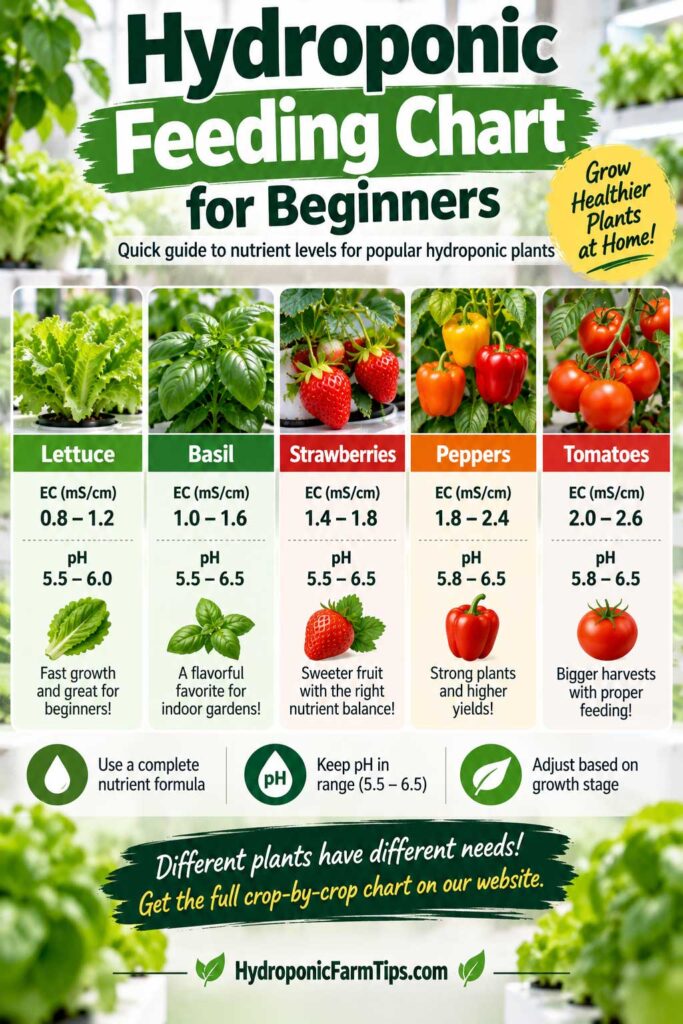
Once you understand EC and pH, feeding hydroponic plants becomes much easier. Instead of guessing how much fertilizer a plant needs, you can use the crop and its growth stage as a starting point and then adjust based on how the plant responds.
The following hydroponic feeding chart for beginners provides general starting ranges for several popular crops.
Important: These are broad starting ranges, not universal targets. Always compare them with the instructions for your nutrient formula and the requirements of the crop you’re growing.
| Plant | Growth Stage | Approx. EC | Suggested pH |
|---|---|---|---|
| Lettuce | Seedling | 0.4–0.8 | 5.5–6.5 |
| Lettuce | Established | 0.8–1.2 | 5.5–6.5 |
| Basil | Seedling | 0.5–0.8 | 5.5–6.5 |
| Basil | Established | 1.0–1.6 | 5.5–6.5 |
| Spinach | Seedling | 0.6–1.0 | 5.5–6.5 |
| Spinach | Established | 1.8–2.3 | 5.5–6.5 |
| Strawberries | Young plants | 0.6–1.0 | 5.5–6.2 |
| Strawberries | Established/Fruiting | 1.0–1.5 | 5.5–6.2 |
| Peppers | Young plants | 0.8–1.2 | 5.5–6.5 |
| Peppers | Mature/Fruiting | 1.8–2.5 | 5.5–6.5 |
| Cucumbers | Young plants | 0.8–1.2 | 5.5–6.5 |
| Cucumbers | Mature/Fruiting | 1.7–2.5 | 5.5–6.5 |
| Tomatoes | Young plants | 0.8–1.5 | 5.5–6.5 |
| Tomatoes | Mature/Fruiting | 2.0–3.5 | 5.5–6.5 |
These figures are general starting ranges, not universal feeding prescriptions. Cultivar, temperature, light intensity, water quality, nutrient formulation, and growing system can all affect the ideal concentration.
Feeding Seedlings and Young Plants
Young seedlings don’t need the same nutrient strength as mature plants.
Starting with a mild nutrient solution reduces the chance of stressing delicate roots. As plants establish themselves and develop more foliage, you can gradually increase nutrient strength toward the appropriate range for the crop.
Avoid jumping immediately from a very weak seedling solution to full-strength feeding.
Feeding Leafy Greens and Herbs
Leafy crops such as lettuce and many herbs generally require less concentrated nutrient solutions than large fruiting plants.
This is one reason crops with similar requirements work well together in the same hydroponic system. Lettuce and compatible herbs, for example, can often be easier to manage together than lettuce and mature tomatoes sharing one reservoir.
Feeding Fruiting Plants
Tomatoes, peppers, cucumbers, and strawberries change considerably as they mature.
Their nutrient demands can increase as plants become larger and begin flowering and producing fruit. This is where multi-part nutrient systems can be useful because some allow you to adjust feeding according to the plant’s growth stage.
Even then, don’t automatically increase fertilizer simply because flowers appear. Check EC, observe your plants, and follow the nutrient manufacturer’s crop-specific feeding recommendations.
Use the Chart as a Starting Point
No feeding chart can tell you exactly what every plant needs under every growing condition.
Use these ranges to establish a reasonable starting point, then monitor:
- EC or PPM
- pH
- Water level
- Leaf color and growth
- Root condition
- Changes in the reservoir over time
Keeping a simple record of these measurements can help you recognize patterns and fine-tune your feeding routine.
For a more detailed crop-by-crop reference, our Hydroponic Nutrient & pH Chart covers recommended pH and nutrient-strength ranges for many popular hydroponic vegetables, herbs, and fruits.
How Often Should You Feed Hydroponic Plants?
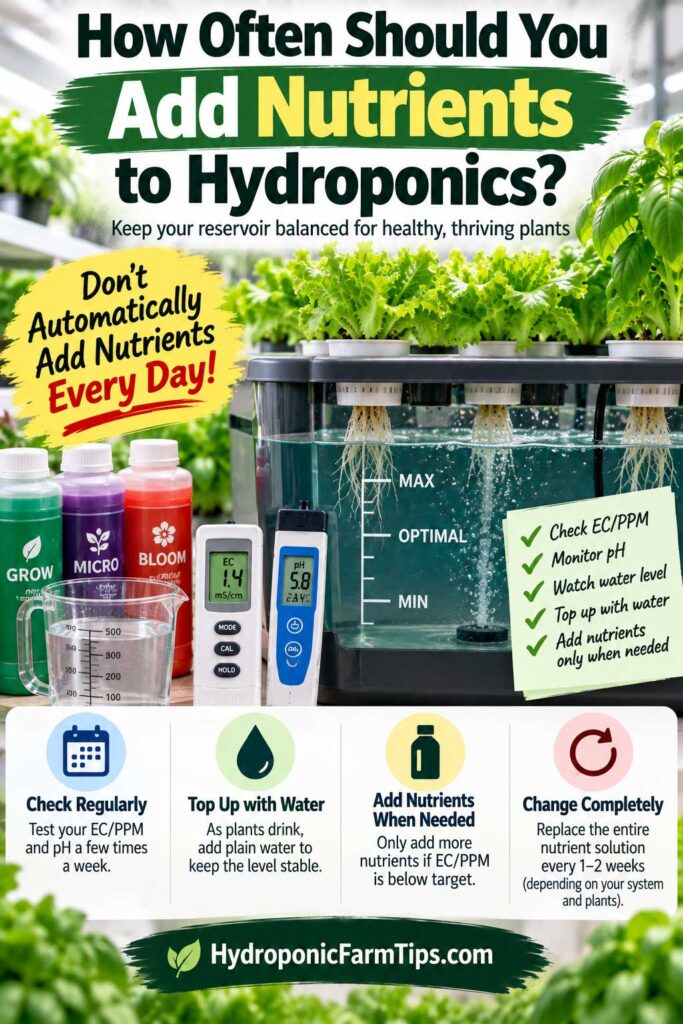
Hydroponic plants don’t usually need to be “fed” on a fixed daily schedule the way you might fertilize a soil garden every few weeks. In most hydroponic systems, the roots have regular or continuous access to a nutrient solution.
Your job is to maintain that solution at an appropriate strength. So in hydroponics, “How often should I feed?” is often better thought of as “How do I maintain the reservoir?”
For a deeper look at top-ups, full reservoir changes and when fresh solution is actually necessary, see How Often Should You Change Hydroponic Water?.
Do You Add Nutrients Every Day?
Usually not. In most hydroponic systems, you don’t need to add another dose of nutrients every day.
As plants grow, they remove both water and dissolved nutrients from the reservoir. Water is also lost through evaporation and transpiration, so the nutrient concentration doesn’t always decrease at the same rate as the water level.
That’s why automatically adding more fertilizer every day can cause problems.
If water disappears faster than nutrients are absorbed, the remaining solution becomes more concentrated. Adding another full dose of fertilizer could push the EC even higher.
Instead, check the reservoir before deciding what it needs.
What Should You Do When the Water Level Drops?
When the reservoir level falls, you will often need to top it up with fresh water.
After topping up, allow the solution to mix and then check the EC or PPM. If the nutrient concentration is below the appropriate range for your crop, add nutrients gradually according to the manufacturer’s instructions.
Then check the pH and adjust it if necessary.
A simple routine looks like this:
Check water level → top up → mix → check EC → adjust nutrients if needed → check pH
This approach is much more reliable than adding nutrients on a calendar.
How Often Should You Check the Reservoir?
For a small home hydroponic garden, checking the reservoir every day or two is a good habit, especially when you’re learning how quickly your plants consume water.
Large, mature plants may use water surprisingly fast, particularly in warm conditions or under strong grow lights.
Pay attention to:
- Water level
- EC or PPM
- pH
- Water temperature
- Root appearance
- Overall plant health
You don’t necessarily need to adjust something every time you check. Monitoring simply helps you catch problems before they become serious.
Feeding Is Really Reservoir Management
One of the biggest mindset shifts for beginners is realizing that hydroponic feeding isn’t about pouring fertilizer onto individual plants.
You’re managing a shared nutrient solution.
Keep that solution within a suitable range, replenish water as needed, refresh it periodically, and let the plants take up what they need.
That makes hydroponic feeding far more predictable—and much less complicated—than trying to decide how many times per week each plant needs fertilizer.
Do Different Plants Need Different Nutrient Levels?
Yes. One of the most important things to understand about hydroponic feeding is that different plants don’t necessarily need the same nutrient strength.
A small lettuce plant and a mature tomato plant have very different growth habits. Lettuce mainly produces leaves, while a tomato plant must support a large root system, stems, foliage, flowers, and developing fruit. Their nutrient requirements reflect those differences.
This is why a reservoir that keeps a tray of lettuce perfectly happy may not be strong enough for a large tomato plant loaded with fruit.
Leafy Greens
Leafy greens generally prefer relatively mild nutrient solutions.
Lettuce, arugula, bok choy, kale, and spinach are all common hydroponic choices. Because many leafy greens have similar requirements, they’re often good candidates for sharing a reservoir.
Herbs
Many culinary herbs also grow well at moderate nutrient concentrations.
Basil, parsley, cilantro, mint, oregano, and thyme can all be grown hydroponically, although their ideal conditions aren’t identical.
Basil is particularly popular with beginners because it grows quickly and responds well to hydroponic conditions.
Fruiting Crops
Fruiting crops such as tomatoes, peppers, cucumbers, and strawberries generally become heavier feeders as they mature.
Their nutrient requirements can also change as they move from vegetative growth into flowering and fruit production.
This doesn’t mean you should automatically use the strongest possible nutrient solution. Excessive EC can stress roots and reduce water uptake. Instead, increase nutrient strength gradually as the plant develops and monitor its response.
Can You Grow Different Plants in the Same Reservoir?
Yes—but choose your combinations carefully.
Plants sharing a reservoir also share the same EC, pH, nutrient formula, and water temperature. That works best when the crops have reasonably similar requirements.
For example, several leafy greens and herbs may coexist comfortably in one system. Pairing young lettuce with large, fruiting tomato plants can be much harder because their preferred nutrient strengths may differ considerably.
Growth rate matters too. A large cucumber or tomato plant can consume water and nutrients much faster than a small herb growing beside it.
Group Plants With Similar Needs
For beginners, one of the easiest strategies is to organize plants into broad groups:
Leafy greens together. Herbs with similar requirements together. Fruiting crops together when practical.
You don’t have to create a separate reservoir for every species. The goal is simply to avoid combinations with dramatically different feeding requirements.
As you gain experience, you can fine-tune nutrient concentrations for individual crops. For your first hydroponic garden, however, grouping plants with similar needs makes reservoir management considerably easier.
How to Change and Refresh Your Nutrient Solution
Topping up your hydroponic reservoir with fresh water helps replace what plants use, but it doesn’t completely reset the nutrient balance.
Over time, plants absorb some nutrients faster than others. Dissolved salts can accumulate, pH can become harder to manage, and the nutrient ratio remaining in the reservoir may gradually differ from the original formula.
That’s why hydroponic systems benefit from periodic nutrient solution changes.
How Often Should You Change Hydroponic Nutrient Solution?
Many small home systems are refreshed somewhere around every one to two weeks, but treat that as a starting point rather than a fixed rule. Reservoir size, crop load, water quality, and how stable your EC and pH remain can all change the ideal schedule.
You may need to refresh it sooner when:
- EC becomes difficult to control
- pH changes unusually quickly
- The solution looks cloudy or develops an unusual odor
- Plants are consuming large amounts of water
- Salt deposits are accumulating
- Plant growth or appearance changes unexpectedly
Larger, well-managed reservoirs may remain stable longer, while small reservoirs can change quickly. If you’re constantly correcting EC or pH and the reservoir seems harder to stabilize each day, replacing the solution is often simpler than continuing to chase the readings.
How to Replace the Nutrient Solution
The process is straightforward:
- Remove the old nutrient solution.
- Inspect the reservoir, tubing, air stones, and roots.
- Remove debris and clean the reservoir if necessary.
- Refill it with fresh water.
- Add your hydroponic nutrients according to the manufacturer’s instructions.
- Mix thoroughly and check EC or PPM.
- Check and adjust pH after the nutrients are mixed.
- Return the system to normal operation.
Dispose of used nutrient solution responsibly. Avoid releasing concentrated fertilizer solution into storm drains, streams, ponds, or other surface water.
Avoid pouring concentrated nutrients directly onto exposed plant roots.
Top-Ups vs. Complete Reservoir Changes
These are two different parts of hydroponic maintenance.
A top-up replaces water lost between reservoir changes. Depending on your EC reading, you may use plain water or add some nutrient solution.
A complete change removes the existing solution and replaces it with a freshly mixed batch.
If you only keep adding nutrients indefinitely without occasionally replacing the reservoir solution, certain mineral salts may accumulate while others become depleted.
Don’t Waste Nutrients Unnecessarily
Changing the reservoir every day isn’t necessary for a typical home hydroponic system and can waste both water and fertilizer.
Instead, watch how your system behaves.
If pH and EC remain reasonably stable and your plants look healthy, your reservoir may not need immediate replacement. If readings become increasingly difficult to manage, a fresh nutrient solution can give you a clean starting point.
For beginners, a simple routine of regular top-ups, EC and pH monitoring, and periodic full solution changes is usually enough to keep hydroponic feeding manageable.
Signs of Too Many or Too Few Hydroponic Nutrients
Hydroponic plants often show visible signs when something in their feeding routine isn’t right. The challenge is that many symptoms overlap, so a yellow leaf doesn’t automatically mean you need to add more fertilizer.
Before changing your nutrient mix, check the EC, pH, water level, root condition, and overall growing environment.
If you notice green growth or slippery buildup in the reservoir, see How to Get Rid of Algae in Hydroponics for prevention and cleanup steps.
Signs Your Nutrient Solution May Be Too Strong
When nutrient concentration becomes excessive, plants can have difficulty taking up water. This is often referred to as nutrient burn or fertilizer stress.
Possible signs include:
- Brown or scorched leaf tips
- Browning along leaf edges
- Leaves curling or becoming unusually dark
- Slowed growth
- Wilting despite adequate water
- EC that continues to rise as the water level falls
If your EC is considerably higher than the recommended range for the crop, don’t add more fertilizer.
You may need to dilute the reservoir with fresh water or replace the solution with a correctly mixed batch.
Signs Your Nutrient Solution May Be Too Weak
When nutrient concentration is consistently too low, plants may not receive enough essential minerals to support healthy growth.
Possible symptoms include:
- Pale or yellowing leaves
- Slow growth
- Smaller-than-expected leaves
- Weak stems
- Poor flowering or fruit development
- General loss of vigor
However, these symptoms can also result from improper pH, inadequate lighting, root problems, temperature stress, or a specific nutrient deficiency.
Lighting can complicate diagnosis too. If plants are stretching, bleaching or struggling despite balanced nutrients, check how high grow lights should be above hydroponic plants.
That’s why checking the reservoir comes before reaching for the nutrient bottle.
Check the Roots Too
Healthy hydroponic roots are generally firm and light-colored, although nutrient solutions and growing media can naturally stain them. Root color alone isn’t enough to diagnose root rot. Texture, odor, plant response, and whether the discoloration is progressing are more informative than color by itself.
Roots that become slimy, soft, foul-smelling, or increasingly dark may indicate a root-zone problem rather than a simple feeding issue.
If the roots themselves look unhealthy, our Hydroponic Root Rot Guide explains how to distinguish root problems from nutrient stress and what to do next.
Poor oxygenation and excessively warm nutrient solution can contribute to root problems that interfere with nutrient uptake, making the plant appear deficient even when nutrients are present.
Diagnose Before You Add More Nutrients
When a plant looks unhealthy, use a simple troubleshooting sequence:
Check pH → check EC/PPM → inspect roots → check water temperature → review lighting → consider nutrient deficiency
This prevents one of the most common beginner mistakes: seeing yellow leaves, adding more fertilizer, and accidentally making the problem worse.
Your plants are useful indicators, but combine what you see with actual reservoir measurements. Symptoms tell you something may be wrong; pH and EC help you figure out what to investigate next.
Common Hydroponic Nutrient Deficiencies
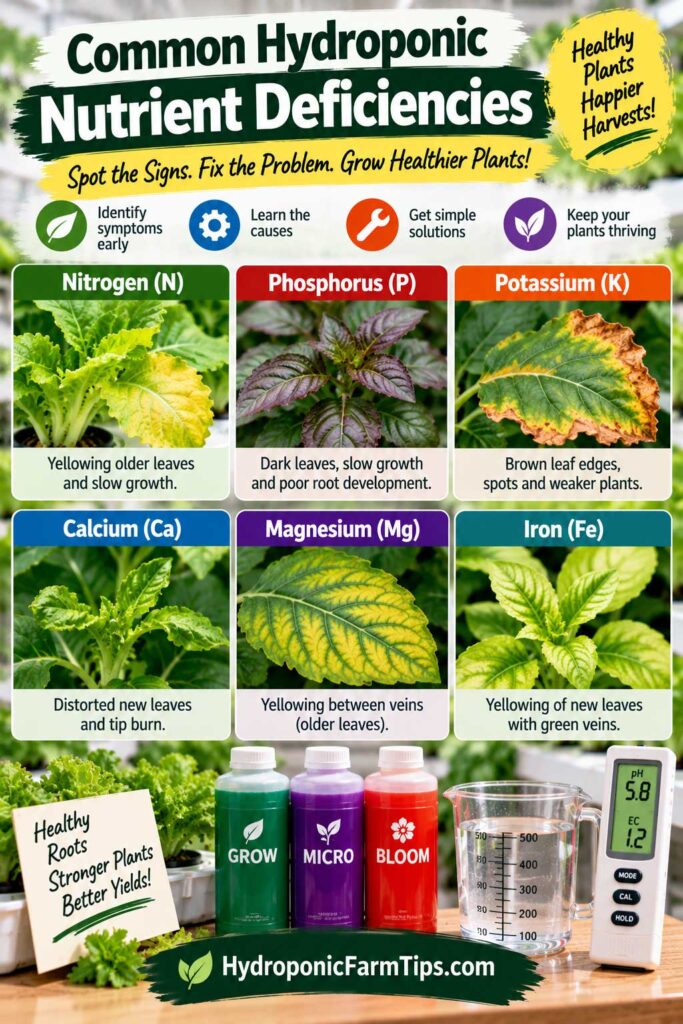
A weak nutrient solution isn’t the only reason plants develop deficiency symptoms. A plant can show signs of a hydroponic nutrient deficiency even when that nutrient is present in the reservoir if pH, root health, or nutrient interactions interfere with uptake.
Here are several common problems beginners may encounter.
Quick Hydroponic Nutrient Deficiency Guide
| Nutrient | Possible Deficiency Signs |
|---|---|
| Nitrogen | Older leaves become pale green or yellow; growth may slow |
| Magnesium | Yellowing between the veins, usually beginning on older leaves |
| Iron | New growth turns yellow while veins may remain greener |
| Calcium | Distorted new growth, damaged growing tips, or blossom-end rot in some fruiting crops |
| Potassium | Browning or scorching around leaf edges, weak growth |
| Phosphorus | Slow growth; leaves may become unusually dark or sometimes develop reddish-purple coloration |
For photos, causes and more detailed troubleshooting, continue with Hydroponic Nutrient Deficiencies: Signs, Causes & Fixes.
Also pay attention to which leaves are affected first and how the symptoms spread. That pattern can often tell you more than color alone.
These symptoms are useful clues, but don’t diagnose a deficiency from leaf appearance alone. Several deficiencies look similar, and problems such as incorrect pH, excessive EC, root-zone problems, or environmental stress can produce comparable symptoms.
Check pH Before Adding Supplements
If nutrients are present but pH is outside an appropriate range, plants may struggle to absorb certain elements.
Before adding extra iron, magnesium, calcium, or another supplement, check your reservoir’s pH and EC.
Correcting the root-zone conditions may solve the problem without adding anything else.
Be Careful With Cal-Mag
Calcium-magnesium supplements—usually called Cal-Mag—are popular in hydroponics, but they aren’t automatically necessary for every reservoir.
Your base nutrient may already contain adequate calcium and magnesium. Adding more without checking your water and nutrient formulation can upset the overall nutrient balance.
Cal-Mag may be useful in specific situations, but it should solve an identified need rather than become something you automatically pour into every nutrient mix.
Look at Where Symptoms Appear
The location of symptoms can provide another clue.
Some nutrients can be moved relatively easily from older plant tissue to new growth. Deficiencies in these mobile nutrients, such as nitrogen and magnesium, often appear on older leaves first.
Other nutrients are less mobile within the plant. Problems involving nutrients such as calcium and iron therefore tend to show up more noticeably in new growth.
This distinction can help narrow down the possibilities, but reservoir measurements should still be part of your diagnosis.
Most beginner nutrient problems are easier to solve when caught early. Keep the nutrient solution balanced, maintain an appropriate pH, protect root health, and avoid adding supplements until you have a good reason to believe they’re needed.
Common Hydroponic Nutrient Mistakes Beginners Should Avoid
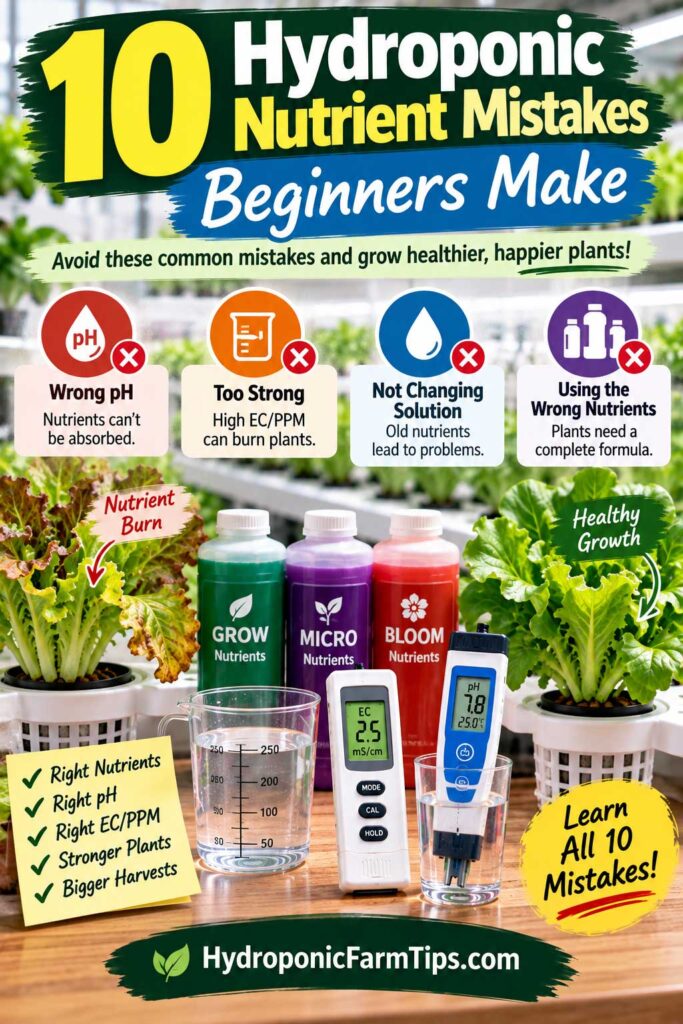
Most beginner feeding problems aren’t caused by choosing the “wrong” brand of nutrients. They’re usually the result of a few simple mistakes with mixing, measuring, or reservoir maintenance.
Avoiding these problems can save you a lot of troubleshooting later.
1. Using Too Much Nutrient Solution
It’s easy to assume that more fertilizer will make plants grow faster.
In hydroponics, an overly concentrated solution can actually stress plants and interfere with water uptake. Follow the manufacturer’s directions, start conservatively with young plants, and use EC or PPM to monitor nutrient strength.
2. Adding Nutrients Every Time You Add Water
Plants don’t necessarily consume water and nutrients at the same rate.
If the water level falls while EC rises, adding more fertilizer can make an already concentrated solution even stronger.
Top up the reservoir, let everything mix, measure the EC, and then decide whether additional nutrients are necessary.
3. Mixing Concentrated Nutrient Parts Together
Never pour concentrated Part A and Part B together before diluting them in water unless the manufacturer specifically instructs otherwise.
Certain concentrated minerals can react and form insoluble compounds.
Add each component to the reservoir separately and mix thoroughly between additions.
4. Adjusting pH Before Adding Nutrients
Hydroponic fertilizers can change the pH of your water.
If you adjust plain water first, you may have to adjust it all over again after adding the nutrients.
A better sequence is:
Water → nutrients → mix → check EC → check and adjust pH
5. Ignoring Your Starting Water
Tap water isn’t the same everywhere.
Some water contains substantial amounts of calcium, magnesium, bicarbonates, and other dissolved minerals. If your starting EC is already relatively high, that needs to be considered when interpreting your final reservoir reading.
Testing your source water gives you a useful baseline.
6. Chasing the Perfect pH Number
If your target range is 5.5–6.5, you don’t need to panic because the reservoir moves from 5.9 to 6.1.
Repeatedly adding pH adjusters to correct tiny changes can create unnecessary instability.
Aim for an appropriate range, not a perfectly fixed number.
7. Adding Supplements Without Knowing Why
Cal-Mag, bloom boosters, root additives, and other supplements can be useful in specific situations, but more products don’t automatically produce healthier plants.
Start with a complete base nutrient. Add something else only when you understand what it provides and why your plants may need it.
8. Never Changing the Reservoir
Continually topping up the same nutrient solution can eventually lead to an unpredictable balance of dissolved minerals.
Periodic reservoir changes give you a fresh, correctly mixed starting point.
9. Diagnosing Problems From Leaf Color Alone
Yellow leaves don’t always mean nitrogen deficiency. Brown tips don’t automatically mean potassium deficiency.
pH problems, excessive EC, poor lighting, root damage, temperature stress, and several nutrient deficiencies can produce similar symptoms.
Measure first. Diagnose second. Correct third.
10. Following a Feeding Chart Too Rigidly
Feeding charts are useful starting points—not guarantees.
Different cultivars, nutrient brands, water sources, temperatures, lighting conditions, and growth stages can change what works best.
Use recommended ranges to get started, then let your EC readings, pH measurements, root health, and plant growth guide your adjustments.
Keeping hydroponic feeding simple is often the best strategy. A complete nutrient formula, accurate measurements, stable pH, healthy roots, and consistent reservoir maintenance will solve—or prevent—many of the problems beginners encounter.
Can You Use Regular Fertilizer in Hydroponics?
Technically, some fertilizers made for conventional gardening contain nutrients that plants can use, but regular soil fertilizer is generally not the best choice for a hydroponic system.
Hydroponic plants depend entirely on the nutrient solution, so the fertilizer needs to provide a complete and appropriately balanced range of essential mineral nutrients in forms that work well in water.
Why Soil Fertilizer Can Cause Problems
Many fertilizers intended for soil assume that the growing medium, organic matter, and microbial activity will contribute to nutrient availability.
Some may provide plenty of nitrogen, phosphorus, and potassium while supplying insufficient amounts of calcium, magnesium, iron, or other micronutrients needed in a complete hydroponic solution.
Certain organic or slow-release fertilizers can also contain materials that don’t dissolve cleanly in water. In a hydroponic system, this can contribute to:
- Sediment in the reservoir
- Clogged pumps, emitters, or tubing
- Unstable nutrient concentrations
- Biofilm or microbial growth
- Difficulty measuring and controlling EC
What About All-Purpose Liquid Plant Food?
An all-purpose liquid fertilizer isn’t automatically suitable just because it dissolves in water.
Check whether the manufacturer specifically recommends it for hydroponic or soilless growing and whether the formula provides a complete range of essential nutrients.
For beginners, choosing a product formulated specifically for hydroponics removes much of the uncertainty.
Can You Use Organic Fertilizers in Hydroponics?
Organic hydroponic growing is possible, but it can be more complicated than using mineral-based hydroponic nutrients.
Many organic fertilizers rely on microorganisms to break compounds down into forms plants can absorb. Managing that biological activity in a water-based system requires additional attention to oxygenation, filtration, cleanliness, and nutrient availability.
For someone learning hydroponics for the first time, a complete mineral hydroponic nutrient formula is usually the simplest and most predictable option.
Once you’re comfortable managing pH, EC, water quality, and reservoir conditions, you can explore more specialized feeding approaches if you want to experiment.
The important thing isn’t whether the fertilizer says “natural,” “organic,” or “all-purpose” on the front of the package. What matters is whether it can provide a complete, soluble, and appropriately balanced nutrient supply for hydroponically grown plants.
FAQs About Hydroponic Nutrients
What are the best hydroponic nutrients for beginners?
The best hydroponic nutrients for beginners are usually complete formulas that are easy to measure and provide both macronutrients and essential micronutrients.
How often should I add nutrients to my hydroponic system?
Don’t add nutrients automatically every day. Monitor the water level and EC or PPM, top up with fresh water when necessary, and add nutrients when measurements indicate that the solution needs them. Periodically replace the reservoir with a freshly mixed nutrient solution.
Can you grow hydroponic plants without nutrients?
Not for long-term healthy growth. Seeds contain enough stored energy and nutrients to support early germination, but once seedlings begin developing, they need an external supply of essential mineral nutrients.
What pH should hydroponic nutrient solution be?
Many hydroponic crops perform well around pH 5.5–6.5, although the preferred range varies by plant. Rather than trying to maintain one exact number, keep the solution within an appropriate range for the crop you’re growing.
Should I measure EC or PPM?
Either can be useful, but EC is generally easier to compare because PPM readings depend on the conversion scale used by the meter. If you use PPM, know whether your meter uses a 500, 640, or 700 conversion factor.
Should I add nutrients before or after adjusting pH?
Generally, add and thoroughly mix your nutrients first, measure the EC or PPM, and then check and adjust the pH. Nutrients can change the pH of the water, so adjusting pH first may mean doing the job twice.
Can I mix Part A and Part B together?
Don’t mix concentrated Part A and Part B directly together unless the manufacturer specifically instructs you to do so. Add each component separately to the reservoir water and mix thoroughly between additions.
Do I need Cal-Mag in every hydroponic system?
No. Many complete hydroponic nutrient formulas already provide calcium and magnesium. Whether additional supplementation is useful depends on your base nutrients, source water, crop, and growing conditions.
Can I use tap water for hydroponic nutrients?
Often, yes. However, tap-water quality varies considerably. Checking its starting EC and, when necessary, reviewing a local water-quality report can help you understand what minerals are already present before you add nutrients.
Why does my EC keep rising?
If plants absorb water faster than dissolved nutrients, the reservoir becomes more concentrated and EC can rise. Evaporation can have a similar effect. Check the water level and consider topping up with fresh water before adding more fertilizer.
Hydroponic Nutrients Are Easier Once You Keep the Routine Simple
Learning how to use hydroponic nutrients for beginners can feel technical at first, but you don’t need to master plant chemistry to grow healthy plants.
Start with a complete hydroponic nutrient formula, follow the manufacturer’s mixing instructions, and pay attention to three basics: nutrient strength, pH, and your plants.
Remember that more fertilizer doesn’t mean faster growth. Young plants usually need gentler feeding than mature plants, different crops have different requirements, and adding nutrients without checking EC or PPM can create more problems than it solves.
A simple routine goes a long way:
Mix carefully → check EC → check pH → observe your plants → maintain the reservoir.
After a few reservoir changes, the numbers start making more sense. You’ll notice how quickly your plants use water, whether EC normally rises or falls between top-ups, and how much your pH tends to drift.
Keep your first feeding routine simple and consistent. Hydroponics gives you remarkable control over plant nutrition—and once you understand the basics, that control becomes one of the biggest advantages of growing without soil.
Your next step: Save the nutrient and pH ranges for the crops you’re growing, then record your reservoir’s starting EC and pH. Those two numbers will give you a baseline to compare against as your plants grow.
More Hydroponic Growing Guides You May Like
Now that you understand the basics of hydroponic nutrients, these guides can help you choose what to grow, manage your reservoir, troubleshoot problems, and build a healthier hydroponic garden.
- Hydroponic Nutrient & pH Chart – Compare recommended pH and nutrient ranges for popular hydroponic vegetables, herbs, and fruits.
- 8 Best Hydroponic Systems for Home – Compare DWC, Kratky, NFT, Ebb and Flow, drip, aeroponics, wick systems, and Dutch Buckets to find the right setup for your garden.
- 10 Best Hydroponic Vegetables – Discover productive vegetables to grow hydroponically and learn which systems work well for different crops.
- 10 Best Hydroponic Herbs to Grow at Home – Choose beginner-friendly herbs such as basil, mint, parsley, and cilantro for your hydroponic garden.
- Are Hydroponic Vegetables Less Nutritious? – Explore what research says about the nutritional quality of hydroponically grown vegetables compared with soil-grown produce.
- Hydroponic Root Rot Guide – Learn how to recognize unhealthy roots, understand common causes of root problems, and protect your plants before serious damage occurs.
- How to Transfer Plants From Hydroponics to Soil – Follow the process of moving hydroponically grown plants into soil while reducing transplant stress.