
If you’re wondering how often should you change hydroponic water, a good general rule is to replace the nutrient solution completely about every 1 to 3 weeks. The ideal schedule depends on your reservoir size, the number and type of plants you’re growing, water quality, nutrient strength, and how stable your pH and EC remain.
Between full water changes, you usually don’t need to dump the entire reservoir every time the water level drops. If you’re still learning the basics, our Hydroponics for Beginners guide explains how reservoirs, nutrients, roots, and growing systems work together. Instead, top it off with fresh water as plants absorb water and lose moisture through transpiration. A complete change becomes more important when nutrient levels become unbalanced, salts accumulate, pH becomes difficult to control, or the reservoir develops algae, cloudiness, unpleasant odors, or root problems.
Your hydroponic system also affects how often the water should be replaced. A small DWC bucket may require more frequent changes than a large recirculating reservoir, while a Kratky system is managed differently because it is designed to operate with minimal reservoir disturbance.
In this guide, you’ll learn how often to change water in hydroponics, when topping off is enough, which warning signs mean it’s time for fresh nutrient solution, and how to create a practical water-change schedule for your specific system.
Why Hydroponic Water Needs to Be Changed
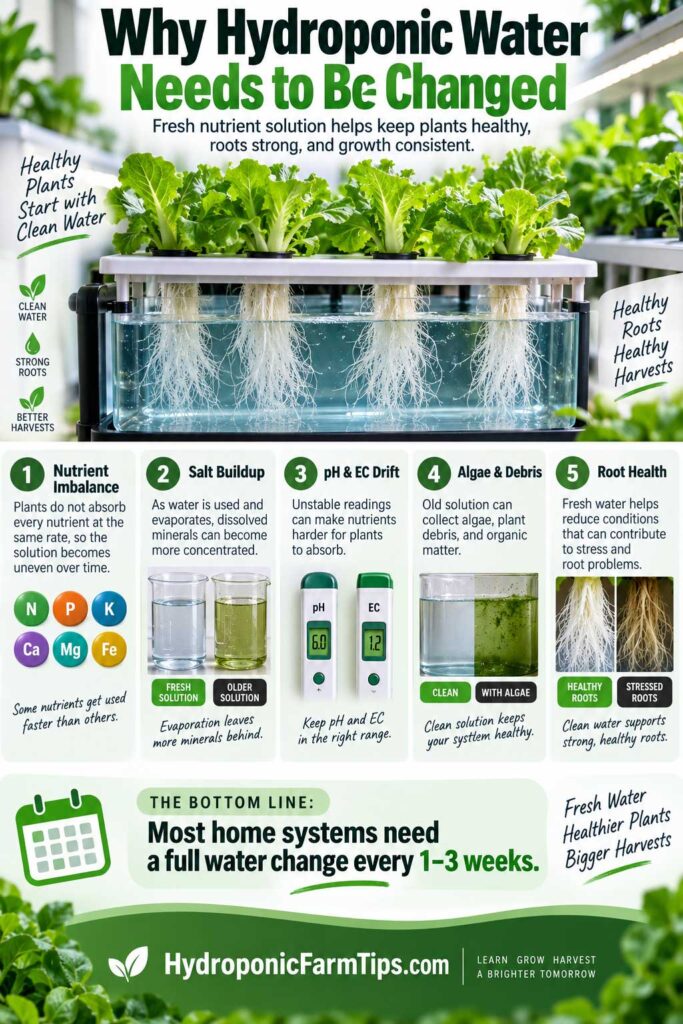
To understand how often you should change hydroponic water, it helps to know what happens inside the reservoir over time. The water may look perfectly clean even when the nutrient solution is no longer well balanced.
As plants grow, they do not absorb every nutrient at the same rate. Depending on the crop and growth stage, they may take up more nitrogen, potassium, calcium, magnesium, or other minerals at different times. Over time, this can leave the reservoir with an uneven nutrient profile even when the overall EC reading still appears acceptable.
Our Hydroponic Nutrient & pH Chart can help you compare recommended pH and nutrient ranges for common hydroponic crops.
Water also leaves the system through plant uptake and evaporation. As the water level drops, dissolved minerals can become more concentrated. Topping off with fresh water helps restore the reservoir level, but it does not completely restore the original nutrient balance.
A full reservoir change gives you a cleaner reset. It can reduce accumulated salts, remove plant debris and organic material, restore a more predictable nutrient mix, and give you an opportunity to clean the reservoir before refilling it. Fresh solution can also make pH and EC easier to manage when the old reservoir has become unstable.
Regular water changes can also reduce conditions that contribute to algae, poor root health, and nutrient imbalance, especially when combined with good reservoir cleaning and light control.
You do not need to replace the nutrient solution every time the water level drops. In most hydroponic systems, topping off between full changes is completely normal.
The goal is to refresh the reservoir before nutrient imbalance, salt buildup, or declining water quality starts affecting plant growth.
This is especially important in smaller reservoirs, where changes in pH, EC, temperature, and nutrient concentration can happen much faster than they do in larger systems.
Changing Hydroponic Water vs. Topping Off the Reservoir
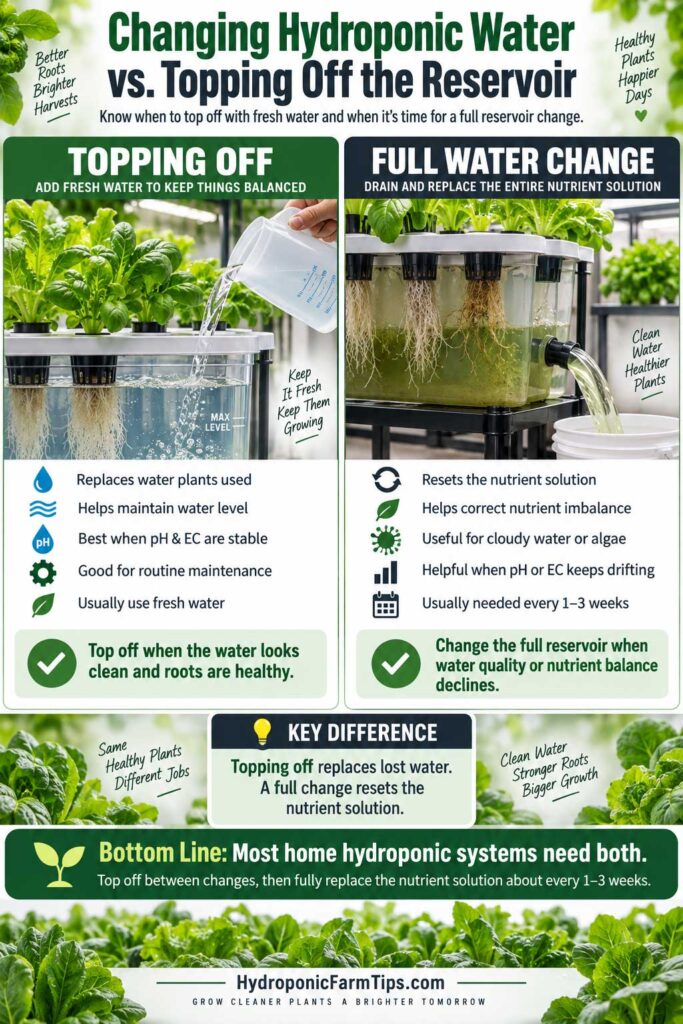
If you’re asking, “How often should you change hydroponic water?”, it helps to first understand the difference between topping off the reservoir and performing a complete water change. Most hydroponic systems need both.
When the water level drops, you can usually top off the reservoir with fresh water rather than replacing the entire nutrient solution. This restores the water plants have used and helps prevent the remaining solution from becoming too concentrated.
A full water change does something different: it resets the nutrient solution. If you’re unsure how nutrient concentration changes as plants feed, see our guide to Hydroponic Nutrient Deficiencies: Signs, Causes & Fixes.
Plants do not absorb every mineral at the same rate. Over time, some nutrients may become depleted while others remain behind. Because of this, an EC reading can still appear reasonable even when the actual nutrient balance has shifted.
Adding nutrient solution every time the water level falls can make the problem worse by allowing certain dissolved salts to accumulate.
For routine maintenance, check the reservoir level regularly, top off with fresh water when needed, and continue monitoring pH and EC. Add nutrients only when your readings and feeding plan indicate they are needed. Then perform a complete nutrient-solution change about every 1 to 3 weeks, adjusting that schedule based on your system.
Smaller reservoirs and fast-growing plants may need fresh solution sooner because water levels and nutrient concentrations can change quickly. Larger reservoirs generally remain more stable and may stay within acceptable ranges for longer.
One common mistake is assuming every change in EC means more nutrients should be added. Plants may be consuming water faster than nutrients, or nutrients faster than water. That is why it is better to consider water level, EC, pH, root health, and overall reservoir condition together rather than relying on a single measurement.
When Is Topping Off Enough?
Topping off is usually enough when the nutrient solution looks and smells normal, the roots appear healthy, and pH and EC remain within the expected range.
If the water level has simply fallen because of normal plant uptake, there is usually no reason to replace the entire reservoir early.
When Should You Do a Full Water Change?
A complete water change is a better choice when pH becomes difficult to stabilize, EC starts behaving unusually, the water becomes cloudy or develops an unpleasant odor, algae appears, or the roots begin looking unhealthy.
It is also useful when the reservoir has been repeatedly topped off for an extended period and you want to restore a known nutrient balance.
A simple way to think about it is this: topping off replaces lost water, while a full water change resets the nutrient solution.
How Often to Change Water in Different Hydroponic Systems
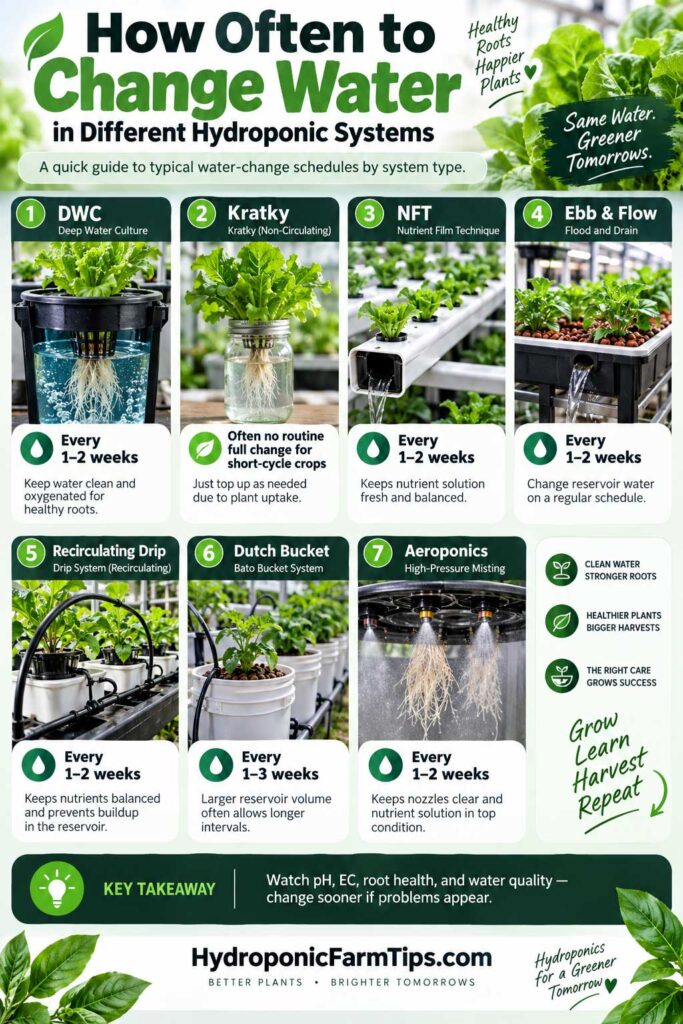
There is no single answer to how often you should change hydroponic water because the ideal schedule depends partly on the type of system you are using. Small reservoirs can change quickly, while larger recirculating systems usually stay more stable for longer.
Deep Water Culture (DWC)
For most DWC systems, a full nutrient-solution change every 1 to 2 weeks is a practical starting point.
Because the roots remain submerged in the reservoir, water quality has a direct effect on plant health. Oxygen is especially important in DWC, so make sure your system has adequate aeration. Our guide to the Best Air Pumps for Hydroponics explains what to look for when choosing an air pump. Small buckets can experience faster swings in pH, EC, temperature, and nutrient concentration, especially as plants become larger and consume more water.
Between changes, top off with fresh water and continue monitoring pH and EC.
Kratky Method
Kratky systems are different because they are designed to operate without pumps and often without routine reservoir replacement.
For short-cycle crops such as lettuce, you may be able to fill the container at the beginning and let the plant use the solution until harvest. Longer-growing crops may need careful topping off or a partial refresh if the nutrient solution becomes depleted.
Avoid completely refilling the container to its original level once a large air gap has formed. Part of the root system adapts to that oxygen-rich space, and submerging those roots again can reduce aeration.
Nutrient Film Technique (NFT)
NFT systems generally benefit from a complete reservoir change about every 1 to 2 weeks, although larger reservoirs may remain stable for longer.
Because the same nutrient solution continuously circulates past multiple plants, nutrient imbalances can gradually develop throughout the system. Monitor the main reservoir closely and keep the channels free of algae, debris, and root buildup.
Ebb and Flow
For ebb-and-flow systems, changing the nutrient solution about every 1 to 2 weeks is a reasonable starting point.
Water repeatedly moves between the reservoir and growing tray, so salts, root debris, and organic material can accumulate over time. Regular changes also give you a chance to inspect the pump and clean the reservoir.
Drip Hydroponic Systems
Recirculating drip systems often need a full reservoir change every 1 to 2 weeks.
Run-to-waste drip systems work differently because the nutrient solution drains away instead of returning to the reservoir. In those systems, there may not be a recirculating nutrient solution that needs to be periodically replaced in the same way.
Dutch Bucket Systems
Dutch bucket systems commonly use a larger recirculating reservoir, so a complete change every 1 to 3 weeks may be appropriate depending on reservoir size, plant load, and nutrient stability.
Heavy-feeding crops such as tomatoes, peppers, and cucumbers can alter nutrient levels quickly, so monitoring pH and EC becomes increasingly important as the plants mature.
Aeroponics
Aeroponic systems usually benefit from fresh nutrient solution every 1 to 2 weeks.
Water quality is especially important because fine misting nozzles can become clogged by mineral deposits or debris. Keeping the reservoir clean helps maintain consistent nutrient delivery to exposed roots.
Quick Hydroponic Water Change Guide
| Hydroponic System | Typical Starting Schedule |
|---|---|
| DWC | Every 1–2 weeks |
| Kratky | Often no routine full change for short-cycle crops |
| NFT | Every 1–2 weeks |
| Ebb and Flow | Every 1–2 weeks |
| Recirculating Drip | Every 1–2 weeks |
| Dutch Bucket | Every 1–3 weeks |
| Aeroponics | Every 1–2 weeks |
These are starting points, not strict rules. If the reservoir develops unstable pH, unusual EC readings, cloudy water, algae, unpleasant odors, or unhealthy roots, it may need to be changed sooner.
Signs Your Hydroponic Water Needs Changing
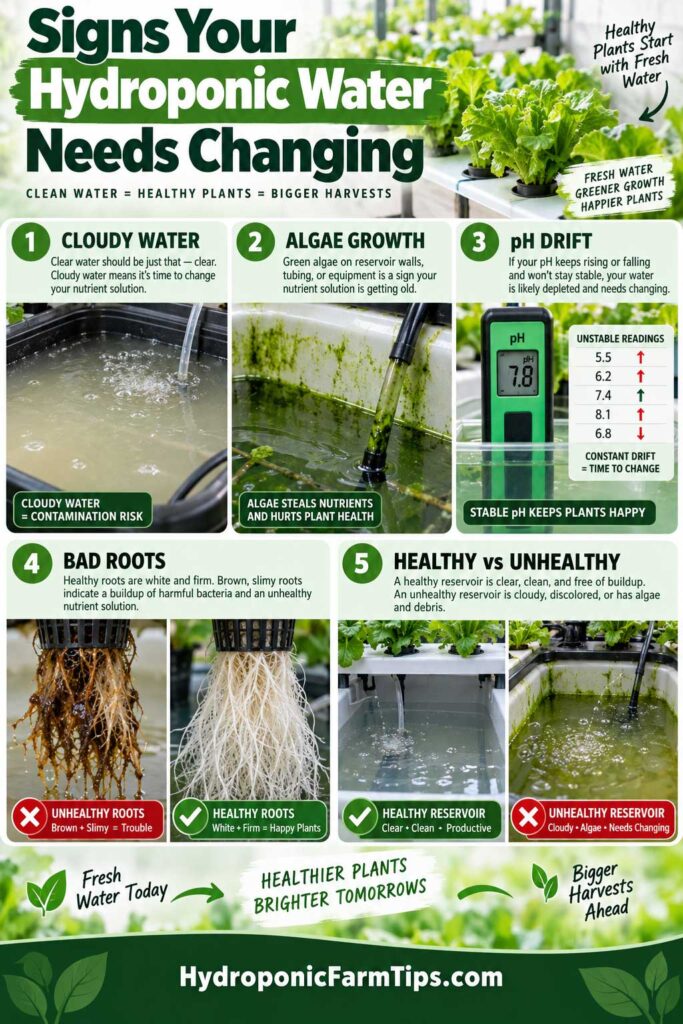
A calendar gives you a starting point, but how often you should change hydroponic water also depends on what the reservoir is telling you. If the nutrient solution starts behaving differently than usual, it may be better to change it early instead of waiting for your normal schedule.
1. pH Keeps Drifting
A little pH movement is normal, but frequent or large swings can be a sign that the nutrient solution is becoming difficult to balance.
If you repeatedly adjust the pH only to see it move out of range again soon after, a fresh reservoir may be easier to stabilize. For a deeper look at managing acidity and nutrient availability, read Best pH for Hydroponics.
2. EC Becomes Unstable
EC shows the overall concentration of dissolved salts in the nutrient solution.
If EC rises sharply as the water level drops, the solution may be becoming too concentrated. If it keeps falling despite reasonable adjustments, your plants may be consuming nutrients faster than expected.
Unusual EC behavior is a good reason to evaluate the entire reservoir rather than automatically adding more fertilizer.
3. The Water Looks Cloudy
Healthy nutrient solution is usually fairly clear, although its color can vary depending on the fertilizer you use.
Cloudiness may point to suspended debris, microbial activity, decomposing plant material, or other changes in the reservoir that deserve closer attention.
4. The Reservoir Develops an Unpleasant Smell
Hydroponic nutrient solution should not smell foul or strongly rotten.
A bad odor can be linked to decomposing organic matter, poor oxygenation, or developing root problems. If the smell appears together with brown, slimy roots, investigate for root rot and replace the nutrient solution.
5. Algae Is Growing in the Reservoir
Green growth on reservoir walls, tubing, growing media, or the water surface usually means light is reaching the nutrient solution.
A small amount of algae does not always mean the entire crop is in danger, but heavier growth can compete for nutrients and oxygen and make the reservoir harder to manage.
Changing the water should be combined with blocking light from entering the reservoir and cleaning affected surfaces. If algae keeps returning, see Algae in Hydroponics: Causes, Prevention & How to Get Rid of It for a complete troubleshooting process.
6. Roots Look Unhealthy
Healthy hydroponic roots are usually light-colored and firm, although some nutrient products can stain them.
Roots that become slimy, mushy, excessively brown, or foul-smelling need closer attention. A water change may help, but the underlying problem could also involve high water temperature, low oxygen, pathogens, or decomposing organic matter.
Our Hydroponic Root Rot guide covers the major warning signs, causes, and steps you can take when roots begin deteriorating.
7. Plants Show Unexplained Nutrient Problems
Yellow leaves, discoloration, slow growth, weak stems, or other deficiency-like symptoms do not always mean the plants need more fertilizer.
Sometimes nutrients are already present but are out of balance or unavailable because the pH has moved outside the ideal range. A fresh nutrient solution can help reset the system before you make stronger feeding adjustments.
Don’t Rely on Just One Sign
One unusual reading does not always mean the reservoir needs to be emptied immediately.
Look at the bigger picture: pH, EC, water temperature, reservoir appearance, root health, odor, and plant growth. When several warning signs appear together, a complete nutrient-solution change is usually the better choice.
Should You Replace All the Hydroponic Water or Only Part of It?
For routine maintenance, a complete reservoir change is usually the simplest way to reset your hydroponic nutrient solution.
A full change removes most of the old solution, which may contain an uneven nutrient balance, accumulated salts, plant debris, or other contaminants. It also gives you a chance to inspect and clean the reservoir before mixing a fresh batch.
Partial water changes can still be useful, especially in larger systems where replacing the entire reservoir frequently may be impractical.
When a Full Water Change Makes Sense
A full or nearly full replacement is usually the better choice when pH becomes difficult to stabilize, EC readings behave unusually, algae or cloudiness develops, the reservoir smells bad, roots show signs of stress, or you need to correct a nutrient-mixing mistake.
It is also useful when your normal water-change interval has arrived and you want to clean the reservoir thoroughly.
For many small home systems, a complete change every 1 to 3 weeks is easier and more predictable than repeatedly making small corrections.
When a Partial Water Change Can Help
A partial change can be useful when the nutrient solution is becoming too concentrated but the reservoir is otherwise clean and stable.
For example, removing part of the existing solution and replacing it with fresh water can help lower EC without emptying the entire system. In other situations, you may replace part of the reservoir with freshly mixed nutrient solution if the concentration has become too weak.
Partial changes are also more practical in larger recirculating systems, where growers may manage nutrient strength through frequent testing and smaller adjustments.
Partial Water Change vs. Topping Off
These two practices are easy to confuse.
Topping off means adding water to replace what plants have used or what has evaporated, without intentionally removing old solution first.
A partial water change means removing some of the existing nutrient solution and replacing it with fresh water or newly mixed solution.
Both can help maintain the reservoir, but neither provides the same reset as replacing the entire nutrient solution.
Why Partial Changes Don’t Fully Reset the Reservoir
The main limitation is that part of the old solution remains behind.
If the nutrient balance has shifted, replacing 25% or 50% of the reservoir also leaves part of that imbalance in place. Partial changes can improve conditions, but they do not restore the system as completely as starting with a fresh nutrient solution.
For beginners, the simplest approach is usually to top off between changes and perform a full reservoir change on a regular schedule. As you gain experience, you can adjust that routine based on pH, EC, water use, reservoir size, and overall plant health.
How to Change Hydroponic Water Step by Step
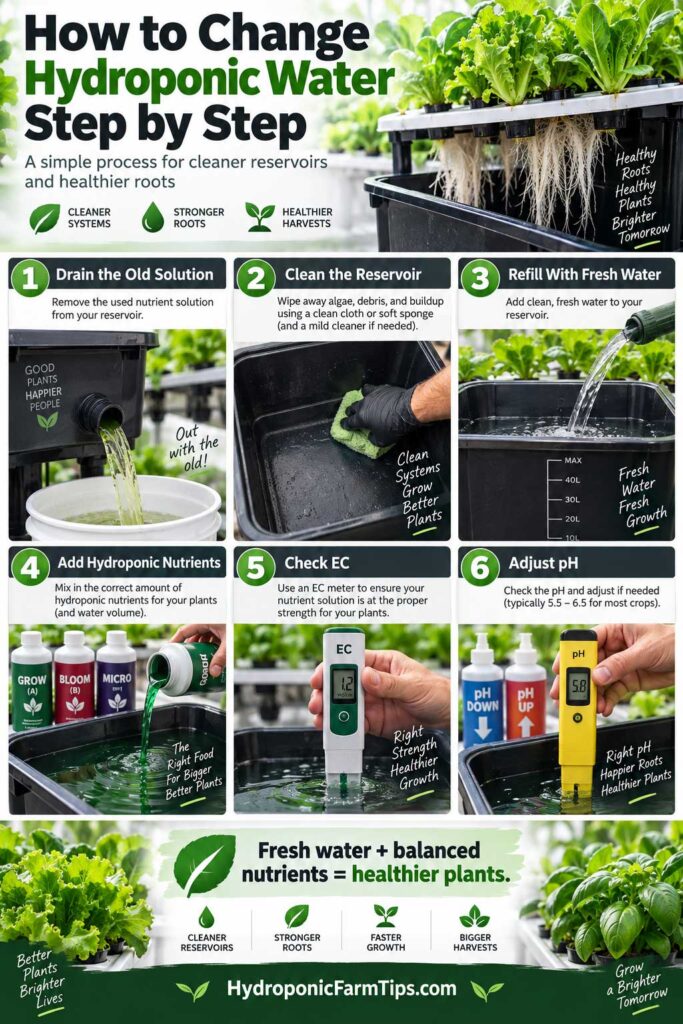
Changing hydroponic water is fairly simple, but doing it in the right order helps protect the roots and gives you a chance to reset the reservoir properly.
1. Prepare Fresh Water
Start with clean water that is suitable for hydroponics. If you use tap water, check its starting pH and EC so you know what you are working with before adding nutrients.
Try to keep the new water reasonably close to the temperature of the existing reservoir. A sudden temperature change can stress the root zone.
2. Turn Off Pumps and Drain the Old Solution
Turn off water pumps before draining the reservoir.
Depending on your setup, you may be able to use a drain valve, siphon, or small transfer pump. In compact systems, you may need to temporarily lift the plant lid or move net pots while emptying the reservoir.
Avoid leaving roots exposed for longer than necessary.
3. Inspect the Reservoir and Roots
Once the old solution is removed, take a quick look at the reservoir, equipment, and roots.
Check for algae, salt deposits, plant debris, clogged tubing, weak air stones, slimy roots, or unusual odors.
This is one of the best times to spot developing problems before they begin affecting plant growth.
4. Clean the Reservoir if Needed
Remove visible debris, algae, and mineral buildup before refilling.
You do not need to deep-clean the entire system during every routine water change, but the reservoir should not contain decomposing plant material or heavy buildup.
If you are dealing with persistent algae, root rot, or suspected contamination, a more thorough cleaning may be necessary before adding fresh solution.
5. Refill With Fresh Water
Add the correct amount of fresh water to the reservoir.
Knowing the actual reservoir volume is important because hydroponic nutrients are usually dosed according to the number of gallons or liters in the system.
6. Add Hydroponic Nutrients
Add nutrients according to the manufacturer’s directions and the needs of the crop you are growing.
If you use a multi-part formula, add each component separately to the water and mix thoroughly before adding the next. Do not mix concentrated nutrient parts directly together, because certain minerals can react and form insoluble precipitates.
7. Check the EC or PPM
Once the nutrients are fully mixed, measure the EC or PPM.
If you need help understanding the numbers, use our Hydroponic Nutrient & pH Chart, which includes EC-to-PPM conversions for the 500, 640, and 700 scales.
Compare the reading with the recommended range for your crop and growth stage. If the solution is too weak, make small adjustments rather than adding a large dose at once.
If EC is too high, dilute the solution gradually with fresh water and recheck.
8. Check and Adjust the pH
Measure the pH after the nutrients have been added and thoroughly mixed.
A reliable meter makes this much easier. See our comparison of the Best pH Meters for Hydroponics if you’re choosing or replacing one.
Most hydroponic crops prefer a slightly acidic root zone, although the ideal range varies by plant. Make small adjustments when needed, allow the solution to mix, and then test again.
9. Restart Pumps and Aeration
Turn your water pump, air pump, and other equipment back on.
Make sure the solution is circulating properly, air stones are producing steady bubbles, and drip emitters or aeroponic nozzles are functioning normally.
10. Recheck the Reservoir After Circulation
After the fresh nutrient solution has circulated, check the pH and EC again.
Small changes can occur as the nutrients become evenly distributed and the roots begin interacting with the new solution.
From there, return to your normal maintenance routine: monitor the water level, top off when necessary, and continue checking pH and EC until the next full reservoir change.
Affiliate Disclosure: This page may contain affiliate links. If you purchase through one of these links, we may earn a commission at no additional cost to you.
Tools for Checking Hydroponic Water
You don’t need a lot of equipment to manage hydroponic water, but a reliable pH meter and EC meter can take much of the guesswork out of deciding when to top off, adjust nutrients, or replace the reservoir.
| Product | Best For | Why It Helps | Buy |
|---|---|---|---|
| Apera Instruments PH20 pH Meter | Accurate pH checks | Easy-to-use digital tester for checking reservoir pH before and after water changes. A strong step up from cheap generic meters. | Check Price |
| Bluelab Conductivity Pen | EC / nutrient strength | Measures EC, PPM 500, PPM 700 and temperature, making it easy to see whether your solution is becoming too concentrated or depleted. | Check Price |
| VIVOSUN pH & TDS Meter Combo | Budget beginners | Gives you separate pH and TDS/EC testing tools without spending much — useful for a first hydroponic setup. | Check Price |
| Bluelab OnePen | All-in-one monitoring | Premium option that combines pH, EC and temperature monitoring in one handheld meter. | Check Price |
What to Do With Old Hydroponic Nutrient Solution
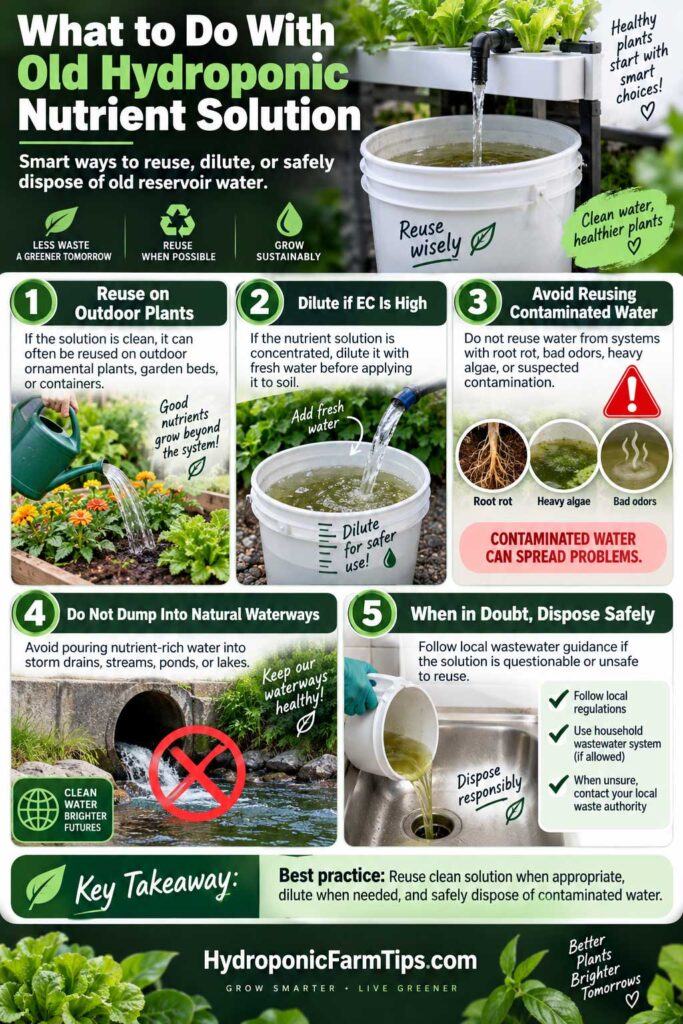
Don’t automatically throw away your old nutrient solution when you drain the reservoir. If it is still clean and free from disease or contamination, you may be able to put some of those remaining nutrients to use elsewhere.
If the solution is still relatively clean and there are no signs of root disease, heavy algae, or contamination, you may be able to reuse it on outdoor ornamental plants, garden beds, or container plants. Because it still contains dissolved minerals, it can act like a diluted fertilizer.
Use some caution, though.
If the EC is high, dilute the old solution with fresh water before applying it to soil. Avoid repeatedly pouring it onto the same small area, because salts can gradually build up and affect soil quality.
Do not reuse old hydroponic water on other plants if the system has had root rot, suspected pathogens, foul-smelling water, heavy algae, or chemical contamination. In those situations, disposal is the safer choice.
Can You Pour Hydroponic Water Down the Drain?
Small amounts of diluted nutrient solution may be suitable for household wastewater disposal in some areas, but local rules can vary.
Avoid pouring nutrient-rich water into storm drains, streams, ponds, lakes, or other natural waterways. Nitrogen and phosphorus can contribute to algae growth and water-quality problems when they enter surface water.
For many home growers, the most practical option is to reuse clean, diluted nutrient solution in the garden when appropriate and dispose of questionable solution according to local wastewater guidance.
How Often Should You Check pH and EC Between Water Changes?
Even if you only perform a full reservoir change every 1 to 3 weeks, you should monitor pH and EC much more frequently.
For most home hydroponic systems, checking both every few days is a practical routine. Daily checks can be helpful in small reservoirs, during hot weather, or when plants are growing quickly and using water and nutrients at a faster rate.
How Often to Check pH
Check pH at least every few days, and more often if your reservoir is small or tends to drift.
As plants absorb nutrients, the pH can gradually rise or fall. Some movement is normal, but repeated swings outside the target range can reduce nutrient availability and contribute to deficiency-like symptoms.
Many hydroponic crops perform well around pH 5.5 to 6.5, although the ideal range depends on the crop and growth stage. The University of Missouri Extension explains how pH, EC, water quality, and nutrient management affect nutrient availability in hydroponic solutions.
How Often to Check EC
EC should also be checked regularly, especially as plants mature and begin consuming more water and nutrients.
Virginia Cooperative Extension provides additional guidance on managing hydroponic crop systems and nutrient solutions through its Hydroponic Production of Edible Crops resources.
A rising EC often means plants are using water faster than nutrients, leaving the remaining solution more concentrated. A falling EC can mean nutrients are being taken up faster than water.
The most useful approach is to evaluate EC together with the reservoir water level rather than interpreting either measurement on its own.
Keep a Simple Reservoir Log
A basic reservoir log can make maintenance much easier.
Record the date, pH, EC or PPM, water level, reservoir temperature, how much water or nutrient solution you added, and the date of the last full water change.
After a few weeks, patterns usually become easier to spot. You may find that one crop keeps the reservoir stable for two weeks, while another causes pH or EC to shift much sooner.
Regular monitoring allows you to base your water-change schedule on what is actually happening in your system instead of relying only on the calendar.
Does Reservoir Size Affect How Often You Change Hydroponic Water?
Yes. Reservoir size is one of the biggest factors affecting how often you should change hydroponic water, because smaller volumes can change much faster than larger reservoirs.
Small reservoirs are usually less stable because plants can remove a large percentage of the available water and nutrients in a relatively short time. As the water level falls, EC may rise, pH can shift more quickly, and water temperature may fluctuate faster.
Larger reservoirs generally change more slowly because they contain more water and nutrients relative to what the plants are using.
For example, a mature tomato plant growing in a small bucket can alter nutrient concentration much faster than the same plant connected to a larger shared reservoir.
Small Reservoirs Need More Attention
With a small reservoir, you may need to check the water level daily, top off more frequently, and monitor pH and EC more often.
You may also need to perform a full water change sooner if readings become unstable or the reservoir develops problems.
This becomes especially important during warm weather or when plants are large, actively growing, and consuming a lot of water.
Larger Reservoirs Are Usually More Stable
A larger reservoir provides more buffering against sudden changes in nutrient concentration, temperature, and pH.
That does not mean the nutrient solution can be left indefinitely. Nutrient ratios can still shift over time, and salts, debris, or organic material can still accumulate.
The real advantage is stability. Because changes happen more slowly in a larger reservoir, you usually have more time to notice a problem before it starts affecting the plants.
A Practical Rule
Instead of choosing a water-change schedule based only on the number of days that have passed, consider reservoir volume in relation to plant size and water consumption.
If your plants regularly use a large portion of the reservoir between top-offs, treat the system as a high-demand setup and monitor it more closely.
If the water level, pH, and EC remain relatively stable, you may be able to stay closer to the longer end of the typical 1- to 3-week water-change range.
In simple terms, the faster your plants use water and nutrients, the more closely you should monitor the reservoir.
Does Water Temperature Affect How Often You Should Change Hydroponic Water?
Yes. Water temperature can influence how often you should change hydroponic water because warmer reservoirs may become unstable more quickly when oxygen levels fall or water quality begins to decline.
Warm nutrient solution holds less dissolved oxygen than cooler water, which can put extra stress on submerged roots. This matters especially in DWC systems, where good aeration is essential. If you’re having trouble keeping oxygen levels up, our Best Air Pumps for Hydroponics guide can help you choose a stronger setup.
For many hydroponic systems, keeping the nutrient solution around 65–72°F (18–22°C) is a useful target range.
What Happens When Hydroponic Water Gets Too Warm?
If the reservoir stays too warm, you may notice lower dissolved oxygen, faster pH changes, increased algae growth, drooping plants, unpleasant odors, or brown and slimy roots.
Warm water can also increase the risk of root-zone problems, especially when poor aeration or organic buildup is already present.
Changing the nutrient solution may help temporarily, but it will not solve the underlying issue if the reservoir quickly heats back up.
How to Keep the Reservoir Cooler
Keep the reservoir out of direct sunlight and away from strong heat sources. Opaque or insulated containers can help reduce heat gain while also blocking light that could encourage algae.
Good aeration is especially important in DWC systems. A properly sized air pump and clean air stones help maintain oxygen around submerged roots.
If grow lights are heating the reservoir, improving airflow or increasing the distance between the light and reservoir may also help.
Does Warm Water Mean You Should Change It More Often?
Not automatically.
If pH, EC, root health, and water quality remain stable, warm water alone does not necessarily mean you need an early reservoir change.
However, consistently high temperatures are a reason to monitor the system more closely. If warm water appears together with cloudiness, odor, algae, unstable pH, or deteriorating roots, changing the nutrient solution sooner is a sensible step while you correct the temperature problem.
A fresh reservoir can reset conditions, but controlling the heat is what helps prevent the same issue from returning.
Common Hydroponic Water-Change Mistakes
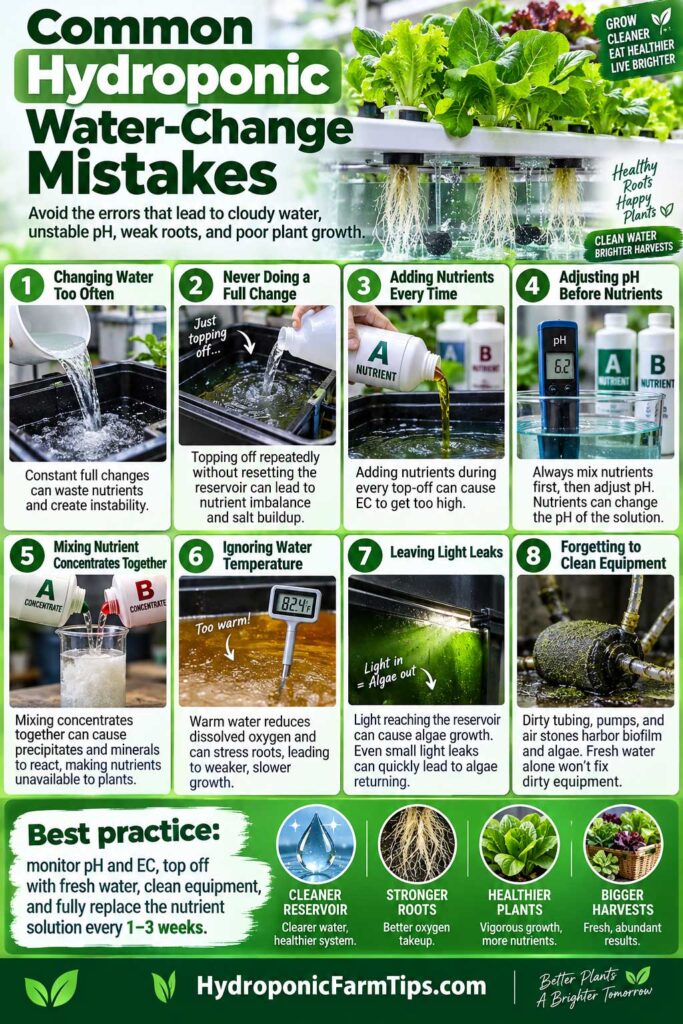
Changing hydroponic water is simple, but a few common mistakes can make the reservoir harder to manage or create unnecessary stress for plants.
Changing the Water Too Often
Replacing the entire reservoir every day or every few days is usually unnecessary unless you are correcting a specific problem.
Frequent full changes waste water and nutrients and can create avoidable fluctuations in pH, EC, and root-zone conditions.
For most home systems, regular monitoring plus a full change every 1 to 3 weeks is a better starting point.
Never Doing a Full Water Change
The opposite mistake is continuously topping off the reservoir without ever replacing the old nutrient solution.
Even if EC still looks acceptable, individual nutrients may no longer be present in the same proportions as when the solution was first mixed. Salts and other dissolved compounds can also accumulate over time.
Topping off is useful, but in most recirculating systems it should not completely replace periodic full reservoir changes.
Adding Nutrients Every Time the Water Level Drops
A lower water level does not automatically mean the reservoir needs more fertilizer. Oklahoma State University Extension recommends using EC measurements to guide adjustments: if EC is too high, dilute with water; if it is too low, additional nutrient concentrate may be needed.
Plants can use water and nutrients at different rates. Adding concentrated nutrients every time you top off can push EC too high and contribute to salt buildup.
Check the EC and water level together before deciding whether more nutrients are actually needed.
Adjusting pH Before Adding Nutrients
Nutrients can change the pH of your water.
Mix the nutrient solution first, let it circulate, and then check and adjust the pH. This gives you a more accurate reading and helps prevent unnecessary corrections.
Mixing Concentrated Nutrient Parts Together
If you use a two-part or three-part fertilizer, never combine the concentrated components directly with each other.
Add each part separately to the water and mix thoroughly before adding the next. Mixing concentrated nutrient parts together can cause minerals to react and form precipitates that plants cannot use effectively.
If you’re still getting comfortable with nutrient strength and feeding schedules, keep our Hydroponic Nutrient & pH Chart nearby as a reference.
Ignoring Reservoir Temperature
A freshly mixed nutrient solution will not stay stable for long if the reservoir repeatedly becomes too warm.
Monitor water temperature, especially in DWC and other systems where roots remain submerged for long periods.
Leaving Light Leaks Around the Reservoir
If light reaches the nutrient solution, algae can return quickly even after a complete water change.
Cover unused openings, use opaque tubing where practical, and keep the reservoir protected from direct sunlight and grow-light exposure.
Forgetting to Clean Equipment
A fresh reservoir can quickly develop problems again if pumps, tubing, air stones, trays, or fittings are covered with algae, debris, or mineral buildup.
You do not need to deep-clean every component during every routine change, but visible buildup should be removed before it becomes a larger problem.
Making Too Many Adjustments at Once
If pH or EC is slightly outside the target range, avoid making several large corrections at the same time.
Small, measured adjustments make it easier to see how the reservoir responds and reduce the chance of overshooting your target.
A stable hydroponic reservoir usually comes from consistent monitoring, clean equipment, and small corrections rather than constant intervention.
How to Keep Your Hydroponic Reservoir Cleaner for Longer
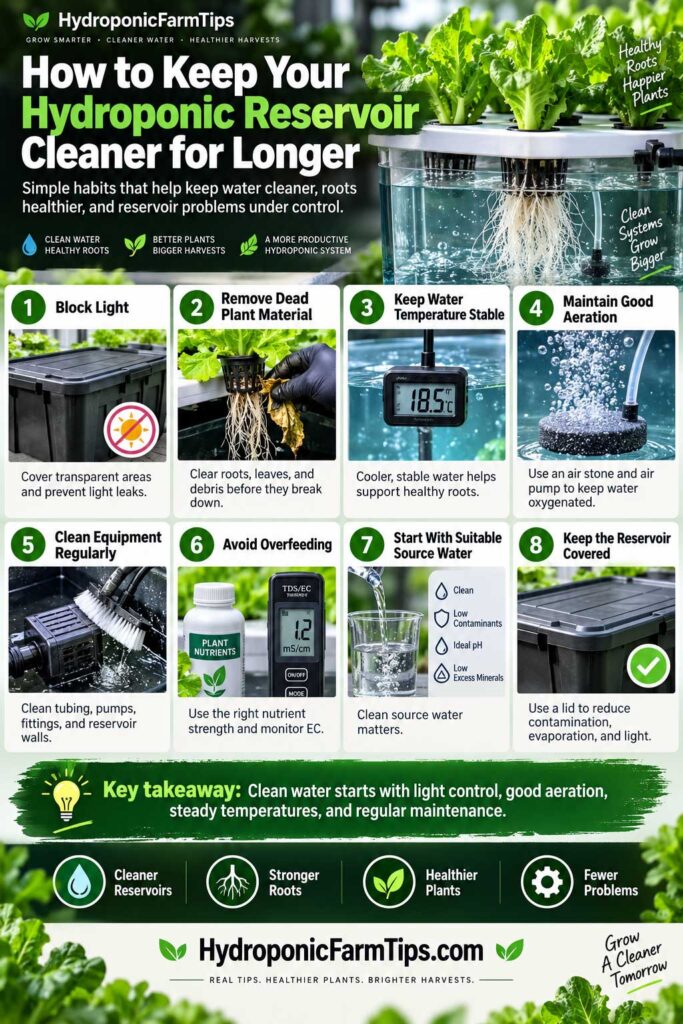
A clean reservoir is easier to manage and less likely to develop algae, debris buildup, and unstable water conditions.
You don’t need to keep it perfectly sterile. The goal is simply to control light, heat, debris, and excess nutrient buildup so the solution stays stable for longer.
Block Light From Reaching the Water
Light is one of the main drivers of algae growth.
Use an opaque reservoir or cover transparent areas so sunlight and grow lights cannot reach the nutrient solution. Pay close attention to gaps around net pots, tubing, lids, and sight gauges.
Even small light leaks can encourage algae over time.
Remove Dead Plant Material
Dead roots, fallen leaves, and other organic debris can break down in the reservoir and affect water quality.
Check the system regularly and remove decomposing material before it accumulates.
Keep the Water Temperature Stable
Try to prevent the nutrient solution from becoming excessively warm.
Cooler, stable water generally holds more dissolved oxygen and creates less favorable conditions for many common root-zone problems.
Maintain Good Aeration
In DWC and other aerated systems, steady oxygenation helps support healthy roots.
Check air pumps and air stones regularly to make sure they are working properly. Clean or replace weak, clogged, or heavily mineralized air stones when needed.
Clean Equipment Before Buildup Gets Heavy
Reservoir walls, tubing, pumps, and fittings can gradually collect algae, salts, and debris.
Light routine cleaning is much easier than dealing with heavy buildup later. Inspect the equipment during water changes and remove visible deposits before refilling the system.
Avoid Overfeeding
More nutrients are not always better.
Mix fertilizer according to the needs of your crop and use EC to guide adjustments instead of automatically choosing the strongest concentration on the label.
Excess fertilizer can increase salt buildup and make the reservoir harder to stabilize.
Start With Suitable Source Water
Your source water affects everything that happens in the reservoir.
If your tap water already has a high EC, contains a large amount of dissolved minerals, or repeatedly causes pH problems, factor that into your nutrient-mixing routine.
Keep the Reservoir Covered
A properly fitted lid helps keep out dust, leaves, insects, and other contaminants. It also reduces evaporation and blocks light from reaching the water.
Small maintenance habits like these can help the nutrient solution stay stable longer and make regular hydroponic water changes easier and more predictable.
Useful Gear for Water Changes & Reservoir Maintenance
A few simple tools can make reservoir changes much faster. A small transfer pump helps with draining, good aeration supports healthy roots, and fresh hydroponic nutrients let you rebuild the solution at the correct strength.
| Product | Best For | Why We Like It | Buy |
|---|---|---|---|
| General Hydroponics FloraSeries 3-Part Nutrients | Mixing fresh nutrient solution | Flexible three-part system that lets you adjust nutrients through different growth stages. General Hydroponics recommends adding FloraMicro, FloraGro and FloraBloom separately and mixing between additions. | Check Price |
| Active Aqua Air Pump | DWC oxygenation | Keeps nutrient solution aerated and helps provide oxygen around submerged roots after a reservoir change. | Check Price |
| VIVOSUN 800 GPH Submersible Pump | Draining reservoirs | Handy for moving water out of larger reservoirs without repeatedly lifting buckets or siphoning by hand. | Check Price |
| VIVOSUN pH & TDS Meter Combo | Quick reservoir checks | Budget-friendly way to recheck pH and nutrient concentration after mixing fresh solution. | Check Price |
Hydroponic Water Change Schedule: Quick Reference
If you’re trying to determine how often you should change hydroponic water in your own setup, use this table as a practical starting point. Then adjust the schedule based on reservoir size, crop type, water quality, pH stability, EC, and root health.
| Situation | What to Do |
|---|---|
| Routine maintenance | Change the nutrient solution about every 1–3 weeks |
| Small DWC bucket | Often every 1–2 weeks |
| Large recirculating reservoir | Often every 2–3 weeks if conditions remain stable |
| Fast-growing or heavy-feeding plants | Monitor closely and consider changing sooner |
| Water level drops but pH and EC are stable | Top off with fresh water |
| EC becomes too high | Add fresh water gradually and recheck |
| pH keeps drifting out of range | Consider a full reservoir change |
| Water becomes cloudy | Inspect the system and replace the solution if needed |
| Reservoir develops a bad odor | Change the solution and inspect the roots |
| Heavy algae appears | Change the water, clean the system, and block light |
| Roots become slimy or foul-smelling | Investigate root rot and replace the solution |
| Nutrient-mixing mistake | Replace the solution rather than repeatedly correcting it |
| Kratky lettuce or other short-cycle crops | A routine full change may not be necessary before harvest |
The Best Schedule Is the One Your Reservoir Supports
There is no single water-change schedule that fits every hydroponic garden.
A small reservoir supporting mature tomatoes may require much more attention than a large reservoir growing a few heads of lettuce. Likewise, a system with stable pH and EC may stay near the longer end of the schedule, while one with recurring water-quality problems may need fresh solution sooner.
For most beginners, a good starting routine is to check the reservoir frequently, top off as needed, and plan a complete nutrient-solution change every 1 to 3 weeks.
Over time, your records for pH, EC, water level, temperature, and plant health will show whether your system performs better with shorter or longer intervals.
FAQs About How Often Should You Change Hydroponic Water
Can You Change Hydroponic Water Too Often?
Yes. Replacing the entire reservoir more often than necessary can waste water and nutrients and may cause avoidable swings in pH, EC, and root-zone conditions.
Unless you are correcting a specific problem, most home hydroponic systems do not need a complete water change every few days.
Can I Just Keep Topping Off Hydroponic Water?
Not indefinitely.
Topping off replaces water that plants have used, but it does not fully restore the original nutrient balance. Over time, some nutrients may become depleted while others remain or accumulate.
For most recirculating systems, periodic full water changes are still useful.
Do I Need to Change the Water if the pH Is Correct?
Not necessarily.
A stable pH is a good sign, but it does not tell you everything about the nutrient solution. The reservoir may still contain an imbalanced nutrient profile, accumulated salts, or other changes that are not obvious from pH alone.
Consider pH together with EC, water clarity, root condition, plant health, and the age of the nutrient solution.
How Often Should I Change DWC Water?
For most small DWC systems, changing the nutrient solution every 1 to 2 weeks is a practical starting point.
You may need to change it sooner if the reservoir is small, plants are large, pH or EC becomes unstable, or the water develops algae, cloudiness, odor, or unhealthy roots.
Should Hydroponic Water Be Completely Replaced?
In many home systems, yes.
A full replacement gives you the cleanest reset because it removes most of the old nutrient solution and lets you start again with a known nutrient concentration.
Partial changes can still be useful in larger systems or when making smaller corrections.
Can I Reuse Old Hydroponic Nutrient Water?
Sometimes.
If the old solution is relatively clean and there are no signs of disease or contamination, it may be diluted and used on outdoor ornamental plants, garden beds, or container plants.
Avoid reusing solution from systems affected by root rot, heavy algae, foul odors, suspected pathogens, or chemical contamination.
How Long Can Hydroponic Water Sit?
There is no single maximum number of days that applies to every system.
If the reservoir remains well aerated, properly mixed, within a suitable pH and EC range, and free from algae or contamination, the nutrient solution may remain usable for several weeks.
For most beginners, though, a regular 1- to 3-week replacement schedule is easier to manage than trying to keep the same solution indefinitely.
Should I Add Nutrients Every Time I Add Water?
No.
Check the EC before adding more fertilizer. If the solution has become concentrated as plants used water, adding more nutrients can push EC even higher.
Sometimes the correct top-off is simply fresh water.
How Often Should You Really Change Hydroponic Water?
So, how often should you change hydroponic water? For most home hydroponic systems, replacing the nutrient solution about every 1 to 3 weeks is a practical starting point.
Between full changes, top off the reservoir with fresh water as plants use it, and monitor pH, EC, water temperature, root health, and overall reservoir condition. Small reservoirs, heavy-feeding crops, warm conditions, and unstable readings may require more frequent changes, while larger, well-balanced systems can often go longer.
The key is not to rely on the calendar alone. If the water becomes cloudy, develops an odor, pH keeps drifting, EC behaves unusually, algae appears, or roots begin to look unhealthy, it is usually better to refresh the reservoir sooner.
A consistent routine of monitoring, topping off, cleaning, and periodic full water changes will help keep the root zone stable and make nutrient management much easier.
Start with the 1- to 3-week guideline, then adjust based on how your own plants and reservoir actually behave.
More Hydroponic Maintenance Guides You May Like
Keeping a reservoir healthy involves more than simply changing the water. These guides can help you manage the most important parts of your hydroponic system:
- Algae in Hydroponics: Causes, Prevention & How to Get Rid of It – Learn why algae appears and how to keep light and nutrient conditions from encouraging it.
- Hydroponic Nutrient Deficiencies: Signs, Causes & Fixes – Identify common deficiency symptoms and determine whether pH, nutrients, or environmental conditions may be responsible.
- Best pH Meters for Hydroponics: 7 Accurate Options – Compare meters for monitoring your nutrient solution.
- Best Air Pumps for Hydroponics: 7 Picks for Healthy Roots – Improve oxygenation in DWC and other aerated systems.
- 8 Best Hydroponic Systems for Home – Compare popular hydroponic systems for home growing.
- Hydroponics for Beginners – Start with the fundamentals of systems, nutrients, lighting, water, and plant care.
