
If you’re new to hydroponics, hydroponic EC and PPM can seem more complicated than they really are. You might see growers talking about an EC of 1.8, a nutrient solution at 900 PPM, or different PPM conversion scales—and wonder which number you’re actually supposed to follow.
Fortunately, the basic idea is fairly simple.
EC and PPM help you understand the overall concentration of dissolved ions in your hydroponic solution. These measurements can indicate whether your nutrient solution is relatively weak, within an appropriate range for your plants, or becoming more concentrated than intended.
This is useful because following the dosage on a nutrient bottle doesn’t tell you everything happening inside your reservoir. Your starting water quality, nutrient additions, plant uptake, evaporation, and changes in water level can all influence the concentration of dissolved salts over time.
An EC or PPM meter gives you another useful piece of information to consider alongside pH, water level, plant appearance, and growth.
In this beginner’s guide, we’ll explain what EC and PPM mean, how they’re related, how to measure them, and what changing readings can tell you about your reservoir. You’ll also find practical hydroponic EC and PPM charts for common vegetables, herbs, and fruiting crops.
By the end, readings such as 1.2 EC, 800 PPM, or 1,400 µS/cm should feel much less intimidating—and much more useful when managing your hydroponic garden.
What Is EC in Hydroponics?
EC stands for electrical conductivity. In hydroponics, it measures how well your nutrient solution conducts electricity.
Pure water conducts very little electricity. Once mineral nutrients dissolve in the water, they separate into electrically charged ions. Common examples include nitrate, potassium, calcium, magnesium, and phosphate.
Generally, the more dissolved ions present in the solution, the higher its electrical conductivity.
That’s what makes EC so useful in hydroponics: it gives you a quick way to monitor the overall concentration of dissolved fertilizer salts in your reservoir.
For example:
- 0.4 EC indicates a relatively low concentration of dissolved ions.
- 1.2 EC indicates a more concentrated solution.
- 2.4 EC indicates a substantially higher concentration.
However, a higher EC isn’t automatically better. Different plants—and even different growth stages of the same plant—perform best at different nutrient concentrations. Young seedlings generally need a weaker solution than mature, heavy-feeding fruiting plants such as tomatoes or peppers.
Affiliate Disclosure: This page may contain affiliate links. If you purchase through one of these links, we may earn a commission at no additional cost to you.
How Is EC Measured?
Hydroponic growers commonly see EC expressed as mS/cm (millisiemens per centimeter).
You may also encounter µS/cm (microsiemens per centimeter). The conversion is straightforward:
1.0 mS/cm = 1,000 µS/cm
So:
1.2 EC = 1.2 mS/cm = 1,200 µS/cm
When hydroponic growers casually say their reservoir is at “1.2 EC,” they usually mean 1.2 mS/cm.
What EC Does—and Doesn’t—Tell You
EC tells you about the overall concentration of dissolved ions in the solution, but it doesn’t tell you which individual nutrients are present or whether they are present in the right proportions.
For example, an EC meter cannot tell you that your plants have enough calcium but too little nitrogen. Two nutrient solutions can produce similar EC readings while having very different nutrient compositions.
That’s why EC shouldn’t be used by itself.
Think of it as one part of the bigger picture. EC tells you how concentrated the solution is, while pH helps you understand whether conditions are favorable for nutrient availability. Plant appearance, root health, water level, and growth provide additional clues about what is happening inside your hydroponic system.
Later in this guide, we’ll look at how changes in EC and reservoir water level together can help you understand whether the remaining nutrient solution is becoming more concentrated, more dilute, or staying relatively stable.
What Is PPM in Hydroponics?
PPM stands for parts per million. In hydroponics, growers use PPM as another way to describe the concentration of dissolved substances in a nutrient solution.
You might see one grower say their reservoir is at 600 PPM, while another describes a similar nutrient strength as 1.2 EC.
The important thing to understand is that most handheld hydroponic PPM or TDS meters don’t directly measure how much fertilizer is in the water.
Instead, the meter measures electrical conductivity and converts that reading into an estimated PPM value using a mathematical conversion factor.
That’s why EC and PPM are closely related—but they aren’t exactly the same measurement.
PPM and TDS: Are They the Same Thing?
You’ll also frequently see the term TDS, which stands for total dissolved solids.
Many hydroponic meters are labeled as TDS meters and display their readings in PPM. In everyday hydroponic gardening, growers often use “TDS” and “PPM” when talking about these meter readings.
However, the displayed PPM value is typically an EC-based estimate, not a laboratory measurement of every dissolved substance in the water.
For day-to-day hydroponic gardening, that’s usually fine. The important thing is to know which scale your meter uses and compare your readings consistently.
Why Can the Same Nutrient Solution Have Different PPM Readings?
This is where PPM can become confusing.
There isn’t one universal EC-to-PPM conversion scale used by every meter.
Common conversion factors include:
- 500 scale: EC × 500
- 640 scale: EC × 640
- 700 scale: EC × 700
For example, a nutrient solution measuring 1.0 EC could be displayed as:
| EC | 500 Scale | 640 Scale | 700 Scale |
|---|---|---|---|
| 1.0 | 500 PPM | 640 PPM | 700 PPM |
Nothing about the nutrient solution changed. Only the mathematical conversion used to display the reading changed.
This is why two growers can test the same solution and report different PPM numbers even though their EC readings are identical.
Why Knowing Your PPM Scale Matters
Suppose a hydroponic growing guide recommends 1,000 PPM.
That number isn’t very useful unless you also know which PPM scale the author used.
For example:
1,000 PPM on the 500 scale = 2.0 EC
while:
1,000 PPM on the 700 scale ≈ 1.43 EC
That’s a meaningful difference in nutrient concentration.
For beginners, this is one reason EC is often easier to compare across meters, feeding charts, and growing guides. An EC of 1.5 remains 1.5 EC regardless of which PPM conversion scale a particular meter uses.
If you prefer working in PPM, that’s perfectly workable too. Just learn which conversion scale your meter uses and stick with that scale when comparing readings.
Later in this guide, we’ll include a complete EC-to-PPM conversion chart so you can quickly compare the 500, 640, and 700 scales.
EC vs. PPM in Hydroponics: What’s the Difference?
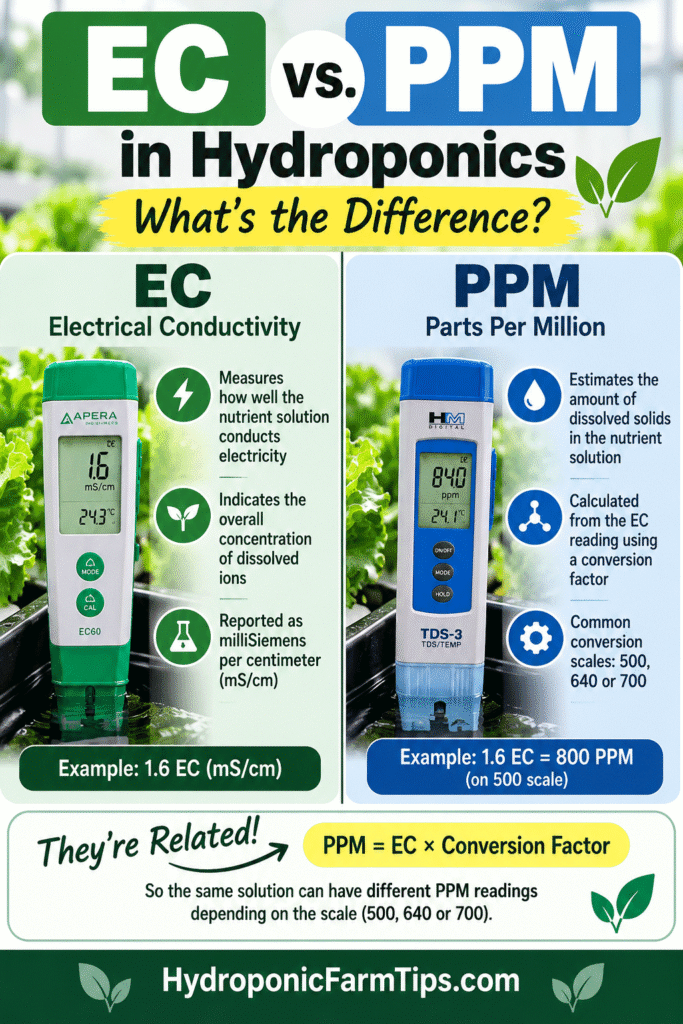
EC and PPM are closely related, but they describe nutrient-solution concentration in different ways.
EC measures electrical conductivity directly, while the PPM reading displayed by most hydroponic TDS meters is calculated from EC using a conversion factor.
Here’s the simplest way to compare them:
| Feature | EC | PPM |
|---|---|---|
| Meaning | Electrical conductivity | Parts per million |
| What the meter measures | Conductivity of the solution | Usually conductivity converted to PPM |
| Common units | mS/cm or µS/cm | PPM |
| Conversion scale needed? | No | Yes |
| Common scales | Not applicable | 500, 640, 700 |
| Can readings vary between meters? | Slightly, depending on calibration and meter accuracy | Yes, and the selected conversion scale can create larger differences |
| Useful for hydroponics? | Yes | Yes |
The biggest practical difference is consistency.
If a properly calibrated meter measures a solution at 1.5 mS/cm, that can be reported as 1.5 EC.
But when that EC reading is converted to PPM:
- 500 scale: 750 PPM
- 640 scale: 960 PPM
- 700 scale: 1,050 PPM
All three PPM numbers can represent the same underlying EC value.
Should You Use EC or PPM for Hydroponics?
For beginners, EC is usually the simpler measurement to learn first because it avoids the confusion created by different PPM conversion scales.
If a growing guide recommends an EC of 1.4, you don’t have to determine whether the author meant the 500, 640, or 700 scale.
That doesn’t mean PPM is wrong or that you need to stop using it. Many growers successfully manage their reservoirs using PPM, and plenty of meters display both EC and PPM.
If you prefer PPM, the key is consistency:
Know which PPM scale your meter uses and make sure the feeding chart or growing recommendation you’re following uses the same scale.
Can You Switch Between EC and PPM?
Yes. Because hydroponic PPM readings are generally calculated from EC, you can convert between the two as long as you know the PPM scale being used.
For example, if your reservoir measures 1.6 EC:
| PPM Scale | Calculation | Approximate Reading |
|---|---|---|
| 500 | 1.6 × 500 | 800 PPM |
| 640 | 1.6 × 640 | 1,024 PPM |
| 700 | 1.6 × 700 | 1,120 PPM |
You don’t need to memorize these calculations. Once you understand why the numbers differ, you can simply use the conversion chart later in this guide whenever you need it.
The main takeaway: EC and PPM aren’t competing measurements. They’re two ways hydroponic growers commonly express information about the concentration of dissolved ions in a nutrient solution. Whichever one you use, consistency matters more than constantly switching between scales.
Why EC and PPM Matter in Hydroponics
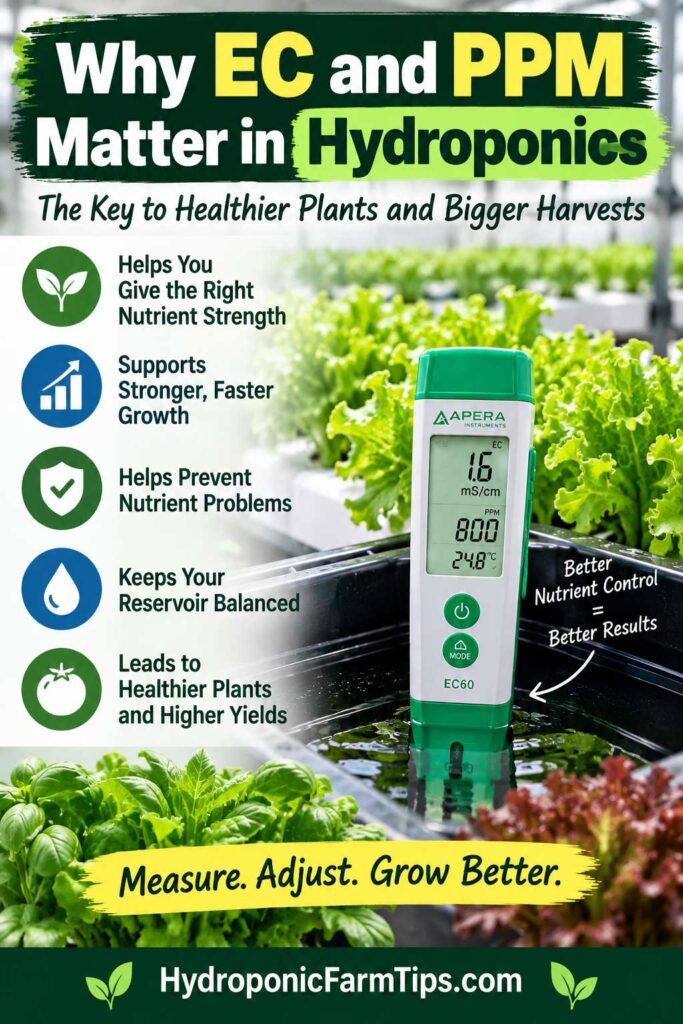
Monitoring hydroponic EC and PPM gives you useful information about how the concentration of your nutrient solution changes between feedings, top-offs, and reservoir changes.
Plants don’t consume water and nutrients at exactly the same rate. Temperature, humidity, plant size, growth stage, crop type, and even the amount of light your plants receive can affect how quickly they use water and nutrients.
As a result, the concentration of your nutrient solution can change even when you haven’t added more fertilizer.
Regular EC or PPM readings help you spot those changes.
1. EC Helps You Avoid an Overly Concentrated Nutrient Solution
More nutrients don’t necessarily mean faster growth.
If the nutrient solution becomes too concentrated, the high concentration of dissolved salts can make it harder for roots to take up water. Plants may begin showing signs of stress such as leaf-tip burn, browning along the leaf margins, curling, wilting, or slowed growth.
An unusually high EC reading gives you a reason to investigate before automatically adding more nutrients.
Depending on the cause, you may need to dilute the reservoir with water or replace the nutrient solution entirely.
2. EC Can Reveal When Your Solution Is Too Dilute
The opposite can happen as well.
If EC or PPM falls below the appropriate range for your crop and growth stage, the nutrient solution may be more dilute than intended.
Plants growing in an under-strength solution may eventually develop slower growth, pale foliage, or symptoms associated with nutrient deficiencies.
If you’re still learning how nutrient strength and feeding work together, start with our Hydroponic Nutrients for Beginners: Complete Feeding Guide.
However, low EC doesn’t tell you which nutrient may be deficient. It only tells you that the overall concentration of dissolved ions is relatively low.
That’s why plant symptoms, pH, root condition, and your feeding program should also be considered.
3. EC Helps You Track Changes in the Reservoir
One of the most useful habits in hydroponics is watching EC and water level together.
Imagine that yesterday your reservoir was at 1.5 EC. Today the water level has dropped, and your EC has increased to 1.8.
That suggests the reservoir has lost proportionally more water than dissolved ions, leaving the remaining solution more concentrated.
In another situation, the water level may fall while EC also decreases. This indicates that the overall dissolved-ion concentration is decreasing as reservoir volume falls. Plant nutrient uptake can contribute to this pattern, but EC alone can’t tell you which nutrients are being removed or whether the remaining solution is balanced.
A single reading tells you what’s happening at that moment. A pattern of readings over several days can tell you much more.
4. Different Crops Need Different Nutrient Strengths
There isn’t one perfect EC or PPM level for every hydroponic plant.
Leafy greens such as lettuce generally perform well at lower nutrient concentrations than many mature fruiting crops. Tomatoes and peppers, for example, may be managed at higher EC levels during later growth stages.
Seedlings and young plants also usually require a gentler nutrient solution than established plants.
This is why copying an EC number from another grower’s system isn’t always appropriate. The crop, growth stage, environment, nutrient formula, and growing method all matter.
Later in this guide, we’ll provide an EC and PPM chart for common hydroponic crops to give you practical starting ranges.
5. EC Makes Nutrient Adjustments More Informed
Without an EC or PPM reading, it’s easy to fall into a common beginner habit:
The plants look unhappy, so add more nutrients.
Sometimes that’s exactly the wrong response.
Yellow leaves in hydroponics, for example, can result from nutrient imbalance, incorrect pH, root stress, lighting problems, disease, or environmental conditions. Adding more fertilizer without checking the reservoir can make an already concentrated solution even stronger.
EC gives you another data point before you make an adjustment.
It doesn’t diagnose every hydroponic problem, but it can help you avoid guessing.
EC and PPM Are Most Useful When You Track Trends
Don’t become overly concerned about every tiny change in your meter reading.
Small fluctuations can occur because of water temperature, meter accuracy, calibration, top-offs, nutrient additions, and normal plant activity.
Instead, pay attention to trends.
If EC steadily rises while the water level falls, steadily drops over several days, or suddenly moves far outside the normal range for your crop, that’s when the reading becomes especially useful.
Combined with pH, water level, root health, plant appearance, and growth, EC and PPM can help you make much more informed decisions about your hydroponic reservoir.
How Do EC Meters Work?
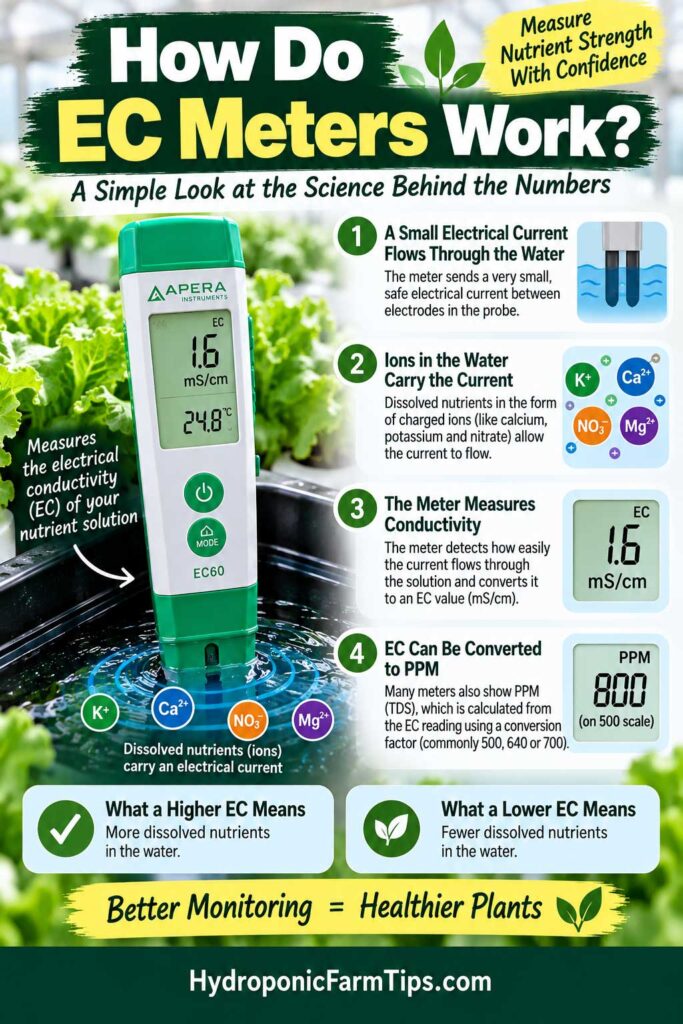
An EC meter measures how easily an electrical current passes through your hydroponic nutrient solution.
The probe contains electrodes that come into contact with the solution. Because dissolved nutrient salts form charged ions, the device can measure the solution’s electrical conductivity and display the result as EC, usually in mS/cm or µS/cm.
It isn’t identifying individual nutrients. An EC reading can’t tell you exactly how much nitrogen, potassium, calcium, or magnesium is present.
Instead, it measures the solution’s overall conductivity.
In practical terms:
More dissolved ions → generally higher conductivity → higher EC
Fewer dissolved ions → generally lower conductivity → lower EC
This makes EC especially useful for checking whether your reservoir is becoming more concentrated or more dilute over time.
Why Temperature Matters When Measuring EC
Electrical conductivity changes with temperature, which means the same nutrient solution can produce slightly different raw conductivity readings at different temperatures.
That’s why many modern EC meters include automatic temperature compensation (ATC).
ATC compensates for the effect of temperature so readings can be compared more consistently, typically using 25°C (77°F) as the reference temperature.
However, ATC doesn’t mean nutrient-solution temperature can be ignored. Very warm or cold water can affect plant and root health regardless of what your EC meter displays.
For consistent measurements, test your solution under reasonably stable conditions and follow the instructions provided by your meter’s manufacturer.
EC Meter vs. TDS/PPM Meter
EC and TDS/PPM meters often rely on the same underlying measurement: electrical conductivity.
The main difference is how the result is displayed.
An EC meter might show:
1.4 mS/cm
A TDS/PPM meter could convert that same conductivity value to:
700 PPM on the 500 scale
or:
980 PPM on the 700 scale
Some digital meters can display EC, TDS/PPM, and temperature using the same probe.
If you’re choosing a meter for hydroponics, having both EC and PPM modes can be convenient—but knowing which PPM conversion scale the device uses is still important.
EC Meters Need Calibration
Even a good EC meter can drift over time.
Mineral residue on the probe, contamination, age, and normal sensor drift can affect readings. Periodic calibration using a known conductivity standard helps confirm that your meter is still measuring accurately.
Don’t assume a digital reading is automatically correct just because it looks precise on the screen.
Later in this guide, we’ll walk through how to calibrate and maintain an EC meter so your readings remain as consistent and useful as possible.
EC to PPM Conversion Chart: 500, 640 & 700 Scales
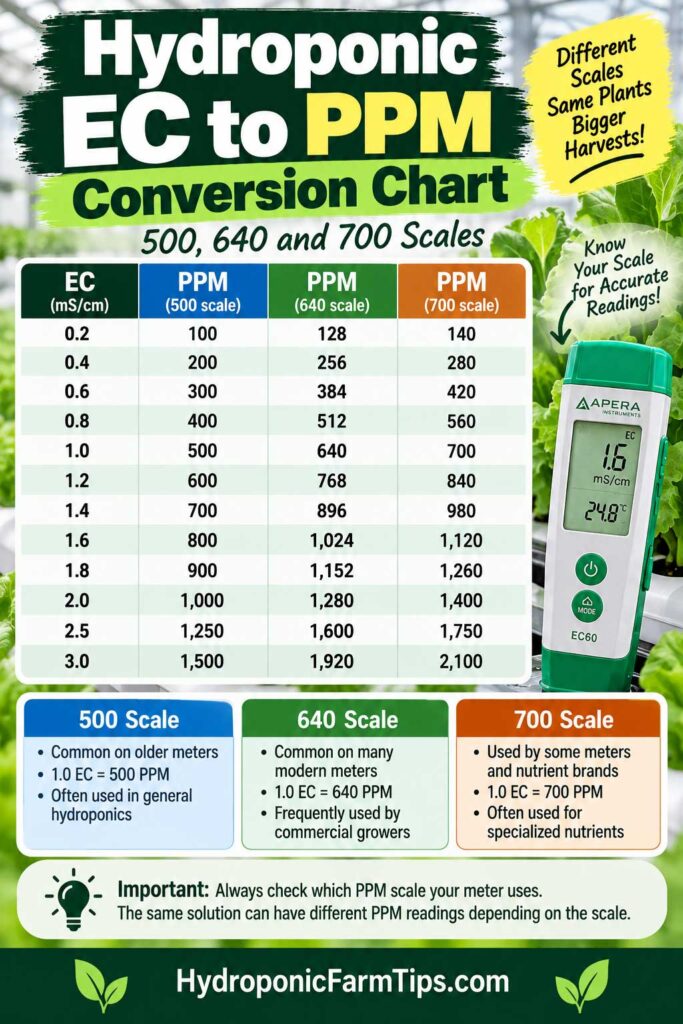
One of the most confusing parts of hydroponic EC and PPM is that the same EC reading can produce different PPM values depending on the conversion scale being used.
Three commonly used conversion factors are:
500 scale: EC × 500 = PPM
640 scale: EC × 640 = PPM
700 scale: EC × 700 = PPM
For example, a nutrient solution measuring 2.0 EC can be displayed as:
- 1,000 PPM on the 500 scale
- 1,280 PPM on the 640 scale
- 1,400 PPM on the 700 scale
The nutrient solution hasn’t changed. Only the conversion factor has.
Use the chart below to quickly compare common hydroponic EC readings across all three PPM scales.
Hydroponic EC to PPM Conversion Chart
| EC (mS/cm) | 500 Scale | 640 Scale | 700 Scale |
|---|---|---|---|
| 0.2 | 100 PPM | 128 PPM | 140 PPM |
| 0.3 | 150 PPM | 192 PPM | 210 PPM |
| 0.4 | 200 PPM | 256 PPM | 280 PPM |
| 0.5 | 250 PPM | 320 PPM | 350 PPM |
| 0.6 | 300 PPM | 384 PPM | 420 PPM |
| 0.7 | 350 PPM | 448 PPM | 490 PPM |
| 0.8 | 400 PPM | 512 PPM | 560 PPM |
| 0.9 | 450 PPM | 576 PPM | 630 PPM |
| 1.0 | 500 PPM | 640 PPM | 700 PPM |
| 1.1 | 550 PPM | 704 PPM | 770 PPM |
| 1.2 | 600 PPM | 768 PPM | 840 PPM |
| 1.3 | 650 PPM | 832 PPM | 910 PPM |
| 1.4 | 700 PPM | 896 PPM | 980 PPM |
| 1.5 | 750 PPM | 960 PPM | 1,050 PPM |
| 1.6 | 800 PPM | 1,024 PPM | 1,120 PPM |
| 1.7 | 850 PPM | 1,088 PPM | 1,190 PPM |
| 1.8 | 900 PPM | 1,152 PPM | 1,260 PPM |
| 1.9 | 950 PPM | 1,216 PPM | 1,330 PPM |
| 2.0 | 1,000 PPM | 1,280 PPM | 1,400 PPM |
| 2.1 | 1,050 PPM | 1,344 PPM | 1,470 PPM |
| 2.2 | 1,100 PPM | 1,408 PPM | 1,540 PPM |
| 2.3 | 1,150 PPM | 1,472 PPM | 1,610 PPM |
| 2.4 | 1,200 PPM | 1,536 PPM | 1,680 PPM |
| 2.5 | 1,250 PPM | 1,600 PPM | 1,750 PPM |
| 2.6 | 1,300 PPM | 1,664 PPM | 1,820 PPM |
| 2.7 | 1,350 PPM | 1,728 PPM | 1,890 PPM |
| 2.8 | 1,400 PPM | 1,792 PPM | 1,960 PPM |
| 2.9 | 1,450 PPM | 1,856 PPM | 2,030 PPM |
| 3.0 | 1,500 PPM | 1,920 PPM | 2,100 PPM |
How to Use the EC to PPM Chart
First, find your EC reading in the left column.
Then move across the table until you reach the PPM scale used by your meter or growing guide.
For example, suppose your nutrient solution measures 1.8 EC.
That equals approximately:
- 900 PPM on the 500 scale
- 1,152 PPM on the 640 scale
- 1,260 PPM on the 700 scale
All three values describe the same underlying EC reading.
How to Convert PPM Back to EC
You can also work backward.
Use:
PPM ÷ conversion factor = EC
For example, if your meter reads 750 PPM on the 500 scale:
750 ÷ 500 = 1.5 EC
If it reads 1,050 PPM on the 700 scale:
1,050 ÷ 700 = 1.5 EC
Again, both readings represent the same EC value.
Which PPM Scale Does My Meter Use?
Don’t assume that every PPM meter uses the same conversion factor.
Check the meter’s manual, specifications, manufacturer website, or settings menu to determine which TDS conversion factor it uses.
Some meters allow you to switch between different conversion factors, while others use a fixed factor.
If you can’t determine which scale your meter uses, switching the display to EC mode, when available, can make comparisons with hydroponic growing charts much easier.
Quick Tip: When a growing guide recommends a PPM target, check which conversion scale it uses. A recommendation of “1,000 PPM” can represent very different EC values depending on the scale.
Ideal Hydroponic EC and PPM Chart by Crop
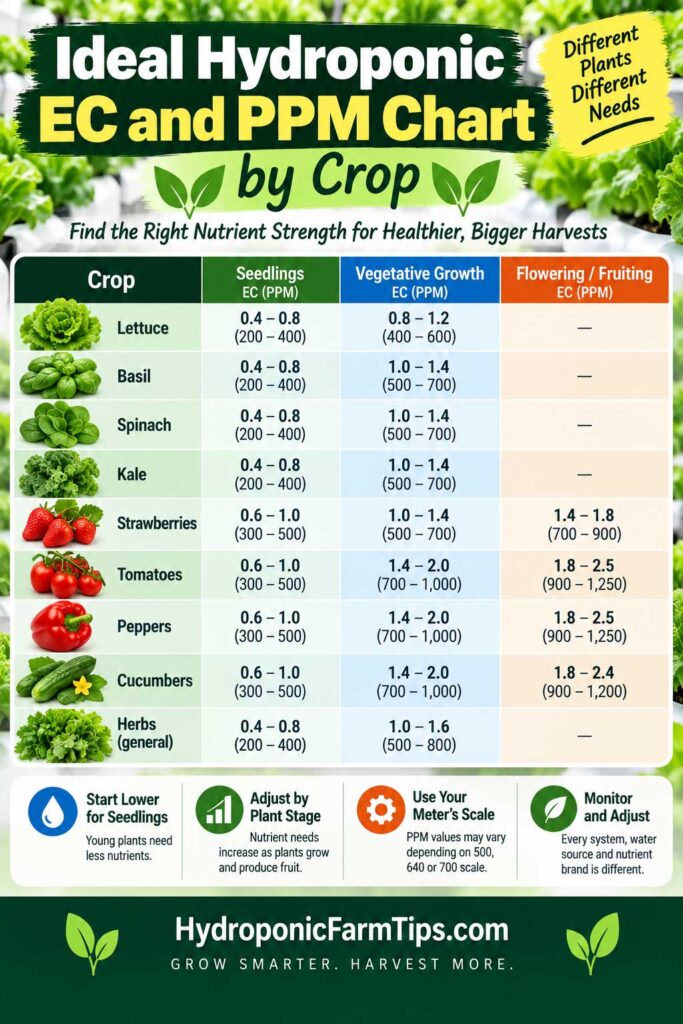
There isn’t one ideal EC level for every hydroponic plant. Lettuce, basil, tomatoes, peppers, cucumbers, and other crops can have very different nutrient-strength requirements.
The ranges below are best used as starting points rather than rigid targets. The ideal EC for your plants can vary with cultivar, growth stage, nutrient formula, water quality, hydroponic system, temperature, light, and other growing conditions.
For simplicity, the PPM column below uses the 500 conversion scale:
EC × 500 = PPM
If your meter uses the 640 or 700 scale, use the EC-to-PPM conversion chart above instead.
Hydroponic EC and PPM Chart
| Crop | Suggested EC Range (mS/cm) | Approx. PPM (500 Scale) |
|---|---|---|
| Basil | 1.0–1.6 | 500–800 PPM |
| Lettuce | 1.2–1.8 | 600–900 PPM |
| Spinach | 1.8–2.3 | 900–1,150 PPM |
| Pak Choi / Bok Choy | 1.5–2.0 | 750–1,000 PPM |
| Parsley | 1.8–2.2 | 900–1,100 PPM |
| Sage | 1.0–1.6 | 500–800 PPM |
| Celery | 1.8–2.4 | 900–1,200 PPM |
| Leeks | 1.4–1.8 | 700–900 PPM |
| Broccoli | 2.8–3.5 | 1,400–1,750 PPM |
| Cabbage | 2.5–3.0 | 1,250–1,500 PPM |
| Beans | 2.0–4.0 | 1,000–2,000 PPM |
| Cucumber | 1.7–2.0 | 850–1,000 PPM |
| Zucchini / Courgette | 1.8–2.4 | 900–1,200 PPM |
| Eggplant | 2.5–3.5 | 1,250–1,750 PPM |
| Peppers | 0.8–1.8 | 400–900 PPM |
| Tomatoes | 2.0–4.0 | 1,000–2,000 PPM |
| Strawberries | 1.8–2.2 | 900–1,100 PPM |
| Asparagus | 1.4–1.8 | 700–900 PPM |
| Okra | 2.0–2.4 | 1,000–1,200 PPM |
| Rhubarb | 1.6–2.0 | 800–1,000 PPM |
About these ranges: The EC ranges in this chart are based primarily on hydroponic EC and pH guidance from Oklahoma State University Extension. Treat them as practical starting ranges rather than exact requirements. Recommendations can vary by growth stage, cultivar, production system, environment, and nutrient-management strategy.
Don’t Treat EC Ranges as Exact Rules
A chart like this is useful for getting into the right neighborhood, but your plants don’t know what number is printed in a table.
For example, lettuce is commonly grown around 1.2–1.8 EC, while tomatoes may be managed at considerably higher concentrations. Even within those ranges, however, the best target can change as plants mature or environmental conditions change.
Young plants generally need a gentler nutrient solution than established plants. Commercial greenhouse growers may also adjust EC according to crop stage, temperature, light, irrigation strategy, and desired crop response.
That’s why you should combine the chart with what your plants and reservoir are telling you.
Starting Water EC Matters Too
There’s another detail beginners often miss: your water may already have an EC reading before you add any nutrients.
Suppose your tap water starts at 0.5 EC and your finished nutrient solution measures 1.5 EC.
That doesn’t necessarily mean all 1.5 EC came from your hydroponic fertilizer. Minerals and dissolved salts already present in the source water contribute to the final conductivity reading.
This is especially important when using hard tap water.
Before mixing nutrients, test your source water and record its starting EC. That gives you useful context when comparing your finished nutrient solution with a crop chart.
We’ll look more closely at tap water, hard water, and reverse-osmosis water later in this guide.
Growth Stage Can Change the Target
Crop type isn’t the only factor that matters.
A newly transplanted seedling may not tolerate the same nutrient concentration as a large mature plant.
As a general principle:
Seedlings and young plants → lower EC
Established vegetative plants → moderate EC
Mature fruiting crops → potentially higher EC, depending on the crop and growing conditions
Don’t jump immediately from a very weak seedling solution to the upper end of a mature-crop range.
Gradual adjustments allow you to observe how the plants respond before increasing nutrient strength further.
Important: Use crop EC charts as starting references, not as substitutes for your nutrient manufacturer’s directions or observations of your plants. EC tells you the overall conductivity of the solution—it does not confirm that every individual nutrient is present in the correct amount.
For a broader crop reference that includes nutrient and pH information, see our Hydroponic Nutrient & pH Chart.
Hydroponic EC by Growth Stage: Seedlings, Vegetative Growth & Fruiting
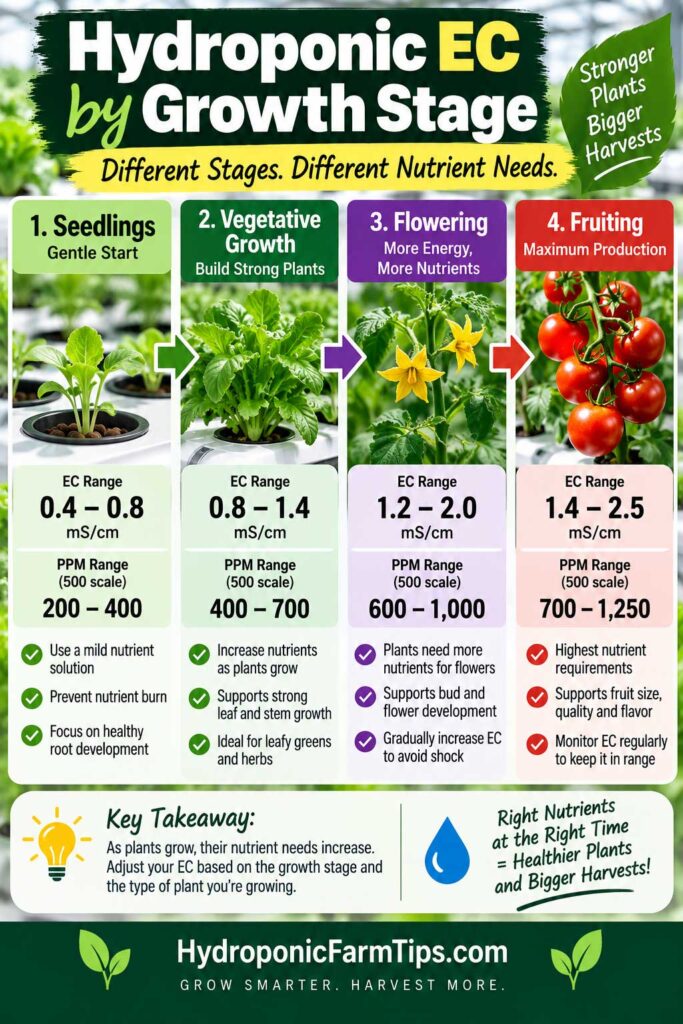
A plant’s nutrient needs don’t stay exactly the same throughout its life.
A newly germinated seedling has a much smaller root system and lower nutrient demand than a mature plant producing leaves, flowers, or fruit. For many crops, nutrient concentration is therefore increased gradually as the plant becomes established.
However, there isn’t one universal EC schedule that works for every hydroponic crop.
A lettuce seedling, mature basil plant, and fruiting tomato have very different requirements. Instead of following a single EC number for every plant, use the recommended range for your specific crop as the starting point.
Seedlings and Young Plants
Seedlings generally begin with a relatively mild nutrient solution.
Very young plants have small root systems and don’t require the same nutrient concentration as mature plants. Starting immediately at the upper end of a crop’s EC range can expose tender plants to unnecessary osmotic stress.
A better approach is to begin conservatively and increase nutrient strength gradually as seedlings develop healthy roots and true leaves.
For example, lettuce production guidance may use a lower EC during germination than during later production.
The exact target depends on the crop and growing method, so follow crop-specific recommendations whenever possible.
Vegetative Growth
Once plants become established and begin producing vigorous leaves, stems, and roots, their overall nutrient demand generally increases.
This is when growers may gradually move toward the normal production EC range for that crop.
Rather than making a large nutrient-strength increase all at once, adjust gradually and watch:
- EC trends
- pH
- water consumption
- leaf color
- root health
- overall growth
If plants are growing vigorously and the reservoir remains stable, there’s usually little reason to chase a higher EC simply because the crop can tolerate it.
Higher EC isn’t automatically better.
Flowering and Fruiting
Fruiting crops such as tomatoes, peppers, cucumbers, eggplants, and strawberries can have different nutrient demands as they mature and begin flowering and producing fruit.
In some production systems, growers adjust nutrient concentration during these later stages.
But this doesn’t mean every fruiting plant should automatically receive a very high EC.
The appropriate concentration still depends on the crop, cultivar, environment, nutrient formula, irrigation strategy, and growing system.
For example, mature tomatoes can generally be managed at substantially higher EC levels than lettuce. That doesn’t mean the upper end of a tomato range should automatically become your target.
Start with established crop-specific guidance and adjust based on how your plants and reservoir respond.
A Simple Way to Think About EC by Growth Stage
| Growth Stage | General Approach |
|---|---|
| Germination / very young seedlings | Start with a mild nutrient solution appropriate for the crop |
| Established seedlings | Increase nutrient strength gradually |
| Vegetative growth | Move toward the crop’s normal production range |
| Flowering | Follow crop-specific recommendations and monitor plant response |
| Fruiting | Adjust only when appropriate for the crop and production system |
This table is intentionally general. It should not replace crop-specific EC recommendations.
Don’t Increase EC Just Because Plants Are Bigger
One of the easiest mistakes to make is assuming that larger plants always need a stronger nutrient solution.
They may consume more total water and nutrients, but that doesn’t necessarily mean they require a higher concentration.
A large plant can use more nutrient solution while the ideal EC remains within roughly the same production range.
That’s an important distinction:
Nutrient demand and nutrient concentration aren’t the same thing.
Your goal isn’t to push EC as high as your plants can tolerate. It’s to maintain an appropriate nutrient concentration while supplying enough solution to support healthy growth.
When in doubt, make small adjustments, monitor the trend over several days, and pay attention to what the plants are telling you.
How to Measure EC and PPM in Hydroponics: Step by Step
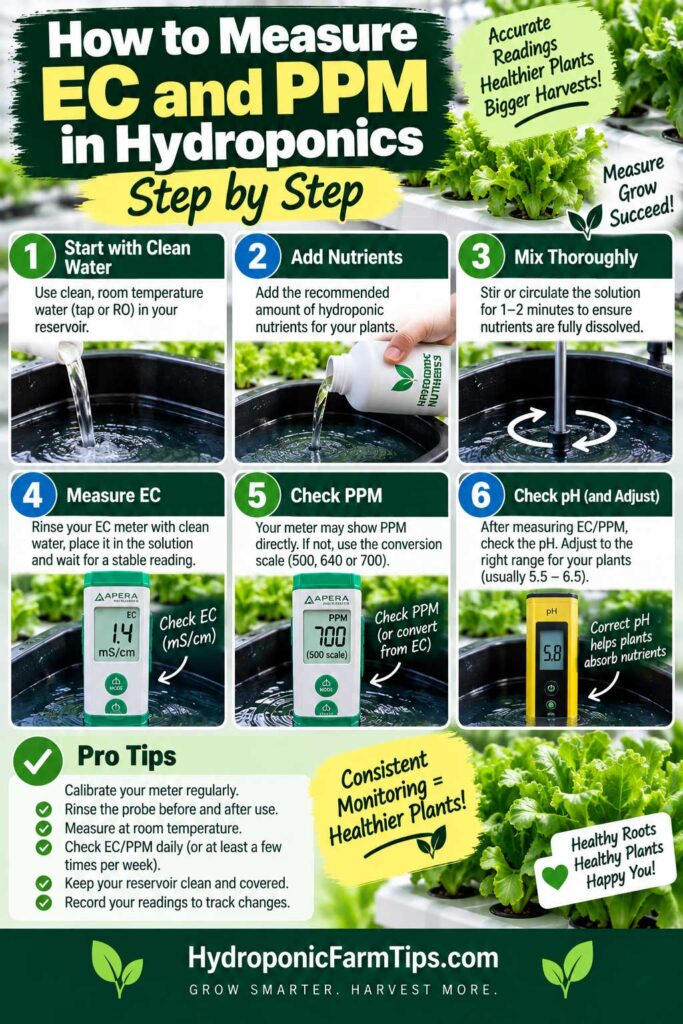
Checking EC or PPM is one of the quickest routine measurements you can make in a hydroponic system. Once you’re familiar with your meter, the process usually takes only a minute or two.
The exact procedure can vary slightly between meters, so always check the manufacturer’s instructions as well.
Step 1: Check Your Source Water
Before adding nutrients, test the water you’re starting with.
Place your clean EC meter probe into the water and allow the reading to stabilize.
Record the result.
For example:
Source water: 0.3 EC
This starting measurement is useful because tap water can already contain calcium, magnesium, bicarbonates, sodium, and other dissolved ions that contribute to conductivity.
Knowing your baseline makes the final nutrient reading easier to interpret.
Step 2: Add Your Hydroponic Nutrients
Add nutrients according to the manufacturer’s directions and the needs of your crop.
If you’re using a multi-part nutrient system, add each component separately and mix thoroughly between additions unless the manufacturer specifies a different procedure.
Avoid mixing concentrated nutrient components directly together before diluting them in water. Some concentrated mineral salts can react with one another and form precipitates, potentially reducing nutrient availability.
Step 3: Mix the Reservoir Thoroughly
Make sure the nutrient solution is well mixed before taking your reading.
In a circulating hydroponic system, allow the pump to distribute the nutrients throughout the reservoir.
In a non-circulating container, stir the solution thoroughly with a clean utensil.
Measuring immediately next to where concentrated nutrients were poured can give you a misleading reading.
Step 4: Rinse the Meter Probe
Rinse the probe according to the manufacturer’s instructions before testing.
This helps prevent residue from a previous nutrient solution or calibration standard from affecting your measurement.
Avoid aggressively wiping, scrubbing, or touching sensitive probe surfaces unless the manufacturer specifically recommends doing so.
Step 5: Place the Probe in the Nutrient Solution
Insert the probe to the depth recommended by the manufacturer.
Avoid pressing it against the bottom or side of the reservoir.
If possible, measure from a representative, well-mixed portion of the nutrient solution rather than directly beside a nutrient inlet, dosing point, or concentrated residue.
Step 6: Wait for the Reading to Stabilize
Don’t record the first number that appears on the screen.
Give the meter time to settle on a stable reading. Depending on the device and solution temperature, this may take several seconds or longer.
Suppose your meter stabilizes at:
1.6 EC
If your target range for that crop is approximately 1.4–1.8 EC, you’re within that reference range.
Step 7: Record the Reading
Keeping a simple reservoir log can be surprisingly useful.
Record:
- Date and time
- EC or PPM
- pH
- Water level
- Water temperature, if monitored
- Nutrients or water added
- Any noticeable plant or root changes
After several days, patterns become much easier to recognize.
For example, you may notice that EC consistently rises as the reservoir level falls, or that pH gradually moves in one direction between adjustments.
Those trends are often more informative than a single measurement.
Step 8: Adjust Only If Necessary
If EC is slightly different from yesterday but your plants look healthy and the reading remains within an appropriate range, you may not need to do anything.
If the nutrient solution is clearly too concentrated, adding suitable source water will dilute the solution and lower its EC.
If EC is too low, you may need to add nutrients according to your feeding plan—or replace and remix the reservoir if the solution is old or you suspect its nutrient balance has drifted.
Avoid repeatedly adding small amounts of fertilizer simply to force the meter toward a particular number. EC measures overall conductivity, not whether each individual nutrient remains in the correct proportion.
Likewise, diluting a reservoir can lower the EC number without necessarily correcting an underlying nutrient imbalance.
Step 9: Mix Again and Recheck
After adding water or nutrients, allow the reservoir to mix thoroughly before taking another measurement.
Then test again.
Don’t keep making adjustments while the solution is still mixing. Give each change time to distribute evenly so you can see what effect it actually had.
Step 10: Rinse and Store Your Meter Correctly
When you’re finished, rinse and store the probe according to the manufacturer’s instructions.
Storage requirements vary by meter and sensor type, so don’t assume every EC meter should be handled the same way.
Proper cleaning, storage, and periodic calibration can help keep readings consistent over time.
A Simple EC Testing Routine
For most home hydroponic systems, the routine can be summarized as:
Test source water → Add nutrients → Mix thoroughly → Measure EC/PPM → Check pH → Adjust if needed → Mix again → Recheck → Record
Once this becomes part of your normal reservoir maintenance, monitoring hydroponic EC and PPM becomes much easier—and you’ll have a useful history of how your nutrient solution changes as your plants grow.
How Often Should You Check EC and PPM?
For many home hydroponic systems, checking EC or PPM once a day is a useful routine, especially when you’re learning how quickly your plants use water and nutrients.
Daily measurements aren’t always necessary in every setup, but they make it much easier to recognize trends before a small change becomes a larger problem.
The more quickly your reservoir changes, the more useful frequent monitoring becomes.
When to Check EC More Frequently
Consider checking EC or PPM more often when:
- Your reservoir is small
- Plants are large and drinking heavily
- Temperatures are high
- Water levels are dropping quickly
- You’ve recently changed nutrient strength
- You’ve added nutrients or topped off the reservoir
- Plants are showing signs of stress
- You’re growing heavy-feeding fruiting crops
- You’re trying to diagnose an unexplained nutrient problem
Small reservoirs can change particularly quickly because plants may remove a significant percentage of the available water in a short period.
A larger reservoir usually changes more gradually.
Check After Mixing a Fresh Nutrient Solution
It’s a good practice to check EC or PPM after preparing a fresh reservoir.
This confirms that the finished solution is reasonably close to the intended range before your plants spend hours or days growing in it.
A useful routine is:
Check source water → Add nutrients → Mix → Check EC/PPM → Check pH → Make adjustments → Recheck
Recording the final EC also gives you a baseline for tracking changes over the following days.
Check After Major Reservoir Adjustments
If you add a substantial amount of water or nutrients, check EC again after the solution has mixed thoroughly.
Don’t assume that a top-off or nutrient addition produced the concentration you expected.
Measure it.
This is particularly useful when correcting a reservoir that has drifted well outside your desired range.
Watch the Trend, Not Just Today’s Number
Daily testing becomes much more useful when you record the results.
Imagine your EC readings look like this:
| Day | Water Level | EC |
|---|---|---|
| Monday | Full | 1.5 |
| Tuesday | Slightly lower | 1.6 |
| Wednesday | Lower | 1.7 |
| Thursday | Much lower | 1.9 |
The important information isn’t simply that Thursday’s EC is 1.9.
The pattern shows that EC is steadily increasing as the reservoir water level falls.
That tells you more about what’s happening in the system than any one reading by itself.
You Don’t Need to Chase Tiny EC Changes
If your EC changes from 1.50 to 1.55, don’t automatically reach for nutrients or water.
Meters have measurement tolerances, temperature can influence conductivity, and normal plant activity can produce small fluctuations.
What matters more is whether the reading:
- Remains within an appropriate range
- Is moving consistently upward or downward
- Changes suddenly
- Matches what you’re seeing in the plants and reservoir
For beginners, a simple once-daily check at roughly the same point in your routine can make EC trends much easier to understand.
As you become familiar with your particular system, you’ll learn how quickly it changes and whether you need to test more or less frequently.
What Happens When EC Is Too High? Signs, Causes & How to Lower It
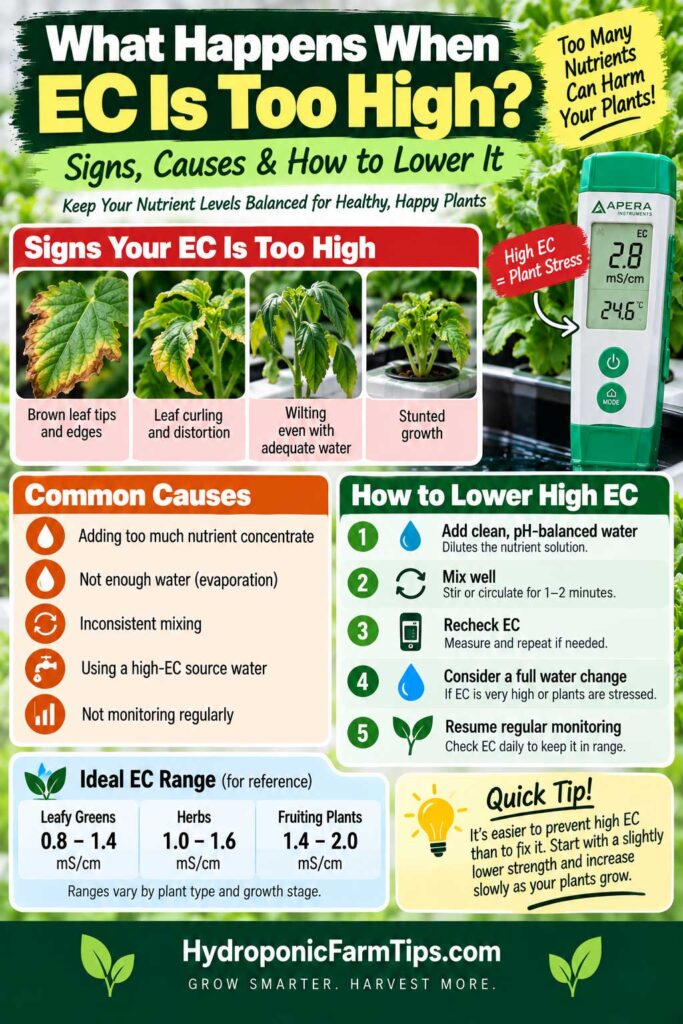
A high EC reading means your nutrient solution contains a relatively high concentration of dissolved ions.
When EC rises beyond an appropriate range for the crop and growth stage, plants can have more difficulty taking up water because the concentration of dissolved salts around their roots is too high.
In practical terms, more nutrients aren’t always better. A solution that’s too concentrated can stress plants even though plenty of fertilizer is present.
Signs Your Hydroponic EC May Be Too High
Possible signs include:
- Brown or scorched leaf tips
- Browning along leaf margins
- Leaf curling
- Wilting despite having access to water
- Slower or stunted growth
- Increasing EC as the reservoir level falls
- Plants appearing stressed after a strong nutrient mix
Severe or prolonged stress can eventually damage leaves and reduce growth.
However, these symptoms aren’t unique to high EC.
Incorrect pH, root problems, excessive heat, nutrient imbalances, disease, and other environmental stresses can produce similar symptoms. Check the meter rather than diagnosing high EC from leaf appearance alone.
What Causes High EC in Hydroponics?
Several situations can push EC above the desired range.
1. Adding Too Much Nutrient Concentrate
This is one of the most straightforward causes.
If too much fertilizer is added for the volume of water in the reservoir, the concentration of dissolved ions increases and EC rises.
This is why measuring nutrient concentrate carefully and checking the finished solution is better than estimating by eye.
2. Water Loss Concentrates the Reservoir
Plants continuously take up water through their roots, while additional water may be lost from the system through evaporation.
If proportionally more water leaves the reservoir than dissolved ions, the remaining nutrient solution becomes more concentrated.
As a result, you may see:
Water level ↓ + EC ↑
This pattern is an important clue that the reservoir is becoming more concentrated over time.
3. Starting Water Already Has a High EC
Tap water can contain dissolved minerals before fertilizer is added.
If your source water begins at a relatively high EC, adding nutrients on top of that baseline can produce a higher final reading than expected.
That’s one reason it’s useful to test your source water separately.
4. Repeated Nutrient Top-Offs
Adding more fertilizer every time the water level drops can gradually push EC upward.
Plants don’t necessarily remove water and every dissolved nutrient in the same proportions.
If you repeatedly replace missing water with a full-strength nutrient solution without monitoring EC, certain dissolved ions may accumulate.
5. Reservoir Management Over Time
Even when the EC number looks acceptable, the composition of an older nutrient solution can change as plants selectively take up nutrients and water.
This is an important limitation of EC:
EC tells you the overall conductivity of the solution, not which nutrients are present or whether they’re still in ideal proportions.
That’s why correcting the EC number alone isn’t always the same as restoring a balanced nutrient solution.
How to Lower EC in Hydroponics
If your EC is clearly above the appropriate range, don’t make a large correction blindly.
Start by confirming the reading.
1. Recheck the meter.
Make sure the solution is thoroughly mixed and the meter is clean, calibrated when needed, and functioning correctly.
2. Compare the reading with your crop’s appropriate range.
An EC that’s high for lettuce may be perfectly reasonable for another crop.
3. Check the reservoir water level.
If the water level has dropped substantially while EC has risen, concentration from water loss may be part of the problem.
4. Check the EC of your source water.
This is especially useful if you’re using hard tap water. Water with a substantial starting EC will still dilute a stronger nutrient solution, but it also introduces additional dissolved ions.
5. Add suitable source water gradually.
Adding lower-EC water dilutes the nutrient solution and lowers its EC.
6. Mix thoroughly and recheck.
Allow the added water to distribute throughout the reservoir before measuring again. Make further adjustments only after seeing the effect of the first one.
For example, suppose a lettuce reservoir is at 2.2 EC and your intended operating range is 1.4–1.8 EC.
Instead of guessing how much water to add, dilute the reservoir gradually with appropriate source water, mix thoroughly, and remeasure until you’re back near the range you’re targeting.
When Dilution Isn’t Enough
Sometimes simply adding water isn’t the best solution.
If the reservoir is old, badly imbalanced, contaminated, or has experienced repeated nutrient additions and corrections, bringing the EC number down doesn’t guarantee that the nutrient ratios are appropriate.
In that situation, it may make more sense to replace the nutrient solution and mix a fresh batch according to your normal feeding program.
Think of it this way:
Dilution can correct concentration. It doesn’t necessarily correct nutrient balance.
Avoid Overcorrecting High EC
If your target is 1.6 EC and the reservoir measures 1.7, that doesn’t automatically mean you need to intervene.
Small differences may be normal.
The bigger concern is a reading that’s clearly outside the appropriate range or a consistent trend such as:
1.6 → 1.8 → 2.0 → 2.2 EC
especially when the water level is falling or plants are beginning to show stress.
Monitor the direction of change, not just whether today’s number is slightly above yesterday’s.
What Happens When EC Is Too Low? Signs, Causes & How to Raise It
A low EC reading means your nutrient solution has a relatively low concentration of dissolved ions.
That isn’t automatically a problem. Seedlings and light-feeding crops may intentionally be grown at lower EC levels than mature, heavy-feeding plants.
But if EC falls well below the appropriate range for your crop and growth stage, the nutrient solution may be more dilute than intended.
Over time, that can mean the solution contains a lower overall concentration of dissolved nutrients than your plants require for healthy growth.
Signs Your Hydroponic EC May Be Too Low
Possible signs include:
- Slow or weak growth
- Pale foliage
- Yellowing leaves
- Smaller-than-expected leaves
- Reduced vigor
- EC steadily falling as the reservoir level drops
- A nutrient solution measuring well below the intended crop range
However, low EC alone doesn’t diagnose a nutrient deficiency.
Yellow leaves, for example, can result from incorrect pH, root stress, nutrient imbalance, disease, lighting problems, or several other causes.
Likewise, a low EC reading tells you that overall conductivity is low—it doesn’t tell you which individual nutrient may be lacking.
If the plants are showing specific symptoms, compare them with our hydroponic nutrient deficiency guide before assuming low EC identifies the missing nutrient.
What Causes Low EC in Hydroponics?
Several situations can cause the nutrient solution to measure below your intended range.
1. The Nutrient Solution Was Mixed Too Weakly
If too little nutrient concentrate was added for the volume of water, the finished solution may simply be more dilute than intended.
This is easy to check when preparing a fresh reservoir.
Measure your source water, add nutrients according to the feeding program, mix thoroughly, and then test the finished EC.
2. Plants Are Removing Dissolved Nutrients
As plants grow, they take up mineral nutrients from the solution.
If dissolved ions are being removed proportionally faster than the reservoir is losing water, EC can gradually decline.
You may see a pattern such as:
Water level ↓ + EC ↓
This can indicate that the concentration of dissolved ions in the remaining solution is decreasing.
However, EC cannot tell you exactly which nutrients the plants have taken up.
3. Too Much Water Was Added
Topping off the reservoir with a large amount of low-EC water dilutes the nutrient solution.
For example, if a reservoir is at 1.6 EC and you add a substantial volume of low-EC water, the new reading might fall to 1.2 EC.
That’s normal dilution.
Whether you need to correct it depends on the appropriate range for your crop.
4. The Reservoir Wasn’t Mixed Thoroughly
An unexpectedly low reading doesn’t always mean the solution itself is too weak.
If nutrients haven’t fully dispersed through the reservoir, measurements taken from different locations may not represent the overall solution accurately.
Mix or circulate the reservoir thoroughly and test again before making a correction.
5. The Meter Reading Is Incorrect
A dirty, poorly maintained, or poorly calibrated meter can mislead you in either direction.
If an EC reading suddenly changes without an obvious reason, confirm the measurement before changing the nutrient solution.
How to Raise EC in Hydroponics
If you’ve confirmed that EC is genuinely below the appropriate range, nutrient concentration can be increased carefully.
1. Confirm your target range.
Make sure the EC is actually low for the crop and growth stage you’re growing.
2. Check the water level and recent changes.
Did you just add a large amount of water? Did the EC fall gradually over several days? Context matters.
3. Recheck your meter.
Make sure the reservoir is well mixed and your meter is functioning correctly.
4. Add nutrients according to your feeding program.
If the solution genuinely needs to be stronger, add the appropriate hydroponic nutrients rather than trying to correct the reading with an unrelated supplement.
5. Mix thoroughly.
Allow the nutrients to distribute evenly throughout the reservoir.
6. Measure again.
Make further adjustments only after checking the new EC.
Small corrections are easier to control than one large addition.
Don’t Add Nutrients Just Because EC Dropped Slightly
Suppose your reservoir starts at:
1.6 EC
The next day it measures:
1.5 EC
That small change doesn’t automatically mean you should add fertilizer.
Look at the bigger picture:
- Has the water level changed?
- Is the EC still within the appropriate range?
- Are the plants growing normally?
- Was water recently added?
- Is the meter reading consistently?
- How old is the nutrient solution?
A small downward trend can be part of normal reservoir behavior.
When a Fresh Nutrient Solution Makes More Sense
If EC is low because you’ve repeatedly topped off the reservoir, added nutrients several times, or maintained the same solution for an extended period, simply adding more fertilizer may not restore the original nutrient balance.
Plants don’t absorb every nutrient at exactly the same rate.
The reservoir could theoretically show an acceptable EC while containing too much of some dissolved ions and too little of others.
If you’re no longer confident in what’s in the reservoir, replacing the old solution with a freshly mixed nutrient solution can be more predictable than repeatedly correcting the EC. For reservoir timing and top-off strategy, see How Often Should You Change Hydroponic Water?.
The key principle is the same whether EC is too high or too low:
Use EC to monitor nutrient concentration—not as a command telling you to add water or fertilizer every time the number moves.
What EC and Water-Level Changes Can Tell You
An EC reading becomes much more useful when you compare it with changes in your reservoir’s water level.
Plants take up both water and dissolved mineral nutrients, but they don’t necessarily take them up in the same proportions at all times. Temperature, humidity, plant size, growth stage, light, and crop type can all influence how quickly water and dissolved ions leave the nutrient solution.
By tracking EC and water level together, you can get useful clues about how the concentration of your reservoir is changing.
Quick EC and Water-Level Troubleshooting Chart
| What You Observe | What It Can Indicate | What to Check |
|---|---|---|
| Water ↓ + EC ↑ | Remaining solution is becoming more concentrated | Water loss, nutrient strength, temperature, source-water EC |
| Water ↓ + EC ↓ | Concentration of dissolved ions is decreasing | Crop demand, nutrient strength, recent top-offs, reservoir age |
| Water ↓ + EC stable | Overall concentration is remaining relatively stable | Continue monitoring the trend |
| Water stable + EC ↑ | Dissolved-ion concentration has increased without much change in water level | Nutrient additions, dosing, mixing, measurement error |
| Water stable + EC ↓ | Dissolved-ion concentration has decreased without much change in reservoir volume | Recent dilution, reservoir inputs, system operation, measurement variation |
| Sudden unexplained EC change | May not represent normal plant activity | Meter accuracy/calibration, mixing, recent additions, source water |
This chart provides clues, not a complete diagnosis. EC measures overall conductivity and cannot tell you which individual nutrients are increasing or decreasing.
Water Level Falls While EC Rises
This is one of the most useful patterns to recognize:
Water ↓ + EC ↑
It means the nutrient solution remaining in the reservoir has become more concentrated.
For example:
Day 1: 10 gallons at 1.6 EC
Day 2: 8.5 gallons at 1.9 EC
The plants may have taken up substantial water, and additional water may have been lost through evaporation. If dissolved ions remain in the reservoir in greater proportion than the water, EC rises.
This doesn’t automatically mean something is wrong.
A modest change may simply reflect normal reservoir dynamics.
But if EC continues climbing well beyond the appropriate crop range, you may need to top off with suitable water, adjust your nutrient-management routine, or investigate environmental conditions that are contributing to rapid water loss.
Water Level Falls While EC Falls
The opposite pattern can also occur:
Water ↓ + EC ↓
Here, the concentration of dissolved ions in the remaining nutrient solution is decreasing.
For example:
Day 1: 10 gallons at 1.6 EC
Day 2: 8.5 gallons at 1.4 EC
Plant nutrient uptake can contribute to this pattern when dissolved ions are removed from the solution in sufficient proportion relative to water loss.
However, don’t interpret a falling EC as proof that your plants are “eating perfectly.”
EC cannot identify which nutrients have been removed, and dilution, reservoir additions, measurement variation, and other factors can also influence the reading.
If EC continues dropping below the crop’s appropriate range, review your feeding program rather than automatically adding nutrients after every small decrease.
Water Level Falls While EC Stays Relatively Stable
You may also see:
Water ↓ + EC → relatively stable
For example:
Day 1: 10 gallons at 1.6 EC
Day 2: 9 gallons at 1.6 EC
This tells you that the overall concentration of dissolved ions in the remaining solution has stayed relatively similar, even though the reservoir contains less water.
That’s generally a more useful interpretation than saying plants are taking up water and nutrients in a “perfect ratio.”
EC cannot show the uptake of individual nutrients, so avoid reading too much into one stable number.
If the plants look healthy, pH is manageable, and EC remains within an appropriate range, continue monitoring.
What If the Water Level Doesn’t Change Much?
Changes in EC can still occur even when the reservoir level appears relatively stable.
For example:
Water stable + EC ↑
could occur after nutrient additions, dosing, or other changes that increase dissolved-ion concentration.
Meanwhile:
Water stable + EC ↓
tells you that the concentration of dissolved ions has decreased, but it doesn’t identify the cause by itself. Recent water additions, plant uptake, reservoir inputs, measurement variation, or other changes may contribute.
That’s why it’s useful to consider what has happened since your previous reading.
Ask yourself:
- Did I add water?
- Did I add nutrients?
- Did I adjust pH?
- Did I change the reservoir?
- Has the temperature changed significantly?
- Is the solution thoroughly mixed?
- Is my meter reading consistently?
Don’t Diagnose Your Plants From One EC Reading
Imagine you check your reservoir once and see 1.9 EC.
Without context, that number tells you relatively little.
But suppose your log shows:
Monday: 1.5 EC
Tuesday: 1.6 EC
Wednesday: 1.8 EC
Thursday: 1.9 EC
while the reservoir level has steadily fallen.
Now you have a trend showing that the nutrient solution is becoming progressively more concentrated.
That’s much more useful.
The goal isn’t to react to every small movement. It’s to understand which direction EC is moving, how quickly it’s changing, what the water level is doing, and whether your plants are showing signs of stress.
When you combine those observations, EC becomes a much more powerful hydroponic troubleshooting tool.
EC Problems vs. pH Problems: How to Tell the Difference
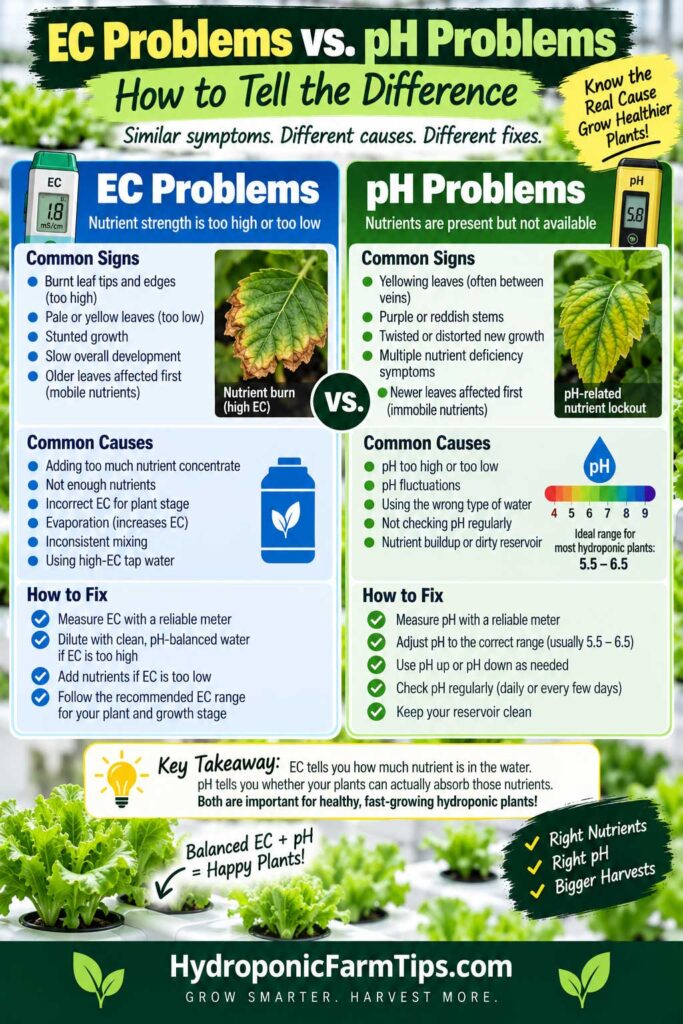
EC and pH are both important measurements in hydroponics, but they tell you different things about your nutrient solution.
EC tells you about the overall concentration of dissolved ions.
pH tells you how acidic or alkaline the nutrient solution is.
A reservoir can have an appropriate EC but an unsuitable pH. It can also have an appropriate pH while the nutrient solution is too concentrated or too dilute.
If you’re still choosing a reliable way to monitor pH, we’ve also compared 7 accurate pH meters for hydroponics.
That’s why checking only one of these measurements can leave you with an incomplete picture.
EC vs. pH at a Glance
| Measurement | What It Tells You | What It Doesn’t Tell You |
|---|---|---|
| EC | Overall electrical conductivity and an indication of dissolved-ion concentration | Which specific nutrients are present or whether their proportions are correct |
| PPM/TDS | An estimated dissolved-solids value calculated from conductivity on most handheld meters | Exact nutrient composition |
| pH | How acidic or alkaline the nutrient solution is | How concentrated the nutrient solution is |
Think of EC and pH as two separate questions:
EC: How concentrated is the solution?
pH: How acidic or alkaline is the solution?
You usually need both measurements to understand what’s happening in the reservoir.
Signs of High EC Can Look Like Other Problems
A nutrient solution that’s too concentrated may contribute to symptoms such as:
- Brown leaf tips
- Scorched leaf margins
- Curling
- Wilting
- Slower growth
But those symptoms don’t prove EC is the cause.
Root stress, heat, disease, nutrient imbalance, and other problems can look similar.
The first step is simple: measure the EC instead of guessing from the leaves.
Incorrect pH Can Cause Deficiency-Like Symptoms
Plants can also show nutrient-related symptoms even when the EC reading appears reasonable.
Why?
Because an acceptable overall nutrient concentration doesn’t guarantee that root-zone conditions are favorable for the uptake of every nutrient.
If pH moves outside an appropriate range for the crop, the availability and uptake of certain nutrients can be affected.
You might see symptoms such as:
- Yellowing leaves
- Interveinal chlorosis
- Poor new growth
- Leaf spotting
- Stunted growth
Adding more fertilizer in this situation may not solve the underlying problem—and could push EC unnecessarily high.
An Example: Yellow Leaves With Normal EC
Suppose your lettuce reservoir measures:
EC: 1.6 mS/cm
That’s within a commonly used range for lettuce.
But the leaves are turning yellow.
It would be a mistake to immediately assume the plants need more fertilizer.
Instead, check:
- pH
- Root health
- Water temperature
- Reservoir condition
- Which leaves are affected—old or new
- Whether EC has been stable, rising, or falling
- Recent changes to nutrients, lighting, or the environment
The EC reading tells you the overall solution isn’t obviously dilute based on that target range. It doesn’t rule out a specific nutrient imbalance or another plant-health problem.
What If Both EC and pH Are Wrong?
Sometimes you’ll find that both measurements have drifted.
For example:
EC: 2.4 when you’re targeting around 1.6
pH: outside your intended range
Avoid making several large corrections at once.
First, consider whether the reservoir is still worth correcting.
If the solution is old, has been repeatedly topped off and adjusted, or you’re unsure what’s in it, replacing it with a freshly mixed nutrient solution may be simpler and more predictable.
With a fresh reservoir, a typical routine is:
Add water → Add nutrients according to the feeding program → Mix thoroughly → Check EC → Make any appropriate nutrient-strength adjustment → Check and adjust pH → Recheck
Always follow the nutrient and pH-adjustment product manufacturer’s directions, especially when determining the order and amount of each addition.
EC Doesn’t Replace pH Testing
An EC meter and a pH meter aren’t substitutes for one another.
A reading of 1.6 EC doesn’t tell you whether your pH is appropriate.
Likewise, a pH of 5.8 doesn’t tell you whether your nutrient solution is weak, concentrated, or somewhere in between.
For routine hydroponic monitoring, think of them as complementary measurements:
EC/PPM → overall dissolved-ion concentration
pH → acidity/alkalinity and an important influence on nutrient availability
Together with water level, root health, plant appearance, and reservoir temperature, they give you a much better picture than any single measurement alone.
Don’t Correct the Number Before Identifying the Problem
When plants look unhealthy, it’s tempting to immediately add nutrients, dilute the reservoir, or adjust pH.
Instead, gather a few measurements first.
Check:
EC → pH → water level → roots → plant symptoms → recent changes
That simple troubleshooting sequence can help you avoid turning one manageable problem into several.
Does Adding Water Lower EC?
Yes. Adding lower-EC water to a hydroponic nutrient solution generally lowers the EC by diluting the concentration of dissolved ions.
This is one of the simplest ways to correct a reservoir that has become more concentrated than intended.
However, the EC of the water you’re adding matters.
Why Adding Water Lowers EC
Imagine you have a reservoir containing dissolved nutrient salts.
If some water is lost while many of those dissolved ions remain behind, the remaining solution becomes more concentrated and EC can rise.
Adding lower-EC water increases the volume of water without adding the same concentration of dissolved ions.
The result is a more dilute solution and a lower EC.
For example:
Before top-off: 8 gallons at 2.0 EC
After adding lower-EC water, the reservoir might return closer to your target of 1.6 EC.
The exact amount of water required depends on the starting EC, target EC, reservoir volume, and EC of the water being added.
A Simple EC Dilution Estimate
If the water you’re adding has very little conductivity compared with the nutrient solution, you can use a simple approximation:
Final Volume ≈ Starting Volume × Starting EC ÷ Target EC
Suppose you have:
- 8 gallons of nutrient solution
- 2.0 EC starting concentration
- 1.6 EC target
- Water with close to 0 EC
The estimate is:
8 × 2.0 ÷ 1.6 = 10 gallons
So the estimated final volume would be about 10 gallons.
That means adding approximately:
10 − 8 = 2 gallons
of very low-EC water could bring the solution close to 1.6 EC.
This shortcut works best when the water being added has negligible EC. If your source water already contains a significant concentration of dissolved ions, the calculation becomes different.
And even with very low-EC water, treat the result as an estimate rather than a guarantee.
The safest approach is still:
Add some water → Mix thoroughly → Measure EC → Adjust again if necessary
What If Your Tap Water Already Has a High EC?
This is where source-water testing becomes important.
Suppose your tap water measures:
0.6 EC
That water can still dilute a reservoir at 2.0 EC, but it isn’t equivalent to adding water with almost no dissolved ions.
It also introduces whatever dissolved minerals and salts are contributing to that 0.6 EC.
For a more realistic estimate when your source water has measurable EC, you can use:
Water to Add ≈ Starting Volume × (Starting EC − Target EC) ÷ (Target EC − Source-Water EC)
Using the same example:
- Reservoir = 8 gallons
- Starting EC = 2.0
- Target EC = 1.6
- Source-water EC = 0.6
The calculation is:
8 × (2.0 − 1.6) ÷ (1.6 − 0.6)
8 × 0.4 ÷ 1.0 = 3.2 gallons
So approximately 3.2 gallons of 0.6 EC source water would be expected to bring the reservoir near 1.6 EC under this simplified mixing model.
Notice the difference:
Very low-EC water → about 2 gallons
0.6 EC water → about 3.2 gallons
That’s why knowing your starting water EC can matter.
Treat EC Dilution Math as an Estimate
These calculations are useful for planning, but hydroponic reservoirs aren’t laboratory-perfect systems.
Actual readings can be influenced by:
- Solution composition
- Source-water chemistry
- Temperature
- Meter accuracy
- Incomplete mixing
- Nutrient additions and other reservoir inputs
So don’t calculate 3.2 gallons and automatically pour in exactly that amount.
Use the math to estimate the correction, then add gradually, mix thoroughly, and measure again.
Does Adding Water Fix Nutrient Imbalance?
Not necessarily.
Adding water can lower the overall concentration of dissolved ions, but it doesn’t tell you whether individual nutrients are still present in the correct proportions.
For example, if an older reservoir has accumulated certain ions while plants have removed others, diluting the solution may produce an attractive EC number without restoring the original nutrient balance.
That’s why an old or repeatedly corrected reservoir may sometimes be better replaced with a fresh nutrient solution.
Don’t Dilute EC Below the Crop’s Range
If your target is approximately 1.6 EC and the reservoir is at 1.9 EC, don’t add a huge amount of water all at once.
You could overshoot and end up with a solution that’s too dilute.
Instead:
Estimate → Add gradually → Mix → Measure → Repeat if necessary
The goal isn’t to make EC as low as possible.
The goal is to bring the nutrient solution back toward an appropriate range for the crop, growth stage, and growing conditions.
Does Adding Nutrients Raise EC?
Yes. Adding mineral hydroponic nutrients generally raises EC because the fertilizer adds dissolved ions to the water.
The more dissolved nutrient salts present in the solution, the greater its electrical conductivity will generally be.
But that doesn’t mean you should keep adding fertilizer until you reach the highest EC your plants can tolerate.
Why Nutrients Increase EC
Most conventional hydroponic fertilizers contain mineral nutrients supplied as soluble salts.
Most conventional hydroponic fertilizers contain soluble mineral salts. Once dissolved in water, these compounds form electrically charged ions associated with nutrients such as nitrogen, potassium, calcium, magnesium, phosphorus, and sulfur.
These dissolved ions allow the solution to conduct electricity, so EC generally rises as their overall concentration increases.
These dissolved ions allow the solution to conduct electricity.
As their overall concentration increases, EC generally increases as well.
For example, you might start with:
Source water: 0.3 EC
After adding your hydroponic nutrients and mixing thoroughly:
Finished nutrient solution: 1.6 EC
The increase reflects the additional dissolved ions introduced by the fertilizer.
However, you shouldn’t simply subtract 0.3 from 1.6 and assume the remaining 1.3 EC represents a precise measurement of plant nutrients. Source-water chemistry and the conductivity contributions of different ions make EC more useful as an overall concentration indicator than as a nutrient-analysis tool.
How to Raise EC Safely
If you’ve confirmed that your nutrient solution is genuinely too dilute, increase nutrient strength gradually.
A simple routine is:
1. Confirm the crop’s appropriate EC range.
Make sure the solution actually needs to be stronger.
2. Follow your nutrient feeding program.
Use the manufacturer’s recommended proportions rather than adding random products simply because they increase EC.
3. Add nutrients carefully.
If you’re using a multi-part fertilizer, add the components in the proper sequence and proportions specified by the manufacturer.
4. Mix thoroughly.
Allow the nutrient solution to circulate or stir it well before measuring.
5. Measure EC again.
Check the effect of your adjustment before adding more.
Don’t Add Concentrated Nutrients Directly Together
If you’re using a two-part or three-part hydroponic nutrient system, don’t mix the concentrated components together unless the manufacturer specifically instructs you to do so.
Certain concentrated nutrient salts can react with each other and form insoluble precipitates.
Instead, the normal approach for many multi-part products is:
Add Part A to water → Mix thoroughly → Add Part B → Mix thoroughly
If there’s a third component, follow the manufacturer’s specified mixing order.
The exact procedure varies by product, so the label should take priority.
Don’t Use Random Supplements Just to Raise EC
EC measures conductivity. It doesn’t know whether the dissolved ions came from a balanced hydroponic fertilizer or an unnecessary supplement.
Adding calcium-magnesium products, bloom boosters, or other additives simply to make the EC number rise can distort the nutrient balance.
If your plants need a stronger solution, use your complete feeding program as the basis for the adjustment.
The goal isn’t:
“My EC is low, so I need to add something.”
It’s:
“My EC is below the appropriate range, so I need to determine why before adjusting the nutrient solution.”
If you’re comparing formulas, our guide to the best hydroponic nutrients for vegetables and herbs explains what to look for before choosing a nutrient program.
Twice the Nutrients Doesn’t Mean Twice the Growth
Plants don’t grow faster simply because the nutrient solution is stronger.
Once nutrient concentration is adequate, pushing EC higher can eventually make water uptake more difficult and increase the risk of salt stress.
Think of EC as a range to manage rather than a number to maximize.
For example, if your crop is performing well at 1.6 EC, raising the reservoir to 2.4 EC without a crop-specific reason isn’t an upgrade.
It’s simply a more concentrated solution.
EC Helps Monitor Concentration, Not Nutrient Balance
This distinction is worth remembering:
Adding nutrients generally raises EC, but a higher EC doesn’t prove the nutrient solution is better balanced.
Two reservoirs could both measure 1.8 EC while containing different proportions of nitrate, potassium, calcium, magnesium, and other dissolved ions.
That’s why EC works best alongside:
- A complete hydroponic nutrient formula
- Manufacturer feeding directions
- pH monitoring
- Regular reservoir maintenance
- Plant observations
- Crop-specific guidance
Use the meter to help monitor nutrient-solution concentration, rather than using the EC number alone to decide what your plants need.
How Water Quality Affects EC in Hydroponics
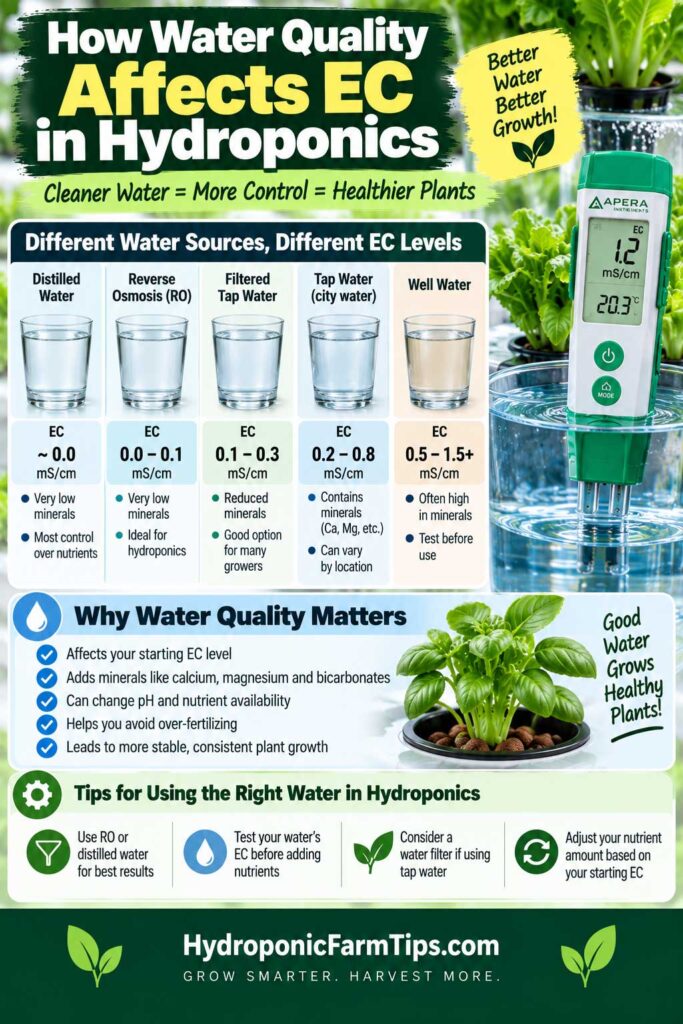
Your nutrient solution doesn’t start with fertilizer.
It starts with water—and that water may already contain dissolved minerals and salts that contribute to EC before you add a single drop of hydroponic nutrients.
That’s why source-water EC is worth checking before you mix your reservoir.
What Is Starting EC?
Starting EC is simply the electrical conductivity of your source water before nutrients are added.
For example:
Source water: 0.4 EC
Finished nutrient solution: 1.6 EC
That initial 0.4 EC comes from dissolved ions already present in the water.
Depending on your water source, that starting EC may come from dissolved calcium, magnesium, sodium, bicarbonate, chloride, sulfate, and other mineral ions already present before you add fertilizer.
The important point is that your EC meter can’t identify which of these substances are present.
It only measures the solution’s electrical conductivity.
A Higher Starting EC Doesn’t Mean More Useful Plant Nutrition
This is an easy mistake to make.
Suppose your tap water measures:
0.5 EC
You shouldn’t assume that 0.5 EC represents calcium and magnesium that your plants can use.
Some of that conductivity may come from useful mineral nutrients, but some may come from ions that you don’t necessarily want accumulating in a hydroponic reservoir.
Two water samples could both measure 0.5 EC while having very different mineral compositions.
That’s why EC alone isn’t a water-quality analysis.
Soft Water vs. Hard Water
Water hardness is primarily associated with dissolved calcium and magnesium.
Hard water often starts with a higher mineral content than soft water, which can contribute to a higher starting EC.
Hard water isn’t automatically unsuitable for hydroponics, but it can make nutrient management more complicated because you’re starting with calcium, magnesium, and potentially other dissolved ions already present in the water.
Depending on the complete water chemistry, you may also encounter:
- Higher starting EC
- Mineral deposits or scale
- Different calcium and magnesium requirements
- More complicated nutrient formulation
- Accumulation of unwanted dissolved salts over time
However, hardness alone doesn’t tell you everything about how the water will behave in a hydroponic reservoir.
The actual effect depends on what’s dissolved in the water and at what concentrations.
Why Alkalinity Matters Too
EC and water hardness aren’t the only things worth considering.
Alkalinity describes the water’s ability to neutralize acids and is commonly influenced by bicarbonates and carbonates.
Water with substantial alkalinity can make pH management more challenging because more acid may be required to lower pH, and the reservoir’s pH behavior can differ from that of low-alkalinity water.
This creates an important distinction:
EC tells you about conductivity.
Hardness relates primarily to dissolved calcium and magnesium.
Alkalinity relates to acid-neutralizing capacity.
They’re connected through water chemistry, but they aren’t the same measurement.
A water source can therefore have a manageable EC while still presenting pH-management challenges.
Should You Subtract Starting EC From Your Target EC?
Not automatically.
Suppose:
Tap water = 0.5 EC
Crop target = 1.8 EC
It’s tempting to think:
1.8 − 0.5 = 1.3 EC of nutrients
But hydroponic nutrient management isn’t quite that simple.
The ions already present in your water don’t necessarily have the same composition or nutritional value as the ions supplied by a balanced hydroponic fertilizer.
Your source water might contain useful calcium and magnesium, but it could also contain substantial bicarbonate, sodium, chloride, or other dissolved ions.
So while starting EC provides important context, don’t treat it as a precise nutrient credit unless you know the water chemistry and your feeding program is designed around it.
When a Water Test Becomes Useful
If your tap water consistently has a substantial EC or you repeatedly struggle with pH management, mineral deposits, or reservoir stability, a water-quality report can tell you much more than an EC meter alone.
A useful water analysis may report calcium, magnesium, sodium, chloride, bicarbonate, alkalinity, hardness, sulfate, and other relevant dissolved minerals.
Many municipal water suppliers publish water-quality reports, although the chemistry at your tap can still vary with the water source, treatment, distribution system, and time of year.
Oklahoma State University Extension also recommends considering pH, EC, and alkalinity when evaluating source water for hydroponic production. Their EC and pH guide for hydroponics explains how naturally occurring salts in water can influence both EC and pH.
For more demanding hydroponic production, a laboratory water analysis can provide a clearer picture of what you’re actually adding to the reservoir.
Test Your Source Water Before Mixing Nutrients
For a home hydroponic grower, you don’t need to turn every reservoir change into a chemistry experiment.
A simple habit goes a long way:
Measure your source water before adding nutrients.
If it consistently reads around 0.1 EC, you’ll know you’re starting with relatively low conductivity.
If it consistently reads 0.6 EC, you’ll know your water already contains enough dissolved ions to contribute substantially to the conductivity you measure after nutrients are added.
That information helps you interpret the final reading more intelligently.
The key takeaway is simple:
Starting EC tells you how conductive your source water is. It doesn’t tell you whether the dissolved ions in that water are beneficial, undesirable, or nutritionally balanced for hydroponic plants.
Tap Water vs. RO Water for Hydroponics
Both tap water and reverse-osmosis (RO) water can be used successfully in hydroponics.
The better choice depends on your local water chemistry, nutrient formula, crop, and how much control you want over the nutrient solution.
For many home growers, ordinary tap water works perfectly well. RO water becomes more useful when the source water contains enough dissolved minerals or unwanted ions to interfere with nutrient or pH management.
Using Tap Water for Hydroponics
Tap water is convenient, inexpensive, and already available in most homes.
If your tap water has a manageable starting EC and doesn’t create persistent nutrient or pH problems, there may be little reason to replace it.
Before using it, check:
- Starting EC
- pH
- Hardness, if known
- Alkalinity, if known
- Your local water-quality report
- How the water behaves after nutrients are added
Suppose your tap water consistently measures:
0.2 EC
and your plants grow well after you add nutrients.
There’s no automatic reason to switch to RO water simply because its starting EC would be lower.
When Tap Water Can Become More Difficult
Tap water can become more challenging when it contains substantial amounts of dissolved minerals or salts.
Potential concerns may include elevated levels of:
- Sodium
- Chloride
- Bicarbonate
- Calcium
- Magnesium
- Other dissolved ions
The concern isn’t simply that the EC number is high.
It’s what is causing that EC.
For example, water containing useful amounts of calcium and magnesium is very different from water with substantial sodium or chloride, even if both produce a similar conductivity reading.
High alkalinity can also make pH management more challenging.
If you’re repeatedly fighting pH drift, scale, unexplained nutrient issues, or a high starting EC, investigating your water chemistry is more useful than judging the water by EC alone.
What Is RO Water?
Reverse osmosis uses pressure to move water through a semipermeable membrane that rejects a large proportion of many dissolved ions.
As a result, RO water generally has a much lower EC than the original source water.
For example:
Tap water: 0.6 EC
RO water: 0.05 EC
The exact reduction depends on the source water, membrane, system condition, pressure, and other factors.
A low starting EC gives you a cleaner baseline when building a nutrient solution.
Advantages of RO Water in Hydroponics
RO water can be useful because it gives you greater control over what’s entering the reservoir.
Potential advantages include:
- Low starting EC
- Fewer dissolved minerals from the source water
- Less interference from unwanted salts
- Greater control over nutrient formulation
- Potentially easier management when source water is problematic
This can be especially useful for growers whose tap water has a high EC or troublesome concentrations of specific ions.
Disadvantages of RO Water
RO water isn’t automatically the best choice for every grower.
Potential drawbacks include:
- Cost of the filtration system
- Filter and membrane replacement
- Wastewater produced by many RO systems
- Slower water production
- Removal of calcium, magnesium, and other minerals that may have been present in the source water
That last point doesn’t necessarily mean you need to start adding supplements.
Your hydroponic nutrient formula may already provide the calcium, magnesium, and other nutrients your plants require.
Does RO Water Always Need Cal-Mag?
No.
Using RO water does not automatically mean you need a separate calcium-magnesium supplement.
What matters is whether your complete nutrient program supplies adequate calcium and magnesium for the crop you’re growing.
If your base nutrients already provide appropriate amounts, automatically adding Cal-Mag can unnecessarily increase EC and alter nutrient ratios.
A better question is:
Does my nutrient formula provide enough calcium and magnesium when used with low-mineral water?
Check the nutrient manufacturer’s recommendations, especially if the company provides separate instructions for soft water, hard water, or RO water.
What About Distilled Water?
Distilled water also contains very few dissolved minerals and usually has very low conductivity.
For a small hydroponic setup, it can provide a clean starting point similar in principle to RO water.
However, purchasing distilled water for a large reservoir can become expensive and inconvenient.
Like RO water, distilled water doesn’t automatically require a Cal-Mag supplement. Your complete nutrient formula should determine whether additional calcium or magnesium is necessary.
Should You Filter Tap Water Before Using It?
That depends on what you’re trying to remove.
A carbon filter and a reverse-osmosis system don’t perform the same job.
Carbon filtration can reduce chlorine and certain organic compounds, depending on the filter design, contact time, and water chemistry. Chloramine removal can require different or more specialized carbon filtration than chlorine removal.
Carbon filtration generally doesn’t remove most of the dissolved mineral ions responsible for water hardness and EC.
So if your goal is to reduce a starting EC of 0.7, a basic carbon filter may make little difference to the EC reading.
RO filtration, on the other hand, can remove a much larger proportion of many dissolved ions and therefore substantially reduce EC.
Tap Water vs. RO Water: Quick Comparison
| Feature | Tap Water | RO Water |
|---|---|---|
| Starting EC | Varies by location | Usually low |
| Mineral content | Varies widely | Greatly reduced |
| Cost | Usually low | Higher |
| Convenience | Excellent | Requires filtration or purchased water |
| Control over nutrient solution | Depends on water chemistry | Generally greater |
| Calcium and magnesium present | May be present | Usually greatly reduced |
| Best choice when | Source water is suitable and manageable | Source-water chemistry creates problems |
Which Water Should You Use?
For most beginners, there’s no reason to buy an RO system before testing the water they already have.
Start with three questions:
1. What is my source-water EC?
2. What does my water-quality report say is actually in the water?
3. Am I experiencing a real problem when I mix and manage my nutrient solution?
If your tap water has a reasonable starting EC, your pH is manageable, and your plants are growing well, keep things simple.
If the water has a high starting EC, troublesome alkalinity, unwanted salts, or repeatedly complicates nutrient management, RO water may give you a more predictable starting point.
The goal isn’t to use the water with the lowest possible EC.
It’s to use water that allows you to create and maintain a balanced, manageable hydroponic nutrient solution.
Helpful Tools for Checking Hydroponic Water Quality
Before buying an RO system or changing your nutrient program, it helps to understand the water you’re starting with. A few basic tools can tell you much more than simply guessing from how your plants look.
| Tool | What It Helps You Check | Best For | Check Price |
|---|---|---|---|
| EC/TDS Meter | Starting conductivity and dissolved-solids estimate | Every hydroponic grower | See Today’s Price |
| Digital pH Meter | Source-water and nutrient-solution pH | Routine reservoir management | See Today’s Price |
| Water Hardness Test Kit | General hardness | Growers using mineral-rich tap water | See Today’s Price |
| RO Water Filter | Reducing many dissolved ions in source water | Growers whose source-water chemistry creates persistent problems | See Today’s Price |
Common EC and PPM Mistakes Beginners Make
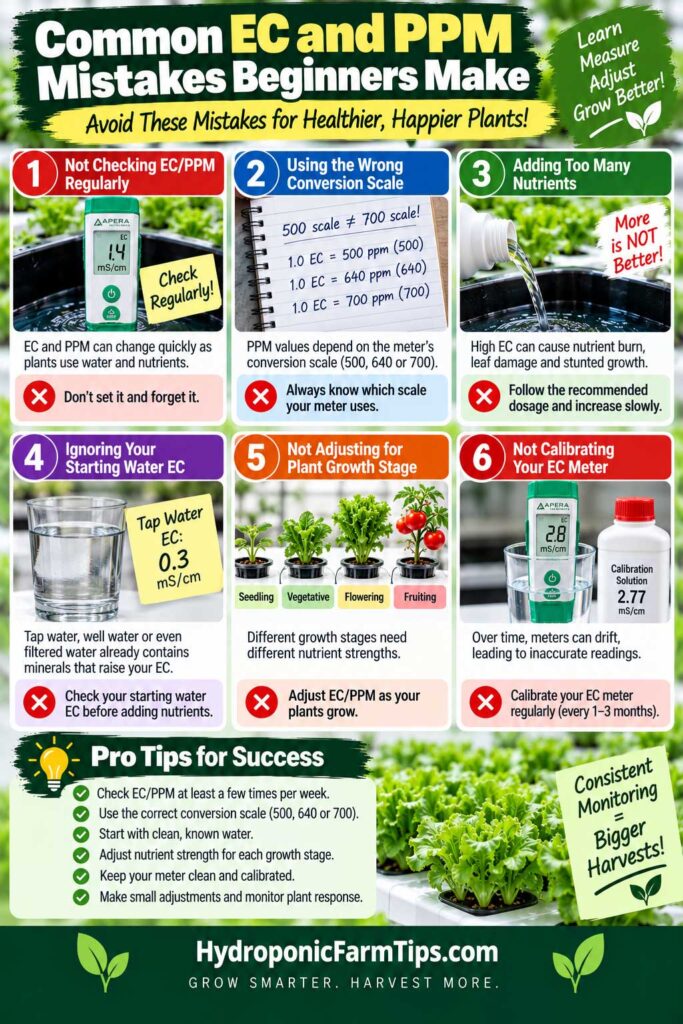
Measuring EC is fairly simple. Interpreting the number correctly is where many beginners run into trouble.
Most mistakes come from treating EC or PPM as a precise description of plant nutrition rather than what it really is: a useful indicator of the overall concentration of dissolved ions in the nutrient solution.
Here are some of the most common mistakes to avoid.
1. Mixing Up the 500, 640, and 700 PPM Scales
One of the biggest sources of confusion is comparing PPM readings without knowing which conversion scale each meter uses.
Remember:
1.0 EC = 500 PPM on the 500 scale
1.0 EC = 640 PPM on the 640 scale
1.0 EC = 700 PPM on the 700 scale
Two growers can therefore measure the same solution and report different PPM numbers.
For example:
Grower A: 800 PPM on the 500 scale = 1.6 EC
Grower B: 1,120 PPM on the 700 scale = 1.6 EC
Their nutrient solutions have the same EC.
If you’re comparing PPM recommendations, always determine which scale is being used.
When in doubt, using EC avoids much of this confusion.
2. Chasing an Exact EC Number
Suppose your target is around:
1.4–1.8 EC
Your meter reads:
1.62 EC
There is usually no benefit in trying to force that reading to exactly 1.60.
Meters have measurement tolerances, temperature influences conductivity, and reservoirs naturally change as plants use water and dissolved nutrients. Automatic temperature compensation can make readings more comparable, but it doesn’t eliminate every possible source of measurement variation.
Think in terms of appropriate ranges and trends, not perfect decimal points.
3. Assuming Higher EC Means More Plant Growth
A stronger nutrient solution doesn’t automatically produce faster-growing plants.
Once nutrient concentration is adequate, increasing EC further can eventually make water uptake more difficult and increase plant stress.
If your plants are healthy at 1.6 EC, raising the reservoir to 2.2 EC without a crop-specific reason isn’t necessarily an improvement.
EC is a number to manage—not a number to maximize.
4. Ignoring the EC of Your Source Water
If your tap water starts at 0.5 EC, that matters.
A finished nutrient solution at 1.8 EC isn’t the same situation as starting with nearly zero-EC water and building the solution with your nutrient program.
Source water may already contain calcium, magnesium, bicarbonate, sodium, chloride, and other dissolved ions.
Measure your water before adding nutrients so you have context for the final reading.
5. Assuming All Starting EC Is Useful Nutrition
This is closely related to the previous mistake.
A tap-water reading of 0.5 EC doesn’t mean your plants already have 0.5 EC worth of useful fertilizer.
EC can’t identify which ions are creating the conductivity.
Some may be useful plant nutrients. Others may contribute little to your nutrient program or become undesirable at excessive concentrations.
If your source-water EC is substantial, check your water-quality report or consider a water analysis rather than guessing from EC alone.
6. Adding Nutrients Every Time EC Drops
A small decline in EC doesn’t automatically mean:
“Feed the plants immediately.”
Before adding nutrients, consider:
- How much the water level changed
- Whether you recently added water
- The crop’s normal EC range
- How old the reservoir is
- Whether the meter reading is reliable
- How the plants and roots look
A change from 1.60 to 1.55 EC may not require any action.
Look for meaningful trends rather than reacting to every small movement.
7. Adding Nutrients at Every Top-Off
When the reservoir level drops, beginners sometimes replace the missing water with another full-strength nutrient solution.
That can gradually push EC upward.
Plants don’t necessarily remove water and dissolved nutrients in the same proportions.
If water has dropped while EC has increased, adding another strong nutrient solution may make the reservoir even more concentrated.
Measure first.
Use the EC trend, water-level change, crop requirements, and your nutrient program to decide how the reservoir should be managed.
And remember that repeatedly topping off and correcting an aging reservoir can eventually make its nutrient composition less predictable. At that point, replacing the old solution with a properly mixed fresh batch may be a better approach than continuing to chase the EC number.
8. Diagnosing Nutrient Deficiencies From EC Alone
Suppose your reservoir reads:
1.7 EC
and your leaves are yellow.
That doesn’t tell you whether the plant lacks nitrogen, iron, magnesium, or anything else.
EC measures overall conductivity—not individual nutrient concentrations.
Deficiency-like symptoms can also result from:
- Incorrect pH
- Root problems
- Nutrient imbalance
- Water-temperature stress
- Lighting problems
- Disease or pests
- Environmental stress
Use EC as one diagnostic clue, not the entire diagnosis.
9. Measuring Before the Reservoir Is Fully Mixed
Adding nutrients and immediately placing the EC meter next to the dosing point can give you a misleading reading.
The nutrient concentrate may not yet be evenly distributed throughout the reservoir.
After making an adjustment:
Mix or circulate thoroughly → Allow the solution to become representative → Measure
Try to measure from a well-mixed area rather than directly beside where nutrients or pH adjusters were just added.
10. Trusting the Meter Without Maintaining It
A digital display can look extremely precise.
That doesn’t guarantee the reading is accurate.
EC meters can be affected by:
- Residue on the sensor
- Contamination
- Calibration drift
- Aging components
- Improper maintenance
- Damaged probes
- Temperature effects
Follow the manufacturer’s instructions for cleaning, calibration, rinsing, and storage because maintenance requirements can vary between meter and sensor designs.
If a reading suddenly looks very different from normal, verify the meter before making a major reservoir correction.
The Biggest EC Mistake: Treating One Number as the Whole Story
A reservoir reading of 1.8 EC by itself doesn’t tell you whether your plants are healthy.
It doesn’t tell you:
- Which nutrients are present
- Whether they’re in appropriate proportions
- Whether pH is suitable
- Whether the roots are healthy
- Whether the reservoir is too warm
- Whether the EC is rising or falling
- Whether the plants are experiencing another type of stress
A much better habit is to look at several pieces of information together:
EC + pH + water level + roots + plant appearance + recent changes
That’s what turns an EC meter from a gadget that displays numbers into a genuinely useful hydroponic troubleshooting tool.
Hydroponic EC and PPM Troubleshooting Chart
When an EC or PPM reading looks unusual, don’t immediately add nutrients or water.
First compare the reading with the water level, pH, source-water EC, plant condition, and recent changes to the reservoir.
Use this hydroponic EC and PPM troubleshooting chart as a starting point:
| What You Notice | What It May Indicate | What to Check | Possible Next Step |
|---|---|---|---|
| EC is above the crop’s normal range | Nutrient solution may be too concentrated | Water level, nutrient dosage, source-water EC, meter accuracy | Verify the reading; if appropriate, dilute gradually with suitable lower-EC water |
| EC is below the crop’s normal range | Solution may be more dilute than intended | Nutrient dosage, recent water additions, reservoir age, meter accuracy | Confirm the crop target and feeding program before adding nutrients |
| Water level ↓ + EC ↑ | Remaining solution is becoming more concentrated | Water loss, temperature, crop demand, nutrient strength | Consider an appropriate water top-off; mix and recheck |
| Water level ↓ + EC ↓ | Dissolved-ion concentration is decreasing | Plant uptake, nutrient strength, recent top-offs, reservoir age | Compare with the crop range and feeding strategy before adjusting |
| Water level ↓ + EC stable | Overall dissolved-ion concentration is remaining relatively stable | Plant condition, pH, reservoir trend | Continue monitoring if everything else looks normal |
| Water level stable + EC ↑ | Dissolved-ion concentration increased without much change in reservoir volume | Recent nutrient or additive additions, mixing, measurement error | Review recent additions and verify the reading |
| Water level stable + EC ↓ | Dissolved-ion concentration decreased without much change in reservoir volume | Recent dilution, reservoir inputs, system operation, measurement variation | Review recent changes and remeasure |
| EC rises quickly after topping off | Added solution may have been too concentrated, or the reservoir wasn’t fully mixed | Top-off solution, mixing, meter location | Mix thoroughly and recheck before correcting |
| EC suddenly changes for no obvious reason | A measurement or mixing problem may be involved | Meter cleanliness, calibration, temperature, recent additions | Verify the meter and remeasure a well-mixed sample |
| EC seems normal but leaves are yellow | EC alone may not explain the problem | pH, roots, nutrient balance, water temperature, lighting, pests | Diagnose the plant rather than automatically adding fertilizer |
| EC seems normal but leaf tips are brown | Could be nutrient stress or another environmental or root issue | EC trend, pH, roots, temperature, humidity, crop condition | Check the complete growing environment before adjusting nutrients |
| EC is high and plants are wilting | Concentrated solution may be contributing to water-uptake stress | Crop EC range, water level, roots, reservoir temperature | Verify EC and root conditions; lower concentration gradually if appropriate |
| EC is low and growth is slow | Solution may be too dilute, but other causes are possible | pH, light, temperature, roots, nutrient program | Confirm the cause before increasing nutrient strength |
| Fresh nutrient solution has unexpectedly high EC | Source water or nutrient dosage may be contributing | Starting-water EC, nutrient measurements, reservoir volume | Recheck measurements and source-water EC |
| Fresh nutrient solution has unexpectedly low EC | Nutrient dosage, reservoir volume, mixing, or measurement may be incorrect | Feeding directions, reservoir volume, mixing, meter | Verify the recipe and meter before adding more fertilizer |
| Two PPM meters show different numbers | They may use different conversion factors | 500, 640, or 700 scale | Convert both readings to EC before comparing |
| PPM seems very high compared with another grower’s reading | Different PPM scales may be used | Meter conversion factor | Compare EC instead of raw PPM |
| pH is outside the intended range but EC is normal | Overall solution concentration may be reasonable while acidity or alkalinity is unsuitable | pH measurement, nutrient solution, water alkalinity | Address the pH issue according to your nutrient-management plan |
| EC repeatedly moves outside the intended range | Reservoir management, source-water chemistry, plant demand, or measurement problems may be involved | Reservoir age, source water, repeated additions, water use, meter accuracy | Look for the trend’s cause; consider a fresh solution if the reservoir has been repeatedly corrected |
How to Use the Troubleshooting Chart
Don’t treat the Possible Next Step column as an automatic instruction.
Instead, use it as the beginning of a diagnosis.
For example, suppose you notice:
Water level ↓ + EC ↑
That tells you the remaining nutrient solution has become more concentrated.
It doesn’t automatically tell you why.
Possible contributors include plant water use, evaporation, temperature, the original nutrient strength, or the way the reservoir has been managed.
The useful question becomes:
“Why is the concentration increasing?”
rather than:
“What do I add to make the number go back down?”
Example 1: EC Keeps Rising
Suppose your reservoir looks like this:
| Day | Water Level | EC |
|---|---|---|
| Monday | Full | 1.5 |
| Tuesday | Slightly lower | 1.6 |
| Wednesday | Lower | 1.8 |
| Thursday | Much lower | 2.0 |
The trend is more informative than Thursday’s 2.0 EC reading alone.
As the water level falls, the remaining solution is becoming progressively more concentrated.
If 2.0 EC is above the appropriate range for your crop, gradually restoring water with suitable lower-EC source water may help bring the concentration back toward the intended range.
Then mix thoroughly and measure again.
Example 2: EC Keeps Falling
Now imagine:
| Day | Water Level | EC |
|---|---|---|
| Monday | Full | 1.8 |
| Tuesday | Slightly lower | 1.7 |
| Wednesday | Lower | 1.6 |
| Thursday | Much lower | 1.4 |
The dissolved-ion concentration is decreasing as the reservoir level falls.
Plant nutrient uptake can contribute to this pattern, but EC alone can’t tell you which nutrients have been removed or whether the remaining solution is balanced.
Before adding more fertilizer, consider the crop’s target range, reservoir age, pH, plant condition, recent top-offs, and your feeding strategy.
Example 3: EC Looks Fine but the Plants Don’t
Suppose your lettuce is sitting at:
EC: 1.6
Water level: normal
Leaves: yellowing
Don’t increase nutrients just because the leaves look pale.
Check:
pH → roots → water temperature → which leaves are affected → nutrient history → lighting → pests and disease
The problem may have little to do with overall nutrient concentration.
If the roots are brown, slimy, or unhealthy-looking, investigate root rot in hydroponics rather than assuming the EC reading explains the problem.
The Goal Is to Diagnose the Reservoir, Not Chase the Meter
EC and PPM are most useful when they help you recognize patterns.
A single reading tells you what the meter detected at that moment.
A series of readings combined with water-level changes and plant observations tells you much more.
When something looks wrong, use this sequence:
Verify meter → Check EC → Check pH → Check water level → Inspect roots → Inspect plants → Review recent changes → Adjust only when the likely cause makes sense
That approach is usually much safer than reacting to every EC or PPM change with more fertilizer or more water.
Do You Really Need an EC Meter for Hydroponics?
You can grow some hydroponic plants without an EC meter, especially in a small, simple system where you’re following a proven nutrient recipe.
But if you want to understand what’s happening inside your nutrient solution rather than relying entirely on the fertilizer label and plant appearance, an EC meter is one of the most useful monitoring tools you can own.
Can You Grow Hydroponically Without an EC Meter?
Yes.
Imagine you’re growing a few basil or lettuce plants in a small passive hydroponic system.
You use:
- A complete hydroponic nutrient
- The correct amount of water
- The manufacturer’s recommended dosage
- A consistent water source
- Regular reservoir changes
That system may perform well without daily EC measurements.
For a beginner experimenting with a few inexpensive plants, buying every possible meter and accessory on day one isn’t necessary.
However, without measuring EC, you lose an important piece of information about how concentrated the nutrient solution is.
What an EC Meter Tells You That a Nutrient Label Can’t
A fertilizer label tells you how much product to add.
An EC meter tells you how conductive the resulting solution actually is.
That difference becomes useful because two growers following the same nutrient dosage may start with different water.
For example:
Grower A source water: 0.1 EC
Grower B source water: 0.6 EC
Even if both add the same fertilizer dosage, their finished solutions may differ because the source-water chemistry isn’t the same.
An EC meter lets each grower measure the actual conductivity of the finished solution rather than assuming the same nutrient dose produces the same starting conditions everywhere.
When an EC Meter Becomes Especially Useful
An EC meter becomes increasingly valuable when you’re:
- Growing several plants from one reservoir
- Managing larger hydroponic systems
- Growing tomatoes, peppers, cucumbers, or other heavy-feeding crops
- Adjusting nutrient strength through different growth stages
- Using tap water with substantial starting EC
- Topping off reservoirs between full solution changes
- Troubleshooting nutrient-related symptoms
- Comparing different nutrient formulas
- Trying to maintain more consistent growing conditions
- Tracking EC trends over several days
The more variables you introduce, the more useful actual measurements become.
Recommended EC and PPM Meters for Hydroponics
You don’t need the most expensive meter to start monitoring your reservoir, but a reliable EC meter can make nutrient management much easier. Here are a few options for different budgets and experience levels.
| EC Meter | Best For | Measures | ATC | Why We Like It | Check Price |
|---|---|---|---|---|---|
| Apera EC60 | Best overall | EC/TDS/salinity/temp | Yes | Replaceable probe and multiple measurement modes | See Today’s Price |
| Bluelab Conductivity Pen | Serious growers | EC/CF/PPM/temp | Yes | Designed specifically for nutrient-solution monitoring | See Today’s Price |
| Hanna GroLine EC/TDS Tester | Hydroponic growers | EC/TDS/temp | Yes | Hydroponics-focused meter from an established instrument brand | See Today’s Price |
| VIVOSUN TDS Meter | Budget/basic checks | TDS/EC/temp* | Model-dependent | Low-cost option for simple reservoir checks | See Today’s Price |
EC Meter vs. Guessing From the Leaves
Plants can tell you a lot—but sometimes visible symptoms don’t appear until a problem has already developed.
If leaf tips begin browning, you might suspect the nutrient solution is too concentrated.
But similar symptoms can have other causes.
With an EC meter, you can check the reservoir immediately.
Instead of:
“The leaves look burned, so maybe the nutrients are too strong.”
you can say:
“The crop is normally managed around this EC range, but my reservoir is well above it. I should investigate why.”
The meter doesn’t complete the diagnosis, but it gives you useful evidence.
Do You Need Both an EC Meter and a pH Meter?
For regular hydroponic monitoring, having access to both measurements is useful because they answer different questions.
EC → How concentrated is the dissolved-ion solution?
pH → How acidic or alkaline is the solution?
One can’t replace the other.
A reservoir can have an appropriate EC but unsuitable pH, or an appropriate pH while being much more concentrated than intended.
If you’re investing in basic hydroponic testing equipment, an EC meter and a reliable way to measure pH are both useful tools.
EC Meter or PPM Meter: Which Should a Beginner Buy?
Many meters can display both EC and PPM/TDS.
If you have a choice, prioritize a meter that provides an EC reading directly.
EC avoids the confusion created by different PPM conversion factors.
Remember:
1.6 EC = 800 PPM on the 500 scale
but:
1.6 EC = 1,120 PPM on the 700 scale
The underlying conductivity is the same.
A meter that displays EC, and optionally PPM/TDS and temperature, can therefore be easier to use when comparing recommendations from different sources.
What to Look for in an EC Meter
For a typical home hydroponic garden, useful features may include:
- EC measurement in mS/cm or µS/cm
- Automatic temperature compensation
- Clear display
- Appropriate measurement range
- Calibration capability
- Simple calibration procedure
- Readily available compatible calibration solution
- Clear cleaning and maintenance instructions
- Waterproof or water-resistant construction if appropriate for your setup
You don’t necessarily need the most expensive professional meter.
A reasonably accurate meter that’s properly calibrated, maintained, and used consistently can be more useful than an expensive meter that isn’t cared for correctly.
Is an EC Meter Worth Buying?
For most growers who plan to maintain hydroponic systems regularly, an EC meter is usually a worthwhile tool.
It can help you:
- Monitor nutrient-solution concentration
- Compare source water with finished nutrient solution
- Recognize rising or falling EC trends
- Avoid unnecessarily strong nutrient solutions
- Troubleshoot reservoir problems
- Make more informed nutrient adjustments
For a single experimental herb jar, you may decide to keep things simple.
But once you’re maintaining a reservoir, growing several plants, or trying to improve consistency, measuring EC becomes much more valuable.
The important thing is to remember what the meter can—and can’t—tell you.
An EC meter measures conductivity. It doesn’t identify individual nutrients, diagnose every plant problem, or replace good nutrient and reservoir management.
How to Calibrate and Maintain an EC Meter
An EC meter is only useful if you can trust the reading.
Over time, residue, contamination, calibration drift, and changes in sensor condition can affect measurements. Proper cleaning and calibration help keep the meter reliable.
The exact procedure varies by manufacturer and meter design, so always follow the instructions supplied with your meter.
For example, Bluelab’s meter-care guidance recommends cleaning and rinsing the conductivity probe before checking it with fresh calibration or reference solution. Procedures vary between instruments, so the instructions for your specific meter should always take priority.
What Does Calibrating an EC Meter Mean?
Calibration compares your meter’s reading with a conductivity standard whose value is known under specified conditions.
For example, 1,413 µS/cm (1.413 mS/cm) is a commonly available conductivity standard. Hanna Instruments lists a 1,413 µS/cm EC/TDS calibration standard among its GroLine calibration solutions.
Conductivity standards are generally specified at a reference temperature, commonly 25°C (77°F). Your meter’s temperature compensation and calibration procedure determine how the standard should be used and interpreted.
If the meter doesn’t read the calibration standard as expected, its calibration function allows the instrument to be adjusted according to the manufacturer’s procedure.
Different meters may use different standards or support one-point or multi-point calibration.
Use the calibration solution specified for your meter rather than assuming every EC meter uses the same standard.
How to Calibrate an EC Meter
Although procedures vary, a typical calibration routine looks something like this:
1. Check the manufacturer’s instructions.
Confirm the required calibration solution, temperature guidance, and calibration procedure.
2. Inspect and clean the sensor if necessary.
Residue from nutrient solution can interfere with reliable measurements.
Use the cleaning method recommended for your meter. Avoid scraping, aggressively wiping, or using household cleaners unless the manufacturer specifically permits them.
3. Rinse the sensor as directed.
Follow the manufacturer’s rinsing procedure to reduce contamination of the calibration standard.
4. Pour fresh calibration solution into a clean container if instructed.
Avoid repeatedly dipping a potentially contaminated probe into the original bottle of calibration solution.
5. Place the sensor in the calibration solution.
Immerse it to the depth recommended by the manufacturer.
6. Allow the reading to stabilize.
Temperature compensation and sensor response may require a short period before the reading settles.
7. Start or confirm calibration.
Depending on the meter, calibration may be automatic, button-controlled, menu-based, or manually adjusted.
8. Verify the result.
After calibration, confirm that the meter responds to the standard as expected according to the manufacturer’s specifications.
Useful EC Meter Calibration and Care Supplies
A reliable EC meter still needs proper care. Keeping the correct conductivity standard and cleaning supplies on hand can help you verify questionable readings before making unnecessary changes to your nutrient solution.
| Product | What It’s For | Best For | Check Price |
|---|---|---|---|
| Bluelab 2.77 EC Conductivity Standard Solution – 250 mL | Checking compatible Bluelab EC meters and probes | Growers who already have cleaning supplies | See Today’s Price |
| Bluelab Probe Care Kit – Conductivity | Cleaning and checking conductivity probes | Best all-in-one EC maintenance option | See Today’s Price |
| Bluelab Probe Care Kit – pH & Conductivity | Maintaining both pH and EC equipment | Growers using both Bluelab pH and EC meters | See Today’s Price |
Don’t Pour Used Calibration Solution Back Into the Bottle
Once calibration solution has been poured into another container and exposed to the probe, don’t automatically return it to the original bottle.
Doing so can introduce water, nutrient residue, or other contaminants that may change the conductivity of the remaining standard.
Use clean containers and follow the calibration-solution manufacturer’s handling instructions.
How Often Should You Calibrate an EC Meter?
There isn’t one calibration schedule that applies to every meter.
Calibration frequency depends on factors such as:
- Manufacturer recommendations
- How frequently the meter is used
- Required measurement accuracy
- How the meter is cleaned and maintained
- Whether readings appear unusual
- Whether the sensor has been exposed to heavy residue or contamination
A home grower using a meter occasionally may have different calibration needs from a commercial grower taking measurements throughout the day.
Rather than following an arbitrary schedule, use the manufacturer’s recommendation as your starting point.
You should also consider checking calibration whenever a reading seems unexpectedly different from normal.
How to Clean an EC Meter
Hydroponic nutrient solutions can leave mineral deposits and residue on conductivity sensors.
After measuring, follow your meter’s recommended rinsing procedure.
If deposits develop, use the cleaning method or cleaning solution specified by the manufacturer.
Avoid assuming that vinegar, alcohol, detergent, acids, or other household cleaners are safe for every probe. Sensor materials and designs vary.
How Should You Store an EC Meter?
This is another area where following the manual matters.
EC sensors don’t all have the same storage requirements.
Some conductivity sensors may be stored clean and dry, while combination meters or devices containing other types of electrodes may require different storage procedures.
Don’t automatically apply pH-electrode storage rules to an EC sensor.
Check the instructions for your specific meter.
Avoid Cross-Contaminating Your Reservoir
If you’re measuring multiple reservoirs, rinse the probe appropriately between samples.
Otherwise, small amounts of one nutrient solution can be carried into another.
This matters even more when moving between:
- Nutrient reservoirs
- Source water
- Calibration solutions
- Cleaning solutions
Good measurement habits help protect both your samples and your calibration standards.
What If Your EC Reading Suddenly Looks Wrong?
Suppose your reservoir normally measures around:
1.5–1.7 EC
and suddenly your meter reports:
2.6 EC
Don’t immediately dilute the reservoir.
First ask:
- Was the reservoir thoroughly mixed?
- Were nutrients or additives just added?
- Is the probe clean?
- Is the meter in the correct measurement mode?
- Is the displayed unit µS/cm, mS/cm, or PPM/TDS?
- Has the meter been calibrated according to its instructions?
- Can the reading be verified with an appropriate conductivity standard?
A measurement problem can sometimes look like a nutrient problem.
Watch the Units on the Display
One surprisingly easy mistake is confusing µS/cm and mS/cm.
Remember:
1.0 mS/cm = 1,000 µS/cm
So:
1.4 mS/cm = 1,400 µS/cm
Those are the same conductivity expressed in different units.
A display showing 1,400 µS/cm doesn’t mean your reservoir has an EC of 1,400 mS/cm.
Also check whether your meter is displaying conductivity directly or a converted PPM/TDS value.
Good Meter Habits Make EC Trends More Useful
You don’t need laboratory-level procedures to manage a home hydroponic reservoir.
You do need consistency.
Try to:
Use the same meter → Maintain it properly → Measure a well-mixed solution → Follow a consistent routine → Record the results
That makes changes from one day to the next much easier to interpret.
And if a reading looks dramatically different from what you expect, verify the measurement before changing the reservoir.
Frequently Asked Questions About Hydroponic EC and PPM
Is EC the Same as PPM in Hydroponics?
No. EC and PPM are related, but they aren’t the same measurement.
EC measures electrical conductivity directly. Most handheld PPM/TDS meters measure conductivity and then convert that reading into an estimated PPM value.
That’s why the same solution can display different PPM numbers depending on whether the meter uses a 500, 640, or 700 conversion factor.
For comparing hydroponic nutrient recommendations, EC is often simpler because it avoids this conversion-scale confusion.
What Should My PPM Be in Hydroponics?
There isn’t one ideal PPM for every hydroponic plant.
The appropriate nutrient concentration depends on the crop, growth stage, growing conditions, water quality, and nutrient program.
It also depends on your meter’s PPM conversion scale.
For example, 1.6 EC corresponds to:
- 800 PPM on the 500 scale
- 1,024 PPM on the 640 scale
- 1,120 PPM on the 700 scale
Before following a PPM recommendation, make sure you know which conversion scale it uses.
What Is a Good EC for Hydroponics?
There isn’t one universal EC for hydroponics.
Leafy greens and herbs are often managed at different nutrient concentrations from mature fruiting crops such as tomatoes.
Even within the same crop, an appropriate EC can vary with growth stage, cultivar, environment, and production system.
Use the crop-specific EC chart earlier in this guide as a starting reference rather than treating one EC number as ideal for every plant.
Is 2.0 EC Too High for Hydroponics?
Not necessarily.
An EC of 2.0 mS/cm may be appropriate for some crops and growing conditions but unnecessarily high for others.
The number should always be interpreted relative to the crop, growth stage, nutrient program, environment, and EC trend.
For example, 2.0 EC may be above a commonly used range for some leafy greens while falling within a practical range for certain fruiting crops.
Can EC Be Too Low?
Yes, but a low EC isn’t automatically a problem.
Young seedlings and some light-feeding crops may intentionally be grown with relatively mild nutrient solutions.
If EC is substantially below the appropriate range for an established crop, however, the solution may be more dilute than intended.
Before adding nutrients, verify the meter, check the water level, review recent top-offs, and compare the reading with the crop’s recommended range.
Does pH Affect EC?
pH and EC describe different properties of the nutrient solution.
pH measures acidity or alkalinity.
EC measures electrical conductivity.
Changing the chemistry of a nutrient solution—including adding acids or bases used for pH adjustment—can also introduce ions and may affect conductivity. However, a pH value by itself doesn’t tell you the EC, and an EC value doesn’t tell you the pH.
That’s why both measurements are useful in hydroponics.
Why Does My EC Keep Rising?
A rising EC means the remaining solution is becoming more conductive.
One common pattern occurs when the water level falls while EC rises. This indicates that the reservoir is becoming more concentrated as it loses water relative to dissolved ions.
Other possibilities include:
- Nutrient additions
- Concentrated top-off solution
- Source-water minerals
- Evaporation
- Measurement or mixing problems
Check the water level and EC trend together before making an adjustment.
Should I Measure EC Before or After Adding Nutrients?
Ideally, measure both.
First measure your source-water EC so you know your starting point.
Then add nutrients according to your feeding program, mix thoroughly, and measure the finished nutrient solution.
A useful sequence is:
Measure source water → Add nutrients → Mix thoroughly → Measure EC → Check pH → Make appropriate adjustments → Recheck
This gives you much more information than measuring only the finished reservoir.
Should I Check EC Before or After Adjusting pH?
A practical approach when preparing a fresh reservoir is generally to mix the nutrient solution first and check its EC before making the final pH adjustment.
A typical sequence is:
Water → Nutrients → Mix → Check EC → Adjust nutrient strength if necessary → Check and adjust pH → Recheck
However, nutrient and pH products can have specific mixing instructions, so follow the manufacturer’s directions for the products you’re using.
Can I Measure EC Without an EC Meter?
Not accurately from appearance alone.
You can prepare nutrient solution according to a manufacturer’s dosage instructions without measuring EC, but you won’t know its actual electrical conductivity unless you measure it with an appropriate conductivity instrument.
Plant appearance also can’t reliably tell you an exact EC.
If you’re regularly managing a hydroponic reservoir, measuring EC provides information that nutrient dosage and visual inspection alone can’t provide.
Does Temperature Affect EC?
Yes. Electrical conductivity changes with temperature.
Many EC meters include automatic temperature compensation (ATC). ATC compensates for the effect of temperature according to the meter’s design so conductivity readings can be interpreted more consistently, commonly relative to a reference temperature such as 25°C (77°F).
The exact compensation method can vary between instruments, so follow your meter manufacturer’s specifications when high measurement accuracy is important.
And remember that ATC only addresses the measurement of conductivity. It doesn’t make nutrient-solution temperature irrelevant to your plants.
Reservoir temperature can still affect root health, dissolved oxygen, plant physiology, and overall system performance.
Why Does My EC Keep Falling?
A falling EC means the solution’s overall conductivity is decreasing.
Plant nutrient uptake may contribute, but other factors can include:
- Adding lower-EC water
- Diluting the reservoir
- Changes in reservoir volume
- Recent system inputs or adjustments
- Measurement variation
- Meter problems
EC alone can’t tell you which individual nutrients have been removed or whether the remaining nutrients are still present in appropriate proportions.
Look at the water level, crop range, pH, reservoir history, and plant condition before adding more fertilizer.
Final Thoughts on Hydroponic EC and PPM
Understanding hydroponic EC and PPM makes nutrient management much less intimidating.
You don’t need to obsess over every decimal point or adjust the reservoir every time the reading moves. The real value of measuring EC is being able to see whether your nutrient solution is becoming more concentrated, more dilute, or staying relatively stable over time.
Remember the basics:
- EC measures electrical conductivity and gives you an indication of the overall concentration of dissolved ions.
- PPM/TDS readings are usually calculated from EC, which is why the 500, 640, and 700 scales can show different numbers for the same solution.
- Different crops and growth stages can require different nutrient strengths.
- Source-water EC matters, but it doesn’t tell you which minerals are present or whether they’re useful to your plants.
- EC and pH should be considered together, along with water level, root health, plant appearance, and recent reservoir changes.
- Trends are often more useful than a single reading.
If you’re new to hydroponics, start simple. Measure your source water, mix nutrients according to a reliable feeding program, check the finished EC, monitor pH, and keep an eye on how the reservoir changes over the next several days.
With experience, numbers such as 1.2 EC, 1.8 EC, or 900 PPM stop looking like mysterious hydroponic jargon. They become useful clues that help you understand what’s happening in your reservoir.
The goal isn’t to chase a perfect number.
It’s to use EC, PPM, pH, water level, and plant observations together to make better decisions and maintain a more stable growing environment.
More Hydroponic Gardening Guides You May Like
Understanding hydroponic EC and PPM becomes much easier when you also understand nutrient strength, pH, reservoir management, and the plant symptoms that can appear when something is out of balance.
These guides can help you take the next step:
- Hydroponic Nutrients for Beginners: Complete Feeding Guide — Learn what hydroponic nutrients contain, how to mix them, and how to build a practical feeding routine.
- Hydroponic Nutrient & pH Chart — Compare practical nutrient and pH information for common hydroponic crops.
- Hydroponic Nutrient Deficiencies: Signs, Causes & Fixes — Learn why deficiency symptoms can appear even when your EC reading seems reasonable and how to investigate the underlying cause.
- Best Hydroponic Nutrients for Vegetables and Herbs — Compare nutrient formulas and learn what to consider when choosing nutrients for different hydroponic crops.
- Best pH Meters for Hydroponics: 7 Accurate Options — Compare pH meters for monitoring the other major measurement you’ll use alongside EC.
- How Often Should You Change Hydroponic Water? — Learn when to top off a reservoir, when to replace the nutrient solution, and why repeated adjustments can make reservoir management more difficult.
- Why Are My Hydroponic Leaves Turning Yellow? 10 Causes & Fixes — Diagnose yellow leaves caused by nutrient problems, pH issues, root stress, lighting, and other common hydroponic problems.
- Hydroponics for Beginners: How to Start Growing at Home — Start with the complete beginner guide if you’re still learning how reservoirs, nutrients, pH, lighting, and hydroponic systems work together.
