


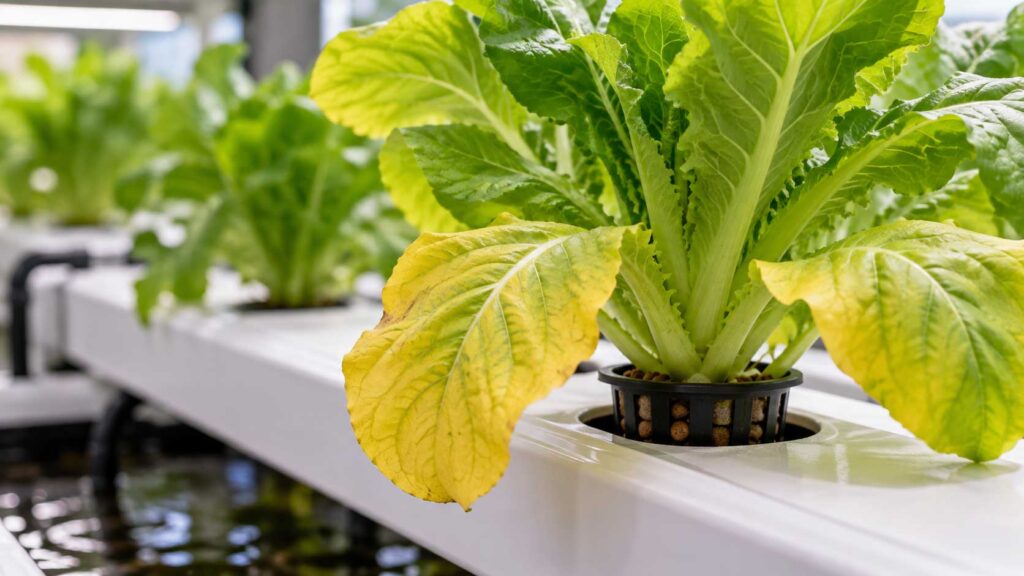
Hydroponic leaves turning yellow can be an early sign that something in your growing system needs attention. Nutrient deficiencies are one possibility, but incorrect pH, stressed roots, warm water, poor aeration, or excessive light can all cause similar yellowing.
That’s what makes yellow leaves tricky in hydroponics: several completely different problems can look surprisingly similar above the reservoir.
The best clue is often where the yellowing starts. Older leaves turning yellow first can point toward deficiencies involving mobile nutrients such as nitrogen, while pale new growth may suggest an iron-availability or pH problem. If yellow leaves appear alongside brown, slimy roots, the real problem may be happening below the surface.
Before changing anything, look at the pattern, check your pH and EC, and inspect the roots. A few simple checks can often narrow down the cause without making the problem worse.
Below are 10 common reasons hydroponic leaves turn yellow, the symptoms to look for, and what you can do about each one.
How to Diagnose Yellow Leaves in Hydroponic Plants

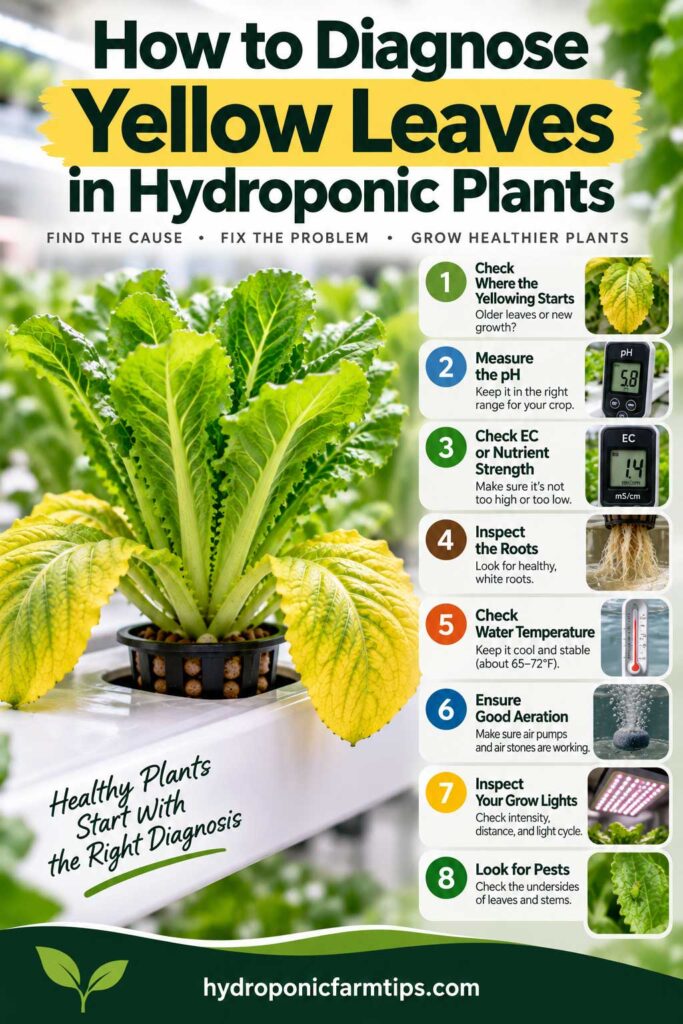
When you notice hydroponic leaves turning yellow, look at where the yellowing starts and what other symptoms appear with it before adding more nutrients or changing your reservoir. Older versus newer leaves, green veins, burned edges, unhealthy roots, or stretched growth can all provide useful clues.
Use these symptoms as a starting point:
| What You Notice | Possible Cause | What to Check First |
|---|---|---|
| Older leaves turn pale or yellow first | Nitrogen deficiency | Nutrient strength and feeding |
| New leaves yellow while veins remain greener | Iron or micronutrient availability | Reservoir pH |
| Yellowing with brown or crispy leaf edges | Nutrient imbalance or excessive nutrient strength | EC and nutrient concentration |
| Leaves yellow while roots become brown or slimy | Root stress or root rot | Root condition, water temperature, oxygen |
| Pale, stretched growth | Insufficient light | Light intensity and distance |
| Yellow or bleached areas closest to the grow light | Excessive light | Light intensity and fixture height |
| Yellow leaves with spots, webbing, or visible insects | Pests | Undersides of leaves and stems |
| Only a few older bottom leaves turn yellow | Natural aging | Overall plant health and new growth |
When you notice hydroponic leaves turning yellow, don’t diagnose the problem from leaf color alone. Several issues can produce very similar symptoms. Check your pH, EC or nutrient strength, reservoir temperature, roots, and lighting before making major adjustments.
Changing several things at once can make troubleshooting harder. Start with the most likely cause, correct it, and watch the plant’s new growth for signs of improvement. Leaves that have already turned completely yellow may not become green again, even after the underlying problem has been corrected.
1. Nutrient Deficiency
Nutrient problems are one of the first things to investigate when you notice hydroponic leaves turning yellow. If you’re seeing several deficiency-like symptoms at once, our hydroponic nutrient deficiencies guide explains how to identify the most common patterns. Sometimes the nutrient solution is genuinely lacking something the plant needs. Other times, the nutrients are present but the plant can’t absorb them efficiently because of pH or root-zone problems.
Nitrogen Deficiency
Nitrogen is important for chlorophyll production and healthy leafy growth. Because nitrogen is mobile within the plant, a deficiency typically becomes noticeable on older, lower leaves first.
Common signs include:
- Lower leaves gradually becoming pale green or yellow
- Yellowing spreading from older leaves toward newer growth
- Slower overall growth
- Smaller or less vigorous leaves
If nitrogen is genuinely low, check that you’re using a complete hydroponic nutrient formula at the recommended concentration for the plant and its growth stage.
Iron Deficiency
Iron problems tend to look different. Because iron is relatively immobile within the plant, symptoms usually appear on young leaves and new growth first.
The leaf tissue may become yellow while the veins remain noticeably greener, a pattern known as interveinal chlorosis.
In hydroponics, apparent iron deficiency is often related to pH rather than an actual lack of iron in the reservoir. If the pH rises too far outside the crop’s preferred range, iron can become less available to the roots.
Magnesium Deficiency
Magnesium is a central component of chlorophyll, so inadequate magnesium can also cause yellowing. Symptoms generally begin on older leaves, often with yellowing between the veins while the veins themselves remain greener.
As the problem progresses, leaves may develop brown or damaged areas.
Penn State Extension provides a useful reference on essential plant nutrients, deficiency symptoms, excess nutrients, and the role pH plays in nutrient availability.
How to Fix a Hydroponic Nutrient Deficiency
Before increasing your nutrient concentration, check the basics:
- Measure the reservoir pH. Make sure it is within the appropriate range for the crop you’re growing.
- Check EC or nutrient strength. A very low reading may indicate that the solution is too weak.
- Review your nutrient formula. Use a complete hydroponic fertilizer containing both macronutrients and essential micronutrients.
- Consider the plant’s growth stage. Seedlings, leafy plants, flowering crops, and fruiting plants don’t always require the same nutrient concentration.
- Replace an old or badly imbalanced reservoir. Sometimes starting with fresh water and a properly mixed nutrient solution is safer than repeatedly adding individual nutrients.
Avoid adding extra nitrogen, magnesium, iron, or other supplements based only on yellow leaf color. Incorrect pH, root problems, or excessive nutrient concentration can mimic nutrient deficiencies, and adding more fertilizer can make the problem worse.
Not sure what concentration your crop needs? Use our Hydroponic Nutrient & pH Chart to compare recommended pH and nutrient ranges for common vegetables, herbs, and fruits.
2. Incorrect pH
Hydroponic leaves turning yellow despite a complete nutrient solution can be a sign that the pH is outside the appropriate range.
pH affects how readily different nutrients are available to plant roots. When the solution becomes too acidic or too alkaline, certain nutrients become harder for the plant to absorb. This can create symptoms that look like a nutrient deficiency even when plenty of that nutrient is present in the reservoir.
Growers often refer to this situation as nutrient lockout, although technically the problem is reduced nutrient availability or uptake rather than the nutrients disappearing from the reservoir.
Signs That pH May Be Causing Yellow Leaves
A pH problem can be difficult to identify from leaf appearance alone because the symptoms overlap with several nutrient deficiencies. You may notice:
- Yellowing between otherwise green leaf veins
- Pale or yellow new growth
- Yellowing on older leaves
- Brown spots or damaged leaf edges
- Slow or stunted growth
- Several apparent nutrient deficiencies occurring at the same time
One useful clue is when you’ve recently mixed a complete nutrient solution at an appropriate strength, yet the plant continues to show deficiency-like symptoms.
What pH Should Hydroponic Plants Have?
Many hydroponic crops perform well with a nutrient-solution pH of approximately 5.5 to 6.5, although the ideal range varies somewhat by plant. Oklahoma State University Extension notes that pH influences nutrient availability in hydroponic solutions and provides crop-specific pH and EC ranges for common hydroponic plants. For a deeper explanation of how pH affects nutrient availability, see our guide to the best pH for hydroponic plants.
Within this general range, many essential nutrients remain readily available to the roots. Allowing the pH to move significantly outside the preferred range for your crop can interfere with nutrient uptake.
Don’t worry if your reservoir pH moves slightly from day to day. Some fluctuation is normal as plants absorb water and nutrients.
How to Fix Incorrect Hydroponic pH
First, test the nutrient solution with a properly calibrated digital pH meter or another reliable testing method.
If you’re choosing a meter, see our comparison of the best pH meters for hydroponics.
If the reading is outside the desired range, make small adjustments using a hydroponic pH-up or pH-down product. Mix the reservoir thoroughly, wait briefly for the solution to circulate, and test it again before adding more.
Avoid trying to force the pH to an exact number with repeated large adjustments. Overshooting in one direction and then correcting it in the other can make the reservoir unnecessarily unstable.
If the pH keeps changing rapidly, look beyond the pH-adjustment bottle. Source-water alkalinity, nutrient concentration, reservoir conditions, temperature, root health, and frequent top-offs can all influence how stable the reading remains.
For many home hydroponic gardens, keeping the nutrient solution consistently within the crop’s preferred pH range is more important than maintaining one exact reading at all times.
Correcting the pH won’t necessarily turn already-yellow leaves green again. Instead, watch the new growth. Healthy new leaves are one of the best signs that nutrient uptake has returned to normal.
3. Nutrient Solution Is Too Strong
More nutrients don’t necessarily produce faster or healthier hydroponic growth. If your nutrient solution becomes too concentrated, the high level of dissolved salts can stress the roots and interfere with their ability to take up water properly.
If you notice hydroponic leaves turning yellow alongside brown or burned-looking tips, an overly concentrated nutrient solution may be responsible. Depending on the plant and severity of the problem, leaves may become yellow, develop brown edges, curl, or eventually dry out.
Signs Your Nutrient Solution May Be Too Strong
Look for yellowing accompanied by brown or crispy tips, burned leaf margins, curling, wilting, or stalled growth. An EC reading above the appropriate range for the crop is a stronger clue that the nutrient solution may be too concentrated.
Problems can develop when nutrients are mixed too strongly from the beginning, but concentration can also increase gradually.
As plants use water and water evaporates from the reservoir, dissolved minerals remain behind. If you repeatedly add full-strength nutrient solution without monitoring the reservoir, the concentration can eventually become too high.
Check the EC Before Adding More Nutrients
An EC meter measures the electrical conductivity of your nutrient solution and provides a useful indication of its overall dissolved-salt concentration.
If your plants are yellowing and the EC is already high, adding more nutrients is unlikely to solve the problem.
Compare your reading with an appropriate range for the specific crop and its stage of growth. Seedlings and young plants generally require a weaker nutrient solution than large, established plants.
How to Fix an Overly Strong Nutrient Solution
If EC is too high, dilute the reservoir with fresh water until the concentration returns to an appropriate range. If the solution is old, extremely concentrated, or you’re unsure what’s been added to it, replacing it with a fresh, properly mixed solution may be the better option. Recheck EC and pH after making the correction.
Avoid trying to compensate for nutrient burn by adding individual supplements. Give the roots a stable, appropriately balanced nutrient solution and allow the plant time to recover.
Damaged leaf tips may remain brown, but healthy new growth without additional yellowing or tip burn is a good indication that the plant is recovering.
4. Nutrient Solution Is Too Weak
If you see hydroponic leaves turning yellow, an overly weak nutrient solution is another possibility, especially when EC is below the recommended range. When plants don’t receive enough essential nutrients to support their growth, chlorophyll production and other important plant processes can begin to suffer.
This can happen when nutrients are mixed below the recommended concentration, the reservoir is repeatedly topped off with plain water, or fast-growing plants consume nutrients faster than expected.
Our guide to the best hydroponic nutrients for vegetables and herbs explains what to look for in a complete nutrient formula.
Signs Your Nutrient Solution May Be Too Weak
Plants growing in an underfed hydroponic system may show:
- Pale green leaves
- Older leaves gradually turning yellow
- Slow or stunted growth
- Smaller-than-normal leaves
- Thin or weak stems
- Reduced flowering or fruit production
- An EC reading lower than the expected range for the crop
A nitrogen shortage is particularly likely to cause older leaves to become pale or yellow because the plant can move nitrogen from older tissue to support newer growth.
However, appearance alone isn’t enough to confirm that your solution is too weak.
Check EC Before Increasing Nutrients
This is where your EC meter saves you from guessing. If EC is below the appropriate range for the crop and growth stage, the solution may simply be too weak. If EC is already where it should be, adding more nutrients probably isn’t the answer.
Keep in mind that different plants have different requirements. Lettuce and many herbs, for example, may perform well at lower nutrient concentrations than heavy-feeding fruiting crops such as tomatoes.
Young seedlings also need considerably less fertilizer than mature plants.
How to Fix a Weak Hydroponic Nutrient Solution
If EC confirms that the solution is too weak, add a properly mixed hydroponic nutrient solution according to the product directions. Mix thoroughly, recheck EC and pH, and increase nutrient strength gradually rather than making a large correction all at once.
If the EC appears appropriate but the leaves remain yellow, don’t automatically add more fertilizer. Check pH, root health, water temperature, and lighting because each of these can interfere with nutrient uptake or produce similar symptoms.
As with most hydroponic problems, focus on what happens next. Severely yellow leaves may never regain their original color, but new leaves should begin looking healthier once the underlying problem has been corrected.
5. Root Rot or Poor Root Health
Sometimes hydroponic leaves turning yellow aren’t primarily caused by a nutrient problem at all. The issue may be happening below the surface.
Healthy roots are essential for absorbing water, oxygen, and nutrients. When hydroponic roots become damaged or begin to rot, nutrient uptake can decline. The plant may then develop yellow leaves, wilting, and slow growth even when the nutrient solution contains everything it needs.
Root problems can become serious quickly, so checking the roots should be one of your first troubleshooting steps when yellowing is accompanied by wilting or an unhealthy-looking root system.
If the roots are brown, slimy, or deteriorating, use our complete hydroponic root rot guide to identify the cause and work through the problem.
What Do Healthy Hydroponic Roots Look Like?
Healthy roots are generally:
- Firm rather than mushy
- Light-colored when young
- Actively producing new root growth
- Free from slime
- Free from strong or unpleasant odors
Don’t assume every tan or brown root has root rot. Some hydroponic nutrients and additives can stain otherwise healthy roots.
Texture, smell, plant condition, and the presence of new root growth can provide better clues than color alone.
Signs of Possible Root Rot
A plant suffering from root problems may show:
- Yellowing leaves
- Wilting or drooping
- Slow or stalled growth
- Brown or darkened roots
- Soft or mushy roots
- Slimy material around the roots
- An unpleasant odor from the root zone or reservoir
- Roots that easily break apart
Warm, poorly oxygenated water can create conditions that favor root problems. Dead plant material, dirty equipment, and light entering the reservoir can contribute to an unhealthy root-zone environment as well.
How to Fix Root Problems
If you suspect root rot, first inspect the root system and remove only clearly dead, soft, or decaying root material when appropriate. Don’t cut healthy roots simply because nutrient staining has made them tan or brown.
Also check:
- Water temperature – Excessively warm nutrient solution holds less dissolved oxygen and can increase root stress.
- Aeration – In systems such as DWC, make sure the air pump and air stone are providing adequate aeration.
- Reservoir cleanliness – Remove decaying leaves, dead roots, and other organic debris.
- Light leaks – Keep the reservoir opaque to limit algae growth.
- Water circulation – Avoid stagnant areas where possible.
- pH and EC – Return both to appropriate ranges for the crop.
Avoid trying to solve root rot by simply increasing nutrient strength. Damaged roots may already have difficulty absorbing water and minerals, and a stronger solution can add further stress.
Once conditions improve, watch for fresh, healthy roots and new green leaves. Existing yellow or badly damaged foliage may not recover, but new growth can tell you whether the plant is returning to health.
6. Not Enough Oxygen in the Root Zone
If you notice hydroponic leaves turning yellow or drooping while the roots still look reasonably healthy, check the oxygen supply.
Roots need oxygen for normal respiration and nutrient uptake. In DWC, where much of the root system remains submerged, a failed air pump, clogged air stone, warm reservoir, or poor circulation can quickly put plants under stress.
For DWC setups, our guide to the best air pumps for hydroponics explains how to choose an appropriately sized pump and improve root-zone aeration.
Low oxygen can eventually contribute to root deterioration, which is why aeration problems and root rot often appear together.
Signs Your Hydroponic Roots May Need More Oxygen
Low oxygen can look a lot like nutrient or root problems. Plants may become pale or yellow, droop, grow slowly, or develop weak and deteriorating roots. Severe oxygen stress can eventually damage the root system and increase the risk of root rot.
What Causes Low Oxygen in Hydroponics?
Several conditions can reduce the amount of oxygen available around the roots.
Warm nutrient solution is a common culprit because warmer water generally holds less dissolved oxygen than cooler water.
Other possible causes include:
- An undersized air pump
- A clogged or poorly performing air stone
- Too few air stones for the reservoir
- Poor water circulation
- Stagnant nutrient solution
- An excessively crowded root mass
- Equipment failure
In systems such as NFT, ebb and flow, drip systems, and aeroponics, oxygen reaches roots differently, so poor flow, incorrect water levels, or clogged equipment can also create oxygen problems.
How to Increase Oxygen Around Hydroponic Roots
If low oxygen appears to be contributing to yellow leaves, start by checking that all pumps and aeration equipment are operating correctly.
For DWC systems, make sure the air stone is producing a steady stream of bubbles throughout the root zone. Clean or replace clogged air stones, check that the air pump is appropriately sized for the reservoir, improve circulation, keep the nutrient solution from becoming excessively warm, and remove dead root material that may be decomposing in the reservoir.
Don’t assume that more bubbles automatically solve every yellow-leaf problem. If aeration appears adequate, check the roots, reservoir temperature, pH, and nutrient concentration before making additional changes.
When oxygen levels and root conditions improve, plants should begin producing healthier roots and greener new growth.
7. Too Much or Too Little Light
Lighting problems are another possible cause of hydroponic leaves turning yellow, especially in indoor gardens where plants depend entirely on grow lights.
Too little light limits photosynthesis and can leave plants pale, weak, and stretched. Too much light can stress or bleach the leaves closest to the fixture. Because both problems can involve yellow or pale foliage, the location of the damage provides an important clue.
Signs Your Hydroponic Plants Need More Light
When plants aren’t receiving enough light, you may notice:
- Pale green or yellowish leaves
- Long, thin stems
- Large gaps between leaves
- Plants stretching toward the grow light
- Slow or weak growth
- Smaller leaves
- Poor flowering or fruit production
If several plants are leaning or stretching toward the light source, inadequate light intensity or poor coverage may be the problem.
Signs Your Grow Light May Be Too Strong
Excessive light usually affects the upper leaves closest to the fixture first.
Possible symptoms include:
- Pale or bleached upper leaves
- Yellow patches near the top of the plant
- Leaf edges curling upward
- Dry or crispy areas
- Damage concentrated directly beneath the light
- Healthy lower foliage but stressed upper growth
Heat from some fixtures can make these symptoms worse, although modern LEDs can cause excessive light exposure even when the leaves don’t feel particularly hot.
How to Fix Hydroponic Lighting Problems
Start by checking the recommendations provided by your grow-light manufacturer. The appropriate hanging height depends on the fixture’s output, the crop you’re growing, and the plant’s growth stage.
Our hydroponic grow light height guide explains how fixture distance changes with light intensity, crop type, and growth stage.
If plants are stretching and receiving insufficient light, you may need to move the fixture closer, increase light intensity, or improve coverage.
If upper leaves appear bleached or stressed, try raising the fixture or reducing its intensity.
Also consider how long the lights operate each day. Plants need an appropriate photoperiod, and leaving grow lights on continuously isn’t necessarily better. Most plants benefit from a regular dark period as part of their daily growth cycle. Not sure how long to run your lights? See our hydroponic grow light schedule guide for recommended light hours for lettuce, herbs, tomatoes, peppers, and other common crops.
Make lighting adjustments gradually and observe the new growth. Don’t move a powerful fixture dramatically closer to the canopy in a single adjustment.
If the light level and distance appear appropriate but yellowing continues throughout the plant, investigate other causes such as pH, nutrient concentration, or root health rather than assuming the grow light is responsible.
8. Water Temperature Problems
The temperature of your nutrient solution can affect root health, oxygen availability, and nutrient uptake, making it another important factor to check when you notice hydroponic leaves turning yellow.
Water that becomes too warm can be particularly troublesome. As water temperature rises, its capacity to hold dissolved oxygen decreases. Warm conditions can therefore place additional stress on the roots and may contribute to an environment where root problems develop more easily.
Water that is excessively cold can also slow root activity and plant growth.
Signs Your Reservoir Temperature May Be a Problem
Temperature problems rarely produce a unique leaf pattern. Suspect the reservoir when yellowing or drooping appears alongside unusually warm or cold water, declining root health, recurring root problems, or large temperature swings.
What Temperature Should Hydroponic Water Be?
For many commonly grown hydroponic crops, a nutrient-solution temperature around 65–72°F (18–22°C) is a practical general target.
The ideal temperature varies by crop and system, so this shouldn’t be treated as a universal rule. Cool-season leafy greens, warm-season fruiting crops, seedlings, and mature plants can have somewhat different preferences.
The goal is to avoid prolonged extremes and maintain a reasonably stable root-zone environment.
How to Keep a Hydroponic Reservoir Cooler
If your nutrient solution regularly becomes too warm:
- Keep the reservoir away from direct sunlight.
- Use an opaque container that blocks light.
- Move the reservoir away from equipment that produces excess heat.
- Improve airflow around the growing area.
- Insulate the reservoir if room temperatures fluctuate significantly.
- Check whether powerful grow lights are heating the reservoir.
- Use a water chiller in larger systems where temperature is consistently difficult to control.
Frozen water bottles are sometimes used as a temporary cooling method in small home systems, but they can cause rapid temperature swings if overused. Stable conditions are preferable to repeatedly moving the reservoir from too warm to too cold.
Don’t Forget to Check Oxygen and Roots
If your reservoir has been running warm, inspect the root system and make sure aeration is working correctly.
Temperature, dissolved oxygen, and root health are closely connected. Correcting the water temperature without addressing poor aeration or deteriorating roots may not completely solve the yellowing.
Regular reservoir maintenance matters too. See how often to change hydroponic water for a practical schedule based on system size, plant growth, and water quality.
Once the root-zone environment is stable again, watch for healthy new roots and greener new leaves rather than expecting badly yellowed foliage to return immediately to its original color.
9. Pests or Disease
Not every yellow leaf in a hydroponic garden is caused by nutrients, pH, or the reservoir. Pests and plant diseases can also be responsible for hydroponic leaves turning yellow, especially when the discoloration appears alongside spots, stippling, curling, webbing, or damaged leaf tissue.
For identification and treatment options, see our complete guide to common hydroponic pests.
Indoor hydroponic gardens aren’t automatically protected from pests. Insects can arrive on new plants, seedlings, clothing, equipment, or plants brought indoors from outside.
Common Pests That Can Cause Yellow Leaves
Some pests feed directly on plant tissue and sap, gradually weakening the leaves.
Watch for:
- Spider mites – Tiny pests that can cause fine yellow or pale speckling. Webbing may appear when infestations become more established.
- Aphids – Often cluster around tender new growth and the undersides of leaves. Affected leaves may curl, distort, or yellow.
- Thrips – Their feeding can leave pale, silvery, or discolored patches on leaves.
- Whiteflies – Small white insects that often gather beneath leaves and fly up when the plant is disturbed.
- Fungus gnats – Adults are mostly a nuisance, but larvae can feed around roots and may become a problem in some growing environments.
Check Your Plants Closely
If yellowing appears suddenly or in irregular patches, inspect the plant closely, especially leaf undersides, tender new growth, stems, growing media, and the area around the roots and reservoir openings. A magnifying glass can help reveal mites, eggs, larvae, and other tiny pests.
How to Handle Pests in a Hydroponic Garden
If you find an infestation, isolate the affected plant from the rest of your indoor garden when practical.
Remove heavily damaged or infested leaves, keep the growing area clean, and choose a pest-control method appropriate for the specific pest and crop you’re growing. Options may include physical removal, insecticidal soaps, horticultural products labeled for the crop and growing environment, or biological controls.
Always follow product-label instructions, particularly when treating herbs, vegetables, or fruits that you plan to eat.
What About Plant Diseases?
Leaf diseases can also produce yellowing, spots, lesions, wilting, or damaged tissue.
Good sanitation can reduce many problems. Remove dead plant material, clean reusable equipment between crops, avoid introducing unhealthy plants into the garden, and maintain appropriate airflow around foliage.
If yellowing is accompanied by spots, unusual lesions, mold-like growth, severe wilting, or rapidly spreading damage, investigate pests or disease rather than repeatedly changing your nutrient solution.
Correct identification matters. Treating a pest problem as a nutrient deficiency won’t eliminate the insects—and adding unnecessary fertilizer could create another problem on top of the first one.
10. Natural Aging of Older Leaves
Sometimes a yellow leaf isn’t a sign that anything is wrong with your hydroponic system.
As plants grow, older leaves naturally age and eventually die. The plant may redirect nutrients and energy away from older foliage as it produces new leaves, flowers, or fruit. These older leaves can gradually change from green to pale green, then yellow before eventually drying and falling off.
This process is known as leaf senescence, and it is a normal part of plant growth.
How to Tell Natural Yellowing From a Problem
Natural aging usually affects only a small number of the oldest leaves near the bottom of the plant.
You may notice:
- One or two older lower leaves yellow gradually
- New growth remains healthy and green
- Roots and overall growth look normal
- Yellowing isn’t rapidly spreading
If the plant continues producing vigorous green growth while an occasional older leaf yellows, there may be nothing you need to correct.
The pattern is more concerning when yellowing begins spreading rapidly, affects young leaves, appears throughout the plant, or occurs alongside wilting, brown roots, leaf damage, or stalled growth.
Should You Remove Yellow Hydroponic Leaves?
A leaf that is only beginning to yellow may still be contributing to the plant, so there’s usually no need to remove every leaf as soon as its color changes.
However, leaves that are completely yellow, dry, badly damaged, or dying can generally be removed with clean scissors or pruning shears.
Removing dead foliage also helps keep decomposing plant material out of the reservoir and growing area.
Avoid removing large amounts of foliage at once unless necessary. Healthy leaves are the plant’s main source of photosynthesis, and excessive pruning can create additional stress.
One old yellow leaf may be normal. Several leaves turning yellow in a short period deserve a closer look.
What to Check First When Hydroponic Leaves Turn Yellow
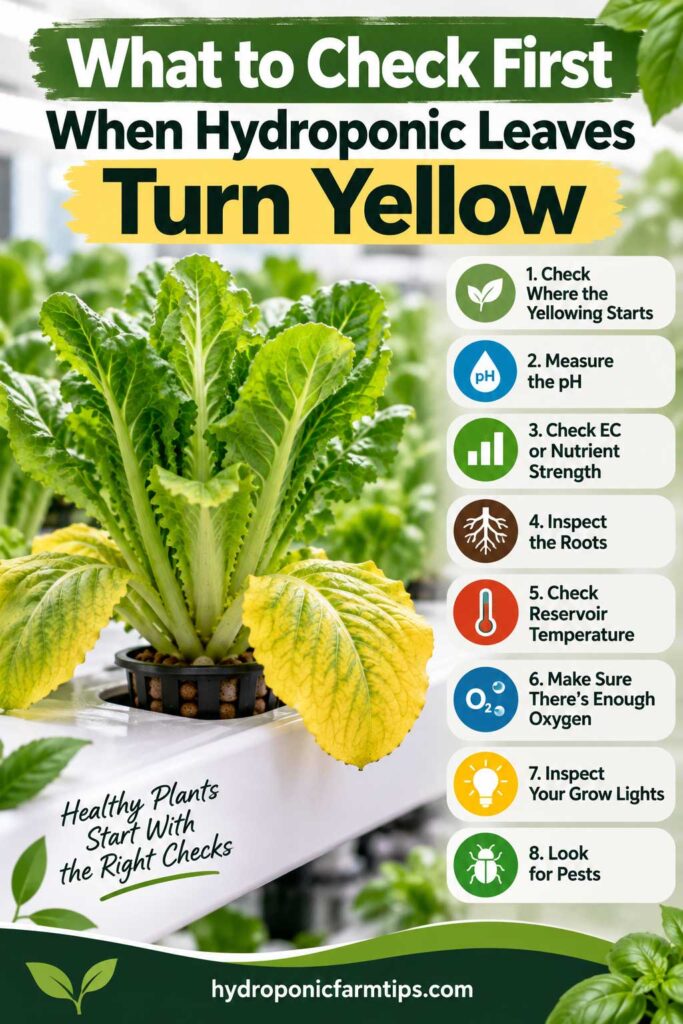
When you notice hydroponic leaves turning yellow, don’t immediately add more nutrients. Work through these checks first:
- Look at the yellowing pattern. Older leaves can point toward nitrogen or magnesium problems, while yellow new growth may suggest pH or micronutrient availability. Bleached upper leaves can point toward excessive light.
- Check pH. Make sure the nutrient solution is within the appropriate range for the crop.
- Measure EC. Determine whether the nutrient solution is unusually weak or concentrated before adding fertilizer.
- Inspect the roots. Look for firm, healthy growth rather than soft, slimy, deteriorating, or foul-smelling roots.
- Check water temperature and aeration. Warm water and poor oxygen availability often contribute to root stress.
- Inspect your grow lights. Look for stretching from insufficient light or bleaching near the top of the canopy from excessive intensity.
- Look for pests. Check leaf undersides and new growth for insects, eggs, webbing, stippling, or unusual damage.
Change One Thing at a Time
Unless you’ve found an urgent problem such as failed equipment or severely deteriorating roots, avoid changing pH, nutrients, lighting, temperature, and aeration all at once.
Correct the most likely problem and watch the plant’s new growth. Existing yellow leaves may never fully recover, so healthier new leaves and roots are better indicators that the plant is improving.
Can Yellow Leaves Turn Green Again?
Slightly chlorotic leaves may regain some color once the underlying problem is corrected, but completely yellow or badly damaged leaves usually won’t. Don’t judge recovery by old foliage. Instead, look for healthy new leaves, fresh root growth, and yellowing that has stopped spreading. Once a leaf is completely yellow, dry, or dying, it can generally be removed with clean pruning scissors.
How to Prevent Yellow Leaves in Hydroponics
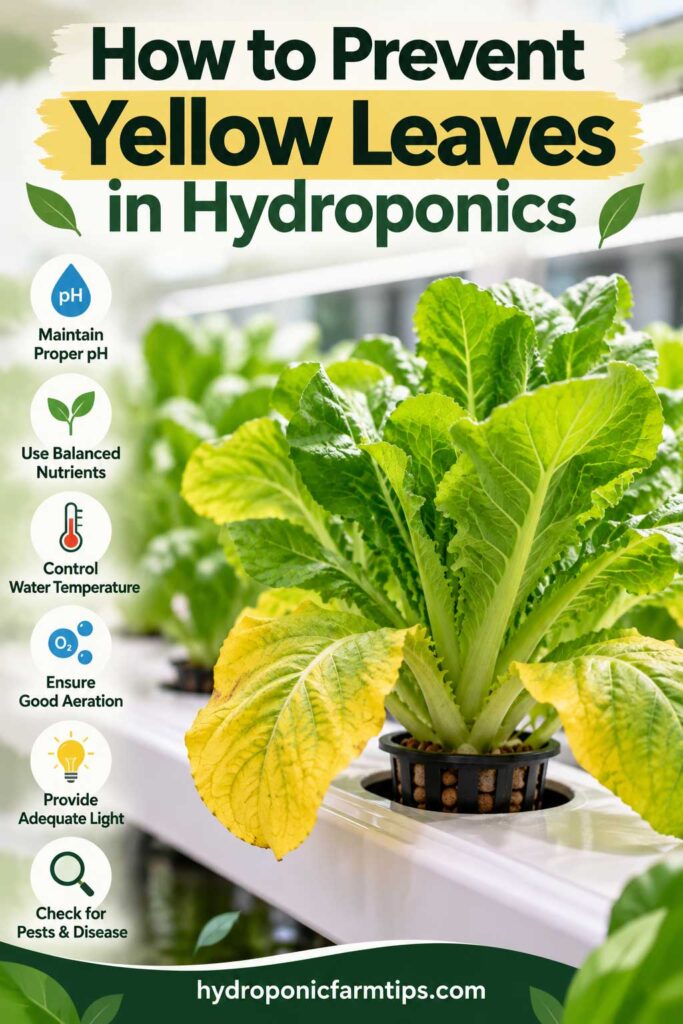
Preventing hydroponic leaves turning yellow starts with keeping the root zone, nutrient solution, lighting, and growing environment reasonably stable. You can’t prevent every yellow leaf, especially as older foliage naturally ages, but a consistent maintenance routine can prevent many of the problems that cause widespread yellowing.
The goal isn’t to constantly adjust your hydroponic system. In fact, stable growing conditions are usually better than frequent corrections.
Test pH and EC Regularly
Monitor your nutrient solution so you can catch changes before your plants develop obvious symptoms.
Keep the pH within the appropriate range for the crop you’re growing and use EC to track the overall strength of your nutrient solution.
Recording your readings can also help you recognize patterns. If the pH rises rapidly every few days or EC consistently increases as the water level falls, you’ll have useful information for adjusting your maintenance routine.
Use a Complete Hydroponic Nutrient Formula
Choose nutrients designed specifically for hydroponic growing and follow the manufacturer’s mixing instructions.
Hydroponic plants require more than nitrogen, phosphorus, and potassium. They also need calcium, magnesium, iron, and other micronutrients in appropriate amounts.
Penn State Extension also explains how complete fertilizers and nutrient-solution recipes are used to supply macro- and micronutrients in hydroponic systems.
Avoid adding individual supplements unless you have a good reason to believe they’re needed.
Replace the Nutrient Solution When Necessary
Topping off the reservoir replaces water, but it doesn’t necessarily restore the original nutrient balance.
Plants don’t absorb every mineral at exactly the same rate. Over time, the nutrient profile in an older reservoir can become different from what you originally mixed.
Periodic reservoir changes provide an opportunity to start again with a fresh, balanced solution.
Keep the Root Zone Healthy
Check your roots whenever you perform routine system maintenance.
Keep the reservoir clean, remove dead plant material, maintain good circulation, and make sure submerged roots receive sufficient oxygen.
Catching deteriorating roots early is much easier than trying to rescue a plant after severe root damage develops.
Monitor Water Temperature
Keep reservoir temperature reasonably stable and within an appropriate range for the crop you’re growing. Pay extra attention during hot weather or when grow lights and other equipment are adding heat to the growing area.
Give Plants Appropriate Light
Follow the recommended hanging height and intensity for your grow light rather than placing it as close to the plants as possible.
As plants grow taller, the distance between the canopy and fixture changes, so check it periodically.
Also provide an appropriate daily light-and-dark cycle for the crop you’re growing.
Inspect Plants Every Few Days
One of the easiest ways to prevent serious problems is simply to look at your plants regularly.
Check:
- New and older leaves
- Leaf undersides
- Stems
- Roots
- Reservoir water level
- pH and EC
- Water temperature
- Pumps and air stones
A small change in leaf color or root appearance is much easier to investigate than widespread yellowing across an entire hydroponic garden.
The healthiest hydroponic systems aren’t necessarily the ones receiving the most adjustments. They’re usually the ones where nutrients, pH, oxygen, temperature, lighting, and sanitation remain reasonably consistent over time.
Frequently Asked Questions About Yellow Hydroponic Leaves
Why are my hydroponic leaves turning yellow?
Hydroponic leaves can turn yellow because of nutrient deficiencies, incorrect pH, nutrient solution that is too strong or weak, unhealthy roots, low oxygen, lighting problems, water temperature, pests, disease, or natural leaf aging. Check the pattern of yellowing along with your pH, EC, roots, reservoir temperature, and lighting before making changes.
Why are the lower leaves on my hydroponic plant turning yellow?
When older, lower leaves turn yellow first, possible causes include nitrogen deficiency, magnesium deficiency, an understrength nutrient solution, or natural leaf aging. If only one or two old leaves are affected while new growth remains healthy, the yellowing may simply be normal senescence.
Why are new hydroponic leaves turning yellow?
Yellowing that begins on young leaves or new growth can indicate a problem with micronutrient availability, particularly iron. Check the reservoir pH first because nutrients may be present in the solution but less available to the plant when pH is outside the crop’s preferred range.
Can too many nutrients cause yellow leaves in hydroponics?
Yes. An overly concentrated nutrient solution can stress roots and cause yellowing, brown or crispy leaf tips, curling, and slowed growth. Measure the EC before adding more fertilizer. If the nutrient concentration is already high, adding additional nutrients could make the problem worse.
Should I remove yellow leaves from hydroponic plants?
You don’t need to remove a leaf simply because it has started to turn yellow. However, leaves that are completely yellow, dry, badly damaged, or dying can generally be removed using clean scissors or pruning shears. Avoid removing large amounts of foliage unnecessarily.
Can yellow hydroponic leaves become green again?
Sometimes. Slightly pale leaves may regain color, but completely yellow or damaged leaves usually won’t. Healthy new growth is a better indicator of recovery.
Why are my hydroponic leaves yellow but the veins are still green?
Yellow tissue between green veins is called interveinal chlorosis. Depending on whether it appears on older or younger leaves, it can be associated with nutrients such as magnesium or iron. Because pH affects nutrient availability, check your reservoir pH before assuming you need to add a supplement.
Final Thoughts: Don’t Guess—Check the System
When you notice hydroponic leaves turning yellow, the leaf itself is only part of the story. Where the yellowing starts—and what’s happening in the reservoir and root zone—usually tells you much more.
Start with the simple checks: pH, EC, roots, water temperature, aeration, and lighting. Look for pests if the discoloration is irregular or accompanied by spots, webbing, or damaged foliage.
And don’t try to fix everything at once. Make one sensible adjustment, give the plant time to respond, and watch the new growth.
A damaged yellow leaf may never look perfect again. What matters is whether the next leaves come in healthy and green.
More Hydroponic Growing Guides You May Like
If you’re troubleshooting hydroponic leaves turning yellow, these guides can help you manage nutrients and pH, improve root health, and create better growing conditions for your plants.
- Hydroponic Nutrient & pH Chart – Compare recommended pH and nutrient ranges for popular hydroponic vegetables, herbs, and fruits.
- Hydroponic Root Rot Guide – Learn how to recognize unhealthy roots, identify common causes of root problems, and protect your plants before serious damage occurs.
- 8 Best Hydroponic Systems for Home – Compare DWC, Kratky, NFT, Ebb and Flow, drip, aeroponics, wick systems, and Dutch Buckets to understand how different hydroponic systems manage water, nutrients, and oxygen.
- 10 Best Hydroponic Vegetables – Discover productive vegetables to grow hydroponically and learn which systems work well for different crops.
- 10 Best Hydroponic Herbs to Grow at Home – Choose hydroponic-friendly herbs such as basil, mint, parsley, and cilantro and learn what they need for healthy growth.
- Are Hydroponic Vegetables Less Nutritious? – Explore what research says about the nutritional quality of hydroponically grown vegetables compared with soil-grown produce.
- How to Transfer Plants From Hydroponics to Soil – Follow the process of moving hydroponically grown plants into soil while reducing transplant stress.