


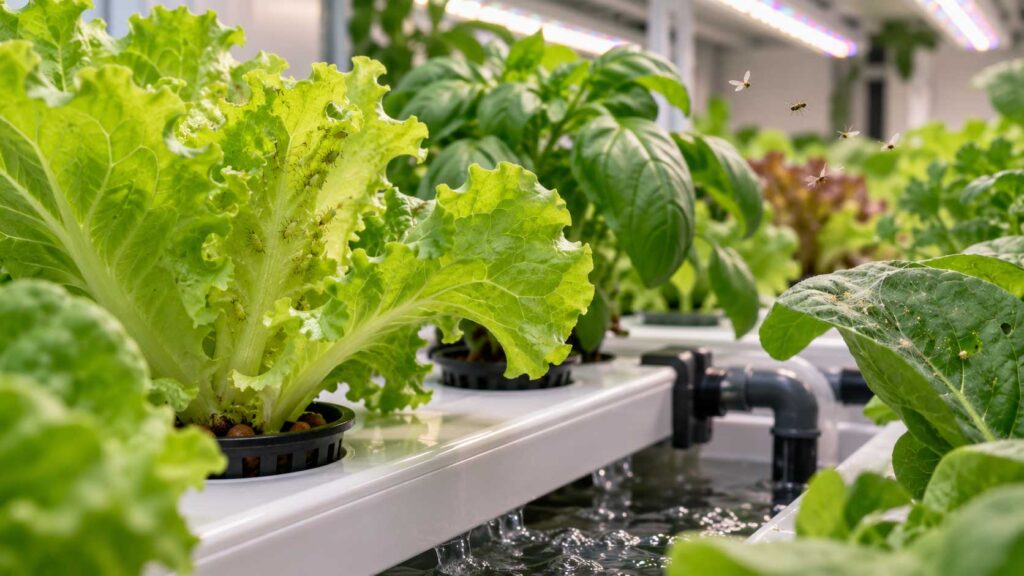
Common hydroponic pests can still become a problem even when plants are grown without soil. Aphids, spider mites, fungus gnats, whiteflies, thrips, and other pests can all find their way into an indoor hydroponic garden.
In some cases, they can spread quickly. Hydroponic plants are often grown close together, indoor temperatures stay relatively stable, and there may be fewer natural predators than there would be outdoors.
Fortunately, most pest problems are much easier to control when they are caught early.
Regularly checking leaf undersides, inspecting new growth, keeping the grow area clean, and isolating new plants can stop a small infestation from spreading throughout the system.
In this guide, you’ll learn how to identify the most common hydroponic pests, recognize the damage they cause, understand where they hide, and choose practical prevention and treatment methods.
You’ll also learn how to tell pest damage apart from nutrient deficiencies and other hydroponic problems, since yellowing, curling, spotting, and slow growth are not always caused by insects.
Can Hydroponic Plants Get Pests?

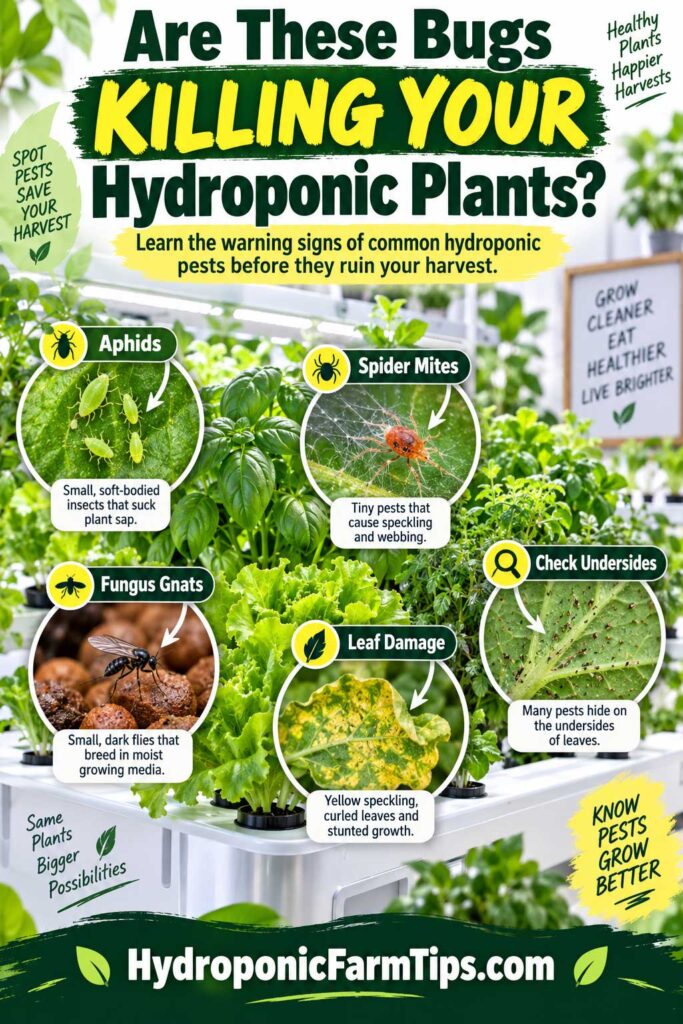
Yes. Hydroponic plants can still get pests even though they are grown without soil.
Many people assume that removing soil also removes most insect problems, but common hydroponic pests such as aphids, spider mites, whiteflies, thrips, and mealybugs do not need garden soil to reach your plants. They can arrive on new seedlings and cuttings, clothing, tools, open windows, pets, or nearby houseplants.
Indoor hydroponic gardens can actually provide favorable conditions for some pests. Temperatures are often stable, plants may be grown close together, and there are usually fewer natural predators than there would be outdoors. Once pests become established, they can move quickly from one plant to another.
Fungus gnats are a good example. Although they are often associated with potting soil, they can also reproduce in consistently moist growing media such as rockwool, coco coir, peat-based plugs, and other damp materials used for hydroponic seedlings.
Pest pressure can also vary depending on the type of setup you use. If you are still choosing a system, compare the major options in our guide to hydroponic growing systems.
The biggest problem is that many pests remain hidden until plant damage becomes obvious. Tiny insects often gather on leaf undersides, around growing tips, inside leaf joints, or near the surface of moist growing media.
That is why regular inspection is one of the most effective forms of hydroponic pest control.
Once or twice a week, check:
- leaf undersides
- new growth and growing tips
- stems and leaf joints
- flowers and buds
- the surface of growing media
- sticky traps placed around the system
Also watch for warning signs such as curled leaves, pale speckles, silvery streaks, sticky residue, fine webbing, distorted new growth, or tiny flying insects around the plants.
Catching pests early usually makes treatment much easier and can prevent a small infestation from spreading throughout the entire hydroponic system.
Quick Hydroponic Pest Identification Chart
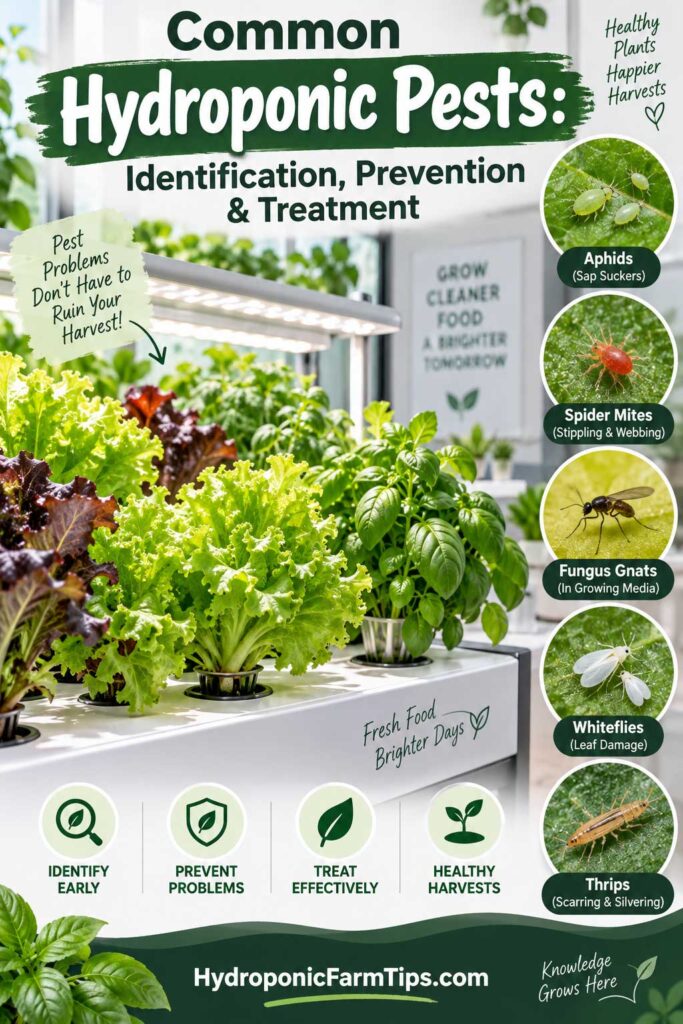
Hydroponic pest problems are much easier to manage when you know what you are looking for. Use the chart below to compare the pest, its appearance, the damage it causes, and where it is most likely to hide.
| Pest | What It Looks Like | Common Signs | Where to Check |
|---|---|---|---|
| Aphids | Tiny soft-bodied insects; green, black, brown, yellow, or red | Curled leaves, distorted new growth, sticky honeydew | New growth, stems, leaf undersides |
| Spider mites | Extremely small mites that may look like moving dots | Fine webbing, pale speckles, yellowing, bronzing | Leaf undersides |
| Fungus gnats | Small dark flies resembling tiny mosquitoes | Adults flying near plants, weak seedlings, possible root damage | Growing media, root-zone surface |
| Whiteflies | Tiny white winged insects | Yellowing leaves, sticky residue, insects flying when disturbed | Leaf undersides |
| Thrips | Tiny, slender insects | Silvery streaks, scarring, distorted leaves or flowers | Leaves, buds, flowers |
| Mealybugs | White, cottony-looking insects | Sticky honeydew, yellowing, weakened growth | Leaf joints, stems, hidden crevices |
| Scale insects | Small brown, tan, gray, or white bumps | Yellowing, sticky residue, reduced vigor | Stems, veins, leaf surfaces |
| Shore flies | Small dark flies with short, stocky bodies | Adults around wet areas and algae | Growing media, trays, algae |
| Leaf miners | Larvae hidden inside leaf tissue | Pale winding trails or irregular blotches | Inside damaged leaves |
Start With the Damage, Not Just the Insect
Sometimes the pest itself is too small to notice at first. In those cases, the pattern of plant damage can provide the first clue.
Fine webbing combined with pale speckling strongly suggests spider mites. Sticky residue may point toward aphids, whiteflies, mealybugs, or some scale insects because these sap-feeding pests can produce honeydew.
Silvery or scratched-looking patches are more commonly associated with thrips, while winding tunnels inside leaves are a classic sign of leaf miners.
Tiny flies around the base of plants are often fungus gnats or shore flies. Fungus gnats deserve closer attention because their larvae can feed around the root zone, particularly in young plants and consistently damp growing media.
Do not assume every damaged leaf is caused by insects, though. Yellowing, curling, spotting, and slow growth can also result from incorrect pH, nutrient imbalance, root problems, excessive light, or low oxygen.
Whenever possible, confirm the presence of a pest or a characteristic feeding pattern before beginning treatment.
1. Aphids
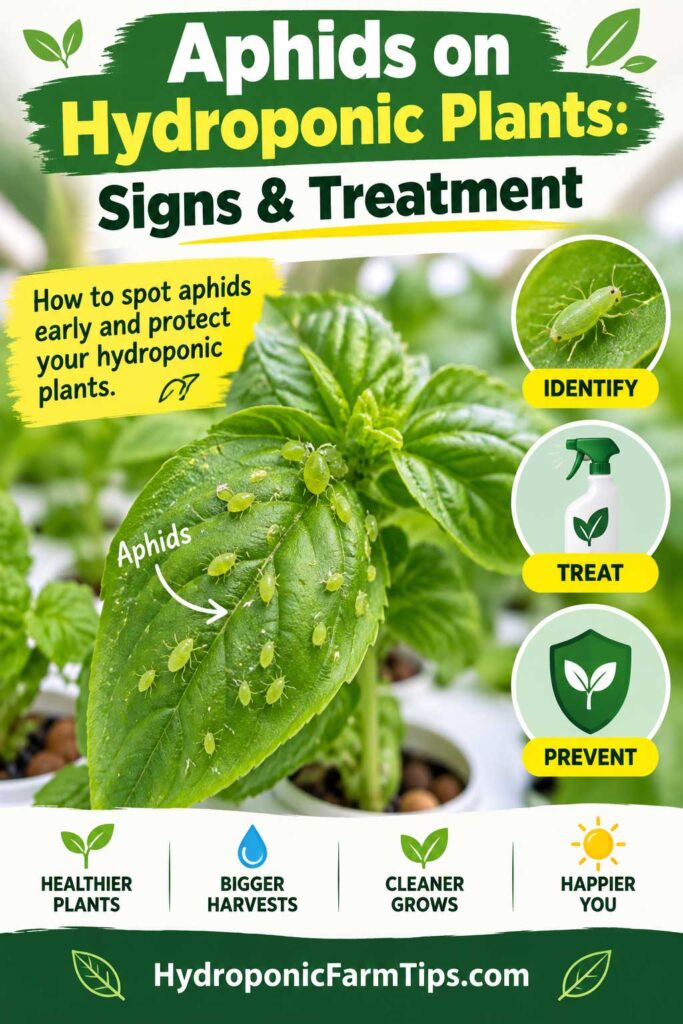
Aphids are among the most common hydroponic pests. These tiny, soft-bodied insects feed by piercing plant tissue and drawing sap from leaves, stems, and tender new growth.
Depending on the species, aphids may be green, black, brown, yellow, gray, or reddish. Some are wingless, while others develop wings and move to new plants.
Because they reproduce quickly, even a small colony can become a serious infestation in a relatively short time.
Signs of Aphids on Hydroponic Plants
Aphids often gather in clusters around new growth, stems, and leaf undersides rather than appearing one at a time.
Typical signs include curled or distorted leaves, weak new growth, yellowing foliage, shiny or sticky leaf surfaces, and visible clusters of insects around stems and growing tips.
The sticky substance they produce, called honeydew, can also encourage sooty mold to develop on leaf surfaces.
How Aphids Get Into a Hydroponic Garden
Aphids can enter indoor growing areas on new plants, seedlings, cuttings, clothing, tools, or through open windows and doors.
Winged adults may also move indoors from outdoor plants.
This is why new plants should be inspected carefully before placing them beside an established hydroponic system.
How to Get Rid of Aphids in Hydroponics
For a light infestation, start with physical removal. Gently rinse affected leaves with water or wipe the insects away by hand.
If aphids are more widespread, insecticidal soap can help when it makes direct contact with the pests. Focus on leaf undersides, growing tips, and other protected areas where colonies tend to gather.
Repeat treatment may be necessary because one application may not reach every insect or newly hatched aphid.
Beneficial insects such as lady beetles and lacewing larvae can also feed on aphids, although they are generally more practical in greenhouses or larger indoor growing spaces.
When to Remove Damaged Leaves
Remove heavily infested leaves when necessary, but avoid stripping so much foliage that the plant becomes severely stressed.
With aphids, early detection matters. A few insects are relatively easy to control; a colony spread across several plants takes much more work.
2. Spider Mites
Spider mites are tiny plant-feeding pests that can become a serious problem in warm, dry indoor growing areas. They are not true insects; they belong to the arachnid group, along with spiders and ticks.
Because they are extremely small, spider mites are often noticed only after visible plant damage begins.
Signs of Spider Mites on Hydroponic Plants
One of the earliest signs is fine, pale speckling on the leaves. As feeding continues, foliage may become yellow, bronzed, dry-looking, or generally weakened.
Heavier infestations often produce fine webbing around leaf undersides, stems, growing tips, leaf joints, and clusters of damaged foliage.
If you suspect spider mites, inspect the undersides of leaves closely. A hand lens or magnifying glass can make them much easier to identify.
Why Spider Mites Spread Quickly Indoors
Spider mites reproduce rapidly when conditions are favorable.
Indoor hydroponic gardens can provide consistent temperatures, dense plant growth, and relatively few natural predators. Warm, dry conditions can make outbreaks even more difficult to control.
They may enter on new plants, cuttings, clothing, equipment, or from nearby outdoor vegetation.
How to Get Rid of Spider Mites in Hydroponics
If possible, isolate heavily affected plants first.
For a light infestation, rinse the undersides of leaves with a firm but gentle stream of water. This can physically remove many mites and some eggs.
Insecticidal soap or horticultural oil may also help when applied thoroughly to affected foliage. Good coverage is essential because spider mites spend much of their time on leaf undersides and other protected areas.
Repeat treatment may be necessary because eggs can survive the first application and hatch later.
Remove leaves that are badly damaged or covered with webbing, but avoid taking off so much foliage that the plant becomes even more stressed.
Monitor Closely After Treatment
Spider mite populations can rebound quickly, so inspect plants every few days after treatment.
Pay particular attention to new growth and areas that were previously infested.
Sticky traps are useful for many flying pests, but they are not very effective for spider mites because mites do not normally fly. Direct leaf inspection is much more reliable.
Prevention Tip
Avoid excessively hot, dry conditions, and inspect new plants before adding them to the grow area. Spider mites are much easier to control before heavy webbing appears.
3. Fungus Gnats
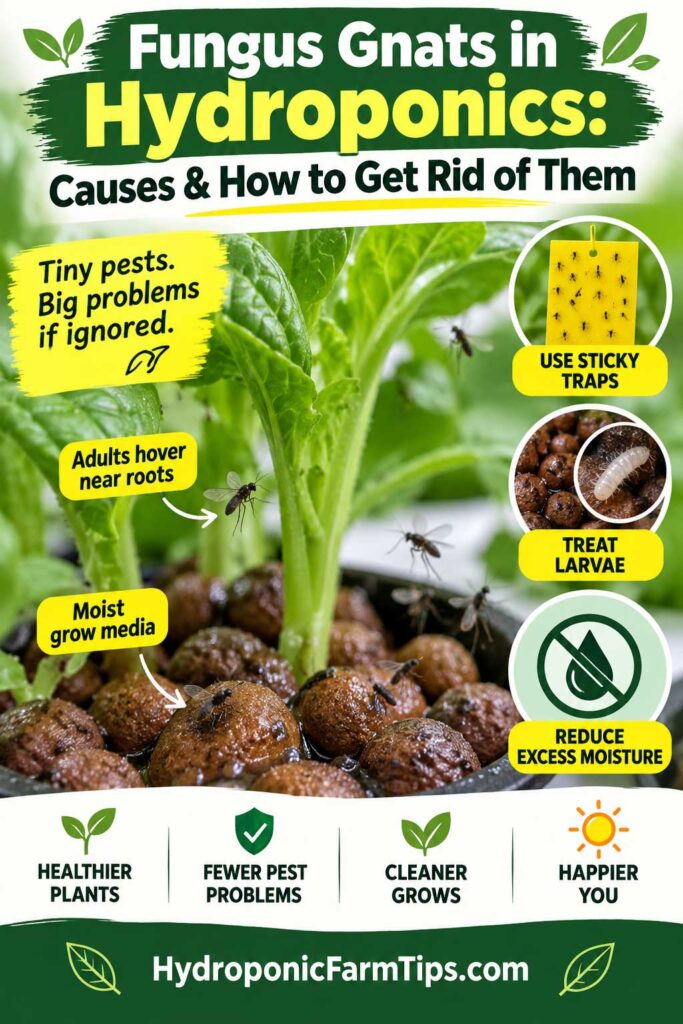
Fungus gnats are small, dark flying insects commonly seen around the base of plants, seedling trays, and moist growing media.
The adults are mostly a nuisance. The greater concern is the larvae, which live in damp organic material and feed on fungi, decaying matter, and sometimes tender plant roots.
Hydroponic systems can still develop fungus gnat problems, especially when they use consistently moist media such as coco coir, peat-based plugs, rockwool, or other materials that stay wet for long periods.
Signs of Fungus Gnats in Hydroponics
The easiest sign to spot is usually tiny black or gray flies moving around the grow area.
They may crawl across moist media, hover near the base of plants, gather around seedling trays, or appear on yellow sticky traps. You may also notice them around algae or other consistently damp surfaces.
Young seedlings can become weak or grow slowly when large numbers of larvae are feeding around the root zone. The University of Wisconsin–Madison Extension notes that fungus gnat larvae can feed on root hairs and damage young plants when populations become high.
Why Fungus Gnats Appear
Fungus gnats are attracted to moist environments with algae, fungi, and decomposing organic matter.
Problems are more likely when growing media stay constantly saturated, dead plant material accumulates, algae develops on exposed surfaces, or drainage is poor.
They can also enter the grow area on new plants or contaminated growing media.
How to Get Rid of Fungus Gnats in Hydroponics
Start by making the environment less favorable for them.
Remove dead plant material, clean algae from trays and exposed surfaces, and avoid keeping the upper part of the growing medium wetter than necessary.
Yellow sticky traps can help catch adult fungus gnats and show whether the population is increasing or decreasing.
For larvae, products containing Bacillus thuringiensis subsp. israelensis (Bti) may be useful when labeled for that purpose. Beneficial nematodes can also be used in some systems to target larvae living in moist growing media.
Always follow the product label and confirm that the treatment is suitable for edible crops and your specific hydroponic setup.
Fungus Gnats vs. Shore Flies
Fungus gnats and shore flies are easy to confuse because both are small, dark flies associated with wet growing areas.
Fungus gnats are usually more slender, with long legs and a mosquito-like appearance. Shore flies are stockier and are more closely associated with algae.
The difference matters because fungus gnat larvae can damage tender roots, while shore flies are usually more of a sanitation problem than a serious plant-feeding pest.
4. Whiteflies
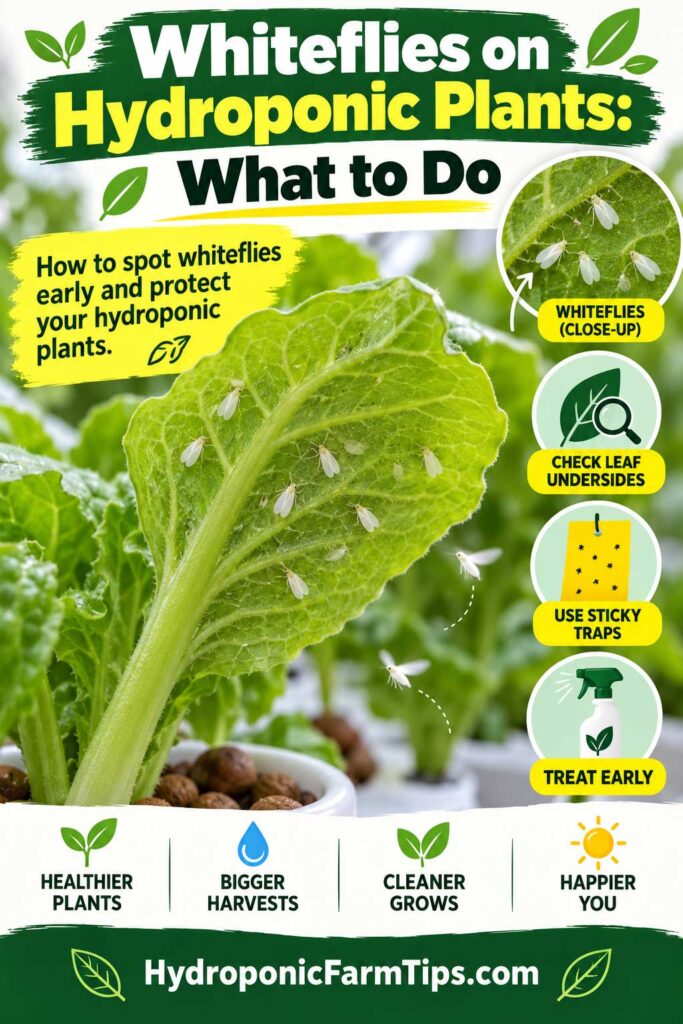
Whiteflies are tiny, white, moth-like insects that usually gather on the undersides of leaves. Despite their name, they are not true flies. They are sap-feeding insects related to aphids and scale.
They can become a serious problem in indoor hydroponic gardens because they reproduce quickly and may remain hidden beneath foliage until the population becomes large.
Signs of Whiteflies on Hydroponic Plants
One of the easiest ways to detect whiteflies is to gently disturb the plant. If a cloud of tiny white insects flutters up from the leaves, whiteflies are a likely cause.
Other signs include yellowing foliage, reduced plant vigor, sticky honeydew, distorted new growth, and clusters of insects on leaf undersides. Sooty mold may also develop on leaves coated with honeydew.
Both adults and immature stages feed on plant sap, so heavy infestations can gradually weaken the plant.
Where Whiteflies Hide
Whiteflies spend much of their time on the undersides of leaves, especially tender or younger foliage.
Their immature stages are even harder to spot because they remain attached to the leaf surface and can look like tiny pale scales.
Checking only the tops of leaves can allow an infestation to go unnoticed.
How to Get Rid of Whiteflies in Hydroponics
Start by removing heavily infested leaves when practical. This can eliminate a large number of eggs and immature insects at once.
Yellow sticky traps are useful for catching adult whiteflies and monitoring whether the population is increasing or decreasing.
Insecticidal soap or horticultural oil may also help when applied thoroughly. Coverage of the leaf undersides is especially important because that is where most whiteflies are found.
Several treatments may be necessary because eggs and immature stages can survive the first application.
Beneficial Insects for Whiteflies
In greenhouse-style hydroponic systems, biological controls can also help.
Parasitoid wasps such as Encarsia and Eretmocerus species are commonly used against whiteflies in commercial growing environments.
These beneficial insects work best when introduced early, before the infestation becomes severe.
Whitefly Prevention
Inspect new plants carefully before bringing them into the grow area and check leaf undersides during routine maintenance.
Sticky traps near the plant canopy can help detect adults before the population becomes obvious. Early detection is much easier to deal with than an established infestation.
5. Thrips
Thrips are tiny, slender insects that feed by scraping the surface of leaves and drawing out plant fluids. Because they are so small and often hide inside flowers, buds, and folded leaves, they can be difficult to spot until visible damage appears.
Depending on the species and life stage, thrips may look yellow, tan, brown, or almost black.
Signs of Thrips on Hydroponic Plants
Thrips damage often looks different from the damage caused by aphids or whiteflies.
Typical signs include silvery or pale streaks, small dark specks on damaged tissue, curled or distorted new growth, leaf scarring, and damaged flowers or buds. Heavy infestations can also slow overall plant growth.
The silvery appearance develops because thrips damage the outer leaf tissue while feeding.
Where Thrips Hide
Thrips often shelter in leaf folds, growing tips, flower buds, blossoms, leaf undersides, and tight spaces between stems and leaves.
They can move quickly when disturbed, which makes them easy to miss during a casual inspection.
How to Check for Thrips
Hold a white sheet of paper beneath a suspicious leaf or flower and gently tap the plant.
Any tiny, slender insects that fall onto the paper are much easier to see against the white background.
Blue or yellow sticky traps can also help detect adult thrips, although traps alone will not eliminate an infestation.
How to Get Rid of Thrips in Hydroponics
Remove badly damaged leaves and flowers when practical, especially if they contain large numbers of insects.
Insecticidal soap or horticultural oil may help reduce exposed thrips when the product is labeled for the crop. Thorough coverage is important because these pests often hide in protected areas.
Repeated treatment may be necessary because several life stages can be present at the same time.
In larger grow rooms or greenhouse systems, predatory mites and other beneficial organisms can also be used as part of an integrated pest-management program.
Why Thrips Can Be Persistent
Thrips can be difficult to eliminate because parts of their life cycle are protected from surface treatments.
Eggs may be inserted into plant tissue, while later stages can move into growing media or other sheltered areas before becoming adults.
That means killing the visible insects does not always end the infestation.
Continue monitoring plants after treatment and keep sticky traps in place so you can detect another increase in activity quickly.
Prevention Tip
Inspect flowers, seedlings, cuttings, and new plants carefully before bringing them into the grow area. Thrips are often introduced on plant material, so catching them before they reach established crops can prevent a much larger infestation.
6. Mealybugs
Mealybugs are small, soft-bodied insects covered with a white, waxy coating that gives them a cotton-like appearance. They often gather in protected parts of the plant, which makes them easy to miss during a quick inspection.
Like aphids and whiteflies, mealybugs feed on plant sap and can gradually weaken hydroponic plants when populations become large.
Signs of Mealybugs on Hydroponic Plants
The easiest sign to recognize is a white, cottony cluster on stems, leaves, or leaf joints.
Other symptoms can include sticky honeydew, yellowing foliage, weakened or distorted new growth, reduced plant vigor, sooty mold, and white waxy residue around stems or nodes.
Mealybugs often concentrate where leaves meet stems, along veins, and inside tight plant crevices.
Why Mealybugs Can Be Difficult to Control
Their waxy outer coating can provide some protection from sprays, and they often hide in areas that are difficult to reach.
A plant may look almost pest-free from above while several colonies remain tucked around stem joints or beneath leaves.
That makes careful inspection especially important.
How to Get Rid of Mealybugs in Hydroponics
For a light infestation, individual mealybugs can often be removed manually with a cotton swab or soft cloth.
Heavily infested leaves or stems may be better removed entirely, especially when the insects are concentrated in one area.
Insecticidal soap or horticultural oil may also help when the product is labeled for the crop. Apply it carefully and make sure it reaches the protected areas where mealybugs tend to hide.
Repeat treatment may be necessary because newly hatched insects can appear after the first application.
Protect the Hydroponic Reservoir
Keep foliar sprays out of the nutrient reservoir whenever possible unless the product is specifically labeled for that use.
Prevention Tip
Mealybugs are often introduced on new plants, cuttings, or nearby ornamentals.
Quarantine new plants when possible and inspect stems, leaf joints, and leaf undersides before placing them near established hydroponic crops.
7. Scale Insects
Scale insects are sap-feeding pests that can be easy to mistake for part of the plant because they often look like small brown, tan, gray, or whitish bumps attached to stems and leaves.
Unlike more mobile pests such as aphids or whiteflies, many scale insects remain fixed in one place while feeding. That makes them easy to overlook when only a few are present.
Signs of Scale on Hydroponic Plants
Typical signs include small raised bumps on stems or leaves, yellowing foliage, weak or slowed growth, shiny leaf surfaces, and sometimes sticky honeydew or sooty mold.
Not every scale species produces honeydew, so the absence of sticky residue does not rule out an infestation.
How to Confirm It Is Scale
If you notice a suspicious bump, inspect it closely.
Scale insects often gather along stems, leaf veins, and protected plant joints. In many cases, they can be gently lifted or scraped away from the plant surface.
That can help distinguish them from natural stem markings, scars, or plant tissue.
How to Get Rid of Scale Insects in Hydroponics
For a small infestation, physical removal is often the simplest approach.
Gently wipe or lift scale insects from stems and leaves with a soft cloth, cotton swab, or similar tool. Remove heavily infested leaves or stems when doing so will not overly stress the plant.
Horticultural oil or insecticidal soap may also help with certain scale insects, particularly during younger, more vulnerable life stages.
Good coverage is important, and repeat treatment may be necessary.
Why Scale Can Return
Mature scale insects can be difficult to control because their protective covering limits direct contact with sprays.
Young scale insects, often called crawlers, are more mobile and usually more vulnerable.
That is why repeated inspection after treatment is important. Even when the visible adults are removed, a new generation can still appear later.
Prevention Tip
Inspect new plants carefully before bringing them into the hydroponic growing area.
Pay close attention to stems, leaf veins, and plant joints, where small scale insects can remain hidden for a long time.
Catching a few isolated insects early is much easier than dealing with a colony spread across several plants.
8. Shore Flies
Shore flies are small, dark flies commonly found around wet hydroponic surfaces, algae, growing media, and greenhouse floors.
They are often confused with fungus gnats because both are attracted to moist environments. Shore flies are usually stockier and more fly-like, while fungus gnats have longer legs and a more delicate, mosquito-like appearance.
Are Shore Flies Harmful to Hydroponic Plants?
Shore flies usually cause much less direct plant damage than fungus gnats.
Adults mainly feed on algae and decaying organic matter, while the larvae tend to live in wet areas where algae are present.
A few shore flies are often more of a sanitation warning than a serious crop threat. Larger populations, however, can be annoying and may indicate that the growing area is staying too wet or that algae are developing around the system.
Signs of Shore Flies
You may notice small dark flies resting near trays or reservoirs, moving across wet growing media, gathering around algae, appearing on sticky traps, or repeatedly showing up around drains and other damp surfaces.
Unlike fungus gnat larvae, shore fly larvae are not considered major root feeders.
Shore Flies vs. Fungus Gnats
These two pests are easy to confuse.
Fungus gnats are usually slender, with long legs and antennae, and their larvae may damage young roots.
Shore flies have shorter, stockier bodies and resemble tiny houseflies. UW–Madison Extension notes that shore flies are strongly associated with algae and wet greenhouse areas.
Correct identification helps prevent unnecessary treatment.
How to Get Rid of Shore Flies in Hydroponics
The most effective approach is usually to remove the conditions they need to reproduce.
Clean algae from your hydroponic system, including grow trays, reservoir lids, tubing, benches, exposed growing media, and drainage areas. Remove dead leaves and decomposing plant material, and correct any standing-water problems around the system.
Yellow sticky traps can help capture adults and show whether the population is decreasing, but sanitation is usually the more important long-term control measure.
Prevention Tip
Persistent shore flies are often a sign that algae or excess moisture needs attention.
Keeping light away from nutrient solution and wet growing surfaces can help suppress algae, removing one of the main food sources that attracts shore flies.
With shore flies, cleaning up algae and excess moisture is usually more effective than spraying the plants.
9. Leaf Miners
Leaf miners are the larvae of certain flies, moths, beetles, and sawflies that feed inside leaf tissue rather than on the surface.
Because they are protected within the leaf, they can be harder to reach with contact sprays than pests such as aphids or whiteflies.
Signs of Leaf Miners on Hydroponic Plants
The most recognizable symptom is a pale, winding trail running through the leaf.
You may also notice irregular white or tan tunnels, translucent blotches, damaged tissue between the leaf surfaces, reduced leaf function, or premature leaf drop when infestations become heavier.
These trails form as the larva feeds between the upper and lower surfaces of the leaf.
How Leaf Miners Get Into Hydroponic Gardens
Adult insects can enter through open windows, vents, or doors, or they may arrive on new plants.
Once eggs are laid, the larvae hatch and begin feeding inside the leaves, where they are relatively protected from surface treatments.
How to Get Rid of Leaf Miners
For a small infestation, removing affected leaves is often the simplest approach.
Dispose of infested foliage away from the growing area rather than leaving it nearby, where adults may continue the life cycle.
Yellow sticky traps can help capture some adult leaf-mining flies and provide an early warning that they are present.
Because the larvae are inside the leaf, contact sprays are often less effective unless they reach the pest at the correct stage.
When to Remove a Leaf
If only one or two leaves are affected, removing them can reduce the pest population quickly.
However, avoid taking off too much foliage from small or already stressed plants. A lightly damaged leaf can still contribute to photosynthesis.
Prevention Tip
Inspect new plants before adding them to your hydroponic garden, especially if they came from a greenhouse, garden center, or outdoor growing area.
Look for the distinctive winding trails before placing the plant near established crops.
Leaf miners are much easier to manage when the first damaged leaves are removed before a new generation of adults develops.
How Pests Get Into Indoor Hydroponic Systems
Pests do not appear because a garden is hydroponic. In most cases, they hitch a ride into the growing area.
New plants are one of the biggest sources. A seedling or cutting can look perfectly healthy while still carrying aphids, thrips, spider mites, whiteflies, mealybugs, or eggs hidden beneath the leaves.
Pests can also enter through open doors and windows, ventilation openings, reused equipment, growing media, clothing, or nearby houseplants.
That is why pests can seem to appear suddenly even when the system itself looks clean.
Be Careful With New Plants
Before placing a new plant beside an established hydroponic crop, inspect the leaf undersides, growing tips, stem joints, and growing media.
If possible, keep new plants separate for a few days first. This gives you time to spot insects or fresh damage before they spread.
A small magnifying glass is especially useful for spider mites and thrips.
Don’t Forget Nearby Houseplants
Sometimes the source is not the hydroponic system at all.
Houseplants in the same room can harbor fungus gnats, spider mites, scale, mealybugs, or other pests. If an infestation keeps returning after treatment, check every plant nearby.
Clean Equipment Between Crops
Trays, net pots, pruning tools, propagation equipment, and reused containers can also carry pests or eggs from one crop to the next.
You do not need a sterile grow room, but clean equipment and careful inspection make it much harder for a small hidden population to become an infestation.
How to Inspect Hydroponic Plants for Pests
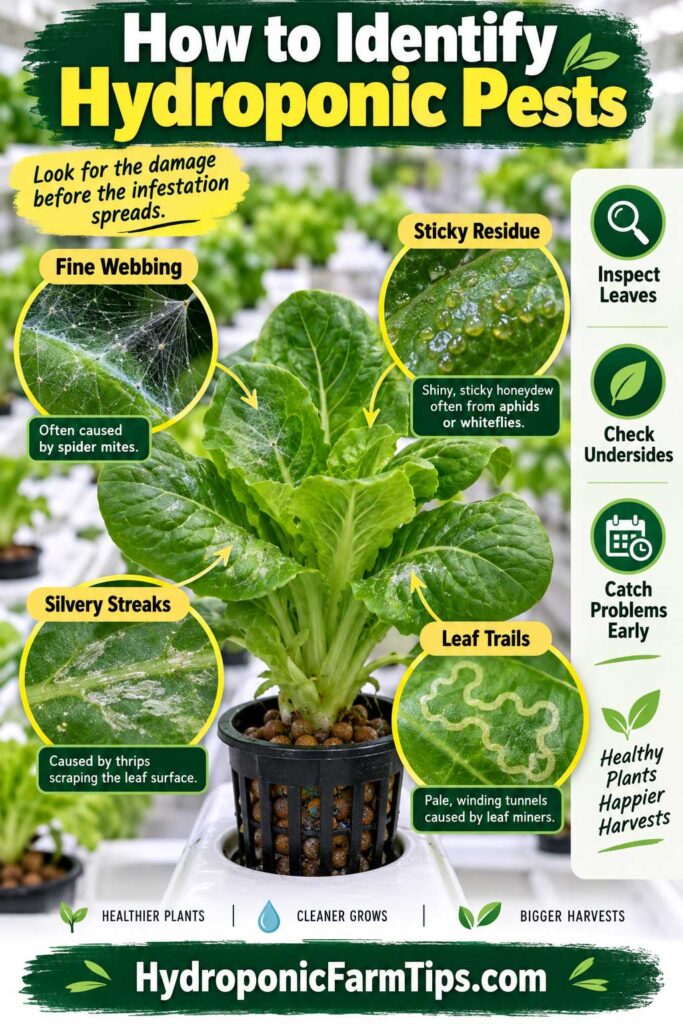
You do not need to examine every leaf every day. A quick inspection once or twice a week can catch most pest problems while they are still manageable.
Start with the newest growth. Aphids, thrips, and several other pests often gather around tender leaves and growing tips.
Then turn over a few leaves.
This is important because some of the most common hydroponic pests spend most of their time where you cannot see them from above.
Look for:
- moving insects
- pale speckles
- fine webbing
- sticky residue
- white cottony patches
- silvery feeding marks
- distorted new growth
- raised bumps on stems
- winding trails inside leaves
- tiny flies around the growing media
Don’t worry if you cannot immediately identify what you see. First determine whether there is actually a pest present.
Check the Growing Media Too
If tiny flies are hovering around the base of your plants, inspect the growing media, trays, and other damp areas.
Fungus gnats and shore flies are often easier to notice there than on the foliage.
Use a Magnifying Glass for Tiny Pests
Spider mites and young thrips can be surprisingly difficult to see.
A small hand lens can quickly tell you whether those suspicious dots are actually moving or are simply dust, mineral residue, or natural leaf texture.
For thrips, another easy trick is to hold a white sheet of paper beneath the plant and gently tap a leaf or flower. Tiny insects are much easier to see against the white surface.
Watch the Plants Next to the Problem
If you find pests on one plant, inspect its neighbors immediately.
That simple habit can be the difference between treating one plant and treating an entire hydroponic garden.
Affiliate Disclosure: This page may contain affiliate links. If you purchase through one of these links, we may earn a commission at no additional cost to you.
Helpful Tools for Catching Hydroponic Pests Early
You do not need complicated equipment to monitor a hydroponic garden. A few inexpensive tools can make it much easier to spot pests before they spread.
| Product | Best For | Why It Helps | Buy |
|---|---|---|---|
| Yellow Sticky Traps | Fungus gnats, whiteflies & shore flies | An inexpensive way to detect flying pests early and monitor whether populations are increasing or decreasing. | Check Price |
| Blue Sticky Traps | Thrips | Blue traps are commonly used to monitor adult thrips around hydroponic plants. | Check Price |
| 30×–60× Plant Magnifier | Spider mites, thrips & eggs | Makes tiny pests much easier to identify before infestations become severe. | Check Price |
| Clip-On Phone Microscope | Detailed pest identification | Useful for getting a closer look at mites, eggs, larvae, and suspicious leaf damage. | Check Price |
How to Get Rid of Pests in Hydroponics
The best treatment depends on the pest, how severe the infestation is, and whether you are growing edible crops.
In most cases, start with the least aggressive method and move to stronger control only if the problem continues.
1. Isolate the Affected Plant
If possible, move the infested plant away from the rest of the hydroponic garden.
This can slow the spread of aphids, whiteflies, thrips, spider mites, and other pests while you identify and treat the problem.
If the plant is connected to a shared system and cannot be moved, inspect neighboring plants carefully because pests may already have spread.
2. Remove Heavily Infested Foliage
Pruning badly infested leaves or shoots can quickly reduce pest numbers.
This works especially well when the problem is concentrated in only a few areas.
Place removed plant material directly into a bag or container and take it out of the grow area. Do not leave infested foliage beside the system.
3. Physically Remove the Pests
For a light infestation, mechanical control may be enough.
Aphids and spider mites can sometimes be dislodged by gently rinsing the foliage with water. Mealybugs and scale insects can often be wiped away individually.
Inspect the plant again several days later because eggs or hidden pests may remain.
4. Use Sticky Traps for Flying Pests
Sticky traps can help monitor and reduce adult populations of whiteflies, fungus gnats, shore flies, thrips, and other flying pests.
They are most effective as part of a broader control strategy rather than as the only treatment.
5. Treat the Foliage When Necessary
Insecticidal soap and some horticultural oils can be useful against soft-bodied pests, but the product must be appropriate for the crop you are growing.
Thorough coverage matters. Many pests hide beneath leaves, around growing tips, and inside stem joints, so spraying only the top of the canopy is unlikely to provide good control.
Do not assume a stronger concentration will work better. Overly concentrated treatments can damage foliage.
Always follow the product label.
6. Reinspect and Repeat if Needed
One treatment may kill visible pests without eliminating eggs or immature stages.
Check the plants again over the following days and repeat treatment only as directed on the label.
The goal is to interrupt the pest’s life cycle, not simply remove the insects you can see.
7. Correct the Conditions Behind the Problem
Pest problems often return if the conditions that supported them are still present.
Remove algae and dead plant material, clean contaminated equipment, improve sanitation, and correct excessive moisture where appropriate.
Also inspect nearby houseplants and recently introduced plants that may be acting as a source of reinfestation.
Avoid Treating the Nutrient Reservoir Without a Reason
Most common hydroponic pests live on leaves, stems, flowers, or growing media rather than in the nutrient reservoir.
Do not add insecticides, soaps, oils, or household pest-control products directly to the nutrient solution unless the product is specifically labeled for that use.
Targeting the pest where it actually lives is usually more effective and helps avoid unnecessary stress on the root system.
Useful Products for Treating Hydroponic Pests
The right product depends on the pest you are dealing with. Always identify the problem first and confirm that the product is labeled for your crop and intended use.
| Product | Best For | Why We Like It | Buy |
|---|---|---|---|
| Insecticidal Soap | Aphids, whiteflies, mealybugs & mites | A useful contact treatment for many soft-bodied pests when used according to the label. | Check Price |
| Neem Oil Spray | Aphids, mites, whiteflies & scale | A versatile option for treating several common plant pests when labeled for your crop. | Check Price |
| Horticultural Oil | Scale, mites & mealybugs | Helps coat exposed pests and is particularly useful against some difficult sap-feeding insects. | Check Price |
| Bti Mosquito Bits/Dunks | Fungus gnat larvae | Bti-based products can target fungus gnat larvae when used according to label directions. | Check Price |
| Beneficial Nematodes | Fungus gnats | Biological control that targets pest larvae living in moist growing media. | Check Price |
Hydroponic tip: Do not add foliar soaps, neem oil, or horticultural oils directly to the nutrient reservoir unless the product specifically says it can be used that way.
Insecticidal Soap for Hydroponic Pests
Insecticidal soap can be a useful treatment for several soft-bodied pests commonly found on hydroponic plants, including aphids, whiteflies, mealybugs, young scale insects, some spider mites, and certain thrips.
It works mainly through direct contact, so good coverage matters much more than simply spraying the general area around the plant. Colorado State University Extension lists insecticidal soaps as a common option for many soft-bodied plant pests and spider mites.
How to Use It More Effectively
Apply the spray directly to the places where pests are hiding, especially leaf undersides, stem joints, new growth, tightly clustered foliage, and areas where insects are visibly feeding.
Avoid treating plants during periods of intense light or excessive heat because stressed foliage may be more likely to develop damage.
It is also a good idea to test the product on a small section of the plant first, especially with tender herbs, seedlings, or unfamiliar crops.
Protect the Reservoir
One of the most important hydroponic precautions is keeping foliar treatments out of the nutrient solution.
Cover exposed reservoirs, channels, or openings before spraying whenever practical.
Insecticidal soap is intended for plant surfaces, and allowing significant amounts to enter the root zone can create unnecessary stress or interfere with the hydroponic system.
Why Repeat Applications May Be Needed
Insecticidal soap has very little lasting effect once it dries.
That can be an advantage because it leaves less persistent residue, but it also means eggs or newly hatched pests may survive the first treatment.
Check the plants again after treatment and follow the product label for any repeat applications.
What About Homemade Soap Sprays?
Household dish soap is not the same as a product formulated and labeled as insecticidal soap.
Some detergents contain degreasers, fragrances, or other ingredients that can damage leaf tissue, especially when mixed too strongly.
For hydroponic vegetables and herbs, a product specifically labeled for pest control on the crops you are growing is the safer and more predictable option.
Neem Oil and Horticultural Oils for Hydroponic Pests
Neem oil and other horticultural oils can help control several common hydroponic pests, including aphids, whiteflies, spider mites, mealybugs, scale insects, and some thrips.
For a broader explanation of how these products work, see Colorado State University Extension’s guide to horticultural oils and neem-based pest treatments.
These products work best when they reach the pests directly, so coverage of leaf undersides, stems, and protected areas matters.
How to Apply Oils Safely
Focus on the places where pests actually hide, especially leaf undersides, stems, growing tips, and plant joints.
Avoid spraying under very intense grow lights or when plants are already stressed by heat, dehydration, or nutrient problems. Oil-treated foliage can be more prone to spotting or damage under harsh conditions.
Whenever you use a new product, test it on a small section of the plant first and watch for discoloration or leaf injury before treating the entire crop.
Be Careful With Edible Hydroponic Crops
For vegetables and herbs, always check the product label to confirm that it is approved for the crop you are growing.
Follow any application limits, harvest intervals, or other restrictions listed by the manufacturer.
Do not assume that every neem or horticultural oil product can be used in the same way.
Keep Oils Out of the Nutrient Solution
Hydroponic growers should take extra care to prevent spray runoff from entering the reservoir.
Cover exposed nutrient solution, channels, or reservoir openings before treatment whenever practical.
Oils are intended for foliar use, not for the root zone. Allowing them to enter the nutrient solution can interfere with normal root function and create unnecessary stress.
Neem Oil vs. Insecticidal Soap
Insecticidal soap works by direct contact and is often useful when soft-bodied pests are exposed and easy to reach.
Neem-based products and other horticultural oils provide another option for some pests and life stages. Which product makes sense depends on the pest, crop, and label directions.
Neither treatment should be considered a one-time fix. Continue inspecting plants after application and repeat treatment only according to the product label.
The most effective hydroponic pest control usually combines targeted treatment with sanitation, monitoring, and removal of heavily infested plant material.
Beneficial Insects and Biological Controls for Hydroponics
Beneficial insects and other biological controls can be useful in hydroponic gardens, especially in greenhouses, grow rooms, and larger indoor systems where pest problems keep returning.
Instead of relying only on sprays, biological control uses predators, parasitoids, or beneficial organisms that target specific pests.
Common Beneficial Controls Used in Hydroponics
Different beneficial species work against different pests.
- Lady beetles feed on aphids and other soft-bodied insects.
- Lacewing larvae prey on aphids, mealybugs, thrips, and other small pests.
- Predatory mites can help control spider mites and certain thrips.
- Encarsia formosa and related parasitoid wasps are commonly used against whiteflies.
- Beneficial nematodes can help reduce fungus gnat larvae in moist growing media.
- Predatory bugs may be used in larger controlled environments for thrips and other small pests.
UW Extension’s greenhouse biological-control guide also discusses nematodes, Bti, predatory mites, and other biological controls for greenhouse pests.
Beneficial nematodes are not insects, but they are commonly included in biological pest-control programs because they can target pest larvae in the root-zone area.
When Beneficial Insects Work Best
Biological control tends to work best when introduced early, before pest populations become severe.
If an infestation is already widespread, beneficial organisms may not reduce the population quickly enough on their own.
In that situation, remove heavily infested foliage and reduce pest numbers first, then introduce the appropriate biological control to help prevent the infestation from rebuilding.
Avoid Mixing Biological Controls With Incompatible Sprays
Do not release beneficial insects and then apply a pesticide that may kill them as well.
Even some soaps and oils can harm beneficial organisms when sprayed directly on them.
If you plan to use biological controls, check whether recent or planned treatments are compatible with the species you are introducing.
Are Beneficial Insects Practical for Home Hydroponics?
Beneficial insects make the most sense in a dedicated grow room or greenhouse. In a countertop or kitchen hydroponic garden, releasing predators or parasitoids may be more trouble than it is worth.
If you do use biological controls, the important thing is choosing one that actually targets the pest you have. Predatory mites used for spider mites, for example, are not a universal solution for every hydroponic pest.
Sticky Traps for Hydroponic Pest Monitoring
Sticky traps are a simple way to detect flying pests early and track whether their numbers are increasing or decreasing.
What Sticky Traps Can Catch
Yellow sticky traps are commonly used to monitor fungus gnats, whiteflies, shore flies, some adult leaf miners, and other small flying insects.
Blue sticky traps are often used for thrips.
Sticky traps are much less useful for pests such as spider mites, mealybugs, and scale insects because those pests usually remain on the plant rather than flying through the grow area.
Where to Place Sticky Traps
For pests that spend time around foliage, place traps near the plant canopy.
For fungus gnats and shore flies, traps can also be positioned lower in the system, closer to the growing media.
Avoid placing them where leaves will constantly touch the sticky surface.
In a larger hydroponic garden, use several traps in different locations rather than relying on a single trap.
Use Traps to Monitor Trends
The real value of sticky traps is not just catching adult insects. They help show whether pest pressure is increasing, decreasing, concentrated in one area, or returning after treatment.
For example, if fungus gnat numbers drop after sanitation and larval control but begin rising again, fresh sticky traps can reveal that rebound before the infestation becomes obvious.
Sticky Traps Are Not a Complete Treatment
Sticky traps only catch insects that land on them.
They do not eliminate eggs, larvae, or pests hiding directly on the plant, and they do not correct the conditions that allowed the infestation to develop.
Use them alongside regular inspection, sanitation, removal of heavily infested material when necessary, and targeted treatment.
For hydroponic growers, sticky traps are best treated as an early-warning and monitoring tool rather than a stand-alone pest-control solution.
When to Remove an Infested Hydroponic Plant
Not every pest problem means a plant needs to be discarded. Light infestations can often be controlled with pruning, rinsing, sticky traps, biological controls, or targeted treatments.
But sometimes removing one plant is the best way to protect the rest of the hydroponic garden.
Consider removing a plant when:
- the infestation covers most of the plant
- pests keep returning after repeated treatment
- the plant is badly weakened or no longer growing normally
- nearby plants are beginning to become infested
- little healthy foliage remains
- the pest is hidden throughout dense growth and difficult to reach
A heavily infested plant can become a constant source of aphids, whiteflies, thrips, spider mites, or other pests that repeatedly spread to healthier plants nearby.
Remove It Carefully
If you decide to discard the plant, avoid carrying it uncovered through the grow area.
Place it directly into a bag or container, seal it, and remove it from the growing space.
Then inspect neighboring plants and clean nearby trays, tools, supports, and surfaces that may still contain insects or eggs.
If the plant was connected to a recirculating hydroponic system, removing it does not automatically mean the nutrient solution needs to be replaced.
Most common foliar pests live on the plant rather than in the reservoir.
However, inspect the net pot, growing media, tray, and surrounding area for larvae, algae, debris, or hidden pests before adding a replacement plant.
Sometimes Removing One Plant Protects the Rest
It can be tempting to keep treating a badly infested plant because you have already invested time in growing it.
In a shared grow area, removing one badly infested plant can sometimes protect the rest of the crop.
How to Prevent Hydroponic Pests
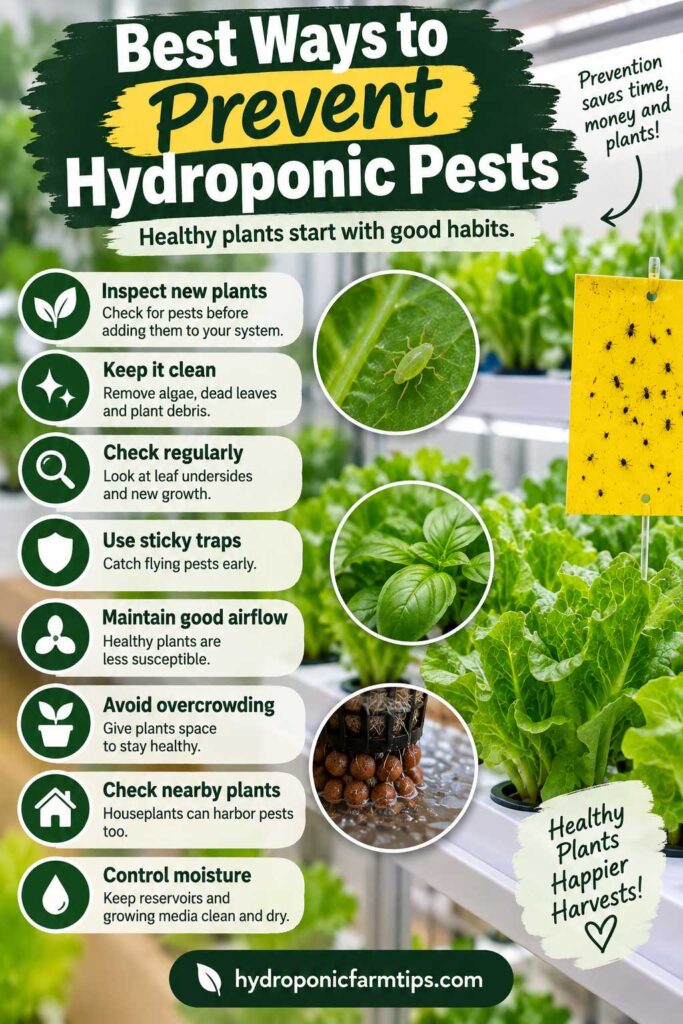
Preventing pests is much easier than controlling a large infestation.
You do not need complicated procedures. Most prevention comes down to keeping pests from entering the grow area, removing the conditions they like, and noticing problems early.
Inspect New Plants Before Adding Them
Seedlings, cuttings, nursery plants, and houseplants can all carry hidden pests.
Check leaf undersides, stems, growing tips, flowers, and growing media before placing a new plant near an established hydroponic system.
If possible, keep new plants separate for several days before adding them to the main system.
Keep the Grow Area Clean
Remove fallen leaves, dead roots, algae, spilled nutrient solution, and decomposing plant material regularly.
Pay particular attention to wet areas around trays and growing media. Fungus gnats and shore flies are much more likely to become persistent when algae and damp organic debris are available.
Check Plants Regularly
Once or twice a week, look beneath leaves and around new growth.
The goal is not to find a major infestation. It is to notice the first few insects, webbing, sticky spots, or damaged leaves before the problem spreads.
Use Sticky Traps as an Early Warning
Yellow sticky traps can help reveal fungus gnats, whiteflies, shore flies, and other flying pests.
Blue traps are often used for thrips.
Think of them as pest monitors rather than a complete treatment.
Avoid Crowding the Plants
Plants packed tightly together are harder to inspect and make it easier for pests to move from one plant to the next.
Give plants enough space that you can see and reach the foliage easily.
Check Houseplants Too
If pests keep returning, inspect every plant in the room.
A hydroponic garden can be perfectly clean and still become reinfested by a nearby houseplant.
Good pest prevention is less about creating a sterile environment and more about catching small problems before they become big ones.
Should You Treat the Hydroponic Reservoir for Pests?
Usually, no.
Most common hydroponic pests live on leaves, stems, flowers, or moist growing media rather than in the nutrient reservoir itself.
Aphids, whiteflies, spider mites, thrips, mealybugs, and scale insects are primarily foliage pests, so adding pest-control products directly to the reservoir usually does not target the actual problem.
It can also create new problems.
Soaps, oils, and pesticides intended for foliar use can affect roots, oxygen exchange, or water quality if they enter the nutrient solution.
When the Root Zone Does Matter
There are a few exceptions.
Fungus gnat larvae can live around moist growing media and the upper root zone, so treatments aimed at larvae may sometimes be applied to the media or root-zone area when the product is specifically labeled for that use.
Beneficial nematodes and some Bti-based products are common examples.
Even then, follow the label carefully rather than assuming that a product considered safe for soil is automatically suitable for a hydroponic reservoir.
What to Do Instead
If you are dealing with a foliage pest, focus treatment on the affected plant parts.
That may mean rinsing or wiping pests away, removing heavily infested foliage, using insecticidal soap or horticultural oil, adding sticky traps, introducing appropriate biological controls, or improving sanitation.
At the same time, protect the reservoir from spray runoff whenever practical.
Should You Change the Nutrient Solution After a Pest Infestation?
Not necessarily.
Finding pests does not automatically mean the nutrient solution needs to be discarded.
If you are unsure whether the reservoir is actually due for replacement, see how often you should change hydroponic water.
A water change makes more sense when:
- significant pesticide, soap, or oil runoff entered the reservoir
- dead insects or plant debris contaminated the solution
- the water develops an unusual odor or appearance
- the reservoir was already due for a routine change
- the roots are showing signs of stress or disease
In those situations, replacing the nutrient solution and cleaning the reservoir can help reset the system.
The key is to treat the pest where it actually lives rather than treating the nutrient solution as if it were the source of every infestation.
Cleaning a Hydroponic System After a Pest Infestation
Once the visible pest problem is under control, cleaning the growing area is an important final step. Eggs, larvae, shed skins, plant debris, and hidden insects can remain on equipment or nearby surfaces and contribute to another outbreak.
You usually do not need to dismantle the entire system after a minor infestation, but a more thorough cleanup is worthwhile after a severe or recurring problem.
Remove Plant Debris First
Start by clearing away fallen leaves, damaged roots, dead plant material, old growing media, algae, discarded flowers or fruit, and debris collected around trays or reservoirs.
Heavily infested material should be removed from the grow area rather than left nearby.
Clean the Areas Around the Plants
Wipe down or wash grow trays, net pots, reservoir lids, plant supports, shelving, propagation trays, tools, and nearby floors.
Pay particular attention to cracks, corners, and sheltered areas where insects or eggs may remain unnoticed.
Clean Reusable Equipment Between Crops
If you are finishing a crop after an infestation, clean reusable equipment before starting the next one.
Net pots, trays, tubing, reservoirs, and other components should be cleaned according to the manufacturer’s recommendations and rinsed thoroughly before being returned to service.
Avoid leaving cleaning residues that could later enter the nutrient solution.
Replace Contaminated Growing Media When Necessary
Some growing media can be difficult to clean completely after a serious fungus gnat or other root-zone infestation.
If the material is inexpensive and heavily contaminated, replacing it may be more practical than trying to reuse it.
This is especially true for propagation plugs and other porous media that remain consistently moist.
Inspect Nearby Plants and Surfaces Too
Do not stop at the hydroponic system if the infestation may have spread elsewhere.
Check nearby houseplants, windowsills, shelves, and propagation areas.
A freshly cleaned hydroponic system can become infested again quickly if the original pest source is still nearby.
Replace Sticky Traps
After treatment, replace old sticky traps with fresh ones.
This gives you a much clearer picture of whether pests are returning rather than continuing to count insects caught before treatment.
Keep Monitoring After Cleanup
Continue checking the plants for the next several weeks.
Watch for fresh webbing, sticky residue, young insects, new leaf damage, or increasing numbers on sticky traps.
Do not assume the infestation is over just because the adults disappear. Keep checking for fresh damage or a new generation over the following days and weeks.
Helpful Tools for Cleaning and Preventing Future Pest Problems
After an infestation, a few simple tools can make cleanup easier and help reduce the chance of pests returning. These are especially useful for removing damaged foliage, cleaning reusable equipment, protecting your hands during treatment, and keeping new pests from entering the grow area.
| Product | Best For | Why It Helps | Buy |
|---|---|---|---|
| Precision Pruning Snips | Removing infested leaves | Makes it easier to remove damaged foliage without unnecessarily injuring healthy growth. | Check Price |
| Plant Cleaning Brush Set | Net pots, trays & equipment | Small brushes help clean algae, debris, and hard-to-reach areas around hydroponic equipment. | Check Price |
| Hydroponic Cleaning Solution | Reservoirs & reusable equipment | Useful for cleaning equipment between crops when used according to manufacturer directions. | Check Price |
| Disposable Gloves | Pest treatment & cleanup | Helps avoid transferring pests between affected and healthy plants during inspection and treatment. | Check Price |
| Fine-Mesh Insect Screen | Grow-room prevention | Can reduce the number of flying pests entering through vents or openings. | Check Price |
Common Hydroponic Pest-Control Mistakes
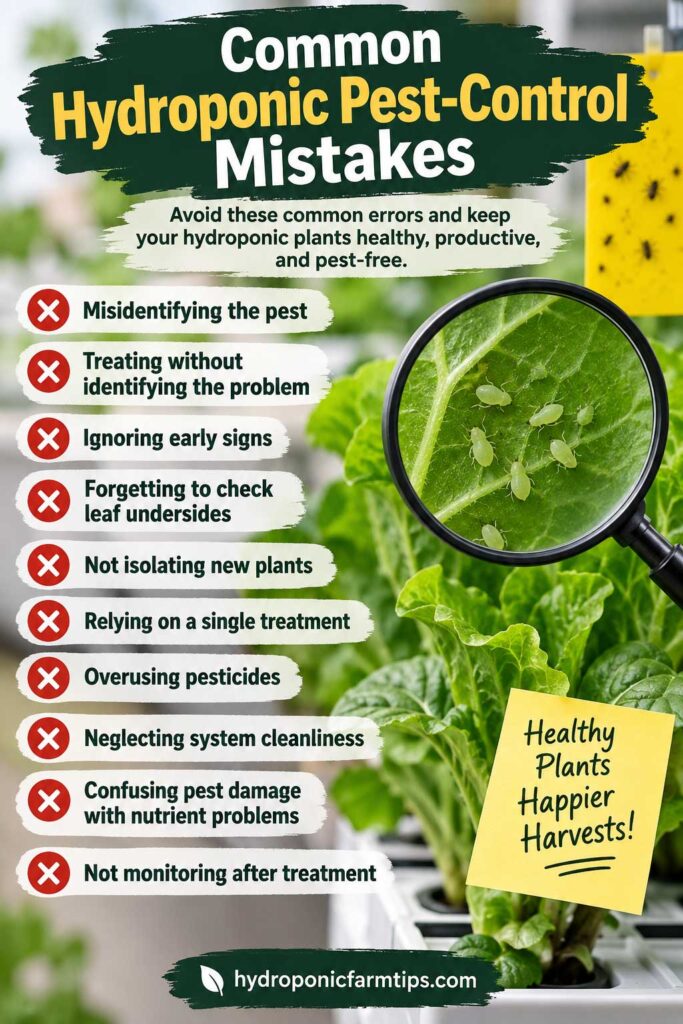
Hydroponic pest control is usually more about consistency than using the strongest treatment available. A few common mistakes can make infestations harder to eliminate or create unnecessary stress for your plants.
Treating Before Identifying the Pest
Yellow leaves, curling, speckling, and slow growth are not always caused by insects.
Hydroponic nutrient deficiencies, incorrect pH, root problems, heat stress, and lighting issues can produce similar symptoms.
Before treating, look for clear evidence such as insects, webbing, honeydew, leaf-mining trails, sticky-trap catches, or characteristic feeding damage.
Spraying Only the Tops of Leaves
Many pests hide on leaf undersides, growing tips, stem joints, and other protected areas.
If a treatment depends on direct contact, poor coverage can leave much of the pest population untouched.
Using Treatments Incorrectly
A single application may kill exposed adults while leaving eggs or immature stages behind. More is not necessarily better. Overly concentrated soap, oil, or pesticide mixtures can burn foliage or stress young plants without improving control.
Continue inspecting plants after treatment and repeat applications only as directed on the product label.
Letting Spray Enter the Reservoir
Foliar pest-control products are not automatically safe for hydroponic roots.
Soaps, oils, and pesticides that drain into the nutrient solution can affect water quality and stress the root system.
Cover exposed reservoirs and openings when practical.
Ignoring the Source of the Infestation
Treating the plant without correcting the underlying conditions can lead to repeated problems.
Fungus gnats may keep returning if algae, saturated media, or decaying plant material remain nearby. Spider mites may return if an infested houseplant is still in the same room.
Also inspect nearby houseplants, seedlings, cuttings, and nursery plants, since they may be acting as a hidden source of reinfestation.
Depending on Sticky Traps Alone
Sticky traps are excellent for monitoring flying pests, but they rarely eliminate an established infestation on their own.
They do not affect eggs, larvae, or pests already feeding on the plants.
Use them as part of a broader strategy that includes inspection, sanitation, and targeted treatment.
Using Incompatible Sprays With Beneficial Insects
Biological controls can fail if beneficial insects are released too soon after a treatment that harms them.
If you plan to use predatory mites, parasitoid wasps, lacewings, or other beneficial organisms, check product compatibility and timing first.
Waiting Too Long
One of the biggest mistakes is ignoring a small pest population because the plants still look healthy.
A few aphids, whiteflies, or spider mites are much easier to control than an infestation spread across the entire grow area.
Early action usually gives you more treatment options and reduces the amount of intervention required.
Hydroponic Pests vs. Nutrient Problems
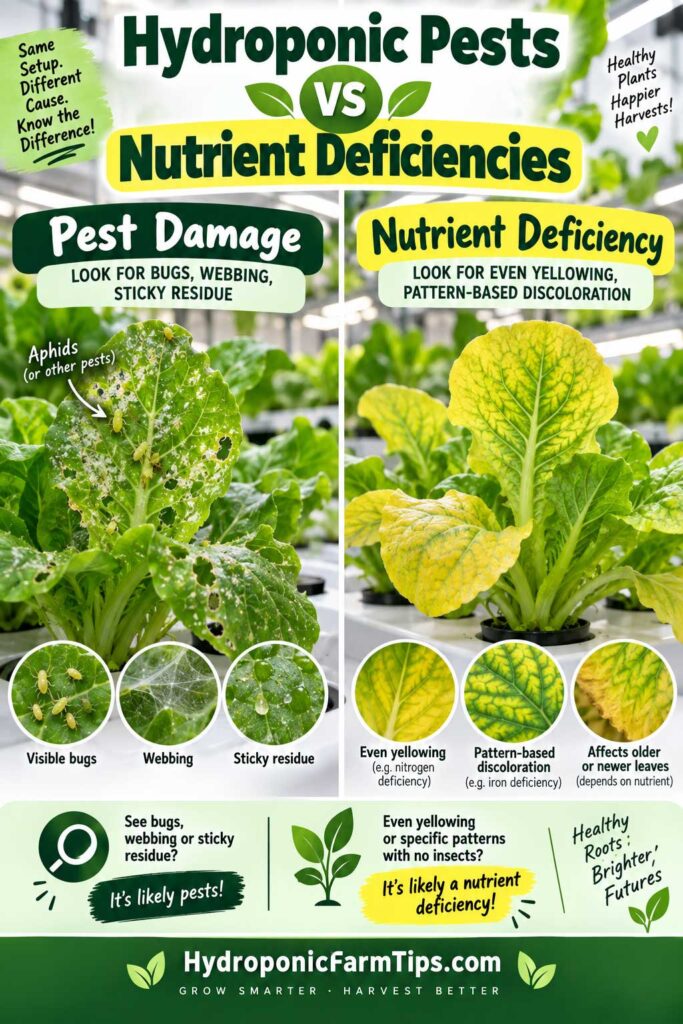
Pest damage can easily be mistaken for a nutrient problem because both can cause yellowing, curling, spotting, weak growth, discoloration, and damaged new foliage. If yellowing is the main symptom, our guide to why hydroponic leaves turn yellow walks through the most common non-pest causes. The difference is that pest problems usually leave physical clues that nutrient problems do not.
The best way to tell the difference is to look for physical evidence.
Signs That Point More Toward Pests
A pest problem is more likely when you find:
- visible insects or larvae
- fine webbing
- sticky honeydew
- white cottony clusters
- raised scale-like bumps
- silvery feeding streaks
- winding tunnels inside leaves
- repeated catches on sticky traps
- damage concentrated around new growth or leaf undersides
These signs are much more specific than yellowing or curling alone.
Signs That Point More Toward Nutrient or pH Problems
A nutrient-related problem is more likely when symptoms follow a consistent pattern across the plant.
For example, several older leaves may yellow at about the same time, or new growth may develop similar discoloration without any insects, webbing, honeydew, or feeding scars.
Incorrect pH can also cause nutrient lockout, making certain elements less available even when they are already present in the reservoir.
That means a plant can look deficient while the real problem is the root-zone environment.
Check the Roots Too
Healthy hydroponic roots are usually light-colored and firm.
If the foliage looks weak but you cannot find pests, inspect the roots and review reservoir temperature, dissolved oxygen, nutrient strength, pH, water level, and any signs of root rot.
Brown, slimy, foul-smelling roots point much more strongly toward hydroponic root rot or another root-zone problem than a foliage pest.
Sometimes Both Problems Happen Together
A stressed plant may be more vulnerable to pest damage, while a heavy infestation can also weaken the plant enough to create secondary nutrient or growth problems.
More than one problem can occur at the same time, so do not stop troubleshooting after finding the first issue.
If you find pests, treat them. At the same time, make sure the hydroponic system is operating within the proper range for the crop.
Correct diagnosis helps prevent unnecessary spraying and makes it much easier to fix the real reason the plant is struggling.
Frequently Asked Questions About Hydroponic Pests
What are the most common pests in hydroponics?
Common hydroponic pests include aphids, spider mites, fungus gnats, whiteflies, thrips, mealybugs, scale insects, shore flies, and leaf miners.
Which ones appear most often depends on the crop, moisture level, growing environment, and whether new plants are introduced regularly.
Can hydroponic plants get bugs without soil?
Yes.
Many pests live on leaves, stems, flowers, or moist growing media rather than in soil.
They can enter through open windows, new plants, tools, clothing, nearby houseplants, or other plant material.
What is the fastest way to get rid of pests in hydroponics?
There is no single treatment that works for every pest. Start by identifying the pest, then use the least aggressive effective method—such as rinsing, pruning, physical removal, sticky traps, insecticidal soap, or an appropriate biological control.
Are fungus gnats dangerous to hydroponic plants?
Adult fungus gnats are mostly a nuisance, but their larvae can feed around the root zone and may damage tender roots, especially on seedlings and young plants.
Their presence can also indicate excessive moisture, algae, or decomposing organic material around the system.
How do I know if my hydroponic plants have spider mites?
Look for pale speckling, yellowing or bronzing, and fine webbing around leaf undersides, stems, and growing tips.
Spider mites are extremely small, so a hand lens or magnifying glass can help confirm them.
Can I use neem oil on hydroponic plants?
Some neem-based products can be used on hydroponic crops, but suitability depends on the product and the crop.
Apply them to foliage rather than directly into the nutrient reservoir, follow the label carefully, and test a small section of the plant first.
Can I use dish soap to kill hydroponic pests?
Household dish detergent is not the same as insecticidal soap.
Some products contain degreasers, fragrances, or other ingredients that can damage plant tissue. A product specifically labeled as insecticidal soap is a safer and more predictable choice.
Should I change my hydroponic water after finding pests?
Usually not just because pests are present.
A water change may make sense if soaps, oils, pesticides, dead plant material, or other contaminants entered the reservoir, or if the solution was already due for replacement.
Do sticky traps get rid of hydroponic pests?
Sticky traps can reduce the number of flying adults, but they rarely eliminate an infestation by themselves.
They are most useful for early detection and monitoring of fungus gnats, whiteflies, shore flies, thrips, and other flying pests.
How often should I check hydroponic plants for pests?
Inspect plants once or twice a week under normal conditions.
Check more often after bringing in new plants, following a recent infestation, or whenever you notice suspicious leaf damage.
Can pests spread from houseplants to hydroponic plants?
Yes.
Spider mites, fungus gnats, whiteflies, thrips, scale, mealybugs, and other pests can move between houseplants and hydroponic crops.
If pests keep returning, inspect all nearby plants rather than treating only the hydroponic system.
What should I do if pests keep coming back?
Recurring infestations usually mean part of the pest life cycle survived treatment or the original source is still nearby.
Inspect surrounding plants, growing media, algae, trays, tools, and propagation areas. Clean the grow space, replace old sticky traps, and continue monitoring for new activity.
A combination of accurate identification, sanitation, targeted treatment, and prevention is usually more effective than repeatedly applying the same product.
Keep Hydroponic Pests Under Control
Hydroponic systems avoid many soil-related problems, but pests can still become an issue when insects arrive on plants, tools, clothing, growing media, or through open doors and windows.
The most common hydroponic pests include aphids, spider mites, fungus gnats, whiteflies, thrips, mealybugs, scale insects, shore flies, and leaf miners. Each leaves different clues, so accurate identification is the first step toward effective control.
Long-term control comes down to early detection, clean growing conditions, careful introduction of new plants, and targeted treatment when necessary.
It is also important not to assume that every yellow, curled, or damaged leaf is caused by insects. Incorrect pH, nutrient imbalance, root problems, low oxygen, and lighting stress can produce similar symptoms.
A few minutes of inspection each week can catch a pest problem while it is still small, easier to identify, and far easier to control.
Pest pressure also varies by crop. If you are planning what to grow next, see our guide to the best hydroponic vegetables.
More Hydroponic Gardening Guides You May Like
If you are troubleshooting your hydroponic garden, these guides can help you diagnose related problems and keep your system running smoothly.
- Hydroponic Nutrient Deficiencies: Signs, Causes & Fixes — Learn how to recognize common nutrient deficiencies and correct them before they seriously affect plant growth.
- Why Are My Hydroponic Leaves Turning Yellow? — Diagnose yellow leaves caused by pH problems, nutrient issues, root stress, lighting, and other common causes.
- Algae in Hydroponics: Causes, Prevention & How to Get Rid of It — Learn why algae develops and how to keep it from taking over reservoirs, trays, and growing media.
- Hydroponic Root Rot: Causes, Symptoms & Treatment — Identify unhealthy roots and learn how oxygen, water temperature, and sanitation affect root health.
- How Often Should You Change Hydroponic Water? — Learn when to replace your nutrient solution and how to maintain a cleaner reservoir.
- Best pH for Hydroponics — Understand how pH affects nutrient availability and why maintaining the correct range is essential for healthy plants.
- Hydroponic Nutrient & pH Chart — Compare recommended pH and nutrient ranges for popular hydroponic vegetables, herbs, and fruiting crops.